Summary: The article explains the SFIO–ED nexus where a corporate fraud investigated under the Companies Act, 2013 may also generate Proceeds of Crime (PoC) connected with a scheduled offence under the PMLA, 2002. It distinguishes the statutory mandates of the Serious Fraud Investigation Office (SFIO) and the Enforcement Directorate (ED): SFIO primarily investigates serious corporate fraud when investigation is assigned under Section 212 of the Companies Act, while ED investigates money laundering under PMLA, 2002 and foreign-exchange violations under FEMA, 1999. The article states that the same factual matrix or transaction may be investigated by both agencies because the same transaction does not necessarily constitute the same offence or confer the same statutory jurisdiction. It discusses how SFIO materials may assist ED investigations and how ED information may assist SFIO, while emphasizing that SFIO findings do not automatically establish a PMLA offence and that the statutory ingredients of money laundering and PoC must be independently established. It also explains separate adjudicatory and prosecution tracks, including provisional attachment, the PMLA Adjudicating Authority and Special Court proceedings, alongside Companies Act prosecution. Particular significance is given to the Delhi High Court decision in Sanjay Aggarwal v. Union of India, dated November 27, 2025, which, as described in the supplied material, held that assignment of a company investigation to SFIO under Section 212 does not bar ED proceedings under PMLA arising from the same factual matrix. The article concludes that the SFIO–ED relationship is complementary rather than hierarchical and that a mere Companies Act violation or corporate irregularity does not automatically become a PMLA case.
41 Frequently Asked Questions (FAQs) on the Serious Fraud Investigation Office (SFIO) ED nexus for investigations and Adjudications across the India
- 1. What is SFIO ED nexus for investigations and Adjudications across India?
- 2. What are Key principles for SFIO ED nexus?
- 3. Whether “same” factual matrix is permitted for investigations by SFIO and ED?
- 4. What is flow chart for investigations by SFIO and ED?
- 5. What SFIO's findings are helpful for ED’s investigations?
- 6. Whether SFIO's findings are “automatically” establishing a PMLA offence?
- 7. What ED's finding are helpful for SFIO’s investigations?
- 8. What is SFIO ED nexus for adjudications?
- 9. What are practical questions needed for nexus test?
- 10. What is conclusion for SFIO ED nexus?
- 11. Whether Statutory jurisdiction is different for SFIO and ED?
- 12. What is SFIO’s jurisdiction?
- 13. What is ED’s jurisdiction?
- 14. What are important criteria for overlapping between SFIO and ED?
- 15. What is important distinction between SFIO and ED?
- 16. Where an actual nexus is existed between SFIO and ED?
- 17. What is comparison for actual nexus between the SFIO and ED?
- 18. What is best example for SFIO ED nexus?
- Adjudication in the SFIO–ED Nexus
- 19. What is parallel adjudicatory and judicial proceedings under SFIO and ED?
- 20. What is SFIO’s prosecution adjudication?
- 21. What is ED’s prosecution adjudication?
- 22. What is Special court under PMLA, 2002?
- 23. Whether SFIO’s and ED’s adjudications can have different conclusions?
- 24. What is flow chart for predicate/schedule offence?
- 25. Whether SFIO findings are binding the ED Adjudicating Authority?
- 26. What are consequences when the SFIO prosecution fails?
- FAQ 27. What is same factual matrix for SFIO ED nexus?
- 28. What are investigations and adjudications nexus?
- 29. Whether “same” evidences are legally used by SFIO and ED?
- 30. When the “same” evidences are become problematic for ED?
- 31. What are important limitations for ED’s investigations?
- The Supreme Court and High Courts judgements
- 32. What is Vijay Madanlal Choudhary v. Union of India (2022) in Supreme Court?
- 33. What are Cochin Minerals and Rutile Ltd. v. ED (2026) in Kerala High Court?
- 34. What is Sanjay Aggarwal v. Union of India and Ors (2025) in Delhi High Court?
- 35. What is Rahul Surana v. Assistant Director (2025) in Madras High Court?
- 36. What is Mohit Arora v. SFIO (2025) in Delhi High Court?
- 37. What is Pankaj Kumar Tiwari v. ED (2024) in Delhi High Court?
- 38. What is Vijayraj Surana v. Assistant Director (2024) in Madras High Court?
- 39. What is ED v. SFIO and Ors. (2018) in Delhi High Court?
- 40. What is Surendera Kumar Jain v. ED (2017) in Delhi High Court?
- 41. What are the conclusions for current judicial status?
1. What is SFIO ED nexus for investigations and Adjudications across India?
i. The SFIO–ED nexus arises mainly where a corporate fraud investigated under the Companies Act (CA), 2013 also generates Proceeds of Crime (PoC) connected with a scheduled offence under the PMLA, 2002.
ii. The SFIO and ED have different statutory mandates:
| S.No | SFIO | ED |
|---|---|---|
| a. | Primarily investigates serious corporate fraud under the Companies Act (CA), 2013 | Primarily investigates money laundering under PMLA, 2002 and FEMA, 1999 violations |
| b. | Investigation is assigned under Section 212 of CA, 2013 | Investigation under PMLA focuses on Proceeds of Crime (PoC) and money-laundering activity |
| c. | Focused on corporate fraud, manage-ment, books, transactions and persons responsible | Focused on generation, possession, con-cealment, acquisition, use or projection of PoC |
| d. | Can file prosecution under Companies Act (CA), 2013 for the offences through Special Courts? | Can provisionally attach property, seek confiscation and prosecute under PMLA, 2002? |
The ED itself describes PMLA enforcement as including tracing PoC, provisional attachment and prosecution/confiscation.
2. What are Key principles for SFIO ED nexus?
i. The SFIO investigation does not, by itself, prevent ED from conducting a parallel PMLA investigation.
ii.This has now been expressly addressed by the Delhi High Court in Sanjay Aggarwal v. Union of India, judgment dated Nov 27, 2025.
iii. The Court held that Section 212(2) of the Companies Act (CA), 2013 which concerns investigation into offences under that Act, does not create a bar against proceedings under another statute such as the PMLA, 2002.
3. Whether “same” factual matrix is permitted for investigations by SFIO and ED?
Yes
i. Investigation by the SFIO:
Company-law investigation
↓
Identify fraud
↓
Identify responsible directors/officers/persons
↓
Companies Act (CA) 2013 prosecution.
ii. Investigation by the ED:
Scheduled offence
↓
Identify PoC
↓
Trace movement of PoC
↓
Identify money-laundering activity
↓
Attachment/prosecution under PMLA.
Thus, same transaction ≠ same offence ≠ same statutory jurisdiction.
4. What is flow chart for investigations by SFIO and ED?
Corporate fraud
↓
Diversion of company funds
↓
Generation of PoC
↓
Laundering/integration of those funds
5. What SFIO’s findings are helpful for ED’s investigations?
The SFIO materials may become important investigative material for ED’s investigations like:
i. Corporate records
ii. Transaction trails
iii. Statements and documents
iv. Identification of beneficiaries
v. Diversion of funds
vi. Sham transactions
vi. Related-party transactions
vii. Movement of funds through companies/entities.
6. Whether SFIO’s findings are “automatically” establishing a PMLA offence?
No
The ED still has to establish the statutory ingredients of money laundering and Proceeds of Crime (PoC).
7. What ED’s finding are helpful for SFIO’s investigations?
i. ED may uncover:
Bank transactions
↓
Shell entities
↓
Diversion of corporate funds
↓
Fraudulent corporate transactions
ii. The ED is also permitted to share information with “other” authorities under the statutory framework and section 66 of PMLA, 2002.
iii. In simple terms
The ED and SFIO both are permitted to share information’s to each other under SFIO ED nexus rather than 1 agency exercising control over the other.
8. What is SFIO ED nexus for adjudications?
i. SFIO adjudication/prosecution consequences and PMLA adjudication are “not” interchangeable.
ii. Adjudication under PMLA, 2002
ED investigation
↓
Provisional Attachment Order (PAO)
↓
Adjudicating Authority under Section 8
↓
Confirmation/other consequences
↓
Special Court proceedings
iii. The ED’s published statistics show that PMLA PAOs are “separately” considered by the PMLA Adjudicating Authority.
iv. Adjudication for SFIO under Companies Act (CA) 2013
a. The SFIO report is “not” itself a substitute for proof of the ingredients required in PMLA adjudication.
b. The SFIO proceeding being pending does not “automatically” suspend PMLA adjudication.
9. What are practical questions needed for nexus test?
i. What is the original corporate fraud?
ii. What offence constitutes the alleged scheduled offence?
iii. Does that offence actually fall within the PMLA Schedule?
iv. What are the identifiable Proceeds of Crime (PoC)?
v. Who generated or acquired the PoC?
vi. What subsequent activity constitutes money laundering?
vii. What independent material connects the person/property to the PMLA offence?
- When these links are established, SFIO proceedings and ED/PMLA proceedings can proceed in parallel.
10. What is conclusion for SFIO ED nexus?
i. SFIO → ED nexus is complementary, not hierarchical.
a. The SFIO to investigate
-
- “Was there serious corporate fraud and who committed it?”
b. The ED to investigate
-
- “Did that fraud produce PoC, and was that PoC subsequently dealt with in a manner constituting money laundering?”
ii. In simple terms
a. The SFIO investigation does “not” immunise the company, directors or other persons from a parallel ED investigation, provided the statutory requirements of PMLA are “independently” satisfied.
b. The Delhi High Court’s Nov 27, 2025 decision is particularly significant on this point.
iii. Conclusion
a. A mere SFIO/Companies Act (CA) 2013 violation or corporate irregularity does not “automatically” become a PMLA case.
b. The existence of a qualifying scheduled offence and identifiable PoC remains central.
11. Whether Statutory jurisdiction is different for SFIO and ED?
Yes.
i. SFIO and ED have different statutory jurisdictions, although “same” corporate/ financial facts may sometimes come within the investigative orbit of both.
ii. SFIO vs ED — Statutory Jurisdiction
| Aspect | SFIO | ED |
|---|---|---|
| Principal statute | Companies Act (CA), 2013 | PMLA, 2002; FEMA, 1999 and other assigned statutes |
| Core jurisdiction | Serious corporate fraud | Money laundering and foreign-exchange violations |
| Investigates | Affairs of a company where investi-gation is assigned to SFIO under Section 212 | Proceeds of Crime (PoC) under PMLA and contraventions under FEMA |
| Trigger | Central Government orders investi-gation into company’s affairs | Scheduled offence + PoC for PMLA; FEMA contravention for FEMA |
| Primary focus | Corporate fraud, management, transactions, books, misstatements, diversion etc. | PoC, laundering, attachment /confis-cation, cross-border foreign exchange issues |
| Nature | Corporate fraud investigation | Financial-crime / money-laundering and foreign-exchange enforcement |
| Can both investigate same facts? | Yes, potentially | Yes, potentially |
| Does SFIO “automatically” have PMLA jurisdiction? | No | — |
| Does ED “automatically” have Companies Act (CA) 2013 /SFIO jurisdiction? | — | No |
12. What is SFIO’s jurisdiction?
i. The SFIO derives its principal investigative jurisdiction from Section 211 and Section 212 of the Companies Act (CA) 2013.
ii. The important point is that SFIO is “not” a general financial-crime agency merely because a company is involved.
iii. Its statutory mandate is primarily investigation into serious fraud relating to companies, when investigation is assigned to it by the Central Govt. in accordance with Section 212 of the CA 2013.
iv. In simple terms
Company + serious corporate fraud + Central Govt. assignment under Section 212 of the CA 2013
↓
The SFIO jurisdiction.
13. What is ED’s jurisdiction?
i. The ED’s PMLA jurisdiction is “fundamentally” different.
ii. Under PMLA 2002, the central issue is the existence of PoC arising from a scheduled offence and activities connected with those PoC.
iii. In simple terms
Scheduled offence + Proceeds of Crime (PoC) + laundering activity
↓
PMLA/ED jurisdiction.
iv. The ED also has a “separate” statutory field under FEMA, 1999 for dealings with foreign-exchange transactions and related contraventions.
14. What are important criteria for overlapping between SFIO and ED?
i. When a company is alleged to have committed a serious corporate fraud and, during that fraud, generated money that constitutes Proceeds of Crime (PoC) from a scheduled offence.
ii. The SFIO is required to investigate under CA, 2013 against alleged a serious corporate fraud and simultaneously the ED is also required to investigate “same” transaction does “not” mean that their statutory jurisdictions become identical beside their legal questions remain different:
iii. The SFIO to investigate
-
- “Was there corporate fraud and who was responsible under the Companies Act (CA) 2013 and connected laws”?
iv. The ED to investigate
-
- “Are there Proceeds of Crime (PoC) and has there been an offence of money laundering under PMLA 2002?”
15. What is important distinction between SFIO and ED?
i. The SFIO investigation ≠ The PMLA investigation.
ii. The Corporate fraud ≠ “automatically” money laundering.
iii. Under the PMLA, 2002 the statutory requirements concerning a scheduled offence and Proceeds of Crime (PoC) must “independently” be satisfied.
iv. A mere violation of the CA, 2013 or an ordinary corporate irregularity does not “automatically” become a PMLA offence.
v. Conclusion
a. The SFIO and ED have distinct statutory jurisdictions.
b. Their jurisdiction can overlap factually, but they do “not” derive their authority from the “same” statute or pursue exactly “same” legal object.
16. Where an actual nexus is existed between SFIO and ED?
i. The actual SFIO–ED nexus is “not” that SFIO and ED are the “same” agency or that one controls the other.
ii. The nexus arises when a corporate fraud investigated by SFIO also generates a Proceeds of Crime (PoC) connected with a PMLA scheduled offence.
iii. Actual nexus:
SFIO
↓
Corporate fraud
↓
ED
↓
Proceeds of Crime (PoC)
17. What is comparison for actual nexus between the SFIO and ED?
| Aspect | SFIO | ED |
|---|---|---|
| Principal statute | Companies Act (CA), 2013 | PMLA, 2002 / FEMA, 1999 |
| Core focus | Serious/fraudulent affairs of companies | Money laundering, Proceeds of Crime (PoC) and foreign-exchange violations |
| Investigation trigger | Govt. assignment under section 212 of CA, 2013 | PMLA scheduled offence / information giving rise to PMLA investigation |
| Main question | How was the company fraud committed? | Where did the PoC go, how were they laundered, and what assets represent PoC? |
| Output | SFIO investigation report / prosecu-tion for CA, 2013 offences | PMLA investigation, attachment, prose-cution and confiscation proceedings |
18. What is best example for SFIO ED nexus?
i. ED itself describes its PMLA mandate as tracing assets derived from Proceeds of Crime (PoC) provisionally attaching property and pursuing prosecution/ confiscation.
ii. Flow chart for SFIO → ED nexus
Company fraud
↓
Generation of illicit money
↓
Movement/layering/concealment of that money
↓
Assets acquired from it
↓
SFIO investigates the underlying corporate fraud.
Adjudication in the SFIO–ED Nexus
19. What is parallel adjudicatory and judicial proceedings under SFIO and ED?
i. 2 separate legal tracks
| S.No | SFIO Track | ED/PMLA Track |
|---|---|---|
| a. | To investigate under Companies Act (CA), 2013 | To investigate under Prevention of Money Laundering Act (PMLA), 2002 |
| b. | To investigate into affairs or fraud of company | To investigate into Proceeds of Crime (PoC) and money laundering |
| c. | To prepare SFIO investigation report | To register ECIR and to start PMLA investigation |
| d. | To file prosecution complaint before Special Court | To file prosecution Complaint before PMLA Special Court |
| e. | To determine Corporate or “criminal” liability | To determine Money-laundering liability and confiscation |
ii. The Delhi High Court in Sanjay Aggarwal v. Union of India (Nov 27 2025) specifically held that assignment of a company investigation to SFIO under Section 212 does “not” bar ED proceedings under PMLA, 2002, merely because both arise from the “same” factual matrix.
iii. The Court emphasized that the statutory ingredients and purposes are different.
20. What is SFIO’s prosecution adjudication?
i. After investigation, SFIO may submit its investigation report and initiate prosecution against the offences like:
a. Offence under head fraud -section 447 of CA, 2013
b. Offence under head false statement -section 448 of CA, 2013
c. Offence under head other offences under CA, 2013
d. Offences under other laws arising from the investigation.
ii. The criminal guilt is ultimately determined by the competent Special Court constituted/designated under the CA, 2013 framework.
21. What is ED’s prosecution adjudication?
i. This is a completely different mechanism when ED provisionally attaches property under Section 5 of PMLA, the matter goes before the Adjudicating Authority under Section 6 PMLA, 2002.
ii. The Adjudicating Authority examines certain questions like:
a. Whether the property is prima facie Proceeds of Crime (PoC)?
b. Whether the property is connected with money laundering?
c. Whether the provisional attachment should be confirmed?
iii. Hence, this is an independent statutory adjudication concerning property, distinct from the SFIO criminal prosecution.
22. What is Special court under PMLA, 2002?
i. After investigation, ED may file a prosecution complaint.
ii. The PMLA Special Court then adjudicates:
a. Whether the offence of money laundering under Section 3 is established?
b. Whether the accused knowingly participated in processes connected with PoC?
c. Whether confiscation consequences arise after trial?
iii. Conclusion
Attachment adjudication → Adjudicating Authority
Criminal guilt under PMLA → Special Court
23. Whether SFIO’s and ED’s adjudications can have different conclusions?
Yes
i. SFIO adjudication’s conclusion
-
- The directors committed corporate fraud under Section 447 CA, 2013
ii. ED adjudication’s conclusion
-
- The fraud generated Proceeds of Crime (PoC), which were subsequently concealed, possessed, acquired, used, or projected as untainted property.
iii. The Delhi High Court’s 2025 decision
The Delhi High Court’s 2025 decision strongly supports this statutory separation between SFIO jurisdiction and PMLA jurisdiction like:
-
- “Same transaction ≠ same offence ≠ same adjudication”
24. What is flow chart for predicate/schedule offence?
SFIO Investigation
↓
Finding of Scheduled Offence
↓
Criminal activity generating proceeds
↓
“Proceeds of Crime (PoC)”
ED acquires PMLA jurisdiction
↓
Attachment → Adjudicating Authority
↓
Prosecution → PMLA Special Court
Hence, SFIO may establish or investigates the underlying corporate fraud, while ED investigates the subsequent or connected money-laundering dimension.
25. Whether SFIO findings are binding the ED Adjudicating Authority?
No
i. SFIO findings are highly relevant but not “automatically” conclusive for every PMLA issue.
ii. The PMLA Adjudicating Authority independently examines:
a. Whether the property constitutes Proceeds of Crime (PoC)?
b. Whether there is a nexus between the property and criminal activity relating to a scheduled offence?
c. Whether attachment should be confirmed?
iii. The PMLA Special Court independently determines whether the ingredients of Section 3 are proved.
iv. Conclusion
The SFIO investigation report can be foundational evidence, but PMLA authorities exercise independent statutory jurisdiction.
26. What are consequences when the SFIO prosecution fails?
i. When the alleged scheduled/predicate offence itself ultimately disappears through acquittal or a finding that no scheduled offence existed, thereafter consequences for the PMLA case may become crucial.
ii. The general PMLA principle is that money laundering is connected to the existence of Proceeds of Crime (PoC) derived or obtained from “criminal” activity relating to a scheduled offence.
iii. Therefore, the final outcome of the SFIO/predicate proceedings can materially affect the sustainability of the ED proceedings.
iv. However, this does “not” necessarily mean that ED proceedings must remain “completely” inactive until SFIO trial concludes.
v. The Courts have recognized “simultaneous” proceedings in appropriate cases.
FAQ 27. What is same factual matrix for SFIO ED nexus?
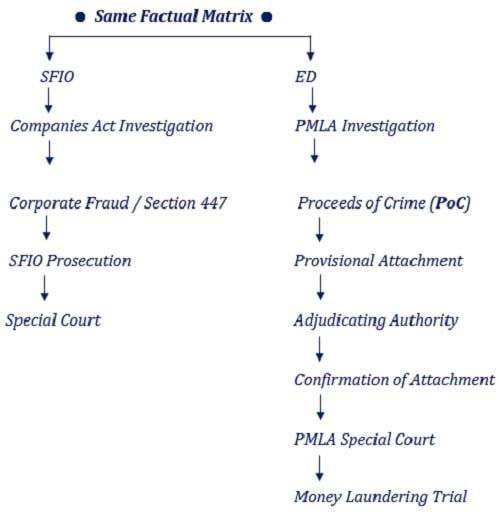
28. What are investigations and adjudications nexus?
i. Investigation nexus
-
- Separate but overlapping.
ii. Jurisdiction nexus
-
- Independent statutory jurisdictions.
iii. Adjudication nexus
-
- Separate adjudicatory forums and tests.
iv. Evidentiary nexus
-
- SFIO findings may provide the factual foundation for ED.
v. Final dependency
-
- The PMLA cannot ultimately survive “without” a legally sustainable foundation of “criminal” activity relating to a scheduled offence.
vi. This distinction is particularly important after Sanjay Aggarwal v. Union of India (Delhi High Court, Nov 27, 2025), which substantially clarifies that Section 212 of the Companies Act (CA) 2013 does “not” create an absolute bar against ED/PMLA proceedings
29. Whether “same” evidences are legally used by SFIO and ED?
i. Yes
| S.No | Common Evidence | SFIO examines | ED examines |
|---|---|---|---|
| a. | Bank statements | Diversion or misuse of company funds | Whether diverted funds became Proceeds of Crime (PoC)? |
| b. | Fake invoices | Fraud or falsification under Companies Act (CA) 2013 | Layering or laundering of “criminal” proceeds |
| c. | Directors’ statements | Corporate fraud and responsibility | Knowledge and involvement in money laundering |
| d. | Forensic audit | Financial manipulation | Generation, possession, concealment or use of PoC |
ii. Therefore, same documents ≠ same offence ≠ same investigation.
iii. The Supreme Court has also recently observed, in the context of ED sharing material with other agencies under Section 66(2) PMLA, 2002 that materials may be common, but conclusions based on further material can be different and investigations may travel on separate channels.
30. When the “same” evidences are become problematic for ED?
-
- The ED may face a serious legal challenge where:
(i) When no independent predicate offence survives?
-
- If the scheduled offence disappears or is quashed, consequences may follow for PMLA proceedings depending on the facts and applicable law.
(ii) When no Proceeds of Crime (PoC) are identified?
-
- Corporate fraud alone does not “automatically” establish money laundering.
(iii) When no laundering activity is demonstrated?
-
- The ED must connect the accused with activities covered by Sec. 3 PMLA.
(iv) When ED simply reproduces SFIO allegations?
-
- A prosecution complaint cannot succeed merely because SFIO has already alleged corporate fraud.
(v) When Same facts, same allegations, same relief, without separate statutory ingredients?
-
- Then the argument of impermissible duplication becomes stronger.
31. What are important limitations for ED’s investigations?
i. To copies the SFIO investigation,
ii. To relies entirely on the SFIO conclusions,
iii. To investigates exactly the same allegations,
iv.To produces “no” independent PMLA material,
v. Cannot establish Proceeds of Crime (PoC) or a laundering activity
The defence can argue that the ED is conducting a duplicative or mechanical investigation when ED used SFIO evidence, therefore ED investigation is illegal
The defence can argue that the ED has failed to independently establish the statutory ingredients of the offence under Section 3 PMLA and is merely reproducing the SFIO case.
The Supreme Court and High Courts judgements
32. What is Vijay Madanlal Choudhary v. Union of India (2022) in Supreme Court?
i. The Supreme Court upheld the constitutional validity of the principal PMLA enforcement framework and explained the relationship between the scheduled offence, Proceeds of Crime (PoC) and money laundering.
ii. The Supreme Court has described the schedule offence:
a. Generates or relates to Proceeds of Crime (PoC)
b. Subsequent processes/activities concerning those PoC
c. Money-laundering offence under Section 3 PMLA, 2002
iii. Therefore, when the scheduled offence is a corporate fraud under Section 447 Companies Act (CA) 2013, the SFIO may investigate that corporate fraud, while ED may investigate the PMLA consequences arising from the PoC of the corporate fraud.
iv. The Supreme Court’s reasoning has subsequently been applied by several High Courts in cases involving SFIO complaints and ED investigations
33. What are Cochin Minerals and Rutile Ltd. v. ED (2026) in Kerala High Court?
i. The Kerala High Court held that the absence of an FIR or complaint concerning the scheduled offence does “not” necessarily prevent ED from commencing civil action such as attachment under Sec. 5 or inquiry under Sec. 50 PMLA. 2002.
ii. It distinguished the civil under section 5 or inquiry under section 50 from penal prosecution under Sections 3 and 4 of PMLA, 2002.
iii. The Court relied extensively on the Supreme Court’s interpretation of the PMLA in Vijay Madanlal Choudhary and emphasised that an ECIR is an internal ED document and is “not” equivalent to an FIR.
iv. This is relevant to SFIO because it demonstrates that ED’s jurisdiction cannot always be made dependent upon the procedural stage reached by the SFIO/predicate-offence proceedings.
34. What is Sanjay Aggarwal v. Union of India and Ors (2025) in Delhi High Court?
i. The Delhi High Court decision discussed in ED’s 2025 Legal Bulletin in Sanjay Aggarwal v. Union of India and Ors., judgment dated Nov, 27 2025.
ii. The ED’s own bulletin records that an investigation by SFIO into a company’s affairs does “not” bar parallel proceedings by ED under PMLA arising from the same factual matrix.
iii. The Delhi High Court position specifically recognises that SFIO proceedings do “not” create a blanket bar on parallel PMLA proceedings.
iv. In simple terms
a. The SFIO investigates the corporate fraud and affairs of the company and ED investigates the Proceeds of Crime (PoC) and money-laundering dimension.
b. The nexus is the financial trail connecting the underlying corporate offence to the PoC and their laundering, “not” a merger of jurisdiction.
35. What is Rahul Surana v. Assistant Director (2025) in Madras High Court?
i. The original ED ECIR was based on a CBI FIR.
ii. Subsequently, an SFIO complaint under Section 447 Companies Act (CA), 2013 was filed.
iii. The ED incorporated that SFIO complaint as a scheduled offence and relied upon the additional corporate-fraud material, including a forensic audit.
iv. The ED’s argument, recorded by the Court, was that the SFIO complaint constituted “new” material and a “separate” scheduled offence, even though the underlying historical transactions were connected.
36. What is Mohit Arora v. SFIO (2025) in Delhi High Court?
i. The Delhi High Court expressly recognised that SFIO and PMLA proceedings could be “simultaneously” maintainable, even though when the underlying financial transactions were “substantially” the same.
ii. It observed that the scope and role attributed in the 2 proceedings may vary.
iii. This supports the proposition that “same” transactions do not “automatically” mean “same” offence or same investigation like:
Corporate fraud
INR 500 crore fraud → false books → diversion of company funds → violation of Companies Act (CA), 2013
↓
SFIO
Investigates corporate fraud, books, directors/officers and CA, 2013 violations.
↓
If those activities generated Proceeds of Crime (PoC), and there was “subsequent” concealment, possession, acquisition, use or projection of those PoC as untainted:
↓
ED/PMLA
Investigates the money-laundering offence and PoC.
37. What is Pankaj Kumar Tiwari v. ED (2024) in Delhi High Court?
i. The predicate offence had been investigated by SFIO, resulting in a complaint under Section 447 Companies Act (CA) 2013 and “other” offences.
ii. These offences were scheduled offences under PMLA, ED registered an ECIR and subsequently filed its own prosecution complaint. The flow chart is as below:
SFIO investigation
↓
Companies Act (CA) 2013 fraud
↓
Scheduled offence
↓
ED identifies Proceeds of Crime (PoC)
↓
PMLA investigation/prosecution.
iii. The important qualification is that ED is “not” merely conducting the “same” investigation again.
iv. Its statutory enquiry is directed towards the money-laundering component.
38. What is Vijayraj Surana v. Assistant Director (2024) in Madras High Court?
i. The Court noted that the SFIO complaint remained in existence even though the FIR investigated by “another” agency had been quashed.
ii. The Court also recognised that Section 447 Companies Act (CA), 2013 is a scheduled offence under PMLA, 2002.
iii. The Court explained an important distinction:
a. When the scheduled offence disappears on substantive grounds, the PMLA, 2002 case may lose its foundation.
b. However, merely quashing an FIR on technical/procedural grounds does not “automatically” destroy the PMLA proceedings.
c. The Court must examine the circumstances case by case.
iv. This is important when SFIO itself has filed a complaint under Sec. 447 CA, 2013.
39. What is ED v. SFIO and Ors. (2018) in Delhi High Court?
i. This is particularly important concerning the coordination of the SFIO / company-offence proceedings with PMLA proceedings.
ii. The Delhi High Court dealt with the question that Special Court should deal with the scheduled offence when a PMLA prosecution was also pending.
iii. The Court applied Section 44 PMLA, 2002 and directed that the SFIO prosecution be transferred/committed to the Special Court which had taken conizance of the PMLA complaint.
iv. Conclusion
a. The existence of parallel SFIO and ED proceedings does “not” necessarily mean that 1 investigation replaces the other.
b. Therefore, Section 44 PMLA, 2002 provides a mechanism for coordinating the trials.
40. What is Surendera Kumar Jain v. ED (2017) in Delhi High Court?
i. The SFIO had investigated the companies and filed a criminal complaint alleging offences including cheating, forgery and conspiracy.
ii. The ED subsequently registered an ECIR, relying upon those scheduled offences under PMLA, 2002.
iii. The important legal issue raised was whether ED could proceed when the SFIO complaint had been filed but cognizance of the scheduled offence had “not” yet been taken.
iv. The case demonstrates that an SFIO investigation/complaint can become the factual and legal starting point for an ED/PMLA investigation.
v. However, the 2 investigations have different statutory objects
vi. Conclusion
a.The SFIO’s role
To investigate the corporate fraud, affairs of the company and offences under the Companies Act (CA) 2013
b. The ED’s role
To trace the Proceeds of Crime (PoC) and money-laundering under PMLA, 2002.
(c) The SFIO ED nexus
SFIO investigation ≠ PMLA investigation.
41. What are the conclusions for current judicial status?
i. The SFIO and ED can use overlapping or even substantially “common” evidence, but SFIO must establish company-law offences while ED must independently establish the ingredients of money laundering under the PMLA 2002.
ii. The Madras High Court has also recognized that an SFIO proceeding involving Sec. 447 of the Companies Act (CA) 2013 can constitute a scheduled offence giving ED jurisdiction, while treating the PMLA investigation as operating under a separate statutory framework.
iii. Practical legal principle
a. Common evidences are permissible
b. Common facts are permissible
c. Common witnesses are permissible
d. Same Investigation for Different Statutory offence is often permissible
e. Mechanical duplication “without” proving independent the PMLA ingredients are legally challengeable
*****
(Author can be reached at email address [email protected] or on Mobile No. 9811081957)
Disclaimer: The contents of this article are solely for informational purpose. Neither this article nor the information as contained herein constitutes a contract or will form the basis of a contract. The material contained in this article does not constitute or substitute professional advice that may be required before acting on any matter. While every care has been taken in the preparation of this article to ensure its accuracy at the time of publication. Satish Agarwal assumes no responsibility for any error which despite all precautions may be found herein. We shall not be liable for direct, indirect or consequential damages if any arising out of or in any way connected with the use of this article or the information as contained herein.