
Summary: The article examines the restriction of input tax credit under Section 17(5)(c) and (d) of the CGST Act on works contract services, goods and services used for constructing immovable property, and the statutory exceptions for plant and machinery and construction not undertaken on a taxable person’s own account. It explains the meaning of immovable property through the General Clauses Act, the Transfer of Property Act and judicial tests concerning the nature, object, intention, functionality, permanency and marketability of annexation. It also discusses ITC eligibility for movable installations, HVAC systems, sewage treatment plants, electrical installations, fire-safety systems and other business equipment, and recommends separate, independent contracts and invoices for civil construction, plant and machinery and movable goods to reduce the risk of denial of otherwise eligible credit.
- Background:
- Blocked credit under section 17(5)(c/d)
- Comments:
- What is immovable property?
- Movable vs immovable property test-various judgements
- The principles laid down by the Apex Court in the case of Bharti Airtel Limited v The Commissioner of Central Excise, Pune
- Eligibility to Input tax credit and immovable property under GST
- Way ahead and conclusion
- Possible issues when there is a Single contract for construction of building and supply of machineries, other moveable goods:
- ACTION POINTS FOR ITC OPTIMISATION:
Background:
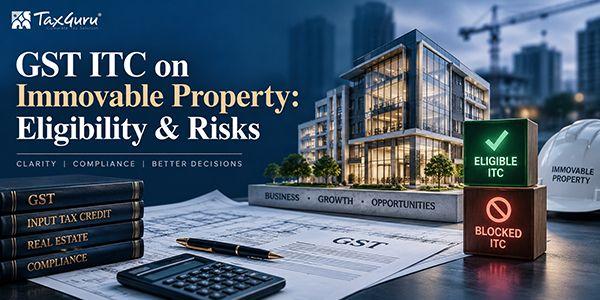
It is being observed that the assesses are receiving notices requiring to reverse/pay back ITC availed pertaining to newly constructed building projects used for business operations[such as factory premise/warehouses], alleging such credit is restricted being of nature of “immovable property”. However in addition to civil works, such projects involve installation of electrical fittings, cabling, STP, security, fire fighting, machines for manufacture of finished goods etc.
In this backdrop, paper writer has examined what is “immovable property” and ITC related to immovable property.
Upon satisfaction of the basic conditions for availing the Input tax credit specified in Section 16, there comes a non-obstante clause under Section 17(5) that restricts input tax credit availed even if it is used in the course or furtherance of business.
One such restriction has been set out under GST by way of the list of blocked credits under Section 17(5)(c)/(d) which is discussed as under.
Blocked credit under section 17(5)(c/d)
Section 17(5)(c) sets out that credit is blocked on works contract services for construction of an immovable property (other than plant and machinery) except where it is an input service for further supply of works contract service;
Construction includes reconstruction, renovation, additions or alterations or repairs to the extent of capitalization, to the said immovable property;
Works contract service is material plus labour contract, for building, construction, completion, erection, installation, fitting out, improvement, modification, repair, renovation alteration of immovable property, which involves transfer of property in goods, in course of executing contract.
Plant and machinery means apparatus, equipment, and machinery fixed to earth by foundation or structural support that are used for making outward supply of goods or services or both and includes such foundation and structural supports but excludes-
(i) land, building or any other civil structures;
(ii) telecommunication towers; and
(iii) pipelines laid outside the factory premises.
The restriction set out denies credit on works contract services used in the construction of immovable property. However, the said restriction has 2 exceptions (which means in the following instances ITC can be taken on the works contract services);
- When the works contract services, is received by a taxable person for the construction of “plant and machinery” as defined in Explanation to Section 17 of CGST Act [eg: when the contract is material and labour works contract resulting in HVAC plant, being immovable property].
- Where the works contract service supplied for the construction of immovable property is an input service for further supply of the works contract. Eg: Developer of mall, selling units in course of construction to buyers of units in mall. Developer gives contract of material plus labour for construction works to a contractor, who executes such works contract. The developer can avail credit to extent related to units sold during construction.
Further, Section 17(5)(d) restricts credit on goods or services or both received by a taxable person for construction of an immovable property (other than plant “and”* machinery)[*replaced in place of “plant or machinery” with retrospective effect from 1.7.2017, vide notification no. Notification No. 16/2025-Central Tax dated 17.09.2025] on his own account including when such goods or services or both are used in the course or furtherance of business.
However, it is to be noted that the restriction of ITC envisaged under Section 17(5)(d) is subject to 2 exceptions as well, which are as under (which means in the following instances ITC can be taken)
- Where goods or services or both are received by a taxable person to construct an immovable property consisting of a “plant and machinery”
- Where goods and services or both are received by a taxable person for the construction of an immovable property made not on his own account.
Comments:
- It means that the restriction set out above applies only to the extent that the relevant expenditure is capitalised to the immovable property.
- To the extent that the expenditure is not capitalised, or where it is treated as revenue expenditure, or is plant and machinery, the definition of “construction” is not satisfied, and the ITC is not restricted.
- With regard to the second exception of Section 17(5)(d), the Hon’ble Supreme Court vide Safari Retreats (CIVIL APPEAL NO. 2948 OF 2023) has clearly observed and discussed the scope of the words “on its own account” At para 32 observed construction cannot said to be on a taxable person’s “own account “if it is intended to be sold or given on Iease or license.“ .
What is immovable property?
The term ‘immovable property’ is not defined under GST Law. However, the General Clauses Act, 1897 defines the term “immovable property” to include the following. The definition of the term “immovable property is inclusive in nature.
- Land,
- Benefits to arise out of the land, and
- Things attached to the earth or permanently fastened to anything attached to the earth.
Section 3 of the Transfer of Property Act, 1882 defines the term ‘attached to the earth’ to mean
- rooted in the earth,
- embedded in the earth, and
- attached to what is so embedded for permanent beneficial enjoyment of that to which it is attached.
The essential character of ‘immovable property’, as emerges from the above discussion and relevant to the present context is that it is attached to the earth, or permanently fastened to anything attached to the earth, or forming part of the land.
Furthermore, in the GST Act, if the article attached to the earth is not agreed to be severed before supply or under a contract for supply, it ceases to be goods and, for that matter, a movable property.
It could be understood that things attached to the earth, or permanently fastened to anything attached to the earth would be treated as immovable property.
Movable vs immovable property test-various judgements
a. Intention and factum to be ascertained from facts and circumstances: Apex Court observes that while determining whether an article is permanently fastened to anything attached to the earth both the intention as well as the factum of fastening has to be ascertained from the facts and circumstances of each case.[In Triveni Engineering & Industries Ltd. [2000 (120) E.L.T. 273 (S.C.)] .
b. Machines fixed to earth by nuts and bolts, no intention to permanently attach to earth: Held that the machine is fixed by nuts and bolts to a foundation not because the intention was to permanently attach it to the earth but because a foundation was necessary to provide a wobble free operation to the machine. At attachment of this kind without the necessary intent of making the same permanent, cannot in our opinion, constitute permanent fixing, embedding or attachment in the sense that would make the machine a part and parcel of the earth permanently. In that view of the matter we see no difficulty in holding that the plants in question were not immovable property so as to be immune from the levy of excise duty. The plants with which we are dealing are entirely over ground and are not assimilated in any structure. They are simply fixed to the foundation with the help of nuts and bolts in order to provide stability from vibrations during the operation. [In case of Solid and Correct Engineering works [2010 (252) ELT 0481 SC].
c. Plant attachment with nuts bolts, detachable from the foundation, not permanent: In Commissioner of Central Excise vs. Solid and Correct Egg. Works 2010 (252) ELT 481 (SC) the Apex court while deciding whether setting up of an Asphalt Drum Mix Plant were immovable property or whether the assessee was engaged in making of components of such plant. Some of the components of such plants were embedded in the earth on a foundation of 1.5 dig deep. It was held that the plants were not per se immovable and they become immovable when embedded in the earth. The attachment of the plant with nuts and bolts intended to provide stability and prevent vibration is not covered as attached to earth. The attachment can be easily detachable from the foundation and is not permanent. The plant moved after road construction or repair project is completed. The plants are not immovable property.
Apex court also states that the machines which are permanently fixed to the structures which are embedded in the earth, the machine thus becoming a part of the structure and were no longer be movable goods. It was in those peculiar circumstances that the installation and erection of machines at site were held to be by this Court, to be immovable property that ceased to remain moveable as they were at the time of their purchase. Moveable character of machine becomes extinct once fixed, embedded or assimilated in permanent structure. Such machine not treatable moveable is not dutiable.
d. Article attached to earth not removed: In S/S Triveni N.L. Ltd. [RN – 910, 911 & 912 of 2001 (All.)] Allahabad High Court observes that permanently fastened to anything attached to the earth’ has to be read in the context for the reason that nothing could be fastened to the earth permanently so that it could never be removed. If the article cannot be used without fastening or attaching it to the earth and is not removed under ordinary circumstances, it may be considered permanently fastened to anything attached to the earth.
e. Item can be removed, attach in another place without damage, it is movable: In the case of M/s. Sirpur Paper Mills [1998 (97) E.L.T. 3 (S.C.)], it was held that where the item can be dismantled and erected at another location without destroying or damaging the item, the said item would be movable and not immovable.
f. In the case of Vodafone Mobile Services Limited [2019 (27) G.S.T.L. 481 (Del.)], it was held that towers, pre-fabricated shelters and accessories used for providing telecom services fastened to civil foundation to make it wobble free and ensure stability, fastened based on rudimentary “screwdriver” technology and can be bolted and unbolted, assembled and re-assembled, located and re-located without any damage, are goods and not immovable property. Affirmed in 2025 (391) E.L.T. 3 (S.C.).
The principles laid down by the Apex Court in the case of Bharti Airtel Limited v The Commissioner of Central Excise, Pune
1. The Hon’ble Supreme Court of India in the case of Bharti Airtel Limited v The Commissioner of Central Excise, Pune [2024] 11 S.C.R. 1525 : 2024 INSC 880, summarized the principles (based on earlier decisions) to be followed to determine the nature of property. The same (verbatim) are reproduced as under:
- Nature of annexation: This test ascertains how firmly a property is attached to the earth. If the property is so attached that it cannot be removed or relocated without causing damage to it, it is an indication that it is immovable.
- Object of annexation: If the attachment is for the permanent beneficial enjoyment of the land, the property is to be classified as immovable. Conversely, if the attachment is merely to facilitate the use of the item itself, it is to be treated as movable, even if the attachment is to an immovable property.
- Intendment of the parties: The intention behind the attachment, whether express or implied, can be determinative of the nature of the property. If the parties intend that the property in issue is for permanent addition to the immovable property, it will be treated as immovable. If the attachment is not meant to be permanent, it indicates that it is movable.
- Functionality Test: If the article is fixed to the ground to enhance the operational efficacy of the article and for making it stable and wobble free, it is an indication that such fixation is for the benefit of the article, such the property is movable.
- Permanency Test: If the property can be dismantled and relocated without any damage, the attachment cannot be said to be permanent but temporary and it can be considered to be movable.
- Marketability Test: If the property, even if attached to the earth or to an immovable property, can be removed and sold in the market, it can be said to be movable.
Eligibility to Input tax credit and immovable property under GST
In this backdrop, by applying the tests set out above, it maybe determined whether an item can be said to be movable or immovable property.
- ITC on Movable goods: If the goods are merely attached to earth for wobble free operation, easily detachable, without damage or merely attached for functionality, it can be said to be movable and not immovable in nature. Example: Pre-fabricated building which is clipped/on drilled ground screws or on civil base but which can be removed and used elsewhere.
- Plant and machinery: It is significant that credit can be availed without restriction on items which qualify as plant and machinery, without being hit by restriction in section 17(5)(c/d) even if it is immovable property. Example can be HVAC system installed in civil works of building, such as factories/malls. Similarly on sewage treatment plant even if these partake character of immovable property after being installed and cannot be removed without damage.
- The CESTAT, Mumbai, in City Centre Mall Nashik Pvt. Ltd. v. Commissioner of Central Excise & Service Tax, Nashik, 2017 (11) TMI 301 (CESTAT-Mum.), held that credit in respect of escalators, DG sets, chillers and HVAC equipment used for the operation of a shopping mall is allowable. It is further well-settled that where the principal equipment qualifies as plant and machinery, all ancillary procurements integral to it such as piping, ducting and accessories equally qualify for credit.
- ITC on other items used in buildings or civil structures: Credit on the below is eligible:
- Electrical installations/cables,
- Electronic equipment such as office appliances,
- Transformers,
- Panels,
- Fire-safety systems (hydrants, sprinklers, fire alarms and smoke detectors) and
- Building management systems (CCTV, access control and BMS) are equipment installed for safety and for the smooth functioning of business operations, affixed for structural support and operational efficiency.
- ITC cannot be denied, since these are movables and can be removed and fitted elsewhere. Similarly Credit on racks, furniture, office appliances, cannot be denied.
Way ahead and conclusion
Possible issues when there is a Single contract for construction of building and supply of machineries, other moveable goods:
- Activity of construction of factory building, being immovable property. Such building may be capitalised to immovable property block and used for own use as factory/office space.
- Under same contract, it also involve the supply of movables. Examples could be-machineries for use on factory shop floor, admin office furniture, carpets, lap tops, shelves and other goods, which are used in factory/office and moveable in nature. In such scenario, department may seek to deny the entire ITC alleging it is blocked credit, for construction of building done under single contract.
ACTION POINTS FOR ITC OPTIMISATION:
- Have separate contracts: Independent contract be entered for procuring such movable goods/materials, such as furniture, racks, benches with separate consideration for same. Credit on it– 100% eligible.
- Independent contract to supply plant machineries, movables: Similarly enter separate contract to procure the plant such as sewage treatment plant, which is plant and machinery [even when it is immovable property, excluded from list of blocked credit]. Such credit 100% eligible.
- Where separate agreements are entered for each nature of supplies set out above, then it could be said that there are independent supplies and the credit eligibility of each of these supplies would be determined separately.
- In State of Madras v. Gannon Dunkerley & Co. (Madras) Ltd. [2015 (330) E.L.T. 11 (SC)], wherein it was recognized that parties may enter into separate contracts notwithstanding a common document, thereby affirming the principle of contractual divisibility.
- Not Co-terminus contracts: Such agreements are independent of each other and there is no cross-reference between the agreements.
- Ensure independent contracts are entered for each of above[procurement of moveable goods and plant machineries], not co-terminus with civil building contract. Invoices also raised separately for such eligible items by vendor. This ensures eligible credit is not denied, citing it is part of supply of civil building works.
For any queries mail [email protected]






One thing worth adding to the Section 17(5)(d) analysis: the movable vs. immovable test is not just about what is fixed to the floor. The GST department is now scrutinising whether plant and machinery is part of a civil work package. If it is, the ITC gets blocked even if the machinery itself is eligible.
Practical safeguard: split the contract. Have two separate agreements, one for civil construction (blocked ITC) and one for eligible plant, machinery, or equipment. If both are in a single works contract agreement, the department can treat the whole supply as immovable.
Also watch Section 17(5)(c) for rented commercial properties: ITC on the property itself is blocked, but ITC on furniture, fittings, and electrical installations (where separately contracted) can often be claimed. The line between fitting and structure is where most notices originate.