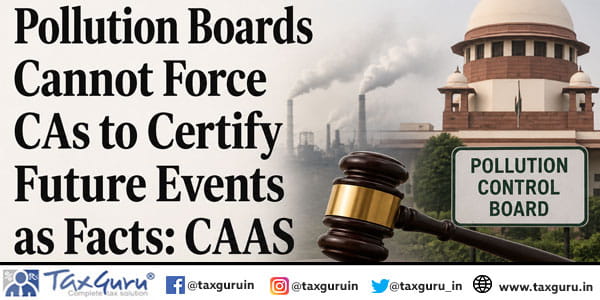
The Chartered Accountants Association, Surat (CAAS), has urged the Central Pollution Control Board (CPCB) to immediately discontinue or modify certificate formats that require Chartered Accountants to certify future or proposed investments as established facts. CAAS argued that such “futuristic certifications” conflict with the ICAI’s Guidance Note on Reports or Certificates for Special Purposes and expose professionals to disciplinary risks under the Chartered Accountants Act, 1949. The representation highlighted that while CAs can verify historical financial information, they cannot provide unqualified assurance on future events dependent on management decisions and external contingencies. CAAS also criticised one-page prescribed formats that prevent inclusion of essential professional safeguards such as scope limitations, management responsibility, reliance clauses, and restrictions on use. It proposed alternative mechanisms, including management declarations, project reports, and board resolutions, while demanding that ICAI-compliant certificates containing professional qualifications should not be rejected by Pollution Control Boards.
Chartered Accountants Association, Surat
Ref: CAAS/Representations/2026-27/01 | Dated: 06-06-2026
To,
The Chairperson,
Central Pollution Control Board,
Parivesh Bhawan, East Arjun Nagar,
Delhi – 110032.
Email: [email protected]
The Member Secretary,
Central Pollution Control Board,
Parivesh Bhawan, East Arjun Nagar,
Delhi – 110032.
Email: [email protected]
Subject: Demand for Discontinuance of Non-Compliant and Futuristic Certifications
Respected Sir,
We address this representation on behalf of the Chartered Accountants Association, Surat (CAAS), representing a large body of practising Chartered Accountants from South Gujarat, many of whom are regularly engaged in matters relating to environmental clearances, consent to establish, consent to operate, change in product mix, capital investment certifications, subsidy-linked certifications and other regulatory compliances involving Pollution Control Boards.
This representation is being made to the Central Pollution Control Board (CPCB) for the first time, after our attempts at the State level have revealed that the root of the difficulty lies not merely in local implementation by the Gujarat Pollution Control Board (GPCB), but apparently in the policy-level format and approach adopted or mandated at the central level.
We therefore demand CPCB to treat this communication as an urgent institutional representation requiring immediate corrective action.
1. Background of the issue
CAAS has been receiving persistent and increasing grievances from its members that industries approaching Pollution Control Boards are being required to furnish Chartered Accountant certificates in rigid, pre-drafted, one-page formats prescribed or insisted upon by various Board offices. These certificates typically relate to matters such as capital investment, proposed or future investment, zero investment declarations, changes in investment, expansion projects, change in product mix, installation of additional machinery, and other financial particulars connected with regulatory approvals and consents.
While the information sought by the regulator may be relevant for administrative purposes, the manner in which such certification is presently being demanded gives rise to serious professional, ethical and legal concerns for Chartered Accountants.
The difficulty is fundamentally twofold:
1. The prescribed format requires certification of future or proposed investment, often through language that effectively requires a Chartered Accountant to certify that an applicant “would be investing” or “shall invest” a specified amount in the future; and
2. The format either expressly or practically prevents the Chartered Accountant from incorporating essential professional safeguards and explanatory disclosures, including the scope of work performed, basis of verification, source of information relied upon, responsibility of management, responsibility of the practitioner, applicable criteria, inherent limitations, restriction on use, and a clear distinction between historical facts and prospective information.
The first issue is particularly serious because a proposed investment is not a completed event capable of verification through books of account, invoices, payment records, fixed asset registers or other documentary evidence ordinarily relied upon by a Chartered Accountant. A future investment is, by its very nature, contingent upon numerous variables such as management decisions, financing arrangements, statutory approvals, market conditions, project execution timelines and other uncertainties. In the result, it is a vague information expected to be certified. Requiring a Chartered Accountant to certify such future conduct as though it were an established fact places the professional in an untenable position and creates a misleading impression of certainty where none can legitimately exist.
The second issue is equally concerning because the prescribed format deprives the Chartered Accountant of the ability to communicate the basis, scope and limitations of the certification. By preventing the inclusion of standard professional safeguards, the format effectively compels the issuance of a certificate that does not adequately reflect the nature of the work performed or the extent of assurance intended to be conveyed. This is inconsistent with the professional framework, reporting principles and ethical requirements prescribed by the Institute of Chartered Accountants of India (ICA!).
In effect, the current approach not only seeks certification of matters that are inherently prospective and uncertain but also restricts the Chartered Accountant from adequately qualifying or contextualising such certification. The result is a format that exposes professionals to unnecessary risk, creates the possibility of misunderstanding by regulators and stakeholders, and undermines the very purpose of responsible and transparent professional reporting.
2. Earlier representation to GPCB and telephonic interaction with Member Secretary CAAS had earlier represented this issue before the Member Secretary, Gujarat Pollution Control Board, demanding that the futuristic certificate format be either discontinued or modified so that Chartered Accountants are permitted to add ICAI-mandated safeguard paragraphs.
Pursuant to the said representation, a telephonic discussion was held with the Member Secretary, GPCB. During the discussion, the Member Secretary straightaway expressed his inability and unwillingness to entertain any demand for change in the format, much less discontinue such futuristic certification requirement.
It was further conveyed that, as a regulator, GPCB cannot teach Chartered Accountants how to develop methodology or documentation to issue such certificates, and that if Chartered Accountants have difficulty in issuing such certificates, they may devise their own methodology. However, it was also stated that such certificates are mandated pursuant to requirements / formats arising from CPCB, and therefore any demand for discontinuance or modification would more appropriately lie before CPCB.
We appreciate the candour of GPCB in identifying CPCB as the appropriate level for escalation. However, that makes it all the more necessary for CPCB to now examine whether its policy or format has unintentionally created a conflict between environmental regulation and statutory professional ethics.
3. The central problem — a regulator cannot require a professional to certify the future as fact
A Chartered Accountant can verify historical facts, examine books of account, check invoices, scrutinise fixed asset registers, verify bank payments, inspect accounting records, and report on documents produced.
However, a Chartered Accountant cannot certify a future event as though it is an accomplished fact. A statement that an entity “would be investing” a particular amount in the future is not a matter of completed fact. It is at best a projection, estimate, proposal, management intention, budget, capital plan or future commitment. Such information is inherently uncertain, dependent upon management decisions, market conditions, financing availability, statutory approvals, vendor execution, project timelines and future contingencies.
If CPCB / SPCBs require such information for regulatory purposes, the applicant may certainly be required to submit a declaration, undertaking, project report, board resolution, consultant certificate, engineer’s certificate, management estimate or bank-sanctioned project cost statement. However, forcing a Chartered Accountant to certify such future investment in a bare format is professionally hazardous and legally unsustainable. The CA’s role cannot be converted into a seal of certainty over future conduct.
4. CPCB / SPCB formats are colliding with ICAI’s Guidance Note
The procedure of issuing certificates by Chartered Accountants is governed by ICAI, a statutory body set up under the Chartered Accountants Act, 1949, which is an Act of Parliament.
ICAI has issued the Guidance Note on Reports or Certificates for Special Purposes (Revised 2016). This Guidance Note requires Chartered Accountants to incorporate essential elements in certificates, including:
- identification of subject matter;
- applicable criteria;
- intended users;
- responsibility of management/ responsible party;
- responsibility of practitioner;
- scope of work and procedures performed;
- inherent limitations;
- restriction on use;
- summary of work performed;
- statement of compliance with the Guidance Note and ethical requirements; and
- appropriately worded conclusion.
These are not drafting luxuries. They are necessary safeguards.
When a Pollution Control Board insists that a Chartered Accountant must issue a one-page certificate without such elements, it is effectively compelling the professional to choose between:
1. complying with the Pollution Control Board format; or
2. complying with ICAI’s professional and ethical framework.
This conflict is unnecessary, avoidable and legally indefensible.
5. No administrative format can override a national professional regulator
CPCB is a regulator in the field of pollution control. It is not a regulator of Chartered Accountants.
Similarly, SPCBs may regulate industries, emissions, effluents, consents, conditions, environmental safeguards and compliance mechanisms. They may ask for information necessary to decide an application. However, they cannot regulate the professional format, ethical safeguards, reporting limitations or attestation methodology of Chartered Accountants.
The manner in which a Chartered Accountant issues a certificate is governed by ICA!. An internal circular, office instruction, portal format, policy checklist, consultant-driven practice or State Board insistence cannot override the ethics established by a national professional regulator constituted under an Act of Parliament.
ICAI’s standards are framed after considering long-term professional repercussions, public reliance, disciplinary consequences, assurance principles, international practice and the credibility of the profession. They cannot be brushed aside by administrative insistence on “one-page” convenience.
In plain terms:
CPCB may prescribe the information it wants. CPCB cannot prescribe professional misconduct as the method of giving that information.
6. The issue is not resistance to regulation; it is resistance to defective certification CAAS is not seeking to dilute environmental safeguards. We are not asking CPCB or SPCBs to accept incomplete information. We are not questioning the regulatory authority of Pollution Control Boards to seek investment details or project information. Our objection is precise and limited:
- do not demand certification of future investment as if it is a completed fact;
- do not prevent CAs from adding scope, limitations and reliance paragraphs;
- do not treat ICAI-compliant certificates as defective merely because they are not in the exact one-page format;
- do not place applicants in difficulty merely because their Chartered Accountant refuses to issue a professionally unsafe certificate.
The regulatory objective of CPCB can be fully achieved without compromising the ethical framework of Chartered Accountants. If CPCB needs future investment information, it may ask the applicant to submit a projected capital investment statement certified by management, supported by board resolution, project report, purchase orders, sanction letters or consultant documents. The CA may only report that such projection has been prepared by management and, if required, that arithmetical accuracy or consistency with specific documents has been checked. But the CA cannot be made to certify the future as a matter of certainty.
7. Similar formats appear to be influencing SPCBs / Regional Pollution Control Boards across India
We are given to understand that similar certificates or similar certificate formats are being demanded by various State and Regional Pollution Control Boards, apparently because such requirement has flowed from CPCB’s policy, practice or model format. If this is so, the problem is not restricted to Gujarat. It is a national professional concern.
A defective central format, once adopted by multiple Boards, multiplies the damage across the country. It creates uneven pressure upon Chartered Accountants, generates friction between clients and professionals, encourages non-compliant certificates, and undermines the dignity of professional attestation.
CPCB, being the central body, must therefore not leave the issue to be dealt with sporadically by State Boards. A central correction is necessary.
8. Alternative mechanisms are available without requiring futuristic CA certification CPCB may also consider whether the regulatory objective sought to be achieved through futuristic CA certificates can be accomplished through simpler and more appropriate mechanisms that do not place Chartered Accountants in an untenable professional position.
If the purpose of obtaining information regarding the size, scale, category or proposed investment of a project is to determine applicable fees, classify industrial units, assess consent requirements, prescribe monitoring norms or evaluate regulatory obligations, such information can be obtained directly from the Project Proponent.
For instance, the Project Proponent may be required to furnish an affidavit or self-declaration stating the proposed size of the project, estimated capital investment, proposed expansion or other relevant particulars. Such a declaration would appropriately place responsibility upon the person who is actually undertaking the project and who is in the best position to know and disclose future plans and intentions. Similarly, CPCB and SPCBs may consider relying upon existing governmental records and registrations wherever relevant. By way of illustration, the Udyam Registration framework already captures information relating to the enterprise and its classification based on investment and turnover criteria. Such information may be useful for regulatory purposes including determination of applicable fees, categorisation of units or prescribing monitoring and compliance requirements.
These alternatives demonstrate that there is no compelling necessity to require a Chartered Accountant to certify future events or proposed investments as though they are established facts. Where the information sought relates to future intentions, projections or proposed activities, the responsibility for such statements should ordinarily rest with the Project Proponent and not be transferred to a professional certifier whose expertise lies in verification of records and reporting on ascertainable facts.
Accordingly, CPCB may consider replacing futuristic CA certification requirements with appropriate declarations, affidavits, project reports, statutory registrations or other documentary evidence that more accurately reflects the nature of the information being sought while avoiding unnecessary professional and legal complications.
9. Professional misconduct risk under the Chartered Accountants Act, 1949
The Chartered Accountants Act, 1949 recognises professional misconduct in relation to members who fail to act in accordance with statutory and professional obligations.
A Chartered Accountant issuing a bare certificate without due diligence, without sufficient information, without inviting attention to departure from generally accepted procedures, or by allowing his name to be used in a manner that overstates assurance, may face disciplinary consequences.
We also draw attention to Clause (3) of Part II of the Second Schedule to the Chartered Accountants Act, 1949, which reads as under:
“(3) permits his name or the name of his firm to be used in connection with an estimate of earnings contingent upon future transactions in a manner which may lead to the belief that he vouches for the accuracy of the forecast;”
The above statutory language reflects the seriousness with which the law treats false or incorrect particulars in professional and disciplinary contexts. More importantly, the Institute of Chartered Accountants of India, through its ethical framework, Guidance Notes and established professional principles, does not permit Chartered Accountants to certify future events, projections or proposed actions as though they are completed and verifiable facts. A Chartered Accountant is expected to report on information capable of verification and cannot provide assurance on matters that are contingent upon future decisions, events or circumstances beyond the scope of present verification. Accordingly, where a certificate format requires a Chartered Accountant to certify that an entity “would invest” or “shall invest” a specified amount in the future, the requirement places the member in direct conflict with the professional standards prescribed by the Institute. Such futuristic certification is not merely a matter of drafting preference; it is fundamentally inconsistent with the principles governing professional certification and assurance engagements. If the certificate format itself compels or encourages a Chartered Accountant to issue a certificate on future events without appropriate qualification, the format becomes the source of professional and disciplinary risk for the member.
CPCB should not, even indirectly, design or perpetuate a format which pushes members of a national statutory profession toward such exposure.
10. Responsibility of CPCB to prevent systemic misuse of CA certificates
CPCB is a national regulator. Its directions, model formats and practices carry influence far beyond a single file or single State.
It is therefore incumbent upon CPCB to ensure that its certificate requirements do not result in:
- mechanical rubber-stamp certifications;
- inappropriate certification of future events;
- suppression of professional limitations;
- false impression of absolute assurance;
- conflict between applicants and CAs;
- forum shopping for pliable professionals;
- disciplinary risk for members of !CAI; and
- avoidable disputes before appellate, vigilance, audit or judicial forums.
A certificate that contains its professional limitations is a safer document for everyone. A certificate without them is a document waiting to be misunderstood.
11. Urgent demand for discontinuance / modification
In view of the above, CAAS firmly demands CPCB to immediately:
1. review all formats, circulars, portal requirements and model certificate language requiring CA certificates for capital investment, zero investment, proposed investment, expansion or change in product mix;
2. discontinue any requirement that asks a Chartered Accountant to certify future or proposed investment as a concluded fact;
3. clarify that prospective information, if required, may be submitted as management’s projection / undertaking / project estimate, and not as an unqualified CA certificate;
4. issue a central clarification to all SPCBs / PCCs that Chartered Accountants must be allowed to incorporate ICAI-compliant safeguard paragraphs in all certificates;
5. direct all Boards that prescribed formats should be treated as identifying the information required, and not as prohibiting professional paragraphs mandated by !CAI;
6. clarify that applications shall not be rejected, returned, queried or delayed merely because a Chartered Accountant has added scope, limitation, responsibility, reliance, basis-of-verification or restriction-on-use paragraphs;
7. consider consultation with ICAI / CAAS before prescribing or revising any format involving Chartered Accountant certification; and
8. immediately communicate interim instructions to State Boards, including GPCB, so that pending applications are not prejudiced.
12. Interim mechanism suggested by CAAS
Pending final rationalisation, CPCB may issue a simple interim clarification as under:
“Any requirement for a Chartered Accountant to certify future, proposed or anticipated investment as a concluded fact is wholly unacceptable and should be discontinued forthwith. Where CPCB or any SPCB requires information relating to proposed investment, the same may be obtained through management declarations, project reports, undertakings, board resolutions or other appropriate documents, but not through an unqualified Chartered Accountant certificate certifying a future event. For existing project proponents and in cases involving historical or already-incurred investment, capital cost, project cost, expansion cost, zero investment or similar financial information capable of verification from records, the Chartered Accountant should be permitted to issue a modified certificate in accordance with the ICAI Guidance Note on Reports or Certificates for Special Purposes. Any prescribed table or format may be incorporated in the certificate or attached as an annexure. Such certificates shall not be rejected, returned or treated as deficient merely because they contain scope, limitation, management responsibility, practitioner responsibility, basis of verification, restriction on use, reliance on records produced, or other professional safeguard paragraphs mandated or permitted under the ICAI framework.”
Such a clarification would immediately resolve the conflict without compromising CPCB’s regulatory interests.
13. Escalation and copy to GPCB
We are marking a copy of this representation to the Member Secretary, Gujarat Pollution Control Board, since the issue has specifically arisen in Gujarat and since GPCB has orally indicated that the matter is better represented before CPCB.
This representation should therefore be treated as escalation of the issue to the appropriate central level, and not as abandonment of our earlier demand to GPCB.
We are also marking a copy to the Chairperson, Ethical Standards Board, ICAI, since CAAS has already apprised certain Central Council Members of ICAI regarding the worsening situation. The conflict between governmental certificate demands and ICAI’s ethical framework is now causing serious friction between clients and CAs, between consultants and CAs, and even between compliant and non-compliant members of the profession.
We therefore demand CPCB to intervene immediately and issue necessary directions as above before further damage is caused to applicants, professionals and the credibility of regulatory certification itself.
CAAS remains available for consultation and would welcome an opportunity to present a draft ICAI-compliant format acceptable to CPCB and SPCBs.
Thanking you,
Regards,
For Chartered Accountants Association, Surat.
President I Secretary
Enclosures
1. Sample futuristic CA Certificate required by Various Regional Pollution Control Boards
2. Copy of CAAS representation submitted to GPCB. Download here: https://bitly/4oHFrGN
3. Copy of ICAI Guidance Note on Reports or Certificates for Special Purposes (Revised 2016). Download here: haps://resource.cdmicaLorg/43452aasb-an-rcsavdt”
Copy to:
1. Honible Chief Minister of Gujarat,
Chief Minister’s Office, 3rd Floor, Swarnim Sankul – 1, New Sachivalaya, Sector 10,
Gandhinagar – 382010. (Email: [email protected])
2. The Member Secretary,
Gujarat Pollution Control Board, Paryavaran Bhavan, Sector 10-A, Gandhinagar
382010. (Email: [email protected] / [email protected])
3. The Chairman,
Gujarat Pollution Control Board, Paryavaran Bhavan, Sector 10-A, Gandhinagar
382010. (Email: [email protected], [email protected])
4. The Secretary,
Ministry of Environment, Forest and Climate Change,
Government of India, Indira Paryavaran Bhawan, Jor Bagh Road, New Delhi – 110003. (Email: [email protected])
5. Chairperson, Ethical Standards Board, ICAI
The Institute of Chartered Accountants of India,
ICAI Bhawan, A-29, Sector 62, Noida – 201309. (Email: [email protected])
6. President, ICAI
The Institute of Chartered Accountants of India,
ICAI Bhawan, Indraprastha Marg, New Delhi – 110002. (Email: [email protected])
SPECIMEN CA CERTIFICATE REQUIRED BY POLLUTION CONTROL BOARDS
I” ON CHARTERED ACCOUNTANT’S LETTER-HEAD ]
TO WHOMSOEVER IT MAY CONCERN
This is to certify that M/s XXXXX XXXXXX located at XXXXXXX (Factory Address). has planned to invest in fixed assets as under
| Sr. No. |
Name of Particular | Proposed Capital Investment (Without depreciation) amount (Rs. In Lakh) |
|---|---|---|
| 1 | Land and Building | 325 |
| 2 | Plant & Machinery | 400 |
| 3 | Miscellaneous | 10 |
| Total | Rs. 735 (in Lack)
(Rs in words) |
The above details of investment is considered purely on the basis of documents, information & explanation given to us by the firm and verification of documents made by us.
All figures mentioned above are pertaining to capital investment. The capital investment including land & building, plant & machinery and miscellaneous cost without depreciation shall be considered as per books of account/Audit report.
Place:________
Date:________
For,__________ (Name of CA Firm) Chartered Accountants
F.R. No.:
Stamp & Signature :
Name;__________________________________________
Designation M. No.:
(Name of CA)_______
UDIN____________