In re PV Lumens India Pvt. Ltd (CAAR Mumbai)
The Customs Authority for Advance Ruling (CAAR), Mumbai, in the matter of In re PV Lumens India Pvt. Ltd., issued an order regarding the classification of Thermal Printer Ribbons (TPRs) under the Customs Tariff Act, 1975. The applicant, M/s. PV Lumens India Pvt. Ltd., sought an advance ruling to confirm its adopted classification of TPRs under Customs Tariff Item (CTI) 84439959.
Issue and Applicant’s Submission
The primary issue was the classification of Thermal Printer Ribbons (TPRs). The applicant, an importer and distributor of various products, intended to classify the TPRs under CTI 84439959, which covers “Parts and accessories of goods of sub heading 8443 31, 8443 32.”
The applicant described TPRs as components used exclusively in thermal transfer printers to print images or barcodes on materials, usually thermal transfer labels. These ribbons are thin films coated with wax, resin, or wax-resin. The printing process involves a heated printhead melting the coating, which is then transferred onto the media. They emphasized that TPRs are unlike typewriter or similar ribbons, which function by impression (impact). TPRs contain components like spools, the ribbon itself, flanges, an RFID tag, and a cleaning roller.
The applicant argued that since thermal printers capable of connecting to an Automatic Data Processing (ADP) machine are classified under CTI 84433290 (“Other”), and TPRs are solely or principally used with these printers and are essential for their operation, the TPRs should be classified as “parts” of the thermal printers under CTI 84439959. The jurisdictional Commissionerate did not offer any comments on the application.
Judicial Precedents and Legal Framework
The applicant and the Authority relied on several judicial precedents and statutory provisions to determine the classification:
Classification of Thermal Printers
The CAAR noted that the classification of thermal printers capable of connecting to an ADP machine is settled under CTI 84433290 (others of other printers capable of connecting to an ADP machine or network). This was supported by the decision of the Hon’ble CESTAT, Mumbai, in the case of Honeywell Automation India Ltd vs. CC, ACC, Mumbai (2018 (359) E.L.T. 402 (Tri. – Mumbai)).
Definition of ‘Part’
To establish that the TPRs are “parts” of the thermal printers, the applicant cited:
- CCEx, Delhi vs. Insulation Electrical (P) Ltd (2008 (224) E.L.T. 512 (S.C.)): The Supreme Court defined a ‘part’ as an essential component of the whole, without which the whole cannot function.
- Sandvik Asia Ltd vs. CCEx, Pune (1997 (93) E.L.T. 475 (Tribunal)): A part is one without which the machinery is not operational or cannot suitably discharge its designed function.
Based on these definitions, the CAAR concurred that thermal printers cannot function in the absence of TPRs, deeming them an essential “part.”
Application of General Rules for Interpretation and Section Notes
The classification was determined by applying the General Rules for the Interpretation (GRIs), particularly GRI 1, and the relevant Section Notes.
The key legal provisions considered were:
1. Section Note 2(b) to Section XVI: This note governs the classification of machine parts. It states that parts suitable for use solely or principally with a particular kind of machine, or with a number of machines of the same heading, are to be classified with the machines of that kind (unless specifically covered elsewhere). Since TPRs are solely or principally used with thermal printers (heading 8443), they qualify to be classified as their parts.
2. Section Note 1(q) to Section XVI: This note excludes “typewriter or similar ribbons, inked or otherwise prepared for giving impressions” (classified under heading 9612) from Section XVI (which covers machinery and parts, including heading 8443).
Exclusion from Heading 9612
The CAAR conducted a detailed analysis to ascertain if the TPRs were excluded by Section Note 1(q) as being “typewriter or similar ribbons” of Heading 9612.
- Heading 9612 covers ribbons “inked or otherwise prepared for giving impressions.” The Explanatory Notes to 9612 confirm this, referring to printing by means of such ribbons in various machines.
- The Authority noted that the word “Impression” in this context means an indentation or depression made by pressure (impact).
- The thermal printing process, as detailed by the applicant, transfers the wax or resin coating by heat and not by impact or impression.
- The CAAR therefore held that TPRs are not covered by Heading 9612 as they are not prepared to give impressions by impact. This meant the exclusion provided by Section Note 1(q) was not applicable.
Final Classification
Since the TPRs:
1. Are an integral part of the thermal printer (as confirmed by judicial definitions of ‘part’).
2. Are solely/principally used with thermal printers (classified under heading 8443).
3. Are not excluded by Section Note 1(q) (not being typewriter or similar ribbons of 9612).
By applying Note 2(b) to Section XVI, the Authority ruled that the Thermal Printer Ribbons (TPRs) are classifiable as a part of a Thermal Printer under Customs Tariff Item (CTI) 84439959 (“Other” parts and accessories of goods of sub heading 844331, 844332).
The CAAR also referenced a similar ruling in the case of M/s. HID India Private Limited, where a similar classification was upheld.
FULL TEXT OF ORDER OF CUSTOMS AUTHORITY OF ADVANCE RULING, MUMBAI
M/s. PV Lumens India Pvt. Ltd. (IEC No.: AAMCP9656N) (hereinafter referred to as ‘the Applicant’) filed an application (CAAR-1) for advance ruling in the Office of Secretary, Customs Authority for Advance Ruling (CAAR) Mumbai. The said application was received in the secretariat of the CAAR, Mumbai on 22.05.2025 along with its enclosures in terms of Section 28H(1) of the Customs Act, 1962(hereinafter referred to as the ‘Act also’). The Applicant is seeking advance ruling on the issue of classification of Thermal Printer Ribbons (hereinafter as “subject goods” or “Thermal Printer Ribbons”) in question under CTI 84439959 of the First Schedule of the Customs Tariff Act, 1975.
2. applicant’s Submissions:
2.1 M/s. PV Lumens India Private Limited (hereinafter referred to as the “Applicant”) is a private limited company incorporated in the year 2022 under the Companies Act, 2013. The Applicant is engaged in the business of trading and distributing across categories including Testing & Measurement Instruments, LAN Infrastructure & Cabling, Building Management – Safety and Security Systems, Automatic Identification and Data Capture Products, and Hardware and Electrical products for global brands in India.
2.2 It has also informed by the applicant in CAAR-I form, that none of the models of subject goods under consideration in the instant application is pending in the applicant’s case before any officer of Customs, Appellate Tribunal or any Court of Law.
2.3 Applicant has submitted that the present application pertains to classification of ‘Thermal Printer Ribbons’. TPRs are components used in thermal transfer printers to print images or barcodes on materials, usually thermal transfer labels. These are thin films coated on one side with either wax, resin, or wax resin. The Applicant has submitted Product brochures of TPRs with its application.
3. Details of the product submitted by the Applicant:
3.1 TPRs are components used in thermal transfer printers to print images or barcodes on materials, usually thermal transfer labels. These are thin films coated on one side with either wax, resin, or wax resin.
3.2 Thermal transfer printers work by using the following process of thermal transfer printing:
a. using a heated printhead, heat is applied to a TPR that has a wax or resin coating, depending on the type of media;
b. the heat from the printhead melts the wax or resin and transfers it from the TPR onto the media;
c. the wax or resin is absorbed by the media so that the image becomes part of the media.
3.3 TPRs are used in thermal printers to ensure high-quality, durable prints for labelling and barcoding applications across various industries such as manufacturing, logistics, healthcare, retail and more.
3.4 TPRs consists of the following core components viz., supply and take-up spools, thermal transfer ink ribbon, geared and non-geared flanges, a RFID tag which communicates information to the printer and a cleaning roller. TPRs do not consist of ink cartridge and/or ink qozzle.spray,but Are in the form of ribbons which serves as a medium for printing by use of heat.
3.5 TPRs become operational upon their installation in the printer, wherein their activation occurs using the electronic and mechanical systems within the TPRs itself. Additionally, the TPRs have SIM card (card ribbons) to communicate with the thermal printer.
3.6 The Applicant intends to import TPRs of the following types:
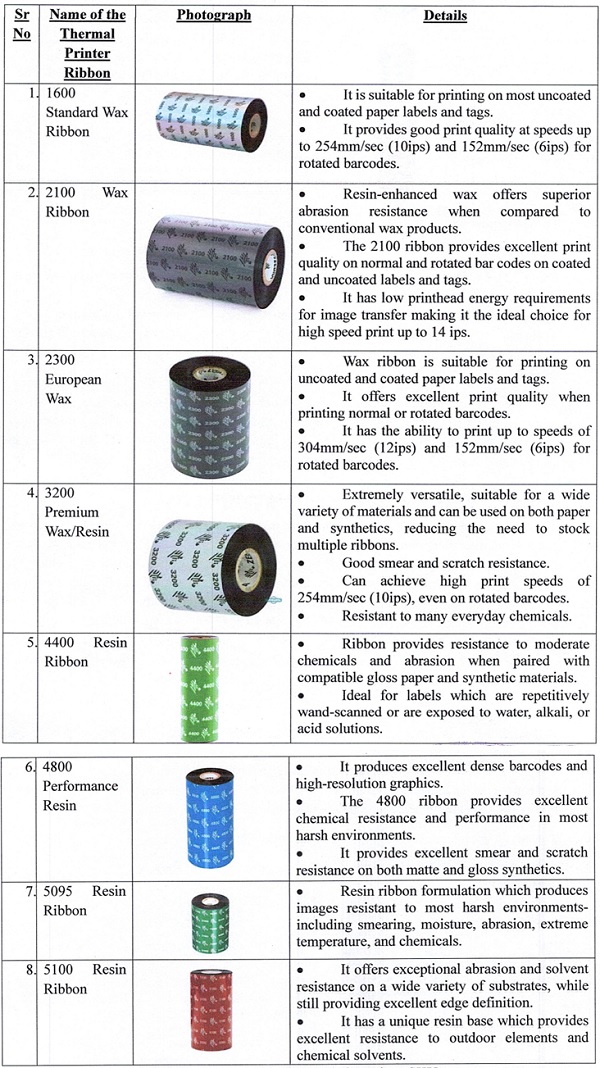
The above-mentioned types of TPRs are available in various
3.7 Benefit of TPRs
3.7.1 Using a TPR instead of other types of printing technologies has various benefits. Few of them are listed below:
a. TPRs are more durable than other types of printing methods, so they will last longer;
b. TPRs provide high speed prints with excellent print quality by utilizing less printhead energy;
c. TPRs can be used on a wide variety of materials due their superior abrasion resistance and durability.
3.8 The Applicant is importing TPRs under Tariff Item 84439959. To date, no issue has arisen regarding the classification of TPRs. The present application is being filed to obtain confirmation and certainty on the classification adopted by the Applicant. Illustrative copy of a Bill of Entry is enclosed as enclosed.
4. Port of Import and reply from jurisdictional Commissionerate:
The applicant in their CAAR-1 indicated that they intend to import the subject goods from jurisdictional Commissionerate of the Commissioner of Customs, Mumbai Customs Zone-II, N.S.-V, Jawaharlal Nehru Custom House, Nhava Sheva, Uran-400707 and Commissioner of Customs(I), Air Cargo Complex, Andheri-400099. The application was forwarded to the jurisdictional Commissionerate of the Commissioner of Customs, Mumbai Customs Zone-11, JNCH for their comments on 11.06.2025, 08.08.2025, 25.08.2025 and 15.09.2025. The Application was also forwarded to the jurisdictional of Commissionerate of the Commissioner of Customs(I), Air Cargo for their comments on 11.06.2025, 08.08.2025, 15.09.2025 and 15.10.2025. However, no response was received from the said Commissionerate.
5. Details of Hearing
A hearing was conducted on 11.08.2025 at 12:15 PM. Ms Srinidhi Ganeshan and Ms Anaya Bhide and Shri Sachin Naik, Advocates/Authorized Representatives (AR), appeared online on behalf of the applicant. They submitted that the subject goods are “Thermal PfinteMbbons” which have exclusive use in high quality durable prints for labelling, barcoding application in the manufacturing, logistics, healthcare, retail etc. That, as the thermal printers fall under CTI 84433290-other of printing machinery capable of being directly connectable to ADP machine. They also submitted that the parts of thermal printers’ merit classification under CTI-84439959. They also argued that CTH 9612 also makes provision of ribbon for typewriters and other ribbons but they work on impression technology and not on thermal technology thus does not merit to be classifiable under CTH 9612. They in support of their claim relied upon several US cross rulings which is annexed with their additional written submission filed. They also relied upon case laws in the matter of M/s Honeywell Automation and HID India Pvt Ltd, CAAR Mumbai 2023,385 ECT302) and other. Nobody appeared from department side to attend the hearing.
DISCUSSION AND FINDINGS
6. I have considered all the materials placed before me in respect of the subject goods. I have gone through the submissions made by applicant in its application and submission made during the hearing as well. No comments were received form the jurisdictional Commissionerate. Therefore, I proceed to pronounce a ruling on the basis of information available on record as well as existing legal framework.
7. The Applicant has sought advance ruling in respect of the following question:
a. Whether the products i.e. “Thermal Printer Ribbons”, are classifiable under CTI 84433290, of the First Schedule of the Customs Tariff Act, 1975, or otherwise. At the outset, I find that the issue raised in the question in the Form CAAR-1 is squarely covered under Section 28H(2) of the Customs Act, 1962 being a matter related to classification of goods under the provisions of this Act.
8. I have gone through the records of the case, oral and written submissions which include various CTHs descriptions, section & chapter notes as well as HSN Explanatory Notes. Applicant proposes to import the products commonly known as “Thermal Printer Ribbon” (“TPR”), which is specially designed for use with thermal ID card printers. Applicant has submitted that they have imported the subject goods in past under Customs Tariff Heading (CTH) 8443 (which according to the applicant is the correct CTH). Applicant further submits that there has been no authoritative determination on classification of the said product by the proper officer of Customs in the applicant’s own case at any time in the past. The present advance ruling application is filed to get an authoritative ruling on the issue of classification of the product in question which can be used in future imports.
9. It is submitted that the applicant that Thermal Printer Ribbon are solely dedicated for use TPRs are used solely/principally with thermal printers. Thermal Ribbon printers are capable of being connected to an automatic data processing machine (ADP) of heading 8471. The printer is specially designed to print images and text directly on the surface of ID cards, such as employee badges, student identification cards, etc., using heat. TPRs in the present case, are coated with wax or resin., the wax or resin is melted by use of heated printhead, which transfers the wax or resin from the TPRs onto the media to be printed. This is unlike typewriter or similar ribbons, which serve as a medium for printing by impression from impact, as they are inked or otherwise prepared to give impressions.
10. Before deciding the Classification of Subject goods i.e “Thermal Printer Ribbon”. I discuss the classification of Thermal Printers in which these ribbons are used.
10.1 A thermal printer uses a heated printhead to produce an image. It is a device capable of being connected to an automatic data processing machine, which prints the output without being a printing machinery used for printing by means of plates, cylinders and other printing components of Heading 8442. The printers capable of connecting to the automatic data processing machine or to a network and is classifiable under CTH 8443.
10.2 The extract of Heading 8443 is reproduced below for reference:
| Tariff Item | Description of goods |
|---|---|
| 8443 | PRINTING MACHINERY USED FOR PRINTING BY MEANS OF PLATES, CYLINDERS AND OTHER PRINTING COMPONENTS OF HEADING 8442; OTHER PRINTERS, COPYING MACHINES AND FACSIMILE MACHINES, WHETHER OR NOT COMBINED; PARTS AND ACCESSORIES ‘THERE OF |
| – Printing machinery used for printing by means of plates, cylinders and other printing components of heading 8442: | |
| *** | |
| – Other printers, copying machines and facsimile machines, whether or not combined: | |
| 84433100 | — Machines which perform two or more of the functions of printing, copying or facsimile transmission, capable of connecting to an automatic data processing machine or to a network |
| 844332 | — Other, capable of connecting to an automatic data processing machine or to a network : |
| 84433210 | — Line printer |
| 84433220 | — Dot matrix printer |
| 84433230 | — Letter quality daisy wheel printer |
| 84433240 | — Laser jet printer |
| 84433250 | — Ink jet printer |
| 84433260 | — Facsimile machine |
| 84433290 | — Other |
10.3 The applicant has submitted no specific CTI for the item “Thermal Ribbon Printers” capable of connecting to an automatic data processing machine or to a network. Therefore, a thermal printer which are cable of connecting to a automatic data processing machine should fall under others of CTSH 844332 and is rightly classifiable under Tariff Item 84433290- others. In regard to classification of “Thermal Ribbon Printer” the applicant has placed reliance on Hon’ble CESTAT, Mumbai decision in the case of Honeywell Automation India Ltd vs. CC, ACC, Mumbai, 2018 (359) E.L.T. 402 (7’ri. – Mumbai), wherein it was held that a thermal printer is a device capable of being connected to an automatic data processing Machine to print an output and is thus covered under Tariff Item 84433290. I have gone through the submission of the applicant and the said case law relied on by applicant regarding classification of thermal printer, I find that the classification of the “Thermal ribbon Printers” is settled and the same are rightly classifiable under CTI 84433290.
11. Now I discuss the Classification of the Subject goods i.e “Thermal Printer Ribbon”.
11.1 The Applicant has submitted that the subject Goods i.e TPR are parts of the Thermal ribbon as TPRs are used solely/principally with thermal printers, they will be classified with the thermal printer under CTSH 844332 as “parts”. The same will fall under the category-..of parts and accessories under Heading 8443, such TPRs will fall under CTI 84439959, as_ parts of goods under t; T,5H 844332.
In support of its claim that the subject goods are parts of the Thermal Printers, the Applicant has placed reliance on the following judgements:
i) Hon’ble Supreme Court of India in the case of CCEx, Delhi vs. Insulation Electrical (P) Ltd, 2008 (224) E.L. T. 512 (5: C), wherein the Hon’ble Supreme Court has defined ‘part’ as an essential component of the whole, without which the whole cannot function.
ii) Sandvik Asia Ltd vs. CCEx, Pune 1997 (93) E.L. T. 475 (Tribunal), wherein the Hon’ble Tribunal has held that a part is one without which the particular machinery is not operational or cannot suitably discharge the function for which it had been designed.
iii) Electrosteel Castings Ltd vs. CCEx, 1989 (43) ELT 305 (Tribunal), wherein the Hon’ble Tribunal has defined ‘part’ of a machine as a component, whose absence will disable a machine or appliance.
In view of the above submission and case laws relied by the applicant, I find that “Thermal printers” will not be able to function in absence of the “Thermal printer ribbons”. Therefore, the same can be considered as the “parts” of the Thermal Printers.
11.2 As there is no specific heading of the subject goods in the Customs Tariff, 1975.
“The classification is to be determined by application of the General Rules for the Interpretation (GRIs) of the First Schedule to the Customs Tariff Act (CTA), 1975. GRI 1 requires that, “in classifying articles, for legal purpose it shall be determined according to the terms of the headings and any relative Section or Chapter Notes,”.
11.3 For the classification of the subject goods which are parts of the “Thermal Printers”. I find that the classification of the Parts of the goods of the section XVI are governed by Note 2 of this section. Relevant portion of Section Note 2 has been extracted below for reference:
“2. Subject to Note 1 to this Section, Note 1 to Chapter 84 and to Note 1 to Chapter 85, parts of machines (not being parts of the articles of heading 8484, 8544, 8545, 8546 or 8547) are to be classified according to the following rules :
(a) parts which are goods included in any of the headings of Chapter 84 or 85 (other than headings 8409, 8431, 8448, 8466, 8473, 8485, 8503, 8522, 8529, 8538 and 8548) are in all cases to be classified in their respective headings;
(b) other parts, if suitable for use solely or principally with a particular kind of machine, or with a number of machines of the same heading (including a machine of heading 8479 or 8543) are to be classified with the machines of that kind or in heading 8409, 8431, 8448, 8466, 8473, 8503, 8522, 8529 or 8538 as appropriate However, parts which are equally suitable for use principally with the goods of headings 8517 and 8525 to 8528 are to be classified in heading 8517, and parts which are suitable for use solely or principally with the goods of heading 8524 are to be classified in heading 8529;
(c) all other parts are to be classified in heading 8409, 8431, 8448, 8466, 8473, 8503, 8522, 8529 or 8538 as appropriate or, failing that, in heading 8485 or 8548.”
11.4 TPRs are not specifically covered in any item heading of the Chapter 84 or 85 of the Tariff and thus do not fall under Section Note 2(a) mentioned above. As per Section Note 2(b) to Section XVI, parts suitable for use solely with a particular kind of machine will be classified with that machine. I find that TPRs are used solely/principally with thermal printers, therefore, as per Note 2(b) to Section XVI, TPR are Classifiable with the thermal printer under Sub-Heading 844332 as “parts”.
In view of the forgoing discussion, I find that, as Thermal Printer Ribbon (TPR) is an integral part of the Thermal printer and without TPR the thermal printers cannot function, therefore, by application of the above mentioned Note 2(b) of the section chapter XVI, the subject goods i.e “Thermal Printer Ribbons” are classifiable as a part of Thermal Printer under CTH 8443 99 —Parts and accessories of goods of sub heading 8443 31, 8443 32 and specifically under Tariff item 8443 99 59 —Other.
11.5 Note 2 of section XVI is Subject to Note 1 to this Section. Therefore, we need to analyse whether the subject goods are excluding as per Note 1 to the Chapter 84 or otherwise. Chapter 84 falls under Section XVI of the Tariff, and Note 1 to Section XVI specifically excludes certain products. Relevant portion of Note 1 to Section XVI is as follows:
“1. This Section does not cover:
(a) transmission or conveyor belts or belting, of plastics of Chapter 39, or of vulcanized rubber (heading 4010); or other articles of a kind used in machinery or mechanical or electrical appliances or for other technical uses, of vulcanised rubber other than hard rubber (heading 4016),–
***
(q) typewriter or similar ribbons, whether or not on spools or in cartridges (classOed according to their constituent material, or in heading 9612 if inked or otherwise prepared for giving impressions), or monopods, bipods, tripods and similar articles, of heading 9620″
11.6 From perusal of the above note, it is evident that the Section Note 1(q) of Section XVI excludes typewriter or similar ribbons of Heading 9612 which are inked or otherwise prepared for giving impressions. Therefore, It is needed to be analysed whether the subject goods “Thermal Printer ribbon” are covered by the CTH 9612 or otherwise:
11.7 The CTH 9612 of The Customs Tariff Act, 1975 and the relevant portion of the Explanatory Notes to the CTH are produced as below:
| 9612 | TYPEWRITER OR SIMILAR RIBBONS, INKED OR OTHERWISE PREPARED FOR GIVING IMPRESSIONS, WHETHER OR NOT ON SPOOLS OR IN CARTRIDGES; INK-PADS, WHETHER OR NOT INKED, WITH OR WITHOUT BOXES |
|---|---|
| 9612 10 | – Ribbons |
| 96121010 | — Computer printer ribbon |
| 96121020 | — Ribbons for typewriters, other than electronic and similar machines |
| 96121030 | — Ribbons for electronic typewriters |
| 96121090 | — others |
| 96122000 | -inkpads |
whether or not on spools or in cartridges; ink pads, whether or not inked, with or without boxes.
9612.10 – Ribbons
9612.20 – Ink pads
This heading covers:
(1) Ribbons, whether or not on spools or in cartridges, for typewriters, calculating machines, or for any other machines incorporating a device for printing by means of such ribbons (automatic balances, tabulating machines, teleprinters, etc.).
(2) The heading also includes inked, etc., ribbons, usually having metal fixing fittings, used in barographs, thermographs, etc., to print and record the movement of the recording machine needle. These ribbons are usually of woven textiles, but sometimes they are made of plastics or paper. To fall in the heading, they must have been inked or otherwise prepared to give impressions (e.g., impregnation qftextile ribbons, or coating of plastics strip or paper with colouring matter, ink, etc.). The heading does not cover :
(a) Rolls of carbon or other copying paper strip, not suitable for use as typewriter, etc., ribbons, but designed to produce duplicate copies in accounting machines, cash registers, etc. This strip, which is usually much wider than typewriter ribbons (generally more than 3 em in width), falls in Chapter 48.
(b)Ribbons not prepared by inking, impregnation, coating, etc., to give an impression; these are classified in Chapter 39, Section XI, etc., according to the constituent material.
(c) Empty spools (classified according to their constituent material).
11.8 It is evident from the CTH 9612 and its explanatory notes that in order for a ribbon to fall under the said heading, it must be inked to give impressions. Further, as per dictionary meaning or the word Impression- Impression is defined as “an indentation or depression made by the pressure of one object on or into another” . TPRs in the present case, are coated with wax or resin. The wax or resin is melted by use of heated printhead, which transfers the wax or resin from the TPRs onto the media to be printed. This is unlike typewriter or similar ribbons, which serve as a medium for printing by impression from impact, as they are inked or otherwise prepared to give impressions. In other words, in the thermal printing process, the wax or resin is transferred onto the media to be printed by way of heat and not through any impact. I find that TPRs in the present case are not inked to give impressions, but rather heated by the use of a thermal printer to transfer the wax or resin onto the media to print, therefore, they are not covered by Heading 9612. I also, find that TPRs are not only functionally, but also physically different from typewriter or similar ribbons. Typewriter or similar ribbons are narrow and thin, whereas TPRs are wide.
11.9 Further, this authority has taken the similar view in an identical matter in the case of M/s. HID India Private Limited, wherein the classification of the similar Thermal Printer ribbons was held under Heading 8443 and more specifically under Tariff Item 84439959.
12. In view of the forgoing discussion, I am of the considered opinion that the Thermal Printing Ribbon (TPR) proposed to be imported by the applicant, falls under CTH 8443 and under sub heading 8443 99-parts and more specifically under CTI 84439959 of the First schedule to the CTA, 1975.
13. I rule accordingly.