Essar Power Gujarat Ltd. Vs Commissioner of C.E. & S.T.-Rajkot (CESTAT Ahmedabad)
CESTAT remits power project interest waiver case back to Chief Commissioner, citing unreasoned rejection and violation of natural justice principle; Power Project Interest Waiver Rejection Overturned by CESTAT; Tribunal Cites Lack of Reasoning, Orders Fresh Decision.
Ahmedabad: The Customs, Excise and Service Tax Appellate Tribunal (CESTAT), Ahmedabad bench, has set aside an order from the Chief Commissioner rejecting a power generation company’s request for waiver of interest on imported goods. The Tribunal found the rejection lacked reasons and violated principles of natural justice, remitting the matter back for a fresh, reasoned decision after hearing the affected party.
The case involves Essar Power Gujarat Ltd., which was engaged in setting up a power project. As part of the project development, the company imported various goods that were initially held in a warehouse. Interest became payable on these goods due to delays in their clearance from the warehouse. Essar Power subsequently sought a waiver of this accrued interest.
The company’s request for interest waiver was notably supported by a Central Board of Indirect Taxes and Customs (CBIC) Circular, specifically Circular No. 10/2006 dated February 14, 2006. This circular provided guidelines for cases where interest waiver on warehoused goods could generally be considered. The CBIC, in this circular, had directed field formations to give appropriate consideration to waiver of interest for certain specified categories of imports, particularly acknowledging that for activities like Ship Building Industry and Power Generating Projects, imported goods often need to be retained for longer periods.
The rationale articulated by the CBIC in the circular was that charging interest in such scenarios could unnecessarily escalate project costs for projects deemed to be of national importance. The circular listed several categories where waiver would generally be considered, subject to the individual merits of each case. Item (ix) of this list specifically mentioned “Machinery, equipment and raw-materials imported for manufacture and installation of power generation units,” clearly indicating that power projects were intended beneficiaries of this facilitative guideline. This CBIC instruction served as the primary basis for Essar Power’s claim for interest waiver, directly applying to the nature of their project activity.
Essar Power Gujarat Ltd. initially approached the Chief Commissioner concerning the interest waiver. According to the appellant, they were initially advised by the Chief Commissioner’s office to apply for the waiver once the power project was completed. Following this guidance, the company formally applied for the interest waiver after project completion. However, the request was subsequently rejected by the Chief Commissioner.
The rejection was communicated through letters dated August 22, 2017, and a follow-up letter from the office of the Chief Commissioner dated November 6, 2017. A critical point of contention highlighted before CESTAT was the nature of this rejection. The letter communicating the rejection, sent by the Joint Commissioner to the company, provided no reasons whatsoever for denying the waiver of interest amounting to Rs. 24,23,880/-. A subsequent order dated November 16, 2017, passed by the Commissionerate of Central GST and Central Excise, Rajkot, also reflected this rejection and directed the appellant to pay the interest.
Aggrieved by these unreasoned rejection letters and the consequential payment direction, Essar Power Gujarat Ltd. filed an appeal before CESTAT Ahmedabad.
During the hearing at CESTAT, the appellant argued that the rejection was arbitrary and in contravention of the guidelines set out in the CBIC circular, which specifically recommended sympathetic consideration for power projects. The appellant contended that without any reasons provided for the rejection, they were left unaware of the grounds for denial, making it impossible to effectively challenge the decision.
The Learned Authorised Representative appearing for the department informed CESTAT that the request had been rejected by the Chief Commissioner as conveyed in the letters, but could not provide any further reasons for the rejection.
CESTAT carefully considered the submissions made by both parties, reviewed the appellant’s application for waiver, the unreasoned rejection letters from the Chief Commissioner’s office, and the significant CBIC Circular No. 10/2006. The Tribunal’s analysis focused heavily on the lack of reasoning in the rejection order.
The Tribunal found that the order conveying the Chief Commissioner’s decision was “totally unreasoned” and amounted to a denial of natural justice. CESTAT observed that the appellant was not even heard in the matter before the decision was taken. The Tribunal stated that the discretion to grant or deny the waiver appeared to have been exercised in a most arbitrary manner, completely devoid of any supporting reasons.
CESTAT invoked a fundamental principle of law, describing it as “trite law,” that even administrative orders that result in denying an entitlement to a party must be supported by reasons. This is essential to allow higher courts or tribunals to examine the decision-making process and ascertain whether the conclusion was correctly reached. The absence of reasons in the Chief Commissioner’s order prevented CESTAT from understanding the basis for the rejection and exercising its appellate function effectively.
The Tribunal drew a clear contrast between the reasoned approach visible in the CBIC Circular, which outlined why certain projects like power projects deserved sympathetic consideration for interest waiver, and the complete lack of any such reasoning or application of mind in the order communicated by the Chief Commissioner’s office.
In light of these findings, CESTAT concluded that it was unable to look into the reasons behind the Chief Commissioner’s decision because none were provided. The Tribunal held that the Chief Commissioner’s order, as conveyed, failed to demonstrate any application of the principles or rationale outlined in the relevant CBIC circular.
Consequently, CESTAT decided to set aside the Chief Commissioner’s rejection letters dated August 22, 2017, and November 6, 2017. The Tribunal also set aside the consequential order passed by the lower authority (Commissionerate of Central GST and Central Excise, Rajkot, dated November 16, 2017), which was based on the Chief Commissioner’s rejection.
The matter was remitted back to the Chief Commissioner with specific directions. The Chief Commissioner is now required to reconsider the request for interest waiver and pass a fresh order. This new order must be a “reasoned order,” explaining the basis for the decision. Crucially, the Chief Commissioner must provide the appellant, Essar Power Gujarat Ltd., with an opportunity of hearing before passing the fresh order, as the decision directly impacts their financial interest and the cost implications for their power project. The Tribunal clarified that fresh orders from the lower authorities regarding interest payment would depend on the outcome of the Chief Commissioner’s reconsidered, reasoned decision.
The appeals filed by Essar Power Gujarat Ltd. were thus allowed by way of remand, ensuring that their request for interest waiver receives a proper and reasoned consideration in line with legal principles and administrative guidelines.
FULL TEXT OF THE CESTAT AHMEDABAD ORDER
In this case, for a power project, the appellants had sought waiver of interest on the goods which were initially in warehouse and were cleared later. The claim was supported by the CBIC Circular No. 10/2006 dated 14.02.2006, in which it was directed to the field formations that waiver of interest on power projects even in case of some delay, in clearance from warehouse should be appropriately considered by the Chief Commissioners, since such costs imposed by the department have the propensity to increase working capital requirements and eventually the project cost, for the project which are of national importance. The CBIC Circular clearly covers the projects which are in the nature of power project, is extracted below: –
“4. The guidelines where the interest would generally be waived have been framed keeping in mind the fact that for certain specified categories of imports such as ship stores and others, the import duty is finally not payable. In certain other cases, it was considered that in view of the production programme or nature of activity of the importers such as Ship Building Industry, Power Generating Project, the imported goods have to be generally retained for a longer period of time. Charging of interest would escalate the costs unnecessarily. In essence the guidelines cover the following cases. This would however be subject to the individual merits of a case:-
(i) Goods supplied as ship stores/aircraft stores
(ii) Goods supplied to diplomats
(iii) Goods used in the units operating under manufacture-in-bond scheme
(iv) Goods imported by 100% EOUs
(v) Goods warehoused and sold through duty free shops
(vi) Machinery, equipment and raw materials imported for building and fitment to ships
(vii) Petroleum products
(viii) Plant and Machinery imported for projects
(ix) Machinery, equipment and raw-materials imported for manufacture and installation of power generation units
(X) Goods imported under OGL and warehoused for subsequent clearance against valid advance licences/Import-Export Pass Book Scheme or any similar scheme
(xii) Goods imported in bulk by canalizing agencies/public sector trading or service agencies and warehoused for subsequent release for export production (xii) Imports under EPCG Scheme
(iii) Import of Capital Goods by Public Sector Undertakings”
From Srl. No. (ix), it is quite clear that the circular covered the power projects which is the type of service, the appellants have providing in the present instance. Initially on approaching the Chief Commissioner, it was responded to them that they should apply for waiver of interest, once the project is completed. Later when they applied for the same, it was rejected by the Chief Commissioner vide his letter dated 22nd August, 2017 and vide the office letter of the office of Chief Commissioner dated 6th November, 2017, which is at page 29 of the appeal paper book, and is reproduced below: –
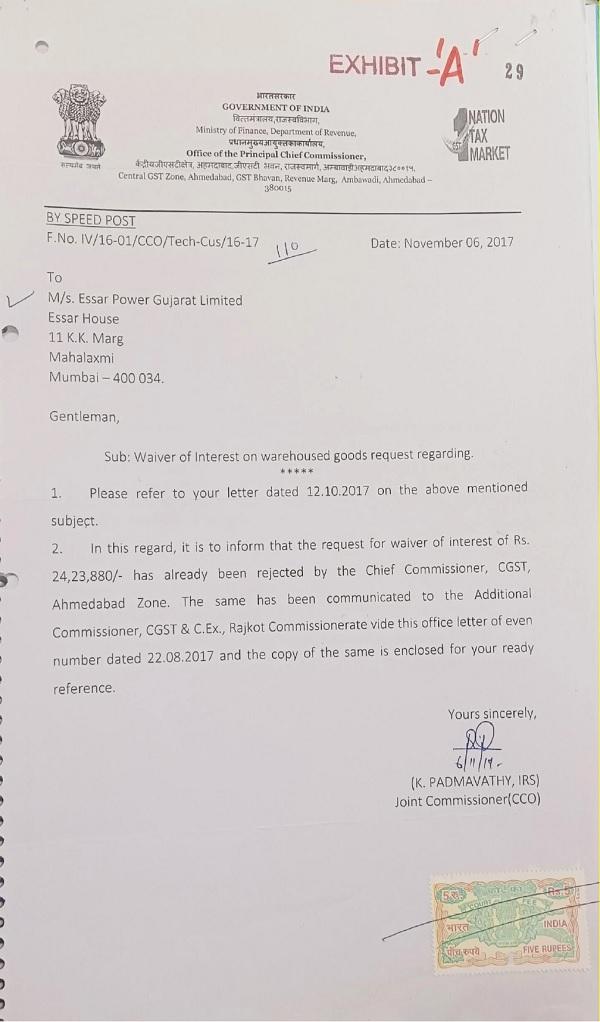
–

The letter was communicated by the Joint Commissioner to the party stating no reason whatsoever for rejection of waiver of interest of Rs. 24,23,880/-. The order is also at page 31 of the paper book on vide letter dated 22nd August, 2017 by which after rejection, the appellant party was directed to pay interest. Aggrieved by both these letter orders, the appellants are here before this Tribunal.
2. On being asked the Learned Authorised Representative has only stated that the request has been rejected by the Chief Commissioner as conveyed vide above two letters and could not give any further reasons for this.
3. This Court has considered the materials placed before it, along with CBIC Circular and finds that the order has conveyed of the Chief Commissioner, is totally unreasoned and has denied natural justice, as even the party was not heard in the matter. The discretion has been exercised in most arbitrary manner without exhibiting any reasons, It is a trite law that even the administrative orders which seek to deny party any of it is entitlement need to be reasoned so the courts can exercise a mind as so whether they were correctly arrived at or not.
4. In the instant matter, this court finds that it has been completely denied of looking into the reasons of the Chief Further this court finds that while the CBIC Circular is well-reasoned and gives out as to why certain kind of projects, which include, interalia, the power projects deserve to be considered sympathetically for waiver of interest, no such application of mind or reasoning is appearing from the order of the Chief Commissioner conveyed to the party vide the aforesaid letters. In view of the foregoing, the matter is remitted back to Chief Commissioner with direction to give reasoned order, after hearing the party as it affects their interest and also unnecessarily raises project cost of the power project.
5. Even the orders which were passed on the basis of the rejection letters of the Chief Commissioner by the lower authorities will need reconsideration but only after Chief Commissioner has passed his reasoned The order, in this regard is dated 16th November, 2017 passed by the Commissionerate of Central GST and Central Excise, Rajkot. Fresh orders will therefore need to be passed after the Chief Commissioner has reconsidered the matter and passed the reasoned order. All orders are set aside and matters are remitted back to the respective authorities.
6. Appeals are allowed by way of remand.