Ram Kishan Verma Vs Additional CIT (ITAT Jaipur)
Introduction: The Income Tax Appellate Tribunal (ITAT) recently ruled in the case of Ram Kishan Verma Vs Additional CIT (ITAT Jaipur), where the penalty order under section 271D was quashed on the grounds of being time-barred. This article provides a comprehensive analysis of the case, examining the legal provisions, timeline of events, and the tribunal’s decision.
Background of the Case: The case revolves around the imposition of a penalty under section 271D of the Income Tax Act. Section 271D deals with penalties for contravention of provisions related to loans and deposits. The crucial aspect of this case was whether the penalty order was within the statutory limitation period.
Legal Provisions and Time Limit: Section 271D stipulates that no penalty order shall be passed after the expiry of the financial year in which the proceedings are completed or six months from the end of the month in which the penalty action is initiated, whichever period expires later. The case delves into the interpretation of this provision, particularly when proceedings span across financial years.
Timeline of Events: The penalty proceedings were initiated based on information provided by the Deputy Director of Investigation-3, Jaipur, in a letter dated October 23, 2015. This letter formed the basis for the Assessing Officer’s satisfaction regarding the violation of section 269SS by the assessee. The tribunal examined whether the initiation of penalty proceedings adhered to the statutory timelines.
Relevance of Limitation: The tribunal emphasized that the crucial factor in determining the limitation period is the communication from the Investigation Wing to the Assessing Officer in October 2015. It concluded that the limitation for passing the penalty order under section 271D would expire on April 30, 2016. The penalty order, dated October 11, 2017, was deemed time-barred, bringing into question its validity.
Jurisprudence on Limitation: The ITAT referred to precedents, notably CIT vs. M.A. Presstressed Works, emphasizing the significance of completing penalty proceedings within the stipulated time frames. The case law highlighted that the relevant period is linked to the satisfaction of income tax authorities regarding the default leading to penalty proceedings.
Merits of Levy of Penalty: Beyond the limitation issue, the tribunal scrutinized the merits of the penalty order. It observed that the penalty was based on documents seized during a search and seizure operation. However, the tribunal questioned the conclusiveness of these documents in establishing a cash transaction of Rs. 15 crores, citing discrepancies and retractions by the assessee.
Retraction and Evidentiary Value: The article delves into the concept of retraction and its evidentiary value. It emphasizes that the retraction made by the assessee was not an abrupt afterthought but was consistent with the stance taken earlier in responses to notices and even before the Settlement Commission.
Conclusion: In its conclusion, the ITAT held that the penalty order under section 271D, dated October 11, 2017, was time-barred and, therefore, illegal. The tribunal stressed that subsequent search and seizure actions could not extend the limitation period already initiated based on the satisfaction communicated in October 2015. The article emphasizes the need for conclusive evidence in penalty proceedings and the relevance of statutory timelines.
FULL TEXT OF THE ORDER OF ITAT JAIPUR
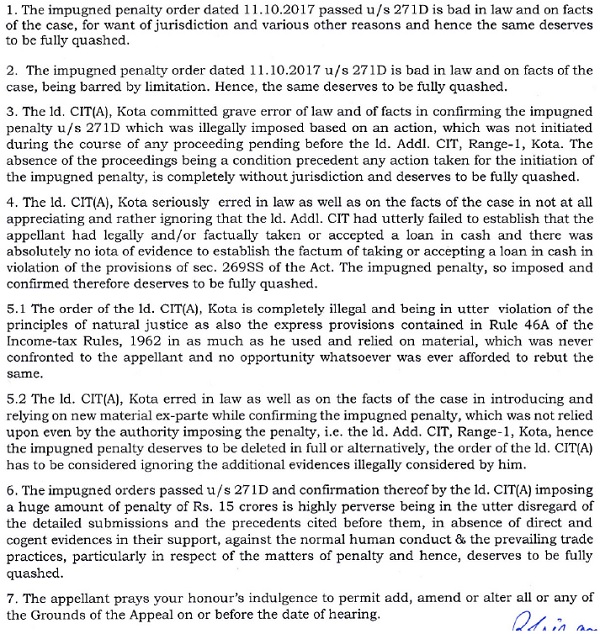
This appeal by the assessee is directed against the order dated 22nd January, 2019 of ld. CIT (A) Kota arising from the penalty order passed under section 271D of the I.T. Act for the assessment year 2015-16. The assessee has raised the following grounds :-
2. The assessee is an Individual and derives income from salary as Managing Director of a closely held company, income from house property, income from interest and other sources. There was a search and seizure action under section 132 of the IT Act on 19.12.2014 in case of one Shri D.P. Sehgal, Jaipur. During the said search and seizure proceedings, a letter signed by the assessee in respect of the loan of Rs. 15 crores from Shri D.P. Sehgal along with the 15 un-named and undated cheques of Rs. 1 crore each signed by the assessee were found. An enquiry was also conducted from the assessee during the assessment proceedings in case of Shri D.P. Sehgal wherein the assessee denied having received any alleged cash loan of Rs. 15 crores from Shri D.P. Sehgal and explained that the said letter was an advance acknowledgement along with the security in the shape of cheques for seeking loan. However, subsequently the loan was not taken from Shri D.P. Sehgal but the assessee received the loan from some financial institution. Thereafter, a search and seizure action under section 132 of the IT Act was also carried out on 07.09.2017 in case of the assessee. During the search and seizure proceedings, statement of the assessee was recorded under section 132(4) on 07.09.2017 wherein the assessee admitted the transaction of cash loan of Rs. 15 crores from Shri D.P. Sehgal. In the meantime, the AO issued a show cause notice dated 1st September, 2017 for imposing the penalty for violating the provisions of section 269SS on account of receiving cash loan of Rs. 15 crores in the month of May-June, 2014. The AO imposed the penalty of Rs. 15 crores vide order dated 11.10.2017 passed under section 271D by holding that the assessee has taken loan of Rs. 15 crores in cash in violation of provisions of section 269SS of the IT Act. The assessee challenged the action of the AO before the ld. CIT (A) but could not succeed.
3. Before us, the ld. A/R of the assessee has submitted that the incriminating material which is the basis of levy of penalty in question was found in the proceedings of search under section 132 of the IT Act carried on 19.12.2014 in case of Shri D.P. Sehgal. However, the said letter and blank cheques as well as promissory notes were given by the assessee only for taking the loan as a precondition but since the assessee in the meantime received the loan from AU Finance Ltd. on 30th July, 2014, therefore, the said request for loan from Shri DP Sehgal or through Shri DP Sehgal was not pursued further. Even in the statement recorded under section 132(4), Shri DP Sehgal has denied the fact of giving the alleged loan to the assessee but he explained that since he could not arrange the money and finally in the month of August, 2014 he expressed his inability to provide any loan. The ld. A/R has further submitted that the documents found during the search in case of Shri DP Sehgal would not prove the transaction of loan of Rs. 15 crores received by the assessee from/through Shri DP Sehgal but it was at the initial stage of request made by the assessee and, therefore, the alleged acknowledgement and security in the shape of cheques and promissory notes were given by the assessee in advance as a condition for grant of loan but there was no loan taken by the assessee as against these documents found from Shri DP Sehgal. Once the assessee has not taken any alleged cash loan from Shri DP Sehgal, the question of violating the provisions of section 269SS of the IT Act does not arise and consequently levy of penalty under section 271D is not sustainable. The ld. A/R has submitted that the impugned penalty order passed by the AO is clearly barred by limitation. There is no specific time limit mentioned for initiation of proceedings. However, the limitation is provided under section 275 for completion of the proceedings. Therefore, even if there is no limitation provided for initiation of proceedings, it is not available for indefinite period but the limitation provided for other similar actions can be taken as a reasonable time limit for the purpose of levy of penalty under section 271D of the IT Act. He has further contended that the department is bound to exercise the powers within the reasonable time as held by the Hon’ble Kerala High Court in case of K. Iswara Bhat vs. Commissioner of Agricultural Income Tax, 200 ITR 238 (Ker.). Therefore, even in the absence of a time limit prescribed by the Statute, the repository of the power should initiate the proceedings within a reasonable time within which the proceedings are to be completed. The ld. A/R has also referred the decision of Hon’ble Supreme Court in case of State of Gujarat vs. Patel Raghav Natha, AIR 1969 SC 1297 wherein the Hon’ble Supreme Court has held that the suo moto power of revision can be exercised within a reasonable time even in the absence of time limit prescribed by the statute. In the case in hand, the AO has initiated the proceedings by issuing show cause notice dated 1st September, 2017. However, since the proceedings are not inconsequence of any assessment order in the case of the assessee, then the reckoning of the limitation should be from the search proceedings in case of Shri DP Sehgal. The ld. A/R has then submitted that the initiation of penalty proceedings is not based on any action or proceedings under the Income Tax Act in case of the assessee and hence the initiation itself is illegal and bad in law. In support of his contention, he has relied upon the decision in case of Sharda Educational Trust vs. ACIT, 99 TTJ 212 (Agra). The ld. A/R has further contended that the penalty under section 271D is governed by section 275(1)(c) of the IT Act and for initiation of penalty there must be some proceedings on the basis of which action for imposition of the penalty has been initiated. Thus in the proceedings under the Act if the AO is satisfied that the assessee has violated the provisions of section 269SS, then the proceedings for levy of penalty under section 271D can be initiated by the AO and the limitation would reckon from the completion of such proceedings. Only those proceedings which are relevant for the purposes during the course of which the AO felt satisfied regarding the default for which the penalty was provided to be imposed will be relevant proceedings. Thus in case of the assessee when no proceedings were initiated by the AO during which the AO was satisfied about the violation of provisions of section 269SS, then the initiation of the proceedings are illegal. He has relied upon the decision of Hon’ble Rajasthan High Court in case of CIT vs. M.A. Presstressed Works, 220 ITR 226 (Raj.). The ld. A/R has also relied upon the following decisions :-
Noble Pictures vs. Jt. CIT
84 TTJ 718 (Coch.)
CIT vs. Hissaria Bros
291 ITR 244 (Raj.)
Kailashben Manharlal Chokshi vs. CIT
328 ITR 411 (Guj.)
Thus the ld. A/R has submitted that the impugned order passed by the AO is barred by limitation and liable to be quashed. Even on the merits, when there is no default on the part of the assessee of violating the provisions of section 269SS as the assessee has not taken any cash loan alleged by the AO, then the levy of penalty on the basis of suspicion is not justified. The ld. A/R has submitted that until and unless a default under section 269SS is found to be committed by the assessee, there cannot be a presumption of such violation. The assessee cannot be asked to prove the negative of the assessee’s alleged transaction but the onus is on the department to prove and establish beyond doubt that the assessee has taken the loan in cash in violation of section 269SS. It is settled law that what is apparent is real unless controverted. The onus lay upon the person, who alleges that what is apparent is not real. The ld. A/R referred the decision of Hon’ble Supreme Court in the case of CIT (Central) vs. Daulat Ram Rawatmull, 87 ITR 349 (SC), followed in case of CIT vs. Bedi & Co. Pvt. Ltd., 230 ITR 580 (SC). In the present case, what was apparent was that both the parties have denied to accept /paid loan. Shri DP Sehgal denied that he could not arrange fund for the assessee Shri Ram Kishan Verma. Similarly, Shri Ram Kishan Verma denied that he never received cash loan from Shri D.P. Sehgal. If, such an apparent state of affair, was alleged to be unreal, it was for the person making such allegation to prove that what is apparent is not real. Unfortunately, the lower authorities have totally failed to prove contrary. He has also referred to section 103 of Evidence Act and submitted that the burden of proof as to any particular fact lies on that person who wishes the court to believe in its existence, unless it is provided by any law that the proof of that fact shall lie on any particular person. The ld. A/R further submitted that “ In our context, since the penalty was to be levied on the fact of having taken loan, and that too in cash, the person levying penalty is required to prove that the offending act took place. The Officer simply ignored the law of the land. This is not an insignificant or a minor law but very fundamental principle of administration of justice. On this rule is based the maxim that everyone is innocent till proved otherwise. We are part of ‘presumptive system’ of jurisprudence and not ‘accusatory system’. In presumptive system, the accused is presumed to be innocent till proved otherwise. It is true that at times, the Legislature has provided for presumptions for inflicting liabilities on citizens, but such presumptions are specific and limited. Whenever the legislature deemed it desirable, it provided for presumption of mens rea or presumption of existence of a state of affairs. There cannot be, and there is no presumption in respect of offending act prescribed under section 269SS / 271D. Therefore, it was the burden of penalizing authority to prove that the said offending act was committed. He having failed to do so, and instead casting the burden on the appellant to prove his innocence, committed a grave mistake of law.” The ld. A/R submitted that the provisions of section 269SS are specific and categorical. They unmistakably and unambiguously require the concerned authority to establish that the noticee has taken or accepted a loan in cash. Taking or accepting a loan, presupposes a valid contract under the provision of India Contract Act, 1872 and the basic minimum requirement of there being a valid contract therefore, must exist, as per Sec. 2(a) of India Contract Act, 1872, when one person signifies to another his willingness to do or to abstain from doing anything, with a view to obtaining the assent of that other to such act or abstinence, he is said to make a proposal. In other words, there has got to be two contracting parties who have come together and the lender has on its own volition agreed to lend a certain amount to the borrower on certain agreed terms & conditions etc. and so on. However, in the present case the seized documents, which are based for the allegation of cash loan received by the appellant, materially lacks the vital aspects in as much as, admittedly, neither the lender Mr. DP Sehgal has signed nor anybody else for that reason, if had he/they granted the loan to the assessee. Therefore, firstly, it was not an executed contract or it was a mere proposal which is yet to be acted upon. Thus, based on the seized documents, which are seriously lacking in material legal aspect, the undated promissory notes and cross account payee cheques etc., there did not exist any legally enforceable agreement and in any case, Mr. DP Sehgal the alleged lender could not have compelled the alleged borrower assessee to pay back the loan, if any given. Interpreting the provision of Section 269SS from the angle of the assessee borrower alone is fallacious, unless there is a completed loan transaction between the two parties which is legally enforceable, section 269SS cannot be applied. He has relied upon the decision of Coordinate Bench of this Tribunal in case of DCIT vs. Rajat Agarwal, 144 TTJ 753 as well as decision of Mumbai Bench of the Tribunal in case of A. Phiroj & Co. vs. CIT, 59 ITR 645, decision of Hon’ble Delhi High Court in case of CIT vs. S.M. Agarwal, 293 ITR 43 (Del.). The ld. A/R has referred to the statement recorded under section 132(4) of Shri DP Sehgal and submitted that in answer to question no. 12, he has categorically denied giving any loan to the assessee. Thus the documents found at the time of search in case of Shri DP Sehgal were nothing but a proposal for seeking loan and even the first letter was only a draft in which certain modifications/amendments were made. Thereafter a second letter was prepared. When both these letters contain the details of the same facts, then the handing over of the cheques by the assessee is not subsequent to the loan but it is prior to the proposed loan. Even there was no certainty about from whom the loan was actually taken as in the alleged acknowledgement letter it is stated that the loan was received from or through Shri DP Sehgal. The AO while passing the penalty order under section 271D was also not sure about the fact from whom the alleged loan was taken. Thus it was only a proposal made by the assessee to his close friend who was helping him out in arranging the finance. The documents which were found in the possession of Shri DP Sehgal were required to be submitted in advance for the proposed loan but finally when no loan was taken by the assessee, these documents itself do not prove the transaction of loan. These are all undated documents, not even indicating the transaction of loan. The department has presumed that the assessee has taken loan in the month of May – June 2014 based on the statement of Shri DP Sehgal as well as statement of the assessee recorded under section 132(4) which was immediately retracted by the assessee. The presumption under section 132(4A) can be raised only against the person from whose control or possession the document was found and, therefore, it is he, who is answerable. Once Shri DP Sehgal has denied having given any loan to the assessee, then there cannot be second presumption against the assessee. In support of his contention, he has relied upon the decision of Hon’ble Jurisdictional High Court in case of CIT vs. SMS Investment Corporation Pvt. Ltd., 207 ITR 364 (Raj.). The ld. A/R then submitted that once the documents found during the search do not disclose the fact of obtaining loan from Shri DP Sehgal and further the assessee has taken a loan of Rs. 10 crores from AU Finance Ltd. on 30.07.2014, then there is no scope of any presumption for taking the alleged loan of Rs. 15 crores by the assessee. He has further contended that even when no corresponding asset was found to show the allegation of the said loan by the assessee, then the penalty levied on the basis of presumption is not sustainable. The ld. A/R has further submitted that the ld. CIT (A) has considered new material which is in violation of Rule 46A of IT Rules read with section 251(4) of the IT Act. He has pointed out that the ld. CIT (A) has considered the statement of the assessee recorded under section 132(4), however, the said statement was retracted by the assessee immediately without any delay and was not the basis of initiation as well as levy of penalty by the AO under section 271D of the IT Act. The ld. A/R has submitted that the penalty levied by the AO under section 271D and confirmed by the ld. CIT (A) is not sustainable and the same be deleted.
4. On the other hand, the ld. D/R has submitted that in the search and seizure under section 132 of the IT Act in case of Shri DP Sehgal, un-named and undated 15 blank cheques of Rs. 1 crore each signed by the assessee were found, inventorized and seized from the possession of Shri DP Sehgal. Along with the cheques, a letter signed by the assessee duly acknowledged receipt of loan of Rs. 15 crores along with another set of 15 blank demand promissory notes of Rs. 1 crore each signed by the assessee were also seized from the possession of Shri DP Sehgal. In the statement recorded under section 132(4) of the IT Act, Shri DP Sehgal has stated to have received them in the month of May-June, 2014 from the assessee as security. The ld. D/R has also referred to question no. 7 and answer thereto of the statement of Shri DP Sehgal and submitted that he has explained that these cheques, promissory notes and letter signed by the assessee were received in the month of May-June, 2014. Subsequently Shri DP Sehgal filed a settlement application before the Settlement Commission, New Delhi. The assessee in the statement recorded under section 132(4) dated 7th September, 2017 has admitted to have received the loan of Rs. 15 crores in cash from Shri DP Sehgal. However, the assessee subsequently retracted the statement by writing a letter dated 30th September, 2017 to the CBDT. The alleged retraction has no evidentiary value as it is sent to the CBDT and not to the Investigation Wing. Further, when the assessee in the statement on oath has admitted the fact of receiving the loan of Rs. 15 crores, then the subsequent retraction without explaining the cogent reason for any mistake in the statement is not acceptable. Even otherwise, the assessee has not alleged any coercion, undue pressure or threat at the time of statement recorded under section 132(4) of the Act. The said admission/confession on the part of the assessee is based on the seized material which was confronted to the assessed at the time of statement recorded under section 132(4) of the Act. The ld. D/R has also referred to the report conducted by the department during the proceedings under section 245D of the Act as well as the order of the Settlement Commission wherein the so called retraction and denial of the assessee was rejected having any evidentiary value. The ld. D/R has also relied upon the decision of Hon’ble Jurisdictional High Court in case of CIT vs. Ravi Mathur in DB IT Appeal No. 67 of 2002 dated 13th May, 2016. Thus in the proceedings before the Settlement Commission, it was established that the assessee borrowed cash loan of Rs. 15 crores from Shri DP Sehgal in lieu of which he has given the acknowledgement letter, blank cheques and demand promissory notes to Shri DP Sehgal which have been seized from the premises of Shri DP Sehgal. This fact was further corroborated by the assessee in his statement recorded under section 132(4) of the IT Act on 07.09.2017 and again on 23.10.2017. The subsequent retraction by the assessee is a make belief document which is nothing but after-thought to escape taxation.
4.1. As regards the limitation of penalty proceedings under section 271D of the Act, the order passed by the AO is within 6 months from the reference made to Additional CIT-1, Kota by the AO. Therefore, it is not barred by limitation. The ld. D/R has referred to the reference made by the ACIT Circle-1, Kota dated 09.08.2017 to Additional CIT-I Kota for levy of penalty under section 271D of the IT Act. The impugned order was passed on 11.10.2017, therefore, the same is within the period of limitation as per provisions of section 275(1)(c) of the IT Act. The ld. D/R has further contended that when the assessee filed a retraction petition after the search operation, then the contents/facts narrated in the sworn in statement made on oath under section 132(4) or under section 131 of the Act cannot be brushed aside or ignored. If he is so aggrieved, then he has to come with fresh evidence so that his claim can be factually sustainable. Mere making allegation will not be accepted. In support of his contention, he has relied upon the decision of Hon’ble Supreme Court in case of Pullangode Rubber Products Co. Ltd. vs. State of Kerala, 91 ITR 18 (SC) and submitted that an admission is an extremely important piece of evidence. He has also relied upon the decision of Hon’ble Jurisdictional High Court in case of M/s. Bannalal Jat Constructions Pvt. Ltd. in DB IT Appeal No. 140/2018 and submitted that the Hon’ble High Court has held that the statement recorded under section 132(4) as well as under section 131 of the IT Act cannot be discarded summarily in cryptic manner and the retraction is required to be made as soon as possible or immediately after the statement of the assessee was recorded. In view of documentary facts gathered and legal position as laid down in various decisions, it is clear that the assessee has committed the default of taking cash loan in violation of section 269SS and consequently liable for penalty under section 271D of the IT Act. He has relied upon the orders of the authorities below.
5. We have considered the rival submissions as well as the relevant material on record. Since the assessee has raised a legal issue regarding validity of the order passed under section 271D as barred by limitation, therefore, we first take up the issue of limitation. The Additional CIT has initiated the penalty proceedings under section 271D by issuing the show cause notice dated 1st September, 2017 as under :-

The said show cause notice was issued by the Additional CIT on the basis of the letter dated 09.08.2017 of the Assistant Commissioner of Income-tax, Circle-1, Kota being the reference for levy of penalty. For ready reference, we reproduce the reference letter of the Asstt. CIT for levy of penalty as under :-

This reference was made on the basis of the documents seized from the possession of Shri DP Sehgal during the course of search and seizure action under section 132(1) on 19.12.2014. The AO has also made a reference in the said letter of summons issued under section 131 on 01.04.2015 by the DDIT Investigation, Jaipur. The DDIT Jaipur vide letter dated 23.10.2015 informed the ACIT/AO about the contravention of provisions of section 269SS of the IT Act by the assessee and appropriate action under the provisions of the Act has to be initiated. Thus the initiation of penalty proceedings by issuing the show cause notice dated 01.09.2017 is based on the information received by the AO of the assessee from the DDIT Investigation Jaipur vide letter dated 23rd October, 2015. Section 275 provides the limitation for imposition of penalty under Chapter-XXI of the IT Act. Since in the case in hand, the penalty under section 271D is not imposed pursuant to any assessment order, therefore, clause (c) of section 275(1) is relevant for the purpose of limitation for passing the order under section 271D of the IT Act. For ready reference, we reproduce the provisions of section 275(1) as under :-
“275. (1) No order imposing a penalty under this Chapter shall be passed—
(a) in a case where the relevant assessment or other order is the subject-matter of an appeal to the Commissioner (Appeals) under section 246 or section 246A or an appeal to the Appellate Tribunal under section 253, after the expiry of the financial year in which the proceedings, in the course of which action for the imposition of penalty has been initiated, are completed, or six months from the end of the month in which the order of the Commissioner (Appeals) or, as the case may be, the Appellate Tribunal is received by the Principal Chief Commissioner or Chief Commissioner or Principal Commissioner or Commissioner, whichever period expires later :
Provided that in a case where the relevant assessment or other order is the subject-matter of an appeal to the Commissioner (Appeals) under section 246 or section 246A, and the Commissioner (Appeals) passes the order on or after the 1st day of June, 2003 disposing of such appeal, an order imposing penalty shall be passed before the expiry of the financial year in which the proceedings, in the course of which action for imposition of penalty has been initiated, are completed, or within one year from the end of the financial year in which the order of the Commissioner (Appeals) is received by the Principal Chief Commissioner or Chief Commissioner or Principal Commissioner or Commissioner, whichever is later;
(a) in a case where the relevant assessment or other order is the subject-matter of revision under section 263 or section 264, after the expiry of six months from the end of the month in which such order of revision is passed;
(b) in any other case, after the expiry of the financial year in which the proceedings, in the course of which action for the imposition of penalty has been initiated, are completed, or six months from the end of the month in which action for imposition of penalty is initiated, whichever period expires later.”
Thus no order imposing a penalty shall be passed after expiry of financial year in which the proceedings in the course of which action for imposition of penalty has been initiated are completed or 6 months from the end of the month in which the action for imposition of penalty is initiated whichever period expires later. The plain reading of this clause reveals that in case the proceedings in the course of which action for imposition of penalty has been initiated in the financial year, then the order for penalty shall not be passed after the expiry of the said financial year. However, there may be instances when such proceedings are completed at the fag end of the financial year to say in the month of March itself, then it is practically not possible to pass a penalty order before 31st March of the same financial year. Therefore, the second limb of this clause is relevant which gives 6 months from the end of the month in which action of imposition of penalty is initiated. In the case in hand, the action for imposition of the penalty was initiated vide letter dated 23rd October, 2015 whereby the DDIT Investigation-3, Jaipur sent information along with the document to the AO for his perusal and necessary action. These are the proceedings from which the AO has satisfied himself about the default on the part of the assessee of violation of the provisions of section 269SS of the Act by taking the alleged loan of Rs. 15 crores in cash. Though there was subsequent search and seizure action in the case of the assessee on 07.09.2017, however, those proceedings were subsequent to the satisfaction of the AO as well as initiation of the penalty proceedings by issuing show cause notice dated 01.09.2017. Therefore, for the purpose of limitation under section 275(1) what is relevant is the communication from the DDIT Investigation-3, Jaipur to the ACIT Circle-1, Kota vide letter dated 23rd October, 2015. Therefore, the limitation would reckon from the end of the month of October, 2015 and shall expire on the expiry of 6 months from the end of the month of October, 2015. In other words, the limitation for passing the penalty order under section 271D shall expire on 30th April, 2016. The Agra Bench of the Tribunal in case of Sharda Educational Trust vs. ACIT (supra) has considered this issue of limitation for passing the order under section 271D in para 13(1) as under :-
“ 13. After having considered the rival submissions, facts and circumstances of the case, provisions of s. 275(1)(c) of the Act and aforesaid various decisions and the Circular No. 387 relied upon by the counsel for the assessee and the fact that the learned Departmental l Representative has not brought any decision contrary to various decisions relied upon by the counsel for the assessee, to our notice at the time of hearing, we are of the opinion that the assessee is to succeed on all counts such as ;
(i) In the present case, it is an admitted fact that neither the assessee had furnished any return for the asst. yr. 1996-97, nor any assessment was made nor any proceedings under the IT Act relating to the assessee was pending before the IT authorities on 12th June, 2003, or later on, till the date of levy o f penalty under s. 271D, i.e., on 12th June, 2003, when the proceedings were initiated or on 11th Dec., 2003, when the penalty order was passed and therefore, the penalty proceedings having not been initiated during the course of any proceedings, the same were illegal and bad in law.
It is also an admitted fact that the penalty proceedings in question were initiated after a lapse of a period of more than seven years. Consequently, we are unable to uphold the levy of penalty. Our conclusion is supported by the decision of Tribunal, Cochin Bench, in the case of Noble Pictures (supra), wherein it has been held that the penalty proceedings under s. 272A having been initiated after a period of more than 6 years were barred by limitation, and also by the decision of Delhi High Court in the case of CIT vs. Rajinder Kumar Somani (supra), which had been followed by the Tribunal in the case of Noble Pictures (supra). ”
In the case in hand, the AO has not satisfied himself during the assessment proceedings or any other proceedings under the IT Act but this satisfaction of the AO as revealed from the reference letter is based on the information and document received from the Investigation Wing, Jaipur. Therefore, even if the said correspondence is considered as part of the proceedings of investigation carried out by the Jaipur Investigation Wing in case of Shri DP Sehgal, the limitation will reckon when the said investigation proceedings were completed and thereafter the information was sent by the Investigation Wing to the AO of the assessee. The Hon’ble Jurisdictional High Court in case of CIT vs. M.A. Presstressed Works, 220 ITR 226 (Raj.) has considered the aspect of initiation of penalty proceedings as under :-
“ We have considered the submissions made by learned counsel for the Revenue.
Section 274 of the Income-tax Act provides the procedure for imposing the penalty while section 275 sets out the time-limit within which the penalty proceedings must be completed. Section 275 requires to complete the penalty proceedings within two years from the end of the financial year in which the proceedings in the course of which the action for imposition of penalty has been initiated, are completed. But where the assessment order or any other order is the subject-matter of appeal before the Deputy Commissioner (Appeals) or the Commissioner of Income-tax (Appeals) or to the Income-tax Appellate Tribunal, the period for completing the penalty proceedings will be either a two year period from the end of the financial year in which the proceedings, in the course of which the action for imposition of the penalty was taken, are completed, or a period of six months from the end of the month in which the order of the appellate authority is received by the Commissioner, whichever period expires later. Section 275, which applies to the case of the assessee, reads as under:
“275. Bar of limitation for imposing penalties. — (1) No order imposing a penalty under this Chapter shall be passed—
(a)in a case where the relevant assessment or other order is the subject-matter of an appeal to the Deputy Commissioner (Appeals) or the Commissioner (Appeals) under section 246 or an appeal to the Appellate Tribunal under sub-section (2) of section 253, after the expiration of the period of—
(i)two years from the end of the financial year in which the proceedings, in the course of which the action for imposition of penalty has been initiated, are completed, or
(ii)six months from the end of the month in which the order of the Deputy Commissioner (Appeals) or the Commissioner (Appeals) or, as the case may be, the Appellate Tribunal is received by the Chief Commissioner or Commissioner,
whichever period expires later;
(b) in any other case, after the expiration of two years from the end of the financial year in which the proceedings, in the course of which action for imposition of penalty has been initiated, are completed.”
Section 275 divides the cases into two categories : the first category of cases is where the assessment order or the order to which proceedings for imposition of penalty relate, was the subject-matter of appeal under section 246 or an appeal under section 253. The limitation for the cases falling under this category, is two years from the end of the financial year in which the proceedings, in the course of which the action for imposition of penalty has been initiated, were completed ; or six months from the end of the month in which the order of the appellate authority was received by the Commissioner, whichever period expires later. The second category covers all other cases not falling within category No. 1 and the limitation provided for these cases is within two years from the end of the financial year in which the proceedings, in the course of which action for imposition of penalty has been initiated, are completed. The words “in which the proceedings, in the course of which action for imposition of penalty has been initiated, are completed” used in section 275 indicate the proceedings in which the income-tax authority is satisfied about the default which attracts the penalty and not with respect to any other proceeding in which the order like the cancellation of the registration, etc., has been passed. It is the assessment order or any other order passed in the proceeding in the course of which it is found that the assessee has brought himself within the mischief of the penalty proceedings.
In the present case, the order, in which the proceedings for imposition of penalty were initiated, was passed on July 30, 1983, which was subjected to appeal and the appeal was dismissed on February 24, 1984.”
The Hon’ble High Court has observed that the words “ in which the proceedings in course of which the action for imposition of penalty has been initiated, are completed” used in section 275 indicate the proceedings in which the Income Tax Authorities satisfied about the default which attracts the penalty and not with respect to any other proceedings in which the order, like cancellation of registration has been passed. In the case in hand, the taxing authority has exhibited his satisfaction about the default of section 269SS in the investigation proceedings carried out by the Investigation Wing in case of Shri DP Sehgal and finally the said satisfaction was communicated to the AO of the assessee vide letter dated 23rd October, 2015. Hence what is relevant is the said letter dated 23rd October, 2015 whereby it was communicated to the AO and based on the said information and material, the AO further made a reference to the Additional CIT for levy of penalty. Thus the limitation for passing the order for levy of penalty under section 271D would reckon from the end of the October, 2015 and shall expire on 30th April, 2016 being the period of 6 months from the end of the said month of October, 2015. The penalty order passed under section 271D in the case of assessee is dated 11.10.2017 which is barred by limitation and, therefore, the same is liable to be quashed. We make it clear that the subsequent search and seizure action under section 132 of the IT Act conducted in the case of assessee on 7th September, 2017 would not extend the period of limitation when the penalty proceedings were already initiated by issuing show cause notice dated 01.09.2017 which is based on the satisfaction vide letter dated 23rd October, 2015. It is not understandable as to why the AO has not initiated the proceedings under section 271D after receiving the said information and documents vide letter dated 23rd October, 2015 till he has made the reference on 09.08.2017. Accordingly, we hold that the impugned penalty order passed under section 271D dated 11.10.2017 is illegal being barred by limitation.
On the merits of levy of penalty :
6. On careful perusal of the penalty order passed under section 271D of the IT Act, we find that the said order is based on the documents found and seized from the possession of Shri DP Sehgal during the search and seizure operation under section 132 of the IT Act carried on 19th December, 2014. The Additional CIT has made the reference of the acknowledgement letter signed by the assessee along with 15 undated blank cheques of Rs. 1 crore each as well as 15 blank promissory notes signed by the assessee. Though there is a subsequent search in the case of the assessee on 7th September, 2017 wherein statement of the assessee under section 132(4) of the Act was recorded to get the confirmation of the transaction of loan of Rs. 15 crores, however, the said admission/confession on the part of the assessee was retracted by the assessee vide letter dated 30th September, 2017. We will deal with the facts of retraction made by the assessee at later stage. First, we will analyze whether the documents found and seized during the course of search and seizure in the case of Shri DP Sehgal on 17th December, 2014 would establish the transaction of loan of Rs. 15 crores in cash. It is pertinent to note that during the course of search and seizure action in case of Shri DP Sehgal two letters signed by the assessee were found along with the 15 undated blank cheques and 15 promissory notes. For ready reference, both the undated letters are reproduced as under :-