Morgan Stanley Mauritius Co Ltd Vs DCIT (ITAT Mumbai)
The reasoning given by the DRP is ex facie incorrect inasmuch as the SCB-India, being a permanent establishment of a company fiscally domiciled in the United Kingdom, and is not a taxable unit in India, and the taxability is in the name of its general enterprise- i.e UK based company, though only in respect of its profits attributable to the permanent establishment. The unit of taxability is not SCB- India, i.e. PE of the UK-based foreign company, but the foreign company itself, and the place of management of the UK-based company is obviously United Kingdom. As observed by Hon’ble Supreme Court, in the case of CIT Vs Hyundai Heavy Industries Ltd [(2007) 291 ITR 482 (SC)], “it is clear that under the Act, a taxable unit is a foreign company and not its branch or PE in India”. Clearly, therefore, the observations of the DRP so far as the basis of taxability, i.e. “assessed to tax on account of place of management” is incorrect.

FULL TEXT OF THE ORDER OF ITAT MUMBAI
1. By way of this appeal, the assessee appellant has challenged the correctness of the order dated 7th October 2019, passed by the Assessing Officer in the matter of assessment under section 143(3) r.w.s. 144C(13) of the Income Tax Act, 1961, for the assessment year 2015-16.
2. The short issue that we are required to adjudicate in this appeal is whether or not the Assessing Officer was justified in holding that the receipts of Rs 9,74,66,600, from India based depository, i.e., Standard Chartered Bank- India, in respect of shares of Standard Chartered Bank plc- UK represented by the India Depository Receipts (IDRs), were chargeable to tax in India in the hands of the assessee. The way the assessee puts it, by way of a ground of appeal is that “On the facts and circumstances of the case, the learned AO, based on the directions of Hon’ble DRP erred in making an addition of Rs 9,74, 66,600, being the dividend income received by the Appellant in respect of shares represented by IDRs of SC Plc, as chargeable to tax in India. In this regard, the learned AO, based on the directions of Hon’ble DRP, erred on the following grounds”. The assessee has raised several sub grounds of appeal, but, in substance, these sub grounds of appeal are arguments in support of the aforesaid ground of appeal.
3. The issue in appeal lies in a narrow compass of material facts. The assessee before us is a company incorporated in, and fiscally domiciled in, Mauritius. The assessee is thus a tax resident of Mauritius and holds a valid Tax Residency Certificate issued by the Mauritius Revenue Authorities. The assessee is an investor in the Indian Depository Receipts (IDR, in short) by “Standard Chartered Bank- India Branch” (SCB-India, in short), with the underlying asset in the form of shares in a UK based company by the name of Standard Chartered Bank plc (SCB-UK, in short) held by the depository’s custodian, i.e., Bank of New York Mellon, USA (BNY-US, in short). SCB-UK is a company listed in London Stock Exchange, and the IDRs so issued, i.e., in respect of the shares of SCB-UK, are listed in India. There is no dispute that the Indian Depository Receipts are issued in terms of Companies (Issue of Indian Depository Receipts) Rule, 2004, and that listing of IDRs are listed in India in terms of SEBI (Issue of Capital and Disclosure Requirements) Regulations 2009. During the relevant financial period, the assessee had received Rs 9,74,66,595, from SCB-India, in respect of dividends for the underlying shares relatable to the IDRs in which the assessee had invested. When the assessee was put to notice, as to why the receipt in question not be taxed as a dividend income in the hands of the assessee, elaborate submissions were made in support of the contention that this receipt is not taxable in India inasmuch as the dividends are in respect of a foreign company, namely SCB-UK, the dividends are received abroad by BNY-US, and, as such, these dividends neither accrue or arise in India nor are received or deemed to be received in India. It was submitted that “SCBIndia was a bare trustee (i.e., akin to a nominee) under the English law for the IDR holders”. It was then pointed out that the dividend was first received outside India, and, accordingly, “such dividend cannot be regarded as received/ deemed to be received in India”. It was contended that “subsequent remittance of the dividend to the IDR holders in and Indian bank account will not trigger receipt based taxation as per the provisions of the Act”. Without prejudice to this contention about non-taxability of this receipt under the Income Tax Act, 1961, it was further contended that, in terms of the India Mauritius Double Taxation Avoidance Agreement [(1984) 146 ITR (St) 214; Indo-Mauritius tax treaty, in short), as these payments did not meet the requirements of the definition of dividends under article 10, such receipts can only be subjected to tax under article 22 which is in the domain of exclusive taxation in the residence jurisdiction, i.e., Mauritius. None of these submissions, however, impressed the Assessing Officer. With a very detailed analysis of the factual position with respect to the Indian Depository Receipts and legal framework thereof, and with a very detailed analysis of the legal framework regarding taxability thereof, the Assessing Officer concluded that so far as the IDR holders are concerned, the first point of receipt of dividend is when it is deposited in the bank accounts of the IDR holders in India, and, therefore, it cannot be said that the income in question is received outside India. He noted the claim of the assessee that the money dividend was received outside India as it was deposited in the bank account of SCB-India in SCB-UK, as maintained abroad, and then distributed by the SCBIndia upon conversion, but rejected the same on the ground, inter alia, that the money continued to be in the possession of the person who was to pay the same, i.e. SCB-UK, and that, in reality as also in substance, the payment was made in India in the Indian bank accounts of the IDR holders, including, of course, the assessee. References were also made to the contents of Red Herring Prospectus (RHP) of the IDR issue to highlight the fact that even according to the RHP, ‘dividends paid to the non-resident IDR holders shall be taxable in India, if it is received in India or is deemed to be received in India, that the exemption from dividend taxation in India is not available under section 10(34) as no dividend distribution tax is paid in India and as IDRs are not subjected to securities transaction tax, corresponding exemption from long term capital gains under section 10(38), as also concessional tax rate under section 111A, is not available. The Assessing Officer thus proceeded to propose tax these dividends under section 115(1)(a) @ 20% plus applicable surcharge and cess. Aggrieved, the assessee raised objections before the Dispute Resolution Panel but without any success. While learned DRP confirmed the action of the Assessing Officer, so far as the treaty protection claimed by the assessee was concerned, it declined to grant the same on the ground that “it is noted that the company making the distribution of dividend income is a resident of India, for the purpose of the definition of dividend under article 10 of India Mauritius DTAA. In the light of the above facts, the receipt of the dividend from IDR is liable to be taxed under the Income Tax Act as also under the DTAA. The objection in this regard is thus rejected”. The Assessing Officer thus proceeded with the proposed draft assessment order, and brought the IDR dividends to tax in the hands of the assessee. The assessee is aggrieved and is in appeal before us
4. We have heard Dr. Sunil Lala, learned counsel for the assessee, and Shri Sanjay Singh, learned Commissioner (DR), at length, we have perused the material on record, and we have duly considered facts of the case in the light of the applicable legal position.
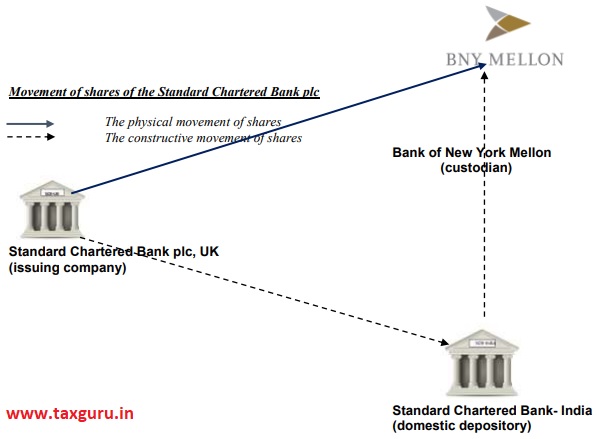
5. It would perhaps be appropriate that we have a basic understanding, so far as relevant to, and necessary for, us, as to what ‘Indian Depository Receipts’ actually mean and stand for. It is a derivative financial instrument, i.e., a financial instrument that draws its value from the underlying asset and is tradable on one or more approved stock exchanges in India. While this financial instrument, tradable in one or more of the Indian stock exchanges, is issued by an Indian Depository, it derives its value from the underlying asset in the form of equity shares of a foreign company. The benefits accruing from the shares in question are, subject to terms on which depository issues the IDRs, are passed on to the IDR holders, and, in that sense, the IDR holders are beneficiaries of the underlying shares in the foreign company. While IDRs may be convertible, subject to certain conditions and requirements about the holding period of IDRs, into underlying equity shares of the foreign company, the IDRs are not necessarily convertible in the equity shares in question. In effect, thus, the IDRs provide a mechanism in which an investor in the Indian market can have the benefits flowing from the shareholding in participating foreign companies. Coming to more specifics about the IDRs, we may add that ‘Indian Depository Receipt’ is defined, under rule 3(i)(d) of the Companies (Issuance of Indian Depository Receipts) Rule 2004, as “means any instrument in the form of a depository receipt created by Domestic Depository in India against the underlying equity shares of issuing company”. Rule 3(i)(e) restricts the natural meaning of the expression ‘issuing company’ but defining it as “means a company incorporated outside India, making an issue of IDRs through a domestic depository”. As for the connotations of expression ‘domestic depository’, rule 3(i)(c) explains it as “means custodian of securities registered with the Securities and Exchange Board of India, hereinafter referred to as SEBI and authorised by the issuing company to issue Indian Depository Receipt”. Under rule 5, no foreign company can raise the funds through the IDRs except with the prior approval of the SEBI. Rule 6 inter alia provides that the repatriation of the funds so raised by the foreign company, through the issuance of IDRs, will be subject to applicable foreign exchange laws in India, that IDRs will be denominated only in Indian Rupees, and that the IDRs can be converted, if at all, only after a certain limit. Rule 9 provides that these IDRs shall be listed on the recognized Stock Exchange(s) in India as specified in clause (iii) of rule 5 and such IDRs may be purchased, possessed and freely transferred by a person resident in India as defined in section 2(v) of Foreign Exchange Management Act, 1999, subject to the provisions of the said Act. What essentially follows is that an Indian Depository Receipt (IDR) is an instrument issued by a custodian of underlying shares of a foreign company, registered with the SEBI, and authorised by the foreign company in this respect. This instrument is required to be denominated in INRs, listed on one or more recognized stock exchanges, the funds so raised through the IDRs can be remitted to the foreign company, as may be permissible under the foreign exchange law from time to time, and that such IDRs are freely transferable by residents as well. In effect thus, the IDRs are means of tapping the Indian investor market by the foreign companies. However, it is not the same thing as subscribing to the share capital of a foreign company, and the IDR holders are not shareholders in the foreign company. While technically the foreign company issues the equity shares to the domestic depository on the strength of which the domestic depository issues the IDRs, these shares never come to the possession of the domestic depository. There is a custodian involved, Bank of New York Mellon in this case, which actually holds custody of these shares- though technically on behalf of the domestic depository, which itself is a trustee of the issuing company. The physical movement of shares is thus between the issuing company, i.e., Standard Chartered Bank plc, the custodian, Bank of New York Mellon, while the constructive movement is from the Standard Chartered Bank plc (i.e., issuing company) to the Standard Chartered BankIndia (domestic depository) to the Bank of New York Mellon (the custodian). In terms of a diagram, this movement could be explained as follows:
6. On the strength of the equity shares of SCB-UK so held through the custodian, with the authorization of the SCB-UK and with the approval of the SEBI, after listing of the IDRs on the Indian Stock Exchanges, the SCB-India issues the IDRs in question and raises the funds in the Indian capital markets. The funds so raised presumably get repatriated to the SCB-UK as well, but that’s not material anyway. What is material is the dividend distribution by the domestic depository to the IDR holders, and that is what has led to this litigation before us. The SCB-India receives dividends from SCB-UK in respect of the shares held by SCB-India, and under the applicable arrangements “if the domestic depository receives any cash dividends or any other cash distribution in respect of the deposited shares (including any amounts received in the liquidation of the foreign company) or otherwise in connection with the deposited property”, the amounts are to be converted into Indian Rupees and paid in Indian Rupees by cheque, pay orders and demand drafts and payable at par at the place where the IDR holders reside”. While making these payments, “the domestic depository may deduct and retain from all monies dues Once again, let us look at the transaction of investing in IDRs and receiving monies, on account of dividends by the SCB-UK, by way of a diagram as below: