Shruti Garg Vs Signature Builders Pvt. Ltd. (National Anti-Profiteering Authority)
The Respondent has also contended that the DGAP has calculated the profiteered amount as Rs. 1,40,41,916/- whereas he has passed on an amount of Rs. 1,29,29,849/- to the 998 home and 91 commercial shop buyers as benefit of ITC. He has also submitted letters addressed to the above Applicants claiming that he is “giving benefit under ITC u/s 171 of the applicable GST laW’ along with ledger accounts of the buyers in support of his claim. However, perusal of the ledger accounts of the buyers shows that there is no evidence to suggest that he has passed on the benefit of Rs. 1,29,29,849/- to the 998 home and 91 commercial shop buyers on account of ITC as there is no such entry in the ledger accounts of these buyers. A typical entry of Rs. 13,115/- made in the ledger account on 31.05.2018 of one MIs Ritika Chhabra, who has been allotted unit No. A-203 in the above project by the Respondent, reads as “Receipt Ref. CRS1/02174/18-19 (12,143.00+ Tax 972.00)” which shows that no where it has been mentioned that this amount has been transferred on account of ITC benefit. Perusal of the copies of the ledger accounts of the other house buyers to whom the Respondent has claimed to have passed on the benefit of ITC also shows that the same entry has been made in all such cases on 31.05.2018. By no stretch of imagination this entry can be construed to have been made on account of passing on of the benefit of ITC, therefore, the above amount cannot be taken to have been passed on account of the ITC benefit. Moreover, the DGAP in his Report dated 14.06.2019 has not verified the above claim of the Respondent. The Applicant No. 3 has specifically stated in his submissions that the Respondent has not passed on the ITC benefit to him. Hence, the above contention of the Respondent that he has passed on the full benefit of ITC is not correct and therefore, the same cannot be accepted.
Vide his submissions dated 09.12.2019 the Respondent has also supplied the details of the credit notes through which he has claimed to have passed on the benefit of ITC. However, the above credit notes have neither been verified by the DGAP nor any reliable and irrefutable evidence has been produced by the Respondent to establish the genuineness of these credit notes. Hence, the above credit notes cannot be relied upon on his mere assertion.
The Respondent has also claimed that 132 residential flats and 20 commercial shops were booked after coming in to force of the GST in respect of which the buyers were not entitled to get benefit of ITC. However, he has not submitted the details of the above buyers during his submissions. Hence, the above contention of the Respondent is untenable due to lack of evidence.
Therefore taking into account the 1.65% net benefit of additional ITC this Authority is in agreement with the DGAP’s calculation, as has been mentioned in Annexure-14 of his Report that the profiteered amount is Rs. 1,40,41,916/-. Thus, this Authority determines the profiteered amount as Rs. 1,40,41,916/- which includes GST @12% for the period w.e.f. 01.07.2017 to 31.12.2018.
It is established from the perusal of the above facts of the case that the provisions of Section 171 of the CGST Act, 2017 have been contravened by the Respondents as he has profiteered an amount of 1,40,41,916/- which includes both the profiteered amount @1.65% of the base price and GST on the said profiteered amount from the above Applicants and the other recipients as well who are not Applicants in the present proceedings. Accordingly, the above amounts shall be paid to the Applicant No.1 to 4 and the other eligible house buyers by the Respondents along with interest @18% PA from the date from which these amounts were realised from them till they are paid as per the provisions of Rule 133 (3) (b) of the CGST Rules, 2017, failing which they shall be recovered by the concerned Commissioner CGST / SGST and paid to the eligible house buyers.
From the above discussion it is clear that the Respondent has profiteered by an amount of Rs. 1,40,41,916/- during the period of investigation. Therefore, this Authority under Rule 133 (3) (a) of the CGST Rules, 2017 orders that the Respondent shall reduce/refund the price to be realized from the buyers commensurate with the benefit of ITC received by him as has been detailed above. The present investigation is only up to 31.12.2018 therefore, any additional benefit of ITC which shall accrue subsequently shall also be passed on to the buyers by the Respondent. In case this additional benefit is not passed on to the Applicant No. 1 to 4 or any other buyer they shall be at liberty to approach the State Screening Committee Haryana for initiating fresh proceedings under Section 171 of the above Act against the Respondents. The concerned CGST or SGST Commissioner shall take necessary action to ensure that the benefit of additional ITC is passed on to the eligible house buyers in future.
It is evident from the above that the Respondent has denied the benefit of ITC to the buyers of the flats/shops being constructed by him and has profiteered in contravention of the provisions of Section 171(1) of the CGST Act, 2017. Therefore he is liable for imposition of penalty under Section 171(3A) of the CGST Act, 2017. Therefore, Show Cause Notice be issued to him directing him to explain as to why the penalty prescribed under Section 171 (3A) of the above Act read with Rule 133 (3) (d) of the CGST Rules, 2017 should not be imposed on him. Accordingly, the notice dated 18.06.2019 vide which it was proposed to impose penalty under Section 29, 122-127 of the above Act read with Rule 21 and 133 of the CGST Rules, 2017 is withdrawn to that extent.
Further the Authority as per Rule 136 of the CGST Rules 2017 directs the Commissioners of CGST/SGST Haryana to monitor this order under the supervision of the DGAP by ensuring that the amount profiteered by the Respondent as ordered by the Authority is passed on to all the buyers. A report in compliance of this order shall be submitted to this Authority by the DGAP within a period of 4 months from the date of receipt of this order.
FULL TEXT OF ORDER OF NATIONAL ANTI-PROFITEERING AUTHORITY
1. The present Report dated 14.06.2019 has been furnished by the Applicant No. 5 i.e. the Director General of Anti-Profiteering (DGAP), under Rule 129 (6) of the Central Goods & Services Tax (CGST) Rules, 2017. The brief facts of the present case are that the DGAP had received a reference from the Standing committee on Anti-Profiteering on 07.01.2019 to conduct a detailed investigation in respect of four complaints as has been shown in Table ‘A’ below, under Rule 128 of the CGST Rules, 2017, alleging profiteering in respect of construction services supplied by the Respondent:‑
Table ‘A’
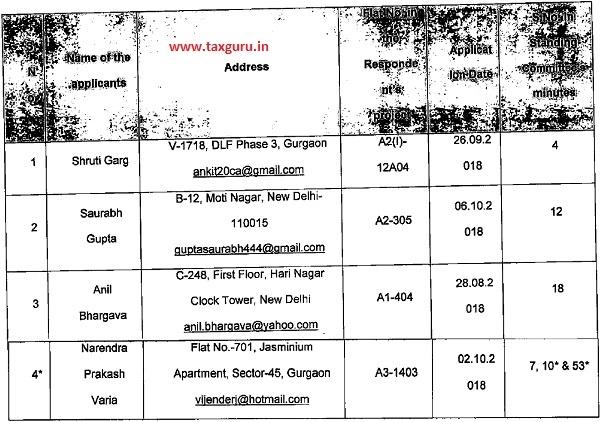
* Name of the Applicant was wrongly mentioned as Sh. Vijender Jain at S. No. 10 & 53, as the applications filed by Shri Narendra Prakash Varia were received by the Standing Committee on Anti-profiteering from the e-mail account of Sh. Vijender Jain ([email protected]).
2. The above Applicants submitted that they had purchased flats ( as shown in Table ‘A’) in the Respondent’s project “Solera Affordable Group Housing” situated in Sec-107, Gurugram, Haryana and alleged that the Respondent had not passed on the benefit of input tax credit (ITC) to them by way of commensurate reduction in prices.
3. The Haryana State Screening Committee on Anti-profiteering had originally examined the application mentioned at S. No. 4 in Table-A above, in its meeting held on 30.10.2018 and observed that there was lesser burden of tax in the GST regime due to availability of ITC, which the Respondent should have passed on to his customers, in terms of Section 171 of the Central Goods and Services Tax Act, 2017. The Haryana State Screening Committee had forwarded the said application with its recommendation to the Standing Committee on Anti-profiteering on 31.10.2018 for further action, in terms of Rule 128 of the Rules.
4. On receipt of the reference and supporting documents from the Standing Committee on Anti-profiteering on 07.01.2019, a Notice under Rule 129 of the Rules was issued by the DGAP on 15.01.2019 calling upon the Respondent to reply as to whether he admitted that the benefit of input tax credit had not been passed on to the Applicants by way of commensurate reduction in prices and if so, to suo-moto determine the quantum thereof and indicate the same in his reply to the notice as well as furnish all the supporting documents. As per the said notice dated 15.01.2019, the Respondent was afforded opportunity to inspect the non-confidential evidences/ information submitted by the above Applicants during the period from 21.01.2019 to 23.01.2019. However, the Respondent did not avail of the said opportunity. The Applicants were also given opportunity to inspect the non-confidential documents/reply furnished by the Respondent on 03.06.2019 or 04.06.2019. However, only one Applicant mentioned at Sr. No. 04 of the Table- ‘A’ above availed of the said opportunity on 03.06.2019 and inspected the non-confidential documents submitted by the Respondent.
5. The period covered by the current investigation is from 01.07.2017 to 12.2018. The time limit to complete the investigation was extended upto 06.07.2019 in terms of Rule 129(6) of Rule by this Authority vide its order dated 19.03.2019. The service of construction was rendered in the state of Haryana.
6. The Respondent submitted his reply vide letters/e-mails dated 02.2019, 21.02.2019, 18.03.2019, 01.05.2019 and 14.05.2019. The submissions of the Respondent are summed up as follows:-
(a) The Respondent was a housing project construction company and was developing the project “Solera Affordable Group Housing” project in Sector-107, Gurugram and the “Orchard Avenue-93” project under the Affordable Housing Scheme, i.e., the Pradhan Mantri Awas Yojna.
(b) The Respondent submitted that he was not directly engaged in any construction activity and all the work related to the project was assigned to various sub-contractors, who procured all the required raw materials on their own except steel, cement and RMC which were supplied by the Respondent on free of charge However, the project was executed under the supervision of the staff employed by the Respondent.
(c) The Respondent informed that in the pre-GST regime, “under-construction properties” were covered by the definition of works contract and attracted Haryana VAT @ 4.5% approximately with full input tax credit of VAT paid on goods involved in the execution of works contracts. Affordable housing was, however, exempted from Service Tax, vide Notification No. 9/2016-ST dated 01.03.2016. In the GST regime, construction of low cost houses upto a carpet area of 60 square meters per house in a housing project approved by any State Government, was taxable @ 12% (effectively @ 8% after 1/3rd abatement for the value of land), vide Notification No. 01/2018-Central Tax (Rate) dated 25.01.2018 (earlier the GST rate on affordable housing was 18% and the effective rate was 12% after 1/3rd abatement for the value of land). Therefore, the total indirect tax burden on the project had increased by 3.5% after the introduction of GST.
(d) Under the erstwhile VAT/Service Tax regime, the Respondent was allowed ITC of all VAT/WCT paid to the vendors/Sub The affordable housing sale price of Rs. 4,000/- per sq. ft. was fixed after considering the benefit of input tax credit of VATIWCT. However, the Central taxes, i.e., Central Excise Duty and Service Tax levied on the goods & services used in the execution of works contract were part of the cost of the project. Now, under the GST regime, the credit of erstwhile Central Excise Duty/Service Tax was available to the Respondent and the same was required to be passed on to the recipients. The Respondent also informed that he has already passed on the benefit of input tax credit in the present project.
(e) The Respondent further informed that Section 171 of the CGST Act, 2017 provided that it was mandatory to pass on benefit which had accrued due to reduction in the rate of tax or the input tax credit, to the consumers, by way of commensurate reduction in prices. The applicability of this statute would arise in the following two situations:
a) If there was reduction in rate of tax on the supply of goods or services.
b) If additional benefit of input tax credit was available.
On perusal of the facts of this case, it could be summarised that in the GST regime, there was no reduction in the rate of tax on supply of goods and services as compared to the pre-GST regime. Instead, there was an increase in the rate of GST by approximately 3.5%.
(f) The Central taxes, i.e., Central Excise Duty/Service Tax levied under the pre-GST regime, on the transfer of property in goods in the execution of works contract, was now available as input tax credit in the GST regime. The Respondent had procured cement, steel and RMC on his own & all construction work was sub-contracted to the various contractors, who procured raw materials directly, after due payment of Central Excise Duty/GST. In order to comply with the provisions of Section 171 of the CGST Act, 2017, the Respondent had himself calculated the additional benefit of ITC (provisionally), now available under GST regime and the same had already been credited to the home buyers.
(g) The Respondent had also raised three objections with the request to dispose off the same by passing a speaking order before proceeding under Section 171 of the Central Goods and Services Tax Act, 2017, in view of the methodology explained by the Supreme Court in M/s. GKN Drive shafts (India) Ltd. [2002] 1 SCC 72. These objections are as follows:
(i) Whether on the facts & circumstances of the case, there was any reduction in rate of tax on the supply of goods & services involved in the execution of works contract in the current GST regime.
(ii) Whether on the facts & circumstances of the case, the benefit already credited/passed on to the buyers before initiation of the present proceeding, should not be treated as compliance with the provisions of Section 171 of the Central Goods and Services Tax Act, 2017.
(iii) Whether on the facts & circumstances of the case, the Co-applicants have misled this investigation by not providing complete facts about the receipt of benefit of input tax credit, in terms of Section 171 of the Central Goods and Services Tax Act, 2017.
7. Vide the aforementioned letters and e-mails, the Respondent submitted the following documents/information:-
a) Copies of GSTR-1 Returns for the period July, 2017 to December, 2018.
b) Copies of GSTR-3B Returns for the period July, 2017 to December, 2018.
c) Copy of Tran-1 Returns for transitional credit.
d) Copies of VAT & ST-3 Returns for the period April, 2016 to June, 2017.
e) Copies of all demand letters and sale agreement/contract issued in the name of the Applicants.
f) Details of applicable tax rates, pre-GST and post-GST.
g) Copy of Balance Sheet (including all annexures and profit & loss account) for FY 2016-17 & 2017-18.
h) Copy of Electronic Credit Ledger for the period 01.07.2017 to 31.12.2018.
i) CENVAT Credit/Input Tax Credit register for the period April, 2016 to December, 2018.
j) Details of turnover, output tax liability, GST payable and input tax credit availed.
k) List of home buyers and commercial shop buyers in the project “Sclera Affordable Group Housing”, along with the details of benefit passed on to them.
l) Reconciliation of turnover reported in the GSTR-3B returns with that in the list of home buyers.
m) Copies of sample ledger showing the benefit of input tax credit passed on.
8. The Respondent also requested to treat all the data/information furnished by him as confidential, in terms of Rule 130 of the above Rules.
9. The Respondent, vide letter dated 06.02.2019, submitted a copy of flat buyer’s agreement dated 03.10.2016, entered with Ms. Shruti Garg (Applicant mentioned at S. No. 1 of Table- ‘A’) and the demand letters for the sale of flat no. A2 (I)-12A04, measuring 489 square feet, at the basic sale price of Rs. 4,0001- per square feet and 65 square feet balcony area at the basic sale price of 500/- per square feet. The details of amounts and taxes paid by the said Applicant No. 1 to the Respondent are furnished in Table-‘B’ below:-
Table –‘B’
(Amount in Rs.)