
SDB Diamond Bourse Vs Commissioner of CGST & Central Excise (CESTAT Ahmedabad)
Summary: The CESTAT Ahmedabad Bench considered whether refundable earnest money deposits (EMDs) collected by SDB Diamond Bourse from prospective members before allotment of land for its proposed Surat Diamond Bourse project constituted advances towards taxable construction services under the Finance Act, 1994 and the Point of Taxation Rules, 2011. The dispute arose from a show cause notice dated 22 October 2019 demanding service tax of ₹24,67,98,056, together with interest under Section 75 and penalties under Sections 77, 78 and 78A. The Commissioner confirmed the demand and imposed penalties, alleging that the appellant had collected substantial amounts towards proposed office and parking spaces without discharging service tax liability at the time of receipt. During the appellate hearing, however, the appellant accepted the service tax liability and confined its challenge to interest and penalties, pointing out that it had already deposited ₹26.96 crore before issuance of the show cause notice.
The appellant explained that the proposed Diamond Bourse was dependent upon obtaining suitable land from the Government of Gujarat and that no certainty regarding construction existed when the deposits were initially collected. Prospective members had submitted expressions of interest accompanied by refundable EMDs calculated at ₹600 per square foot for office space, ₹50,000 for four-wheeler parking and ₹5,000 for two-wheeler parking. The deposits were intended to assess the demand for office and parking space and determine the land requirement. The appellant demonstrated that ₹2.80 crore had actually been refunded to 13 applicants who withdrew their expressions of interest. It further established that the deposits were recorded as liabilities in its audited financial statements and were not initially treated as consideration for construction services. The land lease agreement with DREAM City Ltd. was executed only on 13 April 2017, following which the appellant passed a resolution converting the EMDs into advances towards office space.
The Tribunal examined the chronology of events, the memorandum of understanding, correspondence seeking land allotment, board resolutions, audited financial statements and ST-3 returns. It observed that the appellant had been pursuing the allotment of land since the initial stages of the project and that construction remained uncertain until the land became available. The amount of ₹5,54,97,61,000 shown as EMD against office space as on 31 March 2017 was subsequently reclassified as advance contributions. The appellant disclosed the corresponding amount in its ST-3 return for April–June 2017 and discharged the applicable service tax after claiming abatement. The Tribunal distinguished refundable deposits received for a proposed project whose very implementation depended upon future land allotment from advances collected for construction projects where land and necessary approvals were already available.
Relying upon the principles explained by the Supreme Court in K.R. Suresh Vs R. Poornima & Ors., with reference to Shree Hanuman Cotton Mills Vs Tata Air Craft Ltd. and Videocon Properties Ltd. Vs Bhalchandra Laboratories, the Tribunal emphasised that the true character of a payment depends upon the intention of the parties and the surrounding circumstances rather than its description alone. It concluded that the amounts collected by SDB Diamond Bourse were genuinely refundable EMDs and could not be equated with advances towards construction services before 13 April 2017. The Tribunal held that Rule 5 of the Point of Taxation Rules, 2011 was applicable from that date, when the deposits were converted into construction advances. Since the appellant had already discharged the service tax liability in time, no interest was recoverable. The disclosure of the deposits in the books of account and their subsequent reporting in the ST-3 returns also demonstrated the absence of suppression of facts. Accordingly, the penalty imposed under Section 78(1) was set aside. However, the penalty under Section 77(1) was upheld because the ST-3 return for April–June 2017 had admittedly been filed 42 days late. As regards penalties imposed upon the directors under Section 78A, the Tribunal held that relief could be considered only through separate appeals filed by the respective individuals. The company’s appeal was consequently allowed to the extent indicated in the order.
Cases Discussed
- Jyoti Brothers — AIR 1956 Cal 280 (Calcutta High Court). Cited by the appellant concerning the legal enforceability of an agreement to enter into a future contract.
- Kay Kay Press Metal Corporation Vs Commissioner of Central Excise — (2013) 32 taxmann.com 15 (CESTAT Ahmedabad). Cited by the appellant concerning the extended period of limitation where divergent judicial views existed.
- Cricket Club of India Ltd. Vs Commissioner of Service Tax — (2015) 62 taxmann.com 2 (CESTAT Mumbai). Cited concerning whether entrance fees collected from members constituted consideration for taxable services.
- Vikhroli Corporate Park Vs Commissioner of Service Tax — (2017) 78 taxmann.com 12 (CESTAT Mumbai). Cited regarding service tax treatment of security deposits and forfeited advances.
- State of West Bengal & Others Vs Calcutta Club Ltd. — Supreme Court. Cited by the appellant regarding the doctrine of mutuality and taxation of transactions between clubs and members.
- Emerald Laser Ltd. Vs Commissioner of Service Tax — (2015) 64 taxmann.com 398 (Authority for Advance Rulings, New Delhi). Cited concerning refundable deposits and consideration for services.
- Canara Bank Vs Commissioner of Central Excise and Customs — 72 taxmann.com 52 (CESTAT Bangalore). Cited by the appellant on liability to interest in the circumstances addressed in that decision.
- Mahadev Logistics Vs Customs and Central Excise Settlement Commission — Cited concerning absence of wilful suppression and imposition of penalty under Section 78.
- Murli Realtors Pvt. Ltd. Vs Commissioner of Central Excise, Pune — 2015 (37) S.T.R. 618 (Tri.-Mumbai). Cited concerning notional interest on security deposits.
- Elite Buildcon Pvt. Ltd. Vs Commissioner (Appeals), CE & CGST, Jaipur — 2025 (8) TMI 171 (CESTAT New Delhi). Cited concerning notional interest on security deposits.
- Videocon Properties Ltd. Vs Bhalchandra Laboratories — (2004) 3 SCC 711 (Supreme Court). Considered regarding the distinction between advances and earnest money and the importance of contractual intention and surrounding circumstances.
- V. Lakshmanan Vs B.R. Mangalagiri & Ors. — 1995 Supp (2) SCC 33 (Supreme Court). Referred to concerning contractual forfeiture of money.
- K.R. Suresh Vs R. Poornima & Ors. — 2025 (5) TMI 311 (Supreme Court). Relied upon by the Tribunal for principles distinguishing earnest money from advances.
- Shree Hanuman Cotton Mills Vs Tata Air Craft Ltd. — (1969) 3 SCC 522 (Supreme Court). Discussed through the decision in K.R. Suresh concerning the essential characteristics of earnest money.
- Satish Batra Vs Sudhir Rawal — (2013) 1 SCC 345 (Supreme Court). Discussed through the quoted Supreme Court judgment concerning forfeiture of earnest money and advance payments.
- Chiranjit Singh Vs Har Swarup — (1926) 23 LW 172 : AIR 1926 PC 1 (Privy Council). Mentioned within the Supreme Court extract concerning earnest money.
- DDA Vs Grihsthapana Coop. Group Housing Society Ltd. — 1995 Supp (1) SCC 751 (Supreme Court). Mentioned within the Supreme Court extract concerning forfeiture of earnest money.
FULL TEXT OF THE CESTAT AHMEDABAD ORDER
M/s SDB Diamond Bourse, Surat (Appellant) were issued a show cause notice dated 22nd October 2019 proposing demand of service tax of Rs. 24,67,98,056/- under proviso to sub-section (1) of Section 73 of the Finance Act, 1994 along with interest under Section 75 and penalty under Section 77 and Section 78 of the Finance Act, 1994. Their Directors namely; (a) Shri Mathurbhai Madhabhai Savani, (b) Shri Manubhai Davariya, (c) Shri Govindbhai Laljibhai Dholakia, (d) Shri Asitbhai Vasantlal Mehta, (e) Shri Vallabhbhai Shamjibhai Patel, (f) Shri Laljibhai Tulsibhai Patel, (g) Shri Jitubhai Babulal Shah and their CFO Shri Hareshkumar Chandrakant Pandya, were also issued show cause notices proposing penalty on them under 78A of the Finance Act, 1994.
1.1 As per the facts of the case, departmental officers conducted search at the office premises of the appellant on 06.04.2016 and collected Balance sheet for 2014-15 and list of prospective buyers. During further investigation, it was found that the appellant had entered into MOU dated 12.01.2015 with Gujarat Infrastructure Development Board for development of Surat Diamond Bourse. The appellant had collected initial booking expenses from members @ Rs. 600 per sq. ft. for space and Rs. 50,000/- for 4 wheelers and Rs. 5000/- for two-wheeler parking on which they were liable to pay service tax as per the provisions of Rule 3 of Point of Taxation Rules 2011 and the Finance Act 1994. The appellant did not pay any service tax on these amounts nor filed the ST-3 returns. During investigation, statements of Shri Hareshkumar Chandrakant Pandya, Chief Financial Officer was recorded on 7th July 2016 and again on 30th March 2017, wherein he admitted to have received an amount of Rs. 187.09Cr upto 31st March 2016 from the enrolled members to meet the initial expenses required for the project i.e. to enter into lease agreement with M/s Diamond Research and Mercantile City Co. Limited (DREAM City Ltd.), a special purpose vehicle of the Government of Gujarat. On being pointed out, the appellant paid service tax of Rs. 6 Cr under protest vide challan dated 27.04.2016, challan dated 19.05.2016 and challan dated 22.06.2016. The department alleged that as per Rule 3(b) of the Point of Taxation Rules, 2011, appellant was liable to make payment of service tax as soon as they had received advances from their customers for construction service. The show cause notice also alleges that the directors of the appellant company were fully aware of the advances received and liability of payment of service tax thereon, but have knowingly evaded payment of service tax.
1.2 The show cause notice was decided by the learned Commissioner vide impugned order dated 16.07.2020 wherein he confirmed the demand of service tax as proposed in the show cause notice along with applicable interest under Section 75. He also imposed a penalty of equal amount on the appellant under Section 78(1) of the Finance Act, 1994, penalty of Rs. 10,000/- under Section 77(1) for failure to obtain service tax registration, penalty of Rs. 10,000/- under same Section for failure to file ST-3 returns during year 2014-15 and penalty of Rs. 1,00,000/- each on other co-noticees namely Shri Mathurbhai Madhabhai Savani, Shri Manubhai Davariya, Shri Govindbhai Laljibhai Dholakia, Shri Asitbhai Vasantlal Mehta, Shri Vallabhbhai Shamjibhai Patel, Shri Laljibhai Tulsibhai Patel & Shri Jitubhai Babulal Shah under Section 78 of the Finance Act, 1994. No penalty was imposed on Shri Hreshkumar Chandrakant Pandya, Chief Financial Officer of the appellant company, on the ground that there is no evidence against him.
1.3 Aggrieved with the above order, appellant filed the present appeal before this Tribunal, enclosing copy of their service tax registration dated 16.03.2015 and copy of ST-3 returns filed for the period April to June 2017.
2. In their appeal, the appellant took the following grounds:-
- They approached Hon’ble Gujarat High Court against the impugned order of the Learned Commissioner and as per the directions of Hon’ble High Court, they filed the present appeal before the Tribunal.
- The show cause notice and the order passed by the learned Commissioner is beyond the period of limitation as provided under Section 73(1) of the Finance Act, 1994 as their case does not involve any fraud, collusion, suppression of facts or wilful misstatement on the following grounds:-
i. They were already registered with service tax even before the search by department and were filing service tax return, in time bound manner.
ii. Applicable service tax has been paid on membership fee collected from each prospective member. They had fully cooperated during the search and submitted requisite documents/ information, as and when desired by the department. Even after submission of documents by them, department could not point out any suppression of facts.
iii. The department could not point out any discrepancy in the statements recorded of their authorised person. The company has also filed audit report in a timely manner on MCA portal.
iv. The appellant entered into lease agreement with DREAM City on 13.04.2017 well after the search. As on the date of search, only a memorandum of understanding dated 12.01.2015 existed between SDB and Gujarat Infrastructure Development Board.
- MOU is executed for creating consensus between the contracting parties for future contracts and is usually not intended to have created any obligation upon the parties. MOU is thus, non-binding and legally non-enforceable and is only an “agreement to agree” and highlights business relationship, which are likely to result in some contract or any formal agreements between the parties. A contract to enter in a contract is bad and not valid from the point of view of law as held by Hon’ble Calcutta High Court in Jyoti Brothers case reported at AIR 1956 Cal 280.
- MOU made with DREAM City Ltd was not a formal document to fulfil any condition or promise to each other. As per Section 2(h) of the Indian Contract Act, 1872, contract is defined as an agreement enforceable by law. Therefore, MOU in their case has no legal enforceability in the court of law.
- In the case of Kay Kay Press Metal Corporation Vs. Commissioner of Central Excise (2013) 32 com 15, Cestat Ahmedabad, held that extended period of limitation cannot be invoked for not paying tax if there was divergence of opinion during the relevant period and some judgments were in favour of the appellant as there could be no suppression/wilful misstatement by the appellant.
- Vide Resolution dated 06.02.2015, Gujarat Government had formed DREAM City Company Ltd a Special Purpose Vehicle with an objective of acquisition/transfer of land for construction of smart city which may house other building and infrastructure along with aforesaid proposed Diamond Bourse. To demonstrate commitment of the diamond industry for construction of bourse, 11 active industry leaders became members of SDB Diamond Bourse in addition to 8 subscribers vide resolution dated 11.04.2015. They paid refundable EMD as part of expression of interest, in acquiring offices space in proposed bourse.
- In March 2016, it was decided to accept membership application along with expression of interest for space from prospective members of the trade for sending final request to the Government for allocating requisite land. They started collecting refundable EMD of Rs. 600/- per sq. ft. from the members and further amount of Rs. 50,000/- for parking of four-wheeler and Rs. 5000/- for parking of two-wheeler.
- A member’s agreement dated 22nd March, 2016 covering all the terms related to collective initiative of development of the bourse and related matter was executed. It clearly states that if SDB fails to get the requisite allocation of land from Government of Gujarat at acceptable conditions, EMD would be refunded without any interest. Clause 8.1 of the agreement clearly mentions that development and creation of proposed diamond bourse largely depend on allotment of land at favourable terms and conditions by the Government of Gujarat. If issues arise about availability or title to the land, whether in nature of any delay in approvals/ change in policies, norms, conditions for the allotment of the land, the out come of the project may get affected.
- The appellant had accepted EMD in refundable form only and where members withdrew their expression of interest, it was refunded to them. Total 13 applicants who withdrew their requisition, were refunded Rs 2.80 cr.
- They were allotted land vide lease deed dated 13.04.2017 and possession was also given for starting the construction. Therefore, liability to pay service tax would be crystallised in April 2017 only, as per the point of Taxation Rules, 2011. Regarding amount of Rs. 3.40crs shown under the head “advance against office booking”, it is merely for reporting purpose in line with requirement of presenting a financial statement as per Schedule 3 of the Companies Act, 2013. It cannot be treated as amount received towards services supplied or to be supplied.
- They have not provided any service to the members who have merely expressed interest in the proposed project of the appellant, which did not exist even on any legally binding document. The prospective members have not deducted any tax on the refundable EMD paid to the appellant as required under Section 194-IA of the Income Tax Act, 1962. This is substantial evidence to indicate that all the prospective members were aware that the proposed bourse is uncertain and subject to statutory approval of various departments.
- They rely on the decision of Cestat Mumbai in the case of Cricket Club of India Ltd Vs. Commissioner of ST (2015) 62 com 2, wherein it was held that “where collection of entrance fee by club from its members: (a) did not confer members any access to services, facilities or advantages; and (b) was to meet expenses necessary for sustenance and survival of club and maintenance of its assets, then, entrance fee, not being consideration, was not chargeable to service tax”
- It has been held by Cestat Mumbai in the case of Vikhroli Corporate Park Vs. Commissioner of Service Tax reported in (2017) 78 com 12 that “Where the appellant had constructed commercial building for renting and had taken interest free security deposit from customers and forfeited amount of advance given by customers on relegation of contract by customer, interest free security deposit and forfeited amount were not liable to service tax under ‘renting of immovable property”.
- In the case of State of West Bengal and others Vs. Calcutta Club Ltd, Hon’ble Supreme Court ruled that supply/sale of goods is rendering of service to their members and is not liable to sales tax/service tax by application of principles of mutuality. It held that the judgment in Young Men’s Indian Association (1970) 1 SCC 462 which applied the doctrine of mutuality continues to hold the field even after 46th amendment in the Constitution.
- They collected the amount from prospective buyers in the nature of refundable EMD on which liability of service tax if any, would arise from the date of execution of land lease agreement and grant of legal possession to enable the appellant convert refundable EMD into nonrefundable advance towards allotment of office space in the proposed bourses.
- They had submitted application for advance ruling on 20.05.2016 for clarification regarding applicability of service tax and time and point of taxation on refundable Earnest Money Deposit. No decision was conveyed by the Advance Ruling Authority.
- It has been held by AAR New Delhi in the case of Emerald Laser Ltd Vs. Commissioner of ST (2015) 64 com 398 that refundable deposit is not a consideration for service provided or to be provided as the same would be refunded. As soon as, lease agreement was executed by DREAM City Ltd and formal legal possession was granted, they lifted the protest and reported the entire amount of applicable service tax liability in ST-3 returns. They have already paid an amount of Rs. 26,96,00,000/- to the Government against alleged liability of service tax of Rs. 24,67,94,056/-hence, excess amount paid by them be refunded.
- They had not carried out any construction activity for the members before the execution of above land lease deed. Therefore, whatever deposit taken by them, would not be termed as consideration for providing construction service in absence of provision of such service till the date of allotment of land to the appellant. They rely on the decision of CESTAT Bangalore in Canara Bank Vs. Commissioner of Central Excise and Customs, 72 com 52 wherein it was held that “If differential service tax is paid prior to finalization of provisional assessment, no interest can be demanded under rule 6(4) of Service Tax Rules read with rule 7 of Central Excise Rules”
- They also rely on the decision in the case of Mahadev Logistics Vs. Customs and Central Excise Settlement Commission wherein it was held that “If there is no wilful suppression of facts to evade tax on the part of the petitioner and it was bonafide act, not deliberate and in absence of finding relating to mens rea recorded by the Settlement Commission, penalty imposed upon the petitioner under Section 78 of the Finance Act, 1994 deserves to be quashed”
- As they have not done anything wrong or suppressed anything from the department, extended period as per proviso to Section 73(1) of the Finance Act, 1994 is not invocable in their case. They are also not liable to any penalty under Section 77(1) and Section 78(1) of the Finance Act, 1994. Similarly, other co-noticees who are Directors of the appellant company, are also not liable to any penalty under Section 78A of the Finance Act, 1994.
The appellant prayed for setting aside the impugned order by allowing their appeals.
3. During arguments, Shri Shirish Shah and Ms. Ravina Narang, both Chartered Accountants appeared on behalf of the appellant. They submitted that the company by accepting the service tax liability, has already paid the service tax on the consideration amount which they are not disputing. As such, they are only contesting levy of interest and penalty. Learned CA pleaded that the amount was collected from the members initially in the form of EMD to assess requirement of land for construction of Bourse and the same was shown as liability in their books of accounts. The said EMD was converted as advance only after execution of land lease deed with DREAM City Ltd in April 2017. He produced copy of the relevant schedule of the balance sheet as on 31.03.2018, to indicate that they have showed the amount of Rs. 554.98crs collected by them as EMD against office space till 31st March 2017 and it was converted into advance amount in April 2017 and shown as such in their balance sheet. As on 31st March, 2018, their account shows advance of Rs. 769.47crs from the members for office space.
3.1 Learned Counsel pleads that they have already paid the following service tax amount and therefore, no interest liability arises on them as the consideration of Rs. 554 Cr has been shown by them in their ST-3 return for the period April 2017 to June 2017.
Details of Service Tax paid in advance
| Sr. No. |
Challan date |
Service Tax | SBC | KKC | Total |
|---|---|---|---|---|---|
| 1. | 27-04-16 | 28,000,000 | 1,000,000 | 1,000,000 | 30,000,000 |
| 2. | 19-05-16 | 18,666,666 | 666,667 | 666,667 | 20,000,000 |
| 3. | 22-06-16 | 9,333,334 | 333,333 | 333,333 | 10,000,000 |
| 4. | 24-09-16 | 4,666,666 | 166,667 | 166,667 | 5,000,000 |
| 5. | 21-02-17 | 32,293,334 | 1,153,333 | 1,153,333 | 34,600,000 |
| 6. | 27-03-17 | 130,666,666 | 4,666,667 | 4,666,667 | 140,000,000 |
| 7. | 30-03-17 | 28,000,000 | 1,000,000 | 1,000,000 | 30,000,000 |
| Total | 251,626,666 | 8,986,667 | 8,986,667 | 269,600,000 | |
3.2 He also pleads since service tax has already been deposited more than the demanded amount, they are not liable to any penalty under Section 78 or under Section 77 of the Finance Act, 1994. Learned Counsel relies on the decisions in the case of Murli Realtors Pvt Ltd Vs. CCE, Pune- 2015 (37) S.T.R. 618 (Tri. – Mumbai) and M/s Elite Buildcon Pvt ltd Vs. Commissioner (Appeals) CE & CGST, Jaipur- 2025 (8) TMI 171 – Cestat New Delhi, to support his case where it has been held that there is no provision in service tax law for demanding notional interest on security deposit taken as consideration for leasing of the immovable property.
4. Arguing on behalf of Revenue, learned AR reiterated the findings of the
Learned Commissioner. He mentioned that the advance amount taken by the appellant in this case came the knowledge of revenue only during search conducted by the officers. The appellant had suppressed the fact of taking advances from their members for the construction services to provided, and therefore, they are not only liable to pay service tax but also the interest and penalty. He pleaded that Hon’ble Supreme Court in the case of Videocon Properties Ltd Vs. Bhalchandra Laboratories reported at (2004) 3 SCC 711 has distinguished the term “Advances” and the “Earnest money deposit”. It held that :-
“that the words used in the agreement alone would not be determinative of the character of the “earnest money” but really the intention of the parties and surrounding circumstances. It held that the earnest money serves two purposes of being part payment of the purchase money and security for the performance of the contract by the party concerned.
12. It is not the description by word used in the agreement only that would be determinative of the character of the sum but really the intention of the party have to be looked into and what may be called as an ‘advance money may really be a deposit or earnest money and what is termed as a deposit or earnest money “may ultimately turn out to be really an advance or part of purchase.”
4.1 Citing the provisions of Rule 3(b) of the Point of Taxation Rules, 2011 and explanation thereto, Learned AR submits that whenever any advance by whatever name known, is received by the service provider towards the provision of taxable service, the point of taxation is the date of receipt of each such advance. He pleads that as and when earnest money or advance amount was collected by the appellant, same was to be considered as point in time when service is deemed to have been provided and accordingly service tax is leviable. He supports his say from the statements of Shri Hareshkumar Chandrakant Pandya, Chief Financial Officer of the company, wherein he had accepted that collection of advances for development of property appears to acceptable and service tax at the appropriate rate appears to be payable by them. He also defends invocation of extended period and imposition of penalty under Section 78 on the ground that the appellant failed to show receipt of advance amounts in ST-3 returns and also failed to pay appropriate service tax in time. Learned AR also relied upon the decision dated 13.12.1994 of Hon’ble Supreme Court in the case of V. Lakshmanan Vs. B R Mangalagiri & Ors.
5. We have heard both sides and also seen the records. We find that the appellant has accepted service tax liability of Rs. 24,67,98,056/- on the amount collected from their members and in fact, have already deposited more than the liability confirmed against them. In their submissions during hearing, appellant has only disputed the interest liability, penalty of Rs. 24,67,98,056/- under Section 78(1), penalty of Rs. 10,000/- under Section 77(1) of the Finance Act, 1994 and penalties imposed upon each of the directors of the appellant. The department has alleged suppression in the case on the ground that the appellant had received advance amounts much earlier but failed to show the same in their ST-3 returns and pay appropriate service tax. The department supports above charges on the basis that receipt of huge amount by the appellant towards construction service came to the knowledge of the department only when search was conducted in their office premises which otherwise would have gone unnoticed.
5.1 The facts show that the appellant wanted to make a Diamond Bourse at Surat for development of Diamond trade. To make above project a reality, they required suitable piece of land, which appellant did not possess. Before approaching the State Government for allotment of a suitable piece land in Surat, they required data regarding-
- Number of members willing to take office space.
- Requirement of parking space for four wheelers and two wheelers.
- Size of plot required to be acquired.
For this data, initially, 6 subscribers showed expression of interest and paid refundable earnest money. Later, 11 active industry leaders became members of SDB Diamond Bourse and joined hands for the project. Communication was made with other members for Expression of Interest (EOI) in acquiring the offices space and/or parking space. For having serious response to EOI, they decided to collect Entrance fees, Membership fees and deposit of certain amount from the applicants @ Rs. 600/- per sq. ft for office space and a fixed amount Rs. 50,000/- towards parking space for four- Wheeler and Rs. 5,000/- for two-wheeler. It is the contention of the appellant that whatever amount they had collected from willing members, was towards earnest money to be refunded in case Surat Diamond Bourse project does not become reality. Due to this, they neither showed this amount in their ST-3 returns nor paid the service tax, even though, they were registered with service tax department. They constantly pursued with the State Government for allotting them a suitable land, which fact is reflected from the chronology of events as submitted by them. It can clearly be seen that the appellant pursed this project since December 2014 till they finally got the land allotted and entered in to Land lease agreement on 13th April 2017.
| Sr. No. | Date | Chronology of Events |
|---|---|---|
| 1 | 30-12-2014 | A Section 8 company (i.e., a non-profit organization) was incorporated and duly registered in the name of “SDB Diamond Bourse” (hereinafter referred to as the “Appellant” or “SDB”). |
| 2 | 12-01-2015 | A non-binding MOU was executed with the Government of Gujarat, under which the Government agreed to facilitate the necessary permissions for the proposed project, namely “SDB Diamond Bourse” based on the needs of the G industry at large. |
| 3 | Jan-2015 | Refundable Earnest Money Deposit (EMD) of Rs. 65 lakh was received from six subscribers along with Expression of Interest (EOI) forms for acquiring space in the proposed Diamond Bourse to be constructed in Surat. |
| 4 | 06-02-2015 | The Government of Gujarat, for the first time, passed a resolution for setting up a Special Purpose Vehicle (SPV) in the name of Diamond Research and Mercantile City Company Ltd. (“DREAM City”), with the objective of acquiring/transferring land for the development of a Smart City, which could house various buildings and infrastructure, including the proposed Bourse. |
| 5 | 15-02-2015 | The foundation stone of DREAM City was laid in the presence of the Hon’ble former Chief Minister of Gujarat, Smt. Anandiben Patel. |
| 6 | Feb-2015 to Mar-2015 |
EOI forms along with refundable EMD of Rs. 2.75 crore were received from members of SDB showing their interest in acquiring space in the proposed Diamond Bourse to be constructed in Surat if it was suitable for their trade needs. This was a non-binding expression of interest and not a booking for any office since, till this time, no one knew |
| where, how, and at what cost the office space would be provided. | ||
| 7 | 16-03-2015 | SDB obtained a Service Tax registration. |
| 8 | 11-04-2015 | Eleven active industry leaders became members of SDB Diamond Bourse, in addition to eight subscribers for the proposed development of the proposed Bourse. |
| 9 | May-2015 to Dec-2015 | More EOI forms with refundable EMD of Rs. 45 lakh were received from more members showing their interest in the proposed Diamond Bourse. |
| 10 | 24-07-2015 | The audit report of SDB for 31-3-15 shows the amount received as liability and this report was uploaded on MCA portal and available in public domain and filled with IT department also. So there was no suppression of facts about receipt of EOI-EMD as same was duly disclosed in books of accounts and said information was available with the Service tax authorities also. So extended limitation period for issue of SCN cannot apply. |
| 11 | 05-02-2016 | A Board Resolution was passed calling for expression of interest from the G&J industry at large but duly backed by refundable Earnest Money Deposits so that appropriate representation could be made to the Govt of Guj, SMC, and DREAM City for appropriate space to build the proposed bourse. |
| 12 | Feb-2016 | EOI forms with refundable EMD of Rs. 3.22 crore were received from more members. |
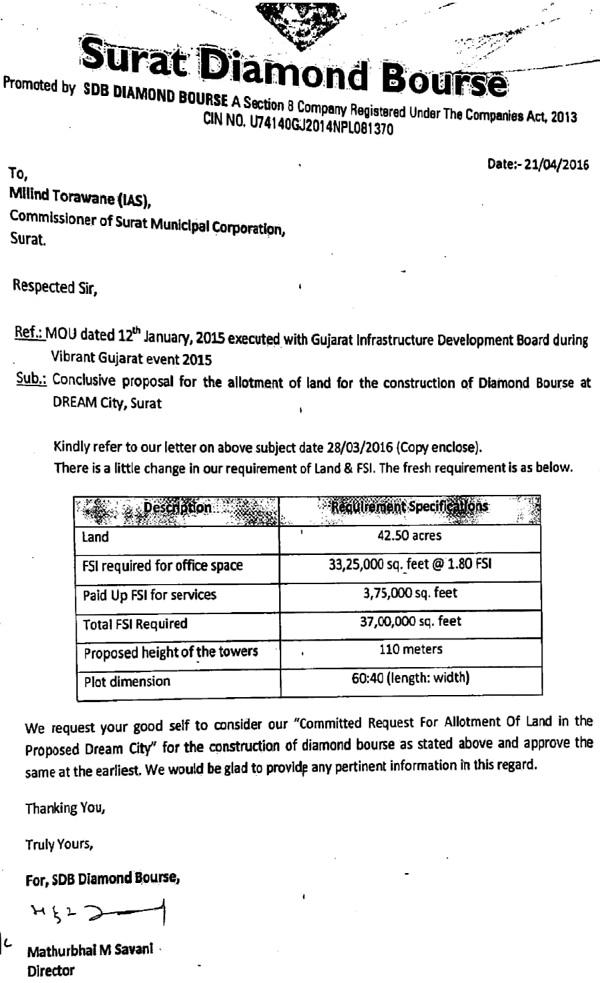
| 13 | 28-03-2016 | A request letter was submitted to the Hon’ble Commissioner of Surat Municipal Corporation seeking allotment of approximately 39 acres of land for construction of the proposed Bourse. |
| 14 | Mar-2016 | EOIs with refundable EMD of Rs. 145.47 cr. were received from more members. |
| 15 | 06-04-2016 | The Service Tax Officers of Surat searched their premises. The respondent contended that since no land had been allotted till date and no project had been designed, launched, or commenced, no Service Tax liability arose at that stage. |
| 16 | 21-04-2016 | Another request letter was submitted to Hon’ble Commissioner of Surat Municipal Corporation seeking allotment of land for construction of the proposed Bourse. |
| 17 | 10-05-2016 | During this period, certain members withdrew their applications whom SDB refunded EMD aggregating to Rs. 2.80 cr. This clearly proves that EMD was refundable amount against an expression of interest and not a binding booking for any office since no one would book any office space without knowing where it would be built, or without knowing the design, cost, etc. |
| 18 | 04-07-2016 | A further request letter was submitted to the Hon’ble Commissioner of Surat Municipal Corporation requesting the land. |
| 19 | Apr-16 to March-17 |
An aggregate amount of Rs. 26.96 crore had already been paid by SDB towards Service Tax under protest during the period from April 2016 to March 2017, i.e. prior to issuance of Show Cause Notice (SCN) and was duly communicated to the concerned authorities. |
| 20 | April-16 to March-17 |
More EOI forms with refundable EMD of Rs. 373.45 cr. were received. |
| 21 | 13-04-2017 | Land was allotted vide Lease Deed dated 13th April 2017. It’s possession was given to commence construction. It was only upon execution of the Lease Deed that the Service Tax liability crystallized. Same was accordingly reported in the Service Tax return for the period of April 2017 to June 2017. |
| 22 | 22-10-2019 | Show Cause Notice proposing demand of Service Tax, along with interest and penalty, was issued on 22.10.2019. All relevant facts and records were already available with the learned authorities. So extended period of limitation for issue of SCN cannot apply. Further, SDB had already paid Rs. 26.96 crore towards Service Tax under protest, which was higher than the amount of tax ultimately proposed in the SCN. |
Also, copy of the letter dated 21.04.2016 written to the Commissioner, Surat Municipal Corporation intimating the requirement of land and request for it’s allotment is reproduced below:-
5.2 The sequence of events clearly indicates that the appellant had no intention to hide the money collected from their members as earnest money along with expression of interest. They have also shown the above amounts as EMD against office space under the head “other long term liabilities” in schedule 4 of the balance sheet for 2015-16 & 2016-17. Their intention behind collection of EMD was to ensure that they get committed requests from the members for calculating requirement of land and the likely size of the project. In their support, they have also submitted copy of the minutes of meeting No. 25/2017 dated 13.04.2017, wherein at item No. 1, it is mentioned that Shri Mathurbhai Madhabhai Savani, Director of the company is authorised to sign, execute and appear before the Registrar in connection with lease agreement for land between SDB Diamond Bourse and M/s DREAM City Ltd for the period of 99 years. Item No. 2 is reclassification of amount collected as EMD. It says that once lease agreement is executed between the company and DREAM City Ltd, title to the land for the proposed bourse shall vest with the company and all uncertainties related to the project would end. The work for various approvals as also the actual execution work on site can also commence on full speed and therefore, EMDs collected from the Members shall be classified as advance contribution from them for the office space in the bourse and shall, no longer be treated as earnest money deposits. It also states that whatever amount is standing to the credit of the members in the books of the company as EMD, shall be transferred to the advance members contribution for office space. At item No. 3, it also approved transfer of 108 applications received from existing trade members for office space as well as parking space to new members. The appellant has submitted Notes Forming Part of the Audited Financial Statement of the company for the year ending March 2018 which also incorporates corresponding figures as on 31.03.2017. The schedule 4 dealing with “other current liabilities” shows an amount of Rs. 5,54,97,61,000/- as EMD against office space as on 31.03.2017 which after transfer plus some additional fresh deposits, has been shown as advance received from members for office space– Rs. 7,69,47,12,007/-. The EMD which was being shown in books up to 31.03.2017, has become nil. Schedule 4 is reproduced below:-
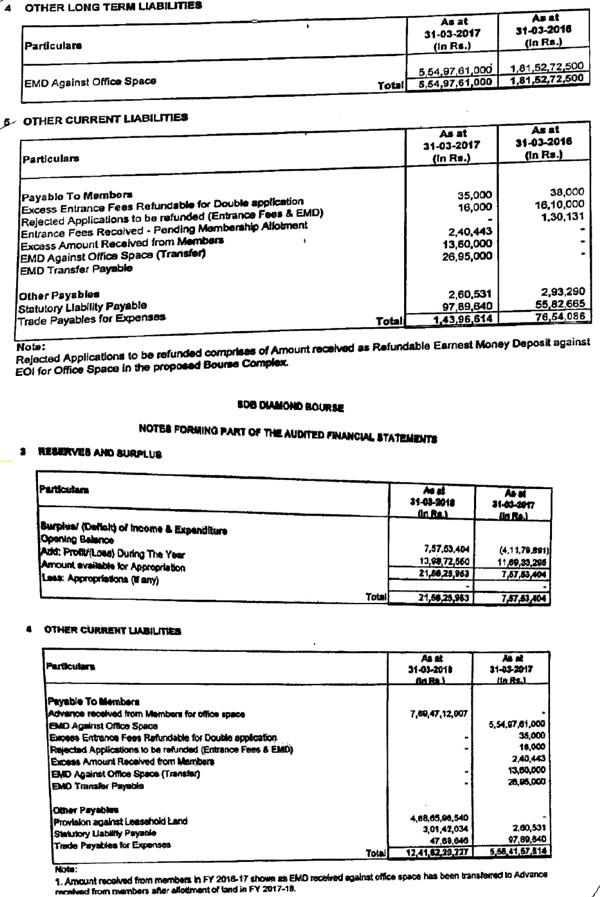
5.3 Above clearly shows that whatever earnest money deposit the appellant was carrying in their books of account, has been converted as advance received from the members for office space. The ST-3 return for the period April-June 2017 submitted by the appellant also confirm that in the month of April 2017, appellant has shown receipt of Rs. 5,54,97,61,000/- as advance amount from the members on which, they after claiming the abatement, have paid the applicable service tax. By submitting all these documentary evidences, the appellant had shown their good intention to plead that they had no reason and intention to hide the amount so received from their members as earnest money deposit. They submitted that as they have already paid the entire service tax amount much before the liability arose on them in April 2017, they are neither liable to any interest on the service tax amount nor any penalty under Section 78(1) of the Finance Act, 1994.
5.4 In view of above facts, entire dispute is whether the amount collected
by the appellant from their members along with expression of interest, is “advance amount towards construction of office space” or a refundable earnest money deposit. The sequence of events as per para 5.1 above, clearly show that till 13.04.2017, the appellant were pursuing the State Government, DREAM City Ltd, and the Commissioner of Surat Municipal Corporation for allotment of approximately 39 acres of land for construction of purposed Surat Diamond Bourse. Without getting the land allotted by the Government, it cannot be said that the appellant was confident of constructing the project. When a construction company announces a residential or commercial project, they do so after acquiring piece of land and after obtaining all necessary approvals like FSI, RERA, building plan approval etc. There is certainty in the construction activity in such cases and therefore, whatever amount they receive from the applicants, is treated as advance for construction services. The case of the appellant is at different footing. Even though, they had taken expression of interest from the members along with certain deposits, they were not sure about land allotment for which they made untiring efforts with the State authorities as indicated above. Therefore, appellant collected the amount from the members as refundable EMD so that it could be refunded in case proposed Surat Diamond Bourse does not see light of the day. We therefore, are of the opinion that the said amount cannot be equated to advances because construction of Bourses itself was uncertain in this case due to non-availability of land with the appellant company.
5.5 We also find that Hon’ble Supreme Court in the case of K.R. Suresh Vs.
R. Poornima & Ors. reported at 2025 (5) TMI 311 has distinguished between “Advances” and “Earnest Money”. Hon’ble Apex Court has mentioned that the principles governing the scope of “earnest money” were succinctly explained in the case of Shree Hanuman Cotton Mills Vs. Tata Air Craft Ltd., reported in (1969) 3 SCC 522. Relevant paras of the decision of Hon’ble Supreme Court in K R Suresh case are reproduced as under: –
“32. The principles governing the scope of “earnest money” were succinctly explained in the case of Shree Hanuman Cotton Mills v. Tata Air Craft Ltd., reported in (1969) 3 SCC 522, reproduced as under:
“21. From a review of the decisions cited above, the following principles emerge regarding ‘earnest’:
‘(1) It must be given at the moment at which the contract is concluded.
2. It represents a guarantee that the contract will be fulfilled or, in other words, “earnest” is given to bind the contract.
3. It is part of the purchase price when that transaction is carried out.
4. It is forfeited when the transaction falls through by reason of the default or failure of the purchaser.
5. Unless there is anything to the contrary in the terms of the contract, on default committed by the buyer, the seller is entitled to forfeit the earnest.’”
(Emphasis supplied)
33.In the case of Videocon Properties Ltd. v. Bhalchandra Laboratories reported in (2004) 3 SCC 711, while assessing the difference between “advance” and “earnest”, this Court took the view that the words used in the agreement alone cannot be determinative of the true nature of the amount advanced. Instead, the intention of the parties and the surrounding circumstances serve as more apt indicators. Further, the Court observed that earnest money fulfils a dual purpose: first, it operates as part-payment of the purchase price and; secondly, as security for the performance of the contractual obligations. Thus, its true character and purpose can only be canvassed on a close reading of the agreement, and the relevant contextual factors. The relevant observations are reproduced hereinbelow:
“14. […] Further, it is not the description by words used in the agreement only that would be determinative of the character of the sum but really the intention of parties and surrounding circumstances as well, that have to be looked into and what may be called an advance may really be a deposit or earnest money and what is termed as ‘a deposit or earnest money’ may ultimately turn out to be really an advance or part of purchase price. Earnest money or deposit also, thus, serves two purposes of being part-payment of the purchase money and security for the performances of the contract by the party concerned, who paid it.”
(Emphasis supplied)
34. In Satish Batra v. Sudhir Rawal, reported in (2013) 1 SCC 345, this Court emphatically held that it is only the “earnest money”, paid as a pledge for the due performance of the contract, that can be forfeited by the seller on account of the buyer’s default. In the same vein, earnest money can also be doubled and paid back to the buyer if the contract falls through due to the seller’s default. An amount which is in nature of an “advance” or serves as part-payment of the purchase price cannot be forfeited unless it is a guarantee for the due performance of the contract. The Court further held that despite the existence of an outright forfeiture clause, it shall not apply if the amount stipulated in the contract is found to be only in the nature of part-payment of the purchase price. Consequently, the forfeiture of “advance money” as part of earnest money can only be justified if the terms of the contract are clear and explicit to that effect. The relevant observations are reproduced hereinbelow:
“6. […] In Chiranjit Singh v. Har Swarup [(1926) 23 LW 172 : AIR 1926 PC 1] it has been held that (LW p. 174) the earnest money is part of the purchase price when the transaction goes forward and it is forfeited when the transaction falls through, by reason of the fault or failure of the purchaser. […]
xx xx xx
10. In DDA v. Grihsthapana Coop. Group Housing Society Ltd. [1995 Supp (1) SCC 751], this Court following the judgment of the Privy Council in Har Swarup [(1926) 23 LW 172 : AIR 1926 PC 1] and Shree Hanuman Cotton Mills [(1969) 3 SCC 522], held that the forfeiture of the earnest money was legal. In V. Lakshmanan v. B.R. Mangalagiri [1995 Supp (2) SCC 33] this Court held as follows : (SCC p. 36, para 5)
“5. The question then is whether the respondents are entitled to forfeit the entire amount. It is seen that a specific covenant under the contract was that the respondents are entitled to forfeit the money paid under the contract. So when the contract fell through by the default committed by the appellant, as part of the contract, they are entitled to forfeit the entire amount.”
xx xx xx The law is, therefore, clear that to justify the forfeiture of advance money being part of “earnest money” the terms of the contract should be clear and explicit. Earnest money is paid or given at the time when the contract is entered into and, as a pledge for its due performance by the depositor to be forfeited in case of non-performance by the depositor. There can be converse situation also that if the seller fails to perform the contract the purchaser can also get double the amount, if it is so stipulated. It is also the law that part-payment of purchase price cannot be forfeited unless it is a guarantee for the due performance of the contract. In other words, if the payment is made only towards part-payment of consideration and not intended as earnest money then the forfeiture clause will not apply.”
(Emphasis supplied)
35. A forfeiture clause identical to the one in the present ATS was found in the case of Satish Batra (supra). It provided for the forfeiture of earnest money in case of the purchaser’s default, as well as the payment of double the amount of earnest money in case of the vendor’s default. This Court allowed the forfeiture of the earnest money, which was held to be security for the due performance of the contract, by the seller when the transaction fell through on account of the purchaser’s fault. The relevant forfeiture clause and observations are reproduced hereinbelow:
“5. […] The question whether the seller can retain the entire amount of earnest money depends upon the terms of the agreement. The relevant clause of the agreement for sale dated 29-11-2005 is extracted hereunder for easy reference:
“(e) If the prospective purchaser fails to fulfil the above condition, the transaction shall stand cancelled and earnest money will be forfeited. In case I fail to complete the transaction as stipulated above, the purchaser will get DOUBLE the amount of the earnest money. In both conditions, the DEALER will get 4% commission from the faulting party.”
The clause, therefore, stipulates that if the purchaser fails to fulfil the conditions mentioned in the agreement, the transaction shall stand cancelled and earnest money will be forfeited. On the other hand, if the seller fails to complete the transaction, the purchaser would get double the amount of earnest money. Undisputedly, the purchaser failed to perform his part of the contract, then the question is whether the seller can forfeit the entire earnest money.
xx xx xx
17. We are, therefore, of the view that the seller was justified in forfeiting the amount of Rs.7,00,000 as per the relevant clause, since the earnest money was primarily a security for the due performance of the agreement and, consequently, the seller is entitled to forfeit the entire deposit. […]”
(Emphasis supplied)
From the above, it is clear that earnest money is different from the advances though, earnest money can be treated as part payment of the sale consideration, if the contractual terms are duly honoured. In other words, earnest money is adjusted against the total sale consideration if the contract goes through.
5.6 In the instant case, we find that what appellant had collected from the willing members, was the earnest money refundable in case project does not go through. At that point of time, appellants were basically conducting demand survey for assessing requirement of land. Had they not been allotted the piece of land, amount would have been returned to the members. Therefore, considering all the facts, it would be incorrect to treat such collected amounts as advances towards construction of office space. As has been clearly brought out above, since appellant was not having required land with them, the future of the project entirely depended upon allotment of land by the State Government which finally happened in the month of April 2017 and then, by way of resolution, the appellant converted the earnest money deposit into advances, shown in the ST-3 returns and made payment of service tax. We therefore, hold that Rule 5 of the Point of Taxation Rules 2011, is applicable in this case w.e.f. 13.04.2017 because from this date, the amount collected from the members towards confirmation of their requisition has been transferred/ treated as advances towards construction of office space. We also hold that the appellant has made timely payment of service tax in this case and no interest amount is recoverable from them. There is also no suppression of facts on the part of the appellant as they had already shown the amount collected from the members in their books of accounts as detailed in para 5.2 above. When the amount was transferred from EMD to advances, they shown it in the ST-3 returns and paid the service tax. We therefore, are of the view that Revenue has not brought out any cogent reason for invoking suppression against the appellant and accordingly, penalty imposed on the appellant under Section 78(1) is not maintainable. The penalty under Section 77(1) is however upheld as ST-3 return for April-June 2017 was admittedly filed late by 42 days.
5.7 Accordingly, we allow the appeal filed by M/s SDB Diamond Bourse, Surat by way of granting relief as indicated above.
5.8 As regards penalty imposed on other Directors of the company under Section 78A of the Act, the appellant though, has prayed for relief to them in this appeal but such prayer can only be considered if separate appeals are filed by the respective persons challenging the order passed in their matter and in this case, no separate appeals have been filed by them.
6. The appeal of the main party is allowed in above terms.
(Pronounced in the open court on 12.11.2026)






