Summary: The GST Appellate Tribunal’s Principal Bench, in its order dated 14 October 2026 concerning Navitas Eduservices Private Limited, examined whether marketing, recruitment support and IT-enabled services supplied by an Indian subsidiary to its Australian parent constituted exports or intermediary services under the IGST Act. Six appeals involving refund claims aggregating ₹1,88,20,996 were considered, comprising five appeals by Navitas and one by the Revenue. The Tribunal examined the contractual arrangements between Navitas Australia, its Indian subsidiary, partner universities and independent recruitment advisors. Navitas India supplied services under a master services agreement on a cost-plus-16% basis, while recruitment advisors operated under separate agreements and received enrolment-linked commissions. Applying Section 2(13) of the IGST Act, CBIC Circular No. 159/15/2021-GST and relevant judicial precedents, the Tribunal held that Navitas India supplied services on its own account as an independent subcontractor and was not an intermediary. Its services consequently qualified as exports under Section 2(6). The Tribunal set aside the adverse appellate orders in the five taxpayer appeals and directed refunds with interest. In the Revenue’s appeal, however, it held that Section 107(11) of the CGST Act prohibits the First Appellate Authority from remanding a matter to the adjudicating authority, even when the direction is framed as an annulment followed by reconsideration. That matter was returned to the First Appellate Authority for a decision on merits. The ruling highlights the importance of contractual obligations, actual service delivery, remuneration arrangements and statutory appellate powers in GST disputes.
- Introduction
- The Facts: A Tale of Two Navitases
- Chapter One: The university contracts
- Chapter Two: The parent hires the child
- Chapter Three: The Advisors enter
- Chapter Four: what Navitas India actually does
- Chapter Five: six claims, one rejection theme
- Who Contracts With Whom (Paras 7-9,11)
- The Long Road to the Tribunal
- The Questions Before the Tribunal
- The Clash of Arguments
- Navitas: "We are a sub-contractor, not a go-between" (Para 15)
- The Department: "Your own papers give you away" (Para 16)
- The Side-Battle in APL/13 (Paras 17–18)
- The Tribunal Speaks
- First, the Names Puzzle (Para 27)
- Then, the Law (Paras 28–29)
- Three High Courts and a Circular
- The Education Case That Sealed It (Para 35)
- The Answer (Para 36)
- The Twist in APL/13: An Annulment That Was Really a Remand
- The Verdict
- Epilogue: What the Order Tells Us
- Cases Discussed
Introduction
When does a supplier become a middleman?
In GST, the answer can decide whether a supplier of services gets a refund on its export or pays tax on its supplies. The test sits in one definition, s.2(13) of the IGST Act. An “intermediary” is a broker, an agent “or any other person” who arranges or facilitates a supply between two or more persons. It excludes one who supplies “on his own account”.
On 14.10.2026, the Principal Bench of the GST Appellate Tribunal took up this question for M/s Navitas Eduservices Private Limited. The Bench was Justice (Retd.) Dr. Sanjaya Kumar Mishra, President, and Sh. Anil Kumar Gupta, Member (Technical). Six appeals were heard together: five by Navitas and one by the Revenue. Rs. 1,88,20,996 of refunds was at stake.
Two verdicts emerged. Navitas was held to be no middleman. Further, the First Appellate Authority was told that “annulling” an order while asking the officer to look at it again is still a remand, which the law forbids.
Here is how the story unfolds, page by page of the order in the matter of M/s Navitas Eduservices Private Limited versus Commissioner of CGST, South Delhi.
The Facts: A Tale of Two Navitases
Our story begins with a family. In Australia sits Navitas Pty Limited (formerly Navitas Limited), a global education provider. It runs pre-university, managed campus and university pathway programmes with Partner Universities in Australia, Canada, the United Kingdom and elsewhere (Paras 5–6).
In India sits its wholly owned child, Navitas Eduservices Private Limited. It was once called Learning Information Systems (India) Private Limited, and is registered under GSTIN 07AABCL6126E1ZT (Para 5).
The Australian parent does two things. It delivers and administers educational programmes for its Partner Universities. And it engages local recruitment Advisors who meet prospective students, explain courses and help with admission and visa procedures (Para 6).
Chapter One: The university contracts
Navitas Australia signed bilateral services agreements dated 15.05.2018 with each Partner University. Under them, Navitas Australia is the sole contracting service provider. The agreements expressly contemplate that it may procure or sub-contract the underlying services through its Indian subsidiary. Clauses 5.1 and 5.2 say neither Navitas entity is an employee, agent, partner or joint venturer of the university, and neither may incur obligations for it (Paras 7, 19).
Chapter Two: The parent hires the child
Through a Master Services Agreement dated 07.12.2016, Navitas Australia sub-contracted marketing, promotion and business support services to Navitas India. Schedule I includes helping manage relationships with the parent’s business partners in India, including recruitment agents. The price: cost plus 16%, paid in Australian Dollars. Clause 5.1 makes Navitas India an independent contractor. Clause 5.2 bars it from incurring any obligation for the parent without written instruction (Paras 8, 20).
Chapter Three: The Advisors enter
Now a separate cast appears. Navitas Australia signed Authorised Advisor Agreements directly with Indian recruitment advisors. These Advisors physically meet students, explain courses and assist with admissions. They are paid commission, linked to successful enrolments. Navitas India is not a party to these agreements and neither gives services to nor takes services from the Advisors (Paras 9, 21).
Notice the contrast. The child earns cost-plus. The Advisors earn commission. Keep it in mind; the Tribunal certainly did.
Chapter Four: what Navitas India actually does
The Transfer Pricing Report and Form 3CEB describe a “bouquet” of services to the parent (Para 10):
• Marketing support: planning enrolment strategies via Advisors, supporting Advisors’ targets, joining agent-run exhibitions, presenting to and counselling students, vetting applications, checking eligibility, verifying visa and admission documents, running the team, liaising between the parent and recruitment agents, and hosting university partners on its payroll.
• IT-enabled services: web development and digital design, marketing automation, social media campaigns, updating the Study Link portal, quality analysis, and mobile app and content development.
Navitas India says it does all this on its own account, with its own people and infrastructure. It has no contract with the universities or the Advisors, raises no invoices on them, and is paid only by its parent in foreign exchange (Paras 11, 22).
Chapter Five: six claims, one rejection theme
Navitas India exported these services without paying tax and claimed refund of unutilised ITC under s.54 CGST read with s.16 IGST, for periods from 2018 to 2023 (Paras 12, 23). Here are the six claims that reached the Tribunal (Paras 3–4):
Six claims, worth Rs. 1,88,20,996 in all, reached the Tribunal. Three were for 2018 (Rs. 40.67 lakh together), and two were for 2020-21 and 2022-23 (about Rs. 50 lakh each). All five were Navitas’s own appeals. The sixth, for 2021-22 (Rs. 47.12 lakh), came from the Revenue, which objected that the First Appellate Authority had sent that claim back for reconsideration (Paras 3–4).
Every claim was rejected for the same reason: the services were “intermediary services”, not exports. The authorities also objected that the agreement and the invoices named different parties (Para 13).
Who Contracts With Whom (Paras 7-9,11)
Before the arguments begin, it helps to see the cast on one page.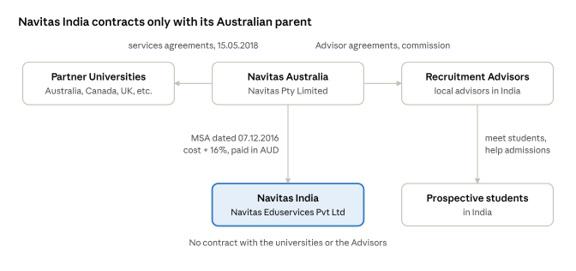
Every contract runs through Navitas Australia. Navitas India’s only line goes to its parent; the Advisors, not Navitas India, are the ones paid per enrolment.
The Long Road to the Tribunal
The refunds did not come easily.
At the first desk, the Adjudicating Authority rejected the claims. Its main reason: the services were “intermediary services”, not exports. It also spotted what it called a discrepancy. The service agreement named Learning Information Systems (India) Pvt. Ltd. and Navitas Limited, but the export invoices were raised on Navitas Pty Limited (Paras 13, 24).
At the first appeal, the Appellate Authority upheld the rejections. In one case, though, it took a different path: it annulled the original order and sent the matter back for fresh consideration in light of the Delhi High Court’s orders (Paras 3, 13, 24).
A detour to the High Court. For October 2018 to March 2020, Navitas had gone to the Delhi High Court in WP(C) Nos. 15773, 15781 and 15764 of 2022. On 19.09.2023 the Court quashed the rejection orders. It restored the applications for fresh decision in light of Ernst & Young and McDonald’s India (Paras 14, 25).
What happened next is told in Para 25. The adjudicating authority did not take up the restored claims and instead asked Navitas to file fresh refund applications. When it did, the claim was rejected as barred by limitation. That order went to the First Appellate Authority, which annulled it and asked the adjudicating authority to reconsider. The Revenue now challenged that annulment before the Tribunal in APL/13.
In the other appeals, Navitas had not gone to the High Court. Still, it argued that the High Court’s view in Ernst & Young and McDonald’s India governs the field (Para 26).
So the stage was set: five appeals by a taxpayer seeking its refunds, and one by the Revenue questioning a remand.
The Questions Before the Tribunal
The Tribunal framed three questions, calling them “simple” questions of fact and law (Para 1). Before reading on, try answering them yourself:
1. Do Navitas India’s services qualify as “export of services“, or are they intermediary services?
2. When the First Appellate Authority annulled the proper officer’s order and asked him to reconsider, was that really a remand, prohibited by law?
3. What relief do the taxpayer and the Revenue get?
The Clash of Arguments
Navitas: “We are a sub-contractor, not a go-between” (Para 15)
Counsel for Navitas walked the Bench through s.2(6) of the IGST Act. All five conditions of an export were met, he said:
1. The supplier, Navitas India, is in India.
2. The recipient, Navitas Australia, is outside India.
3. Place of supply is outside India under s.13(2), because these are not intermediary services.
4. Payment comes in convertible foreign exchange, Australian Dollars.
5. Supplier and recipient are separate legal entities, not mere establishments of one person.
And the middleman label? It does not fit. Navitas India is not an “intermediary” under s.2(13), but a sub-contractor. The arrangement is bipartite (not tripartite): contract, invoice and payment run only between Navitas India and its parent. There is no ancillary facilitation supply, only substantive marketing and IT work. The contract denies agency and any power to bind. A sub-contractor supplying on its own account is excluded from “intermediary” by Circular No. 159/15/2021-GST. And the Advisors, separately contracted and paid on commission, do not turn a cost-plus sub-contractor into a middleman.
What about s.13(3)(b), a ground by Revenue? It applies only to services supplied to an individual requiring physical presence. Navitas Australia is a body corporate (Vodafone Idea, Bom.; Cube Highways, Del.).
Navitas added that the lower orders were non-speaking and breached natural justice. Unjust enrichment could not apply because no GST was charged to the parent, as the FIRCs showed. It relied on Ernst & Young, McDonald’s India, IDP Education India, K.C. Overseas Education, Global Opportunities, Dow Chemical International and Columbia Sportswear, and claimed interest under s.56.
The Department: “Your own papers give you away” (Para 16)
The Deputy Commissioner answered for the Revenue. The appellant’s services falls within “Intermediary” as per Section 2(13) of IGST Act, 2017. Look at the Subject Agreement and the TP Report, he urged. They speak of activities such as supporting Advisors, joining agent-run exhibitions, liaising with recruitment agents and assisting student admissions, facilitating supply of education services.
The Department’s picture had three parties and two supplies. The main supply is education, flowing between Navitas Australia or the Partner Universities and the students. Navitas India merely facilitates it. That, it argued, ticks every box in Circular 159. A sub-contractor must provide the main service, and Navitas India does not teach anyone.
The Department also argued that:
• the name discrepancy between agreement and invoices hid the true recipient and the nature of services;
• for some periods, s.13(3)(b) applied because the services needed the recipient’s physical presence, placing the supply in India;
• Navitas had not proved the tax incidence was not passed on, so s.54(8) unjust enrichment barred the refund;
• interest is only consequential.
It relied on three Advance Rulings: Airbus Group India (vendor identification for a foreign holding company), Global Reach Education (promoting foreign courses for commission) and Toshniwal Brothers (support services to a foreign parent). Each was held to be an intermediary.
The Side-Battle in APL/13 (Paras 17–18)
In its own appeal, the Revenue said the First Appellate Authority had illegally remanded the case, contrary to s.107(11). It also repeated its s.13(3)(b) and intermediary arguments.
Navitas’s reply was sharp. Hearing this appeal, it said, would deprive it of its statutory first appeal, since the Appellate Authority never decided the merits. The “tripartite theory” was new, absent from both the show cause notice and the original order. On merits, it was a principal-to-principal sub-contractor with no agency or commission. And s.13(3)(b) could not apply, since no service went to any local agent or needed physical presence. It too sought interest, relying on Sandvik Asia (SC).
The Tribunal Speaks
First, the Names Puzzle (Para 27)
The Tribunal began with the discrepancy that troubled the adjudicating authority. The original agreement was between Learning Information Systems (India) Pvt. Ltd. and Navitas Australia. The Indian company was later reconstituted and renamed. This was not seriously challenged, and the reconstitution was never in issue before either lower authority. The supposed discrepancy regarding Export Invoices, the Tribunal held, “is of no substance”.
Then, the Law (Paras 28–29)
The Tribunal set out s.2(13) IGST (intermediary), s.2(86) CGST (place of supply) and ss.10–13 IGST. Under s.13(8)(b), the place of supply of intermediary services was the supplier’s location. That is the trap: if Navitas were an intermediary, its place of supply would be India, and no export would exist.
The Tribunal noted a twist in the tale here. Clause (b) of s.13(8) has been omitted by the Finance Act, 2026, w.e.f. 30.03.2026.
Three High Courts and a Circular
The Tribunal then called its witnesses, in the form of precedents.
Genpact India v. Union of India, (2022) 1 Centax 226 (P&H), 2022 SCC OnLine P&H 4254 (Para 30). Genpact India provided BPO services to clients of its foreign group entity under a sub-contracting agreement. The High Court laid down three conditions for an intermediary:
1. a principal–agent relationship;
2. arranging or facilitating a service provided to the principal by a third party;
3. not itself performing the main service.
The agreement’s “no agency” clause defeated the Department. Sub-contracting is not intermediary service. And when the Department tried to support its order with fresh reasons in an affidavit, the Court applied Mohinder Singh Gill v. Chief Election Commissioner, [1978] 1 SCC 405: an order must stand on its own reasons.
Columbia Sportswear India Sourcing (P.) Ltd. v. Union of India, [2025] 174 taxmann.com 936 (Karnataka) (Para 31). Columbia India surveyed markets, identified and visited factories, monitored production and tracked shipments for its US parent, on cost-plus. The High Court found six reasons why it was not an intermediary: only two parties; services on own account; independent contractor who cannot bind; cost-plus fee rather than success-based pay; recommendations not binding on the parent; and services akin to business support, not order procurement on commission.
Pr. Commissioner, Central Excise and CGST – Delhi South v. Blackberry India Pvt. Ltd., 2023 SCC OnLine Del 4467 (Para 32). The same principles, the Tribunal said, apply here.
The Tribunal’s own precedent: Dow Chemical International Pvt. Ltd. v. Commissioner of State Tax, Mazgaon, Mumbai, (2026) 1 GSTAT E-Journal 15 (Principal Bench) (Paras 32, 33(iii)). The Bench was not writing on a blank slate. In its Final Order dated 04.06.2026 in Dow Chemical, it had already considered and relied on Blackberry India and Columbia Sportswear, and had examined CBIC Circular No. 159/15/2021-GST. The Tribunal held that the same principles apply to Navitas. It also carried forward the view taken in Dow Chemical that “any other person” in s.2(13) must be read ejusdem generis. The phrase cannot cover a person who lacks the character of a broker or an agent, that is, one with authority to bind and act on behalf of the principal. Since Navitas India admittedly had no authority to bind Navitas Australia, it fell outside the phrase.
Circular No. 159/15/2021-GST (Paras 32–33). The Tribunal walked through its requisites and applied each to Navitas:
| Requisite in the Circular | Tribunal’s application to Navitas |
|---|---|
| At least three parties; an activity between two parties is not intermediary | Covered through the Circular’s reasoning |
| Two distinct supplies: main and ancillary | One on principal-to-principal basis in the main supply is not an intermediary |
| Broker, agent “or any other person”: a supportive role | Navitas is admittedly not a broker or agent and cannot bind its parent. “Any other person” is read ejusdem generis: it must share a broker’s or agent’s character of binding and acting for the principal |
| Own-account supplier excluded | Navitas India supplies its services to Navitas Australia on its own account |
| Sub-contracting is not intermediary service | Navitas India is a sub-contractor providing the main supply; the Circular’s “A–B–C” annual maintenance example “fortifies” this |
| s.13(8) applies only in cross-border cases | Noted |
Pause on the “A–B–C” example. A contracts to maintain B’s machines and sub-contracts it to C. C works on B’s machines, yet C supplies maintenance to A on its own account. C is no intermediary. Swap in Navitas Australia, the Partner Universities and Navitas India, and the parallel is plain.
The Education Case That Sealed It (Para 35)
The exact question, education consultancy, had come before the Delhi High Court in FATEH Education Consulting (P) Ltd. v. Assistant Commissioner, 2026 SCC OnLine Del 3200. FATEH gave marketing and recruitment support to foreign universities, was paid by them, took no fees from students, and could neither bind the universities nor guarantee admission. Incidental help to students did not make it an intermediary.
FATEH itself drew on:
• Global Opportunities (Del. HC): consultancy services to foreign universities, invoiced to and paid by them, are not intermediary services just because Indian students are helped along the way;
• K.C. Overseas Education (Bom. HC): the Union’s SLPs were dismissed by the Supreme Court, having regard to CST v. Vodafone India (06.05.2025) and the Blackberry SLP order (04.11.2024).
The deciding factor, FATEH said, is not where an incidental beneficiary sits. It is who receives the service under the contract, who pays for it, and what the service is.
The Answer (Para 36)
Applying these principles, the Tribunal held that Navitas India’s services are not intermediary services. They are export of services under s.2(6) of the IGST Act.
And the Advance Rulings? AARs “are not courts of record”. Faced with High Court judgments, the Tribunal chose to follow the High Courts.
The Twist in APL/13: An Annulment That Was Really a Remand
Now to the Revenue’s own appeal. Here the Department scored a point.
The First Appellate Authority had held the officer’s order incorrect. But instead of allowing the appeal, it annulled the order and directed the officer to reconsider (Para 38). Can it do that?
The Tribunal turned to s.107(11) of the CGST Act. The Appellate Authority may confirm, modify or annul the order appealed against, “but shall not refer the case back to the adjudicating authority”.
The Tribunal’s reading was firm (Para 39). The Appellate Authority may annul, but it cannot direct reconsideration. Where a statute expressly bars a type of order, an authority cannot, “by resorting to jugglery of the words”, pass an order that is in fact a remand.
So the Revenue’s appeal was allowed to that extent. The matter went back, not to the officer, but to the First Appellate Authority, to decide on merits and in line with the principles the Tribunal had just laid down.
The Tribunal also drew a clear line. The First Appellate Authority cannot remand. The Tribunal can, under s.113(1), at its discretion, to the Appellate Authority, the Revisional Authority or the Original Adjudicating Authority.
The First Appellate Authority must hear both sides and decide preferably within six weeks of taking cognizance of the order (Para 40).
The Verdict
In Navitas’s five appeals, the First Appellate Authority’s orders were set aside. The Department was directed to refund the unutilised ITC with interest “at the rate of six percent and nine percent, respectively” from these dates (Para 37):
| Appeal | Refund (Rs.) | Refund applied on | Interest payable from |
|---|---|---|---|
| APL/23/PB/2026 | 50,77,028 | 08.05.2024 | 08.07.2024 |
| APL/89/PB/2026 | 49,64,984 | 19.05.2022 | 19.07.2022 |
| APL/33/PB/2026 | 32,62,600 | 15.03.2019 | 15.05.2019 |
| APL/38/PB/2026 | 4,24,248 | 18.12.2018 | 17.02.2019 |
| APL/37/PB/2026 | 3,80,506 | 08.03.2019 | 08.05.2019 |
In the Revenue’s appeal, APL/13, the remand was struck down and the matter sent to the First Appellate Authority to decide on merits and principles laid down in order (Paras 39–40).
The order was pronounced in open court on 14.10.2026 (Para 41).
Epilogue: What the Order Tells Us
What should a reader carry away? The order’s own words supply the lessons.
• “Any other person” is not anyone. Read ejusdem generis, it must share a broker’s or agent’s character: authority to bind and act for the principal (Para 33(iii)).
• Follow the contract and the money. Two parties, a no-agency clause, invoices to the parent alone and payment in foreign exchange point away from intermediation (Paras 30–31, 33).
• Cost-plus is not commission. The Advisors earned per enrolment under their own contracts with the parent; Navitas India earned cost plus 16% (Paras 9, 21, 31).
• A sub-contractor supplies the main service. The Circular’s “A–B–C” example applies even when the sub-contractor deals with the principal’s customers (Para 33(v)).
• Helping students does not change the recipient. What matters is who receives the service under the contract, who pays, and what is supplied (Para 35).
• High Courts outrank Advance Rulings. AARs are not courts of record (Para 36).
• Words cannot disguise a remand. An Appellate Authority that “annuls and directs reconsideration” breaches s.107(11); only the Tribunal holds the power to remand under s.113(1) (Para 39).
So, when does a supplier become a middleman? On this order’s answer: only when it acts like one. Navitas India did not.
Cases Discussed
- Dow Chemical International Pvt. Ltd. v. Commissioner of State Tax, Mazgaon, Mumbai, (2026) 1 GSTAT E-Journal 15, Final Order dated 04.06.2026 (GSTAT Principal Bench) — Followed by the Tribunal on own-account supplies and the intermediary definition.
- FATEH Education Consulting (P) Ltd. v. Assistant Commissioner, 2026 SCC OnLine Del 3200 (Delhi High Court) — Applied on education consultancy and marketing services supplied to foreign universities.
- Columbia Sportswear India Sourcing (P.) Ltd. v. Union of India, [2025] 174 taxmann.com 936 (Karnataka High Court) — Applied on independent contracting, cost-plus remuneration and absence of authority to bind.
- Commissioner of Delhi Goods and Service Tax DGST v. Global Opportunities Private Limited, 2025 SCC OnLine Del 6316 (Delhi High Court) — Discussed through FATEH on identifying the actual contractual recipient.
- K.C. Overseas Education (P.) Ltd. v. Union of India, 2025:BHC-NAG:2166-DB (Bombay High Court) — Discussed through FATEH on education consultancy and export of services.
- CST v. Vodafone India Ltd., Civil Appeal Nos. 10815–10819 of 2014, decided 06.05.2025 (Supreme Court) — Referred to through FATEH in connection with the Supreme Court proceedings.
- IDP Education India Pvt. Ltd. v. Union of India, 2025 (99) G.S.T.L. 193 (Bombay High Court) — Cited by Navitas for the classification of services supplied to a foreign parent.
- Commissioner, Central Excise, CGST – Delhi South Commissionerate v. Blackberry India (P.) Ltd., SLP (C) No. 25992 of 2024, order dated 04.11.2024 (Supreme Court) — Mentioned through FATEH in relation to the challenge to the Blackberry decision.
- Pr. Commissioner, Central Excise and CGST – Delhi South v. Blackberry India Pvt. Ltd., 2023 SCC OnLine Del 4467 (Delhi High Court) — Relied upon for the intermediary classification of independent services.
- Ernst & Young Ltd. v. Additional Commissioner, Central GST Appeals-II, [2023] 148 taxmann.com 461; 2023 SCC OnLine Del 1764 (Delhi High Court) — Referred to in the earlier Delhi High Court writ proceedings.
- McDonald’s India Pvt. Ltd. v. Additional Commissioner, CGST Appeals-II, Delhi, 2023 SCC OnLine Del 3089 (Delhi High Court) — Referred to in the earlier Delhi High Court writ proceedings.
- Cube Highways and Transportation Assets Advisor Pvt. Ltd. v. Assistant Commissioner CGST Division, 2023 (77) G.S.T.L. 387 (Delhi High Court) — Cited by Navitas concerning the place-of-supply argument.
- Genpact India v. Union of India, (2022) 1 Centax 226 (P&H); 2022 SCC OnLine P&H 4254 (Punjab and Haryana High Court) — Relied upon for the distinction between subcontracting and intermediary services.
- Vodafone Idea Ltd. v. Union of India, (2022) 66 G.S.T.L. 63 (Bombay High Court) — Cited by Navitas on the physical-presence place-of-supply provision.
- In re Airbus Group India Private Limited, (2021) 54 G.S.T.L. 194 (GST AAR Karnataka) — Cited by the Department in support of intermediary classification.
- In re Toshniwal Brothers (SR) Private Limited, (2018) 18 G.S.T.L. 129 (GST AAR Karnataka) — Cited by the Department in support of intermediary classification.
- In re Global Reach Education Services Pvt. Ltd., (2018) 12 G.S.T.L. 387 (GST AAR West Bengal) — Cited by the Department concerning recruitment of students for foreign universities.
- Mohinder Singh Gill v. Chief Election Commissioner, (1978) 1 SCC 405 (Supreme Court) — Discussed through Genpact on the rule that an order must stand on its recorded reasons.
Circular: CBIC Circular No. 159/15/2021-GST dated 20.09.2021