Dinabandhu Steel and Power Limited Vs Commissioner of Central Excise (CESTAT Kolkata)
Summary: The Customs, Excise and Service Tax Appellate Tribunal (CESTAT), Kolkata, in the case of Dinabandhu Steel and Power Limited & Ors. v. Commissioner of Central Excise, Customs and Service Tax, Bhubaneswar, examined the legality of a central excise duty demand of Rs. 1,12,98,357/- along with interest and penalties imposed on allegations of clandestine manufacture and removal of sponge iron, MS ingots, TMT rods and other steel products. The alleged clearances related to the period February 2007 to October 2008. During searches conducted on 18 March 2010 at the appellant’s factory and office premises and at the office of its group company, M/s Eastern Foods Private Limited (EFPL), at Jagatpur, Cuttack, the Department recovered loose sheets, two notebooks and other documents. The Revenue alleged that these records contained details of unaccounted clearances, including dates, vehicle numbers and quantities. A show cause notice dated 30 June 2011 proposed recovery of duty, interest and penalties. The adjudicating authority confirmed the demand and imposed penalties on the appellants, who challenged the order before the Tribunal.
The Department relied principally on the seized documents and statements recorded from the directors and officials associated with the appellant and EFPL. Shri Subhrajeet Sahoo, Director of the appellant company, could not confirm whether the seized documents related to the appellant. Shri Sanjay Kumar Sahoo, Director of EFPL, stated that some documents concerned money receipts, costing calculations, sale orders and other commercial matters, but he could not identify the persons who had written the entries. Shri Samarjeet Sahoo, Managing Director of the appellant company, also expressed ignorance regarding the authorship and maintenance of the documents. Although he deposited Rs. 40,00,000/- on the date of the search, he did not identify the disputed records as evidence of clandestine transactions. The Department nevertheless treated the entries in the loose sheets and notebooks as reflecting unaccounted clearances, particularly because some entries reportedly corresponded with the appellant’s statutory invoices.
The appellants contended that the entire demand was founded on unauthenticated private records recovered from the premises of a third party, without independent evidence establishing clandestine manufacture or removal. They argued that merely because certain entries matched statutory records, the remaining entries could not automatically be treated as evidence of unaccounted clearances. The Department had neither identified nor examined the authors of the notebooks and loose sheets. No statements were obtained from suppliers of raw materials, purchasers of finished goods, transporters or vehicle drivers to establish actual movement of unaccounted goods. There was also no evidence of excess raw-material purchases, abnormal electricity consumption, disproportionate production, receipt of unaccounted sale consideration or financial transactions relating to alleged clandestine clearances. The appellants pointed out that stock verification had revealed neither shortages nor excess quantities. They further challenged the invocation of the extended period of limitation and submitted that allegations of clandestine removal required positive and corroborative evidence rather than presumptions drawn from unexplained handwritten entries.
After examining the records and submissions, the Tribunal found substantial deficiencies in the Revenue’s investigation. Although the seized documents contained certain truck numbers and quantities, the Department had not investigated the concerned vehicle owners or drivers to determine whether those vehicles had transported goods belonging to the appellant. The Revenue also failed to establish excess procurement of raw materials, additional consumption of electricity, receipt of clandestine sale proceeds or any other supporting circumstances indicating unaccounted manufacture and clearance. The persons responsible for preparing and maintaining the disputed documents remained unidentified. The Tribunal observed that mere recovery of documents from the premises of EFPL, a group company, could not establish that the entries represented clandestine clearances by the appellant. Particular reliance was placed on the Allahabad High Court’s decision in Continental Cement Co. v. Union of India, 2014 (309) E.L.T. 411 (All.), which emphasised that allegations of clandestine removal must be supported by tangible evidence concerning production, raw-material procurement, electricity consumption, transportation, purchasers and realisation of sale proceeds. The Tribunal held that the Department had failed to undertake the necessary investigation or produce corroborative evidence sufficient to sustain the allegations.
Consequently, the CESTAT Kolkata concluded that the Revenue had failed to establish clandestine manufacture and removal of goods by Dinabandhu Steel and Power Limited. The Tribunal held that loose sheets and notebooks recovered from third-party premises, without identification of their authors and independent corroboration of the alleged transactions, were insufficient to justify confirmation of central excise duty. The absence of evidence relating to excess production, procurement of raw materials, transportation of goods, electricity consumption and receipt of unaccounted consideration rendered the demand unsustainable. Since the principal duty demand of Rs. 1,12,98,357/- could not be sustained, the consequential penalties imposed on the appellants were also liable to be set aside. Accordingly, the Tribunal set aside the impugned adjudication order and allowed the appeals filed by the appellants. The order, pronounced on 17 April 2024, reiterates that clandestine removal is a serious allegation requiring credible, positive and corroborative evidence and cannot be established merely through unverified private records or assumptions arising from third-party documents.
Cases Discussed
- K. Rajagopal v. Commissioner of Central Excise, Madurai — 2002 (142) E.L.T. 128 (Tri.-Chennai)
- Portland Cement (I) Ltd. v. Commissioner of Central Excise, Lucknow — 2015 (326) E.L.T. 304 (Tri.-Del.)
- Rajpur Forging Pvt. Ltd. v. Commissioner of Central Excise, Rajpur — 2016 (335) E.L.T. 297 (Tri.-Del.)
- Commissioner of Central Excise v. Mira Silk Mills — 1999 (112) E.L.T. 934 (Tri.)
- T.G.L. Poshak Corporation v. Commissioner of C.Ex., Hyderabad — 2002 (140) E.L.T. 187 (Tri.-Chennai)
- Nidhi Auto Pvt. Ltd. v. Commissioner of C.Ex., Noida-I — 2020 (33) G.S.T.L. 419 (Tri.-All.)
- A.R. Shanmugasundaram v. Commissioner of C.Ex., Salem — 2016 (333) E.L.T. 158 (Tri.-Chennai)
- Continental Cement Co. v. Union of India — 2014 (309) E.L.T. 411 (All.)
- Triveni Engineering & Industries Ltd. v. Commissioner of C.Ex., Allahabad — 2016 (334) E.L.T. 595 (All.)
- Commissioner of C.Ex., Ahmedabad-I v. Gopi Synthetics Pvt. Ltd. — 2014 (302) E.L.T. 435 (Tri.-Ahmd.)
- Commissioner of C.Ex. & S.T., Udaipur v. Mittal Pigment Pvt. Ltd. — 2018 (16) G.S.T.L. 41 (Raj.)
- Commissioner of C.Ex., Delhi-I v. Mayfair Industries — 2016 (338) E.L.T. 594 (Tri.-Del.)
- Shree Venkatesh Metal Corporation v. Commissioner of C.Ex., Mumbai-V — 2012 (284) E.L.T. 663 (Tri.-Mum.)
- Commissioner of C.Ex., Jaipur-I v. Sumetco Alloys Pvt. Ltd. — 2008 (230) E.L.T. 81 (Tri.-Del.)
- Rina Dyeing & Printing Works v. Commissioner of C.Ex., Surat-I — 2007 (209) E.L.T. 190 (Tri.-Mum.)
- Commissioner of C.Ex. v. Brims Products — 2011 (271) E.L.T. 184 (Pat.)
- Commissioner of C.Ex., Chandigarh v. Gurmeet Singh — 2014 (312) E.L.T. 689 (Tri.-Del.)
FULL TEXT OF THE CESTAT KOLKATA ORDER
By way of the impugned order, demand of Central Excise Duty has been confirmed against the main appellant herein alleging clandestine removal of the goods. Penalty on all the appellants has also been imposed.
2. The facts of the case are that the appellant is engaged in the manufacture of Sponge Iron, MS Ingots, TMT Rods, etc. On 18.03.2010, a search was conducted at their factory premises at Kalinga Nagar Growth Centre, office premises at Cuttack and office premises of M/s. Eastern Foods Private Limited (hereinafter referred to as ‘EFPL’) at Jagatpur, Cuttack. Various records were recovered and seized, Panchanama was drawn and seizure list was also prepared during the search at the premises of M/s. EFPL; some loose sheets and two notebooks were also recovered and seized. The said documents were containing entries on different dates.
2.1 The Officers of the Department also recorded statements of Shri Subhrajeet Sahoo, Director of the appellant-company, who could not say as to whether these documents were relating to the appellant-firm or not. He also stated that one Shri Sanjay Kumar Sahoo was associated with their company and was advising relating to costing in relation to some activities of the appellant and the Managing Director sometimes used to discuss at the premises of M/s. EFPL.
2.2 The statement of Shri Sanjay Kumar Sahoo, Director of M/s. EFPL, was also recorded, who stated that some of the documents were relating to money receipt, statement and costing of power plant and also costing of Sponge Iron, TMT Rods and Ingots and sale order of TMT Rods and Sponge Iron. He had expressed his inability regarding as to who had written those documents and notebooks; since the appellant viz. M/s. Dinabandhu Steel and Power Ltd. was their group company, they were maintaining some records in their office.
2.3 On the date of search, Shri Samarjeet Sahoo, Managing Director of the appellant-company, deposited a sum of Rs.40,00,000/- (Rupees Forty Lakhs only). The statement of Shri Samarjeet Sahoo was also recorded; he stated that their Jagatpur office was used for marketing purposes only. He had expressed his ignorance about the documents and as to who maintained those documents and also could not say as to whether all those documents were written by the same person or not and ultimately stated that he could not recognize those documents.
3. After investigation, a Show Cause Notice dated 30.06.2011 was issued to the appellants alleging that the loose sheets and notebooks recovered in their premises i.e., the premises of M/s. EFPL, are documents reflecting clearance of goods without payment of duty. It has been mentioned in the Show Cause Notice that some entries also match with the invoices of the appellant and hence, those entries are nothing but reflection of clearance of the goods without payment of duty. Accordingly, Central Excise Duty amounting to Rs.1,12,98,357/-was sought to be demanded for the period from February 2007 to October 2008 along with interest and for imposition of penalty.
4. The appellant contested the issue, but the demand on the ground of clandestine removal of the goods was confirmed by the adjudicating authority; penalty on all the appellants was also confirmed. Against the said order, the appellants are before us.
5. The Ld. Counsel appearing on behalf of the appellants submits that the entire demand has been raised on the basis of three private unauthenticated seized documents from the office of M/s. EFPL; merely because few entries tally with the statutory records it cannot be inferred that all the entries are relating to the clandestine manufacture and clearance of the goods without payment of duty.
5.1 He further submitted that no attempt has been made by the respondent to find out the author of the loose sheets and/or notebooks; the Managing Director of the appellant was not aware of the maintenance of such documents and also, he did not instruct anybody or any staff member to maintain such types of documents; although it was specifically requested to investigate into the issue, the respondent did not give any importance to the said request. He contended that it is the settled position of law that scribing in notebooks when no examination and no corroborative evidence is available in respect of purchase of raw materials, sale and purchase by any particular person or transportation of goods, the allegation of clandestine manufacture and removal cannot be sustained.
5.2 It is further submitted by the Ld. Counsel for the appellants that there is no evidence that during the relevant period, more than 3100 M.T. of Sponge Iron had been manufactured and removed. He further stated that the respondent did not record any statement from any supplier of raw materials or from the buyers of the goods; there is no evidence as to receipt of the sale consideration, transportation of goods, disproportionate procurement of goods, consumption of electricity, etc., available in this case. 5.3 He also stated that the names of the buyers have appeared in the Annexure annexed to the Show Cause Notice, but no investigation was made in respect of the buyers of the said goods as alleged; there is no evidence except the rough entries in the notebooks, which are not sufficient to allege clandestine removal of the goods. It is his submission that no demand can be raised only on the basis of some entries in loose sheets and/or notebooks without any corroborative evidence; in this case, no corroborative evidence is available and hence, no demand is sustainable against the appellants; mere loose sheets / notebooks are unauthenticated documents which were never maintained by the appellant or any employee of the appellant; no discrepancy in the stock verification was found; no shortage or excess was found during the course of investigation. He submitted that for the allegation of clandestine removal, some positive evidence is required, which is absent in this case.
5.4 Moreover, he submitted that although the visit took place on 18.03.2010, the Show Cause Notice had been issued on 30.06.2011; the extended period of limitation is not invokable.
5.5 He placed reliance on the following case-law: –
i. K. Rajagopal v. Commissioner of Central Excise, Madurai [2002 (142) E.L.T. 128 (Tri. – Chennai)]
ii. Portland Cement (I) Ltd. v. Commissioner of Central Excise, Lucknow [2015 (326) E.L.T. 304 (Tri. – Del.)]
iii. Rajpur Forging Pvt. Ltd. v. Commissioner of Central Excise, Rajpur [2016 (335) E.L.T. 297 (Tri. – Del.)]
iv. Commissioner of Central Excise v. Mira Silk Mills [1999 (112) E.L.T. 934 (Tri.)] v. T.G.L. Poshak Corporation
v. Commissioner of C.Ex., Hyderabad [2002 (140) E.L.T. 187 (Tri. – Chennai)]
vi. Nidhi Auto Pvt. Ltd. v. Commissioner of C.Ex., Noida-I [2020 (33) G.S.T.L. 419 (Tri. – All.)]
vii. A.R. Shanmugasundaram v. Commissioner of C.Ex., Salem [2016 (333) E.L.T. 158 (Tri. – Chennai)]
viii. Continental Cement Co. v. Union of India [2014 (309) E.L.T. 411 (All.)]
ix. Triveni Engineering & Industries Ltd. v. Commissioner of C.Ex., Allahabad [2016 (334) E.L.T. 595 (All.)]
x. Commissioner of C.Ex, Ahmedabad-I v. Gopi Synthetics Pvt. Ltd. [2014 (302) E.L.T. 435 (Tri. – Ahmd.)]
xi. Commissioner of C.Ex. & S.T., Udaipur v. Mittal Pigment Pvt. Ltd. [2018 (16) G.S.T.L. 41 (Raj.)]
xii. Commissioner of C.Ex., Delhi-I v. Mayfair Industries [2016 (338) E.L.T. 594 (Tri. – Del.)]
xiii. Shree Venkatesh Metal Corporation v. Commissioner of C.Ex., Mumbai-V [2012 (284) E.L.T. 663 (Tri. – Mum.)]
xiv. Commissioner of C.Ex., Jaipur-I v. Sumetco Alloys Pvt. Ltd. [2008 (230) E.L.T. 81 (Tri. – Del.)]
xv. Rina Dyeing & Printing Works v. Commissioner of C.Ex., Surat-I [2007 (209) E.L.T. 190 (Tri. – Mum.)] xvi. Commissioner of C.Ex. v. Brims Products [2011 (271) E.L.T. 184 (Pat.)]
xvii. Commissioner of C.Ex., Chandigarh v. Gurmeet Singh [2014 (312) E.L.T. 689 (Tri. – Del.)]
6. On the other hand, the Ld. Authorized Representative appearing on behalf of the respondent reiterated the findings in the impugned order.
7. Heard the parties.
8. We have gone through the records placed before us as well as the arguments advanced by both the sides. In this case, the charge has been made against the appellants that they were engaged in the activity of clandestine removal of goods on the basis of certain documents recovered from the premises of M/s. EFPL, Jagatpur, Cuttack, a sister concern of the appellant-company. We have gone through the scribing in the said loose sheets and notebooks recovered from the said premises. One such sample scribe is as under: –
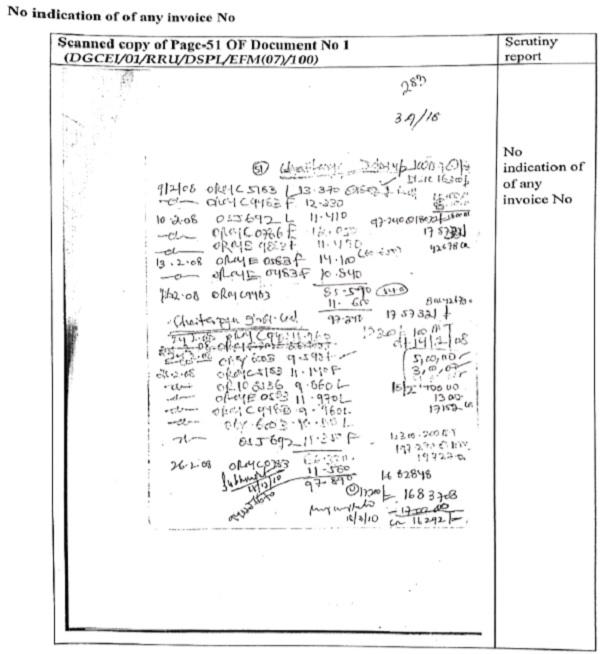
9. The Revenue alleged that on these documents, certain truck numbers and quantity along with dates have been mentioned and it is alleged that there is clandestine removal of the goods by the appellants on the basis of the above documents. Although it is the claim of the Revenue that truck numbers are mentioned on the said documents which were involved in clandestine removal of goods, no investigation was conducted with regard to the truck owners or drivers to find out as to whether those vehicles were used by the appellant for clandestine removal of the goods, in support of the allegation of clandestine clearance.
9.1 Further, no evidence has been produced by the Revenue with regard to excess purchase and payment thereof. No evidence in the form of clandestine manufacture cases” target=”_blank” rel=”noopener”>excess consumption of electricity was brought on record. Moreover, no payment for clandestine removal of the goods by illicit means has been brought on record. Mere documents recovered from the premises of a third party cannot be the basis to allege clandestine removal of goods.
9.2 Moreover, it has not been ascertained as to who was maintaining those documents and who had kept these documents in the premises of M/s. EFPL.
10. Therefore, as held in various decisions cited by the appellant hereinabove, the Revenue has failed to establish their case of clandestine removal of the goods in question, particularly in view of the decision in the case of Continental Cement Company reported in 2014 (309) E.L.T. 411 (All.) (supra) wherein the Hon’ble High Court of Allahabad has observed as under: –
“10. We have heard the learned counsel for the parties and gone through the material available on record, from which it appears that Shri Shubhashis Dev, Government Examiner of questioned documents, Shimla gave his written opinion dated 12-6-1998, wherein he has stated that “the documents of this case have been carefully and thoroughly examined. The enclosed writings and signatures stamped and marked were all written by one and the same persons”.
11. From the above, it appears that all the documents were written by one and the same persons, though the dates and the name of the parties are different. When it is so then the genuineness of the documents cannot be accepted.
12. Further, unless there is clinching evidence of the nature of purchase of raw materials, use of electricity, sale of final products, clandestine removals, the mode and flow back of funds, demands cannot be confirmed solely on the basis of presumptions and assumptions. Clandestine removal is a serious charge against the manufacturer, which is required to be discharged by the Revenue by production of sufficient and tangible evidence. On careful examination, it is found that with regard to alleged removals, the department has not investigated the following aspects:
(i) To find out the excess production details.
(ii) To find out whether the excess raw materials have been purchased.
(iii) To find out the dispatch particulars from the regular transporters.
(iv) To find out the realization of sale proceeds.
(v) To find out finished product receipt details from regular dealers/buyers.
(vi) To find out the excess power consumptions.
13. Thus, to prove the allegation of clandestine sale, further corroborative evidence is also required. For this purpose no investigation was conducted by the Department.
14. In the instant case, no investigation was made by the Department, even the consumption of electricity was not examined by the Department who adopted the short cut method by raising the demand and levied the penalties. The statement of so called buyers, namely M/s. Singhal Cement Agency, M/s. Praveen Cement Agency; and M/s. Taj Traders are based on memory alone and their statements were not supported by any documentary evidence/proof. The mischievous role of Shri Anil Kumar erstwhile Director with the assistance of Accountant Sri Vasts cannot be ruled out.
15. In view of the above, we are of the opinion that when there is no extra consumption of electricity, purchase of raw materials and transportation payment, then manufacturing of extra goods is not possible. No purchase of raw material out side the books have been proved.
16. In the light of the above discussions and considering the totality of the case, we are satisfied that no case is made out for extra so called clandestine sale of the Portland Cement to the said parties. We are satisfied that the first appellate authority has rightly deleted the addition and cancel the penalties. Hence we hereby set aside the impugned order passed by the Tribunal and restore the order passed by the first appellate authority, along with the reasons mentioned herein.
17. In the result, all the appeals filed by the appellants are hereby allowed.”
11. As there is no corroborative evidence available on record in support of the charge of clandestine removal of the goods, we hold that the demand of Central Excise Duty is not sustainable against the appellant. As the demand of duty is not sustainable, consequently, no penalty can be imposed on the appellants.
12. In view of the above, we set aside the impugned order and allow the appeals filed by the appellants.
(Order pronounced in the open court on 17.04.2024)