In re L&T-MHI Power Boilers Private Limited (CAAR Mumbai)
Summary: The Customs Authority for Advance Rulings (CAAR), Mumbai, held that the project-specific Boiler Support Steel Structures (BSSS) proposed to be imported by L&T-MHI Power Boilers Private Limited in completely knocked-down (CKD) condition are classifiable under Customs Tariff Item 84029090 as “Other” parts of boilers. Classification under tariff item 73089010 as steel structures and Heading 9406 as prefabricated buildings was rejected on the facts and technical material placed on record. The ruling expressly requires the goods to be established as identifiable parts of the boiler system through their design, function and intended use.
The applicant, a joint venture of Larsen & Toubro Limited and Mitsubishi Heavy Industries Ltd., manufactures, supplies and services supercritical and ultra-supercritical boilers from its Hazira facility. Its application, received on 24 July 2026, concerned fabricated H-beams, column beams, girders, bracings and associated primary and secondary steelwork intended for particular boiler installations. According to the applicant, a supercritical boiler assembly bears an aggregate vertical load of approximately 75,000 MT, with nearly 18,000 MT suspended from top girders. Primary steelwork provides the load-bearing and suspension framework while accommodating thermal movement. Secondary steelwork includes platforms, galleries, walkways, stairs, ladders, gratings, handrails and equipment-support arrangements for operation, inspection and maintenance.
The applicant submitted that the members are engineered to boiler-specific drawings and load calculations and undergo cutting, welding, precision drilling, inspection, protective treatment and individual tagging. They are imported disassembled because of their dimensions and weight, with tags matching engineering drawings, packing lists and shipping documents. It relied on Section XVI Note 2(b), the HSN exclusion from Heading 7308 for constructions clearly identifiable as machinery parts, Circular No. 964/07/2012-CX dated 2 April 2012 and Swetha Engineering Ltd. The jurisdictional Commissionerate furnished no comments, and no departmental representative attended the personal hearing on 9 September 2026.
CAAR applied the tariff headings and relevant Section and Chapter Notes, distinguishing objective product identity from a declaration of future use. Heading 7308 broadly covers fabricated steel structures, including disassembled members, but excludes constructions clearly identifiable as machinery parts. The absence of Heading 7308 from the statutory definition of “parts of general use” did not by itself establish boiler-parts classification: Section XVI Note 2(b) still had to be satisfied. Substantial fabrication, regulatory coordination under the Indian Boiler Regulations and inclusion in project drawings were relevant evidence rather than independent classification tests.
On the cumulative evidence, the Authority found that the primary framework had a specific relationship with the boiler’s geometry, suspension, thermal movement and operating loads, beyond that of a machine resting on an ordinary floor or foundation. Secondary steelwork was described as part of the same identified engineering package, rather than stand-alone walkways or general access arrangements for the power plant. Together, the members were objectively identifiable with, and suitable for use solely or principally with, the particular boiler system. Swetha Engineering supported this distinction, but was not read as classifying every steel structure in a boiler installation under Heading 8402. The BHEL decision concerned when unassembled components have the essential character of a complete boiler; the BSSS themselves did not constitute a complete or incomplete steam-generating boiler.
Heading 9406 was rejected because the imported goods did not constitute, or possess the essential character of, a complete or incomplete prefabricated building. CKD presentation and on-site assembly alone could not give them that character. Beehive Foundry Engineering Works was distinguished because classification there depended on building-specific drawings, contractual scope and components imparting the essential character of a building. The intended-use authorities were considered only insofar as use is objectively discernible from the goods. The United States ruling on fabricated boiler panels was a non-binding comparison involving a different product and nomenclature. CAAR accordingly classified the described BSSS under CTI 84029090, subject to their established boiler-specific identity.
Cases Discussed
- M/s. ABB India Limited v. Joint Commissioner of Commercial Taxes, 2026 (5) TMI 1225 (Karnataka High Court) — Cited by the applicant on intended use; CAAR confined its relevance to objectively discernible use within the applicable statutory scheme.
- Commissioner of Customs (Import) v. Welkin Foods, 2026 (1) TMI 348 (Supreme Court) — Considered on intended use discernible from objective characteristics; the ruling was not based merely on declared future use.
- M/s. Thermax Ltd. v. Commissioner of CGST & CE, Pune-I, 2022 (12) TMI 1047 (CESTAT Mumbai) — Cited in the applicant’s submissions concerning bought-out items, boiler assemblies and separately presented parts.
- Commissioner of Central Excise v. BHEL, 2018 (2) TMI 1112 (Supreme Court) — Considered for the distinction between a complete or incomplete boiler presented unassembled and separately identifiable parts.
- M/s. Swetha Engineering Ltd. v. Commissioner of Central Excise, Chennai, 2016 (5) TMI 448 (Supreme Court) — Relied upon for boiler-system structural components, without treating every steel structure in a boiler installation as a boiler part.
- CCE, Chennai v. M/s. Beehive Foundry Engineering Works, 2013 (11) TMI 876 (CESTAT Chennai) — Distinguished because the present goods lacked the essential character of a prefabricated building.
- United States Customs ruling NY I88421, dated 11 December 2002 — Considered as a non-binding comparative administrative ruling on fabricated panels for central-heating boilers.
- Dunlop India Ltd. v. Union of India, 1983 (13) ELT 1566 (Supreme Court) — Cited by the applicant for preference for a specific tariff description over a general description.
FULL TEXT OF THE ORDER OF CUSTOMS AUTHORITY OF ADVANCE RULING, MUMBAI
3. Question(s) on which Advance Ruling is required:
Whether the boiler structural support steel parts intended to be imported for exclusive use in boiler systems should be classified under the tariff entry 73089010 as structures of iron/steel, . or 84029090 as ‘Parts’ of boilers, or under CTH 9406 as prefabricated buildings of the Customs Tariff Act, 1975.
4. Submission by Applicant
Statement of relevant facts having a bearing on the questions on which advance ruling is required. Background
4.1 The applicant is a Joint Venture between Larsen & Toubro Limited (L&T), India, and Mitsubishi Heavy Industries Ltd, Japan (MHI). The applicant has established a state of the art manufacturing facility for Pressure Parts and Pulverisers for super-critical boilers(boilers) at Hazira in Gujarat. The applicant specializes in the design, engineering, manufacturing, supply and servicing of supercritical and ultra-supercritical boilers for coal-fired thermal power plants after procuring such contracts from their customers. These high-capacity boilers (500 MW to 1000 MW+) efficiently convert water into steam to generate electricity with reduced emissions and fuel consumption.
4.2. For the purpose of designing and manufacturing such high capacity boilers classified under CTH 8402, various components are required which are procured by the Applicant either domestically or are imported. One such component is specialized support structural steel parts (“Boiler Support Steel Structures” or “BSSS” or Subject Goods”) which are intended to imported from Asian countries to be exclusively used as an integral element of the boiler systems.
4.3. The Government of India is currently in the process of executing a multi-year capex cycle . doubling the investments in thermal power projects by 2028 in view of country Energy Security in response to these, there has been increase in the number of projects and due to the limited manufacturing capacity of the applicant and qualifying vendors in India, they are intending to import these BSSS for the manufacturing of boilers.
4.4 To appropriately understand the Subject Goods to be imported, it is imperative to understand its technical specifications, the overall essentiality and the functional role such BSSS entail in the boiler system. These critical aspects have been explained in detail in the ensuing paras: Essentiality and Functional Role of the Structural Steel in Boiler Operations
4.5 The requirement for purpose-built structural steel is indispensable, considering that supercritical boilers constitute one of the most demanding categories of thermal power generation equipment. A single supercritical boiler assembly is subjected to an aggregate vertical load of approximately 75,000 Metric Tons (MT), comprising the furnace enclosure, piping systems, coal silos, air pre-heaters, and other auxiliary equipment. Out of the said load, nearly 18,000 MT is directly suspended from the Top Girders through hanger rods and sling assemblies.
4.6 Under such extreme operating conditions, the supporting steel structure functions not merely as a passive framework, but asa specially engineered load-bearing system. The geometry, stiffness, member sizing, and connection integrity of the structure directly govern the long-term stability and operational reliability of the boiler’s critical pressure parts. The structure is simultaneously required to withstand exceptionally high static loads, resist wind and seismic forces over a design life of 35-40 years, and maintain precise geometric alignment during operation.
4.7 Further, the structural system must transfer these loads without imposing unintended restraint or secondary stresses on the boiler pressure parts. Any deviation in fabrication tolerances or compromise in structural integrity would result in uneven load distribution, locked stresses, and progressive structural failure, thereby affecting the safety, functionality, and operational performance of the supercritical boiler system.Product description and technical specifications
4.8 These BSSS constitute an engineered, purpose-built steel framework designed exclusively to support, suspend, and stabilize a coal-fired steam generator (boiler) and its ancillary equipment within a thermal power plant. These steel frameworks are neither a generic civil steel structure nor a simple warehousing or industrial shed framework but are an integral, safety and structure-critical component of the power plant, designed in strict coordination with the boiler OEM, and is entirely specific to the boiler geometry, mass, thermal expansion behavior, and seismic/wind loading conditions at the project site. Furthermore, the entire structural system complies strictly with earthquake-resistant design standards (IS 1893 Parts 1 and 4), utilizing vertically braced frames to transfer lateral seismic loads safely to the foundation.
4.9 Additionally, these BSSS are highly specialized steel components comprising of the following two critical components:
i. Fabricated H-Beams: These structural components are pre-designed fabricated parts meant to be assembled on-site using detachable nuts and bolts.
ii. Fabricated Column Beams: Similar to the H-beams, these fabricated column beams come with precise manufacturing, holes, and additional attachments exclusively engineered for the structural assembly of the boiler system
4.10 Technically, these components are broadly categorized into Primary and Secondary steel work.
4.10.1 Primary (Main) Steel work:
i. The primary steelwork comprises a moment-resisting structural frame integrated with vertical bracing systems, engineered to safely withstand and transfer dead loads, live loads, equipment loads, and external environmental loads, including wind and seismic forces, to the foundation system in accordance with the applicable design and engineering standards.
ii. A distinguishing and essential characteristic of the supercritical boiler support structure, which fundamentally differentiates it from conventional structural systems, is its specialized suspended support arrangement. Under this configuration, the boiler is supported through hanger slings connected to the Suspension Girder (Top Girder) positioned near the roof elevation of the structure.
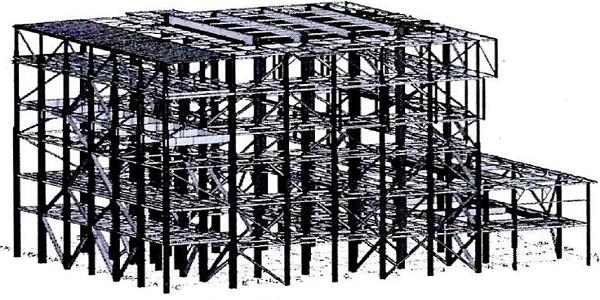
iii. The aforesaid suspension-based support mechanism is specifically designed to accommodate both vertical and horizontal thermal expansion of the boiler during operation, without transmitting or imposing thermal stresses and associated loads onto the supporting steel structure. Accordingly, the primary steelwork performs an integral and indispensable function in ensuring the structural stability, operational efficiency, and thermal flexibility of the supercritical boiler system. An illustrative image demonstrating the Primary steelwork is provided below for ease of reference:
i. The secondary steelwork comprises structural and ancillary steel components provided for operational accessibility, inspection, servicing, and maintenance of equipment and associated systems within the boiler structure. The said secondary steelwork consists of galleries, platforms, walkways, stairways, ladders, and allied access arrangements, supported through an interconnected structural framework of steel members.
ii. The scope of the secondary steelwork, inter alia, includes the following components:
a. Intermediate platforms, designed either as bottom-supported platforms resting on the lower main structural level or as hanger-supported platforms suspended from the top main structural level;
b. Equipment handling and maintenance support structures associated with Primary Air (PA) Fans, Forced Draft (FD) Fans, Combined Induced Draft (ID) Fans, Air Preheaters (APH), and Mills;
c. Motor-operated hoists mounted on runway beams, supported either through independent ground-mounted support structures or through integration with the primary steelwork system;
d. Main staircase towers located on both sides of the boiler structure, having a nominal width of 1000 mm, provided for safe personnel access and movement;
e. Open grill-type flooring comprising hot-dipped galvanized gratings of 32 mm thickness, along with chequered plates installed in areas adjoining burner operation zones; and
f. Hot-dipped galvanized tubular handrails, stanchions, and toe plates provided as part of the safety and access infrastructure
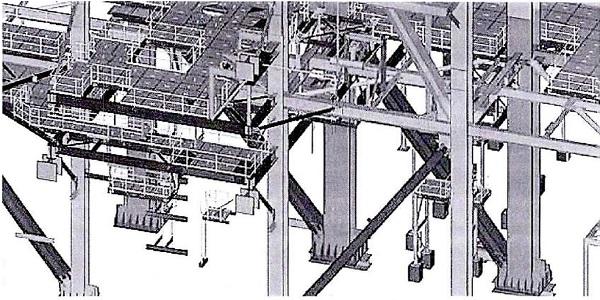
iii. The aforesaid secondary steelwork components are essential and incidental to the effective operation, accessibility, inspection, maintenance, and safe functioning of the boiler and associated equipment systems. We have attached below an illustrative image of the primary steel work component for ease of reference:
integrates High Strength Friction Grip (HSFG) bolts (Grade 10.9), the secondary steel structure utilizes standard bearing-type bolts (Grade 8.8).
4.12 Furthermore, the design and functionality of these structural components are as per the statutory framework of the Indian Boiler Regulations (IBR), 1950. Although the Boiler Support Steel Structure itself is not a pressure-retaining part requiring direct IBR stamping, its fundamental purpose is to support and safely bear the load of IBR-regulated pressure equipment. Consequently, the framework must be designed in strict conformance with accepted structural codes and forms a mandatory, integrated part of the overall Boiler General Arrangement (GA) drawings submitted and accepted under statutory IBR compliance protocols.
Raw materials and fabrication process of structural steels
4.13 All raw materials used in the fabrication of the Boiler Support Steel Structure are high- quality structural steels that conform strictly to internationally recognized standards. For example, the primary load-bearing columns are manufactured using high-tensile steel grades such as IS 2062. We have attached herewith a complete list of component used in the fabrication along with its equivalent Indian standards.
4.14. The fabrication process is a highly complex and quality-controlled operation carried out in dedicated heavy structural steel workshops. It involves review of Approved for Construction drawings, procurement and third-party inspection of traceable steel, CNC cutting and edge preparation, precision assembly, and welding by certified personnel using approved procedures under strict quality controls. The fabricated members are then straightened, dimensionally checked, CNC-drilled for HSFG bolting, and subjected to extensive Non-Destructive Examination (NDE). Finally, the structures undergo protective surface treatment, final inspection, and tagging for CKD shipment.
4.15 In other words, the Subject Goods proposed to be imported are not standard, multi- purpose structural steel profiles (such as generic pipes or beams). They are bespoke, precision- engineered boiler components subjected to rigorous thermal, static, and dynamic load testing, fabricated to exceptionally tight dimensional tolerances that dictate the operational safety of the particular thermal power plant being constructed. There is a complex engineering process undertaken for fabrication of BSSS and not mere standard process of bending or curving pipes, tubes or beams. .
4.16 The Boiler Support Steel Structure components are proposed to be imported in Completely Knocked Down (CKD) condition due to the immense size, weight, and transportation constraints associated with large-scale power plant structures. The structural members, including columns, beams, girders, and bracings, are too large and heavy to be transported as fully assembled units, with certain columns measuring up to 24 meters in length and top suspension girders weighing approximately 332 Metric Tons. Accordingly, the fabricated members are dispatched separately, while secondary steelwork and fasteners are shipped in identified bundles or containers.
“Whether the boiler structural support steel parts (explained above) intended to be imported for exclusive use in boiler systems should be classified under the tariff entry 73089010 as structures of iron/steel, or 84029090 as ‘Parts’ of boilers, or under 9406 as prefabricated buildings of the Customs Tariff Act, 1975.” Statement containing Applicant’s interpretation of law and/or facts in respect of the question on which advance ruling is required First proposition — whether the goods merit classification under Tariff entry 84029090 or 73089010?
4.19 The Applicant proposes to import boiler support steel structure components which are designed, manufactured and intended for exclusive use in the onward use for engineering, procurement and construction (EPC) based supply of boiler systems for thermal power plants. These support structures comprise a wide range of components classified as primary (main) steel work and secondary steel work, each of which undergoes an extensive and complex manufacturing process in accordance with specific designs created for the construction of the boilers that would be supplied by the Applicant. Conceptually, the structural steel components proposed to be imported by the Applicant are not merely bent or curved steel items such as pipes, tubes or beams, but are specially manufactured and engineered products that are ultimately intended for exclusive use in the construction and installation of boilers.
4.20 It is submitted that the classification of goods under Indian tax jurisprudence is strictly governed by the General Rules for the Interpretation of Import Tariff (GRI), as contained in the First Schedule to the Customs Tariff Act, 1975. To ascertain the appropriate HSN code for the Subject Goods, it is imperative to apply these principles systematically. Under GRI Rule I, while titles of Sections and Chapters are provided solely for ease of reference, the legal classification is primarily determined according to the terms of the headings and any relative Section or Chapter Notes.
4.21 However, in the present factual matrix, the classification of the Subject Goods cannot be conclusively determined through Rule | alone, as the goods are not exclusively or exhaustively covered by any single heading or its corresponding notes. Consequently, a sequential application of the subsequent GRls is necessitated. Given that the Subject Goods are neither presented in an incomplete or unfinished state nor constitute a mere mixture of materials, GRI Rules 2(a) and 2(b) are legally inapplicable. Therefore, the determination of the correct classification naturally progresses to GRI Rule 3(a).
| Sr. No | HSN Code | Description |
|---|---|---|
| 1. | 73 | Articles of Iron and Steel |
| 7308 | Structures (excluding prefabricated buildings of heading 9406) and parts of structures (for example, bridges and bridge-sections, lock-gates, towers. lattice masts, roofs, roofing frame-works, doors and windows and their frames and thresholds for doors, shutters, balustrades, pillars and columns), of iron or steel; plates, rods, angles, shapes, sections, tubes and the like, prepared for use in structures, of iron or steel |
|
| 73089010 | Beams, channels, pillars and girders prepared for use in structures | |
| 2 | 84 | Nuclear reactors, boilers, machinery and mechanical appliances;
parts thereof. |
| 8402 | Steam or other vapour generating boilers (other than central heating hot water boilers capable also of producing low pressure steam ); super-heated water boilers | |
| 84029090 | Other |
4.24 Chapter 73 covers structures (excluding prefabricated buildings classified under heading 9406) and parts of structures made of iron or steel. Examples include bridges and bridge sections, lock-gates, towers, lattice masts, roofs, roofing frameworks, doors and windows along with their frames and thresholds, shutters, balustrades, pillars, and columns. Additionally, this chapter includes plates, rods, angles, shapes, sections, tubes, and similar items that have been prepared for use in such structures.
4.25 According to the World Customs Organization (WCO) Explanatory Notes under CTH 7308, this heading encompasses both complete and incomplete metal structures, as well as parts thereof. These structures are generally characterized by their fixed nature once installed, meaning they arc typically not moved after assembly. They are usually constructed from various metal components such as bars, rods, tubes, angles, shapes, sections, sheets, plates, and castings, joined together by riveting, bolting, welding, or similar means. Moreover, these structures may include . materials classified under other headings, such as woven wire panels or expanded metal. The heading also covers parts such as flat-rolled products and wide flats, including so-called universal plates, strips, rods, angles, shapes, sections, and tubes that have been prepared through drilling, bending, notching, or other processing for use in structures.
CTH 7308:
Structures (excluding prefabricated buildings of heading 94.06) and parts of structures (for example, bridges and bridge-sections, lock-gates, towers, lattice masts, roofs, roofing frame-works, doors and windows and their frames and thresholds for doors, shutters, balustrades, pillars and columns), of iron or steel; plates, rods, angles, shapes, sections, tubes and the like, prepared for use in structures, of iron or steel (+) This heading covers complete or incomplete metal structures, as well as parts of structures.
For the purpose of this heading, these structures are characterized by the fact that once they are put in position, they generally remain in that position. The heading does not cover:
(a) Assembled sheet piling (heading 73.01) )
(b)….
(c) Constructions clearly identifiable as machinery parts (Section XVI)
4.27 Upon perusal of the above, it is prudent to note that CTH 7308 encompasses the following two exceptions/exclusions from its purview:
i) Prefabricated buildings classifiable under CTH 9406
ii) Constructions clearly identified as machinery parts under Section XVI Therefore, it is important to evaluate whether the BSSS identifies as machinery parts under chapter 84, In this regard, we have discussed chapter 84 and precisely CTH 8402 in the ensuing paras.
4.28 In the present case, given the functionality, complex engineering and construction process specific to the design qua boiler, these BSSS would not be considered as generic civil or building structure such as those exemplified in heading 73.08 (bridges, towers, roofs, building frameworks, etc.) as there is no generic or alternative use in the civil structures mentioned (bridges, towers, lock-gates). The BSSS isa bespoke structural system designed solely to suspend skeleton integral to the boiler assembly, the BSSS falls squarely within the intended statutory . scope of “boiler bases” explicitly covered under CTH 8402.
4.29 Chapter 84 specifically addresses nuclear reactors, boilers, machinery, and mechanical appliances, including parts thereof. CTH 8402 specifically covers steam or other vapor-generating boilers, excluding central heating hot water boilers capable of producing low-pressure steam, as well as superheated water boilers.
4.30 Further, the WCO Explanatory Notes of CTH 8402 clarify that steam or vapor-generating boilers are specialized equipment designed to produce steam or vapors for heating and industrial applications. These boilers include fire tube, water tube, hybrid, and forced circulation designs that enhance efficiency. Superheated water boilers operate under high pressure to effectively supply heat.
4.31 Importantly, a clear distinction exists between boilers and their auxiliary devices, which affects their classification when sold separately or together. Parts of boilers include boiler bodies and bases, internal assemblies such as tubes, water tube caps, headers, boiler drums, steam domes, non-mechanical fireboxes, inspection covers, and fusible plugs. However, metal tubes or pipes that have only been bent or curved without additional processing and presented in an unassembled state, without clear identification as boiler parts, are excluded. Such tubes or pipes identifiable as boiler components during inspection are classified under Section XV rather than as boiler parts. This establishes a threshold at which items are deemed part of a boiler. We have reproduced below the Relevant extracts of CTH 8402 for reference:
CTH 8402:
Steam or other vapour generating boilers (other than central heating hot water boilers capable also of producing low pressure steam); super-heated water boilers.
Parts:
Subject to the general provisions regarding the classification of parts (see the General Explanatory Note to Section XVI), parts of the boilers of this heading are also covered, e.g., boiler bodies and bases, internal assemblies for boilers consisting of tubes, watertube caps, headers, boiler drums, steam domes, non-mechanical fire-boxes, inspection covers and fusible plugs.
Metal tubes or pipes which have been bent or curved but not otherwise worked, presented unassembled, are not identifiable as parts of boilers and are therefore to be classified in Section XV
“Accordingly it is clarified that those structural components which are to be used essentially as a part of Boiler System would be classifiable as parts of Boiler only under Heading 8402 of the Thrift:
It is further clarified that since these structural components are nothing but the parts and accessories of the Boiler, they would be covered by the definition of inputs under Rule 2(k)(iii) of the CENVAT Credit rules, 2004 (i.e. all goods for generation of electricity & steam).
Further these structural components shall not be hit by the exclusion clause to the said definition of inputs, as these are not used for laying offoundation or making of structures for support of capital goods, but are essentially the part of said Boilers.”
4.47 We wish to highlight that the classification on fabricated structural steel components designed for the boilers has also been subject matter of dispute earlier. The said dispute came before the I-Ion’ble Supreme Court, which inter alia relied on the aforementioned Circular and set aside the order passed by the Tribunal in the case of M/s. Swetha Engineering Ltd. vs. Commissioner of Central Excise, Chennai (2016 (5) TMI 448 – Supreme Court). The dispute concerned the classification of steel fabricated structures manufactured by the appellant as parts of boilers under Chapter Subheading 8402.90 of the Central Excise Tariff Act, 1985.
4.48 In the ‘facts of the case before Supreme Court, the Applicant had imported plates, racks, angles etc. for erecting structures of iron or steel as a structural support to hold boilers and classified these goods as boiler parts and paid excise duty accordingly, whereas the Department challenged this classification by seeking to classify these items as structures and parts of
4.52 To further strengthen the Applicant’s position, an analogy can be drawn from the international jurisprudence (NY 188421 – December 11, 2002), where by a ruling was pronounced classifying the steel panels of varying size and shape, specifically bent, curved, drilled, and punched used in the assembly of Endurance central heating boiler units under 1-ITS code 8403.90.0000 on the basis that such fabricated panels are clearly identifiable as boiler-specific components at the time of import and cannot be regarded as generic structural steel or sheet products. Similarly, Applicant’s precision-engineered BSSS, tailored to the unique geometry, load paths, and thermal movement of the supercritical boiler, is properly and necessarily classifiable as “parts” of boilers under CTH 8402.4.53 Therefore, based on the above legal principles and arguments it is humbly submitted that the appropriate classification for BSSS intended to be imported consisting of fabricated H-beams and column beams which are custom-designed, precision-manufactured structures, and are intended solely for integration into the boiler system as essential load-bearing elements, merit classification as parts of boilers under CTH 8402 and not as general steel structures under 7308.Submission on the Principle of “Intended Use” for Classification of Boiler Support Steel Structures4.54 The Explanatory Notes to Section XVI explicitly provide that parts which are suitable for use “solely or principally” with a particular machine or apparatus are to be classified in the same heading as such machine, subject to specific exclusions; this wording embeds the “intended/principal use” test directly into the statutory scheme for machinery parts, including boilers under Heading 8402.4.55 The General Explanatory Note to Section XVI (which covers Heading 8402) provides that parts which are suitable for use solely or principally with particular machines or apparatus (including those of Heading 84.02) are to be classified in the same heading as those machines, subject to limited exclusions; this formulation gives legal force to the “intended use” or “principal use” principle in the context of machinery parts, particularly where, as here, the design and fabrication of the component.4.56 Recently, the Hon’ble Supreme Court’s in Commissioner of Customs (Import) V. Welkin Foods [2026 (1) TMI 348-SC/ has categorically held that for tax consequences, what is relevant is the intended use inherent in and objectively discernible from the goods, while “actual use” post-event is irrelevant in the absence of a specific statutory mandate.4.57 Further, reliance can also be placed on the recent Karnataka High Court ruling in M/s. ABB India Limited Versus The Joint Commissioner of Commercial Taxes [2026 (5) TMI 1225] which held that the “intended use” of the imported product is relevant criterion for determining the exemption and not the “actual use” of the product. Basis this principle of “intended use”, the court quashed the orders under question denying the benefit of the exemption under Entry 234 of Schedule Ito Notification No. 1/2017-CT(R) to the solar inverters imported by M/s ABB India Limited.4.58 Drawing an analogy from the above legal precedents, the Applicant most humbly submits that the subject goods under consideration clearly exhibits that such goods are intended to be used for boiler plant only and are not generic beams or columns which could be deployed for any building or civil structure; they are precision-engineered, bespoke steel members designed strictly in accordance with Applicant’s requirements. The design and specification of the subject goods are developed on the basis of specific directions, thus rendering them unsuitable for any other independent use without extensive re-engineering and re-fabrication.
4.59 In light of the foregoing analysis under the General Rules for Interpretation and Section XVI Notes, the essential character and principal function of the BSSS clearly align them with heading 8402 as “parts” of steam or other vapour-generating boilers, rather than with heading 7308 for generic structures of iron or steel. This is also supported by the fact that the subject goods arc not standard beams which are “prepared for use in structures” in the civil-engineering sense, but are bespoke, precision-engineered members that derive their geometry, hole patterns, connection details, and load paths exclusively designed and manufactured from a boiler arrangement and its thermal/static load calculations, soil & seismic requirement.
4.60 From the above, it can be construed that since the subject goods are intended to be used as an integral part of boiler, therefore the same should merit classification under CTH 8402 only. This conclusion is firmly supported by binding departmental clarification and Supreme Court level judicial authority, which recognize that structural steel components specially designed and fabricated as integral elements of a boiler system are to be treated as parts of boilers under CTH 8402 and not as generic structures under CTH 7308.
Second proposition — whether the goods merit classification under CTH. 9406?
4.61 While CTH 8402 seems appropriate based on the analysis above, it is important to evaluate CTH 9406. i.e., it is imperative to evaluate and firmly rule out the classification of the Subject Goods under Chapter 94, specifically CTH 9406, which pertains to “Prefabricated buildings”. It is a settled principle that WCO Explanatory notes are recognized guide for interpretation of tariff schedules. Therefore, these guidelines must be strictly applied to ascertain the scope of CTH 9406.
4.62 Chapter 94 covers furniture; bedding, mattresses, mattress supports, cushions and similar stuffed furnishing; luminaires and lighting fittings, not elsewhere specified or included; illuminated signs, illuminated name plates and the like and prefabricated buildings. As per Note 4 of chapter 94, the expression ‘prefabricated buildings’ means buildings which are finished in the factory or put up as elements, presented together, to be assembled on site, such as housing or worksite accommodation, offices, schools, shops, sheds, garages or similar buildings. ‘[he relevant statutory extract of Chapter 94 Note 4 is reproduced below:
4.- For the purposes of heading 94.06, the expression “prefabricated buildings” means buildings which are finished in the factory or put up as elements, presented together, to be assembled on site, such as housing or worksite accommodation, offices, schools, shops, sheds, garages or similar buildings.”
“Prefabricated buildings include “modular building units” of steel, normally presented in the size and shape of a standard shipping container, but substantially or completely pre-fitted internally. Such modular building units are normally designed to be assembled together to form permanent buildings.”
4.63 Further, prefabricated buildings include ‘modular building units’ of steel, normally presented in the size and shape of a standard shipping container, but substantially or completely pre-fitted internally. Such modular building units are normally designed to be assembled together to form permanent buildings. This legislative intent clearly indicates that the structural elements meant for CTH 9406 must possess the inherent characteristics of an architectural or habitable enclosure, rather than functioning merely as an industrial framework.
4.64 According to WCO Explanatory notes under CTH 9406, prefabricated buildings can be either equipped or unequipped; however, only built-in equipment that is typically supplied with such structures is classified along with them. This includes integrated systems like electrical wiring, heating and air conditioning units, plumbing and sanitary fixtures, kitchen installations, and built-in furniture such as cupboards. A notable type within this category is the modular building unit, which resembles a shipping container in size and form but is internally pre-fitted with elements such as walls, flooring, plumbing, and electrical systems. These modules are structurally self-supporting and designed for horizontal or vertical assembly with other units to form permanent buildings like schools, hospitals, or residential complexes.
4.65 Accordingly, the statutory language and WCO Explanatory Notes unequivocally restrict CTH 9406 to structures possessing habitable characteristics that are either fully finished in the factory or presented as prefabricated elements, intended to be assembled on-site into complete buildings such as housing, worksite accommodation, offices, schools, shops, sheds, or garages. These buildings may include modular building units typically steel structures made in the size and shape of a standard shipping container that are substantially or completely pre-fitted internally with components such as internal walls, flooring, doors, windows, electrical wiring, plumbing, and insulation. Only built-in equipment that is normally supplied with such buildings as electrical fittings, sanitary fixtures, kitchen installations, and built-in furniture is classified with prefabricated buildings.
4.66 To further validate the scope of the term “building”, one must look at its common parlance and dictionary definitions, as customs classifications heavily rely on how terms are understood in general trade. As per various dictionary meanings, a general building can be said to be a structure with walls and a roof, such as a house or factory, constructed to provide shelter or serve a specific purpose. It may also refer to the act, process, or business of construction. Definitions according to various dictionary are as follows:
i. Collins’s dictionary – anything that is built with walls and a roof, as a house or factory; structure or the act, process, work, or business of constructing houses, ships, etc.
ii. Merriam webster – a usually roofed and walled structure built for permanent use (as for a dwelling) or the art or business of assembling materials into a structure
iii. Cambridge dictionary – a structure with walls and a roof, such as a house or factory or a structure with walls and a roof, such as a house or factory, to give protection to people, animals, or things.
4.67 Therefore, in the absence of a restrictive statutory definition, reliance on common trade parlance and dictionary definitions reinforces that a ‘building’ inherently provides shelter, featuring walls and a roof, which the Subject Goods do not possess. Further these buildings are considered to be providing a suitable habitat and protection to people. Consequentially, under CTH 9406, building which possess these characteristics and are prefabricated in nature would merit classification.
4.68 However, in the present scenario, the BSSS intended to be imported are precision-engineered components, featuring pre-drilled holes and mounting provisions which are designed to enable bolted on-site assembly of the boiler. These components do not possess any characteristics of the building as mentioned above and thus not constitute a complete building or any part thereof. Instead, they are designed specifically for industrial use within a boiler system, functioning as critical load-bearing elements that support the boiler’s pressure parts, associated piping, platforms, and mechanical equipment.
4.69 Further, these structural components are integral to the mechanical design and operation of the boiler, ensuring its stability, safety, and structural integrity. Notably, they are not intended for human occupancy and do not include any internal fittings typically associated with prefabricated or modular buildings, such as walls, electrical systems, plumbing, or insulation. Their function is purely industrial and mechanical, rather than architectural or residential Thus BSSS to be imported would not fall under the definition of pre-fabricated buildings under CTH 9406 and would merit classification under CTH 8402 as “parts of boilers”.
4.70 Reliance is placed on the case of CCE, Chennai Versus M/s. Beehive Foundry Engineering Works (2013 (11) TMI 876 – CESTAT CHENNAI) where in the Tribunal decided on the key issue of whether the goods supplied by the respondent should be classified as structural components under CTI-I 7308 or as prefabricated buildings under CTH 9406. The Revenue was of the opinion that since the imported goods were mere steel structures such as beams and columns and did not contain walls or roofs in some cases, they would not merit classification under CTH 9406.
4.71 However, the Tribunal held that where the goods were manufactured as per specific building designs and supplied in a form ready to be assembled into buildings even if unassembled or with some parts like roofing sheets supplied by the customer qualify as prefabricated buildings under CTH 9406. The classification has to be decided by the facts whether the goods manufactured are made to measurements of a building and that the components manufactured and supplied will give essential characteristics of a building. As a result, contracts involving full building components were classified under 9406, while those limited to structural steel work were classified under 7308. Relevant extract of the ruling has been reproduced below:
“11. In respect of other purchase orders, it appears that the respondent entered into contract for manufacturing pre fabricated building as per drawing and specification of the contract. On reading of Note 4 of Chapter 94 and HSN Explanatory Notes, it is clear that pre fabricated building whether in assembled form or unassembled form and to be assembled at site, it would cover within Heading No. 94.06. Regarding the submission of the learned AR that every prefabricated building should have wall as a component, we find from the diagrams for the factory at Viralitnalai, that the walls are made of pre fabricated concrete slabs. In our considered view, the classification as pre fabricated building cannot be changed for the reasons that roofing sheets or walls were bought-out items or supplied by the buyer of the product. The classification has to be decided by the facts whether the goods manufactured are made to measurements of a building and that the components manufactured and supplied will give essential characteristics of a building as may be seen from purchase orders and bills of materials. In the present cases, it is seen ,from letter dated 10.1.2000 of the respondent that they supplied pre fabricated cut to size parts as per drawing of pre fabricated building together with other bought out elements, such as roofing sheets, side walls etc. and as per HSN Explanatory Notes, it would be covered within the Heading 94.06 as pre fabricated building. So, the goods supplied in respect of the other purchase orders are rightly classifiable under sub-heading No.9406.00. We have noted that the Revenue in the grounds of appeal had mentioned only the contract of M/s. Godrej & Boyce Manufacturing Co. Ltd.”
4.72 Therefore, based on the above judicial precedent it is crucial to note that the essential prerequisite to be considered as a prefabricated building under CTH 9406 is that the structure to be imported possesses the characteristics of the building. If the structure does not possess the characteristic of the building, then the same would not be classified under CTI-I 9406. As mentioned in above para, the BSSS to be imported does not possess the essential characteristic of the building and thus would not merit classification under CTH 9406.
5. Port of Import and reply from jurisdictional Commissionerate:
The applicant in their CAAR-1 indicated that they intend to import the subject goods at the jurisdiction of Office of the Commissioner of Customs, NS-III, JNCH, Nhava Sheva, Uran, Raigad, Maharashtra – 400707. Accordingly, the application was forwarded to the concerned jurisdictional Commissionerate for furnishing their comments vide letter dated 13.08.2026. However, no comments have been received from the jurisdiction Commissionerate till dated.
Details of Personal Hearing: A personal hearing in the matter was held on 09.09.2026. The authorised representative/Advocates of the Applicant reiterated the submissions made in the application and submitted that the subject goods, namely, “Boiler Support Steel Structure”, are specialised structural steel support parts of boilers, designed for exclusive use as integral components of the boiler system. They submitted that the subject goods merit classification under CTI4 8402. They further stated that the subject goods would be imported in Completely Knocked Down (CKD) condition. The authorised representative/advocates also explained why the subject goods are not classifiable under CTH 7308 and relied upon certain case laws in support of their proposed classification.
6.1 Nobody appeared for the PH from the Department.
Discussion and Findings
7.1 I have carefully considered the application, the statement of facts, the submissions made by the Applicant, the technical description and drawings of the subject goods, the manufacturing and fabrication process, and the documents placed on record. I have also examined the relevant provisions of the Customs Tariff Act, 1975, the General Rules for the Interpretation of the Import Tariff, the relevant Section and Chapter Notes, the HSN Explanatory Notes and the judicial decisions relied upon by the Applicant. The issue for determination is the appropriate classification of the Boiler Support Steel Structures (BSSS), proposed to be imported in Completely Knocked Down (CKD) condition, whether under CTH 73089010 as structures or parts of structures of iron or steel, under CTH 84029090 as parts of boilers, or under Heading 9406 as prefabricated buildings.
Nature and Identity of the Subject Goods
7.2 From the material placed on record, I find that the BSSS comprise fabricated H-beams, column beams, girders, bracings and other associated primary and secondary structural steel members, specifically designed for supporting, suspending and stabilising the designated supercritical boiler and its associated equipment. The Applicant has submitted that these members are engineered with reference to the General Arrangement of the particular boiler, the prescribed design loads, geometry, thermal expansion requirements and applicable wind and seismic loading conditions. Thus, the subject goods are not merely standard or generic steel sections imported for subsequent fabrication into an unspecified structure.
7.3 The Applicant has submitted that the primary steelwork constitutes the principal load-bearing framework of the boiler support arrangement. It comprises a structural frame, including columns, beams, girders and vertical bracing systems, designed to withstand and transfer the relevant dead loads, live loads, equipment loads and environmental forces to the foundation. The Applicant has further explained that the boiler is supported and suspended through hanger rods or sling assemblies connected to designated suspension or top girders. The dimensions, strength, configuration and connection arrangements of these members are determined with reference to the weight, geometry, suspension arrangement and operational requirements of the particular boiler.
7.4 I find that the primary steelwork performs a specifically engineered load-bearing and load-transfer function in relation to the boiler installation. The structural arrangement is designed to accommodate the loads associated with the boiler and its components while maintaining the requisite stability and alignment. The Applicant has also submitted that the structure is designed to accommodate the thermal expansion and contraction of the boiler during operation, so that unintended restraint or additional stresses are not imposed on the boiler pressure parts. These features demonstrate a close engineering relationship between the primary steelwork and the designated boiler. However, the tariff significance of this relationship must be determined under the applicable classification provisions and cannot be inferred solely from the fact that the structure is necessary for the installation of the boiler.
7.5 The BSSS also comprises secondary steelwork, which, includes platforms, galleries, walkways, stairs, ladders, gratings, handrails, stanchions, toe plates, equipment-support structures and runway beams for operational and maintenance equipment. These members provide access, inspection, operation and maintenance facilities and may also support equipment associated with the boiler system, including PA Fans, FD Fans, ID Fans, Air Preheaters and Mills. Their dimensions, locations and configurations are stated to be determined with reference to the layout and operational requirements of the particular boiler installation.
7.6 I find that the primary and secondary steelwork perform different, though related, functions within the overall boiler installation. The primary steelwork principally provides the load-bearing and suspension framework, whereas the secondary steelwork provides access, maintenance and equipment-support arrangements. Their respective functions must be considered while determining the tariff classification of the imported goods. In particular, the functional relationship of the principal load-bearing members with the boiler may require a different assessment from that of platforms, walkways, stairs or other members whose immediate function is to facilitate access or support ancillary equipment.
Degree of Fabrication and Condition of Importation
7.7 The degree of fabrication undertaken on the subject goods is relevant to their identity at the time of importation. The Applicant has submitted that the fabrication process involves examination of approved-for-construction drawings, procurement and inspection of structural steel, cutting, edge preparation, precision assembly, welding, straightening, dimensional inspection, CNC drilling for bolted connections, non-destructive examination, protective surface treatment, final inspection and tagging. The fabricated members are thereafter identified for shipment and erection in accordance with the relevant engineering drawings.
7.8 From the foregoing, I find that the subject goods undergo substantial fabrication before importation. The presence of predetermined holes, stiffeners, plates, attachments and connection arrangements indicates that the members have been prepared for specified positions and functions within the intended structural assembly. The Applicant has further stated that each member is assigned a unique tag number corresponding to the relevant engineering drawings and that these identification numbers are reflected in the packing lists and shipping documentation. Such tagging facilitates traceability and erection of the members at their designated locations.
7.9 The Applicant has submitted that the subject goods are manufactured from structural steel conforming to specified standards, including IS 2062 for the relevant members and that the fabrication is undertaken in heavy structural steel workshops subject to quality control, dimensional checks, inspection and testing. These features support the conclusion that the imported goods are fabricated structural members rather than raw or semi-finished steel materials. Nevertheless, the degree of fabrication does not determine whether the goods fall under Heading 7308 or constitute parts of machinery under Section XVI. Their classification must also be determined with reference to the terms of the competing headings and the applicable Notes.
7.10 The subject goods are proposed to be imported in CKD or disassembled condition. The Applicant has explained that, owing to their substantial dimensions and weight, transportation of the entire assembled structure is impracticable. The fabricated columns, beams, girders, bracings and other members are accordingly transported separately or in identified bundles and are assembled at the project site, principally through bolted connections. The Applicant has further stated that the primary steelwork employs High Strength Friction Grip (HSFG) bolts of the specified grade, while the secondary steelwork employs bearing-type bolts.
7.11 I find that the CKD condition of importation must be considered in the context of the physical dimensions, transportation constraints and erection requirements of the structure. The individual members retain their predetermined dimensions, identification, connection arrangements and designated locations. Their subsequent assembly at the site does not render them generic or. unfinished steel sections. At the same time, the fact that separately fabricated members are intended to be assembled into a particular structure does not automatically make them parts of a boiler or a prefabricated building. The classification must follow from the objective characteristics of the goods and the scope of the relevant tariff headings.
Objective Characteristics and Intended Use
7.12 In determining the tariff identity of the subject goods, it is necessary to consider their material composition, degree of fabrication, design, functional role and intended use together. The evidence indicates that the members are manufactured according to project-specific engineering drawings, have predetermined dimensions and connection points, are individually identified and are intended for incorporation into the designated boiler support arrangement. These characteristics distinguish them from ordinary commercially available steel sections capable of being used in a variety of unrelated structures.
7.13 The Applicant has also referred to the Indian Boiler Regulations, 1950, and stated that the BSSS itself is not a pressure-retaining component requiring direct IBR stamping. According to the Applicant, the support structure is nevertheless designed in coordination with the boiler and forms part of the overall boiler General Arrangement. I consider this aspect relevant only to the extent that it demonstrates the engineering relationship between the support structure and the boiler. Regulatory coordination or inclusion in the overall project drawings does not establish the tariff classification of the goods.
7.14 On a cumulative consideration of the technical description, fabrication details, engineering identification, manner of importation and intended use, I find that the subject goods constitute specially fabricated structural steel members forming the BSSS for a designated boiler installation. Their project-specific design and predetermined functions are relevant to their tariff identity. However, whether they are classifiable as structures under Heading 7308 or as parts of boilers under Heading 8402 requires separate examination under the relevant tariff provisions.
Examination of the Competing Tariff Headings
7.15 In terms of Rule 1 of the General Rules for the Interpretation of the Import Tariff, classification is to be determined according to the terms of the headings and any relevant Section or Chapter Notes. Accordingly, the applicability of Headings 7308, 8402 and 9406 must be examined with reference to their respective descriptions, the relevant Notes and the HSN Explanatory Notes. The classification cannot be determined solely by the description adopted by the Applicant or by the fact that the goods are intended for a particular project.
Whether the Goods are classifiable under CTH 7308
7.16 Heading 7308 covers structures and parts of structures of iron or steel excluding prefabricated buildings of Heading 9406. It also covers plates, rods, angles, shapes, sections, tubes and the like which have been prepared for use in structures. The relevant portion of the heading is reproduced below:
7308 Structures (excluding prefabricated buildings of heading 9406) and parts of structures (for example, bridges and bridge-sections, lock-gates, towers, lattice masts, roofs, roofing frame-works, doors and windows and their frames and thresholds for doors, shutters, balustrades, pillars and columns), of iron or steel; plates, rods, angles, shapes, sections, tubes and the like, prepared for use in structures, of iron or steel.
730810 Bridges and bridge-sections:
730820 Towers and lattice masts:
730890 Other:
73089010 Beams, channels, pillars and girders prepared for use in structures
7.17 The l-ISN Explanatory Notes to heading 7308 are relevant For determining the scope of the said heading. The relevant portion is reproduced below:
CTH 7308:
This heading covers complete or incomplete metal structures, as well as parts of structures. For the purpose of this heading, these structures are characterized by the fact that once they are put in position, they generally remain in that position. They are usually made up from bars, rods, tubes, angles, shapes, sections, sheets, plates, wide flats including so-called universal plates, hoop, strip, forgings or castings, by riveting, bolting, welding, etc. Such structures sometimes incorporate products of other headings such as panels of woven wire or expanded metal of heading 7314. Parts of structures include clamps and other devices specially designed for assembling metal structural elements of round cross-section (tubular or other). These devices usually have protubernces with tapped holes in which screws are inserted, at the time of assembly, to fix the clamps to the tubing.
******
The heading does not cover:
(d) Assembled sheet piling (heading 73.01)
(e)
(f) Constructions clearly identifiable as machinery parts (Section XVI)
7.18 The above Explanatory Note indicates that Heading 7308 has a broad scope in respect of complete or incomplete metal structures and their parts, including structural members prepared and joined by riveting, bolting or welding. The fact that the subject goods comprise fabricated steel members and are supplied in disassembled condition would not take them outside the scope of the heading. Indeed, the primary and secondary members of the BSSS possess structural characteristics of the kind ordinarily encountered in fabricated steel structures.
7.19 At the same time, the Explanatory Note specifically excludes “constructions clearly identifiable as machinery parts (Section XVI)” from Heading 7308. This exclusion is material in the present case. It indicates that where a steel construction, notwithstanding its structural form, is clearly identifiable as a part of machinery falling within Section XVI, its classification is required to be considered under the provisions applicable to such machinery and its parts, rather than merely on the basis that the goods are made of iron or steel and perform a structural function.
7.20 Section XV Note 1(f) also provides as follows:
Notes.
i. This Section does not cover:
ii. Articles of Section XVI (machinery, mechanical appliances and electrical goods):
This Note excludes articles falling within Section XVI from Section XV. Consequently, if the subject goods are properly classifiable as parts of machinery under Section XVI, their classification under Heading 7308 would not be warranted. Conversely, the exclusion cannot be invoked merely because a steel structure is used in connection with machinery; the goods must first qualify for classification within Section XVI under the relevant provisions.
7.21 I therefore find that the physical characteristics of the subject goods bring Heading 7308 into consideration, but the applicability of the heading must be assessed in light of its express exclusion of constructions clearly identifiable as machinery parts and the general exclusion under Section XV Note 1(f). It is accordingly necessary to examine whether the subject BSSS satisfy the provisions governing parts of boilers under Heading 8402.
Whether the Goods are Classifiable as Parts of boilers under Heading 8402
7.22 Heading 8402 covers steam or other vapour generating boilers, super-heated water boilers and parts thereof. The relevant portion is reproduced below:
8402 Steam or other vapour generating boilers (other than central heating hot water boilers capable also of producing low pressure steam) super-heated water boilers
840290 Parts:
84029010 Parts of fire tube boilers
84029020 Parts of watertube boilers
84029090 Other
7.23 The inclusion of a specific subheading for “Parts” under Heading 8402 indicates that identifiable parts of boilers may be classified under the said Heading, subject to the applicable Section and Chapter Notes. In this regard, Section XVI Note 2 lays down the principles governing the classification of parts of machinery. The relevant portion is reproduced below:
“2. Subject to Note 1 to this Section, Note 1 to Chapter 84 and Note 1 to Chapter 85, parts of machines (not being parts of articles of heading 8484, 8544, 8545, 8546 or 8547) are to be classified according to the following rules:
(a) Parts which are goods included in any of the headings of Chapter 84 or 85 (other than headings 8409, 8431, 8448, 8466, 8473, 8487, 8503, 8522. 8529, 8538 and 8548) are in all cases to be classified in their respective headings.
(b) Other parts, if suitable for use solely or principally with a particular kind of machine, or with a number of machines of the same heading (including a machine of heading 84.79 or 85.43), are to be classified with the machines of that kind or in heading 8409, 8431, 8448, 8466, 8473, 8503, 8522, 8529 or 8538 as appropriate. However, parts which are equally suitable for use principally with the goods of headings 85.17 and 85.25 to 85.28 are to be classified in heading 85.17, and parts which are suitable for use solely or principally with the goods of heading 8524 are to be classified in heading 8529;
7.24 The above Note establishes a distinction between parts which are themselves goods specifically covered by another heading of Chapter 84 or 85 and other parts suitable for use solely or principally with a particular kind of machine. In the former case, Note 2(a) generally requires classification under the respective heading. In the latter case, Note 2(b) may permit classification with the machine, subject to the applicable exclusions and conditions. In the present case, no material has been placed before me to indicate that the subject BSSS, as presented for importation, are themselves goods specifically covered by another heading of Chapter 84 or 85. The relevant question is therefore whether they qualify as other parts under Section XVI Note 2(b).
7.25 Section XVI Note 1(g) excludes parts of general use, as defined in Note 2 to Section XV, of base metal. The relevant portion is reproduced below:
I. This Section does not cover:
(g) parts of general use, as defined in Note 2 to Section XV, of base metal (Section XV), or similar goods of plastic (Chapter 39);
Accordingly, before classifying the subject goods as parts of a boiler under I leading 8402, it is necessary to ascertain whether they fall within the definition of “parts of general use” under Note 2 to Section XV.
7.26 Note 2 to Section XV defines the expression “parts of general use” as follows. The relevant portion is reproduced below:
2. Throughout this Schedule, the expression “parts of general use” means:
(a) articles of heading 7307, 7312, 7315, 7317 or 7318 and similar articles of other base metal, other than articles specially designed for use exclusively in implants in medical, surgical, dental or veterinary sciences (heading 9021);
(b) springs and leaves for springs, of base metal, other than clock or watch springs (heading 9114); and
(c) articles of headings 8301, 8302, 8308, 8310 and frames and mirrors, of base metals, of heading 8306.
(d) In Chapters 73 to 76 and 78 to 82 (but not in heading 7315) references to parts of goods do not include references to parts of general use as defined above.
Subject to the preceding paragraph and to Note 1 to Chapter 83, the articles of Chapter 82 or 83 are excluded from Chapters 72 to 76 and 78 to 81.
Heading 7308 is not included among the enumerated categories of parts of general use under Note 2 to Section XV. Accordingly, the exclusion under Section XVI Note 1(g) does not apply merely because the subject goods are fabricated steel structures. However, this does not independently establish that they are parts of a boiler; the requirements of Section XVI Note 2(b) must still be satisfied.
7.27 The HSN Explanatory Notes to Heading 8402 provide the following relevant description of parts:
(A) Steam or other vapour generation boilers
(B) Super-heated water boilers
Parts
Subject to the general provision regarding the classification of parts (see the General. Explanatory Note to Section XVI), parts of the boilers of this heading are .also covered, e.g., boiler bodies and bases, internal assemblies for boilers consisting of tubes, watertube caps, headers, boiler drums, steam domes, non-mechanical fire-boxes, inspection covers and fusible plugs.
Metal tubes or pipes which have been bent or curved but not otherwise worked, presented unassembled, are not identifiable as parts of boilers and are therefore to be classified in Section XV.
7.28 The above Explanatory Note makes it clear that parts of boilers are covered by Heading 8402 subject to the general provisions governing classification of parts under Section XVI. The examples include boiler bodies and bases as well as internal and other components of the boiler. These examples demonstrate that the parts provision is not confined exclusively to components directly involved in the generation of steam or vapour. Nevertheless, the Note does not provide that every structure which supports, surrounds or facilitates access to a boiler necessarily constitutes a part thereof. The nature and functional relationship of the article with the boiler must be assessed under Section XVI Note 2.
7.29 The HSN Explanatory Note to Heading 8402 further states that metal tubes or pipes which have been bent or curved but not otherwise worked and are presented unassembled are not identifiable as parts of boilers and are to be classified in Section XV. This specific illustration concerns tubes or pipes which have undergone only limited processing and which, in their imported condition, do not have the characteristics needs to identify them as boiler parts. It cannot be read as a universal rule that every fabricated component must satisfy the same processing test, regardless of its nature. The proper inquiry is whether the imported article is objectively identifiable as a part of the boiler, applying the relevant tariff terms and Section XVI Note 2.
7.30 The Applicant has submitted that the subject goods are not merely standard beams or columns selected from commercial stock. They are fabricated according to the specific geometry, load calculations and connection requirements of the designated supercritical boiler. The members have predetermined positions and are tagged to correspond with the relevant engineering drawings; they are also subjected to operations such as CNC cutting, precision drilling, welding of stiffeners and plates, dimensional checking and inspection. I find these matters relevant because they establish the objective identity of the goods at the time of importation and the relationship between each member and the designed boiler support arrangement.
7.31 The Applicant’s submission that the members could not be put to another use without substantial re-engineering or re-fabrication is also relevant, when considered alongside the drawings, dimensions, hole patterns, connection arrangements and tagging. The question is not whether it is physically imaginable that a steel beam could be reused elsewhere; it is whether, as imported, the fabricated members are objectively suitable for use solely or principally with the particular boiler system. On the facts described in the application and the technical material relied upon, the primary steelwork is specifically configured to support and suspend the boiler and to transfer its loads through the designed girders, columns and bracing system.
7.32 The functional relationship is more specific than the general relationship between a machine and the floor or foundation on which it is installed. According to the Applicant’s technical explanation, the primary members are engineered around the boiler’s weight, geometry, suspension arrangement, thermal movement and operating loads, and their connection details are coordinated with the boiler design. They form the prescribed load-bearing and suspension framework through which the boiler is maintained in its designed position. On this basis, the primary steelwork is not merely a civil structure incidentally supporting a machine; it is a purpose-built structural component of the designated boiler arrangement.
7.33 I have also considered the secondary steelwork, which includes platforms, galleries, walkways, stairways, ladders, gratings, handrails, toe plates, equipment-support structures and runway beams. The Applicant submits that these are designed as part of the same engineering package and are necessary for safe operation, inspection and maintenance of the boiler and its associated equipment. I find that the fact that these items provide access or support ancillary equipment does not determine their classification either way. Their design, location, attachment, identification and functional relationship with the boiler installation must be considered as part of the imported BSSS package.
7.34 On the facts submitted, the secondary steelwork is not described as a stand-alone access platform or a general walkway for the thermal power plant. Rather, the Applicant states that it is designed to the particular boiler layout, included in the integrated structural drawings and supplied with identified members for the same boiler installation. When these characteristics are read together with the primary framework and the stated scope of supply, the secondary steelwork forms the associated access, inspection and maintenance arrangement of the specifically engineered boiler support structure. Its classification follows the nature and identity of the goods established by the record and the applicable parts provisions, rather than the mere fact that it is situated within a boiler house.
7.35 I therefore find, on a cumulative assessment of the stated technical characteristics, that the subject BSSS is a project-specific, fabricated structural system whose members are identified for designated positions in the support arrangement of the particular boiler. Its primary function is to support, suspend, stabilise and transfer the loads of the boiler and its associated equipment; the associated secondary steelwork provides the access and maintenance arrangements designed around that boiler installation. These characteristics distinguish the goods from generic beams, pillars or girders merely prepared for use in an unspecified structure.
7.36 The fact that the structure is erected at site and transfers loads ultimately to the foundation does not make it a general foundation or an independent civil structure. The classification must be based on the complete factual description. Here, the Applicant’s case is that the members are manufactured to the boiler-specific engineering drawings, incorporate predetermined connection details, are individually tagged and collectively perform the designated support and suspension functions within the boiler arrangement. I find these features sufficient, when considered together, to establish that the goods are clearly identifiable with the particular boiler system and are suitable for use solely or principally with that system for the purpose of Section XVI Note 2(b).
7.37 I have considered Circular No. 964/07/2012-CX dated 02.04.2012, relied upon by the Applicant, which addresses the classification of structural components intended to be used essentially as parts of a boiler system. The relevant portion is reproduced below:
“Accordingly, it is clarified that those structural components which are to be used essentially as a part of Boiler System would be classifiable as parts of Boiler only under Heading 8402 of the Tariff. It is further clarified that since these structural components are nothing but the parts and accessories of the Boiler, they would be covered by the definition of inputs under Rule 2(k)(iii) of the CENVAT Credit rules, 2004 (i.e. all goods for generation of electricity & steam). Further these structural components shall not be hit by the exclusion clause to the said definition of inputs, as these are not used for laying of foundation or making of structures for support of capital goods, but are essentially the part of said Boilers.”
In the present case, the subject goods are described as purpose-built members of the boiler support structure, engineered and fabricated for the specific boiler and performing the identified supporting and suspension functions within its designed arrangement. The distinction drawn in the Circular is therefore relevant. On the facts and technical description placed on record, the subject BSSS are not presented as general foundation steel or an independent structure on which unrelated capital goods may be installed. They are intended to form the designated support framework of the boiler system. The Circular accordingly supports consideration of the subject goods under Heading 8402, subject to the tariff provisions governing parts.
7.38 I have also considered the decision of the Hon’ble Supreme Court in M/s. Swetha Engineering Ltd. v. Commissioner of Central Excise, Chennai (2016 (5) TMI 448 (SC)), relied upon by the Applicant. The dispute concerned fabricated steel components used as structural support to hold boilers, where the Department sought classification under Heading 7308 instead of the boiler-parts entry under Heading 8402. The Supreme Court referred to the departmental clarification and observed that the clarification that structural components used as parts of a boiler system are classifiable under Heading 8402 vindicated the assessee’s classification of the boiler parts under sub-heading 8402.90 of the Central Excise Tariff.
Tribunal’s Order:
“Ld. SDR submits that from the purchase order of the appellants’ customer, the appellants were required to supply steel structures for erection of boilers. The appellants had cleared items such as plates, racks, angles etc. for erecting structures of iron or steel as a structural support to hold boilers. CTI 73.08 covered such structures and parts of structures.”
Hon’ble Supreme Court’s Judgment:
“The Department itself has come out with the clarification that those structural components which are to be used as parts of Boiler System would be classifiable as parts of Boiler only under Heading 8402 of the Tariff This clarification, thus, vindicates the stand which was taken by the assessee throughout by rightly classifying the parts of the boilers under Chapter sub heading 8402.90 of the Central Excise Tarif f Act, 1985.”
This decision is relevant because it concerns the very classification distinction at issue here—fabricated structural components used as support for boilers versus structures and parts of structures of iron or steel. I do not read the decision as laying down that every steel structure used anywhere in a boiler installation must invariably be classified under Heading 8402. Its significance is that structural form and material do not preclude Heading 8402 where the components are established to be used essentially as part of the boiler system. For the reasons set out above, the subject BSSS has the specific design, fabrication, identification and functional relationship which brings it within that principle.
7.39 I have further considered the decision of the Hon’ble Supreme Court in Commissioner of Central Excise v. BHEL (2018 (2) TMI 1112 (SC)). The Applicant relies on this decision in relation to the distinction between a complete or incomplete boiler presented in an unassembled condition and separately identifiable parts of a boiler. The principle emerging from the decision is that the condition in which goods are presented as unassembled or incomplete machines must be considered before deciding whether the goods are classifiable as a complete boiler or as parts. The relevant extract of the judgment is reproduced below:
“5. That apart, relying on the HSN note Part V under Section XVI, as extracted below, the aforesaid two authorities concluded that such components which are essential to classify the boiler as a machine, even if transported as components, must be understood to have been transported as a complete machine. Therefore, levy of duty should be under sub-heading 840210 and not sub-heading 840290 as claimed by the Revenue……”
In the present case, the I3SSS, as described, do not themselves constitute a complete or incomplete steam-generating boiler. The decision therefore does not make the subject goods classifiable as a boiler under subheading 8402.10; rather, their classification is to be considered under the parts provision and Section XVI Note 2.
4.40 The Applicant has referred to the United States Customs ruling NY 188421 dated 11.12.2002, concerning fabricated steel panels for Endurance central-heating boiler units classified under 8403.90.0000. The ruling noted that the panels were bent, curved, drilled or punched in accordance with the specifications of the boilers for which they were designed and were identifiable as boiler parts when presented unassembled. The relevant extract of the ruling is reproduced below:
“The steel panels will be used in the assembly of Endurance central heating boiler units. The Endurance boilers come in three models — EBP, EDP and EDN. The EBP series is a modulating combination boiler which provides domestic hot water as well as hydronic space heating. The EDP series is a modulating hydronic boiler. The EDN series is a nonferrous, modulating boiler The EDP series and EDN series provide heat for hydronic space heating. All use natural or propane gas. The boilers are for residential use only. The panels come in various sizes and shapes. Examination of the two samples submitted shows that each panel is bent, curved, drilled or punched in accordance with the specifications of the boiler for which the panel has been designed As such, the plates, presented unassembled, are identifiable as parts of boilers.”
The said ruling is not binding for classification under the Indian Customs Tariff and concerns a different product and tariff nomenclature. Nevertheless, it provides a comparative illustration of the relevance of product-specific fabrication and objective identifiability. In the present case, similar considerations arise from the stated fabrication, tagging and boiler-specific connection arrangements of the BSSS, but the conclusion rests on the Indian tariff provisions and the material placed on record.
7.41 The Applicant has also referred to the decisions concerning intended use, including Commissioner of Customs (Import) v. Welkin Foods [2026 (1) TMI 348-SC] and M/s. ABB India Limited v. Joint Commissioner of Commercial Taxes [2026 (5) TMI 1225]. The relevance of the intended-use principle in the present matter is confined to the extent that intended or principal use must be discernible from the objective characteristics of the goods and the applicable statutory scheme. The conclusion here is not founded merely on the Applicant’s stated future use; it is supported by the claimed drawings, predetermined dimensions and connections, fabrication, tagging and the particular load-bearing and suspension functions of the members as described in the application.
Whether the goods are classifiable under CTH 9406
7.42 I now examine the alternative possibility of classification under Heading 9406 which covers “Prefabricated Buildings”. The relevant portion of the said Heading is reproduced below:
9406 Prefabricated Buildings
940610 Of wood:
94062000 Modular building units, of steel
940690 – Other:
94069090 Other
7.43 Further Chapter Note 4 to Chapter 94 defines the expression, “prefabricated buildings” for the purposes of Heading 9406. The Note further encompasses modular building units of steel, normally presented in the size and shape of a standard shipping container but substantially or completely pre-fitted internally, which are designed to be assembled together to form permanent buildings. The relevant portion of the said Note is reproduced below:
For the purposes of heading 9406, the expression “prefabricated buildings” means buildings which are finished in the factory or put up as elements, presented together, to be assembled on site, such as housing or worksite accommodation, offices, schools, shops, sheds, garages or similar buildings.
“Prefabricated buildings include “modular building units” of steel, normally presented in the size and shape of a standard shipping container, but substantially or completely pre-fitted internally. Such modular building units are normally designed to be assembled together to form permanent buildings.
7.44 The HSN Explanatory Notes to Heading 9406 further elaborate upon the scope of the Heading. The relevant portion is reproduced below:
This heading covers prefabricated buildings, also known as “industrialised buildings”, of all materials.
These building, which can be designed for a variety of uses, such as housing, worksite accommodation, offices, schools, shops, sheds, garages and greenhouses, are generally presented in the form of
-
-
- Complete buildings, fully assembled, ready for use;
- Complete buildings, unassembled,.
- Incomplete buildings, whether or not assembled, having the essential character of prefabricated buildings.
-
In the case of buildings presented unassembled, the necessary elements may be presented partially assembled (for example, walls, trusses) or cut to size (beams, joists, in particular) or, in some cases, in indeterminate or random lengths for cutting on the site (sills, insulation, etc.).
The buildings of this heading may or may not be equipped. However, only built-in equipment normally supplied is to be classified with the buildings. This includes electrical fillings (wiring, radiators, air conditioner, etc.), sanitary equipment (baths, showers, water heater, etc.), kitchen equipment (sinks, hoods, cookers, etc.) and items of furniture which are built in or designed to be built in (cupboards, etc.).
Prefabricated buildings, include “modular buildings units” with a steel structure, also referred to as modules. They are normally presented in the size and shape of a standard shipping container intended for multi-modal transport. However, they are substantially or completely pre fitted internally with internal walls, floorings, ceilings, doors, windows and electrical and plumbing facilities as appropriate to the type of buildings module. They may also be equipped with other fixtures and fittings such as staircases, built-in furniture, kitchen equipment, sanitary fixtures, external cladding and roofing. They are structurally self-supporting and designed for assembly with other modules horizontally or vertically to become permanent buildings, such as hospitals, hotels, residential, communal facilities, or schools. They may be presented with assembly components to link modules.
However, modular building units do not include units with a permanent chassis (“mobile homes’) (Chapter 87).
Material for the assembly or finishing of prefabricated buildings (e.g., nails, glues, plaster, mortar, electric wire and cables, tubes and pipes, paints, wallpaper, carpeting) is to be classified with the building, provided it is presented therewith in appropriate quantities.
Presented separately, parts of building and equipment, whether or not identifiable as intended for these buildings, are excluded from the heading and are in all cases classified in their own appropriate headings.
7.45 The aforesaid Heading, Chapter Note and HSN Explanatory Notes, when read together, indicate that Heading 9406 covers complete or incomplete prefabricated buildings, whether assembled or unassembled, which are finished in the factory or presented as elements for assembly at the site and possess the essential character of a building. Such buildings may be made of different materials, including steel, and may include modular building units designed to be assembled together to form permanent buildings. The Heading also covers materials and bu i lt-in equipment presented with the building in appropriate quantities. However, parts of buildings and equipment presented separately are expressly excluded from Heading 9406 and are required to be classified under their respective appropriate headings. Therefore, classification under this Heading depends upon whether the goods, in the condition in which they are presented at the time of importation, constitute a complete or incomplete prefabricated building or elements thereof possessing the essential character of such a building, rather than merely fabricated structural components intended for a specific industrial application.
7.46 The subject goods are described as a boiler support steel structure consisting of beams, columns, girders, bracings and associated access and equipment-support members. Their stated function is to support and suspend the boiler and its associated equipment and to provide the structural and access arrangements required for operation and maintenance. They are not presented as elements for assembly into housing, offices, schools, shops, sheds, garages or similar buildings, nor do they possess the essential character of such a building. Accordingly, the fact that the BSSS is imported in CKD condition and assembled at the project site does not bring it within Heading 9406.
7.47 The decision of the CESTAT in CCE, Chennai v. Beehive Foundry Engineering Works (2013 (11) MTI876 — CESTAT Chennai), relied upon by the Applicant, is also required to be examined ‘in the context of the facts of the present case. In the said decision, the Tribunal considered whether the goods supplied under different purchase orders were classifiable as structural steel components under Heading 7308 or as prefabricated buildings under Heading 9406. The Tribunal held that the absence of certain components, such as roofing sheets or walls, would not preclude classification under Heading 9406 where the goods were manufactured in accordance with the drawings and specifications of a building and the components supplied, considered together with the relevant contractual documents and other elements, imparted the essential character of a prefabricated building. The Tribunal distinguished such supplies from contracts involving only structural steel work, which did not possess the essential characteristics of a building. The relevant extract of the decision is reproduced below:
“11. In respect of other purchase orders, it appears that the respondent entered into contract for manufacturing pre fabricated building as per drawing and specification of the contract. On reading of Note 4 of Chapter 94 and HSN Explanatory Notes, it is clear that pre fabricated building whether in assembled form or unassembled form and to be assembled at site, it would cover within Heading No. 94.06. Regarding the submission of the learned AR that every prefabricated building should have wall as a component, we find from the diagrams for the factory at Viralimalai, that the walls are made of pre fabricated concrete slabs. In our considered view, the classification as pre fabricated building cannot be changed for the reasons that roofing sheets or walls were bought-out items or supplied by the buyer of the product. The classification has to be decided by the facts whether the goods manufactured are made to measurements of a building and that the components manufactured and supplied will give essential characteristics of a building as may be seen from purchase orders and bills of materials. In the present cases, it is seen from letter dated 10.1.2000 of the respondent that they supplied pre fabricated cut to size parts as per drawing of pre fabricated building together with other bought out elements, such as roofing sheets, side walls etc. and as per HSN Explanatory Notes, it would be covered within the Heading 94.06 as pre fabricated building. So, the goods supplied in respect of the other purchase orders are rightly classifiable under sub-heading NO.9406.00. We have noted that the Revenue in the grounds of appeal had mentioned only the contract of M/s. Godrej & Boyce Manufacturing Co. Ltd.”
7.48 The aforesaid decision establishes that the classification of fabricated steel components under Heading 9406 depends upon whether the goods supplied, having regard to the relevant drawings, specifications, purchase orders and bills of materials, constitute or impart the essential character of a prefabricated building. The decision does not support the proposition that every fabricated steel structure intended for assembly at a project site is classifiable under Heading 9406. In the present case, the subject goods, namely, Boiler Support Steel Structure (BSSS), are designed to perform a specific industrial function as part of the boiler installation. They serve as a framework for supporting and suspending the boiler and associated equipment and for providing the requisite access and support arrangements for operation and maintenance. They do not constitute a building, nor do the goods, as presented for importation, possess the essential character of a prefabricated building. Accordingly, the decision in Beehive Foundry Engineering Works is distinguishable on facts and does not support classification of the subject goods under CTH 9406.
7.49 In view of the foregoing discussion, I find that the subject Boiler Support Steel Structure (BSSS) does not merit classification under Heading 9406. The mere fact that the fabricated structural members are imported in completely knocked-down (CKD) form and assembled at the project site does not impart to them the character of prefabricated buildings. Having regard to their nature, design and intended function, the subject goods are identifiable as specialised structural components designed to support and form an integral part of the particular boiler installation, rather than as complete or incomplete prefabricated buildings or elements possessing, the essential character of such buildings. Accordingly, classification of the subject goods under CTH 9406 is ruled out.
Conclusion
7.50 On a cumulative consideration of the nature and technical description of the BSSS, the project-specific GA drawings, predetermined dimensions and connection arrangements, degree of fabrication, unique tagging, CKD condition of importation and the functions performed within the designated boiler support arrangement, I find that the subject goods are specially engineered structural components identifiable with the particular boiler system. Their primary steelwork provides the load-bearing and suspension framework for the boiler and its associated equipment, while the associated secondary steelwork is designed as part of the same boiler-specific arrangement for access, inspection, maintenance and equipment support. I also observe that since the Applicant is purely into manufacturing, supply & servicing of super critical & ultra-super critical Boilers and the imported goods presented in CKD condition shall be used in boiler unit only for specified purpose. These observations are based on the Submission & additional Submissions made by the applicant viz:
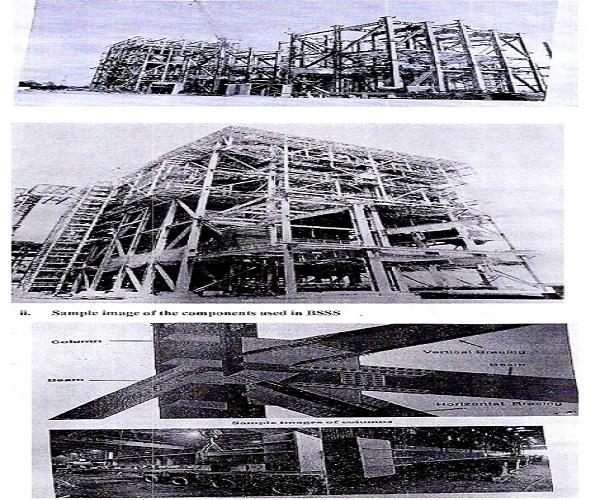
–
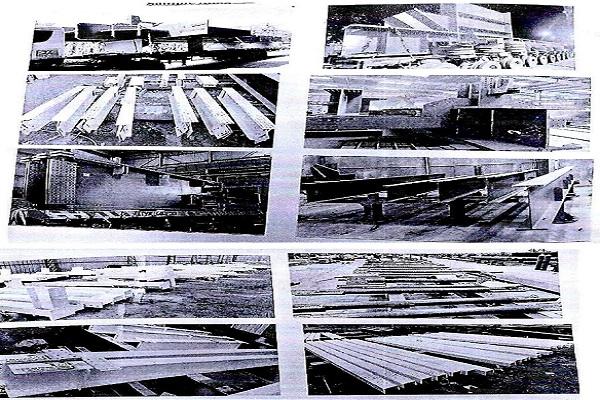
–
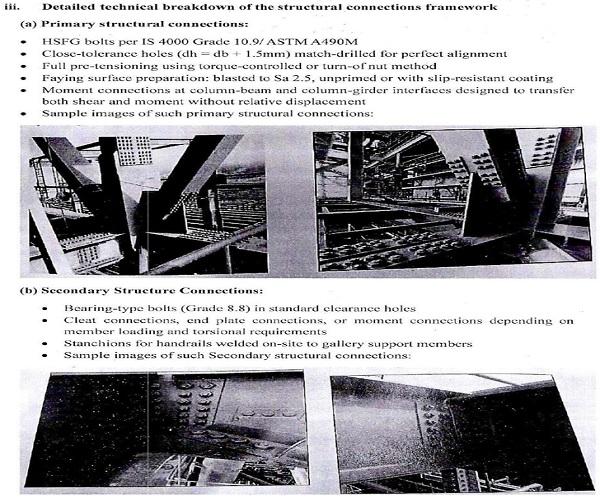
iv. Detailed List of components used in the fabrication process
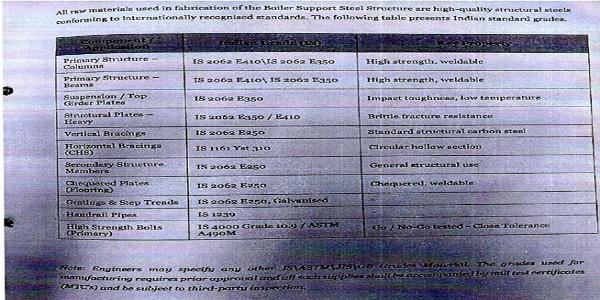
7.51 I further find that the subject goods are suitable for use solely or principally with the boilers of Heading 8402 and qualify as parts for the purposes of Section XVI Note 2(b). This conclusion is supported by the specific exclusion in the HSN Explanatory Notes to Heading 7308 for constructions clearly identifiable as machinery parts, the description of parts in the Explanatory Notes to Heading 8402, Circular No. 964/07/2012-CX dated 02.04.2012 and the principle recognised by the Hon’ble Supreme Court in Swetha Engineering Ltd. The conclusion is based on the cumulative objective characteristics and functional relationship of the subject goods with the boiler, and not solely on the Applicant’s declaration of intended use.
7.52 Accordingly, I find that the subject goods, namely, “Boiler Support Steel Structures”, as described in the application and supported by the material placed on record, merit classification as parts of boilers under Heading 8402 of the First Schedule to the Customs Tariff Act, 1975. The relevant portion of Heading 8402 and its corresponding tariff entries are reproduced below:
8402 Steam or other vapour generating boilers (other than central heating hot water boilers capable also of producing low pressure steam) super-heated water boilers
840290 Parts:
84029010 Parts of fire tube boilers
84029020 Parts of watertube boilers
84029090 Other
In view of the above, the subject goods are appropriately classifiable under CTI 84029090, as “Other” parts of boilers, provided that the goods are established to be identifiable as parts of the boiler system on the basis of their design, function and intended use, as evidenced by the material on record.
8. I rule accordingly.