DCIT (TDS) Circle Vs Sadashiv Sugars Limited (ITAT Panaji)
Background of the Case
The Panaji Tribunal held that the applicability of Section 194C to sugarcane harvesting and transportation payments requires examination of the actual contractual arrangement.
The crucial distinction was whether the sugar manufacturer paid contractors on its own account under independent contracts, or merely facilitated payments on behalf of farmers and recovered those amounts from the sugarcane price.
Finding additional evidence indicating different arrangements, the Tribunal set aside the CIT(A)’s orders deleting the TDS demands and restored the matters for fresh adjudication. It neither finally confirmed the demands nor granted blanket exemption from TDS.
Survey Results in TDS Demands
The assessee manufactured sugar and purchased sugarcane from farmers.
A survey under Section 133A on 17 February 2016 examined compliance with TDS and TCS provisions. The Department found payments to harvesting and transport contractors without deduction under Section 194C, despite the payments exceeding the applicable monetary thresholds.
The Assessing Officer treated the company as an assessee in default and raised demands under Sections 201(1) and 201(1A) for seven assessment years.
The company contended that harvesting and transportation formed part of the procurement of sugarcane. It argued that the payments were components of purchase cost rather than independent expenditure on services.
CIT(A) Accepts Composite Purchase Arrangement
The CIT(A) deleted the demands, accepting that the transactions constituted a composite arrangement for purchase of sugarcane.
On that approach, the farmers were responsible for delivery at the factory gate, and payments to harvesters and transporters formed part of the overall purchase arrangement.
The company maintained that it merely paid the contractors on the farmers’ behalf and adjusted those payments against the cane price payable.
The Revenue challenged this conclusion before the Tribunal. Its appeals, filed with an eight-day delay, were admitted after condonation.
Favourable Bengaluru Decision Relied Upon
The assessee relied on ITO v. M.S. Sadashiva Sugars Ltd., ITA No. 2364/Bang/2025, dated 6 July 2026, and Parry Sugar Industries Ltd. v. DCIT, order dated 29 May 2020.
The Bengaluru decision recognised that where harvesting and transportation costs were borne by farmers and recovered from their cane bills, the manufacturer acted as a facilitator rather than a principal engaging contractors for its own work.
In those circumstances, the payments could not be artificially separated from the procurement transaction and treated as independent contractual expenditure of the manufacturer.
However, the Panaji Tribunal found that this reasoning required comparison with the actual arrangements in the present appeals.
Contrary EID Parry Decision Required Consideration
The Revenue relied on EID Parry India Ltd. v. ITO (TDS) [2022] 140 taxmann.com 20 (Panaji–Trib.). The Tribunal noted that Sadashiv Sugars had amalgamated with EID Parry India Ltd., making that decision particularly relevant.
In EID Parry, the factual findings showed that the company independently appointed contractors, entered enforceable agreements, directed their work, maintained separate running accounts and paid advances without reference to individual farmers’ cane bills.
The company could also pursue contractual remedies against defaulting contractors.
On those facts, the earlier Bench held that the company engaged contractors on a principal-to-principal basis for services on its own account, attracting Section 194C.
The distinction therefore depended on contractual responsibility and payment mechanics, rather than the description of expenditure in the accounts alone.
Additional Evidence Indicated Different Payment Arrangements
The Tribunal examined additional documents, including farmer ledgers, harvester and transporter ledgers, and sample agreements.
Some farmer ledgers showed deduction of harvesting and transport charges from sugarcane dues, supporting the explanation that payments were made on farmers’ behalf.
Other documents showed direct payments to labour and transport contractors. A sample agreement dated 8 October 2015 required contractors to harvest and supply a minimum quantity of sugarcane daily and contained transportation-related obligations.
These documents had not been furnished before the CIT(A). It was also unclear whether the earlier EID Parry decision had been considered, since the appellate orders did not discuss it.
Fresh Examination and Bifurcation Directed
The Tribunal restored the disputes to the CIT(A) for fresh adjudication after considering the additional evidence and relevant decisions.
It directed examination, where necessary through an Assessing Officer’s remand report, of the bifurcation between payments made directly under the company’s contractual arrangements and payments made on behalf of farmers.
The CIT(A) must provide an opportunity of hearing and pass a speaking order under Section 250(6).
All seven Revenue appeals were allowed for statistical purposes.
Author’s Comments
The ruling cautions against applying either line of decisions without examining the underlying contracts. Recovery from cane bills, responsibility for harvesting and delivery, separate contractor accounts, advances and enforceable contractual rights are material indicators.
Booking harvesting charges as purchase cost does not conclusively remove Section 194C exposure. Equally, the company’s act of making payment does not alone establish that it incurred the expenditure on its own behalf.
The practical requirement is a documented reconciliation of the contractual and ledger position, supported by farmer agreements, contractor agreements and cane bills. The present order requires that factual exercise; it does not settle the TDS liability uniformly for every payment.
List of Cases Discussed / Relied Upon
1. ITO Vs MS Sadashiva Sugars Limited (ITAT Bangalore), ITA No. 2364/Bang/2025, dated 06.07.2026: The assessee relied upon this coordinate-bench decision concerning harvesting and transportation payments adjusted against the purchase price payable to farmers. The Bangalore Tribunal held that, on the facts examined there, the assessee acted as a facilitator of sugarcane procurement rather than as the principal engaging contractors for independent work. The Panaji Bench considered this decision alongside the contrary factual findings in EID Parry India Limited.
2. Inder Singh Vs State of Madhya Pradesh (Supreme Court), 2025 INSC 382, dated 21.03.2025: Relied upon by the Tribunal while condoning the Revenue’s eight-day delay in filing the appeals, after finding reasonable cause and absence of intentional delay.
3. EID Parry India Limited Vs ITO (TDS) (ITAT Panaji), (2022) 140 taxmann.com 20, decided on 20.04.2022: Relied upon by the Revenue. The Tribunal had held that Section 194C applied where the sugar company independently engaged resident harvesting and transportation contractors under enforceable agreements and made payments for services on its own account. The present Bench considered this decision significant because the same substantive issue arose and the assessee company had been amalgamated with EID Parry India Limited.
4. Parry Sugar Industries Limited Vs DCIT (ITAT Bangalore), ITA Nos. 2814/Bang/2018 and 782/Bang/2019, dated 29.05.2020: Relied upon by the assessee. The decision concerned harvesting and transportation arrangements in which farmers were responsible for supplying sugarcane and authorised the sugar factory to arrange harvesting and transportation on their behalf, with the costs recovered from cane bills.
5. DCIT & Another Vs NSL Sugar Limited (ITAT Bangalore), ITA No. 76/Bang/2017, dated 08.11.2019: Considered in the discussion of earlier judicial precedents. The decision examined sugarcane purchase bills showing harvesting and transportation charges deducted from amounts payable to farmers, supporting the treatment of those charges as part of the overall cane procurement transaction.
6. Collector, Land Acquisition, Anantnag & Another Vs Mst. Katiji & Others (Supreme Court), (1987) 2 SCC 107: Relied upon by the Tribunal in condoning the eight-day delay in filing the Revenue’s appeals.
7. Ryatar Sahakari Sakkare Karkhane Niyamit Vs ACIT (Karnataka High Court), 383 ITR 261; Supreme Court reference at 308 CTR 507: Discussed in the extensively reproduced decision in EID Parry India Limited. The case concerned TDS liability on harvesting-related payments and the significance of contractual arrangements. The quoted decision distinguished the relevant facts and noted the Supreme Court’s remand for fresh consideration.
8. CIT Vs Dwarkadheesh Sakhar Karkhana Ltd. (Bombay High Court), 2018-TIOL-118-HC-MUMB-IT: Discussed in the reproduced EID Parry India Limited judgment. The decision was distinguished on its facts, including the nature of payments to mukadams and the absence of a separately claimed deduction.
9. Shri Kamrej Vibhag Sahakari Khand Vs ITO (Special Bench), 304 ITR 1: Discussed in the reproduced EID Parry India Limited judgment. The Special Bench decision was distinguished with reference to the cooperative society’s bye-laws, the obligations of farmer-members and the manner in which harvesting and transportation payments were adjusted against sugarcane bills.
FULL TEXT OF THE ORDER OF ITAT PANAJI
The captioned appeals at the instance of Revenue pertaining to 2009-10 to 2012-13 and 2014-15 to 2016-17 are directed against the separate orders of ld. NFAC, Delhi emanating out of respective Orders passed u/s.201(1) & 201(1A) of the Income Tax Act, 1961 (in short ‘the Act’).
2. Registry has pointed out that the appeals are barred by limitation as the Revenue has filed the appeals before this Tribunal with a delay of 8 days. Revenue has filed application for condonation of delay stating the reasons which led to delay. On due consideration of the said reasons, We find that ‘reasonable cause’ prevented the Revenue from filing the appeals within the stipulated time limit. We find that the delay is not intentional and therefore placing reliance on the judgments of Hon’ble Apex Court in the case of Collector, Land Acquisition, Anantnag & Anr. Vs. Mst. Katiji & Ors. reported in (1987) 2 SCC 107 and in the case of Inder Singh Vs. State of Madhya Pradesh judgment dated 21.03.2025 (2025 INSC 382) condone the delay of 8 days in filing the appeals before this Tribunal and admit the appeals for adjudication.
3. The common grievance raised by the Revenue is against the finding of ld.CIT(A) deleting the following demand raised by the Assessing Officer in the order u/s.201(1)/201(1A) for non-deduction of tax at source u/s.194C of the Act on the alleged payments made to Harvesting and Transport Contractors :
| A.Y. | Demand u/s.201(1) | Demand u/s.201(1A) |
|---|---|---|
| 2009-10 | Rs.1,86,714/- | Rs.1,56,828/- |
| 2010-11 | Rs.96,67,819/- | Rs.81,20,968/- |
| 2011-12 | Rs.80,02,129/- | Rs.57,61,533/- |
| 2012-13 | Rs.2,10,65,286/- | Rs.1,26,39,172/- |
| 2014-15 | Rs.83,61,409/- | Rs.20,06,712/- |
| 2015-16 | Rs.28,55,680/- | Rs.3,42,672/- |
| 2016-17 | Rs.25,59,483/- | Rs.3,07,138/- |
4. Before us, ld. Departmental Representative vehemently argued supported the orders of the Assessing Officer. In support of his contention, he relied on CBDT Circular No.5/2024 dated 15.03.2024 and the decision of Panaji Bench in the case of EID Parry India Limited Vs. ITO (TDS) reported in (2022) 140 taxmann.com 20 (Panaji – Trib.)
5. On the other hand, ld. Counsel for the assessee placing reliance on the decision of Coordinate Bench, Bangalore in the case of ITO Vs. MS Sadashiva Sugars Limited – ITA No.2364/Bang/2025, dated 06.07.2026 as well as decision of Coordinate Bench, Bangalore in the case of Parry Sugar Industries Limited Vs. DCIT – ITA Nos. 2814/Bang/2018 and ITA No.782/Bang/2019 order dated 29.05.2020 submitted that in the instant case also the facts are identical as the harvesting and transport charges are borne by the farmers and are adjusted against the sugarcane price payable and that the assessee merely facilitates the arrangement.
6. We have heard the rival submissions and perused the record placed before us. We observe that the assessee is a Limited Company engaged in production of sugar. A survey u/s.133A of the Act was conducted at its business premises on 17.02.2016 to verify compliance of TDS/TCS provisions. Survey team observed that the assessee had engaged number of contractors called as Harvesting Contractors for harvesting (cutting) the sugarcane grown by the farmers and also made payments to Transport Contractors. However, the assessee has not deducted the tax at source u/s.194C of the Act for the payments made to these harvesting and transport contractors even when such payments exceeded the monetary limit prescribed u/s.194C of the Act. However, during the course of proceedings carried out u/s.201(1)/201(1A), it was submitted by the assessee that no tax is deductible on payment of purchase of goods because the amount paid towards harvesting sugarcane and transport of goods is part and parcel of the cost of the sugarcane purchased. It is also claimed by the assessee that harvesting and transport charges are not specifically debited in the profit and loss account as an expenditure in the nature of services since the assessee books the purchases as part of cost of raw material which includes the alleged payments. It is also claimed before the Assessing Officer that harvesting charges received by the harvesting contractors are in the nature of Agricultural income and that the harvesting charges are included in the value of closing stock and any disallowance made u/s.40(a)(ia) of the Act will amount to double taxation. However, ld. Assessing Officer was not satisfied with these submissions and he considered the assessee in default for non-deduction of tax u/s.194C of the Act and calculated the TDS amount for A.Y. 2009-10 at Rs.1,86,714/- and also the interest amount of Rs.1,56,828/-. Similar working has been made for the impugned assessment years. Aggrieved assessee preferred appeal before ld.CIT(A) and on consideration of the settled judicial precedents including the decision of Coordinate Bench in the case of NSL Sugars Limited in ITA No.1228/Bang/2017 for A.Y. 2012-13 held that the payments of harvesting and transporters is composite arrangement and cannot be seen in delineated manner and is very well part of purchase of goods and not that of the independent contract to harvest and transport sugarcane. Ld. CIT(A) further held that responsibility of farmer is to deliver goods at the factory gate of appellant in order to complete the transactions of purchase of sugarcane. The payments made to harvestor and transporter is forming part of overall arrangement with farmer for purchase of goods and that the assessee has not made payment for harvesting and transporting sugarcane in isolation. Aggrieved Revenue is now in appeal before this Tribunal.
7. The only issue for our consideration is whether ld.CIT(A) erred in deleting the demand raised by the Assessing Officer treating the assessee in default for non-deduction of tax at source u/s.194C of the Act on the payments made to harvesting and transport contractors. We find that the assessee is manufacturer of sugar and in the course of this activity purchases the sugarcane from farmers which is raw material for manufacturing sugar. In the process of purchasing the raw material, i.e. sugarcane, the assessee makes the payment to various harvesting and transport contractors. It has been contended by ld. Counsel for the assessee that assessee merely makes the purchase of sugarcane and against the total purchase consideration as agreed with the farmer assessee makes payments to the harvesting and labour contractors on behalf of the farmers. Ld. Counsel for the assessee placed reliance on the decision of Coordinate Bench, Bangalore in the case of ITO Vs. MS Sadashiva Sugars Limited (supra) contended that similar issue has been dealt with and the relevant finding of the Tribunal reads as under :
“21.8 In the present case, however, the harvesting and transport charges are not claimed as a separate expenditure of the assessee. The material placed before us demonstrates that such payments were merely adjusted against the purchase price payable to the farmers. The assessee was acting only as a facilitator for procurement of sugarcane and not as a principal engaging contractor for carrying out work on its own behalf. Therefore, the factual matrix before the Hon’ble Karnataka High Court, in our humble understanding, is clearly distinguishable and the ratio of the said decision cannot be mechanically applied to the facts of the present case.
21.9 We also find considerable force in the reasoning adopted by the learned CIT(A) that the arrangement in question is a composite arrangement for purchase of sugarcane. The harvesting and transportation activity cannot be artificially segregated from the overall procurement transaction. Once it is accepted that the responsibility for harvesting and delivery rests with the farmer and the corresponding cost is recovered from the cane price payable to him, the payment made by the assessee to harvesters partakes the character of a component of purchase price rather than a payment under an independent works contract. Considering the totality of the facts and circumstances of the case, the documentary evidence placed on record, the contractual terms governing procurement of sugarcane, and respectfully following the decision of the coordinate bench in the case of Parry Sugar Industries Limited. (supra), we hold that the provisions of section 194C of the Act were not attracted to the harvesting and transport charges in the facts of the present case. Consequently, no disallowance under section 40(a)(ia) of the Act could have been made. Accordingly, we find no infirmity in the order of the learned CIT(A) deleting the disallowance of Rs. 10,78,58,310/-. The same is upheld and the grounds raised by the Revenue are hereby dismissed.”
8. On the other hand, ld. DR before us has referred to the decision of the Tribunal in the case of EID Parry India Ltd. Vs. ITO (TDS) reported in (2022) 140 taxmann.com 20 (Panaji-Trib.). We note that the assessee company has also been amalgamated with EID Parry India Ltd. and therefore the decision rendered by this Tribunal in the case of EID Parry India Ltd. Vs. ITO has much greater significance as the very same issue has been dealt where also TDS deduction u/s.194C was not made for the payments made towards harvesting and transport contractors and the assessee has been claiming that it is only purchasing the sugarcane from the farmers and the payments to the harvesting contractors and transporters are made on behalf of the farmers. However, this Tribunal has decided against the assessee observing as follows :
“6. After hearing to the rival contentions of both the parties; perused material placed on records and duly considered the facts of the case in the light of settled legal position and the case laws relied upon by the appellant assessee as well the respondent revenue.
7. It is evidently noticeable form the records that;
7.1 The primary issue in the present controversy is, as to whether the payment to harvesting contractors is a payment towards contracted services availed by the appellant, so has to attract the provision of section 194C of the Act & consequential liability to deduction tax at source (TDS).
7.2 It is palpable that, pursuant to a survey proceedings u/s 133A, the assessee company was called upon to produce details regarding harvesting charges paid to the respective contractors in excess of ceiling ₹30,000/- in each case and in aggregate exceeding ₹75,000/- and to showcase the TDS/TCS compliance (if any) made relating thereto. Based on the records, submissions, and the confirmation in the form of statement recorded of deductor represented by AGM-Finance & Accounts of the company “Shri Santosh Ponnappan” and its senior executive finance “Shri Revanappa Todkar” it was alleged by the Ld. AO that, the appellant company for the payments made to harvesting contractors was liable to deduct TDS at the prescribed rate u/s 194C but failed to deduct applicable TDS and insofar as payment to transport contractors is concern, the assessee was failed to deduct the TDS from the payment of those transport contractors whose PAN has not been placed on records u/s 194(6) of the Act. However, the appellant company in its defence through written submission tendered fourfold contention before the Ld. AO such were;
a. No tax is deductible on payment of purchase of goods as the payment made to harvesting contractors is part and parcel of cost of goods of sugarcane purchased.
b. Harvesting charges are not debited to Profit & Loss account of the company as expenditure in the nature of services and same is booked as part of cost of raw material.
c. No tax is deductible on the agricultural income as the harvesting charges paid to harvesting contractor are in the nature of agricultural income in the hands of recipients and
d. Harvesting charges are included in the value of closing stock and any disallowance u/s 40(a)(ia) will amount of double taxation.
e. Payments to contractors were made on behalf of farmers who are the prime source of supply of raw-material i.e., sugarcane.
7.3 Considering the written submissions, copy of one sample agreement entered for the sugar season year 2014-2015 with “Shri Gulappa Ningappa Haranatti” and in the light of statement recorded u/s 133A of “Shri Santosh Ponnapan” an Asstt General Manager (Finance & Accounts) of the assessee company, the Ld. AO, confuting each of the foresaid defence taken by the appellant, deduced that;
a. Contract for harvesting cannot be claimed as contract for purchase of goods.
b. Mere colouring of harvesting expenditure as purchase of raw material would not change the basic characteristic of the expenditure and liability to deduct.
c. The non-taxability of payment in the hands of recipient contractors cannot absolve the deductor from the statutory liability cased under chapter XVII of the Act, and
d. The 201(1) & 201(1A) proceedings are unconnected with disallowance of expenditure u/s 40(a)(ia) of the Act.
7.4 Nota bene, as regards to appellants claim that, the payments to harvesting contractors were made on behalf of the farmers was controverted by the Ld. AO with following categorical findings as laid at Para 3 of page 3 of the assessment order;
“The claim of the deductor that payment to the harvesting contractor is made on behalf of the farmers was verified with the help of the contract which the deductor made with the harvesting contractors and it is found that the claim of the deductor is factually incorrect for the following reasons;
i) The harvesting contractors are appointed by the deductor and an agreement is made between the deductor and the harvesting contractors.
ii) The payment to the harvesting contractors is made by the deductor through the cheques and the expenditure is debited in the books of accounts of the deductor.
iii) The cane staff of the deductor allots the harvesting contractors the sugarcane field which are supposed to be harvested. The harvesting contractors work as per the direction of the deductor.
iv) The deductor takes legal action against the harvesting contractors who do not fulfil the terms of the contract as agreed by the deductor and the harvesting contractor. The deductor has produced documents wherein it is noticed that, the deductor has actually filed a civil suit for breach of contract against a harvesting contractors.” (Emphasis supplied).
7.5 Further from the statement recorded in the course of survey, the Ld. AO attempted to establish on record that, the appellant procures/d the sugarcane either at ex-gate price or at gate price at the option of the farmers, leaving them with an option to avail the services of harvesting and transporters independently, consequently price for the raw material is bifurcated into two parts; first part to the farmers towards cost of sugarcane and second part towards cost of harvesting and transport. It was also brought on records that, the appellant company in respect of aforesaid transactions generates two separate bills, wherein the cane bill is generated in the name of the supplying farmer and the separate bills of harvesting contact services & transport contract services are generated in the name of the respective contractors and the same were settled without reference to sugarcane bills through running account maintained for each of contractor separately in terms of agreement or contract entered into.
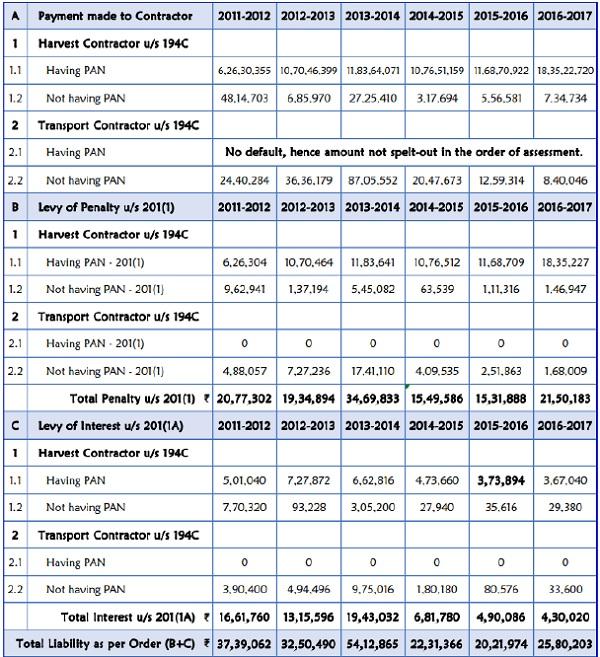
7.6 The appellant before the Ld. AO under a statement has confirmed that, there are three sources through which appellant engages services of harvesting and transportation of raw material namely; (a) from the open market, (b) through its own sources and (c) through farmers. The consideration for contact services is paid directly to the contractors in advance through running accounts and such accounts are finally settled at the end of each crushing season without reference to sugarcane bill raised. During assessment proceedings, the Ld. AO’s made categorical observation as regards to engagement of contractor for harvesting of sugarcane for company and payments were made to those contractors without deduction of TDS u/s 194C of the Act in-spite the individual / single payments were exceeded the ceiling of ₹30,000/- or the aggregate annual payment to the individual / single contractor exceeded the ceiling of ₹75,000/-. From statement recorded, the Ld. AO observed that, the assessee company engaged these harvesting contractors and transport contractors on its own account and not at the bequest of supplying farmers, furthermore the appellant was engaging them without reference to any farm field but under an open contract, whose financial accounts were settled based upon the quantum of services rendered at the end of each crushing season, thus these payments were noting but in the nature of contractual payments for independent services availed within the meaning of section 194C of the Act and hence held as liable to make TDS from such payments made to its harvesting contractors, however the company failed to deduct tax at source u/s 194C of the Act.
Resultantly by an orders u/s 201(1) and 201(1A) of the Act, Ld. AO held the appellant company as “deemed to be an assessee in default”, for the following assessment years for sums mentioned there against and computed consequential penalty u/s 206AA(1) of the Act, with the following demands.
8. Aggrieved, in an appeal before first appellate authority, the assessee company through its authorised representative [for short “AR”] filed analogous submission and in sum & substance contended that, harvesting activity is a part and parcel of growing sugarcane which is done by the farmers, for which the company is facilitating the farmers in harvesting activity by paying gang leader who takes care of the said activity as the farmer is not found be expert in carrying these techniques. It is also contended before the Ld. CIT(A) that, total cost of sugarcane in fact include cost payable to farmer and harvester as raw material are delivered at the factory gate, and the claim of expenditure is eligible expenditure. To buttress the non-applicability of provisions of section 194C, it is also contended that, no tax is deductible on agricultural income as these payment falls into and in support of contention relied upon plethora of judicial pronouncements. In given facts & circumstances of the case and bone of contentions laid by the appellant, did not impress the Ld. CIT(A), resultantly echoed with the views of Ld. AO and relying upon the Hon’ble Jurisdictional High Court decision in “Ryatar Sahakari Sakkare Karkhane Niyamit Vs ACIT” reported in 383 ITR 261 (Kar), acceded with the assessment framed, in holding that, impugned payments are subject matter of TDS and the assessee company failed to comply with the requirement of section 194C and consequently upheld the assessments orders in toto.
9. Aggrieved, appellant company is before us alleging the action of both the tax authorities as factually incorrect & bad in law and in supports of its claim Ld. AR during the course of hearing heavily relied upon the decision of co-ordinate bench in “M/s Parry Sugar Industries Limited Vs DCIT” ITA No 2814/Bang/2018 and 782/Bang/2019 (order dt 29/05/2020).
10. Au contraire, Learned Counsel for the Revenue [for short “DR”] opposing the appeals filed by the assessee contended that, Section 194C of the Act mandates the payer assessee to deduct tax at source from sum paid to carry out any work in pursuance of separate contracts entered on principal-to-principal basis between the company and harvesters. As a consequence of failure to comply with Section 194C of the Act, for such payment made without deduction of tax at source, the Ld. AO has rightly treated the appellant as “assessee-in-default”, and in support of aforesaid contention, the Ld. DR also heavily relied on the orders of authorities below and placed reliance on the decision of Hon’ble Jurisdictional High Court in “Ryatar Sahakari Sakkare Karkhane Niyamit Vs ACIT” (Supra).
11. Since the genesis of controversy is non deduction of taxes from source payment, we consider it inexorable to quote relevant provisions of law at this juncture;
194C. Payments to contractors.
(1) Any person responsible for paying any sum to any resident (hereafter in this section referred to as the contractor ) for carrying out any work (including supply of labour for carrying out any work) in pursuance of a contract between the contractor and a specified person shall, at the time of credit of such sum to the account of the contractor or at the time of payment thereof in cash or by issue of a cheque or draft or by any other mode, whichever is earlier, deduct an amount equal to
(i ) . . . . . . .
(ii ) . . . . . . .
(2) Where any sum referred to in sub-section (1) is credited to any account, whether called “Suspense account” or by any other name, in the books of account of the person liable to pay such income, such crediting shall be deemed to be credit of such income to the account of the payee and the provisions of this section shall apply accordingly.
(3) Where any sum is paid or credited for carrying out any work mentioned in sub-clause (e) of clause (iv) of the Explanation, tax shall be deducted at source—
(i) . . . . . . .
(ii) . . . . . . .
(4) . . . . . . .
(5) No deduction shall be made from the amount of any sum credited or paid or likely to be credited or paid to the account of, or to, the contractor, if such sum does not exceed thirty thousand rupees:
Provided that where the aggregate of the amounts of such sums credited or paid or likely to be credited or paid during the financial year exceeds seventy-five thousand rupees, the person responsible for paying such sums referred to in sub-section (1) shall be liable to deduct income-tax under this section.
(6) No deduction shall be made from any sum credited or paid or likely to be credited or paid during the previous year to the account of a contractor during the course of business of plying, hiring or leasing goods carriages, on furnishing of his Permanent Account Number, to the person paying or crediting such sum.
(7) The person responsible for paying or crediting any sum to the person referred to in sub-section (6) shall furnish, to the prescribed income-tax authority or the person authorized by it, such particulars, in such form and within such time as may be prescribed.
Explanation.—For the purposes of this section,—
(i) “specified person” shall mean,—
(a) the Central Government or any State Government; or (b) any local authority; or (c) any corporation established by or under a Central, State or Provincial Act; or (d) any company; or (e) any cooperative society; or (f ) any authority, constituted in India by or under any law, engaged either for the purpose of dealing with and satisfying the need for housing accommodation or for the purpose of planning, development or improvement of cities, towns and villages, or for both; or (g) any society registered under the Societies Registration Act, 1860 (21 of 1860), or under any law corresponding to that Act in force in any part of India; or (h) any trust; or (i) any university established or incorporated by or under a Central, State or Provincial Act and an institution declared to be a university under section 3 of the University Grants Commission Act, 1956 (3 of 1956); or (j) any Government of a foreign State or a foreign enterprise or any association or body established outside India; or (k) any firm; or (l) any person, being an individual or a Hindu undivided family or an association of persons or a body of individuals, if such person,—
(A) does not fall under any of the preceding sub-clauses; and
(B) is liable to audit of accounts under clause (a) or clause (b) of section 44AB during the financial year immediately preceding the financial year in which such sum is credited or paid to the account of the contractor;
(ii) “goods carriage” . . . . . . . .
(iii) “contract” shall include sub-contract;
(iv) “work” shall include —
(a) advertising; (b) broadcasting and telecasting including production of programmes for such broadcasting or telecasting;
(c) carriage of goods or passengers by any mode of transport other than by railways; (d) catering; (e) manufacturing or supplying a product according to the requirement or specification of a customer by using material purchased from such customer, but does not include manufacturing or supplying a product according to the requirement or specification of a customer by using material purchased from a person, other than such customer.] (Emphasis supplied)
11.1 From the text of the provision, it can be evinced that, the prime constituent of section 194C of the Act are fourfold viz; a specified person responsible for making payment to a resident for work in pursuance of a Contract with such specified person. Any transaction which is characterised with aforestated four key constituents, shall be mandatorily liable for compliance u/s 194C of the Act.
11.2 Insofar as the present case is concern, of the above four, three constituents remained undisputed that, the assessee is a company falling with the ambit of specified person in terms of clause (i)(d) of explanation to section 194C of the Act, the payee namely harvesting & transport contractor are resident in India and the company indeed has entered into contracts with various harvesting contractors (by whatever name called or referred). Surviving controversy spins around the fourth constituent i.e. “any work or work”. The definition of “work” under the provision is not exhaustive but inclusive, and although circular issued by the Central Board of Direct Taxes [for short “CBDT”] vide circular No. 715 dt 08/08/1995, 716 dt 09/08/1995 has broadly clarified the applicability of section 194C of the Act to all type of contracts for carrying out any work, however applicability in each case needs to be examined with reference to the terms of each contract. In substance this section applies to each and every contract where the predominant factor of contract is service, per contra when contract is for supply of goods or material, the provision of sub-section 3 per se carves out the application of 194C.
11.3 We are not unmindful to the incontrovertible facts of these present appeals such as, the appellant before us is a company and during the periods under consideration was engaged in the business of manufacturing / production of sugar by running various sugar factories, the assessee’s specific case is that, the farmers are not the members of assessee company and are paid value of sugarcane on the basis of sugarcane bill raised separately, and such bill value is exclusive of harvesting and transportation charges. Further the unique feature of the case under adjudication is that, for the purpose, the assessee entered into contracts with various harvester for a term (referred them by whatever name called), on principal-to-principal basis, without reference to any field to be served and the farmers are not at all the party to any of such contract or agreement entered between the assessee and the contractors. Such principal contractors are in turn engaged for services in terms of contract & as per the requirement of the appellant contractee. Further the assessee company pursuant to contractual right, is independently capable bringing suit against the contractors for breach of any contractual terms without the reference to farmer or field. It is also an admitted fact that, in terms of open contract or agreement, the assessee extends advance payments to the contractors creating a contractual rights and obligation without reference to farm-field or farmer and raises a separate bill for harvesting services against the services availed from respective contractors and the financial accounts of each of such contractors is settled at the end of each crushing seasons. Eventually the total payments made towards harvesting services and transport services availed by the company, is then added to the total cost of material in terms generally accepted accounting principle and norms of inventory valuation regularly employed by the appellant company.
11.4 In this backdrop of undisputed facts, the case of the assessee for various years were taken for scrutiny and according due opportunity, the Ld. AO clearly brought on record that, the assessee company since engaged these resident contractors on its own account on principal-to principal basis, for a services under a valid enforceable contracts and paid them sum of money in terms of such contracts / agreements for the services availed, consequently, held as liable to comply with the provisions of sections 194C. The Ld. CIT(A), reconsidering the factual position in the light of judicial precedents, concurred with the findings of the Ld. AO. In these facts and circumstance, we prima-facie are not able to persuade ourselves to accept the argument of Ld. AR for the reason laid in immediately preceding paragraphs. In our view, it is hardly any legal ground for consideration as the non-compliance of statutory obligations shall always have their own consequences to flow.
11.5 Before eventide the adjudication, we turn no deaf ear to the decision of co-ordinate bench in the case of “M/s Parry Sugar Industries Limited Vs DCIT” (Supra) referred by the Ld. AR, however the adjudication in the afore-referred case prima facie does not help the appellant company in as much as, while dealing with allowability of harvesting and transportation expenses with reference to section 40(a)(ia) r.w. CBDT circular, has categorically vide para 8 of its order, observed that, the “farmer by a written agreement vide clause 8 requested the assessee to engage the service on his behalf and authorised to recover cost of such harvest and transport services from his cane bill” and it is noteworthy to reproduce the relevant observation to smoke the reliance;
“8. Harvesting and supplying of cane to the factory is my responsibility, however for any reason if it is not possible, on my request the factory can arrange both harvesting and transportation on my behalf and I do not have any objection to the deduction of costs of such harvesting and transportation from my cane bill. Further, I agree to make appropriate inner roads to the plots to facilitate smooth transportation of cane from the field to the factory and extend all such help that may be required in this respect. In case the factory has to incur expenses to lay such roads, I agree to deduction of such cost(s) from my cane bill.”
(Emphasis supplied)
11.6 In the instant case, the Ld. AO contrariety, from the copy of agreement entered for the sugar season year 2014-2015 (applicable year) and in the evince of the statement recorded, has undoubtedly brought on records dissimilar facts as against the fact of the case adjudicated by the co-ordinate bench referred in foregoing para, which Ld. AR did neither controvert nor brought any deprecative material in rebuttal, except contending that, in the present case there wasn’t any disallowance of expenses u/s 40(a)(ia) of the Act, which is not the matter of adjudication before us. In resting the case, the appellant assessee has also relied upon the decision of Hon’ble Supreme Court in the case of “Ryatar Sahakari Sakkare Karkhane Niyamit Vs ACIT” reported at 308 CTR 507 (SC), however we find that, the appeal of the assessee therein is remanded back to the Hon’ble Jurisdictional High Court to decide the appeal a fresh on merits in accordance with law, consequently, would be of no help to the appellant company before us, for the reason of dissimilar facts as to constitution of appellant, relation of farmer with that of appellant, mandate of bye-laws, mode of raising bills and contract or agreement with contractors etc. Insofar as the decision of Hon’ble Bombay Hight Court in “CIT Vs Dwarkadheesh Sakhar Karkhana Ltd” (2018-TIOL-118-HC-MumbIT) is concern, at the outset, it shall be indispensable to mention that, the Hon’ble High court dismissed the aforesaid appeal in the absence of substantial question of law arising out of the order of lower authorities. Nevertheless the facts therein in its entirety dissimilar with that of facts of the case before us, and few of such dissimilarities of case relied are noteworthy to make mention of;
a. no separate deduction was even claimed for the aforesaid payment to harvesting and transport contractor,
b. copy of contract pertaining to assessment under adjudication was before the authorities
c. amount were paid to mukadams
d. the payment to mukadams as Bakshish
e. no separate deduction of amount paid as Bakshish to mukadams
11.7 Before reaching the estuary of adjudication, it is necessary to quote relevant portion of operating para number 26 of adjudication laid in the case of “DCIT & Another Vs NSL Sugar Limited” (ITA/76/Bang/2017) dt. 08/11/2019, which was also relied upon the Ld. AR, to showcase the distinguishable facts;
26. We have perused the paper-book filed by the assessee containing sample bills for purchase of sugarcane issued by the assessee. The sample bill shows the value of cane supplied by individual farmers and the transportation & harvesting charges are shown as deduction, which by implication means that the cane price is inclusive of transportation & harvesting charges.
(Emphasis supplied)
Au contraire, in the present case under adjudication, it is an well founded fact that, two separate bills viz; one for supply of cane in the name of the farmer and one for the harvesting services were raised and payments were undeniably made thereagainst separately without reference to each other. While adjudicating aforesaid case, the coordinate bench also considered the ration laid in the other two cases relied upon by the appellant company before us, hence we are not inclined to duplicate the dissimilar findings here again.
11.8 Nota bene, the decision of Special bench in the case of “Shri Kamrej Vibhag Sahakari Khand Vs ITO” reported in 304 ITR 1 is also of no help to the appellant before us for the reason again of distinguishable / dissimilar facts which are noteworthy to mention as;
a. the assessee was a co-operative society and bye-laws invariably provided that, only farmers can become members of assessee society,
b. supplier farmer were members of the said society who in terms of clause 2(A) & 6(A) of its bye-laws, the farmer-member were under obligation to supply the cane at the factory date of the society,
c. invariably the payment to contractor were made by the assessee society out of retention of sugarcane supplies bill owned to farmer-members etc.
11.9 As a final resort but Interestingly, the appellant submitted a copy of purchase agreement entered on 18/08/2016 in the local language “Kannada” whereas the entire draft is in “Kannada” and demographical details are in English. Although uncertified, free translation copy thereof has been placed before us, however no contract / agreement pertaining to any of the five years under consideration brought before the bench controverting established the facts, in the absence thereof, findings of Ld. AO concluded on the basis of contact / agreement entered for sugar season year 2014-2015 reinforced. Per contra the appellant failed to establish on records that, there exist a contract between the farmer and the harvesting contractor on principal basis for harvesting of sugarcane at the behest of farmer to the assessee and the consideration for such harvesting is paid by the assessee out of the payment due to farmer against sugarcane supplied bill. The Ld. AR in resting the submission adverting para 4 of the assessment order (referring answer to question number 8 of statement recorded) candidly brought to our notice that, the company from the financial year 2016-2017 has started making TDS from the payments made to harvesting contractor, however this is in no way have any implication on the present adjudication.
12. Considering the entire conspectus of the case and in the light of foregoing findings vis-à-vis discussion, we find substantial force in the view of the lower tax authorities, consequently we do not hesitate to upheld the orders of assessments with no infirmity to the effect that; assessee company having incurred itself liable, has defaulted in terms of section 201(1) and thereby exposed itself to consequential provisions of section 201(1A) & 206AA(1) of the Act
13. Resultantly, the appeals of the assessee are dismissed in term of aforesaid observation.
9. In the above decision, this Tribunal has held that since the assessee company has engaged resident contracts on its own account on principal to principal basis for services under valid enforceable contracts and paid them sum of money interms of such contract for services availed, which is liable to comply with the provisions of section 194C of the Act and in absence of such deduction of tax, the assessee has defaulted in terms of section 201 and is also liable to pay interest u/s. 201(1)/201(1A) of the Act. We are conscious of the fact that this Tribunal in the case of EID Parry India Ltd. (supra) has been pronounced on 20.04.2022 whereas the decision of Coordinate Bench, Bangalore referred and relied on by ld. Counsel for the assessee is pronounced on 06.07.2026
10. Further, we also notice that the assessee has furnished various additional evidences in the form of details of farmers doing own harvesting/transport and company organised harvesters and transporters are being paid but in majority of the cases assessee company is paying for the transport and harvesting. In these additional evidences one of the sample agreement for harvesting and transporting dated 08.10.2015 is also placed on record entered into between the assessee company and the contractor namely Rajendra Tulasiram Kekan and others agreeing to harvest and supply minimum of 18 Metric Ton sugarcane per day. Further the contractor shall also furnish the necessary documents of the vehicle which will be used for transporting the sugarcane and the rate of transport charges will be agreed mutually between the parties under this agreement. Assessee has also furnished documents in the paper book dated 06.04.2026 under the heading ‘Additional Evidences’ for the system generated and certified copies of sample Farmer Ledger, Harvester and Transporter ledger. These details shows that in some cases the sample Farmer Ledgers indicate that against the sugarcane supply dues the assessee has made deduction for transportation and harvesting charges indicating that they have been paid on behalf of the farmers but details are also available for the labour contract payments made to persons namely Baburao Shamrao Nande and similarly for transport payments to the contractors namely Bhagavan Tukaram Patole who are apparently not the farmers. All these additional evidence were not filed before ld.CIT(A). Further, it is also not clear as to whether the decision of this Tribunal in the case of EID Parry India Ltd. (supra) was placed before ld.CIT(A) as there is no discussion about the same.
11. Considering the overall facts and circumstances of the case, the decision of this Tribunal dated 20.04.2022 in assesee’s own case rendered dealing with the very same issue, various additional evidences filed by the assessee relating to payments to the contractors for transportation and harvesting charges and including sample agreements, we deem it appropriate to restore the issue raised in the instant appeals to the file of ld.CIT(A) for afresh adjudication considering the observations made hereinabove and then decide in accordance with law and if necessary call for a Remand Report from the Assessing Officer and also details from the assessee about the bifurcation of transportation and harvesting charges which have been paid directly by the assessee company to the contractors as well as paid on behalf of the farmers which have not been subjected to TDS. Needless to mention that ld.CIT(A) shall afford due opportunity of hearing to the assessee and pass a speaking order as contemplated u/s.250(6) of the Act. Impugned orders are set aside and effective grounds of appeal raised by the Revenue for the assessment years under consideration are allowed for statistical purposes.
12. In the result, all the appeals of the Revenue are allowed for statistical purposes.
Order pronounced on 15th October 2026 under Rule 34(5) of the Income Tax (Appellate Tribunal) Rules, 1963.