Summary: The Goods and Services Tax Appellate Tribunal (GSTAT) has introduced a Standard Operating Procedure (SOP) for transfer of appeals involving identical questions of law before different Benches. This procedure is particularly relevant to companies operating in several States through multiple GST registrations linked to one Permanent Account Number (PAN). Such businesses may face separate assessments and first appellate orders on the same legal issue, creating the risk of repeated litigation and inconsistent decisions. The SOP provides a portal-based facility called “Transfer of Appeal Filing”, through which eligible appeals can be selected and grouped for consideration by an appropriate Bench. However, the documented SOP applies only where multiple GSTINs belong to the same PAN and the appeals raise an identical question of law. The article distinguishes this facility from the wider statutory power of the GSTAT President under Section 109(6) of the CGST Act, 2017. Subject to Section 109(5), the President may distribute Tribunal business and transfer cases between Benches through general or special orders. Unlike the SOP, this power is not expressly restricted to appeals involving one PAN. Notification S.O. 4219(E), dated 17 September 2025, identifies specified categories of appeals requiring hearing by the Principal Bench, including cases pending before two or more State Benches where the President is satisfied that an identical question of law is involved. The SOP involves logging into the GSTAT portal, selecting qualifying appeals, verifying particulars, providing representative details, uploading documents, completing a checklist and submitting the application to obtain an acknowledgement. Nevertheless, it does not expressly clarify filing fees, required documents, Bench selection criteria, processing timelines or the consequences for existing individual appeals. For situations outside the SOP, the article discusses a practical approach of addressing a written request to the Registry for consideration by the President, while expressly recognising the absence of a documented procedural route and the discretionary character of the transfer power. Both mechanisms must be distinguished from the independent statutory requirements governing individual appeals. Each appeal must be instituted within its applicable limitation period and comply with its own pre-deposit, filing fee and procedural obligations. Grouping or transferring cases does not itself extend limitation or cure defects in an individual appeal. The central recommendation is to identify the legal question precisely, maintain complete appeal records, choose the appropriate route and preserve consistency across any requests made to the Tribuna
Transfer of GSTAT Appeals: SOP Route, Clubbing of Appeals and President’s Power | One Question, Many Benches: Clubbing GSTAT Appeals Through the SOP and the President’s Power
A company registered in several States has a separate GSTIN in each, all under one PAN. If it loses the same point at the first appeal in each State, it does not have one dispute. It has several, each with its own order, appeal number and Bench, and each capable of producing its own answer. The same argument is prepared and presented more than once, and the results may differ. Where such issues are now listed to hear by GSTAT depending on the territorial jurisdiction, that risk arises now.
The GSTAT has issued a Standard Operating Procedure (SOP) for Transfer of Appeals, which describes a portal facility, “Transfer of Appeal Filing”, for this problem. But the SOP covers one situation only. Outside it, the route is the President’s power under the Act. This article keeps the two scenarios apart: Scenario A, the SOP route; and Scenario B, the President’s power under Section 109(6) of the CGST Act, read with Notification S.O. 4219(E).
WHAT THE SOP SAYS. The SOP is for a taxpayer with “multiple GSTINs linked to the same PAN of the company” that has filed appeals before various Benches raising an identical question of law. Such a taxpayer “may consolidate such matters through a single Transfer Appeal”. The SOP speaks of the same PAN and of no other case. Treat the portal facility as limited to one PAN.
- The Two Routes at a Glance
- Scenario A: The SOP Route (Same PAN Only)
- The Steps Under the SOP
- The Screens
- What the SOP Does Not Tell You
- Scenario B: The President’s Power
- When Scenario B Is the One to Consider
- How to Approach It, and What Is Not Documented
- Choosing Between the Routes
- A Practical Method for Either Route
- Companions to Either Route
- Cautions
- Conclusion
The Two Routes at a Glance
| Particulars | Scenario A: the SOP | Scenario B: the President’s power |
|---|---|---|
| Source | SOP for Transfer of Appeals, issued by GSTAT. | Section 109(6) CGST Act, subject to Section 109(5); S.O. 4219(E) of 17 Sept 2025 for the Principal Bench. |
| Who | A taxpayer with several GSTINs under the same PAN. | Not limited by PAN on the statute’s wording. This is the route to consider for different PANs, such as companies of one group, or other cases the SOP does not cover. |
| How | Online: a single Transfer Appeal created from the Appellant Corner. | No application procedure found in the Procedure Rules. A written request to the Registry for the President’s consideration; confirm the mode with the Registry. |
| Who decides the Bench | The SOP speaks of an “appropriate Bench”. It does not state the criteria. | The President, by general or special order. S.O. 4219(E) lists the Principal Bench categories. |
| Certainty | A documented portal workflow, but silent on fee, documents and time. | A statutory power, but no documented procedure and a discretion that rests with the President. |
Scenario A: The SOP Route (Same PAN Only)
Using any one of the GSTINs linked to the PAN, the taxpayer logs in to the GSTAT portal, views the appeals/ filed under that PAN, selects those raising the identical question and creates a single Transfer Appeal for adjudication by an “appropriate Bench”. Three points follow:
- It works across GSTINs under one PAN, and only that. The SOP’s premise is a taxpayer whose GSTINs are linked to the same PAN. Appeals of different legal entities, such as the companies of a corporate group, have different PANs and are not covered on the SOP’s wording. For them, see Scenario B.
- It gathers appeals that already exist. Each appeal has to be filed first, on its own order, within time and with its own pre-deposit and fee.
- The test is identity of the question of law, not similarity of facts. The grouping is yours to justify.
The Steps Under the SOP
The SOP runs to seventeen steps. They reduce to eight actions.
| Step | What you do on the portal | Note |
|---|---|---|
| 1 | Log in with any GSTIN linked to the PAN. | It need not be the GSTIN of the lead matter. |
| 2 | Under Appellant Corner, choose “Transfer of Appeal Filing”, and click the GSTIN to see the list of cases. | The list covers appeals filed across Benches under the PAN. |
| 3 | Tick the appeals that raise the identical question, then click “Save selected cases”. | The selection defines the group. Select only what you can defend. |
| 4 | Verify the tabs of the application that opens, such as Appellant Details and Respondent Details. | Check names and GSTINs against the appeals themselves. |
| 5 | Search for and select the representative, click Submit, then Next. | The representative is searched for on the portal. |
| 6 | In Upload Document, read the requirements message and upload each document. A pop-up confirms each upload. | The SOP does not list the documents. |
| 7 | In the final checklist, select Yes, No or NA for each item. Every No or NA needs a remark. | Write remarks as if the Bench will read them. |
| 8 | Review the Final Preview and click Final Submit. An Acknowledgement Receipt with a filing number is generated. | Download it and file it with each appeal in the group. |
The Screens
The following screens are taken from the SOP issued by GSTAT. The filing number on the acknowledgement is a specimen.
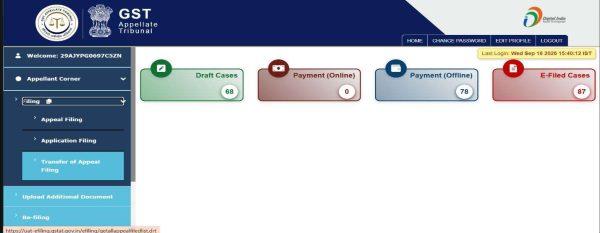
Figure 1. Appellant Corner: the “Transfer of Appeal Filing” option (Step 2).
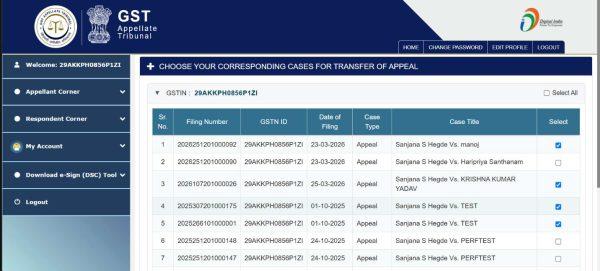
Figure 2. Selecting the appeals to be clubbed and saving the selection (Steps 5 and 6).
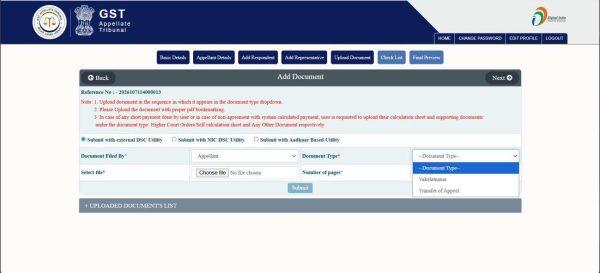
Figure 3. The Upload Document tab of the Transfer Appeal (Steps 12 to 14).
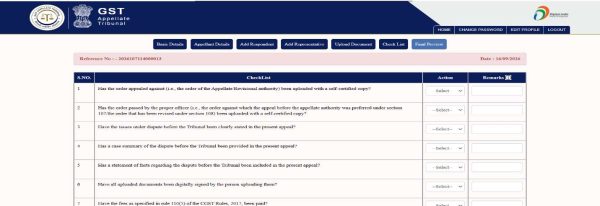
Figure 4. The final checklist, with Yes, No or NA against each item (Step 15).
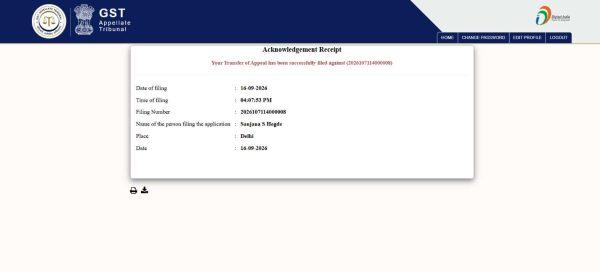
Figure 5. The Acknowledgement Receipt for a Transfer Appeal (Step 17).
Source: Standard Operating Procedure for Transfer of Appeals (GSTAT portal), issued by GSTAT. Reproduced for illustration with acknowledgement.
The acknowledgement screens carry a filing date of 16 September 2026, so the facility appears to be recent. Compare each screen with the live portal before relying on this description.
What the SOP Does Not Tell You
Four questions matter to a practitioner and are not answered in the document as supplied:
- Fee. The SOP does not say whether a fee is payable on a Transfer Appeal.
- Documents. It refers to “requirements” shown on screen but does not list them. Expect, at a minimum, a statement of the identical question and the list of appeals it governs, but confirm on the portal.
- Criteria and consequence. It does not say how the receiving Bench is chosen, what happens to the individual appeals once grouped, or whether hearing dates are aligned.
- Limitation. It is silent on time. The Transfer Appeal is not a substitute for filing each appeal within limitation, and nothing in it suggests that it extends time.
PRACTICE NOTE. Until the Registry clarifies these points, treat the Transfer Appeal as an addition to a properly filed set of appeals, never as a replacement for any of them.
Scenario B: The President’s Power
The SOP is a portal workflow. The Act itself gives the President a wider power. Section 109(6) of the CGST Act says that, subject to Section 109(5), the President shall, from time to time, by a general or special order, distribute the business of the Tribunal among the Benches and may transfer cases from one Bench to another. Nothing in that wording confines it to a single PAN.
Section 109(5) matters here because it carves out business that goes only to the Principal Bench. Its provisos cover place-of-supply cases and anti-profiteering matters under Section 171(2), and its third proviso lets the Government notify further categories. Notification S.O. 4219(E) of 17 September 2025 does that. Among its categories for the Principal Bench at New Delhi are identical issues pending before two or more State Benches. The book treats that category as applying where the President is satisfied that the issue is identical; I have not seen the notification’s own text, so check it for the exact conditions before relying on this.
When Scenario B Is the One to Consider
- Different PANs. Companies of a corporate group, or a company and its related entity, litigating the same question. The SOP’s same-PAN wording does not reach them; the statutory power is not framed by PAN.
- Where the Bench allocation itself is in doubt. The book notes that if the allocation is genuinely unclear, the President may transfer the appeal to the appropriate Bench.
- Where a notified Principal Bench category applies. Identical issues before two or more State Benches is one such category under S.O. 4219(E). Others include matters such as Input Service Distributor, online information and database access or retrieval services, and online gaming, and place-of-supply cases and anti-profiteering matters go to the Principal Bench by the Act itself.
How to Approach It, and What Is Not Documented
I did not find an application procedure for a transfer by the President in the Procedure Rules. The only Rule-level power I found nearby is Rule 123 (removal of difficulties), which is not an application route. So the following is a method, not a rule:
1. Write to the Registry, for the President’s consideration. Give the appeal numbers, Benches, parties, orders challenged, and the identical question of law. State the Bench you ask for, and why: avoiding inconsistent decisions and duplicated hearings.
2. Make the identity of the question easy to see. Annex a short table comparing the grounds of appeal, and attach copies of the orders.
3. File first, ask second. The request does not extend limitation. Every appeal must be filed in time on its own footing.
4. Ask the Registry about the mode. Whether the request goes by letter, by an application on the portal, or at a hearing, is for the Registry to say. Do not assume.
CAUTION. A transfer is at the President’s discretion. There is no right to it on request. Plan the hearings on the footing that the appeals may stay where they are.
Choosing Between the Routes
- Same PAN, several GSTINs, an identical question of law: use Scenario A, but also consider writing under Scenario B if you need a particular Bench and the SOP does not give it.
- Different PANs: Scenario B is the only route I can point to. Do not plan on the portal accepting appeals of two PANs in one Transfer Appeal.
- Do not file a Transfer Appeal and a request to the President that ask for different Benches. Keep the two consistent.
A Practical Method for Either Route
1. State the question. Write one paragraph that states the identical question of law. It serves the remarks in the SOP checklist and the letter to the Registry alike.
2. List the appeals. For each, give the Bench, appeal number, GSTIN or PAN, tax period, amount and stage. Include the order-in-appeal date for each, since limitation is tested appeal by appeal.
3. Choose a lead matter. Pick the appeal with the cleanest facts and the best paper book. If the set is heard together, that appeal will carry the argument.
4. Keep the individual appeals in order. Check that the pre-deposit, fee, paper book and defect memos for each appeal are in good order. A defect in one appeal can still cost you that appeal.
Companions to Either Route
- A request for a common hearing. Reported orders show that the Benches already take related appeals together. The Principal Bench decided six appeals of one taxpayer by a single order (Dow Chemical International, (2026) 1 GSTAT E-Journal 15). The Kolkata Bench disposed of two appeals from the same dispute by a common order with the parties’ consent (Anil Kumar Singh, (2026) 1 GSTAT E-Journal 99). A written request for a common hearing costs nothing.
- A test case. Where a question will recur, litigate first on the matter with the strongest facts, so that precedent is set on favourable ground.
Cautions
- Same PAN only for the SOP. The login step works through a GSTIN linked to the PAN. Do not plan to club appeals of two different companies on the footing that the portal will accept it.
- The question must truly be identical. A grouping that mixes a limitation point with a merits point invites the Bench to separate them.
- A single bad result now has a wider reach. If clubbed appeals go to one Bench, an adverse answer binds all of them in practice, even if it does not in law.
- The Revenue’s position is unrecorded. Neither the SOP nor the Rules, as I read them, say whether the respondent is heard on grouping or transfer.
- Keep a copy of the acknowledgement and of the screens you used, and a copy of any letter to the Registry with proof of delivery.
Conclusion
A taxpayer that litigates one question in many places has two tools. The SOP’s Transfer Appeal is a documented portal route, but it reaches only appeals under one PAN and is silent on fee, documents, Bench selection and time. The President’s power under Section 109(6) is wider on its wording, but it has no documented application procedure and rests on discretion. In either case, file every appeal on its own merits and treat clubbing or transfer as the way to bring the set together.
This article draws on the SOP for Transfer of Appeals issued by GSTAT (acknowledgement screens dated 16 September 2026). It is general information and not advice on any matter. Check the current portal screens, the text of S.O. 4219(E) and Registry instructions before acting.