Aananda Devcon Private Limited Vs ACIT (ITAT Raipur)
Summary: The Raipur Bench of the Income Tax Appellate Tribunal examined the appeal of Aananda Devcon Private Limited against the CIT(A), NFAC, order dated 02.05.2023 for Assessment Year 2015-16. The company, engaged in the development and sale of plots in the Shristi Srijan project, had returned income of Rs. 21,44,050. Its scrutiny assessment resulted in disallowances of development expenses of Rs. 1,16,73,020, stamp expenses of Rs. 27,65,260, registry expenses of Rs. 4,20,181 and typing expenses of Rs. 88,000. The assessing authority questioned the expenditure evidence, estimates, original bills and suppliers; the CIT(A) confirmed the additions.
The assessee challenged the assessment principally on jurisdictional grounds. Its Section 143(2) notice dated 17.03.2016 had been issued by ITO Ward 1(1), Bilaspur, although CBDT Instruction No. 1/2011, Instruction No. 6/2011 and the Chief Commissioner’s modified monetary limits placed a corporate taxpayer declaring more than Rs. 15 lakh within the jurisdiction of an ACIT or DCIT. The ITO subsequently transferred the case, but DCIT Circle 2(1), Bilaspur, who completed the assessment on 23.12.2017, had not issued a fresh notice under Section 143(2).
In support, the assessee relied on Mata Road Carriers v. DCIT and Durga Manikanta Traders v. ITO, which discussed the effect of mandatory jurisdictional notices issued by officers lacking pecuniary jurisdiction. The quoted decisions considered a substantial body of precedent, including Ashok Devichand Jain, Pankajbhai Jaysukhlal Shah, Sudhir Kumar Agrawal, UCO Bank, Sunita Finlease and Nopany & Sons. The Revenue asserted that the ITO issued the notice because the PAN was within his charge and that the assessee’s jurisdictional objection was time-barred under Section 124(3).
The Tribunal found that the ITO did not possess pecuniary jurisdiction when he issued the original Section 143(2) notice. It further found that the DCIT who ultimately passed the assessment order had not issued a statutory notice of his own. Following the coordinated Raipur Bench rulings, it rejected the Revenue’s Section 124(3) objection because the challenge concerned inherent or pecuniary jurisdiction rather than a belated dispute about territorial jurisdiction.
The Tribunal accordingly quashed the assessment order dated 23.12.2017 under Section 143(3). Having allowed the appeal on the jurisdictional issue, it did not determine the merits of the expense disallowances and expressly left the remaining contentions open. The appeal was allowed by the order pronounced on 22.02.2024.
Cases Discussed
- Mata Road Carriers Vs DCIT (ITAT Raipur) — ITA No. 79/BIL/2016, order dated 10.07.2023. Relied upon on invalidity of a notice issued by a non-jurisdictional officer.
- Ravi Sherwani (ITAT Raipur) — ITA No. 64/RPR/2020, order dated 29.05.2023. Discussed within the passage from Mata Road Carriers.
- Durga Manikanta Traders Vs ITO (ITAT Raipur) — ITA No. 59/RPR/2019, order dated 12.12.2022. Directly relied upon for pecuniary-jurisdiction defects.
- Anderson Printing House (P) Ltd. Vs ACIT (ITAT Kolkata) — (2022) 192 ITD 548. Discussed within quoted precedent on binding CBDT limits.
- PCIT Vs Nopany & Sons (Calcutta High Court) — (2022) 136 taxmann.com 414. Discussed for want of notice by jurisdictional AO.
- Peter Vaz Vs CIT (Bombay High Court) — Tax Appeal Nos. 19–30 of 2017, judgment dated 05.04.2021. Cited on territorial jurisdiction under Section 124.
- ACIT Vs Pankajbhai Jaysukhlal Shah (Supreme Court) — (2020) 120 taxmann.com 318. Discussed as affirming the Gujarat High Court decision.
- OSL Developers (P) Ltd. Vs ITO (ITAT Kolkata) — (2021) 211 TTJ (Kol) 621.
- Balaji Enterprise Vs ACIT (ITAT Gauhati) — (2021) 187 ITD 111.
- Bhagyalaxmi Conclave (P) Ltd. Vs DCIT (ITAT Kolkata) — ITA No. 2517/Kol/2019, order dated 03.02.2021.
- Hillman Hosiery Mills Pvt. Ltd. Vs DCIT (ITAT Kolkata) — ITA No. 2634/Kol/2019.
- Soma Roy Vs ACIT (ITAT Kolkata) — ITA No. 463/Kol/2019 as cited in one passage; a subsequent extract refers to ITA No. 462/Kol/2019, order dated 08.01.2020.
- Kshirod Kumar Pattanaik Vs ITO (ITAT Cuttack) — ITA No. 380/CTK/2019, order dated 10.12.2020.
- Shri Sukumar Ch. Sahoo Vs ACIT (ITAT Kolkata) — ITA No. 2073/Kol/2016, order dated 27.09.2017.
- Shri Sudhir Kumar Agrawal Vs ITO (ITAT Raipur) — ITA No. 158/RPR/2017, order dated 17.10.2022.
- CIT Vs Ramesh D. Patel (Gujarat High Court) — (2014) 362 ITR 492.
- Pankajbhai Jaysukhlal Shah Vs ACIT (Gujarat High Court) — (2019) 110 taxmann.com 51.
- Ashok Devichand Jain Vs UOI (Bombay High Court) — W.P. No. 3489 of 2019, judgment dated 08.03.2022.
- UCO Bank Vs CIT (Supreme Court) — (1999) 237 ITR 889.
- Commissioner of Customs Vs Indian Oil Corporation Ltd. (Supreme Court) — (2004) 267 ITR 272.
- DCIT Vs Sunita Finlease Ltd. (Chhattisgarh High Court) — (2011) 330 ITR 491.
- Amarjeet Singh Bhatia (ITAT) — Mentioned within the quotation from Mata Road Carriers; citation not supplied.
FULL TEXT OF THE ORDER OF ITAT RAIPUR
The present appeal is directed against the order of Commissioner of Income Tax (Appeals), National Faceless Appeal Centre (NFAC) (in short ‘CIT(A)’) dated 02.05.2023 u/s 250 of the Income Tax Act, 1961 (In short ‘The Act’) for the assessment year 2015-16, which in turn arose from the order u/s 143(3) of Act by office of the Assistant Commissioner of Income Tax, Circle 2(1), Bilaspur, (In short ‘The AO’) dated 23.12.2017.
2. The grounds of appeal raised by the assessee are as under:
1. That the order u/s 250 as passed by the Ld. CIT (Appeals) is bad in law as well as on facts.
2. On the facts and circumstances of the case notice u/s 143(2) dated 17/03/2016 (Within time) has been issued by the ITO, Ward 1(1), Bilaspur, who is not the jurisdictional AO, and no notice u/s 143(2) has been issued by the jurisdiction A.O. i.e. Assistant commissioner Circle), Bilaspur C.G.
3. That the Ld. DCIT Bilaspur Circle 2(1) passed the order, has no jurisdiction as the jurisdiction was with DCIT, Bilaspur Circle 1. The appellant being a company, the jurisdiction lies with DCIT Circle 1(1), Bilaspur vide notification no 1 of 2014 dated 15/11/2014.
4. That the Ld. CIT(Appeal) erred in confirming the Rs. 26,89,094/- out of Rs.1,43,62,114/- as development expenses which were calculated by AO on estimates, resumptions & surmises ignoring the audited books of accounts.
5. That the large other expenses were to be examined wii) Durga Manikanta Traders.ith the audited books of accounts, and bills and vouchers. The addition made on the basis of estimated report of SDM, Bilha is perverse and unwarranted.
6. That the Ld. CIT(A) is not justified to confirm addition of Development expense of Rs. 11673020/-, whereas most of the expenses are paid by cheques and without development expenses like road, drainage no plots can be sold.
7. That the Ld. CIT(A) is not justified in confirming the addition of Rs. 2765260/- being stamps expense incurred by the company, ignoring the fact that stamps purchased bears the name of the company as purchaser.
8. That the Ld. CIT(A) is not justified in confirming the addition of following Expenses: –
1. Registry Expenses:420181
2. Typing Expense: 88000
9. That the appellant craves leave to add to and/or amend. Alter; rescind the grounds taken here in above, before or the time of hearing of this appeal.
3. The brief facts of the case culled out from records are that the assessee is a Private Limited Company, engaged in development and trading of plots. The assessee filed its return of income on 30.09.2015, declaring income at Rs. 21,44,050/-. Subsequently, the case was selected for limited scrutiny which was converted into complete scrutiny. During the year under consideration the assessee has shown income from sale of plots in the project “Shristi Srijan”. The learned Assessing Officer (The Ld. AO) disallowed development expenses of Rs.1,16,73,020/-. As per assessee, the Ld. AO does not consider the bills submitted at the time of assessment proceedings. The appellant has also given address of sundry creditors which were outstanding on account of development expenses. The Ld. AO further disallowed Rs.27,65,260/- and Rs.4,20,181/- on account of stamp expenses and registry expenses by considering that such expenses had been borne by the purchaser of plot themselves in spite of the facts of the statement recorded from M/s Shrishti Infrabuild Private Limited in which they have confirmed that registry and stamp expenses have been incurred by the assessee. Ld. AO further disallowed typing expenses of Rs. 88,000/- by considering that the documents are being prepared by M/s Shrishti Infrabuild Pvt. Ltd.
3.1 Cass selection for limited scrutiny in the case of assesse was for the reason “large other expenses claimed in the profit & loss account”. The Ld. AO observed that the assessee is not specified the nature and amount under the head “Other Expenses”. Only a figure of Rs.3,81,94,500/- is mentioned under the head “Other”. It is seen from the schedule of “Other expenses” annexed to Profit & Loss account that a sum of Rs.3,83,10,728/- has been debited under different heads. However, the total figure under this head is not matching with the total figure shown under this head in the return of income. During the year the assessee had incurred major Expenses under the head “Other Expenses” are as under:
| Expenses | Amount (in Rs.) |
|---|---|
| Brokerage Exp. For sales | 1,91,05,906/- |
| Developing Expenses | 1,43,62,114/- |
| Stamp Expenses | 27,65,260/- |
| Registry Expenses | 4,20,181/- |
| Typing Expenses | 88,000/- |
3.2 Regarding genuineness of the above expenses, the assessee was show caused by the Ld AO, in response details and explanations were submitted by the assessee but the Ld AO did not find the explanations so offered as convincing, therefore, he made the following additions: Expenses Amount (in Rs.) Developing Expenses 1,16,73,020/- Stamp Expenses 27,65,260/- Registry Expenses 4,20,181/- Typing Expenses 88,000/- Total 1,49,46,491/-
4. Aggrieved by the aforesaid additions in the order of Ld. AO, assessee preferred an appeal before the Ld CIT(A) NFAC, Delhi, however the appeal of asseseee therein have been dismissed by the Ld CIT(A) with the following observations:
DECISION:
6. I have carefully considered the grounds of appeal, statement of facts and the contents of assessment order along with written submission filed by the assessee. During the appellate proceedings, the assessee has filed copy of ledger account of developing expenses and written submission stating that the purchases were not known to the assessee as M/S Shrishti Infrabuild Pvt. Ltd. was engaged to take booking of the plots, to collect payment from the customers and to make payment to the assessee after deducting their commission. The AO has not pointed out any consistency/discrepancy in the books of accounts/bills/vouchers in respect of development work.
6.1 I have examined the claim of the appellant. The assessee has not submitted any evidence to rebut/negate the findings of the AO. The AO has noticed that out of developing expenses of Rs. 1,43,62,114/- debited in the P&L accounts, a sum of Rs. 44,35,700/- was debited as provision which is not an allowable deduction. During the appellate proceedings also, no evidence has been filed to prove that the aforesaid provision represented an ascertained liability by furnishing the basis and quantification for working of the aforesaid provisions. Notice u/s 133(6) issued by the AO to some of the parties returned unserved. Even after giving new address of sandy Creators notice u/s 133(6) return back in case of M/S Singh & Co. The claim of the expenditure was not abnormally higher than the expenses as per information obtained from the office of Town & Country Planning and SDM office. The escalation of expenses cannot be more than three times the estimation submitted before SDM. The purchasers in their statements have confirmed that no major development work was done. The purchasers have borne their registration cost and stamp duty. Original bills related to developing expenses were not produced for verification. The parties were not produced for verification. The assessee has failed to furnish the copy of sale deed or any evidence of making payment for stamp expenses or registry charges. The AO has mentioned discrepancies on bills produced in case of 13 parties like payment details not available, name of assessee absent on bill, bills prepared on letter heads/computer printout etc. The submission of the assessee does not address the various discrepancies pointed out by the AO. In view of above, I do not have any material to interfere with the findings of the AO and therefore all the additions made by the AO are hereby confirmed. All grounds of appeal are dismissed.
7. Accordingly, the appeal is treated as dismissed.
5. Dissatisfied with the order of Ld CIT(A), the assessee is before us with the present appeal.
6. At the outset, Ld. AR of the assessee has submitted a written synopsis the same is extracted as under:
M/s Ananda Devcon Pvt. Ltd.
A Y 2015/16 ITA No. 223/RPR/2023
1. Return of income filed on 29.09.2015, with returned income of Rs. 21,44,050/-
2. First notice u/s 143(2) required to be issued latest by 30.09.2016.
3. First notice u/s 143(2) cit. 17.03.2016 issued by ITO-1(1), Bilaspur, PN 49 of PB.
4. In view of returned income being more than Rs. 15 lakh, jurisdiction vested with AC/ DC.
5. ITO-1(1), Bilaspur himself transferred the case to ACIT-I(I), Bilaspur. Letter at PN 50 of PB. He admits that jurisdiction did not vest with him but with ACIT-I(I), Bilaspur.
6. No notice u/s 143(2) issued by ACIT-2(l), Bilaspur, who passed the assessment order.
7. A case of pecuniary jurisdiction. Reliance on: –
i) Mata Road Carriers vs DCIT, at PN 84 to 101 of PB, relevant finding at PN 100 of PB, para no. 19.
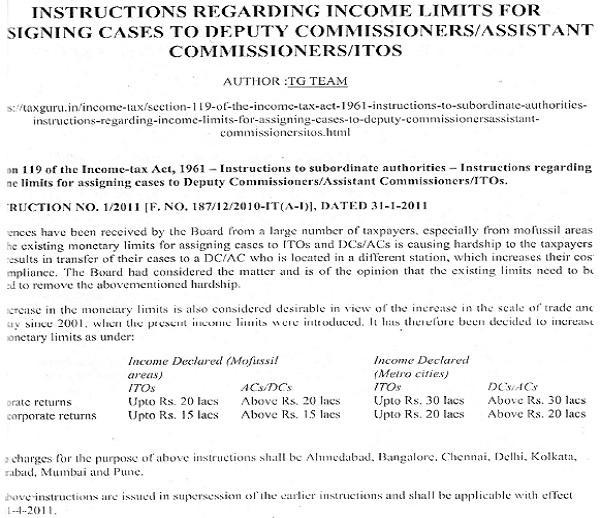
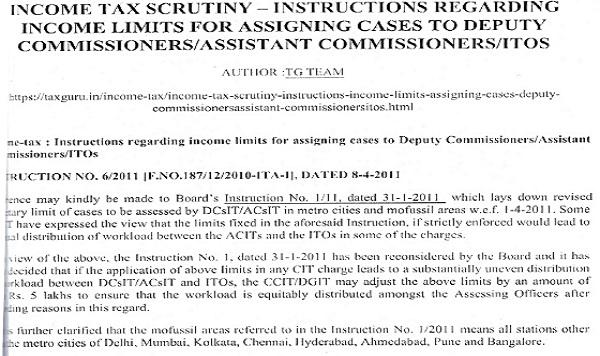
7. Elaborating the above synopsis, Ld. AR on behalf of the assessee submitted that order passed by the Ld. AO itself was bad in law, de hors valid assumption of jurisdiction and therefore the same deserves to be quashed. In order to substantiate such contention, Ld. AR submitted that in the present case the assessee had filed its return showing total income of Rs.21,44,050/- and the Assessee, who is a corporate assessee having retuned income more than Rs.15 Lakhs, thus, the jurisdiction on the case of assessee lies with the Assistant Commissioner or Deputy Commissioner. However, the notice for initiation of scrutiny assessment was issued by ITO Ward 1(1), Bilaspur. Regarding the prescribed threshold pecuniary limits for assumption jurisdiction, Ld. AR drew our attention to CBDT’s instruction No. 1/2011 dated 31.01.2011 a/w instruction No.6/2011 dated 08.04.2011, wherein the limits for assigning the cases for assessment to respective Assessing Officers have been prescribed by the CBDT, further liberty was granted to the Chief Commissioner of the respective charges to adjust the limits by Rs. 5 Lakhs either upward or downward in order to ensure that the workload is equitably distributed amongst the Assessing Officers after recording reasons in this regard. In exercise of such powers granted by the CBDT, Ld. Chief Commissioned of Income Tax, Raipur has revised the limits vide letter F. No.CCIT/RPR/2011-12 dated 30.05.2011 whereby the limits for returns filed by corporate assessee’s have been fixed up to Rs.15 Lacs to be assessed by ITO’s and above Rs.15 Lacs by AC’s/DC’s. Copy of the CBDT Instruction and the letter effecting revision in the monetary limits are extracted as under:
–
–
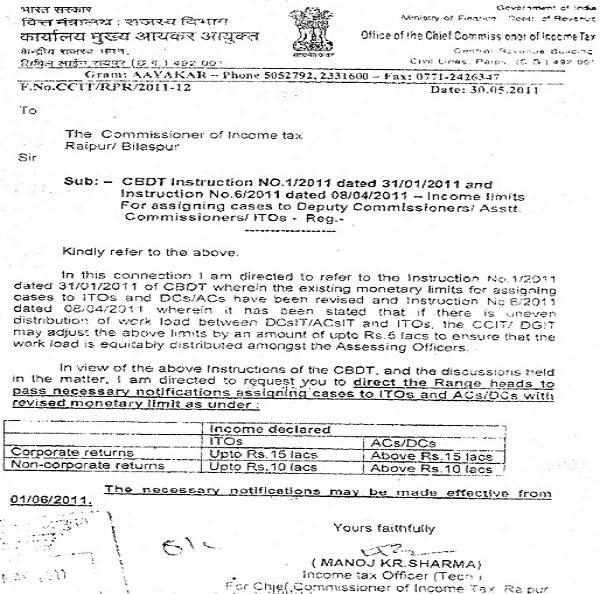
8. In view of aforesaid instructions and CBDT and modifications by the Ld. CCIT, Raipur, it is the submission of Ld. AR, that the case of the assessee undoubtedly falls under the jurisdiction of AC’s/DC’s, but, the first notice u/s 143(2) dated 17.03.2016 was issued by ITO’s Ward-1(1), Bilaspur. ITO 1(1) subsequently transferred the case to ACIT-1(1), Bilaspur and have admitted in the said communication that the jurisdiction did not vest with him. Carrying the argument further, Ld. AR submitted that ITO’s Ward 1(1), who issued the notice u/s 143(2) was not vested with valid jurisdiction, whereas valid jurisdiction was conferred upon ACIT-2(1), Bilaspur, who finally has passed the assessment order, but have never issued any notice u/s 143(2), therefore, the entire assessment proceedings have been build up on the foundation of an illegal notice, thus, there was clear violation of the provisions of the Act, instructions of CBDT and the revenue authorities. Accordingly, the order passed u/s 143(3) dated 23.12.2017 was illegal, void-ab-initio and therefore, the same should be considered as non-est. To strengthen the contentions raised by way of drawing support from legal pronouncements, Ld. AR submitted that the present case is squarely covered by the following judgments, wherein similar issue have been deliberated upon by the coordinate bench of the ITAT, Raipur and has held as under:
i) Mata Road Carriers vs DCIT, ITA No. 79/BIL/2016 vide order dated 10.07.2023
19. The coordinate bench of the Tribunal under the similar facts and circumstances, in the case of Ravi Sherwani, passed in ITA No.64/RPR/2020, order dated 29.05.2023, observations of which have been reproduced in the foregoing paragraphs, which has already been followed in the case of Amarjeet Singh Bhatia (supra), considering the observations made in the case of Durga Manikanta Traders (supra), held that the assessment framed by the AO on the basis of notice issued u/s.143(2) of the Act by the non-jurisdictional officer is void ab initio. In the present case, the ITO-1(1), Raipur having no jurisdiction over the assessee issued notice u/s.143(2) of the Act, overlooking the binding Instructions of the CBDT as well as the Notification issued by the CCIT, Raipur, which is not sustainable in the eyes of law. Had the notice u/s.143(2) of the Act been issued by the jurisdictional AO, i.e. DCIT-1(1), who was having pecuniary jurisdiction over the assessee, there would have been no case for the assessee to raise the issue of wrong assumption of jurisdiction. When the notice issued u/s.143(2) of the Act is itself invalid owing to the wrong assumption of jurisdiction, the assessment framed thereafter has no legs to stand. Respectfully following the observations of the coordinate bench of the Tribunal in the case reproduced hereinabove, we set aside the order of the ld. CIT(A) and ITA No.79/BIL/16 trike down the assessment order dated 27.03.2014. The legal ground raised by the assessee is allowed.
ii) Durga Manikanta Traders vs ITO in ITA No. 59/RPR/2019 dated 12.12.2022:
15. On the basis of the aforesaid facts, we are of the considered view, that as stated by the Ld. AR, and, rightly so, as per the CBDT Instruction No.1/2011, dated 31.01.2011 the jurisdiction over the case of the assessee who is located in a mofussil area i.e. Bhilai and had filed a non- corporate return for the year under consideration, i.e., A.Y.2014-15 declaring an income of Rs.6,57,380/- was vested with the ITO, Ward 1(1), Bhilai. Although notice u/s. 143(2), dated 24.09.2015 had been issued within the stipulated time period, i.e., within six months from the end of the relevant assessment year which would have expired as on 30.09.2015, however, the same was issued by the DCIT-1(1), Bhilai, i.e., an A.O who pursuant to the CBDT Instruction No.1 of 2011, dated 31.01.2011 was not vested with the jurisdiction over the case of the assessee for the year under consideration. On the other hand, the ITO-1(1), Bhilai, who as per the aforesaid CBDT Instruction (supra) was vested with the exclusive pecuniary jurisdiction over the case of the assessee for the year under consideration had issued the notice u/s. 143(2) of the Act, dated 05.05.2016, i.e., beyond the stipulated time period, therefore, no valid jurisdiction could have been assumed on the basis of the same for framing the assessment vide order under Sec. 143(3), dated 29.12.2016.
16. On the basis of our aforesaid deliberations, we are in agreement with the Ld. AR that the ITO-1(1), Bhilai could not have validly assumed jurisdiction and framed the assessment vide his order passed u/s. 143(3) of the Act, dated 29.12.2016 on the basis of the notice issued u/s. 143(2), dated 24.09.2015 by the DCIT-1(1), Bhilai i.e. a non-jurisdictional A.O. Our aforesaid view is fortified by the judgment of the Hon’ble High Court of Bombay in the case of Ashok Deckhand Jain Vs. UOI in W.P. No.3489 of 2019, dated 08.03.2022. In the said case the Hon’ble High Court by referring to the CBDT Instruction No.1 of 2011, dated 31.01.2011, had observed, that as the pecuniary jurisdiction over the case of the assessee before them who had returned an income of Rs.64.34 lacs was vested with the DCs/ACs, therefore, the notice issued u/s.148 of the Act by the ITO who during the year under consideration had no pecuniary jurisdiction over the Assessee’s case was bad in the eyes of law. Considering the aforesaid lapse in the assumption of jurisdiction the Hon’ble High Court had quashed the notice that was issued by the ITO u/s.148 of the Act. Also, a similar view had been taken by the Hon’ble High Court of Gujarat in the case of Pankajbhai Jaysukhlal Shah Vs. ACIT, Circle-2 (2019) 110 taxmann.com 51 (Guj.). In the said case, though the A.O who had jurisdiction over the case of the assessee had recorded the ‘reasons to believe’ but notice u/s.148 of the Act was issued by another officer, therefore, the notice so issued u/s.148 of the Act was quashed by the Hon’ble High Court. At this stage, we may herein observe, that the aforesaid order of the Hon’ble High Court had thereafter, been upheld by the Hon’ble Supreme Court in the case of ACIT, Circle-1 Vs. Pankajbhai Jaysukhlal Shah[2020] 120 taxmann.com 318 (SC). Also, we find that the similar view had been taken by this Tribunal in its recent order passed in the case of Shri Sudhir Kumar Agrawal, Durg Vs. ITO, Ward-2(2), Bhilai in ITA No.158/RPR/2017 dated 17.10.2022, wherein dealing with the multifacet contentions that were raised by the department, the Tribunal had observed as under:
“13. On the basis of our aforesaid deliberations, we are in agreement with the Ld. AR that though the assessment proceedings were rightly initiated and initially embarked upon by Dy. CIT, Circle- 1, Bhilai i.e. the officer who was vested with the jurisdiction over the case of the assessee, but the same thereafter had wrongly been framed by an officer who as observed by us hereinabove did not have jurisdiction over the case of the assessee in so far the year under consideration was concerned. As the criteria laid down vide the CBDT Instruction No.1/2011, dated 31.01.2011 for conferring the varied jurisdictions with the ITOs/DCs/ACs on the basis of income declared by the assessee in his return of income is binding upon the department and has to be scrupulously followed, therefore, there can be no escape from the same for justifying assumption of jurisdiction by an officer other than that prescribed in the said instruction. Our aforesaid view is fortified by the Judgments of the Hon’ble Supreme Court in the case of UCO Bank Vs. CIT (1999) 237 ITR 889 (SC) and Commissioner of Customs etc. Vs. Indian Oil Corporation Ltd. & Anr. (2004) 267 ITR 272 (SC). In the aforesaid judgments it was held by the Hon’ble Apex Court that though the CBDT/CBEC circulars are not binding on court or the assessee, but the departmental authorities are bound by them and cannot act in contravention of the same. Also, support is drawn from the judgment of the Hon’ble High Court of Chhattisgarh in the case of Dy. CIT Vs. Sunita Finlease Ltd. [2011] 330 ITR 491 (Chhattisgarh). In its said order it was observed by the Hon’ble Jurisdictional High Court that the administrative instructions issued by CBDT are binding on the Income-tax authorities. On the basis of our aforesaid observations, we are of the considered view that as the framing of the assessment in the case of the present assessee by the Income- Tax Officer, Ward-2(2), Bhilai is clearly found to be in contravention of the CBDT Instruction No.1/2011, dated 31.01.2011, therefore, the same cannot be justified.
14. We shall now deal with the objection raised by the Ld. DR that as the assessee had not called in question the jurisdiction of the Income-Tax Officer, Ward-2(2), Bhilai within the stipulated time period of one month from the date on which he was served with the notice(s) u/ss.143(2) and 142(1), dated 03.03.2015, therefore, it was not permissible for him to challenge the same for the first time in the course of the proceeding before the tribunal. Having given a thoughtful consideration to the aforesaid claim of the ld. DR we are unable to persuade ourselves to subscribe to the same. On a careful perusal of Section 124 of the Act, it transpires that the same deals with the issue of “territorial jurisdiction” of an Assessing Officer. Ostensibly, sub-section (1) of Section 124 contemplates vesting with the A.O jurisdiction over a specified area by virtue of any direction or order issued under sub- section (1) and sub-section (2) of Section120 of the Act. On the other hand, sub-section (2) of Section 124 contemplates the manner in which any controversy as regards the territorial jurisdiction of an A.O is to be resolved. Apropos, sub- section (3) of Section 124 of the Act, the same places an embargo upon an assessee to call in question the jurisdiction of the A.O where he had initially not raised such objection within a period of one month from the date on which he was served with a notice under sub-section (1) of Section 142 or sub-section A.O, and not otherwise. Our aforesaid view is fortified by the judgment of the Hon’ble High Court of Bombay in the case of Peter Vaz Vs. CIT, Tax Appeal Nos. 19 to 30 of 2017, dated 05.04.2021 and that of the Hon’ble High Court of Gujarat in the case of CIT Vs. Ramesh D Patel (2014) 362 ITR492 (Guj.). In the aforesaid cases the Hon’ble High Courts have held that as Section 124 of the Act pertains to territorial jurisdiction vested with an AO under sub- section (1) or sub-section (2) of Section 120, therefore, the provisions of sub-section (3) of Section 124 which places an embargo on an assessee to raise an objection as regards the validity of the jurisdiction of an A.O would get triggered only in a case where the dispute of the assessee is with respect to the territorial jurisdiction and would have no relevance in so far his inherent jurisdiction for framing the assessment is concerned. Also, support is drawn from a recent judgment of the Hon’ble High Court of Calcutta in the case of Principal Commissioner of Income-tax Vs. Nopany & Sons (2022) 136 taxmann.com 414 (Cal). In the case before the Hon’ble High Court the case of the assessee was transferred from ITO, Ward-3 to ITO, Ward-4 and the impugned order was passed by the ITO, Ward-4 without issuing notice u/s 143(2) and only in pursuance to the notice that was issued by the ITO, Ward-3, who had no jurisdiction over the assessee at the relevant time. Considering the fact that as the assessment was framed on the basis of the notice issued under Sec. 143(2) by the assessing officer who had no jurisdiction to issue the same at the relevant point of time, the Hon’ble High Court quashed the assessment. Apart from that, the aforesaid view is also supported by the order of the ITAT, Kolkata ‘B’ Bench in the case of OSL Developers (p) Ltd. Vs. ITO, (2021) 211 TTJ (Kol) 621 and that of ITAT, Gauhati Bench in the case of Balaji Enterprise Vs. ACIT (2021) 187 ITD 111 (Gau.). Accordingly, on the basis of our aforesaid observations, we are of the considered view that as the assessee’s objection to the validity of the jurisdiction assumed by the Income- Tax Officer, Ward-2(2), Bhilai is by no means an objection to his territorial jurisdiction, but in fact an objection to the assumption of jurisdiction by him in contravention of the CBDT Instruction No.1/2011, dated 31.01.2011, therefore, the provisions of sub- section (3) of Section 124 would not assist the case of the revenue.
15. We shall now deal with the contention of the Ld. DR that as both the officers in question i.e. Dy. CIT, Circle-1, Bhilai and the Income Tax Officer, Ward-2(2), Bhilai as per sub-section (5) of Section 120 were vested with concurrent jurisdiction over the assessee, therefore, initiation of the assessment proceedings by the Dy. CIT, Circle-1, Bhilai vide notice issued u/s.143(2) dated 24.09.2013, which thereafter had culminated into an assessment framed by the Income-Tax Officer, Ward- 2(2), Bhilai vide his order passed u/s.143(3), dated 30.03.2015 does not suffer from any infirmity. In our considered view the aforesaid contention of the Ld. DR is absolutely misplaced and in fact devoid and bereft of any (2) of Section143. In sum and substance, the obligation cast upon an assessee to call in question the jurisdiction of the A.O as per the mandate of sub-section (3) of Section 124 is confined to a case where the assessee objects to the assumption of territorial jurisdiction by the merit. As the aforesaid CBDT Instruction No.1/2011, dated 31.01.2011 exclusively vests the pecuniary jurisdiction over the case of the assessee for the year under consideration i.e. A.Y.2012-13 with the ACs/DCs, therefore, in our considered view despite vesting of concurrent jurisdiction with the Income- Tax Officer, Ward-2(2), Bhilai and the Dy. CIT, Circle-1, Bhilai the assessment in his case for the year under consideration could only have been framed by the Dy. CIT, Circle-1, Bhilai. Neither is there any reason discernible from the orders of the lower authorities nor demonstrated before us by the ld. DR which would by any means justify framing of the assessment vide impugned order u/s 143(3), dated 30.03.2015 by the Income-Tax Officer, Ward-2(2), Bhilai. Apart from that, we find that as per the mandate of sub-section (1) of section 127 of the Act, where a case is to be transferred by authorities therein specified from one or more Assessing Officers subordinate to him (whether with or without concurrent jurisdiction) to any other Assessing Officer or Assessing Officers (whether with or without concurrent jurisdiction) also subordinate to him, then he is under an obligation to record his reasons for doing so after giving the assessee a reasonable opportunity of being heard in the matter wherever it is possible to do so. For the sake of clarity sub-section (1) of section 127 is culled out as under:
“(1) The [Principal Director General or] Director General or [Principal Chief Commissioner or] Chief Commissioner or [Principal Commissioner or] commissioner may, after giving the assessee a reasonable opportunity of being heard in the matter, wherever it is possible to do so, and after recording his reasons for doing so, transfer any case from one or more Assessing Officers subordinate to him (whether with or without concurrent jurisdiction) to any other Assessing Officer or Assessing Officers (whether with or without concurrent jurisdiction) also subordinate to him.”
On a careful perusal of the aforesaid mandate of law, it transpires, that even in a case where jurisdiction over the case of an assessee that is vested with one A.O (having concurrent jurisdiction over the case of the assessee) is to be transferred to another A.O (having concurrent jurisdiction over the case of the assessee), even then the authority specified under sub-section (1) of Section 127 is obligated to record his reasons for doing so. Considering the aforesaid position of law, we are of the considered view that now when in the present case the assessment proceedings were initiated by the Dy. CIT, Circle-1, Bhilai vide notice u/s.143(2), dated 24.09.2013, which thereafter were taken up and culminated by the Income-Tax Officer, Ward-2(2), Bhilai vide his order passed u/s.143(3) dated 30.03.2015, then, as per the mandate of sub-section (1) of Section 127 of the Act, the specified authority i.e. Commissioner or above was obligated to have recorded his reasons for transferring the case from the aforesaid Dy. CIT, Circle-1, Bhilai to the Income-Tax Officer, Ward-2(2), Bhilai. However, nothing has been brought to our notice which would justify the transfer of jurisdiction over the Assessee’s case from the Dy. CIT, Circle-1, Bhilai to Income-Tax Officer, Ward-2(2), Bhilai.
16. Be that as it may, we are of the considered view that as in the case of the assessee the assessment order u/s.143(3), dated 30.03.2015 had been passed by a non-jurisdictional officer i.e. the Income-Tax Officer, Ward-2(2), Bhilai, which is in clear contravention of the CBDT Instruction No.1/2011 dated 31.01.2011, therefore, the same cannot be sustained and is liable to be struck down on the said count itself. Before parting, we may herein observe that a similar issue as regards the validity of an assessment framed by an A.O who had invalidly assumed jurisdiction in contravention to the CBDT Instruction No.1/2011, dated 31.01.2011 had came up in a host of cases before the various benches of the Tribunal, wherein the respective assessments framed were struck down, for the reason that the same were passed by officers who were not vested with the requisite jurisdiction as per the CBDT Instruction No.1/2011, dated 31.01.2011. Our aforesaid view is fortified by the order of the ITAT, Kolkata Bench ‘SMC’ in the case of Anderson Printing House (P) Ltd. Vs. ACIT (2022) 192 ITD 548 (Kolkata- Trib.). In its order the Tribunal had after drawing support from the order of the ITAT, Kolkata in the case of Bhagyalaxmi Conclave (P) Ltd. Vs. DCIT, ITA No.2517 (Kol) of 2019, dated 03.02.2021 which in turn had relied on the earlier orders passed in the case of Hillman Hosiery Mills Pvt. Ltd. Vs. DCIT, ITA No.2634/Kol/2019; Soma Roy Vs. ACIT, ITA No.463/Kol/2019 dated 08.01.2020; and Shri Sukumar Ch. Sahoo Vs. ACIT, ITA No.2073/Kol/2016 dated 27.09.2017, had struck down the assessment for want of valid assumption of jurisdiction by the A.O who had framed the assessment in contravention of the CBDT Instruction No.1/2011, dated 31.01.2011, observing as under:
“5. A perusal of the aforesaid statutory provisions would reveal that the jurisdiction of Income Tax Authorities may be fixed not only in respect of territorial area but also I.T.A. No.339/Kol/2021 Assessment Year: 2016- 17 Anderson Printing House Pvt. Ltd having regard to a person or classes of persons and income or classes of income also. Therefore, the CBDT having regard to the income as per return has fixed the jurisdiction of the Assessing Officers. The ld. Counsel in this respect has relied upon the CBDT Instruction No.1/2011 [F.No.187/12/2010-IT(A-I), for the sake of convenience is reproduced as under:
“Instruction No.1/2011 [F.No.187/12/2010-IT(A-I), DATED 31-1-2011
References have been received by the Board from a large number of taxpayers, especially from mofussil areas, that the existing monetary limits for assigning cases to ITOs and DCs/ACs is causing hardship to the taxpayers, as it results in transfer of their cases to a DC/AC who is located in a different station, which increases their cost of compliance. The Board had considered the matter and is of the opinion that the existing limits need to be revised to remove the abovementioned hardship.
An increase in the monetary limits is also considered desirable in view of the increase in the scale of trade and industry since 2001, when the present income limits were introduced. It has therefore been decided to increase the monetary limits as under:
Income Declared Income Declared
(Mofussil areas) (Metro cities)
| ITOs ACs/DCs ITOs DCs/ACs | ||||
|---|---|---|---|---|
| Corporate returns | Upto Rs.20 lacs | Above Rs.30 lacs | Upto Rs.30 lacs | Above Rs.30 Lacs |
| Non- corporate returns | Upto Rs.15 lacs | Above Rs.15 lacs | Upto Rs.20 lacs | Above Rs.20 lacs |
Metro charges for the purpose of above instructions shall be Ahmedabad, Bangalore, Chennai, Delhi, Kolkata, Hyderabad, Mumbai and Pune.
The above instructions are issued in supersession of the earlier instructions and shall be applicable with effect from 1-4-2011.
6. Now, in this case, the assessment has been framed by the ACIT. At this stage, it will be appropriate to refer to the provisions of section 127 of the Act as under:
Power to transfer cases (1) The [Principal Director General or] Director General or [Principal Chief Commissioner or] Commissioner may, after giving the assessee a reasonable opportunity of being heard in the matter, wherever it is possible to do so, and after recording his reasons for doing so, transfer any case from one or more Assessing Officers subordinate to him (whether with or without concurrent jurisdiction) to any other Assessing Officer or Assessing Officers (whether with or without concurrent jurisdiction) also subordinate to him.
7. A perusal of the above statutory provisions would reveal that jurisdiction to transfer case from one Assessing Officer to other Officer lies with the Officers as mentioned in section 127(1) who are of the rank of Commissioner or above. No document has been produced on the file by the Department to show that the case was transferred by the competent authority from Income Tax Officer to ACIT. The notice u/s 143(2) has been issued by ACIT which was beyond his jurisdiction and the same is therefore, void ab initio. Under the circumstances, the assessment framed by ACIT, is bad in law as he did not have any pecuniary jurisdiction to frame the assessment. The issue relating to the pecuniary jurisdiction also came into consideration before the Coordinate Bench of the Tribunal in ITA No.2517/Kol/2019 and Others vide order dated 03.02.2021, wherein the Tribunal further relying upon various other decisions of the Coordinate Benches of the Tribunal has decided the issue in favor of the assessee and held that the assessment framed by Assessing Officer who was not having pecuniary jurisdiction to frame such assessment was bad in law. The relevant part of the order dated 03.02.2021 passed in ITA No.2517/Kol/2019 and Others is reproduced as under:
5.2. The assessee relied on the recent decision of this Tribunal in the case of Hillman Hosiery Mills Pvt. Ltd. vs. DCIT, in ITA No. 2634/Kol/2019, order dated 12.01.2021. We find that the issues that arise in this appeal are clearly covered in favour of the assessee. This order followed the principles of law laid down in a number of other decisions of the ITAT, Kolkata Bench on this issue.
5.3. Kolkata “B” Bench of the Tribunal in the case of Hillman Hosiery Mills Pvt. Ltd.(supra) held as follows:
“10. In this case, the ITO Ward-3(3), Kolkata, issued notice u/s 143(2) of the Act on 04/09/2014. In reply, on 22/09/2014, the assessee wrote to the ITO, Ward-3(3), Kolkata, stating that he has no jurisdiction over the assessee. Thereafter on 31/07/2015, the DCIT, Circle-11(1), Kolkata, had issued notice u/s 142(1) of the Act to the assessee. The DCIT, Circle- 11(1), Kolkata, completed assessment u/s 143(3) of the Act on 14/03/2016. The issue is whether an assessment order passed by DCIT, Circle-11(1), Kolkata, is valid as admittedly, he did not issue a notice u/s 143(2) of the Act, to the assessee. This issue is no more res-integra. This Bench of the Tribunal in the case of Soma Roy vs. ACIT in ITA No. 462/Kol/2019; Assessment Year 2015-16, order dt. 8th January, 2020, under identical circumstances, held as under: –
“5. After hearing rival contentions, I admit this additional ground as it is a legal ground, raising a jurisdictional issue and does not require any investigation into the facts. The ld. Counsel for the assessee submitted that as per Board Instruction No. 1/2011 [F. No. 187/12/2010-IT(A-I)], dt. 31/01/2011, the jurisdiction of the assessee is with the Assistant Commissioner of Income Tax, Circle-1, Durgapur, as the assessee is a non- corporate assessee and the income returned is above Rs.15,00,000/- and whereas, the statutory notice u/s 143(2) of the Act, was issued on 29/09/2016, by the Income Tax Officer, ward-1(1), Durgapur, who had no jurisdiction of the case. He submitted that the assessment order was passed by the ACIT, Circle-1(1), Durgapur, who had the jurisdiction over the assessee, but he had not issued the notice u/s 143(2) of the Act, within the statutory period prescribed under the Act. Thus, he submits that the assessment is bad in law.
5.1. On merits, he rebutted the findings of the lower authorities. The ld. Counsel for the assessee relied on certain case-law, which I would be referring to as and when necessary.
The ld. D/R, on the other hand, submitted that the concurrent jurisdiction vests with the ITO as well as the ACIT and hence the assessment cannot be annulled simply because the statutory notice u/s 143(2) of the Act, was issued by the ITO and the assessment was completed by the ACIT. He further submitted that the assessee did not object to the issue of notice before the jurisdictional Assessing Officer and even otherwise, Section 292BB of the Act, comes into play and the assessment cannot be annulled. On merits, he relied on the orders of the lower authorities.
I have heard rival contentions. On careful consideration of the facts and circumstances of the case, perusal of the papers on record, orders of the authorities below as well as case law cited, I hold as follows:-
I find that there is no dispute in the fact that the notice u/s 143(2) of the Act dt. 29/09/2016 has been issued by the ITO, Wd-1(1), Durgapur. Later, the case was transferred to the jurisdiction of the ACIT on 11/08/2017. Thereafter, no notice u/s 143(2) of the Act was issued by the Assessing Officer having jurisdiction of this case and who had completed the assessment on 26/12/2017 i.e., ACIT, Circle- 1(1), Durgapur. Under these circumstances, the question is whether the assessment is bad in law for want of issual of notice u/s 143(2) of the Act.
This Bench of the Tribunal in the case of Shri Sukumar Ch. Sahoo vs. ACIT in ITA No. 2073/Kol/2016 order dt. 27.09.2017, held as follows:-
“5. From a perusal of the above Instruction of the CBDT it is evident that the pecuniary jurisdiction conferred by the CBDT on ITOs is in respect to the ‘non corporate returns’ filed where income declared is only upto Rs.15 lacs; and the ITO doesn’t have the jurisdiction to conduct assessment if it is above Rs 15 lakhs. Above Rs. 15 lacs income declared by a non- corporate person i.e. like assessee, the pecuniary jurisdiction lies before AC/DC. In this case, admittedly, the assessee an individual (non corporate person) who undisputedly declared income of Rs.50,28,040/- in his return of income cannot be assessed by the ITO as per the CBDT circular (supra). From a perusal of the assessment order, it reveals that the statutory notice u/s. 143(2) of the Act was issued by the then ITO, Ward-1, Haldia on 06.09.2013 and the same was served on the assessee on 19.09.2013 as noted by the AO. The AO noted that since the returned income is more than Rs. 15 lacs the case was transferred from the ITO, Ward-1, Haldia to ACIT, Circle-27 and the same was received by the office of the ACIT, Circle-27, Haldia on 24.09.2014 and immediately ACIT issued notice u/s. 142(1) of the Act on the same day. From the aforesaid facts the following facts emerged:
The assessee had filed return of income declaring Rs.50,28,040/-. The ITO issued notice under section 143(2) of the Act on 06.09.2013.
The ITO, Ward-1, Haldia taking note that the income returned was above Rs. 15 lacs transferred the case to ACIT, Circle-27, Haldia on 24.09.2014. On 24.09.2014 statutory notices for scrutiny were issued by ACIT, Circle-27, Haldia.
We note that the CBDT Instruction is dated 31.01.2011 and the assessee has filed the return of income on 29.03.2013 declaring total income of Rs.50,28,040/-. As per the CBDT Instruction the monetary limits in respect to an assessee who is an individual which falls under the category of ‘non corporate returns’ the ITO’s increased monetary limit was upto Rs.15 lacs; and if the returned income is above Rs. 15 lacs it was the AC/DC. So, since the returned income by assessee an individual is above Rs.15 lakh, then the jurisdiction to assess the assessee lies only by AC/DC and not ITO. So, therefore, only the AC/DC had the jurisdiction to assess the assessee. It is settled law that serving of notice u/s. 143(2) of the Act is a sine qua non for an assessment to be made u/s. 143(3) of the Act. In this case, notice u/s. 143(2) of the Act was issued on 06.09.2013 by ITO, Ward-1, Haldia when he did not have the pecuniary jurisdiction to assume jurisdiction and issue notice. Admittedly, when the ITO realized that he did not had the pecuniary jurisdiction to issue notice he duly transferred the file to the ACIT, Circle-27, Haldia on 24.09. 2014 when the ACIT issued statutory notice which was beyond the time limit prescribed for issuance of notice u/s. 143(2) of the Act. We note that the ACIT by assuming the jurisdiction after the time prescribed for issuance of notice u/s. 143(2) of the Act notice became qoarum non judice after the limitation prescribed by the statute was crossed by him. Therefore, the issuance of notice by the ACIT, Circle-27, Haldia after the limitation period for issuance of statutory notice u/s. 143(2) of the Act has set in, goes to the root of the case and makes the notice bad in the eyes of law and consequential assessment order passed u/s. 143(3) of the Act is not valid in the eyes of law and, therefore, is null and void in the eyes of law. Therefore, the legal issue raised by the assessee is allowed. Since we have quashed the assessment and the appeal of assessee is allowed on the legal issue, the other grounds raised by the assessee need not to be adjudicated because it is only academic. Therefore, the additional ground raised by the assessee is allowed.
In the result, appeal of assessee is allowed.”
Apart from that, we find that a similar view had been taken by the ITAT, Cuttack Bench, Cuttack in the case of Kshirod Kumar Pattanaik Vs. ITO, Angul Ward, Angul, ITA No.380/CTK/2019 dated 10.12.2020.
17. Consequent to our aforesaid deliberations, we are of the considered view that as in the present case before us the assessment had been framed by the Income Tax Officer, Ward-2(2), Bhilai u/s. 143(3), dated 30.03.2015 in clear contravention of the CBDT Instruction No.1/2011, dated 31.01.2011, which divested him of his jurisdiction over the case of the assessee for the year under consideration i.e. AY 2012-13, therefore, the same cannot be sustained and is liable to be struck down in terms of our aforesaid observations. We, thus, in terms of our aforesaid observations quash the order passed by the Income-Tax Officer, Ward-2(2), Bhilai for want of jurisdiction on his part.”
17. On the basis of our aforesaid observations, we are of the considered view that as in the case of the present assessee before us the impugned assessment had been framed by the ITO-1(1), Bhilai vide his order passed u/s.143(3) dated 29.12.2016 on the basis of a notice u/s. 143(2), dated 24.09.2015 that was issued by the DCIT-1(1), Bhilai, i.e., an A.O who at the relevant point of time was not vested with jurisdiction over the case of the assessee, therefore, the assessment so framed cannot be sustained and is liable to be struck down on the said count itself. Apropos the notice issued u/s.143(2) of the Act, dated 05.05.2016 by the ITO-Ward 1(1), Bhilai, we are of the considered view that as the said notice was issued after the lapse of the stipulated time period, i.e., beyond the specified time frame which expired as on 30.09.2015, therefore, the assessment order so framed would also not be saved on the said basis. To sum up, as the impugned assessment u/s. 143(3), dated 29.12.2016 had been framed by the ITO- Ward 1(1), Bhilai de-hors the issuance of a valid notice u/s. 143(2) of the Act, therefore, the same cannot be sustained is liable to quashed. We, thus, in terms of our aforesaid observations quash the assessment framed by the A.O u/s.143(3), dated 29.12.2016 for want of valid assumption of jurisdiction on his part.
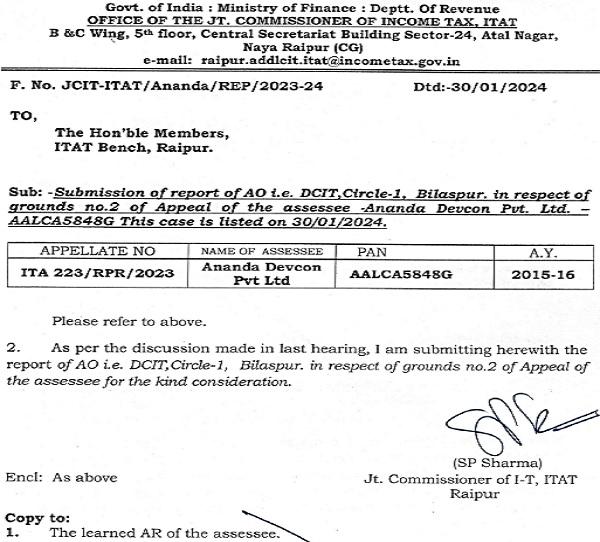
9. Based on aforesaid submissions, it was argued by the Ld. AR that in absence of assumption of valid jurisdiction by the Ld. AO, who had framed the assessment order cannot survive. Ld. AR submitted that since the first notice u/s 143(2) was issued by an officer, having no vested jurisdiction over the case of assessee, by wrongly assuming the jurisdiction, further when the case is transferred to Jurisdictional AO he did not issued any notice u/s 143(2), consequently the assessment order framed on the foundation of a notice issued by the officer who is not the jurisdictional AO of the assessee and no notice by the jurisdictional AO, shall be liable to be rendered as illegal and unsustainable. It is, therefore, the prayer that the impugned order passed u/s 143(3) of the Act should be treated as illegal and the entire assessment should be quashed.
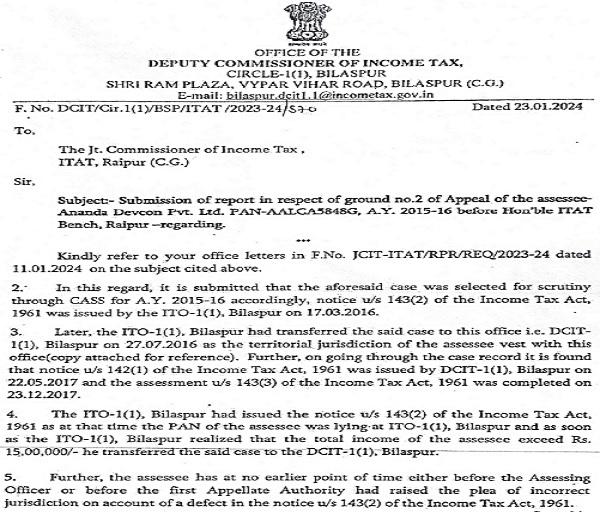
10. In rebuttal, Ld. Sr DR, on the issue has submitted a written submission by the department the same is extracted as under:
–
–
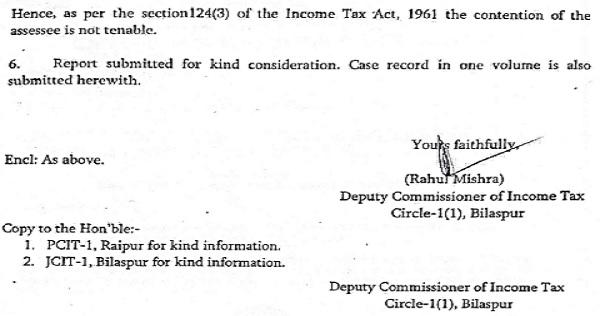
11. Baked by aforesaid submissions, it was the contention of Ld. Sr. DR that the notice u/s 143(2) of the Act was issued by the ITO Ward 1(1), Bilaspur, since the PAN of the assessee was lying with him at the time of issuance of notice. As soon as ITO 1(1) has realized that the amount of returned income filed by the assessee exceeds Rs. 15 Lacs, he transferred the said case to DCIT-1(1) Bilaspur. It is further submitted that the assessee at no earlier point of time either before the Ld. AO or before the Ld. CIT(A) had raised such plea of incorrect jurisdiction on account of the defect in issuing of notice u/s 143(2), therefore, as per provisions of section 124(3) such contentions at this juncture are not tenable. With such submissions, Ld. Sr. DR submitted that the question raised by the assessee on validity of jurisdiction shall not be entertained and the appeal should be deliberated upon on the merits.
12. We have considered the rival submissions, perused the material available on record and the case laws relied upon. Admittedly, in the present case the mandatory notice u/s 143(2) for initiating the assessment proceedings was issue by ITO Ward 1(1), Bilaspur vide notice dated 17.03.2016, who at relevant point of time was not vested with valid jurisdiction over the case of the assessee, since the cases having returned income above Rs.15,00,000/- in the case of corporate assessee’s are under the jurisdiction of ACIT/DCIT. The assessee’s returned income was Rs.21,44,050/-, which as discussed hereinabove is more than Rs.15 Lac, therefore the valid jurisdiction was with ACIT/DCIT.
13. In view of aforesaid CBDT’s instructions referred to supra, followed by communication by the Ld. CCIT, Raipur, we hold that the first notice u/s 143(2) issued by the ITO Ward-1(1), Raipur, was clearly against the mandate of instructions issued and thereafter subsequently no notice u/s 143(2) was issued by the jurisdictional AO i.e., DCIT-2(1), Bilaspur who had framed and passed the assessment order.
14. Regarding the objection raised by Ld. Sr. DR that the assessee has not objected to the jurisdiction of the ITO-1(1) within the stipulated time period as per provisions of section 124(3) of one month from the date on which the notice was served on the assessee. The issue has been duly considered in the case of Durga Manikanta (supra) following the analogy drawn from Sudhir Kumar Agrawal (supra), wherein it is observed by the tribunal that: “the provisions of sub-section (3) of Section 124 which places an embargo on an assessee to raise an objection as regards the validity of the jurisdiction of an A.O would get triggered only in a case where the dispute of the assessee is with respect to the territorial jurisdiction and would have no relevance in so far his inherent jurisdiction for framing the assessment is concerned. Also, support is drawn from a recent judgment of the Hon’ble High Court of Calcutta in the case of Principal Commissioner of Income-tax Vs. Nopany & Sons (2022) 136 taxmann.com 414 (Cal). In the case before the Hon’ble High Court the case of the assessee was transferred from ITO, Ward-3 to ITO, Ward-4 and the impugned order was passed by the ITO, Ward-4 without issuing notice u/s 143(2) and only in pursuance to the notice that was issued by the ITO, Ward-3, who had no jurisdiction over the assessee at the relevant time. Considering the fact that as the assessment was framed on the basis of the notice issued under Sec. 143(2) by the assessing officer who had no jurisdiction to issue the same at the relevant point of time, the Hon’ble High Court quashed the assessment. Apart from that, the aforesaid view is also supported by the order of the ITAT, Kolkata ‘B’ Bench in the case of OSL Developers (p) Ltd. Vs. ITO, (2021) 211 TTJ (Kol) 621 and that of ITAT, Gauhati Bench in the case of Balaji Enterprise Vs. ACIT (2021) 187 ITD 111 (Gau.). Accordingly, on the basis of our aforesaid observations, we are of the considered view that as the assessee’s objection to the validity of the jurisdiction assumed by the Income- Tax Officer, Ward-2(2), Bhilai is by no means an objection to his territorial jurisdiction, but in fact an objection to the assumption of jurisdiction by him in contravention of the CBDT Instruction No.1/2011, dated 31.01.2011, therefore, the provisions of sub- section (3) of Section 124 would not assist the case of the revenue.”
15. In terms of foregoing observations of the tribunal, wherein the objection raised by the revenue are specifically dealt with, therefore, in the present case the same contention raised by the revenue cannot be decided differently. We, therefore, in absence of any cogent material brought on record by the revenue w.r.t. facts in the present case to dislodge the aforesaid conviction are unable to convince ourselves with the objections raised, accordingly the objections are disposed-off against the revenue.
16. In backdrop of aforesaid observations, respectfully following the decision of coordinate bench of ITAT, Raipur, in the case of M/s Durga Manikanta Trader (supra), adverting to the facts of the present case, wherein admittedly, the first notice u/s 143(2) was issued by ITO Ward- 1(1), Bilaspur, on 17.03.2016, who was not vested with valid jurisdiction over the case of the assessee, therefore, the assessment framed on the foundation of such invalid notice is liable to be struck down. It is pertinent to mention that the DCIT, Circle-2(1), Bilaspur, who had framed the assessment have never issued any notice u/s 143(2) of the Act, therefore, the assessment order framed u/s 143(3) cannot survive on the basis of the first notice u/s 143(2).
17. We, therefore, are of the considered view that assessment order passed u/s 143(3) dated 23.12.2017 by DCIT, Circile-2(1), Bilaspur, on the basis of proceedings initiated vide notice u/s 143(2) dated 17.03.2016 by ITO, W-1(1), Bilaspur, who at the relevant point of time was not vested with valid jurisdiction over the case of the assessee, cannot be sustained, thus, the same is liable to be quashed, and we do so.
18. Since we have quashed the assessment for want of valid assumption of jurisdiction by the AO, therefore, we refrain from adverting to and to deal with the other contentions raised by the Ld. AR as per the grounds of appeal in the instant case, which, therefore, are left open.
19. In the result appeal of the assessee is allowed, in terms of our aforesaid observations.
Order pronounced in the open court on 22/02/2024.