Ferosh D. Marak Vs ITO (ITAT Guwahati)
Bank Account Outside Scheduled Area Does Not Defeat Section 10(26) Exemption Where Business Income Accrues Within It
The legal principle
The Guwahati Tribunal held that operating a bank account outside the specified area does not, by itself, defeat exemption under section 10(26) where the eligible assessee’s business is carried on and the income accrues within that area.
For AY 2015–16, the Tribunal allowed exemption for the assessed coal-business income, rejecting the Department’s reliance on banking transactions conducted in Guwahati.
For AYs 2016–17 and 2017–18, the assessee succeeded on a separate jurisdictional ground: reopening beyond three years had been approved by the PCIT instead of the authority required under the applicable section 151(ii).
Business in Meghalaya, banking in Guwahati
The assessee carried on the business of trading in Meghalaya coal. He claimed that he resided and conducted business within the area covered by section 10(26).
His bank account, however, was maintained with Axis Bank, Beltola Branch, Guwahati, Assam. Substantial credits and debits in that account led the Department to initiate reassessment.
For AY 2015–16, the Assessing Officer estimated business income at approximately ₹1.55 crore, applying an 8% rate to the bank credits. Exemption under section 10(26) was denied because the deposits and withdrawals occurred outside the specified area.
The CIT(A) sustained the denial. The central dispute was therefore whether the location of banking transactions established that the business income accrued outside Meghalaya.
Why the bank account was maintained outside Meghalaya
The assessee explained that inadequate banking facilities and difficulty obtaining cash for business needs had prompted him to open the account in Guwahati.
He furnished registration documents and returns relating to his Meghalaya business, together with details of parties whose payments were credited to the account. His case was that the credits represented coal-sale receipts and the withdrawals funded coal purchases and other business expenditure.
He also explained the practical geographical convenience of banking in Guwahati rather than Shillong.
These explanations supported his position, but the decisive point was the place and source of accrual of business income, rather than convenience alone.
Receipt location did not determine business accrual
The Tribunal found that the lower authorities themselves had recognised that the assessee carried on the coal business in Meghalaya. The business documents supported operations within the specified area.
There was no dispute concerning the assessee’s eligibility apart from the Department’s objection that income was received and the bank account operated outside that area.
The Tribunal held that banking outside the specified area was not a condition disqualifying the assessee from exemption. The relevant criterion was where the income accrued.
Relying on ITO v. N. Takin Roy Rymbai [1976] 103 ITR 82 (SC), it concluded that the assessed business income qualified for exemption because the business was carried on within the specified area.
AY 2015–16: limitation objection rejected
The assessee also challenged reopening for AY 2015–16, relying on the Revenue’s concession reproduced in Union of India v. Rajeev Bansal and its application in Deepak Steel & Power Ltd. v. CBDT.
The original notice had been issued on 23 April 2021. The assessee argued that notices for AY 2015–16 issued after 1 April 2021 had to be dropped.
The Tribunal rejected this contention by reading the cited concession alongside the Supreme Court’s discussion concerning the ₹50 lakh threshold and surviving limitation under the earlier regime.
Since the alleged escaped income exceeded ₹50 lakh, the Tribunal held that the limitation argument did not invalidate reopening in this case.
Accordingly, the AY 2015–16 appeal was partly allowed: the legal challenge failed, but exemption was granted on merits.
Later years: approval from the wrong authority
For AYs 2016–17 and 2017–18, the notices dated 30 June 2022 recorded approval from PCIT, Shillong.
The Tribunal held that, since reopening was beyond three years, approval should have been obtained from the authority contemplated by the then-applicable section 151(ii). It identified the required authority as the PCCIT and relied on Mrs. Chitra Supekar v. ITO [2023] 149 taxmann.com 26 (Bombay).
The additional jurisdictional grounds were allowed, and both appeals succeeded. One sentence in the order inconsistently refers to approval from the PCCIT; the surrounding discussion clearly identifies PCIT approval as the defect.
Author’s comments
A bank branch is a place of collection and payment; it does not automatically become the place where business income accrues. The Department’s approach confused the movement of money with the source of income.
The decision nevertheless does not grant exemption merely because an assessee resides in a specified area. The income’s connection with business operations there remained essential and was supported by the documents accepted in this case.
The different outcomes across the years are equally instructive. AY 2015–16 succeeded on exemption; the later years succeeded on defective sanction. The order should not be presented as allowing every jurisdictional objection or as independently deciding the later years’ exemption claims on merits.
Cases Discussed
- Union of India & Ors. v. Rajeev Bansal & Ors., 2024 SCC OnLine SC 2693; [2024] 340 CTR 865 (SC) (Supreme Court) — Considered regarding the limitation period for reassessment notices, application of TOLA, and the monetary threshold under Section 149.
- Mrs. Chitra Supekar v. ITO, [2023] 149 taxmann.com 26 (Bombay High Court) — Relied upon concerning jurisdictional defects in reassessment notices, including the requirement of approval from the prescribed authority under Section 151(ii).
- Deepak Steel & Power Ltd. v. CBDT & Ors., 476 ITR 369 (Supreme Court) — Relied upon by the assessee in challenging reassessment notices for AY 2015–16 issued after 1 April 2021.
- Union of India v. Ashish Agarwal (2022) 444 ITR 1 (Supreme Court) — Considered in relation to transitional reassessment proceedings under the Finance Act, 2021.
- Jute Corporation of India Ltd. v. CIT, 187 ITR 688 (Supreme Court) — Relied upon to admit additional legal grounds in appellate proceedings.
- National Thermal Power Co. Ltd. v. CIT, [1998] 229 ITR 383 (Supreme Court) — Relied upon regarding the Tribunal’s power to consider additional legal grounds arising from the existing record.
- ITO v. N. Takin Roy Rymbai, [1976] 103 ITR 82 (Supreme Court) — Relied upon for determining the application of Section 10(26) to income accruing or arising from a specified area.
- Sing Killing v. Income Tax Officer, Civil Rule No. 3278 of 1994 (Gauhati High Court) — Cited by the assessee regarding banking transactions outside the specified area.
- Lalchand Bhagat Ambica Ram v. CIT, [1959] 37 ITR 288 (Supreme Court) — Cited regarding additions founded on suspicion rather than evidence.
- CIT v. Paras Cotton Co., [2007] 288 ITR 211; [2008] 170 Taxman 431 (Rajasthan High Court) — Cited regarding the evidentiary basis of additions.
- Faqir Chand Chaman Lal v. ACIT, [2004] 1 SOT 914 (ITAT Amritsar) — Cited in the assessee’s submissions concerning additions unsupported by sufficient evidence.
- Assam Tea Co. v. ITO, [2005] 92 ITD 85 (ITAT Amritsar Special Bench) — Cited regarding the requirement for an evidentiary basis for additions.
- Jhantala Investments Ltd. v. ACIT, [2000] 73 ITD 123 (ITAT Mumbai) — Cited regarding additions based on conjecture and assumptions.
- Eshaan Holding (P.) Ltd. (Delhi High Court) — Mentioned within the reproduced extract of Chitra Supekar on valid service of reassessment notices; complete citation not supplied.
- Avtar Singh (Punjab & Haryana High Court) — Mentioned within the reproduced extract of Chitra Supekar regarding valid service of notices; complete citation not supplied.
FULL TEXT OF THE ORDER OF ITAT GUWAHATI
These are the appeals by the assessee against the order of the Ld. Commissioner of Income Tax (Appeals)-NFAC, Delhi (hereinafter referred to as the “Ld. CIT(A)”] dated 13.08.2025 in DIN & Order No. ITBA/APL/S/250/2024-25/1075298081(1), ITBA/NFAC/S/250/2025-26/1079595336(1), ITBA/NFAC/S/250/2025-26/1079595623(1) passed u/s 250 of the Act for the AY 2015-16, 2016-17 & 2017-18 respectively on the following grounds of appeal:
For AY 2015-16
1. For that on the facts and in the circumstances of the case, the order dated 25.05.2023 passed by the ITO, Ward-1, Shillong u/s 147 of the Income Tax Act, 1961 assessing the appellant’s total income at Rs. 1,55,33,927/- and raising a demand of Rs. 1,42,79,585/- in ultra vires, disputed, arbitrary, erroneous, beyond jurisdiction and bad in law.
2. Against the order passed by ITO, Ward-1, Shillong, the appellant filed an appeal in form 35 on 21.06.2023 to the CIT(Appeals), National Faceless Assessment Centre, the commissioner of Income Tax (Appeals), Income Tax Department passed its order dated 13.08.2025 under Section 250 of the Act by dismissing the appeal of the appellant and the appeal order passed by the CIT(Appeals) is disputed, arbitrary, erroneous and bad in law.
3. On the facts and circumstances of the case, the Ld. AO has erred in both law and on fact for issuing notice u/s 148 of the Income Tax Act, 1961 as the original notice issued u/s 148 of the Act dated 23.04.2021 was invalid and bad in law as the limitation period to issue notice in the instant case was not covered under the Taxation and Other Laws (Relaxation of Certain Provisions) Ordinance, 2020 thereby making it invalid as the Ld. AO has again issued notice u/s 148 of the Act on 26.07.2022 after Hon’ble Supreme Court’s order in Ashish Agarwal case.
4. On facts and circumstances of the case, it is submitted that the notice u/s 148A(b) of the Act dated 19.05.2022, order passed u/s 148A(d) of the Act dated 26.07.2022, notice u/s 148 of the Act dated 26.07.2022 and order passed u/s 147 dated 25.05.2023 are invalid and illegal as the same is contrary to the amended provision of Section 151A read with Section 1448 of the IT Act. As per the said Section, the said notice(s)/orders must have been issued by the Faceless Assessing Officer (“FAO”) and not by the Jurisdictional Assessing Officer(“JAO”), as there is no concurrent jurisdiction of FAO and JAO to Issue a notice/order under the Income Tax Act. As the impugned notice(s) must have been issued by the FAO, the Issuance of the impugned notice(s) are void & illegal and, therefore, liable to be quashed.
5. The Order u/s 147 dated 25.05.2023 has been passed by Hon’ble JAO and not by FAO and the same is contrary to the amended provision of Section 151A read with Section 1448 of the IT Act. Hence, the order itself is void, illegal, beyond jurisdiction and bad in law and hence liable to be dropped and quashed.
6. The ITO, Ward -1, Shillong as well as the CIT (Appeals) while passing the order dated 25.05.2023 and 13.08.2025 respectively has erred in law as well as facts in making an addition of Rs. 1,55,33,927/- to the total income of the appellant on account of income accruing outside the specified area.
7. For that the appellant craves leave to amend, add or delete any of the above grounds at any time before the final hearing of the Appeal.
For AY 2016-17
1. For that on the facts and in the circumstances of the case, the Order dated 25.05.2023 passed by the ITO, Ward -1, Shillong u/s 147 of The Income Tax Act, 1961 assessing the appellant’s total income at Rs. 28,27,623/- and raising a demand of Rs. 17,89,057/-is ultra virus, disputed, arbitrary, erroneous, beyond jurisdiction and bad in law.
2. Against the order passed by ITO, Ward -1, Shillong, the appellant filed an appeal in form 35 on 21.06.2023 to the CIT (Appeals), National Faceless Assessment Centre. The Commissioner of Income Tax (Appeals), Income Tax Department passed its order dated 13.08.2025 under section 250 of the Income Tax Act, 1961 by dismissing the appeal of the appellant and the appeal order passed by the CIT(Appeal) is disputed, arbitrary, erroneous and bad in law.
3. On facts and circumstances of the case, it is submitted that the notice u/s 148A(b) of the Act dated 19.05.2022, order passed u/s 148A(d) of the Act dated 30.06.2022, notice u/s 148 of the Act dated 30.06.2022 and order passed u/s 147 dated 25.05.2023 are invalid and illegal as the same is contrary to the amended provision of Section 151A read with Section 1448 of the IT Act. As per the said Section, the said notice(s)/orders must have been issued by the Faceless Assessing Officer (“FAO”) and not by the Jurisdictional Assessing Officer(“JAO”), as there is no concurrent jurisdiction of FAO and JAO to issue a notice/order under the income Tax Act. As the impugned notice(s) must have been issued by the FAO, the issuance of the impugned notice(s) are void & illegal and, therefore, liable to be quashed.
4. The Order u/s 147 dated 25.05.2023 has been passed by Honourable JAO and not by FAO and the same is contrary to the amended provision of Section 151A read with Section 1448 of the IT Act. Hence, the order itself is void, illegal, beyond jurisdiction and bad in law and hence liable to be dropped and quashed.
5. The ITO, Ward -1, Shillong as well as the CIT (Appeals) while passing the order dated 25.05.2023 and 13.08.2025 respectively has erred in law as well as facts in making an addition of Rs. 28,27,623/- to the total income of the appellant on account of income accruing outside the specified area.
6. For that the appellant craves leave to amend, add or delete any of the above grounds at any time before the final hearing of the Appeal
For AY 2017-18
1. For that on the farts and in the circumstances of the case, the Order dated 25.05.2013 passed by the ITO. Ward-1. Shillione u/s 147 of The Income Tax Act. 1961 assessing the appellant’s total Income at Rs. 1.63.40.422/- and raising a demand of Rs. 2.84,42.731/- is ultra virus, disputed, arbitrary. erroneous, beyond jurisdiction and bad in law.
2. Against the order passed by ITO, Ward -1. Shillong the appellant filed an appeal in form 35 on 22.06.2023 to the CIT (Appeals), National Faceless Assessment Centre. The Commissioner of income Tax (Appeals). Income Tax Department passed its order dated 13.08.2025 under section 250 of the CIT(Appeal) is disputed, arbitrary, erroneous and bad in law. Income Tax Act, 1961 by dismissing the appeal of the appellant and the appeal order passed by the CIT(A) is disputed, arbitrary, erroneous and bad in law.
3. On facts and circumstances of the case, it is submitted that the notice u/s 148A(b) of the Act dated 19.05.2022 order passed u/s 148A(d) of the Act dated 30.06.2022. notice u/s 148 of the Act dated 30.06.2022 and same is contrary to the amended provision of Section 151A read with Section 1448 of the IT Act. As per the said Section, the said notice(s)/orders must have been issued by the Faceless Assessing Officer (FAO) and not by the Jurisdictional Assessing Officer(“JAO”), as there is no concurrent jurisdiction of FAD and JAO to issue a notice/order under the Income Tax Act. As the impugned notice(s) must have been issued by the FAO, the issuance of the impugned notice(s) are void & illegal and, therefore, liable to be quashed.
4. The Order u/s 147 dated 25.05.2023 has been passed by Hon’ble JAO and not by FAO and the same is contrary to the amended provision of Section 151A read with Section 1448 of the IT Act. Hence, the order itself is void, illegal, beyond jurisdiction and bad in law and hence liable to be dropped and quashed.
5. The ITO, Ward -1, Shillong as well as the CIT (Appeals) while passing the order dated 25.05.2023 and 13.08.2025 respectively has erred in law as well as facts in making an addition of Rs. 1,63,40,422/- to the total income of the appellant on account of income accruing outside the specified area.
6. For that the appellant craves leave to amend, add or delete any of the above grounds at any time before the final hearing of the Appeal.
Further the assessee has filed additional grounds which is as under:
For AY 2015-16
“For that under the facts and circumstances of the case, the assumption of jurisdiction by Assessing Officer by issuing notice u/s 148 of the I.T. Act is bad in law in view of provision of Section 147 to 151 and as such assessment orders are liable to be annulled/quashed.
For AY 2016-17
“For that under the facts and circumstances of the case, the assumption of jurisdiction by Assessing Officer by issuing notice u/s 148 of I.T.Act, is bad in law in view of provisions of section 147 to 151 and as such assessment orders are liable to be annulled/quashed.”
For AY 2017-18
“For that under the facts and circumstances of the case, the assumption of jurisdiction by Assessing Officer by issuing notice u/s 148 of I.T.Act is bad in law in view of provisions of Section 147 to 151 and as such assessment orders are liable to be annulled/quashed.”
Since legal ground raised by the assessee goes to the root of the matter and the additional ground are legal in nature, therefore relying on the judgment of the Hon’ble Supreme Court in the case of Jute Corporation of India Ltd. Vs CIT in 187 ITR 688 and National Thermal Power Co. Ltd v. CIT [1998] 229 ITR 383.
2. Now we shall take-up first to ITA No. 263/Gau/2025 for AY 2015- 16.
The Ld. Counsel submitted that the notices were issued on 23.04.2021 u/s 148, accordingly as per judgement of Hon’ble Apex court and concession made by ld. ASG before the Hon’ble Supreme Court in the case of UOI vs. Rajeev Bansal & Ors. in [2024] 340 CTR 865 (SC) in para 19.(f) which reads as under:
The revenue concedes that for the asst. yr. 2015-16, all notices issued on or after 1st April, 2021 will have to be dropped as they will not fall for completion during the period prescribed under the Taxation and Other Laws (Relaxation and Amendment of Certain Provisions) Act, 2020.”
He also relied on the judgement of Hon’ble Apex Court in the case of Deepak Steel & power Ltd. vs. CBDT & Ors. 476 ITR 369 (SC) in para 4 to 6 which has been held as under:
4. The learned counsel appearing for the Revenue with his usual fairness invited the attention of this Court to a three judge bench decision of this Court in Union of India & Ors. vs. Rajeev Bansal & Ors. (2024) 340 CTR (SC) 865: (2024) 242 DTR (SC) 297: 2024 SCC OnLine SC 2693, more particularly, para 19(f) which reads thus:
“19. (f) The Revenue concedes that for the asst. yr. 2015-16, all notices issued on or after 1st April, 2021 will have to be dropped as they will not fall for completion during the period prescribed under the Taxation and Other Laws (Relaxation and Amendment of Certain Provisions) Act, 2020.”
5. As the Revenue made a concession in the aforesaid decision that is for the asst. yr. 2015-16, all notices issued on or after 1st April, 2021 will have to be dropped as they would not fall for completion during the period prescribed under the taxation and other laws (Relaxation and Amendment of certain Provisions Act, 2020). Nothing further is required to be adjudicated in this matter as the notices so far as the present litigation is concerned is dt. 25th June, 2021.
6. In view of the aforesaid, in such circumstances referred to above the original Writ Petn. Nos. 2446, 2543 of 2023 and 2544 of 2023 respectively filed before the High Court of Orissa at Cuttack stands allowed.”
Accordingly he submitted that the Assessing Officer has no power to make assessment for AY 2015-16.
3. On the other hand, Ld. DR strongly supported the order of Assessing Officer and noted that the Ld. ASG has conceded in case of escaped income is less than Rs. 50 Lakhs which is clear from the judgment of UOI vs. Rajeev Bansal & others.(supra). Since the escaped income in the case of assessee is Rs. 1,55,33,927/- which is more than 50 lakhs. Accordingly, the argument advanced by the ld. counsel is not applicable in the present case. On merits, he relied on the orders of the lower authorities.
4. In the rejoinder the Ld. Counsel stated that on merits of the case that the Assessing Officer considered that the assessee is engaged in the business of coal and the business is carried out in the specified area. Accordingly income of the assessee is exempted u/s 10(26) of the Act.
5. Considering the rival submissions and perusing the material available on record and order of authorities below. The case of the assessee has been reopened as per notice issued u/s 148 dated 23.04.2021 on the basis of information available in the Income Tax Department That there was huge debit and credit in the bank account of the assessee in account no. 91402006926449 maintained with Axis Bank Ltd., Beltola Branch. The Assessing Officer has estimated the income on the total credit of Rs. 19,41,74,096/- @ 8% resultantly there is an income computed by Assessing Officer of Rs. 19,49,74,096/- u/s 44AD and exemption u/s 10(26) has not been given to the assessee. The assessee carried out business of coal in the State of Meghalaya, Belatola. The total deposits and withdrawals took place of outside of Meghalaya i.e. outside scheduled area. The Assessing Officer noted that the accrual of such income outside scheduled area and income arising from such transaction should be taxable. The assessee has raised legal issue as additional ground which is decided as under:-
In this case the AO issued notice u/s 148 on 23.04.2021 for the AY 2015-2016. The new amendment in section 147/148 was effective from 04.04.2021 in this case the escaped income is more than Rs. 50 Lakhs. Even as per the old provision the serving period was six years which would expire on 31.03.2022. The notice u/s 148 before30.03.2022 even as per old provision is within the time. The ld. Counsel for the assessee relied of the statement of the ld. ASG in the proceedings of Union of India vs Rajeev Bansal reported in [2024] 167 taxmann.com 70 (SC) where in para No.19.f. it has been observed as under: –
19.f. The Revenue concedes that for the assessment year 2015-16, all notices issued on or after 1 April 2021 will have to be dropped as they will not fall for completion during the period prescribed under TOLA;
Further in the above noted Judgement the Hon’ble Apex court has further held as under:-
51. Given Section 149(1)(b) of the new regime, reassessment notices could be issued after three years only if the income chargeable to tax which escaped assessment is more than Rupees fifty lakhs. The proviso to Section 149(1)(b) limits the retrospectivity of that provision with respect to the time limits specified under section 149(1)(b) of the old regime.
52. In Ashish Agarwal (supra), this Court held that the benefit of the new regime must be provided for the reassessment conducted for the past periods. The increase of the monetary threshold from Rupees one lakh to Rupees fifty lakh is beneficial for the assesses. Mr Venkataraman has also conceded on behalf of the Revenue that all notices issued under the new regime by invoking the six year time limit prescribed under section 149(1)(b) of the old regime will have to be dropped if the income chargeable to tax which has escaped assessment is less than Rupees fifty lakhs.
53. The position of law which can be derived based on the above discussion may be summarized thus: (i) Section 149(1) of the new regime is not prospective. It also applies to past assessment years; (ii) The time limit of four years is now reduced to three years for all situations. The Revenue can issue notices under section 148 of the new regime only if three years or less have elapsed from the end of the relevant assessment year; (iii) the proviso to Section 149(1)(b) of the new regime stipulates that the Revenue can issue reassessment notices for past assessment years only if the time limit survives according to Section 149(1)(b) of the old regime, that is, six years from the end of the relevant assessment year; and (iv) all notices issued invoking the time limit under section 149(1)(b) of the old regime will have to be dropped if the income chargeable to tax which has escaped assessment is less than Rupees fifty lakhs.
ii. TOLA can extend the time limit till 31 June 2021
54. The proviso to Section 149(1)(b) of the new regime uses the expression “beyond the time limit specified under the provisions of clause (b) of sub section (1) of this section, as they stood immediately before the commencement of the Finance Act, 2021.” Thus, the proviso specifically refers to the time limits specified under section 149(1)(b) of the old regime. The Revenue accepts that without application of TOLA, the time limit for issuance of reassessment notices after 1 April 2021 expires for assessment years 2013-2014, 2014-2015, 2015-2016, 2016-2017, and 2017-2018 in the following manner:
(i) for the assessment years 2013-2014 and 2014-2015, the six years period expires on 31 March 2020 and 31 March 2021 respectively; and
(ii) for the assessment years 2016-2017 and 2017-2018, the three years period expires on 31 March 2020 and 31 March 2021 respectively.
a. Finance Act 2021 substituted the old regime
It appears that the Learned Counsel for the assessee has not gone into the Para No.51 to 54 of the aforesaid judgement noted supra where it is clear that in the case of the assessee the notice issued u/s 148 is within the time allowed u/s 149(1)(b) of the Act. In this case the escaped income is more than Rs. 50.00 lakhs and notice was issued on 23.04..2021, therefore, new provision of section 149(1)(b) w.e.f. 01.04.2021, the time limit for 10 years will be applicable. Therefore, relying on the judgement of Hon’ble Apex Court in the case of Ashish Agrawal & Rajeev Bansal and others the notice u/s 148 dated 23.04.2021 is within the time limit. Accordingly, the arguments advanced by the Learned Counsel is rejected since the judgements of Hon’ble Apex Court noted supra will prevail. The ld. Counsel has also relied on the judgement of Hon’ble Apex court where the para No. 51 to 54 has not been considered of the very same judgement where it is concession made by the ld. ASG is clear with quantification for withdrawing the notice. We have considered those para of the very same judgement where the quantification is very much clear as stated by the ld. ASG.
Considering the above arguments advanced by the Ld. Counsel we reject the legal ground raised by the assessee. On merits of the case during the course of hearing the Ld. Counsel reiterated the submissions made before the lower authorities for the sake of convenience, we are reproducing the submission made before the Ld. CIT(A) which is as under:
1. Brief Facts of the case
1.1. The assessee filed his return of income in compliance to notice u/s 148 of the Income Tax Act, 1961 vide acknowledgement number 219430080290722 on 29.07.2022 declaring taxable income as Rs.NIL.
1.2. The assessee belongs to “Garo” tribe and resides in an area mentioned under sixth schedule of the constitution of India and all the income is earned in that area only. So, all the Income earned by the assessee is exempt under section 10(26) of the Income Tax Act, 1961. Hence, the assessee did not file Return of Income u/s 139(1) of the Income Tax Act, 1961.
1.3. The case of the assessee was reopened for scrutiny by ITO, Ward- 1, Shillong. The assessee was issued various online notices from Income Tax Department and all the notices were properly been replied with by the assessee.
1.4. The assessee in his submissions has stated that he was carrying on business of trading in Meghalaya Coal by the name of M/s FD Coal Agency under the registration of Meghalaya Value Added Tax as well as Central Sales Tax under the registration number 17121312085 and 17121312279 respectively. He is maintaining Bank Account Number 914020006926449 with Axis Bank Limited, Beltola Branch, Guwahati and all the money deposited in his bank account is from his trading business of Meghalaya Coal. The assessee also claimed that all the income earned by him during the year comes within the area specified under section 10(26) of the act and as such all his income earned during the year is exempt under section 10(26) of the Act as he resides in 20, Tambo Gittinm, Williamnagar, East Garo Hills-794111, Meghalaya.
1.5. Despite all the submission made by the assessee, the Income Tax Officer made an addition of Rs. 1,55,33,.927/- to the total income of the assessee on the assumption that the assessee was doing business in the state of Assam since the bank account was opened in the state of Assam. Copy of the assessment order dated 25.05.2023 is attached for your honours reference and marked as Annexure A.
2. Submission
2.1 Regarding nature of business carried out by the assessee during the year under consideration The assessee was doing Business of trading in Meghalaya Coal by the name of M/s FD Coal Agency whose head office is situated in Kalugaregithim, Siju– 794007, Meghalaya. The assessee is also registered under Meghalaya Value Added Tax as well as Central Sales Tax vide registration number 17121312085 and 17121312279 respectively. The Value Added Tax and Central Sales Tax Registration Certificates are attached for your honours reference and marked as Annexure B. The assessee does not have any other Registration under any other act. Moreover, the assessee did not have any other place of business in any other state except in the state of Meghalaya.
2.2 Regarding applicability of exemption under section 10(26) of the Income Tax Act, 1961 The assessee resides in an area which comes under sixth schedule of the constitution of India. We are attaching Voter ID, Aadhar Card and Caste Certificate as proof that the assessee resides in an area which come under sixth schedule and marking it as Annexure C. Also, as stated above, the place of business as given in VAT and CST Registration Certificate is Kalugaregithim, Siju– 794007, Meghalaya which is an area which comes under sixth schedule of the constitution of India. Now, since the assessee resides in an area which comes under sixth schedule of the Constitution of India and all the Income is earned from that area only, so, all the Income earned by the assessee is exempt under section 10(26) of the Income Tax Act, 1961.
2.3 Regarding Bank Account maintained by the assessee during the year under consideration The assessee is having Bank Account Number 914020006926449 maintained with AXIS Bank Limited, Beltola Branch, Guwahati, Assam. We are attaching copy of the bank statement for the year under consideration and marking it as Annexure D1. All the money deposited in the assessee’sBank Account are from Trading Business of Meghalaya Coal. We are also attaching a summary of party wise payment received in the bank account along with their PAN or CST Number and marking it as Annexure D2. Your honour can clearly see that all the amount received in my bank account is from parties who regularly deal in trading of coal.
3. Regarding reason for opening Bank Account outside the state of Meghalaya
3.1. The bank account number 914020006926449 of Axis Bank Limited was maintained in Beltola Branch, Guwahati. In this regard we would like to state that Meghalaya is not a state where banking facilities are at our doorstep even today and the situation during that time was were even if operational did not had proper banking facility to disburse Cash Currency to Accountholders. It was the trend during that time that the people of Meghalaya generally open bank accounts outside Meghalaya and do business in Meghalaya mainly because of poor banking facility. Hence, the bank account of the assessee was opened in Beltola Branch, Guwahati.
3.2. We are attaching copy of Judgement passed by Honourable Jurisdictional Guwahati High Court in the caseof Sing Killing vs Income Tax Officer civil rule no. 3278 of 1994 and marking it as Annexure E where court has passed an order stating thatif the income is originated from sixth schedule area, then the petitioner’s income is exempted under section 10(26) even if the Banking transaction has taken place in non-schedule area. This ruling is the final word on this issue.
3.3. The assessee has come across many faceless and jurisdictional Assessment Orders where people of Meghalaya open their bank accounts in other states, whereas they are doing business in the state of Meghalaya due to poor banking facility in the state of Meghalaya. We are attaching some of the cases along with sample of their Bank Statements for your honours reference and marking it as Annexure F1 to Annexure F10 as follows:
| Name of Party | Assessment Year | Bank and Branch Name | Account Number | Remarks |
|---|---|---|---|---|
| Brenia Marak | 2013-14 | ICICI Bank, Guwahati Kotak Mahindra Bank, Guwahati |
0708055000050 033120000154 |
Order Passed and Statements attached marked as Annexure F1 and F2 respectively. |
| Kantison B Marak | 2013-14 | ICICI Bank, Guwahati ICICI Bank, Bongaigaon |
634305010565 070805500022 |
Order Passed and Statements attached marked as Annexure F3 and F4 respectively. |
| Gracebina Nengbinza Sangma | 2014-15 | Axis Bank, Beltola, Guwahati | 913020055429978 | Order Passed and Statement attached marked as Annexure F5 and F6 respectively. |
| Dear Marak | 2014-15 | ICICI Bank, Guwahati ICICI Bank, Bongaigaon |
634305010319 070805000049 |
Order Passed and Statements attached marked as Annexure F7 and F8 respectively. |
| Pither Chandra Marak | 2014-15 | Axis Bank, Beltola, Guwahati | 910020033489843 | Order Passed and Statement attached marked as Annexure F9 and F10 respectively. |
| Brenia Marak | 2017-18 | ICICI Bank, Bongaigaon Axis Bank, Bongaigaon |
070805500005 916020022726322 |
Order Passed and Bank Statements attached and marked as Annexure F11 and F12 respectively. |
There are hundreds of more cases where your honour will find that the tribal people of Meghalaya do business in Meghalaya but open their bank accounts in other states and in such cases, they all are eligible for exemption u/s 10(26) of the Income Tax Act, 1961.
3.4. From the above submission, your honour will find that the problem of poor banking facility in the state of Meghalaya is genuine and people of Meghalaya who are having huge transactions in their businesses generally opens their bank accounts outside the state of Meghalaya so that they do not have to face problem of Cash Crunch. Moreover, in all the assessment order attached above and marked as Annexure F1 to F12, the Assessing Officers were having no problem with the fact that bank accounts were opened outside Meghalaya and the assessing officers made no addition while passing their Assessment Orders.
3.5.The Ld. Assessing Officer while passing the assessment order dated 25.05.2023 has stated that Shillong, the capital of Meghalaya do not have poor banking facility. In this regard the assessee would like to state that Meghalaya and Assam are neighbouring states and hence Williamnagar is away from Shillong and near to Guwahati. The distance between Williamnagar to Shillong is 242 Kms whereas the distance between Williamnagar to Guwahati is 202 Kms. Moreover, the hilly terrain in the road from Williamnagar to Shillong is such that one has to cross Guwahati for going from Williamnagar to Shillong. Hence, it is more comfortable for the assessee to open bank account in Guwahati, Assam rather than in Shillong, Meghalaya.
3.6. Also, nowhere in the Income Tax Act, 1961 it is written that exemption under section 10(26) will only be granted to the assessee if he is having bank account within the area mentioned under sixth schedule. So, just because the assessee is having bank account outside the state of Meghalaya, cannot stop the assessee from claiming exemption u/s 10(26) of the Income Tax Act, 1961.
3.7. Before the introduction of GST, there were two indirect taxes namely Value Added (VAT) and Central Sales Tax (CST). VAT is a state tax and one is required to get registration under state VAT for selling goods within the same state. CST is a central tax and one has to get registration under both VAT and CST if they are selling goods from one state to another. CST is an origin-based tax i.e., tax is required to be paid in the state from where goods are sold. In the present case, the assessee has taken registration under Meghalaya VAT as well as CST vide registration number 17121312085 and 17121312279 respectively. Registration Certificates are attached and marked as Annexure B. The assessee sells goods from the state of Meghalaya to the local people of Meghalaya as well as to the people located in Assam. Since the goods are sold from Meghalaya to Assam, the assessee is correctly paying CST Tax and filing CST Return. Hence, all the sales of the assessee are from Meghalaya Only. The assessee has sold goods to buyers in Assam from his place of Business in Meghalaya. And there is NIL Sales that arise in the state of Assam.
3.8. The Income Tax Officer was having suspicion that the assessee was having Place of Business outside the state of Meghalaya but the officer has not bought any evidence on record which even give a hint that the assessee has place of business outside Meghalaya. Whereas the assessee has produced all the documents such as VAT an CST Registration Certificate, CST Return, etc. to prove that the Assessee is having place of business only in the state of Meghalaya. Copy of CST Return for the year under consideration is attached for your honours reference and marked as Annexure G.
3.9. Suspicion is the mother of enquiry but it cannot take the place of proof. In the present case, the addition made is based on suspicion and nothing but suspicion. During the whole period of assessment, The Income Tax Officer had not brought any evidence or material on record which suggest that the assessee is having Place of Business outside the state of Meghalaya. This finding is thus purely an assumption based on conjecture made by the officer.
3.10. Suspicion, howsoever strong, cannot take place of proof and there can be no addition on the basis of mere suspicion. Reference, in this regard, may be made to the following decisions: –
-
- Lalchand Bhagat Ambica Ram v CIT [1959] 37 ITR 288 (SC);
- CITv.Paras Cotton Co. [2008] 170 Taxman 431/ [2007]288 ITR 211 (Raj.); Faqir Chand Chaman Lal v. Asstt. CIT [2004] 1 SOT 914 (Asr. Trib.) [Appeal dismissed by P&H High Court in 262 ITR 295 and SLP dismissed by SC in 268 ITR 215 (St)];
- Assam Tea Co. v. ITO [2005] 92 ITD 85 (Asr. -Trib.) (SB);
- Jhantala Investments Ltd. v. Asstt. CIT [2000] 73 ITD 123 (Mum. -Trib.) Thus, the order passed by The Income Tax Officer is without any basis and merely based on assumption.
4. Prayer
4.1.The assessee resides in the state of Meghalaya which is an area mentioned under sixth schedule of the constitution of India. The place of business as given in VAT and CST Registration Certificate is Kalugaregithim, Siju– 794007, Meghalaya which is an area which comes under sixth schedule of the constitution of India. So, all the income earned by the assessee is from sixth schedule area and hence all the income is exempt u/s 10(26) of the Income Tax Act, 1961.
4.2. All the amount received in bank accounts of the assessee is from the business of trading in Meghalaya Coal. A list of parties from whom amount is received in axis bank account along with their PAN or CST Number is attached above and marked as Annexure D2.
4.3. The cash withdrawals that were made from bank account is for purchase of Meghalaya Coal and for incurring various business expenses. The cash withdrawal is made from amount received in bank account. The source of receipts in the assessee’s bank account is receipt against sales made to registered dealers over a period of time. Copies of CST Return for the year under consideration is attached and marked as Annexure G. The receipt in FY 2014- 15 is received partly from sales made in FY 2014-15 and partly from sales made in earlier years.
4.4. The Axis Bank Limited account number 914020006926449 was maintained in Beltola Branch, Guwahati. Even if the bank account of the assessee is located outside the sixth schedule area, that does not mean that the assessee is doing business outside the sixth schedule area. The assessee is eligible for exemption under section 10(26) of the Income Tax Act, 1961 even if bank account is located outside sixth schedule area. The case of the assessee is supported by Honourable Jurisdictional Guwahati High Court in the case of SingKilling vs Income Tax Officer civil rule no. 3278 of 1994 where the court has stated that if the income is originated from sixth schedule area, then the petitioner’s income is exempted under section 10(26) even if the Banking transaction has taken place in non-schedule area. The case law is attached and marked as Annexure E.
4.5. The National Faceless Assessment Centre had passed Assessment Orders in various cases for the in which exactly similar issues were raised by the department and on submission made by the assessee, the department had found everything in order and granted relief under section 10[26) of the Income Tax Act, 1961. We are attaching the Assessment Order passed by the department and marking it as Annexure F1 to F12. The Assessment Order have all the details and covers every aspect of income, cash withdrawal, exemption under section 10(26), bank accounts outside sixth schedule area and in the assessee’scase also the issues are exactly similar.
In view of the above, it is respectfully prayed that appeal may please be allowed and entire addition is liable to be deleted.
On going through the order of Assessing Officer and the Ld. CIT(A), we noted that both the authorities below have noted that the assessee is in the business of coal at Meghalaya and they have denied the exemption u/s 10(26) only because of transaction have been carried out outside the state of Meghalaya. The assessee has maintained bank account with Axis Bank Ltd., Beltola Branch. The assessee has filed VAT return and GST registration certificate to prove that the business was carried out by the assessee at Meghalaya. Here there is dispute regarding business income as assessed by Assessing Officer to qualify the exemption u/s 10(26) which was arose out of bank deposit outside the specified area. To get the exemption place/source of accrual of income is important Here there is no dispute that the assessee is carrying her business within the specified area which is proving by the VAT & GST documents. According to our considered opinion the assessee is eligible for exemption u/s 10(26), since the business was carried out within the specified area. The business receipt outside of the specified is immeaterials In support of our decision we rely on the judgement of Hon,ble Apex Court in the case of Income-tax Officer v.N. Takin Roy Rymbai reported in [1976] 103 ITR 82 (SC). In the case on hand Income in respect of which exemption is claiming must be an income computed from the valid source of income as per the provision of the I. T. Act arise to the assessee from valid source from specified area and assessee claimed that she is residing in specified area. There is no dispute raised by the revenue authority about the eligibility of the assessee, the only dispute is the income was received outside the specified area. and the bank account is operated from outside from specified area which is not the pre-condition to get exemption u/s 10(26) the pleas of accrual of income is basic criteria for determination of exempted income. Here the income is accrued in the specified area and bank account is operated outside from the specified area i.e. Guwahati. During the course of first appellate proceedings the assessee has submitted the reason for operating bank account from Guwahati but the business is carried out at the specified area. Accordingly the assessee is liable for exemption u/s 10(26) on the business income as determined by the Assessing Officer of Rs. 1,55,32,927/-. Accordingly, the legal ground raised by the assessee is dismissed and case is decided on merits and allowed in above terms. Therefore, the appeal of the assessee in ITA No. 263/Gau/2025 for AY 2015-16 is partly allowed.
6. Now we shall take in ITA Nos. 264 & 265/Gau/2025 for AY 2016- 17 and 2017-18.
The legal issue raised by the assessee are key for both the year regarding approval obtained by the Assessing Officer from PCIT in respect of PCCIT for the sake of convenience. We are reproducing notices issued by the Assessing Officer for AY 2016-17 & 2017-18 which is as under:
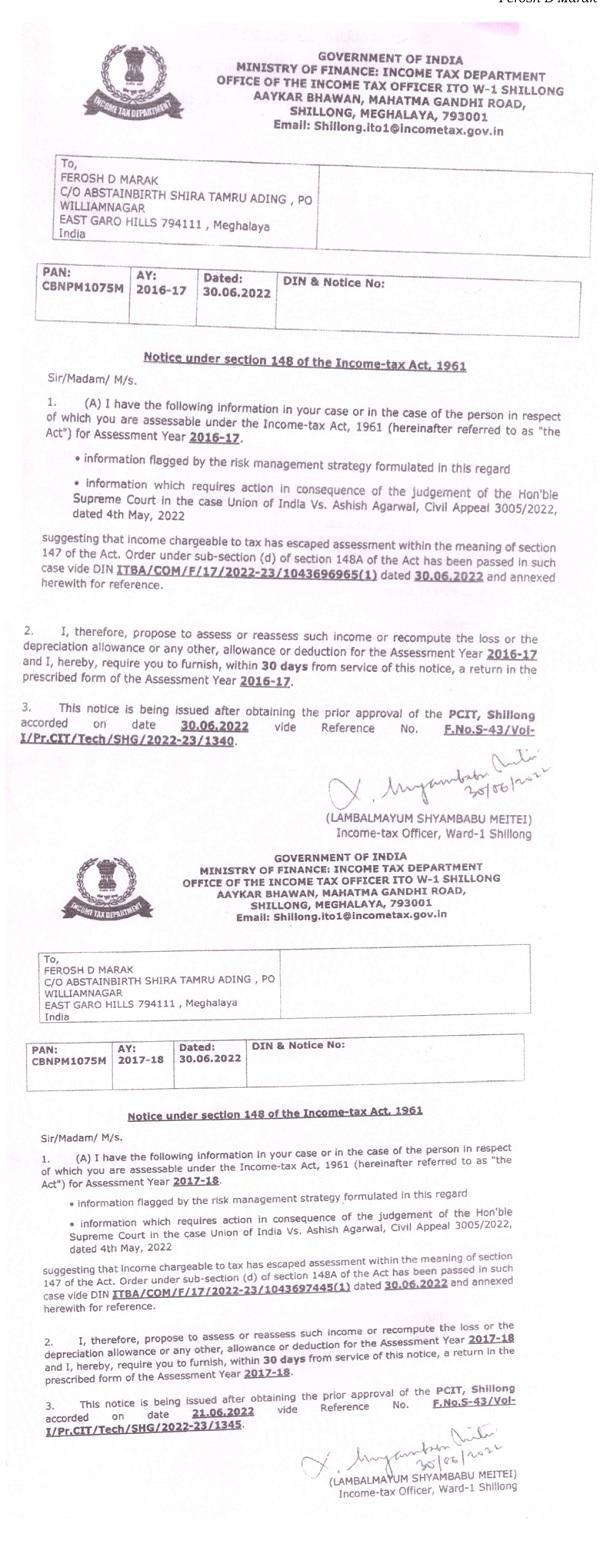
On going through the above notices issued by Assessing Officer dated 30.06.2022, it is clear that the notice has been issued after obtaining approval from PCIT, Shillong since, in this case the notice had been issued beyond the period of three years. Accordingly, the prior approval for issue of notice as per Section 151 (ii) the Assessing Officer should have obtained permission from PCCIT. However, in the case of for both the years, the Assessing Officer has obtained approval from the PCCIT which is not as per mandatory provision for obtaining approval. This view is supported by the decision of Hon’ble Bombay High Court in the case of Mrs. Chitra Supekar vs. ITO in [2023] 149 taxmann.com 26 (Bom) which held as under:
“Conclusion:
7. We have heard both counsels at length and have perused the proceedings. we agree with the view taken by the Delhi High Court in the case of Eshaan Holding (P.) Ltd. (supra) upholding the view of the ITAT that if there is no valid service of notice under section 148, the reassessment proceedings are null and void as also the decision of the Punjab and Haryana High Court in the case of Avtar Singh (supra) which held that service of notice under section 148 is a condition precedent for making reassessment or re-computation under section 147 of the Act.
8. In our view, before issuing the notice under section 148A (b) it was imperative for the AO to have checked if there was a change of address. A condition precedent for any proceeding including a proceeding u/s. 148A, is a valid service of notice, lest it would be a jurisdictional error. With regard to, the first notice dated 20th March 2022, it is the case of the petitioner that they had not received any notice dated 20th March 2022 and the revenue contended that it was served through speed post at the last known address. It is evident that though the respondents had the new address of the petitioner as evinced from the ITR filed on 10th January 2021, the respondents chose to send the notice to their old address. We also find no averment or proof of the service of notice dated 20th March 2022 on the petitioner in respondent’s affidavit in reply dated 14th November 2022. The cascading effect of non-service was the petitioner did not get an opportunity to respond to the notice. Consequently, the notice dated 20th March 2022 and the proceedings thereafter are void. Apropos section 151(ii) of the Act the sanction from the PCCIT ought to have been taken when order was sought to be passed beyond the period of three years i.e. beyond 31st March 2022 on 5th April 2022. Consequently, the notice dated 20th March 2022 and order dated 5th April 2022 deserves to be set aside on account of jurisdictional error i.e. for want of service and consequently, for non-compliance with the provisions of the Act.
9. With regard to the reopening notice u/s. 148 dated 13th April 2022, the contention of the petitioner that they received the hand delivery of the notice on 21st April 2022 pursuant to the message received on the registered mobile number on 18th April 2022 is also not controverted by the respondents in their reply. No approval from PCCIT was taken as contemplated u/s 151(ii) as the reopening was caused beyond three years and is therefore vitiated. We also find no averments responding to the ITRV dated 29 April 2022 filed for A.Y. 2018-19 by the petitioner in response to the notice u/s. 148 dated 13 April 2022 nor with regard to the compliance of the stipulations by the respondents u/s. 148 of the IT Act.
10. We are accordingly of the view that the impugned order dated 5 April 2022 and the notice dated 13 April 2022 also deserves to be quashed and set aside. The respondent will be at liberty to proceed with the assessment after issuance of notice and providing the Petitioner a hearing after a response is filed. Such exercise shall be completed preferably within a period of twelve weeks from the date of receipt of this order. It is made clear that we have not examined the merits of the matter.”
Respectfully following the above judgment of Hon’ble High Court, we allow the additional ground raised by the assessee and holding that the notice issued by Assessing Officer u/s 148 is not proper in the eyes of law. In the result, the appeals of the assessee are allowed in above terms.
7. To sum up, for AY 2015-16 in ITA No. 263/Gau/2025 is partly allowed. For AY 2016-17 in ITA NO. 264 & 265/Gau/2025 is allowed.
Any common order passed shall be kept in the respective case files.
Order is pronounced in the open court on 9th October, 2026