DCIT Vs Arena Textiles & Industries Limited (ITAT Kolkata)
Reopening Beyond Four Years Fails Without Recorded Failure to Disclose Material Facts: Kolkata ITAT Quashes Reassessment
Case Details
In DCIT, Circle 7(1), Kolkata v. Arena Textiles & Industries Limited, the Kolkata “A” Bench of the Income Tax Appellate Tribunal held that reopening an assessment beyond four years, where the original assessment had been completed under section 143(3), could not survive when the recorded reasons failed to identify any failure by the assessee to disclose material facts fully and truly.
The common order in ITA No. 2082/KOL/2025 and Cross Objection No. 38/KOL/2026, concerning Assessment Year 2009-10, was pronounced on 7 October 2026 by Shri Rajesh Kumar, Accountant Member, and Shri Pradip Kumar Choubey, Judicial Member.
The Tribunal allowed the assessee’s cross-objection and quashed the reopening. Consequently, the Revenue’s appeal concerning deletion of a ₹2.67 crore unsecured-loan addition became infructuous and was dismissed.
Background: Completed Scrutiny Assessment Reopened
The assessee filed its return under section 139(1) on 24 September 2009. The return was selected for scrutiny, and an assessment under section 143(3) was completed on 26 December 2011.
Subsequently, the Assessing Officer issued a notice under section 148 on 30 March 2016, reopening the assessment under section 147. The notice was issued after four years from the end of AY 2009-10.
Following further enquiries and examination of details during reassessment, the Assessing Officer passed an order under section 147 read with section 143(3) on 27 December 2016. He added ₹2,67,00,000 concerning unsecured loans from Mandpam Commercial Limited, treating the amount as unexplained cash credit under section 68.
The CIT(A), National Faceless Appeal Centre, deleted the addition by order dated 17 July 2025. The Revenue challenged that deletion before the Tribunal.
Assessee’s Cross-Objection
Alongside the Revenue’s appeal, the assessee filed a cross-objection challenging the jurisdictional validity of the reopening.
It argued that all material facts had been disclosed in the return and during the original scrutiny proceedings. Therefore, reopening after four years was contrary to the first proviso to section 147, applicable to the proceedings in question.
The Tribunal decided to consider this legal objection first. If the reopening itself lacked jurisdiction, the Revenue’s challenge to the merits of the loan addition would no longer require adjudication.
What the Recorded Reasons Contained
The reasons reproduced in the order referred to information received from the Investigation Wing following post-search enquiries.
According to that information, the assessee had received funds from Mandpam Commercial Limited during FY 2008-09. The communication alleged that Mandpam was a shell entity without genuine business activities and was engaged in providing accommodation entries.
It also referred to a statement recorded under section 131 describing a mechanism in which cash from beneficiaries moved through paper companies before cheques were issued as share capital, share premium or unsecured loans.
The reasons identified ₹2.67 crore received by the assessee from Mandpam Commercial Limited during the relevant period.
However, the Tribunal found that these reasons contained no assertion or finding that the assessee had failed to disclose the relevant material facts fully and truly. The alleged accommodation-entry information did not, by itself, address that additional jurisdictional requirement.
Tribunal’s Interpretation of the First Proviso
The Tribunal noted two undisputed circumstances: the original assessment had been completed under section 143(3), and reopening occurred beyond four years from the end of the relevant assessment year.
In that setting, the first proviso required a failure attributable to the assessee concerning full and true disclosure of material facts necessary for assessment, leading to escapement of income.
On examining the reasons, the Tribunal found no recorded satisfaction concerning such failure. It therefore held that reopening had not been undertaken in accordance with the first proviso and was bad in law.
The Tribunal followed DCIT v. Murlidhar Ratanlal Exports Limited, order dated 28 October 2025, where reopening had similarly been quashed because the recorded reasons failed to identify the requisite disclosure failure.
The reproduced reasoning from that precedent also referred to ACIT v. CEAT Ltd., [2023] 146 taxmann.com 108 (SC) in support of the requirement.
Decision
The assessee’s cross-objection was allowed, and the reopening was quashed.
As a consequence, the Revenue’s appeal against the CIT(A)’s deletion of the ₹2.67 crore addition became infructuous and was dismissed.
The Tribunal did not independently adjudicate whether the lender was genuine, whether the loan satisfied section 68 requirements, or whether the CIT(A)’s reasoning on those merits was correct. The assessee succeeded on the threshold jurisdictional objection.
Author’s Comments
The decision illustrates the distinction between information suggesting escapement of income and satisfaction of every statutory condition for reopening. Allegations concerning a shell company or accommodation entries may warrant scrutiny, but they do not automatically establish an assessee’s failure to disclose material facts.
The ruling concerns the first proviso to section 147 governing these historical proceedings. It should not be presented as an unrestricted four-year rule applicable to every reopening regime.
The procedural outcome is equally important. The Revenue’s appeal was dismissed because the reassessment foundation failed, rather than because the Tribunal examined and accepted the loan on merits.
For similar disputes, the recorded reasons deserve close examination. The decisive question is whether they identify the assessee’s disclosure failure and its connection with escapement, rather than merely recount adverse information about a third party.
Cases Discussed
- DCIT v. Murlidhar Ratanlal Exports Limited (ITAT Kolkata; Order dated 28/10/2025): The coordinate bench quashed reopening beyond four years where the original assessment had been completed under section 143(3) and the recorded reasons did not identify failure by the assessee to disclose fully and truly the material facts necessary for assessment. The Tribunal followed this decision in the present case.
- ACIT v. CEAT Ltd. (Supreme Court; [2023] 146 taxmann.com 108): The precedent was referred to in the reasoning reproduced from Murlidhar Ratanlal Exports Limited in support of the restriction on reopening beyond four years in the absence of the required disclosure failure.
FULL TEXT OF THE ORDER OF ITAT KOLKATA
In these appeals of Revenue and CO of the assessee are against the order of the National Faceless Appeal Centre, Delhi (hereinafter referred to as the “Ld. CIT(A)”] dated 17.07.2025 for the AY 2009-10.
2. The only issue raised by the Revenue is against the order of ld. CIT (A) deleting the addition of ₹2,67,00,000/- as made by the ld. AO on account of unsecured loans taken from M/s Mandpam Commercial Ltd., whereas the assessee has raised a legal issued in the cross objection challenging the validity of the proceedings u/s 148 of the Act and the consequent assessment framed. Since, the assessee has raised legal issue therefore, we are inclined to decide the cross objection first. The legal issue raised as under:-
“1. That the ld. CIT (A) was wrong in not allowing the assessee’s objections regarding re-opening of assessment proceeding by issuing notice u/s 148 dated 30.03.2016 after elapse of four years from the end of the relevant assessment year as the assessee disclosed all the material facts in its return of income and in the course of the assessment proceedings u/s 143(3) dt. 26.12.2011. thus, the re- opening of assessment after four years is bad in law and need to be quashed along with consequential assessment order passed. ”
3. After hearing the rival contentions and perusing the materials available on record, we find that the assessee filed the return of income on 24.09.2009, u/s 139(1) of the Act. The case of the assessee was selected for scrutiny and accordingly, the assessment was framed u/s 143(3) vide order dated 26.12.2011. Thereafter, the assessment was reopened u/s 147 of the Act by issuing notice u/s 148 of the A ct on 30.03.2016. Thereafter, the ld. AO, after calling for various details and evidences from the assessee during the assessment proceedings, framed the assessment u/s 147/ 143(3) of the Act vide order dated 27.12.2016, wherein the addition of ₹2,67,00,000/- account of unsecured loans by treating the same as unexplained cash credit u/s 68 of the Act.
4. We note that the case of the assessee was reopened after a period of four years from the end of the relevant assessment year and it is undisputed that the assessment wa s also framed u/s 143(3) of the Act vide order dated 26.12.2011. T herefore the reopening of assessment can only be made in accordance with the first proviso to Section 147 of the Act, which provides that where the assessment has been framed u/s 143(3) of the Act, the reopening beyond four years from the end of the relevant assessment year can only be made if there is a failure on the part of the assessee to fully and truly disclose all the facts in the return of income or during the assessment proceedings, which was led to escapement of income. We have also perused the reasons recorded by the ld. AO copy of which is available at page no.2 of the Paper Book, wherein there is no whisper of any failure on the part of the assessee to disclose fully and truly all the information qua the escarpment of income. F or the sake of ready reference, the same is extracted below:-
Intentionally left Blank
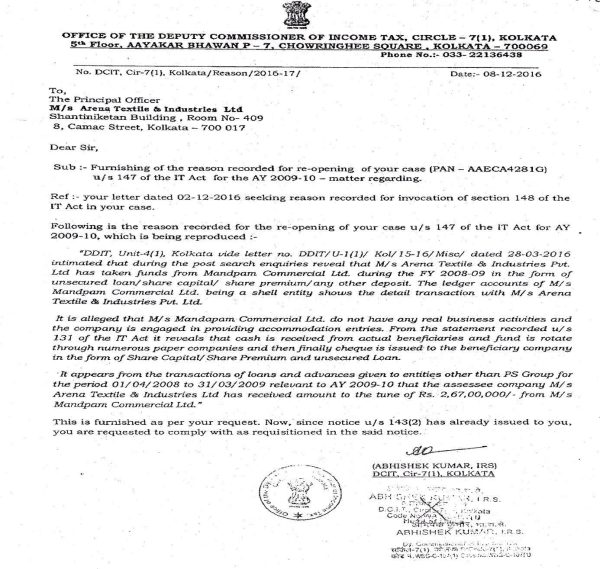
4.1. A perusal of the above reasons reveals that the ld. AO has not recorded any satisfaction as to the failure of the assessee in the reasons which has led to the escapement of income. Therefore, the reopening is not made in accordance with the first proviso to section 147 of the Act and accordingly, the same is bad in law. The case of the assessee is squarely covered by the decision of the co- ordinate Bench Limited vide order dated 28.10.2025, wherein the Tribunal held as under:-
“07. After hearing the rival contentions and perusing the materials available on record, we find that the assessment in this case were framed u/s 143(3) vide order dated 28.03. 2016.Thereafter, the case of the assessee was reopened u/s 147 of the Act by issuing notice u/s 148 of the Act on 01.02.2021, after recording the reasons to believe copy of which is available at page no.80 to 83 of the Paper Book of the assessee. We observe from the said reasons that the AO has not recorded any satisfaction or finding as to failure of the assessee to disclose any information truly and materially in the return of income filed or during the assessment proceedings u/s 143(3) of the Act. Therefore, the reopening of assessment does not meet the parameters as provided under First proviso to Section 147 of the Act. The proviso to Section 147 of the Act provides that where an assessment u/s 143(3) has been framed and four years have elapsed from the end of the relevant assessment year then the reopening u/s 147 of the Act can only be made if there is failure on the part of the assessee to disclose any information fully and truly disclosing all material facts necessary for assessment or failure on the part of the assessment to make the return u/s 139(1) of the Act or in response to notice u/s 143(1) or 148 of the Act for that assessment year and not otherwise. In the present case, the case of the assessee falls in none of the parameters mentioned in the said proviso, therefore, the reopening of assessment u/s 147 of the Act has been made in violation of proviso to section 147 of the Act and cannot be sustained. The case of the assessee find support from the decision of Hon’ble Apex Court in the case of ACIT vs. CEAT Ltd. in [2023] 146 taxmann.com 108(SC) wherein it has been decided by the Hon’ble Apex court that no re- opening can be made u/s 147 of the Act after elapse of four years from the end of relevant assessment year where an assessment has been framed u/s 143(3) of the Act if the AO has not recorded in the reasons to believe that there was failure on the part of the assessee to disclose any information fully and truly disclosing all material facts necessary for assessment. Considering the facts of the case in the light of the aforesaid decision, we are inclined to quash the reopening of assessment by allowing ground no.1 raised by the assessee. The CO of the assessee is allowed.”
ITA No. 2082/KOL/2025
5. Since, we have allowed the appeal of the assessee in Cross objection No. 38/KOL/2026 for A.Y. 2009-10 by quashing the reopening of assessment u/s 147 of the Act, the appeal filed the additions on merit becomes infructuous and consequently, dismissed.
6. In the result, the appeal of the Revenue is dismissed and the CO of the assessee is allowed.
Order pronounced on 07.10.2026.