
Avinash Arora Vs ITO (ITAT Agra)
Alleged Flat “On-Money”: Show-Cause Notices Cannot Replace Cross-Examination, Rules Agra ITAT
₹11 Lakh Addition Sent Back for Fresh Assessment
The Agra ITAT has restored an alleged ₹11 lakh on-money addition to the Assessing Officer for fresh assessment after holding that the assessee should have been permitted to cross-examine the persons whose statements were relied upon.
The dispute arose from Excel data seized during a search on a builder. The Revenue treated the difference between the consideration recorded in that data and the registered consideration as cash paid outside the books.
The Tribunal rejected the CIT(A)’s reasoning that confronting the material through notices and permitting a written rebuttal sufficiently addressed the cross-examination objection. On the particular facts, the assessee was entitled to question the persons whose statements supported the alleged cash payment.
Separately, the Tribunal held that the absence of a Section 65B certificate was an irregularity that did not, by itself, render the proceedings a nullity. It nevertheless directed the Assessing Officer to inform the assessee about the procedure followed for seizing the electronic material if that material was to be relied upon.
Builder’s Excel Sheet Showed Higher Consideration
The assessee purchased Flat No. 601 at Orchid Tower, Gwalior, developed by Narayanan Builders and Developers Private Limited, along with his father and mother.
A search conducted on 20 March 2023 yielded electronic records concerning the sale of flats. According to the Assessing Officer, the seized data showed total consideration of ₹72 lakh for the flat, against ₹39 lakh paid through banking channels.
The difference of ₹33 lakh was treated as unaccounted cash consideration. One-third of that amount, ₹11 lakh, was attributed to the assessee.
The Assessing Officer relied on statements of Shri Niket Jain, Shri Paras Jain, and the builder’s accountant, Shri Ajay Singh Bhadoriya, concerning cash receipts from flat buyers.
The Revenue also emphasised that details such as the flat number, area, registration date, and cheque payments matched the actual transaction. It considered that correspondence supportive of the cash component recorded in the same data.
CIT(A) Confirmed the Addition
The CIT(A) upheld the addition, treating the seized Excel records and supporting statements as sufficient evidence of the assessee’s alleged cash investment.
The appellate authority reasoned that the assessee had received opportunities to respond through notices, a show-cause notice, and examination during the assessment proceedings.
It also rejected the cross-examination objection on the footing that there was no absolute right to cross-examine where the adverse material had been confronted and an opportunity to rebut it had been provided.
Before the Tribunal, the assessee challenged the electronic evidence, denial of cross-examination, attribution of the alleged cash payment, and the shifting of the burden of proof.
Missing Section 65B Certificate Did Not Automatically Nullify Proceedings
The assessee argued that the Excel data could not be relied upon without the certificate contemplated by Section 65B(4) of the Indian Evidence Act, 1872.
The Tribunal treated the objection as concerning the manner of reliance on the seized document, rather than the Assessing Officer’s jurisdiction to consider it. It held that the absence of the certificate was an irregularity and not an illegality per se, and that the proceedings would not become a nullity solely for that reason.
The Tribunal referred to the recording of electronic seizures through a panchnama and generation of a hash value to safeguard authenticity against subsequent tampering.
If the Assessing Officer proposed to rely on the seized electronic documents in the fresh proceedings, he was directed to inform the assessee about the seizure procedure. This direction should not be read as a factual certification that every safeguard had already been established in this case.
Witnesses’ Connection with the Transaction Required Examination
The assessee submitted that Shri Niket Jain became a director only on 10 March 2021, whereas the flat purchase had been completed on 13 June 2019. He supported this contention with information obtained from the Ministry of Corporate Affairs website.
He also questioned reliance on Shri Paras Jain’s status as a 50% shareholder during a later financial year.
These timing issues were relevant to testing the witnesses’ knowledge of the transaction. The Tribunal agreed that, in the circumstances, the assessee had a right to cross-examine Shri Niket Jain and Shri Paras Jain.
It expressly disagreed with the denial of that opportunity by both the Assessing Officer and CIT(A).
Fresh Assessment Directed; Merits Remain Open
The Tribunal set aside the CIT(A)’s order and restored the matter to the Assessing Officer for fresh assessment, incorporating its directions on cross-examination and electronic material.
The challenge concerning manual issuance of the reassessment notice was not pressed. The ground alleging mechanical disposal of objections and approval without application of mind was dismissed because no specific submission substantiated it.
The appeal was partly allowed for statistical purposes. The alleged on-money addition was not finally deleted on merits.
Author’s Comments
The decision distinguishes receiving an adverse statement from having an opportunity to test the person who made it. A written denial may not resolve questions about personal knowledge, the period of involvement, or the basis for identifying a particular buyer’s alleged cash payment.
Matching cheque and property details can be relevant evidence, but the disputed cash component still requires examination. Here, the Tribunal required that examination through cross-examination and a fresh assessment.
Equally, the order does not support automatic rejection of electronic records merely because a Section 65B certificate is absent. Its approach combines procedural correction with further factual scrutiny.
The Revenue may rely on the builder’s records, but the buyer must receive the opportunity directed by the Tribunal to challenge the evidence supporting the alleged cash payment.
Cases Discussed
- Andaman Timber Industries Vs Commissioner Of Central Excise (Supreme Court)
- Ravinder Singh Kaku Vs State of Punjab (04.05.2022) (Supreme Court)
- Kishanchand Chellaram vs CIT (1980) 125 ITR 713 (SC)
FULL TEXT OF THE JUDGMENT/ORDER OF ITAT AGRA
1. This appeal is directed against the impugned order dated 15.01.2026 passed in appeal No NFAC/2019-20/10486596 by the ld. Commissioner of Income Tax/ National Faceless Appeal Centre (NFAC), Delhi [hereinafter referred to as the “CIT(A)] u/s. 250 of the Income Tax Act, 1961 (hereinafter referred to as the “Act”) for the A.Y. 2020-21, wherein ld. CIT(A) has dismissed assessee’s appeal.
2. Brief facts of the case: A search and seizure action was conducted in the case of M/s. Narayanan Builders and Developers Private Limited (hereinafter referred to as M/s NBDPL) on 20.03.2023. The assessee had purchased Flat no. 601 at Orchid Tower, Gwalior which was developed by M/s NBDPL. The assessment in this case was reopened by the AO by issuing in notice u/s 148 of the Act dated 29.03.2022 on the basis of information that the assessee had paid on money in respect of purchase of the aforesaid flat. In this regard, the relevant noting made by the AO in the assessment order is reproduced as under:
The case of assessee was reopened under section 147 of the IT Act 1961 for the scrutiny as per the following information received from the Dy. Director of Income Tax (Investigation)- Gwalior for the Assessment Year under consideration:
| S. No. | Nature of Transaction | Amount (in Rs.) | AY | Source |
|---|---|---|---|---|
| 1. | Unexplained Cash Transaction/ Investment | 11,00,000/- (33.33% of 33,00,000) | 2020- 21 | Search action u/s 132 in case of Paras Jain Group, Gwalior. Transactions identified from the excel sheet seized from the premises of M/s Narayanan Builders and Developers Pvt. Ltd maintain by Shri Niket Jain, Director. |
2.1 In this regard, the relevant extract of the seized document marked as LPS-1 relating to the alleged payment of on money by the assessee for the purchase of the aforesaid flat as reproduced by the AO on page no. 31 and 32 of the assessment order is as under:
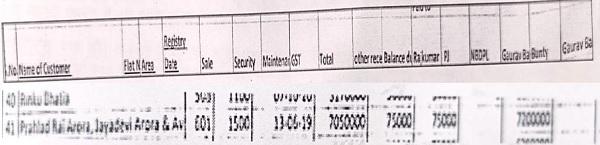
2.2 During the course of assessment proceedings, the AO took note of the fact that Shri Niket Jain, Director of M/s. NBDPL in reply to a question admitted receiving sale consideration in cash and admitting that registration is done on guideline value (Registry value) and the difference in actual sale consideration and guideline value (Registry value) was received in cash. The AO also took note of the fact that the statement of Shri Ajay Singh Bhadoriya working as an Accountant for M/s NBDPL, was recorded where he stated that almost 50% of the consideration in Orchid Tower ‘A’ & ‘B’ was received in cash, which was not entered in the books of account. The AO further took note of the fact that shri Paras Jain father of Shri Niket Jain who held 50% shareholding in M/s NBDPL also admitted about the receipt of on money in cash on account of the difference in the guideline value (Registry value) and the difference in actual sale consideration. Thereafter, the AO reproduced the relevant extracts of the seized documents marked as LPS1, wherein, according to the AO, the entries of cash and cheque receipts from various buyers were duly recorded in respect of the transactions made by the assessee.
2.3 Thereafter, the AO reproduced statement of the Director Shri Niket Jain of M/s NBDPL wherein he was asked about similar entries in respect of the sale of various flats including flat No. 104 purchased by another assessee Shri Dilip Kumar Jain, wherein according to the AO, the Director admitted about the receipt of cash mentioned in the above seized document LPS-1. Thereafter, the AO stated that when the buyer accepts the entries of cheques and other details such as flat number, area etc. which tally with the figures mentioned in the seized documents, which is part of “computerized types document” and observed that part of the document cannot be true and other be false. The AO also observed that for the simple reason, the said observation will be applicable to all the flats which were being sold. The AO observed that if for all the flats, cheque number, flat number, area etc., which is correctly mentioned and other components, which has not been accepted by the assessee, cannot be held to be inadvisable. The AO further observed that the seized document is a computerized document and the same has been retrieved and seized during the course of search.
2.4 The AO thereafter referred to the provisions of section 132 of the Act and also observed that the statement recorded of Shri Niket Jain, Shri Bhadoria and Shri Paras Jain clearly establish the receipts of “on money” from various buyers including the assessee Shri Avinash Arora along with his father Shri Prahlad Rai Arora and his mother Smt. Jaya Devi Arora. Thereafter, the AO reproduced the statement recorded of the assessee u/s. 131(1A) of the Act dated 21.03.2025 wherein the assessee stated on oath that in the seized excel sheet data states as “Flat No. 601, Area 1500, registry date 13.06.2019, GST amount” etc. matches with the actual data of their flat and as per their e-registry. The AO further noted that in the remaining data in the seized excel sheet states “sale 70,50,000, Security 75,000/-, maintenance 75000, total 72,00000/-“, the assessee did not have any satisfactory rely. The AO further took note of the fact that the actual consideration amount received in lieu of sale of flats in Orchid Tower A has been mentioned in the above excel sheet, but only the amount mentioned in the registry has been entered in the books of account and the difference amount between the final consideration and registry amount should be considered as out of books cash receipts. The AO also took note of the fact that almost 45% of the registered deed of Rs.39,00,000/- has been done before execution agreement dated 23.03.2019, which was neither notarized and in absence of any witnesses this agreement could not be a cogent evidence, which could be considered for the purpose of assessment. Accordingly, out of the total sum of Rs.33,00,000/- in excess of the total consideration as per seized NPS1 (Rs.72,00,000/-) and the consideration paid through cheque Rs.39,00,000/-, an amount of Rs.11,00,000/- being 1/3rd of the difference of Rs.33,00,000/- was added u/s. 69 read with section 115BBE of the Act in the hands of the assessee.
3. Aggrieved with the said order, the assessee filed an appeal before learned CIT(A), who dismissed the appeal of the assessee. The relevant extract of the said order is reproduced as under:
“5. I have carefully considered the assessment order passed by the AO dated 28.03.2025, the grounds of appeal raised by the assessee, assessee’s written submissions filed during appellate proceedings, remand report called for from the AO, and the entire material available on record including the seized documents, statements recorded u/s 132(4), assessment records and corroborative evidences gathered during investigation.
6. Section 147 of the Act empowers the Assessing Officer to assess or reassess income which has escaped assessment where he has reason to believe that any income chargeable to tax has escaped assessment. The expression “reason to believe” has been judicially interpreted to mean existence of tangible material leading to formation of such belief. In the present case, specific information received from DDIT(Inv.), Gwalior regarding search u/s 132 conducted on 20.03.2023 on NBDPL premises clearly disclosed unaccounted cash receipts of Rs.33,00,000/- (assessee’s share Rs.11,00,000/-) for Flat No.601, Orchid Tower, which satisfied the conditions for issuance of notice u/s 148A(b) and approval u/s 151 by PCIT. Section 69A of the Act provides that where in any financial year the assessee is found to be the owner of any money, bullion, jewellery or other valuable article and such money etc. remains unexplained, the same shall be deemed to be the income of the assessee for such financial year. Further, u/s 115BBE, such unexplained investment is taxable at flat rate of 60% without any deductions or allowances. The onus is squarely on the assessee to prove the nature and source of such investment, which the assessee has failed to discharge. The Hon’ble Supreme Court in Andaman Timber Industries vs CCE (2015) 7 SCC 798 has clarified the principles of natural justice in the following words:Principles of natural justice require opportunity to meet material proposed adverse; no absolute right to cross-examine if material confronted via notices/SCN and rebuttal permitted; retraction without corroboration self-serving.
7. The Hon’ble Supreme Court in Ravinder Singh Kaku vs State of Punjab (04.05.2022) has observed on electronic evidence and statements u/s 132(4) that; Primary seized documents with corroborative u/s 132(4) statements carry presumptive value u/s 132(4A); oral corroboration suffices in assessment proceedings. Section 65B(4) certificate mandatory for court admissibility of secondary electronic evidence, but primary seized documents (Excel sheets) during search have independent evidentiary value.
8. The seized Excel sheets (LPS-01 pp.118-119) from Seagate external hard drive (S.No. NA8ZLSHZ) recovered from NBDPL office during search u/s 132 are completely self-corroborative in nature. The specific entry at Serial No.41 pertains to “Prahlad Rai Arora, Jaya Devi Arora, Avinash Arora” for Flat No.601 (area 1500 sq.ft., registry date 13.06.2019) showing total consideration Rs.72,00,000/- comprising cheque payments Rs.39,00,000/- and unaccounted cash Rs.33,00,000/-, with assessee’s 1/3rd share worked out at Rs.11,00,000/-. These details perfectly tally with the registered sale deed (e-registry No. MP142602019A1404382 dt.13.06.2019) and bank statements produced by assessee confirming only Rs.39,00,000/- paid through banking channel via home loan and account payee cheques. The balance Rs.33,00,000/- cash remains completely unexplained despite adequate opportunities provided to the assessee.
9. The evidentiary value of these seized documents stands fortified by corroborative statements recorded u/s 132(4) of Shri Niket Jain (Director who maintained the hard drive), Shri Paras Jain (50% shareholder and key management personnel) and Shri Ajay Singh Bhadoriya (accountant of NBDPL), who consistently admitted 40-50% on-money receipts in Orchid Tower-A flats, unbooked in regular accounts. Post-search retraction by Shri Niket Jain lacks any independent corroboration and is clearly self-serving. Further, third-party enquiries from flat buyers like Shri Sunil Kumar Gabra (Flat 702) and Shri Sanjay Kumar Goyal (Flat 50 confirmed Excel details except cash component, proving the pattern of on-money transactions.
10. The assessee was afforded full opportunity of being heard through series of notices u/s 142(1) dated 25.07.2024, 07.08.2024, 13.12.2024, 17.02.2025; summons u/s 131 dated 20.03.2025 wherein statement recorded on 21.03.2025; and detailed Show Cause Notice dated 01.03.2025. All preliminary objections regarding validity of notice u/s 148, admissibility of electronic evidence and cross-examination opportunity were disposed of point-wise through speaking order dated 10.02.2025 by AO. The assessee’s statement u/s 131 dated 21.03.2025 itself admitted correctness of Excel details (flat no., area, registry date, cheque payments) except cash component, but failed to tender any evidence regarding source of Rs.11,00,000/- or disprove 1/3rd share attribution. The assessee’s cited cases distinguished on facts: Kishanchand Chellaram vs CIT involved uncorroborated third-party statement without any primary document or confrontation; here primary seized material from search premises exists with multiple corroborative statements and repeated opportunities provided. Principles of natural justice stand fully satisfied; addition u/s 69A fully justified on facts and law.
11. In view of the aforesaid detailed facts, circumstances, statutory provisions and binding judicial precedents, I am satisfied that the Assessing Officer was fully justified in making addition of Rs.11,00,000/- u/s 69A r.w.s. Section 115BBE of the Act on account of assessee’s unexplained share in unaccounted cash investment in Flat No.601, Orchid Tower. The assessment order dated 28.03.2025 passed u/s 147 r.w.s. 143(3) stands confirmed in full. All grounds of appeal are dismissed.
12. In the result, the appeal filed by the assessee is dismissed.”
4. Aggrieved with the said order, assessee is in appeal before us on the following grounds:
“1. CIT(A) erred in upholding reassessment u/s 147 though notice u/s 148 dated 23.03.2024 was issued manually contrary to CBDT Notification No. 18/2022.
2. Objections against reopening were disposed of mechanically and approval u/s 151 was granted without proper application of mind.
3. Reliance on alleged excel sheets from third party without certificate u/s 65B of Indian Evidence, Act.
4. Addition confirmed without providing opportunity of cross examination of persons relied upon.
5. Addition of Rs. 11,00,000 u/s 69A made without proving ownership of unexplained money.
6. Alleged excel sheet is loose unsigned document whereas registered deed shows payment through banking channel.
7. Burden of proof wrongly shifted to appellant though primary burden lies on department.
8. CIT(A) failed to adjudicate grounds independently.
9. Appellant craves leave to add, amend or withdraw grounds before hearing.”
5. In this regard, the assessee has not pressed ground No. 1 of the appeal, which is dismissed as not pressed.
6. Regarding ground no-2 of the appeal, no specific submission has been filed by the assessee to demonstrate as to how the objection against reopening was disposed mechanically and approval u/s. 151 without proper application of mind was granted. Accordingly, ground No. 2 of the appeal is also dismissed.
7. Ground No. 3 of appeal states that reliance on alleged excel sheet of third party without certification u/s. 65B of the Indian Evidence Act, is not justified. In this regard, the assessee has submitted in his written submissions as under:
“GROUND No. 3
Addition based on inadmissible electronic evidence – Violation of Section 65B
3.1 That the Ld. A.O. grossly erred in law in upholding reliance upon alleged Excel sheets recovered from a third party’s premises without compliance of mandatory provisions of Section 658 of the Indian Evidence Act, 1872.
3.2 That no certificate under section 65B (4) was produced to authenticate the electronic record.
3.3 That the impugned addition is based on unverified, unauthenticated and legally inadmissible electronic material and is therefore unsustainable in law.
Submission- it is submitted that There is no certificate under Section 65B Of Indian evidence Act, 1872 was obtained before considering the digital record in the Seagate external hard drive form which the default relating to sale of flats in Orchid Tower. In this case proceedings u/s 148 were initiated on the basis of information found int the Seagate external hard drive sized during search of M/s Narayan Builders and Developers Pvt. Limited therefore before relaying on the data certificate u/s 65B (4) of Indian evidence act, 1872 was mandatorily required as explained below.
“65B certificate issued under Section 65B (4) of the Indian Evidence Act, 1872, which provides for the admissibility of electronic evidence in court. The certificate is essentially a statement by a person who is in charge of the computer or electronic device from which the evidence was obtained or by a person who is qualified to do so, confirming the authenticity of the electronic evidence. The 65B certificate is necessary for the admissibility of electronic evidence in court proceedings. It serves as proof that the electronic evidence is authentic and has not been tampered with. The certificate must be signed by the person who is producing the electronic evidence and must be accompanied by the electronic record or document in question. It is important to note that the certificate must be produced at the time when the electronic evidence is presented in court proceedings. Failure to produce the certificate at the appropriate time can result in the electronic evidence being declared inadmissible by the court.”
Sonu @ Amar vs State of Harvana (2017 INSC 634),
Luthra contended that the CDRs are not admissible under Section 65B of the Indian Evidence Act, 1872 as admittedly they were not certified in accordance.
Ravinder Singh @ Kaku Vs State of Punjab
The Hon’ble Supreme Court vide its order dated May 04, 2022 has observed that a certificate under Section 65B (4) of the Indian Evidence Act, 1872 is mandatory to produce electronic evidence, and that submitting oral evidence in place of such certificate cannot possibly suffice.
Regarding admissibility of the electronic records, It is here by submitted that certificate U/s 65B (4) of Indian evidence act, 1972 is a condition precedent to the admissibility of evidence extracted from electronic record oral evidence in the form of statement of key person M/s Narayan Builders and Developers Pvt. Ltd. (Shri Paras Jain, Shri Niket Jain, and accountant of the company Shri Ajay Singh Bhaduria) can suffice as section 65B(4) of the IEA, 1872 clearly state that secondary evidence is admissible only if there is certificate U/s 65B of IEA, 1872 has been issued by the concern person/authority who made or entered the value in electronic device Accordingly, the statement recorded of Shri Paras Jain and Shri Niket Jain have no “Locus Standi” and there is no value of their statement as an evidence. In absence of certificate U/s 65B (4) of IEA, 1872 the secondary evidence of oral statement has no values in the eyes of Law. The above submission was also made before the AO and The CIT (A)”
8. We have heard both the parties and perused the material on record. The assessee submits that the documents relied upon by the AO retrieved from the computer hard disc from the assessee’s premises marked as NPS-1 has been relied upon by the AO without the requisite certificate u/s. 65B of the Indian Evidence Act. In view of this fact, the assessee submits that in absence of the requisite certificate u/s. 65B of the Indian Evidence Act, reliance placed by the AO on the said document was legally not valid. The Ld. AR further submits that the certificate u/s. 65B of the Indian Evidence Act is essentially a statement by a person who is in charge of the computer or electronic device from which the evidence was obtained or by a person who is qualified to do so, confirming the authenticity of the electronic evidence. The Ld. AR further submits that the 65B certificate is necessary for the admissibility of electronic evidence in court proceedings which serves as proof that the electronic evidence is authentic and has not been tampered with. On perusal of the above submission of the assessee, we note that assessee has not challenged that the AO does not have the jurisdiction to rely upon the said seized document marked as NPS-1 but has challenged that in absence of certificate u/s. 65B of the Indian Evidence Act was not proper. This, in our considered view, is only an irregularity and not an illegality per se and the proceedings will not become a nullity for want of the certificate u/s. 65B of the Indian Evidence Act. Further, in a search and seizure proceedings u/s 132 of the Act, the seizure of the data in any electronic device is recorded by a panchanama drawn after the conclusion the search, which is signed by the authorised officer and the searched party in the presence of two independent witnesses. Further, a ‘hash value’ is generated of the seized electronic item about the data contained in the seized electronic item to ensure that the electronic evidence is authentic and cannot be tampered with subsequently. In this regard, for the reasons as discussed later in this order, the AO is directed to intimate the assessee about the said procedure of the seizure of the electronic item in the event the AO wants to rely upon the seized document NPS-1 and any other such seized document. Ground No. 3 of the appeal is allowed in above terms.
9. Ground No. 4 to 9 of the appeal are against the merits of the addition of Rs.11,00,000/- u/s. 69A of the Act and in respect of denial of opportunity to cross examine the persons whose statements have been relied upon.
9.1 In this regard, as noted above, the AO had inter alia relied upon the statement of Shri Niket Jain who as per the details mentioned by the AO on page No. 19 of the assessment order states that he was the director of M/s NBDPL on 20.03.2023, i.e., the date of search. However, the assessee submits that during the period when the flat was purchased (13.06.2019) in F.Y. 2019-20, Shri Niket Jain was not a director of M/s NBDPL and he became a director only w.e.f. 10.03.2021. In support, the assessee filed a report generated from the website of Ministry of Corporate Affairs and placed at Annexure-4 of the written submission filed by the assessee. Further, assessee submits that the statement of Shri Paras Jain was also relied upon by the AO which as per the details mentioned by the AO on page No. 19 of the assessment order was a 50% shareholder of M/s NBDPL in financial year 2020-21. In this background, the assessee submits that since the purchase of flat was completed in financial year 2019-20, therefore, the statements of Shri Niket Jain and Shri Paras Jain will not have any evidentiary value. Further, the assessee also requested that he should be given an opportunity to cross examine Shri Niket Jain and Paras Jain. In this background, we agree with the submission of the assessee that the assessee will have a right to cross examine Shri Niket Jain and Shri Paras Jain since the entries in NPS-1 was seized during the course of search on 20.03.2023 and as per the claim of the assessee, the transaction for the purchase of the flat was completed in F.Y. 2019-20 when neither Shri Niket Jain was the director of M/s NBDPL nor Shri Paras Jain was having 50% share holding in M/s. NBDPL. In this regard, we do not agree with the action of the AO in denying the right to cross examine Shri Niket Jain and Shri Paras Jain. Further, we also do not agree with the order of the learned CIT(A) denying the right to cross examine them on the ground that there is no absolute right to cross examine if material was confronted via notices/SCN and rebuttal permitted. We note that in the statement recorded u/s. 132(4) of the Act of Shri Niket Jain and Shri Paras Jain admitting receipt of cash was recorded. However, we also note the fact that Shri Niket Jain was neither the director of M/s NBDPL, or Shri Paras Jain was having 50% shareholding in M/s NBDPL, when the transaction regarding purchase of flat by the assessee was completed. Therefore, in the given facts of the case, the assessee will have a right to cross examine Shri Niket Jain and Shri Paras Jain. Accordingly, we allow the assessee to cross examine Shri Niket Jain and Shri Paras Jain and direct the AO to allow the cross examination accordingly. Ground No. 4 of the appeal is allowed.
10. In view of ground No. 4 of the appeal, being allowed, we set aside the order of the learned CIT(A) and restore the matter to the file of the AO for fresh assessment in accordance with law keeping in view our above directions. Accordingly, the balance grounds, being ground No.5 to 8 are allowed for statistical purposes.
11. In the result, the appeal of the assessee is partly allowed for statistical purposes.
Order pronounced in the open court on 30/09/2026.





