DCIT Vs Tata Communications Ltd (ITAT Mumbai)
Separate Telecom Undertaking, Computer-Rate Depreciation and Lower Guarantee Fee: Tata Communications Wins Major Issues Before ITAT
Case Details
DCIT v. Tata Communications Ltd. and cross-appeal, ITA Nos. 830 and 977/Mum/2016, Assessment Year 2011–12. The Mumbai Bench of the Income Tax Appellate Tribunal pronounced its order on 25 September 2026. Both the Revenue’s and the company’s appeals were partly allowed.
The 118-page order addresses several domestic tax and transfer pricing issues. Its central findings concern the company’s National Long Distance business, depreciation on telecom assets, and the rates applied to transactions involving overseas associated enterprises.
National Long Distance Business Was a Separate Undertaking
Tata Communications claimed a deduction of ₹104.43 crore under section 80-IA on profits from its National Long Distance (NLD) services. The Assessing Officer rejected the claim principally because the company had long been in the telecommunications business. He regarded the NLD activity as an extension of its existing International Long Distance operations, rather than a separate eligible undertaking.
The Tribunal examined the NLD business itself. It noted the separate NLD licence, substantial fresh infrastructure, an identifiable optical fibre network, points of presence and network operating centres. The company also maintained separate revenue and expenditure records and deployed dedicated personnel and resources.
These features established an independently identifiable commercial undertaking. The Tribunal distinguished an earlier Special Bench decision concerning an earth station that formed only a component of the existing international transmission system. An entire NLD operation, supported by its own network and business activity, stood on a different footing.
The Tribunal therefore held that the NLD undertaking could not be denied section 80-IA treatment merely because the same company also operated other telecom businesses. Its finding on independent identity was subject to satisfaction of the other statutory conditions for the deduction.
Gateway Switches and Obsolete Iridium Assets
The company claimed 60% depreciation, applicable to computers for the relevant year, on its Gateway Digital Switch System (GDS). The Department had restricted depreciation to 15% as plant and machinery.
Considering the system’s computer-controlled functions and earlier findings concerning the same asset, the Tribunal held that the GDS belonged in the computer block and qualified for 60% depreciation. It sent only the opening written down value and consequential calculation back to the Assessing Officer for verification. The legal question about the applicable rate was decided in the company’s favour.
The Tribunal also allowed depreciation relating to Iridium assets acquired in an earlier year. Although those individual assets had stopped operating because of technological obsolescence, they remained within an existing plant and machinery block that continued to be used for business. Their book impairment did not itself reduce the tax written down value. The officer was directed to allow depreciation after verifying the block’s computation.
Interest Income and Section 14A
Interest of ₹56.42 lakh earned on the temporary deployment of business funds had been assessed as income from other sources. The Tribunal found that the deposits formed part of the company’s treasury and cash-management operations while funds awaited business use. It directed that the interest be assessed as business income.
On section 14A, the company had itself disallowed ₹51.54 lakh in its return, but the officer applied Rule 8D to make a larger disallowance of ₹4.66 crore. The Tribunal noted the absence of exempt income during the year and deleted the additional Rule 8D disallowance. It nevertheless sustained the company’s own voluntary disallowance of ₹51.54 lakh, which had not been shown to be factually erroneous.
The Tribunal also accepted the company’s depreciation claim concerning a payment to MMRDA for change of permitted use of leased premises. It directed the officer to verify the relevant written down value using depreciation actually allowed in intervening years, rather than notional depreciation.
Transfer Pricing: Rates Must Have a Basis
For corporate guarantees given for overseas associated enterprises, the company had charged 0.25%. The Transfer Pricing Officer proposed 3%, and the Dispute Resolution Panel reduced it to 1.75%. Drawing on a decision in the company’s own later year and the absence of a material factual difference, the Tribunal directed benchmarking at 0.33%.
For US dollar loans to associated enterprises, the company charged LIBOR plus 1.75%. The Tribunal accepted that rate as arm’s length, considering the company’s foreign-currency borrowing data, external comparables and acceptance of the same rate in the following assessment year. It rejected the use of domestic borrowing cost as the benchmark.
The Tribunal directed a 0.20% rate for Letters of Comfort, taking support from a later Advance Pricing Agreement while recognising that the agreement did not directly govern Assessment Year 2011–12. It also adopted 0.20% for the Letter of Support in the particular circumstances of this long-running dispute, expressly declining to make that treatment a general rule. A further adjustment on overdue receivables was deleted because the company had charged associated enterprises LIBOR plus 1.75%, while comparable independent customers had not been charged interest for similar delays.
The company withdrew its ground concerning international telecommunications services covered by its Advance Pricing Agreement. That issue was not decided on its merits.
Author’s Comments
The order demonstrates the importance of examining the actual undertaking, asset or transaction, rather than relying on a broad label. An established telecom company could still create a separate NLD undertaking. A gateway switch could fall in the computer block because of its functions. A foreign-currency loan required a relevant currency-based benchmark.
The relief is also varied. Several legal issues were decided in Tata Communications’ favour, while written down value calculations and other consequential computations require verification. The guarantee and support fees were reduced to directed rates, not eliminated. The company’s own section 14A disallowance remained intact. Those distinctions matter when applying the order beyond its facts.
Cases Discussed / Relied Upon
1. Videsh Sanchar Nigam Ltd. v. JCIT [2009] 121 ITD 384 (Mumbai) (SB)
2. Textile Machinery Corporation Ltd. v. CIT [1977] 107 ITR 195 (SC)
3. CIT v. Yokogawa India Ltd. — [2017] 391 ITR 274 (SC)
4. DCIT v. Datacraft India Ltd. — 133 TTJ 377 (Mumbai) (SB)
5. Everest Kanto Cylinder Ltd. — (ITA No. 542/Mum/2012)
6. Glenmark Pharmaceuticals Ltd. —[43 taxmann.com 191]
7. Asian Paints Ltd. — (ITAT Mumbai; ITA Nos. 655/Mum/2017 and 749/Mum/2017)
8. Four Soft Ltd. Vs DCIT — (ITA No. 1495/Hyd/2010)
9. Bharti Airtel Limited Vs ACIT — (ITA No. 5816/Del/2012)
10. Godrej Household Products Ltd. Vs ACIT — (ITA No. 7369/Mum/2010)
11. Godrej Sara Lee Ltd. Vs ACIT — (ITA No. 7227/Mum/2011)
12. United Breweries Ltd. — (Karnataka High Court; Miscellaneous First Appeal No. 4243 of 2007 (SFC))
FULL TEXT OF THE ORDER OF ITAT MUMBAI
Present cross- appeals arise out the final assessment order dated 14/01/2016 passed by the Dy. Commissioner of Income Tax – 1(3)(2), Mumbai u/s 143(3) r.w.s. 144C(13) of the Act for A.Y. 2011-12.
The assessee has raised the following grounds of appeal:-
“GROUNDS OF APPEAL
On being aggrieved by the Order dated January 14, 2016 of the learned Deputy Commissioner of Income-tax – 1(3)(2), Mumbai (“the learned AO”) passed u/s 143(3) read with section 144C of the Income tax Act, 1961 (“the Act”) as also directions issued by the Dispute Resolution Panel – II, Mumbai (“DRP”), present appeal is being preferred on the following grounds amongst others which, it is prayed, may be considered without prejudice to one another.
1) On the facts and circumstances of the case, and in law, the learned AO erred in:
(a) rejecting the claim of the Appellant for deduction made under section 80- IA(4)(ii) of the Act, in respect of profits and gains derived by the Appellant from the operation of qualifying undertaking being National Long Distance services;
(b) holding that the audit certificate in the prescribed Form 10CCB, issued by the firm of independent Chartered Accountants, not being the statutory auditor of the Appellant, was not in conformity with the requirement of section 80-IA(7) of the Act.
2) On the facts and circumstances of the case, and in law, the learned AO erred in:
(a) not accepting the Appellant’s claim that the Gateway Digital Switch System (“GDS”) used by the Appellant constitutes ‘Computer’ within the meaning of entry III(5) of New Appendix – I (depreciation table) and thereby erred in restricting rate of admissible depreciation to 15% applicable to Plant and Machinery as against the Appellant’s claim for depreciation @ 60% applicable to Computers; (b) rejecting the claim for differential depreciation made on a without – prejudice basis to allow depreciation at the rate applicable to Plant and applying the same rate of depreciation as considered by the Learned AO in all the earlier years from the date of capitalization of original cost of GDS.
3) On the facts and circumstances of the case, and in law, the learned AO erred in not accepting the claim for depreciation amounting to Rs. 3,15,571/- on the Inter-Connect S ystem (‘ICS’) on reworking opening WDV after reducing the depreciation actually granted in the earlier years from the date of its capitalisation, as per the department’s contention of restricting rate of admissible depreciation thereon to 25% /15% as again st Appellant’s claim for depreciation @ 60% in AY 2001-02.
4) On the facts and circumstances of the case, and in law, the learned AO erred in not allowing depreciation claim of Rs. 51,82,407/- in respect of Iridium assets which admittedly formed part of th e depreciation block of “Plant and Machinery” since AY 1999- 2000, on the ground that it does not qualify the test of putting to use during the financial year 2010- 11 relevant to AY 2011-12 being under consideration.
5) On the facts and circumstances of the case, and in law, the learned AO erred in holding that interest income of Rs. 56,42,284/- earned by the Appellant from temporary deployment of its surplus funds was assessable under the head “income from other sources” instead of the head “profits and gai ns of business or profession” as characterized by the Appellant.
6) On the facts and circumstances of the case, and in law, the learned AO erred in disallowing Rs.4,66,88,779/- by invoking Rule 8D r.w.s. 14A of the Act, on the alleged ground that the same being attributable to the investments earning exempt income without substantiating the reasons therefor, as against Rs. 51,54,865/- suo- moto offered for disallowance by the Appellant in its return of income.
7) On the facts and circumstances of the case, a nd in law, the learned AO erred in not allowing the Appellant’s claim made during the assessment proceeding for –
(b) grant of depreciation of Rs. 9,02,87,269/- on payment made to Mumbai Metropolitan Region Development Authority (MMRDA) for changing the ri ght to use land for commercial purposes at Bandra Kurla Complex (BKC) Mumbai during the Assessment Year 2007- 08, having been disallowed therein holding the same as capital expenditure;
(c) in the alternative and without prejudice to (a) above, amortizatio n of the said payment be granted equally over the period of lease of land i.e. over 74 years. (i.e. Rs. 1,54,24,452/- per annum)
8) Transfer pricing adjustment
The Transfer Pricing Adjustment made by the Assessing Officer is bad in law, illegal and unsusta taken singly or cumulatively, and, therefore, its upholding by the Hon’ble Dispute Resolution Panel ought to be deleted.
8.1
a) The conditions stipulated in section 92C(3) of the Income Tax Act, 1961 (“Act”) ar e mandatory and the Assessing Officer is expected to record his satisfaction in that respect before making the reference to the Transfer Pricing Officer (“TPO”).
b) Further, the TPO has failed to prove that any of the conditions laid down in section 92C(3) of the Act had been satisfied, which made out a case for tax evasion.
8.2 On the facts and in the circumstances of the case, a Transfer Pricing Adjustment cannot be made without arriving at the finding that the intention of the assessee was to evade tax a nd shift profits outside of India. Further, such finding of tax evasion and of shifting of profits constitutes a condition precedent for making the Transfer Pricing Adjustment.
8.3 On the facts and circumstances of the case and in law, the learned AO erred in making the reference to the Transfer Pricing Officer (“TPO”), without recording his reason and without legal and valid approval of CIT and hence the same is not in accordance with the provisions of Section 92CA(1) of the Act. The Appellant prays that t he proceedings initiated by the TPO under Section 92CA of the Act on the basis of the said reference be held as void ab initio and thus the order passed by the TPO under Section 92CA(3) of the Act be cancelled.
8.4 The Transfer Pricing Adjustment made by the Assessing Officer is bad in law, illegal, without jurisdiction and contrary to and / or beyond, and in excess of the express statutory provisions of the Act including sections 4, 5, 9, 92, 92C, 92CA, etc. The approval of the CIT under section 92CA(1) i s also not in accordance with law and hence adjustment must be quashed.
8.5 Without prejudice to the above, the Additional Commissioner of Income Tax who has passed the relevant Transfer Pricing Order could not have any legal authority to act as a Transfer Pricing Officer in view of the clear provisions of section 92CA and consequently the order passed by him is bad in law and illegal. Accordingly the adjustment made by the AO in the Assessment Order in relation to the Transfer pricing adjustment is also bad in law and illegal.
8.6 The Appellant prays that the Transfer Pricing Adjustment and the consequent addition made by the learned AO under section 143(3) of the Act should be deleted.
9.1 On the facts and circumstances of the case, and in law, the learned AO erred in making an upward adjustment of Rs. 227,74,51,145/- to the income of the Appellant in respect of the international telecommunication services provided / availed by the Appellant to / from its AEs by –
a. considering payment made to third party service providers as part of the Appellant’s total costs for performing the functions in respect of international telecommunication services as well as concluding that such costs are related to Appellant’s core activity of providing international telecommunication services and thereby applying a mark-up on this cost;
b. concluding that pass through costs are not driven by market forces but it is the Central Contracting Party (‘CCP’) i.e. Tata Communications (Netherlands) BV that contracts and decides the co sts and their allocation between various associated enterprises. Further, the Appellant incurs pass through costs through CCP;
c. making certain factually incorrect statement / observations; d. rejecting the value added drivers and allocation methodology applied by the Appellant under the residual profit split method without understanding the nuances considered by the Appellant whilst determining the allocation approach;
e. concluding that relevant provisions of residual profit split method under Indian tr ansfer pricing regulation only specify sharing of profits on the basis of relative contribution of the entities and thereby disallowing the attribution of residual loss to the Appellant;
f. disregarding residual loss of Rs. 97,11,76,735/- despite of clear guidelines of OECD in this regard;
g. disregarding the Appellant’s functional analysis and considering different genres of routine activities of the Appellant and aggregating them all as information technology enabled services; h. disregarding the Appellan t’s contemporaneous transfer pricing documentation (including economic analysis) without providing appropriate reasoning and conducting a fresh comparability analysis, which is not in accordance with the Indian transfer pricing regulations; and
i. using current year’s financial data (i.e. Financial Year 2010-11) of the comparable companies for benchmarking the Appellant’s international transaction pertaining to international telecommunication services.
9.2 On the facts and circumstances of the case, and in law, the learned AO erred in making an upward adjustment of Rs. 99,31,04,070/- to the income of the Appellant in respect of the international transaction of guarantee fee charged by the Appellant to its AEs.
9.3 On the facts and circumstances of the case, and in law, the learned AO erred in making an upward adjustment of Rs. 14,23,46,929/- to the income of the Appellant in respect of the international transaction of interest on loans charged by the Appellant to its AEs.
9.4 On the facts and circumstances of the case, and in law, the learned AO erred in making an adjustment of Rs. 8,18,83,767/- to the income of the Appellant in respect of deemed fees on letter of comfort issued by the Appellant to its AEs.
9.5 On the facts and circumstances of the case, and i n law, the learned AO erred in making an adjustment of Rs. 9,34,28,250/- to the income of the Appellant in respect of deemed fees on letter of support issued by the Appellant to its AE.
9.6 On the facts and circumstances of the case, and in law, the learne d AO erred in making an upward adjustment of Rs. 1,91,211/- to the income of the Appellant in respect of the international transaction of interest on recoverable advances charged by the Appellant to its AEs.
On the facts and circumstances of the case, and in law, the learned AO erred in not allowing the benefit of ± 5% range as per proviso to Section 92C(2) of the Act in respect of the various international transactions, where adjustments have been made.
10) In facts and circumstances of the case and in law , the learned AO erred in short granting TDS credit to the extent of Rs. 7,78,54,395/- nor has passed any speaking order to this effect.
11) Consequently, the Learned AO erred in computing interest u/s 234B in excess.
12) a) Consequentially, the Learned AO erred in computing interest u/s 234D in excess.
b) The Learned AO erred in not computing interest u/s 234D in accordance with law.
13) As a consequence to the relief, if any, to be granted on the above Grounds, it is submitted that the learned AO be direc ted to compute interest on the refund due as per the provisions of section 244A of the Act and grant the same upto the date of issue of the refund cheque.
The Appellant craves leave to add to, alter, amend and/ or withdraw all or any of the above Grounds o f Appeal and to submit such statements, documents and papers as may be considered necessary either at or before the appeal hearing.”
The revenue has raised the following grounds of appeal:-
2. Brief facts of the case are as under:-
The assessee- company filed its original return of income on 09/11/2011, declaring total income of Rs.2,09,95,14,568/-. Subsequently, the assessee filed a revised return of income electronically on 28/03/2013, declaring total income of Rs.174,63,34,638/-. Statu tory notice u/s. 143(2) was issued on 10.09.2012/30.05.2015 and duly served upon the assessee. In response to the statutory notices issued from time to time, the authorised representative of the assessee appeared before the Ld.AO and furnished the details/ replies called for, along with explanations and written submissions.
2.1. The Ld.AO observed that the assessee was engaged in the business of providing international telecommunication services, National Long Distance (‘NLD’) services within India, internet -related services, INmarsat services and other value-added services. Since the assessee had entered into international transactions during the year under consideration, the case was referred to the Transfer Pricing Officer (‘TPO’) for determination of the arm’s length price (‘ALP’) of the international transactions entered into by the assessee with its Associated Enterprises (‘AEs’).
2.2. On receipt of the reference u/s. 92CA, the Ld.TPO called upon the assessee to furnish the economic details of the international transactions entered into by it with its AEs, as reported in Form No.3CEB. In response thereto, the assessee furnished the following details setting out the international transa ctions entered into with its AEs during the year under consideration:
Sr. No. |
Description of services/transactions |
Destination |
Amount Received/(Paid) – A.Y. 2011-12 |
Method |
Transaction for A.Y. 2010-11 |
||
|---|---|---|---|---|---|---|---|
1 |
Domestic Telecommunication and Enterprise Data Transmission Services |
Singapore |
227,813,176 |
CUP |
128,392,583 |
||
Hong Kong |
34,740,072 |
CUP |
47,991,576 |
||||
United Kingdom |
114,514,240 |
CUP |
59,385,584 |
||||
[In country Services] |
USA |
586,803,053 |
CUP |
297,485,442 |
|||
USA |
-28,885,677 |
CUP |
– |
||||
Sri Lanka |
563,979 |
CUP |
1,635,242 |
||||
USA |
351,008,182 |
CUP |
278,107,652 |
||||
Germany |
7,175,658 |
CUP |
7,026,038 |
||||
The Netherlands |
– |
CUP |
194,300 |
||||
France |
10,142,639 |
CUP |
1,858,972 |
||||
Canada |
10,624,243 |
CUP |
5,236,141 |
||||
Australia |
4,082,246 |
CUP |
2,003,821 |
||||
Japan |
1,628,221 |
CUP |
751,622 |
||||
Belgium |
461,402 |
CUP |
– |
||||
Norway |
1,109,566 |
CUP |
– |
||||
South Africa |
31,013,332 |
CUP |
– |
||||
2 |
Purchase of Assets |
USA |
– |
CUP |
-935,804 |
||
Canada |
– |
CUP |
-2,097,236 |
||||
South Africa |
– |
CUP |
-72,565 |
||||
Singapore |
-136,323 |
CUP |
– |
||||
3 |
Provision of undersea cable capacity |
Sri Lanka |
2,15,303 |
CUP |
2,15,303 |
||
4 |
International Telecommunication Services rendered |
Nepal |
86,564,307 |
CUP |
42,816,217 |
||
The Netherlands |
1,999,790,257 |
Residual Profit Split Method |
1,228,668,751 |
||||
5 |
International Telecommunication Services availed |
Nepal |
-676,659,067 |
CUP |
-580,904,893 |
||
South Africa |
-40,788,833 |
CUP |
-28,169,542 |
||||
Sr. No. |
Description of services/transactions |
Destination |
Amount Received/(Paid) – A.Y. 2011-12 |
Method |
Transaction for A.Y. 2010-11 |
||
6 |
International Telecommunication Services [related to incountry services] availed |
The Netherlands |
-128,769,761 |
Cost Plus Method |
-65,368,262 |
||
7 |
Finance Outsourcing |
The Netherlands |
275,786,334 |
TNMM |
144,687,940 |
||
8 |
Technical support Service |
South Africa |
120,929,160 |
TNMM |
223,171,293 |
||
9 |
Guarantee fee |
The Netherlands |
5,14,24,130 |
CUP |
55,866,844 |
||
United Kingdom |
3,81,936 |
CUP |
475,664 |
||||
USA |
11,762 |
CUP |
363,491 |
||||
Singapore |
10,14,61,652 |
CUP |
59,723,695 |
||||
Singapore |
1,22,37,865 |
CUP |
15,886,132 |
||||
10 |
Satellite bandwidth cost |
Sri Lanka |
– |
CUP |
24,690 |
||
Nepal |
5,315,726 |
CUP |
63,66,356 |
||||
11 |
Lending – Interest Received |
Singapore |
124,785,011 |
CUP |
29,17,21,647 |
||
Singapore |
125,861,442 |
CUP |
7,19,08,246 |
||||
12 |
Recoverable Advances |
Sri Lanka |
– |
CUP |
2,270 |
||
USA |
880,008 |
CUP |
54,791 |
||||
USA |
1,098,136 |
CUP |
2,87,684 |
||||
The Netherlands |
536,350 |
CUP |
3,11,877 |
||||
Bermuda |
25,005 |
CUP |
799 |
||||
Spain |
1,971 |
CUP |
1,596 |
||||
Singapore |
1,317,111 |
CUP |
23,69,027 |
||||
Singapore |
3,757,997 |
CUP |
– |
||||
Germany |
6,941 |
CUP |
– |
||||
Hong Kong |
5,226 |
CUP |
– |
||||
Australia |
556 |
CUP |
– |
||||
Belgium |
2,516 |
CUP |
– |
||||
Poland |
2,745 |
CUP |
– |
||||
France |
13,429 |
CUP |
– |
||||
USA |
14,945 |
CUP |
– |
||||
13 |
Letter of Comfort Given to the bank on behalf of the AEs |
– |
11,596,000,000 |
Not an international transaction |
11,477,600,000 |
||
14 |
Letter of support |
Singapore |
12,457,100,000 |
Not an international transaction |
15,084,100,000 |
||
2.2.1. The Ld.TPO observed that, during the year under consideration, 26% of the shareholding in the assessee-company was held by the Government of India and 50% was held by the Tata Group. The balance shareholding was held by public financial institutions, ADR holders and the public at large. The Ld. TPO further noted that, during June 2005 and February 2006, the assessee expanded its presence in several countries by acquiring the assets of Tyco Global Network and by acquiring Teleglobe Group. The Ld.TPO noted that, during the year under consideration, the assessee rendered international telecommunication services for which it received Rs.208,63,54,564/-. It was further noted that the assessee had also availed international telecommunication services amounting to Rs.71,74,47,900/-.
2.2.2. During the course of the transfer pricing proceedings, the Ld.TPO identified two international transactions pertaining to rendering and availing of international telecommunication services with the AEs situated in Nepal and the Netherlands. Insofar as the transactions with the AE situated in Nepal were concerned, the assessee had rendered international telecommunication services amounting to Rs.8,65,64,307/- and had availed international telecommunication services amounting to Rs.67,66,59,067/-. The Ld. TPO noted that United Telecom Limited, Nepal, was a joint venture of the assessee. It was noted that the assessee re ndered identical services to unrelated party in Nepal, namely Nepal Telecom. Accordingly, the assessee adopted Comparable Uncontr olled Price (‘CUP’) method as the most appropriate method for benchmarking the aforesaid international transactions.
2.2.3. The assessee submitted that, where a call originated in payment for the services. By way of illustration, it was explained that where the assessee paid Rs.4.65 per minute to its AE for traffic terminating in Nepal, as against Rs.4.50 per minute paid to an independent entity for similar traffic terminating in Nepal, the tr ansaction with the AE was at arm’s length when compared with the uncontrolled transaction. It was further submitted that, in respect of traffic terminating in India, the assessee received Rs.0.65 per minute from its AE as against Rs.0.67 per minute from a non – AE. Accordingly, the assessee contended that the transactions with the AE were at arm’s length, since the variation was within the permissible range of +/- 3%. The Ld. TPO, however, did not accept the assessee’s determination of the arm’s length price in respect of the transactions with the AE in Nepal and proposed a transfer pricing adjustment of Rs.2,44,89,382/-.
2.3.4. In respect of the international telecommunication services availed from and rendered to the entity situated in the Netherlands, the Ld.TPO noted that the assessee had adopted the Residual Profit Split Method (RPSM) as the most appropriate method for benchmarking the said transactions. It was submitted that the assessee had entered into a Master Service Agreement dated 26/01/2007, effect ive from 01/04/2006, with Tata Communications Netherlands B.V., formerly known as VSNL Netherlands B.V. It was noted that, as per the Master Service Agreement (‘MSA’), the assessee provided and received telecommunication services to/from its AEs through the central contracting party on a principal-to- principal basis. It was further noted that the assessee an d its associated enterprises had entered operators in their respective jurisdictions for rendering telecommunication services. In pursuan ce of the MSA, the assessee rendered and received telecomm unication services to and from the central contracting party.
2.2.5. The Ld.TPO issued show- cause notice dated 24/12/2014, calling upon the assessee to explain as to why the network activity and other linked transactions should not be tested against comparables engaged in IT- enabled services. In response thereto, the assessee submitted that the services rendered by it were highly regulated and, accordingly, each group entity in the respective country possessed the requisite telecommunication licence(s) and other regulatory approvals. It was submitted that the group entities offered global integrated services seamlessly to their customers by leveraging their global assets. The assessee further submitted that it possessed the requisite licence to provide inter national telecommunication services by using its own assets, besides leveraging the assets and personnel of the group entities.
2.2.6. The assessee submitted that, in order to enable the group entities to operate in a truly integrated manner and to appropriately remunerate each entity having regard to the assets employed, functions performed and risks assumed by it, the Residual Profit Split Method (‘RPSM’) was considered to be the most appropriate method. In its response, the assessee explained the functions performed and the assets employed by it in rendering international telecommunication services, as also the functions performed and assets employed by the respective group entities at various locations.
2.2.7. The Ld.TPO, after considering the sub missions of the assessee, was of the view that the activities carried out by the assessee were in the nature of IT- enabled services (‘ITES’). The Ld.TPO further observed that the comparables selected by the assessee were based on different parameters. Acco rdingly, the Ld.TPO broadened the search under the ITES segment and identified following seven comparable:-
| Sr. No. | Company Name | OP/TC (%) |
|---|---|---|
| 1 | Accentia Technologies Ltd. | 29.00 |
| 2 | Acropetal Technologies Ltd. | 39.66 |
| 3 | Cosmic Global Ltd. | 9.81 |
| 4 | e4e Healthcare Business Services Pvt. Ltd. | 13.82 |
| 5 | eClerx Services Limited | 69.70 |
| 6 | Informed Technologies India Ltd. | 9.24 |
| 7 | Infosys BPO Ltd. | 17.73 |
| Average | 26.99 |
2.2.8. A show-cause notice dated 18/12/2014 was issued to the assessee, calling upon it to explain as to why the set of com parables shortlisted by the Ld. TPO under the ITES segment should not be applied.
2.2.9. In response thereto, the assessee, vide its reply dated 24/12/20 14, submitted that it could not be characterised as an ITES service provider, as it undertakes activities such as sales and marketing services, network operations and maintenance, general and administrative functions, and deployment of assets for rendering telecommunication services. The assessee further submitted that the comparables selected by the Ld. TPO were specific nature of activities carried on by each of the comparables was required to be examined before treating them as functionally comparable with the assessee.
2.2.10. The Ld.TPO, however, observed that during the transfer pricing proceedings for A.Y. 2007- 08, the assessee accepted that it was performing low-end ITES functions and had itself benchmarked the relevant transactions by adopting a search methodology involving ITES functions. The Ld. TPO further observed that there was no material change in the facts for the year under consideration and that the business operations of the assessee continued to remain the same. The Ld. TPO also noted that the DRP, for A.Ys. 2007-08 to 2009- 10, upheld the methodology based on comparables performing functions akin to ITES.
2.2.11. Accordingly, the Ld.TPO considered the seven comparables having an average margin of 26.99% to be appropriate for determination of the arm’s length price of the impugned transactions. Applying RPSM, the Ld.TPO benchmarked the transaction and proposed a transfer pricing adjustment of Rs.227,74,51,145/-.
2.3. The Ld.TPO noted that the assessee furnished guarantees in respect of certain borrowings made by its overseas Associated Enterprises (“AEs”) and had charged guarantee commission at the rate of 0.25% on such guarantees. In its transfer pricing study report, the assess ee had adopted the Comparable Uncontrolled benchmarking the said transaction, relying upon an offer obtained from ABN AMRO Bank.
2.3.1. The Ld.TPO noted that, at the time of providing such guarantees, assessee had enquired with ABN Amro Bank as to how much it was charged as guarantee commission if it were to guarantee such borrowings.
2.3.2. The Ld. TPO noted that, at the time of furnishing such guarantees, the assessee approached ABN AMRO Bank to ascertain the rate of guarantee commission that would have been charged by the bank for guaranteeing similar borrowings. The quotation obtained from ABN AMRO Bank was furnished before the Ld.TPO vide submis sion dated 11/12/2014. As per the said quotation, ABN AMRO Bank had indicated that the guarantee commission would be in the range of 22– 25 basis points (“bps”). Based thereon, the assessee benchmarked the guarantee commission at 25 bps and accordingly char ged commission to its AEs.
2.3.3. The Ld. TPO, however, rejected the quotation obtained from ABN AMRO Bank on the ground that it was merely an indicative/certifying document and did not set out the terms and conditions governing the proposed guarantee. Acc ordingly, vide order- sheet entry dated 05/12/2014, the assessee was called upon to show cause as to why an adjustment in respect of the guarantee commission should not be made by adopting the rate applied by the State Bank of India in respect of guarantee transactions between the assessee and its group entities.
2.3.4. In response thereto, the assessee, vide its reply dated 11/12/2014, submitted that it would be inappropriate to apply the guarantee fee quoted by the State Bank of India to a corporate guarantee furnished by the assessee on behalf of its AE. The assessee contended that a bank guarantee and a corporate guarantee stand on a different footing and, therefore, the rate applicable to a bank guarantee could not be mechanically adopted for benchmarking the corporate guarantee transaction. In support of its contention, the assessee placed reliance on the following decisions of the Tribunal wherein, according to the assessee, the aforesaid principle had been recognised:-
- Asian Paints Ltd. (ITA No. 408/Mum/2010);
- Everest Kanto Cylinder Ltd (ITA No.542/Mum/2012);
- Glenmark Pharmaceuticals Ltd (43 taxmann.com 191).
- Four Soft Ltd Vs DCIT (ITA No. 1495/HYD/2010);
- Bharti Airtel Limited Vs ACIT (ITA No. 5816/DEL/2012);
- Godrej Household Products Ltd. Vs ACIT (ITA No. 7369/Mum/2010);
- Godrej Sara Lee Ltd. Vs ACIT (ITA No. 7227/Mum/2011)
2.3.5. The Ld.TPO rejected the submissions of the assessee and held that the external CUP relied upon by the assessee was not reliable, particularly when an internal CUP was available. The Ld. TPO accordingly adopted guarantee commission at the rate of 1.75% for loans exce eding Rs.10 crores, based on the information gathered from the State Bank of India, and consequently proposed an adjustment of Rs.182,06,97,962/- towards guarantee commission.
2.4. The Ld.TPO further noted that the assessee had advanced loans to its subsid iaries, inter alia, Tata Communications International Pte. Ltd., Singapore, and VSNL Snospv Ltd. The said loans were denominated in US Dollars and the assessee had charged interest thereon at six-month USD LIBOR plus a mark- up of 1.75%.
2.4.1. The Ld. TPO called upon the assessee to explain as to why the interest charged on such loans should not be benchmarked by adopting the cost of funds plus a mark- up of 3% towards the risk assumed.
2.4.2. In response thereto, the assessee, vide its submissions dated 02/ 12/2014 and 11/12/2014, submitted that various factors were required to be considered while benchmarking the transaction, including the currency in which the loan was denominated, the credit standing of the borrower, the tenure/maturity of the loan, the co untry in which the borrower was situated and the other terms and conditions governing the loan.
2.4.3. The assessee submitted that, after considering the aforesaid parameters, a set of nine comparable loan transactions was identified, which yielded an average rate of three- month USD LIBOR plus 1.46%. It was accordingly submitted that CUP constituted the most appropriate method for benchmarking the interest charged on the loans advanced to the AEs. Since the assessee had charged interest at six-month USD LIB OR plus a mark- up of 1.75%, it was contended that the interest charged by the assessee was at arm’s length.
2.4.4. The Ld. TPO rejected the submissions of the assessee on the ground that no material had been brought on record to establish that the AEs were capable of raising the impugned loans independently on a standalone basis. The Ld. TPO further observed that the assessee had not demonstrated whether the loans raised by the AEs were secured, the extent of such security, or whether the AEs were already l everaged at the time when the loans were advanced by the assessee.
2.4.5. The Ld. TPO further noted that the assessee had itself borrowed funds in the domestic market at an average rate of interest of 8.73%, whereas it had charged interest from its AEs at six-month USD LIBOR plus a mark- up of 1.75%. The Ld. TPO was therefore of the view that, had the assessee advanced such loans to an unrelated party, the same would have carried a higher arm’s length rate of interest, particularly considering that the loans in question were unsecured. According to the Ld. TPO, the rate of interest charged by the assessee from its AEs was substantially lower than the rate at which the assessee itself had borrowed funds in the domestic market.
2.4.6. The Ld. TPO accordingly determined the arm’s length rate of interest at 11.73% and proposed a transfer pricing adjustment of Rs.108,53,85,338/- in respect of the aforesaid international transaction of loans advanced to the AEs.
2.5. The Ld.TPO thereafter examined the payments made by the assessee towards various expenses for and on behalf of its AEs and other amounts due from them. The assessee submitted that, since outstanding amounts repre sented advances recoverable from the respective AEs.
2.5.1. The Ld. TPO noted that the assessee had charged interest on such advances at LIBOR plus a mark- up of 1.75%. The Ld. TPO, however, observed that the arm’s length rate of interest in respect of the international loans advanced by the assessee had been determined by him at 11.73%. He, therefore, applied the same rate of 11.73% to the advances recoverable by the assessee from its AEs and consequently proposed an adjustment of Rs.14,60,530/-.
2.5.2. The Ld. TPO further observed that the assessee had issued letters of comfort in favour of its AEs in connection with standby letters of credit and/or overdraft facilities extended by overseas branches of banks on behalf of such AEs. The details thereof, as noted by the Ld. TPO, are as under:-
| Sr. No. | Date | Bank | Name of the AE | Amt in USD | Amt in INR in Cr. |
|---|---|---|---|---|---|
| 1 | 5- Sep-08 | HSBC | TCIPL | 10,000,000 | 44.60 |
| 2 | 10- Mar-10 | DBS | TC Netherlands | 50,000,000 | 223.00 |
| 3 | 20- Feb-10 | DBS | TC Bermuda | 50,000,000 | 223.00 |
| 4 | 15- Mar-10 | RBS | TC Bermuda | 100,000,000 | 446.00 |
| 5 | 20- Jul-10 | ICICI | TC Netherlands | 50,000,000 | 223.00 |
| Total | 260,000,000 | 1,159.60 |
2.5.3. It was submitted that the aforesaid facilities, in respect of which the letters of comfort were issued by the assessee to the respective banks, aggregated to USD 250 million, out of which the AEs had actually utilised facilities to the extent of USD 50 mi llion only.
2.5.4. The Ld. TPO called upon the assessee to explain as to why guarantee commission should not be computed in respect of the aforesaid letters of comfort by applying the SBI rate along with an appropriate risk factor.
2.5.5. In response there to, the assessee, vide its reply dated 24/12/2014, furnished sample copies of the letters of comfort issued to the banks on behalf of its AEs. It was submitted that the terms of the letters of comfort merely recorded that the assessee held 100% of the issu ed equity share capital of the concerned AE and that it would continue to retain beneficial ownership of at least 51% of the issued share capital of such AE so long as the respective facility remained outstanding.
2.5.6. The assessee further submitted that the letters of comfort did not create any financial obligation upon it towards these banks in the event of default by the concerned AEs and, therefore, the same could not be equated with a financial or corporate guarantee.
2.5.6. The Ld.TPO, however, was of the view that the issuance of letters of comfort constituted rendition of a service by the assessee to its AEs, though the degree of risk involved therein was lower than that involved in a corporate guarantee. Considering the rate adopted by him in resp ect of corporate guarantees and having regard to the comparatively lower risk associated with the letters of comfort, the Ld.TPO adopted a rate of 1.5% and proposed an adjustment of Rs.16,37,56,752/-.
2.6. The Ld.TPO further noted that the assessee had iss ued letters having negative net worth as on 31/03/2011, with a view to enabling such subsidiaries to continue as going concerns.
2.6.1. In respect of the aforesaid transaction also, the Ld. TPO issued a show- cause notice to the assessee on similar lines as in the case of the other letters of comfort and proposed to determine the arm’s length consideration by reference to the SBI rate together with an appropriate risk factor.
2.6.2. After considering the submissions advanced by the assessee, the Ld. TPO applied a rate of 1.5% and proposed an adjustment of Rs.18,68,55,650/- in respect of the aforesaid transaction.
2.7. Accordingly, the Ld. TPO proposed the following transfer pricing adjustments:-
| International Transactions | Amount of adjustment |
|---|---|
| International telecommunication service Nepal | Rs. 2,44,89,382.78 |
| International telecommunication services | Rs 227,74,51,145 |
| Guarantee fee charged | Rs 182,06,97,962 |
| Lending interest received | Rs . 108,53,85,338 |
| Recoverable advances | Rs 14,60,530 |
| Letter of comfort | Rs 16,37,67,534 |
| Letter of support | Rs 18,68,56,500 |
| Total adjustment | Rs.556,01,08,392 |
3. Upon receipt of the transfer pricing order dated 27/01/2015, the Ld. AO passed the draft assessment order dated 11/03 /2015, incorporating the transfer pricing adjustments proposed by the Ld. TPO and proposing further additions, as under:-
| Sr. No. | Undertakings | Amount |
|---|---|---|
| 1. | National Long Distance | 104,43,25,209 |
| Total | 104,43,25,209 |
Aggrieved by the additions proposed in the draft assessment order, the assessee filed objections before the Ld. DRP. 4. The Ld. DRP, after considering the submissions advanced by the assessee, upheld the additions proposed in the draft assessment order.
4.1. Pursuant to the directions issued by the Ld. DRP, the Ld. AO passed the final assessment order dated 14/01/2016, making additions in the hands of the assessee aggregating to Rs.639,45,69,590/-. Consequential adjustment to the book profit was also made u/s. 115JB of the Act.
Aggrieved by the final assessment order passed by the Ld. AO, the assessee is in appeal before this Tribunal.
5. It is noted that the assessee, vide application dated 13/09/2021, sought substitution of original Ground Nos.6 and 7 and also raised Additional Ground Nos.14 to 16. As the facts necessary for adjudication of the substituted grounds and the additional groun ds are already available on record and no fresh investigation of facts is required, we admit the same for adjudication. In doing so, we draw support from the ratio laid down by the Hon’ble Supreme Court in the case of Co. Ltd. v. CIT reported in 229 ITR 383 (SC) and Jute Corporation of India Ltd. v. CIT reported in 187 ITR 688 (SC).
5.1. At the outset, the Ld. Sr. Counsel appearing for the assessee submitted that Additional Ground No.16, raised vide application dated 13/09/2021, relat ing to the claim for deduction of Education Cess and Secondary and Higher Education Cess, as well as Additional Ground No.17, raised vide application dated 19/10/2022, challenging the validity of the assessment order on the ground of limitation, may be kept alive for consideration bef ore the higher forum. The Ld.Sr. Counsel fairly admitted that, as on date, the aforesaid issues stand decided against the assessee.
Considering the aforesaid submission,Additional Ground No.16 and Additional Ground No.17 raised by the assessee are dismissed, with liberty to the assessee to raise the same before the appropriate forum, if so advised and in accordance with law.
6. Ground No.1 raised by the assessee is in respect of the disallowance of deduction claimed u/s. 80-IA of the Act amounting to Rs.104,43,25,209/- in relation to the profits derived from the National Long Distance (“NLD”) services undertaken by the assessee through its 80-IA unit.
6.1. Brief facts relating to this issue are that, d uring the course of the assessment proceedings, the Ld. AO noted that the assessee had claimed deduction u/s. 80- IA of the Act and accordingly called upon the assessee to substantiate the eligibility of such claim.
6.2. In response thereto, the assessee, vide its reply dated 19/02/2015, submitted that it is an international telecommunication service provider and also provides various value- added telecommunication services in the country, besides being one of the leading providers of N ational Long Distance services. It was submitted that the assessee was incorporated in the year 1986 as Videsh Sanchar Nigam Limited (“VSNL”) for exclusively providing International Long Distance (“ILD”) telecommunication services, in respect of which it enjoyed monopoly rights up to the year 2004. For rendering ILD services, the assessee operated and maintained the requisite telecommunication infrastructure, including undersea cables substantially located outside India, subsequently, earth st ations for satellite- based transmission, for connecting domestic telecommunication networks in India, belonging to various local telecommunication service providers such as MTNL and BSNL, with overseas telecommunication networks.
6.3. The Ld.Sr.Counsel submitted that, monopoly granted to the assessee in respect of international telecommunication services was prematurely terminated by the Government of India in the year 2002. He submitted that i n consideration of such premature termination, the Government of India granted certain compensatory benefits to the assessee, which, inter alia, included a licence to provide NLD services within India. 6.4. The assessee submitted that, prior to the grant of aforesaid NLD licence, BSNL and MTNL were amongst the principa l entities assessee was licensed primarily for providing international telecommunication services. An extract of the agreement entered into between the Department of Telecommunications, Governm ent of India, and the assessee for grant of licence to provide NLD services was placed on record in the paper book.
6.5. It was further submitted that the NLD services constituted a distinct, independent and new line of business requiring, inter alia, subs tantial capital investment and creation of separate infrastructure. Accordingly, considerable deliberations were undertaken by the Board of Directors of the assessee before venturing into the said activity. After undertaking the necessary feasibility studi es, the Board of Directors decided to commence the NLD business and, pursuant thereto, the Government of India granted an NLD licence to the assessee in February 2002 for a period of 20 years. The Ld.Sr.Counsel submitted that the assessee rendered International Long Distance (“ILD”) services and National Long Distance (“NLD”) services through separate and distinct undertakings.
6.6. The Ld.Sr. Counsel submitted that the principal basis on which the Ld.AO rejected the claim of deduction u/s.80- IA was that the NLD undertaking, in respect of which the deduction was claimed, was not a separate undertaking, but merely an extension of the existing business of the assessee, which had commenced in the year 1986. The Ld.AO had further observed that the NLD business did not have any separate establishment, geographical location or building of its own.
6.7. Referring to the observations of the Ld.AO in para 3.2 of the draft assessment order, the Ld.Sr.Counsel submitted that, the claim u/s. 80-IA was rejected, on the ground that an earth station was merely a sub- station and, by itself, could not be regarded as an independent undertaking. In arriving at th e aforesaid conclusion, the Ld.AO referred to the order of the Ld.CIT(A) f or A.Y. 1996-97 and the order of the Tribunal in ITA No.840/Mum/2003 dated 17/08/2007, wherein a similar view had been upheld.
6.8. The Ld.Sr.Counsel submitted that the earth stations, which were situated at separate geographical locations and housed in separate buildings, constituted independent plant and machinery forming part of distinct undertakings. The Ld. AO, however, relying upon the decision of the Hon’ble Special Bench in assessee’s own case arising out of the order passed in ITA No.840/Mum/2003, observed that the earth stations could not be regarded as independent undertakings since they were not complete in themselves. On this basis, the Ld. AO held that the assessee was not entitled to deduction u/s. 80- IA in respect of such earth station undertakings.
6.9. The Ld.AO further observed that the Hon’ble Special Bench, while deciding the issue, held that the earth stations did not constitute independent undertakings. According to the Ld. AO, the wire, cable, exchange, earth station or satellite, independently, could not be regarded as separate undertakings for the purposes of deduction u/s. 80-IA. The Ld.AO also noted that a Miscellaneous Application being M.A. No.512/Mum/2008 aforesaid Special Bench order, was filed before the Tribunal and the same was dismissed vide order dated 10/07/2009.
6.10. The Ld. AO further observed that the telecommunication operations of the assessee commenced in the year 1986 and, since the deduction u/s. 80-IA was available from 01/04/1985. The Ld.AO accordingly held that the facts and the claim involved in the year under consideration were similar to those examined by Hon’ble Special Bench in the assessee’s own case for A.Y.1996- 97. The Ld.AO thus denied the claim u/s. 80-IA by relying on the aforesaid decision of Hon’ble Special Bench in the assessee’s own case(supra).
6.11. The Ld.Sr.Counsel submitted that the DRP, while considering the aforesaid claim of the assessee, observed and held as under:-
“5.3. Directions of DRP: The assessee is the International Telecommunication basic and other value added service provider for the country and is also involved in providing National Long Distance Service. According to the assessee this is separate from the main activity of intern ational telephony and therefore is eligible for deduction u/s. 801A. In this connection, it is pertinent to refer to the decision of the Special Bench of the Hon’ble ITAT in ITA No. 840/Mum/2003 dated 22.08.2007 that the claim of the assessee relating to d eduction u/s.80IA for the Earth Station was not allowable on the ground that it could not be construed as an ‘Undertaking’ by itself. In the same way national long distance service is only extension of its already existing activity of international telepho ny and cannot be treated as new independent undertaking which is a pre requisite for the deduction u/s.80IA. Therefore, the assessee is not eligible for the claim u/s. 80IA. The Objection is disallowed on this ground.”
6.12. The Ld.Sr.Counsel drew our atte ntion to the provisions of section 80-IA(4) of the Act and, in particular, clause (ii) thereof, telecommunication services. The relevant provision reads as under:-
“(4) This section applies to—
…
(ii) any u ndertaking which has started or starts providing telecommunication services, whether basic or cellular, including radio paging, domestic satellite service, network of trunking, broadband network and internet services on or after the 1st day of April, 1995, but on or before the 31st day of March, 2005.
Explanation.— For the purposes of this clause, ‘domestic satellite’ means a satellite owned and operated by an Indian company for providing telecommunication service;”
He submitted that the expression “undertaking” refers to a concern, enterprise or project started or formed for a specific purpose and that the expression has to be understood in a broad commercial sense, having regard to the nature of the activity carried on. In support of the aforesaid proposition, the he relied on following decisions:-
1. Textile Machinery Corporation Ltd. v. CIT [1977] 107 ITR 195 (SC);
2. Madras Machine Tools Manufacturers Ltd. v. CIT [1975] 98 ITR 119 (Mad.);
3. CIT v. Hemsons Industries [2001] 251 ITR 693 (AP);
4. Mahindra Sintered Products Ltd. — 43 Taxman 103 (Bom.)
5. P. Alikunju, M.A. Nazeer Cashew Industries v. CIT [1987] 166 ITR 804 (Ker.);
6. Sree Yellamma Cotton, Woollen and Silk Mills Co. Ltd. v. Official Liquidator AIR 1969 Mys 280 / [1970] 40 Comp Cas 466 (Mys.).
6.13. The Ld.Sr. Counsel submitted that it is a settled proposition that an undertaking is distinct from the company which owns it and that the deduction contemplated u/s. 80- IA is available with reference to the eligible undertaking and not to the assessee company as a whole. In support of the proposition, relied on following decisions:-
1. CIT v. Yokogawa India Ltd. [2017] 391 ITR 274 (SC);
2. CIT v. Chanda Diesels [1995] 216 ITR 639 (Bom.);
3. Madras Machine Tools Manufacturers Ltd. v. CIT [1975] 98 ITR 119 (Mad.);
4. Premier Cotton Mills Ltd. v. CIT [2000] 243 ITR 434 (Mad.);
5. Ashok Motors Ltd. v. CIT [1961] 41 ITR 397 (Mad.); and
6. CIT v. Industrial Gases Ltd. [1965] 58 ITR 317 (Cal.).
6.14. The Ld.Sr.Counsel emphasised that the assessee was already engaged in the business of providing telecommunication services and that the deduction u/s. 80-IA was claimed only in respect of the new undertaking set up in the year 2002 for providing NLD services. He thus submi tted that the NLD services were rendered through an identifiable, separate and distinct undertaking. In support of this contention, the Ld.Sr. Counsel drew our attention to the following documents placed at page 5- 6 onwards of Paper Book, Volume IV, evidenc ing the setting up and independent existence of the NLD undertaking:-
- Separate license was obtained from the GOI for providing the NLD services in February 2002. Prior to that, the Appellant was not allowed to provide NLD services.
- Prior to February 2002, the Appellant did not have any telecommunication network and infrastructure, for providing NLD services as explained above and which was established only post obtaining the license in February 2002 for the purpose of providing the NLD services within India.
- List of companies to whom DOT has granted license for providing NLD services submitted vide Paper Book IV (page no. 5-6).
6.15. Referring to a diagrammatic representation of the optical fibre cable network rolled out by the assessee within India, as filed at the time of hearing, the Ld.Sr. Counsel submitted that the assessee had rolled out an optical fibre cable network of approximately 40,000 kilometres across various parts of the country for providing NLD services.
6.16. It was submitted that the said network clearly demonstrate that the NLD business was carried on through a separate and identifiable infrastructure, distinct from the pre-existing business of the assessee. The pictorial/diagrammatic representation relied upon by the Ld.Sr. Counsel is extracted hereinbelow for ready reference:-
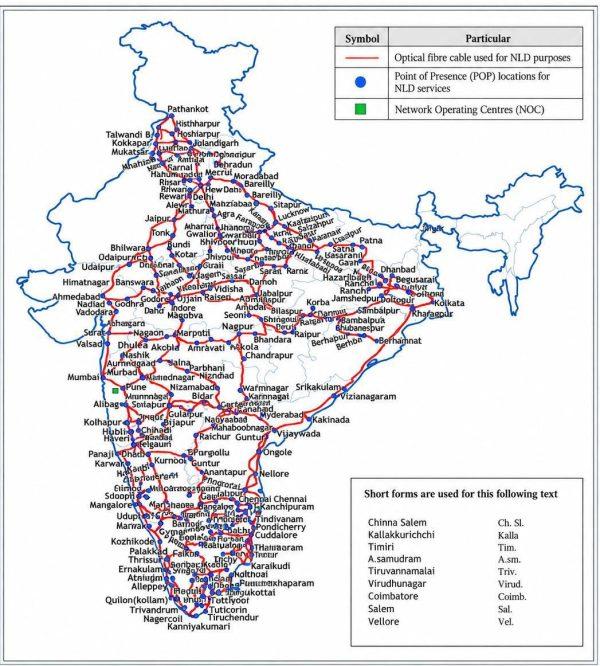
6.17. The Ld.Sr. Counsel further submitted that, up to 31/03/2001, the assessee an investment of approximately Rs.1,521 crores towards laying of underground optical fibre cable network, setting up of Points of Presence (“POPs”) and other related infrastructure for the NLD undertaking. It was submitted that the aforesaid infrastructure was not in existence prior to the setting up of the NLD undertaking. Referring to the diagrammatic representation of the NLD network reproduced herein above, the Ld.Sr.Counsel submitted that, the entire network is monitored through a dedicated Network Operating Centre (“N OC”), comprising qualified personnel, specialised equipment and requisite technology, operating on a 24×7 basis. He submitted that the assessee has dedicated fibre restoration team responsible for attending to and rectifying faults in the network, including cuts in optical fibre cables, patrolling of the network and carrying out preventive maintenance and related activities.
6.18. Referring to the audited financial statements of the assessee, the Ld.Sr.Counsel submitted that, separate details of the revenue and expenditure pertaining to the NLD undertaking were maintained and furnished along with Form No.10CCB. He further submitted that, details of licence fee payable for providing NLD services, as per the terms of the NLD licence and furnished to the Depart ment of Telecommunications, Government of India, also demonstrated that substantial revenue was generated by the assessee from the NLD services, which business was not in existence prior to March 2002. The Ld.Sr. Counsel emphasised that the NLD undertaking of the assessee, that did not exist prior to March 2002, was capable of independently existing, functioning and operating even if the other businesses of the assessee were to cease. It was submitted that separate investments were made for the NLD undertaking, personnel were independently employed and deployed exclusively for the said undertaking, and the serv ices were rendered pursuant to separate licence obtained specifically for providing NLD services.
6.19. The Ld.Sr.Counsel submitted that, the revenue generated and profits earned by the NLD undertaking arose directly from its customers and that the core network, along with separate equipment and components employed therein, was identifiable as separate and distinct undertaking. He, therefore, contended that the NLD undertaking, in respect of which deduction was claimed u/s. 80- IA(4) of the Act, constituted a separate and independent unit capable of generating profits on its own.
6.20. Without prejudice to the aforesaid submissions, the Ld.Sr.Counsel contended that, even if the NLD services were regarded as an expansion or extension of the assessee’s existing telecommunication business, the NLD undertaking would nevertheless qualify for deduction u/s. 80- IA(4) of the Act, since it constituted a new and independently identifiable undertaking which came into existence after the year 2001.
6.21. The Ld.Sr.Counsel submitted that, it is a settled principle that even where an assessee sets up a new undertaking in the same line of business in which it is already engaged, such new undertaking would be eligible for the deduction, provided the statutory conditions are otherwise satisfied. By way of illustration, it was submitted that establishment of a new factory for manufacture of an existing product would not, by itself, disentitle the assessee from claiming deduction in respect of the profits derived from such new undertaking. The Ld.Sr. Counsel submitted that, in the present case, although the assessee was already engaged in the business of providing telecommunication services, category of telecommunication service, namel y, National Long Distance (“NLD”) services, which had not been provided by it earlier.
6.21. The Ld.Sr. Counsel further submitted that the NLD services were provided by the assessee independently to other service providers and constituted a separately ident ifiable service. According to him, the NLD undertaking represented a distinct and identifiable business activity and constituted a separate business segment of the assessee, independent of its pre- existing operations. He thus submitted that the basis on wh ich the claim of deduction u/s.80-IA had been rejected by t he Ld.AO and upheld by the Ld. DRP was untenable, since the assessee had sufficiently demonstrated that the NLD unit constituted an independent and separately identifiable undertaking. In support of the afore said contention, the Ld.Sr. Counsel placed reliance on the following decisions:-
1. Textile Machinery Corporation Ltd. v. CIT [1977] 107 ITR 195 (SC);
2. CIT v. Orient Paper Mills Ltd. [1974] 94 ITR 73 (Cal.);
3. Indian Aluminium Co. Ltd. v. CIT [1977] 108 ITR 367 (SC);
4. CIT v. Gujarat Alkalies & Chemicals Ltd. [2012] 20 taxmann.com 764 (Guj.);
5. Mahindra Sintered Products Ltd. [43 Taxman 103]; and
6. Associated Cement Companies Ltd. [1 Taxman 256].
6.22. The Ld.Sr.Counsel further su bmitted that the decision of Hon’ble Special Bench in the assessee’s own case, reported as Videsh Sanchar Nigam Ltd. v. JCIT reported in [2009] 121 ITD 384 (Mum.) (SB), rendered for A.Y. 1996- facts. Referring to the decision, he submitted that the controvers y before Hon’ble Special Bench related to the eligibility of deduction u/s. 80- IA in respect of an earth station undertaking, whereas, in the year under consideration, the claim u/s. 80-IA was claimed in respect of the NLD undertaking, which, according to the assessee, constituted a separate and independently identifiable undertaking.
6.23. The Ld.Sr.Counsel thus submitted that the obse rvations and conclusions of Hon’ble Special Bench for A.Y. 1996- 97 could not be applied to the issue arising in the presen t year. He sought to distinguish the said decision on the following facts:-
- Prior to the year 1995, the assessee was engaged in providing International Long Distance (“ILD”) services, involving transmission of voice/data between the Indian domestic telecommunication network and overseas networks, primarily through undersea cables.
- During A.Y. 1996-97, the assessee established earth stations for transmission of voice/data through satellite. The earth stations represented a change in the technology emp loyed for rendering the existing ILD services.
- An earth station comprised several sophisticated sub -systems, such as satellite dish antenna, modulator, up -converter, high-power amplifier, low-noise amplifier, down -converter, demodulator and computerised servo- controlled mechanisms for satellite tracking, together with associated infrastructure.
- Thus, the earth stations considered by the Special Bench constituted a new technology for rendering the same pre -existing ILD services, which had earlier been render ed through undersea cables.
6.24. Ld.Sr.Counsel submitted that Hon’ble Special Bench denied deduction u/s. 80- IA in respect of the earth stations, on the ground that:
- the earth station constituted an internal pathway forming part of the assessee’s overall transmission system;
- it represented merely an improvement in the existing system for providing ILD services;
- it was not functionally independent and could not commercially operate without the other systems forming part of the chain of activities involved in rendering telecommunication services; and
- it did not independently provide services to other telecommunication service providers nor function as an independent profit centre.
6.25. He thus submitted that the issue that was there for consideration before Hon’ble Special Bench was, whether the earth stations commissioned by the assessee constituted “new undertakings” for the purposes of section 80-IA. W hereas the issue in the year under consideration is whether the independently established NLD undertaking is eligible for deduction u/s. 80-IA. The Ld.Sr. Counsel emphasised that ILD services involve transmission of traffic between India and foreign countries, whereas NLD services involve transmission of traffic within India. According to him, the two services/ undertakings are materially distinct and separate. He submitted that t he NLD undertaking does not represent a mere technological upgradation of the existing ILD services but constitutes an altogether new and separately identifiable telecommunication service.
6.26. The Ld.Sr.Counsel submitted that as per section 80- IA(2) of the Act, the deduction is allowable for any ten consecutive assessment years out of the prescribed period of fifteen years. A.Y. 2006-07 was stated to be the first year in which deduction u/s.80 – IA was claimed in respect of the profits derived from the NLD undertaking. The said claim was initially allowed in the intimation dated 22/10/2008 issued u/s. 143(1) of the Act. He submitted that the Ld.AO subsequently denied the deduction for A.Y. 2006- 07 in the final assessment order dated 22/10/2010 passed u/s. 143(3) r.w.s. 144C, the said assessment order was quashed by the Tribunal vide order dated 24/12/2019 on a technical ground.
6.27. The Ld.Sr.Counsel submitted that, the disallowances made in the said assessment, including disallowance of deduction u/s. 80- IA, ceased to survive and the deduction claimed in the return for A.Y. 2006-07 stood allowed. It was submitted that the deduction had continued to be allowed for A.Ys. 2007-08 to 2010 -11. The Ld.Sr. Counsel contended that once the eligibility of an undertaking for deduction u/s. 80- IA is accepted in the initial year, of the eligible period, in the absence of any material change in the relevant facts. In support of the aforesaid proposition, reliance was placed on:
1. CIT v. Paul Brothers [1995] 79 Taxman 378 (Bom.);
2. CIT v. Simple Food Products (P.) Ltd. [2017] 84 taxmann.com 239 (Bom.); and
3. Western Outdoor Interactive (P.) Ltd. v. DCIT [2012] 25 taxmann.com 340 (Bom.).
6.28. The Ld.Sr.Counsel submitted that t he Ld.AO disallowed the claim, on the ground that the audit report contemplated u/s. 80 -IA(7) was obtained from M/s. Jhawar Mantri & Associates, Chartered Accountants, and not from the statutory auditor of the assessee, M/s. S.B. Billimoria & Co. He submitted that, a ccording to the Ld.AO, the report/certificate contemplated u/s. 80- IA(7) was required to be furnished only by the statutory auditor and, therefore, the rep ort furnished by another Chartered Accountant amounted to non-compliance with the mandatory requirement. The Ld.Sr.Counsel submitted that section 80- IA(7) merely requires the accounts of the eligible undertaking to be audited by an “accountant”.
6.29. Referring to the Explanation to section 288(2) of the Act, it was submitted that the expression “accountant” refers to a Chartered Accountant within the meaning of the Chartered Accountants Act and is not restricted only to the statutory auditor of the company. A ccordingly, it was submitted that the report furnished in Form No.10CCB, duly certified by a Chartered Accountant, satisfied the requirement of section 80- and could not be rejected merely because the certifying Chartered Accountant was not the statutory auditor of the assessee.
6.30. The Ld.Sr.Counsel referring to the decision of the Coordinate Bench of this Tribunal for A.Y. 1999- 2000 in ITA No.1978/Mum/2024, order dated 22/10/2025, wherein a similar controversy relating to the eligibility of deduction u/s. 80- IA was considered in the context of an internet undertaking providing Electronic Data Interchange (“ED I”) services since August 1995. The Ld.Sr. Counsel submitted that, while adjudicating the aforesaid issue, the Coordinate Bench examined, inter alia, whether EDI services could be equated with internet services and whether an internet undertaking comprising a combination of routers, switches and other equipment housed in a hall/room could constitute an eligible undertaking for the purposes of section 80 -IA(4) of the Act.
6.31. It was further submitted that the Coordinate Bench analysed the relevant clause of section 80- IA governing telecommunication services for the purpose of determining whether such an undertaking qualified for deduction. The Ld.Sr. Counsel submitted that the Tribunal took note of the practical reality that it is not possible for a single internet service provider to independently provide end-to- end connectivity from a consumer in India to another person locat ed elsewhere in India or abroad without depending upon the infrastructure facilities of other service providers.
6.32. Drawing an analogy therefrom, the Ld.Sr. Counsel referred to and submitted t hat the Network Operating Centres (“NOCs”) are connected to multiple Points of Presence (“POPs”), which, in turn, are interconnected through the optical fibre cable network spread across the country. The Ld.Sr. Counsel compared the diagrammatic representati on of the optical fibre cable network, POPs and the investments made in the NLD undertaking with the network configuration considered by the Tribunal in the aforesaid decision for A.Y. 1999- 2000. According to him, in that case also, effective telecommunica tion connectivity was achieved through an integrated network involving satellite connectivity, partner cables, consortium cables and global data network services connecting various locations, including locations outside India.
6.33. The Ld.Sr.Counsel therefore submitted that merely because the NLD undertaking is interconnected with other systems or networks, the same cannot cease to be an independent undertaking. He emphasised that the assessee sufficiently demonstrated that the NLD undertaking was fu nctionally identifiable, commercially viable and capable of surviving independently even if the other businesses of the assessee were to be discontinued. On this basis, he contended that the deduction claimed u/s. 80-IA(4) of the Act could not be denied.
6.34. Per contra, the Ld. DR relied upon the observations of the Special Bench in the assessee’s own case (supra) and submitted that the NLD services provided by the assessee do not constitute a separate and functionally independent undertaking. According t o the other components of the assessee’s telecommunication network.
6.35. The Ld.DR further submitted that the conditions prescribed u/s.80- IA(4) of the Act are not satisfied in the present case, inter alia, for the reason that the assessee does not provide the impugned services directly to the end consumer. He accordingly placed reliance upon the findings recorded by t he Ld.AO and upheld by the DRP and prayed that the disallowance of deduction u/s. 80-IA be sustained.
We have perused the submissions advanced by both sides in light of the record placed before us.
7. The controversy before us is whether, the NLD activity undertaken by the assessee pursuant to the NLD licence granted in February 2002 constitutes an “undertaking” within the meaning of section 80- IA(4)(ii) of the Act. The relevant provision applies to “any undertaking” which h as started or starts providing telecommunication services within the period prescribed therein.
7.1. In this context, we find it necessary to keep in view the distinction between the assessee and the undertaking through which the eligible activity is carried on. An undertaking is not synonymous with the corporate entity which owns it. The fact that the same assessee may own and operate more than one undertaking, or may already be engaged in the same broad line of business, cannot by itself be determinative of the eligibility of a subsequently established undertaking. What is required to be an identity of its own as an undertaking, having regard to i ts commercial and functional characteristics. The assessee had relied upon, inter alia, the decisions in Textile Machinery Corporation Ltd(supra)., Yokogawa India Ltd.(supra), Chanda Diesels and Madras Machine Tools Manufacturers Ltd.(supra) in support of this proposition.
7.2. The reliance placed by the Ld.AO and the DRP on the decision of Hon’ble Special Bench in Videsh Sanchar Nigam Ltd. v. JCIT (Supra) also requires examination in its proper factual and legal context. We note that Hon’ble Special Bench was concerned with the claim of deduction in respect of earth stations established by the assessee for transmission of voice and data through satellite. The earth stations represented a change in the techno logy employed for rendering assessee’s existing I LD services, which were earlier rendered through undersea cables.
7.3. It is noted that the reasoning of Hon’ble Special Bench, as emerging from the material relied upon by the Ld. AO, was that an earth station, considered by itself, constituted only an internal pathway forming part of the assessee’s overall transmission system; it was an improvement in the existing system for rendering ILD services and was not functionally or commer cially capable of operating independently of the other components of that system. It did not itself render services to customers or function as an independent profit centre. It was in that factual setting that the earth station was held not to constitute a n independent undertaking.
7.4. The aforesaid decision, in our considered view, cannot be applied mechanically to the NLD undertaking in the year under consideration. The question before Hon’ble Special Bench was whether an individual component of the existing ILD transmission system, namely, an earth station, constituted a new undertaking. The question before us is materially different, whether the NLD business established pursuant to a separate NLD licence and supported by a newly created network and infrastructure constitutes an undertaking for the purposes of section 80- IA(4)(ii). The distinction is not merely one of nomenclature. In the former case, the earth station was examined as a component or link in an already existing transmission system; in the present case, what is claimed to be an undertaking is the entire NLD activity carried on through its own identifiable network and infrastructure.
7.5. The material on record demonstrates that the NLD activity was not merely a technological modification o f the assessee’s existing ILD operations. The assessee obtained a separate licence from the Government of India for providing NLD services in February 2002, and prior thereto it was not permitted to provide such services. Pursuant thereto, a separate NLD n etwork and infrastructure was established, including an extensive optical fibre network of more that 40000 Kms. and Points of Presence. The assessee has also maintained separate details of the revenue and expenditure pertaining to the NLD undertaking and furnished the same along with Form No.10CCB.
7.5.1. We also find it relevant to take note of the requirement contained in section 80- accounts of the undertaking claiming deduction to be audited by an “accountant” as defined in the Explanation to section 288, and requires the report of such audit in the prescribed form to be furnished. Rule 18BBB prescribes Form No. 10CCB for this purpose and specifically provides for a separate report in respect of each undertaking or enterprise claiming deduction. The provision, therefore, does not contemplate that the certification for the purposes of section 80- IA(7) must necessarily emanate from the statutory auditor of the assessee-company.
7.5.2. In the present case, the Form No. 10CCB furnished in respect of the NLD undertaking has been certified by an independent Chartered Accountant in the prescribed capacity. We consider this aspect relevant because the certification contemplated under section 80- IA(7) is not merely a certification of the assessee- company’s accounts in their entirety. It is specifically directed towards the accounts of the undertaking claiming the deduction. The statutory scheme thus recognises the undertaking as a separately ascertainable unit for the purposes of section 80 -IA.
7.5.3. The fact that the NLD undertaking is part of the larger corporate structure of the ass essee and that the assessee’s statutory accounts are audited by its statutory auditors cannot, therefore, be a ground to disregard the separate certification furnished in Form No. 10CCB by the accountant prescribed under section 80-IA(7). The relevant enqu iry is whether the NLD activity constitutes an identifiable undertaking and whether its accounts prescribed Form No. 10CCB, duly certified by the accountant contemplated under section 80-IA(7), is consistent with such separate identification.
7.6. In our view, the test of an undertaking cannot be limited to the question whether every individual component of the network is capable of independently rendering the ultimate service. It cannot be ignored that in a telecommunication business, service is necessarily rendered through integrated network comprising several interconnected components. The fact that NLD network is connected to, or interfaces with, other telecommunication networks does not, by itself, destroy the separate identity of the NLD undertaking. The relevant consideration is whether the undertaking as a whole is an identifiable commercial and functional unit engaged in the specified activity. The record shows that the NLD network was separately established, wa s supported by dedicated infrastructure and personnel, generated identifiable revenue and was operated pursuant to a specific licence.
7.7. We also find force in the contention of the Ld.Sr.Counsel that the expression “any undertaking” in section 80- IA(4)(ii) cannot be construed narrowly so as to require physical isolation of the undertaking from every other activity or asset of the assessee. Such an interpretation would effectively make the eligibility dependent upon the organi sational structure adopted by the assessee rather than upon the nature and identity of the eligible activity. The statutory provision does not stipulate that the undertaking must have a separate legal personality, nor does it prescribe that it must necessa isolated from the other operations of the assessee. What is relevant is the existence of a distinct and identifiable undertaking carrying on specified telecommunication activity.
7.8. In the present c ase, the NLD undertaking satisfies this test. The NLD activity came into existence pursuant to the separate NLD licence; substantial fresh infrastructure was created for carrying on that activity; the NLD network, comprising the optical fibre network, POPs and Network Operating Centres, was separately identifiable; separate revenue and expenditure were maintained; and the undertaking generated revenue from its own customers. The material placed before us further indicates that dedicated personnel and resour ces were deployed for the NLD operations. These features, considered cumulatively, establish that the NLD activity was not merely an internal component or technological improvement of the assessee’s pre- existing ILD system, but constituted a separately identifiable commercial undertaking.
7.9. We are, therefore, unable to accept the approach of the Ld.AO/DRP that merely because the assessee was engaged in telecommunication business since period years, every subsequent telecommunication activity undertaken by it would constituted an extension of its existing undertaking. Such an approach overlooks the statutory distinction between the company and the undertaking. The relevant enquiry under section 80- IA(4)(ii) is whether the undertaking claiming the benefit satisfies the statutory requirements. In the facts before us, the NLD undertaking is identifiable independently of the assessee company’s other businesses and possesses the necessary commercial and functional attributes of an undertaking.
7.10. The distinction from the Honble Special Bench decision is thus fundamental. The earth station considered therein was found to be a component in the existing ILD transmission chain and incapable of independently functioning as a commercial undertaking. The NLD undertaking before us, on the other hand, is itself the commercial activity comprising the network, infrastructure, personnel and operations established for providing NLD services. The Special Bench decision, therefore, does not conclude the issue against the assessee merely because both cases concern telecommunication services. The nature of the unit claimed as the eligible undertaking and its relationship with the pre-existing business have to be examined on their respective facts.
7.11. We thus hold that, for the purposes of section 80-IA(4)(ii), the NLD undertaking has to be considered as an independent undertaking, distinct from the assessee-company as a whole, and not by treating the entire business of the assessee as one indivisible undertaking. On the facts brought on record, we find that t he NLD undertaking constitutes such a separate and independently identifiable undertaking. The fact that it operates within, and is ultimately owned by, the assessee- company or that its network interfaces with other telecommunication systems cannot, by its elf, disentitle it from the benefit of section 80- IA, subject of course to satisfaction of the other statutory conditions.
PART – II
8. Ground No. 2 is in respect of restricting the depreciation to 15%, being the rate applicable to plant and machinery, as against the assessee’s claim of depreciation at 60%, being the rate applicable to computers.
8.1. The assessee owns and uses certain sophisticated t elecom equipment known as Gateway Digital Switch (“GDS”) system. It is submitted that, up to F.Y. 1998- 99, the GDS was classified by the assessee under the block of “Plant and Machinery” and depreciation thereon was claimed at 25%. According to the assesse e, pursuant to the enactment of the Information Technology Act, 2000, wherein the expressions “computer” and “computer network” came to be statutorily defined, the nature, characteristics and functions of the GDS system were re- examined. On such examinatio n, the assessee treated the GDS system as falling within the category of “Computers and Computer Peripherals” and, accordingly, claimed depreciation at 60% from A.Y. 2000- 01 onwards.
8.2. During the year under consideration, the opening WDV of the computer block included the WDV of the GDS system amounting to Rs. 2,34,46,262/-. The assessee also made further additions to the GDS system amounting to Rs. 6,34,48,189/- during the year. Depreciation at 60% was claimed on the GDS forming part of the computer block, resulting in a claim of Rs. 3,31,02,214/-. The assessee claimed that, having regard to the features and functions purposes of Entry III(5) of Appendix I to the Income- tax Rules, 1962, applicable from A.Y. 2006-07 onwards.
8.3. The Ld. AO, however, did not accept the assessee’s contention that the GDS system falls within the block of “Computers” eligible for depreciation at 60%. The Ld. AO treated the GDS system as “Plant and Machinery” and, a ccordingly, restricted the depreciation thereon to 15%. 2.4 The submissions of the assessee that the Gateway Digital Switch falls within the block of “Computers” and is, therefore, eligible for depreciation at the rate of 6 0% were not accepted by the Ld.AO. The Ld. AO further observed that the equipment in question cannot even be regarded as a computer peripheral and, in this regard, recorded the following observations:-
“4.2.4 In the assessee’s case, the assets in question are not even computer peripherals. It is a complex machine of which computer is a small part. Just because any plant or machinery works on computer, does not automatically make it a computer. In modern times more and more machineries and scientific equipments, vehicles, vessels run and wor k on computers. Computer is integral part of these machines. For instance, Air planes, Submarines, diagnostic testing machines like MRI machine. CT Scanning machines, surveillance systems, security systems etc have computers as their integral part, but by no stretch of imagination can they be defined as computers. Hence, the AR’s explanation is rejected. The above GDS is treated as plant and machinery and depreciation is restricted to 15% of WDV. Excess depreciation claimed @45% is thus to be disallowed and added back to the total income”
The above observation was upheld by the DRP.
8.4. Before this Tribunal, the Ld.Sr.Counsel submitted that it owns and uses certain sophisticated telecom equipment known as Gateway Digital Switch (“GDS”) system. It was submitted that the said system broadly consists of two main components, namely, (i) switching equipment used for switching telep computer for controlling the switching equipment. The Ld.Sr.Counsel drew our attention to the diagram depicting the various components of the GDS system and the detailed written submissions placed on record in support of the assessee’s contention which were also filed before the authorities below. The diagrams is as under:-
8.4.1. Before us, the Ld.Sr.Counsel submitted that the Gateway Digital Switch (“GDS”) is essentially a sophisticated switching system comprising switching equipment and computer-based call – control equipment. It was submitted that the GDS sorts incoming telephone calls on the basis of the di alled code and routes them to the designated destination. The process is carried out electronically on a continuous basis and, apart from maintaining the carrier- wise volume of telecommunication traffic, the system stores and processes information and take s programmed decisions. It was thus contended that the GDS functions as a special- purpose computer.
8.4.2. The Ld.Sr.Counsel submitted that, unlike general- purpose computers, which are capable of being used for a variety of functions, the GDS is a special-purpose computer pre- programmed to receive input data in the form of electronic, magnetic or optical signals, process such data and transmit the resultant output to the next stage of the communication process. He submitted that i n technical parlance, the G DS is stated to be a “Stored Program Control System”, wherein the programme stored in the computer controls the operations of the equipment. He submitted that t he system employs multiple processors for analysing call data and controlling the making and bre aking of connections between the input and output trunk lines for establishing telephone calls. The processors are also stated to perform control, interfacing and recording functions, including recording of call data for billing purposes.
8.4.3. It was fur ther submitted that the switching equipment operates in conjunction with the computer and its functions are integrated with the computer. According to the Ld.Sr.Counsel, the GDS performs logical, arithmetical and memory functions by manipulating electronic and magnetic impulses and, therefore, possesses the essential attributes of a computer system. In support of this contention, he submitted that the assessee relied on expert opinion obtained from the Institution of Electronics and Telecommunication Engine ers (“IETE”), wherein, the GDS has been regarded as a computer for practical and technical purposes. The Ld.Sr.Counsel further submitted that, where the determination of an issue requires technical expertise, due weight ought to be given to the opinion of technical experts.
8.4.4. The Ld.Sr.Counsel submitted that the assessee, being an International Long Distance Operator, uses the GDS system for routing international calls originating from India as well as calls originating outside India and terminating in India. He submitted that t he routing process is automatic and is achieved through software and programmes operating upon a complex computer architecture and related computer platforms. It was thus contended that the GDS forms part of the computer network and performs functions integrally connected with computer operations.
8.4.5. Reliance was also placed upon the decision of Hon’ble Mumbai Special Bench in case of DCIT v. Da tacraft India Ltd. reported in133 TTJ 377, wherein it is held that, routers and switches, when used along with computers and when their functions are integrated with computers, were held to form part of the block of “computers” eligible for the higher rate of depreciation. The Ld.Sr.Counsel submitted that, its case stood on a stronger footing since the GDS itself performs computer functions, whereas routers and switches considered in the aforesaid decision were peripherals forming part of the computer system.
8.5. The Ld.Sr.Counsel placed reliance upon the order of the Coordinate Bench in the assessee’s own case for A.Y. 2000- 01, wherein, while considering the identical issue relating to depreciation on GDS, the Tribunal observed as under:-
“13.3 Having considered the rival submissions as well as relevant material on record . We note that the issue of higher rate of depreciation on router and switches has been considered and decided by the Special Bench of this Tribunal in case of DCIT Vs. Datacraft India Ltd. (supra). The Special Bench has taken a view that definition of computer as given in the Information Technology Act, 2000, cannot be applied in the context of section 32 of the Income Tax Act. It was held in para 31.4 as under:
‘In view of the above discussion, we are of the considered view that router and switches can be classified as a Computer Hardware when they are used along with a computer and when their functions are integrated with a ‘computer’. In other words, when a device is used as part of the computer in its functions, then it would be termed as a computer.’
13.4 It is clear that if the routers and switches are used along with computer and functions as integrated part with the computer then it would be termed as computer. In the case in hand there is no detail before us to show whether the GDS in question are u sed with the computer and functions are integrated with the computer or not. Accordingly, we set aside this issue to the record of CIT(A) for a limited purpose to verify this aspect and then decide this issue as per the law including decision of Special Bench in case of Datacraft India Ltd.”
8.5.1. The Ld.Sr.Counsel submitted that for assessment year 2000-01, the matter was remanded to the Ld.CIT(A), for limited verification to show whether the GDS in question are used with the computer and functions are integrated with the computer or not. The Ld.CIT(A), however held that GDS cannot qualify as computer, against which the assessee is in appeal before this Tribunal. It was further submitted that following the decision of Hon’ble Mumbai Special Bench in case of DCIT v. Datacraft India Ltd.(supra) this Tribunal in the assessee’s own case for the subsequent assessment year being 2005-06 held that GDS system falls within the ‘Computer’ block of assets and is therefore eligible for depreciation @ 60%.
8.5.2. The Ld.Sr.Counsel also updated that for the interagnum assessment years, i.e; 2001-02 to 2010-11, the appeals filed by the assessee were pending before this Tribunal. He submitted that this Tribunal therefore the depreciation computed by the assessee @60% in its return of income stands automatically allowed.
8.6. The Ld. Sr.Counsel submitted that, for the present year, the assessee placed on record detailed technical material explaining the archite cture and working of the GDS, establishing that the switching equipment is used along with the computer and that its functions are integrated with the computer. Accordingly, it was contended that the condition contemplated by the Coordinate Bench in the ea rlier year stands satisfied and depreciation at 60% is allowable.
8.7. Per contra, the Ld. DR relied upon the findings of the Ld. AO as well as the directions issued by the DRP. The DRP rejected the assessee’s contention by observing as under:-
“Assessee has stated that Gateway Digital Switch (GDS) is a special purpose computer, pre programmed to receive input data in the form of electronic, magnetic and optical signals which are processed and the output is sent to the next leg of the communicati on process. But, as noted by the AO the GDS is a complex machine and it is not known for certain to what extent it has the characteristics of a computer. In the absence of any definition of computer in the Income tax Act, one has to go by the meaning in co mmon language and it is difficult to accept a claim of the assessee that GDS is a computer and therefore it is entitled to depreciation at 60%. Therefore, the depreciation is restricted to 15%.
As regards the alternate claim DRP is of the view that the alt ernate contention has not been accepted by the DRP in earlier years and therefore it is not accepted in this year also.”
We have perused the submissions advanced by both sides in light of the record placed before us.
9.1. We have considered the rival submissions and perused the whether the Gateway Digital Switch (“GDS”) installed and used by the assessee is entitled to depreciation at the rate applicable to t he block of “computers”, or at the general rate applicable to plant and machinery.
9.2. At the outset, we note that the issue is not res integra in the assessee’s own case. In the immediately relevant earlier proceedings, while considering the same issue, the Coordinate Bench, following the decision of the Hon’ble Mumbai Special Bench in case of DCIT v. Datacraft India Ltd. reported in 133 TTJ 377, observed that the relevant consideration is whether the switching equipment is used along with a computer and whether its functions are integrated with the computer. The matter was restored to the file of the CIT(A) only for verification of this factual aspect. Thus, the earlier order did not hold that GDS, as a matter of principle, is incapable of falling within the computer block; rather, the matter was restored for verification of its functional integration with the computer system.
9.3. In the year under consideration, the assessee has furnished detailed technical material describing the architecture, configura tion and functioning of the GDS. From the material placed on record, it is evident that the GDS is not merely a conventional switching or transmission apparatus functioning independently of a computer. The switching operations are computer-controlled and i nvolve processing of electronic signals through processors, memory and software/programmed instructions. The system receives input signals, processes the determines and executes the appropriate routing of the calls. The switching equipment thus performs its functions in conjunction with, and as an integrated part of, the computer system.
9.4. In this regard, we find considerable force in the assessee’s reliance on the decision of Hon’ble Mumbai Special Bench in Datacraft India Ltd. (supra). Hon’ble Special Bench, after examining the issue in the context of the depreciation provisions, held that where routers and switches are used along with a computer and their functions are integrated with the computer, they would constitute computer hardware and would fall within the computer block. The ratio of the said decision is that the classification for purposes of depreciation has to be considered having regard to the functional role of the equipment in the computer system, and not merely on the basis of its nomenclature or the fact that it performs a specialised function.
9.5. Applying the above principle to the facts before us, we find that the GDS satisfies the functional test laid down in Datacraft India Ltd. (supra). The material on record demonstrates that the GDS works through computer- controlled operations and performs processing, storage and logical functions in an integrated manner. Its switching function cannot, therefore, be viewed in isolatio n from the computer architecture and software with which it operates. The mere fact that the system is designed for the specialised purpose of routing and switching telecommunication traffic would not, by itself, take it outside the ambit of the computer b lock when, in actual operation, it performs its functions as an integral component of the computer system.
9.6. We also find that the technical opinion furnished by the assessee supports the functional description of the GDS. While the ultimate question of classification for purposes of section 32 is a matter for determination under the Income- tax Act, the technical material and expert opinion are relevant for appreciating the nature, architecture and actual functioning of the equipment. The Revenue has not brought on record any contrary technical material or demonstrated that the factual description of the GDS furnished by the assessee is incorrect.
9.7. The reasoning adopted by the DRP, in our considered view, does not adequately address the aforesaid fact ual material. The DRP proceeded principally on the premise that the GDS is a “complex machine” and that, in the absence of a definition of “computer” in the Income- tax Act, it is difficult to accept the assessee’s claim. However, the absence of an exhaustive statutory definition does not mean that the classification has to be decided merely by reference to the common understanding of the word “computer”. Once the functional test laid down by the Special Bench is applied, the relevant enquiry is whether the equipment is used along with a computer and whether its functions are integrated with the computer. On the facts brought on record by the assessee, both these conditions stand satisfied.
9.8. We further take note of the fact that, in the assessee’s own case for A.Y. 2005- 06, the Coordinate Bench, after considering the decision of the Special Bench in Datacraft India Ltd. (supra), has accepted the GDS system as falling within the computer block and consequently allowed depreciation at the rate applicable thereto.
The Revenue has not brought before us any distinguishing feature in the GDS system used during the year under consideration which would warrant a different view. Judicial consistency, particularly where the same assessee, the same asset and the same functional issue are involved, also requires that a departure be made only where there is a material change in facts or law.
9.9. In view of the foregoing discussion, we hold that the GDS installed and used by the assessee, being an integral and computer-controlled component of its computer system and performing functions which are integrated with the computer architecture, falls within the block of “computers” for the purposes of depreciation under section 32 of the Act. Accordingly, the assessee is entitled to depreciation at the rate applicable to the computer block, i.e. 60%, as claimed.
9.10. While, for the reasons discussed hereinabove, we hold that the assessee is entitled to depreciation at the rate of 60% on the GDS, the consequential computation of depreciation for the year under consideration would require determination of the correct opening Written Down Value (WDV), having regard to the treatment accorded to depreciation in the intervening assessment years. Accordingly, we restore this limited aspect to the file of the Ld. AO for verification of the computation furnished by the assessee at pages 131 to 133 of the paper book, including the opening WDV, and for determining the correct WDV and consequential depreciation allowable for the year under consideration, in accordance with law. The Ld. AO shall give due effect to our finding Needless to say, the assessee shall be afforded reasonable opportunity of being heard before determining the consequential depreciation.
Accordingly, Ground No. 2 raised by the assessee stands allowed in terms indicated hereinabove.
10. Ground No. 3 raised by the assessee was not pressed by the Ld. Senior Counsel, under instructions.
Accordingly, Ground No. 3 stands dismissed as not pressed.
11. Ground No.4 raised by the assessee is in respect of disallowance of depreciation claimed on Iridum assets, which form part of the block of “Plant and Machinery” since A.Y. 1999-2000.
Brief facts on this issue are that the assessee had acquired the Iridium technology along with the associated assets in the nature of plant and machinery in January 1999 for a consideration of Rs. 50 crores. Depreciation on the cost of such assets was allowed to the assessee in the initial years up to A.Y. 2002- 03 and that, admittedly, the Iridium assets continued to form part of the relevant block of assets under the head “Plant and Machinery” from the preceding assessment years, including the year und er consideration.
11.2. The Ld.Sr.Counsel further submitted that, notwithstanding the recognition of impairment in the books of account, the Iridium assets continued to form part of the relevant block of assets for the purposes of the Income-tax Act. Since the impairment loss was not claimed as a deduction for income- result in any corresponding reduction in the tax WDV of the block. The assessee, accordingly, continued to compute and claim depreciation on the said block in accordance with the provisions of section 32 of the Act.
11.3. It was therefore submitted that the book impairment of the Iridium assets cannot be equated with a reduction in the WDV for the purposes of the Income- tax Act. The Ld.Sr.Counsel submitted that the accounting treatment adopted in the books, which was necessitated by the applicable accounting requirements, operates independently of the computation of depreciation under the provisions of the Act. According to him, unless the relevant statutory provisions require such impairment to be reduced from the tax WDV, the mere recognition of an impairment loss in the books cannot alter the WDV of the block for tax purposes.
11.4. The Ld.Sr.Counsel further submitted that the assessee had not claimed any separate deduction in respect of the impairment loss of Rs.21,82,55,077/- and had, in fact, added back the same while computing its taxable income. Therefore, permitting depreciation on the WDV of the block would not result in double deduction. He submitted that t he depreciation claim was made only in accordance with section 32 read with the block-of- assets mechanism under the Act.
11.5. The Ld.Sr.Counsel submitted that identical issue was decided in favour of the assessee by the Ld.CIT(A) for A.Y. 2005- 06 vide order dated 11/03/2011. In the said order, the Ld. CIT(A), after considering the judicial precedents on the issue, recorded that block of “Plant and Machinery” and had been used for the purpose s of business in the earlier years. The suspension of use in subsequent years was attributable to tech nological obsolescence. The Ld.CIT(A), therefore, directed the Ld. AO to allow depreciation on the Iridium assets as part of th e block of assets. The Ld.Sr. Counsel submitted that, the facts being identical, the same treatment ought to be followed for the year under consideration.
11.6 The Ld.Sr.Counsel submitted that the Ld.AO disallowed depreciation for the year under consideration on the premise that an as set would qualify for depreciation only when it was actually “put to use” during the relevant previous yea r. According to the Ld.Sr. Counsel, such approach was contrary to the scheme of depreciation under the block of assets concept. It was submitted that t he condition of actual user of an individual asset is relevant at the stage when the asset first enters the block and, once the asset forms part of an existing block, the requirement of user is to be examined with reference to the block as a whole and not qua each individual asset comprised therein.
11.7. It was further submitted that, after introduction of the concept of “block of assets”, individual asset loses its separate identity once it becomes part of the block. Consequently, for the purpose of allowance of depreciation, the Ld.AO is required to consider the existence and user of the block as a whole rather than examining the use of each constituent asset independently. In support of this proposition, the Ld.Sr. Counsel also referred to CBDT Circular No. 469 dated 23/09/1986, explaining the rationale that the said Circular emphasises computation of depreciation with reference to the entire block of depreciable assets instead of individual assets and, being binding upon the de partmental authorities, the Ld. AO could not adopt an approach contrary thereto.
11.8. The Ld. Sr. Counsel further submitted that the Ld. AO failed to appreciate the scope of section 43(6)(c)(B) of the Act. It was submitted that reduction from the WDV of a block is contemplated only to the extent of the “moneys payable” in respect of an asset sold, discarded, demolished or destroyed. Thus, where no amount is receivable or payable to the assessee upon discard of an asset, there is no corresponding amount liable to be reduced from the WDV of the block. According to the Ld. Senior Counsel, the mere recording of impairment in the books does not result in any money becoming payable to the assessee and, therefore, cannot by itself warrant a reduction from the block value.
11.9. Elaborating further, the Ld. Sr. Counsel submitted that once an asset has entered the block, its value continues to remain embedded in the block except to the extent reduction is specifically mandated under the Act. The existence or non- existence of the particular asset in a subsequent year would not, by itself, alter the WDV of the block. It was contended that even assuming that the Iridium assets had been discarded on account of technological obsole scence, in the absence of any monetary realisation therefrom, the amount deductible from the block under section 43(6) (c)(B) would be nil. Consequently, no disallowance of assets were not put to use during the year or had suffered impairment in their book value.
11.10. Per contra, the Ld. DR relied upon the orders passed by the authorities below.
We have perused the submission advanced by both sides in light of recorda placed before us.
12. It is an undisputed facts are that the assessee acquired the Iridium technology and the associated plant and machinery in January 1999 for a consideration of Rs.50 crores; depreciation thereon was allowed in the initial years up to A.Y. 2002- 03; and the sa id assets continued to form part of the relevant block of assets under the head “Plant and Machinery” in the preceding years as well as in the year under consideration. The dispute essentially arises on account of the subsequent technological obsolescence of the Iridium system, the consequent impairment recognised in the books of account, and the fact that the individual assets were not actually used during the year under consideration.
12.1. We find merit in the contention of the Ld.Sr.Counsel that the acc ounting treatment of impairment cannot, by itself, determine the tax WDV of the block of assets. The assessee had recognised impairment of 95% of the book value of the Iridium assets and had charged the resultant loss of Rs.21,82,55,077/- to its Profit and Loss Account. It is also undisputed that the said impairment loss was not claimed as a deduction while computing the taxable income and was duly added back. Thus, the reduction in the book value of the assets pursuant to the accounting treatment did not result in a corresponding reduction of the tax WDV under the Act.
12.2. The computation of depreciation under the Income- tax Act has to be made in accordance with the statutory scheme contained in sections 32, 43(6) and the relevant Rules. Once an asset has entered an existing block of assets, the block, and not each individual asset comprised therein, becomes the relevant unit for determining the WDV and allowance of depreciation, subject of course to the specific adjustments contemplated by the Act. This i s also consistent with the rationale underlying the introduction of the block-of- assets concept, as explained by the CBDT in Circular No.469 dated 23.09.1986.
12.3. In the present case, the Iridium assets had admittedly entered the block of “Plant and Mach inery” in the earlier years and depreciation thereon had been allowed. The fact that, on account of technological obsolescence, the particular Iridium assets ceased to be commercially viable and were not actually used during the year cannot, in our view, b e considered in isolation from the statutory scheme of block depreciation. The requirement of actual use cannot be applied by identifying and examining each individual asset forming part of an existing block in every subsequent year in which depreciation i s claimed. What is relevant is whether the block of assets continued to exist and was used for the purposes of the business.
12.4. We also find substance in the assessee’s reliance on section 43(6)(c)(B). The provision contemplates reduction from the WDV o f the block by the amount of the “moneys payable” in respect of an asset falling within the specified circumstances, including an asset sold, discarded, demolished or destroyed, subject to the statutory conditions. In the facts before us, there is no mater that any amount became payable to the assessee on account of the alleged discard or obsolescence of the Iridium assets. Mere impairment recognised in the books does not constitute “moneys payable” within the meaning of the said provision. Consequently, such book impairment cannot, in the absence of a corresponding statutory adjustment, be reduced from the tax WDV of the block.
12.5. Equally, the recognition of impairment in the books cannot be treated as though the assessee had claimed a se parate tax deduction in respect thereof. The assessee has admittedly added back the impairment loss of Rs.21,82,55,077/- while computing its taxable income. Therefore, allowing depreciation with reference to the tax WDV of the block does not result in a do uble deduction. The accounting WDV and the tax WDV operate in different statutory fields and, in the absence of a provision requiring the book impairment to be adopted for tax purposes, the former cannot be imported into the computation under section 32.
12.6. We further note that the Ld.CIT(A), while adjudicating the identical issue in the assessee’s own case for A.Y. 2005- 06, had considered the fact that the Iridium assets formed part of the block of “Plant and Machinery”, had been used for the purposes o f business in the earlier years and that the subsequent suspension of their use was attributable to technological obsolescence. On those facts, depreciation was directed to be allowed as part of the block. The Revenue has not brought before us any material distinguishing the factual position for the year under consideration so as to warrant a different conclusion.
12.7. The approach adopted by the Ld.AO, in our considered view, overlooks the fundamental consequence of the block-of- scheme. Once the Ir idium assets had become part of the existing block and their cost had been absorbed into the WDV of that block, the allowance of depreciation is governed by the statutory mechanism applicable to the block. The individual asset cannot be notionally taken ou t of the block merely because it ceased to be operational on account of technological obsolescence, particularly when there is no corresponding sale consideration, scrap value or other “moneys payable” resulting in an adjustment under section 43(6).
12.8. In view of the foregoing, we hold that the impairment loss recognised in the books in respect of the Iridium assets does not result in any reduction of the tax WDV of the relevant block of assets. Further, the non-use of the individual Iridium assets durin g the year, on account of technological obsolescence, cannot by itself disentitle the assessee from depreciation on the existing block, when the block continued to be used for the purposes of the assessee’s business. Accordingly, the depreciation claimed b y the assessee on the Iridium assets as forming part of the block of “Plant and Machinery” is allowable in accordance with law.
12.9. We, therefore, direct the Ld.AO to allow the depreciation claimed by the assessee on the relevant block of assets, after v erifying the computation of the WDV in accordance with section 43(6) and the provisions of the Act. The addition/disallowance made on this count is accordingly deleted.
Accordingly, Ground no.4 raised by the assessee is allowed.
13. Ground No.5 raised by assessee is against recharacterising the interest income of Rs. 56,42,284/- earned by the assessee from head “other sources” as against “profits and gains from business and profession” declared by the assessee.
The brief facts relating to this issue are that during the year under consideration, the assessee earned interest income of Rs.56,42,284/– on short- term fixed deposits placed with banks. The assessee treated the said interest income as “Profits and gains from Business or Profession” in its return of income. The assessee submitted that the funds placed in the short- term deposits were business funds that was not required for immediate deployment in its core business. It was submitte d that the funds were placed for a short duration and were intended to be utilised for business requirements. The management of such funds was undertaken by the assessee’s Treasury Department as part of its regular business functions, which included bankin g, cash management, foreign exchange risk management and funding/borrowing activities.
13.1. The assessee further submitted that funds aggregating to approximately Rs.92.63 crores were temporarily deployed in bank deposits during the year, while the assessee had contingent liabilities exceeding Rs.1,000 crores, including liabilities relating to income- tax. It was therefore contended that the funds could not be regarded as surplus f unds permanently set apart from the business. The assessee also pointed out that such interest income had consistently been assessed as business income up to A.Y. 2002-03 and that there was no change in the underlying facts or the nature of the assessee’s business warranting a departure from the earlier treatment.
13.2. The Ld. AO, however, treated the interest income of Rs.56,42,284/- as taxable under the head “Income from Other Sources” instead of “Profits and gains from Business or Profession”. The Ld. AO noted that in A.Y. 2003-04, the interest income arising from similar deposits had been assessed as income from other sources and that the said treatment had been upheld by the Ld.CIT(A) for A.Ys. 2003-04 and 2004-05. The Ld. AO further observed t hat the DRP had also upheld the same treatment in the subsequent years, i.e., A.Ys. 2006-07 to 2010-11. In support of his conclusion, the Ld.AO relied on the decisions of Hon’ble Supreme Court in case of Tuticorin Alkali Chemicals & Fertilizers Ltd. v. CIT reported in 227 ITR 172 and Hon’ble Madras High Court in case of CIT v. Gimpex (P.) Ltd. reported in 268 ITR 377, and accordingly assessed the interest income under the head “Income from Other Sources”.
13.3. The DRP upheld the observation of the Ld.AO.
13.4. Before this Tribunal, t he Ld.Sr.Counsel submitted that the interest income was intrinsically connected with the assessee’s business funds and was earned only because such funds were temporarily placed in short- term bank deposits pending their deployme nt for business purposes. He submitted that the funds were not surplus funds permanently withdrawn from the business, but constituted circulating business funds which were required to be kept readily available to meet the assessee’s business requirements.
13.5. He submitted that the assessee had deployed approximately Rs.92.63 crores in short- term bank deposits during the year, whereas it had contingent liabilities exceeding Rs.1,000 crores including income- tax liabilities. According to him, these circumst ances demonstrate that the funds continued to remain earmarked for and connected with the assessee’s business requirements.
13.6. The Ld.Sr.Counsel further submitted that the management and deployment of the funds was undertaken by the assessee’s dedicated Treasury Department, which was responsible for banking, cash management, foreign exchange risk management and funding/borrowing. The placement of funds in short- term deposits was therefore not an independent investment activity divorced from the assessee’ s business, but part of the systematic treasury and cash- management functions carried out in the ordinary course of business.
13.7. It was submitted that the assessee had consistently offered such interest income as business income up to assessment year 2002-03 and that there was no change in the facts or in the nature of the assessee’s business in the year under consideration. Reliance was placed on the principle of consistency recognised by Hon’ble Supreme Court in Radhasoami Satsang v. CIT reported i n 193 ITR 321. The Ld.Sr.Counsel also submitted that the mere fact that the funds were temporarily placed in fixed deposits could not determine the head of income. According to him, where business funds are temporarily parked in readily encashable deposits pending their deployment for business purposes, the interest arising therefrom retains its business character, particularly where the funds are not surplus or permanently withdrawn from the business.
13.8. Without prejudice, the Ld.Sr.Counsel submitted that even if the temporary deployment of funds were viewed independently, the activity of managing such funds itself constituted a systematic business activity. He submitted that the Treasury Department, with its requisite personnel and expertise, actively managed the assessee’s funds with the objective of optimising returns while ensuring that the funds remained available for business requirements. The activity was therefore undertaken as part of the assessee’s regular business operations and not as a passive investment of surplus funds.
13.9. The Ld.Sr.Counsel distinguished the reliance placed b y the Ld.AO on Tuticorin Alkali Chemicals & Fertilizers Ltd. (supra), submitting that the said decision concerned a company which had not yet commenced its business a nd the question before the Hon’ble Supreme Court arose in the context of the treatment of interest earned on borrowed funds during the pre- commencement stage. According to him, the decision did not lay down a proposition that interest earned on funds of an existing business, temporarily parked for business purposes, must invariably be assessed under the head “Income from Other Sources”.
13.10. He similarly distinguished CIT v. Gimpex (P.) Ltd. (supra), submitting that in that case the funds were admittedly surplus to the business and there was no demonstrated nexus between the deposits and the business requirements. The facts in the present case, according to him, were materially different since the funds were business funds temporarily deployed pending thei r utilisation. The Ld.Sr.Counsel, thus income of Rs.56,42,284/- ought to be assessed under the head “Profits and gains from Business or Profession”.
13.11. On the contrary, the Ld.DR relied on the orders passed by the authorities below.
We have perused the submissions advanced by both sides in light of records placed before us.
14. We note that the assessee is an existing business entity and the funds in question were admittedly placed in short- term bank deposits. The case of the assessee is that such deposits represented temporary deployment of business funds pending their utilisation for the requirements of its business. The assessee has also placed on record that the deployment and management of its funds was undertaken by its Treasury Department as part of its regular functions relating to banking, cash management, foreign exchange risk management and funding/borrowing.
14.1. In determining the character of the interest income, the immediate source of the income, namely, the fixed deposits, cannot be considered in isolation. It is necessary to examine the purpose and character of the funds which were placed in such deposits. Where funds are demonstrated to be business funds temporari ly parked in short- term deposits pending their deployment for business purposes, the mere fact that interest is earned through a bank deposit would not, by itself, conclude the character of such income.
14.2. In the present case, the assessee has submitted that approximately Rs.92.63 crores were placed in short- term deposits during the year, while it had substantial business- and contingent liabilities exceeding Rs.1,000 crores, including income-tax liabilities. These facts, when consider ed along with the short- term nature of the deposits and the explanation regarding their intended deployment, support the assessee’s contention that the funds were not permanently surplus funds segregated from the business. The Revenue has not brought any m aterial on record to establish that the deposits represented surplus funds permanently withdrawn from or divorced from the business of the assessee.
14.3. We also find force in the submission that the deployment of the funds was undertaken as part of the a ssessee’s treasury and cash- management function. The assessee has explained that its Treasury Department was responsible for managing banking operations, cash flows, foreign exchange exposure and funding requirements. Thus, the placement of temporarily ava ilable business funds in short- term deposits, with a view to earning a return until the funds were required for business purposes, cannot be regarded, on the facts before us, as an independent investment activity unrelated to the business.
14.4. The reliance placed by the Ld. AO on Tuticorin Alkali Chemicals & Fertilizers Ltd. v. CIT reported in (supra) is, in our view, distinguishable on facts. The said decision dealt with treatment of interest earned by a company during the period when its business had not commenced and in the context of funds deployed during the pre-commencement stage. The factual pos ition before us is factually different, as the assessee was an ongoing business concern and the funds in question are stated to have been temporarily deployed out of its business funds.
14.5. Likewise, the decision in CIT v. Gimpex (P.) Ltd. (supra) cannot be applied mechanically to the facts before us. The assessee demonstrated that the business nexus of the funds and their temporary deployment pending business utilisation. The Ld. AO has not brought any material on record to establish that the funds represented surplus funds which had been permanently set apart from the business or that the deposits constituted an independent investment activity.
14.6. We also take note of the fact that similar interest income had been treated as business income by the assessee in the earlier years up to A.Y. 2002-03. While the principle of consistency cannot override the statutory provisions, in the absence of any material change in the nature of the assessee’s business or the character of the funds, the Revenue ought to ha ve a cogent basis for departing from the treatment consistently adopted in the earlier years. In the present case, no such material change has been demonstrated before us.
14.8. The mere fact that the funds were placed in fixed deposits and thereby yielded interest cannot, therefore, be determinative of the head under which the income is assessable. On the facts of the present case, we are satisfied that the deposits represented temporary deployment of business funds in the course of the assessee’s treasury and cash- management operations and pending their requirement for business purposes. The interest income consequently bears a sufficient nexus with the assessee’s business operations to be assessed under the head “Profits and gains of business or profession”.
14.9. We accordingly direct the Ld. AO to assess the interest income under the head “Profits and gains of business or profession”.
Accordingly Ground no.5, raised by the assessee stands allowed.
15. Substituted Ground No. 6 is in respect of disallowance made by Ld.AO u/s 14A by invoking Rule 8D at Rs.4,66,88,779/- not accepting the suo moto disallowance offered at Rs.51,54,865/- in its return of income.
At the outset, the Ld.Sr.Counsel submitted that the assessee suo moto disallowed um of Rs.51,54,865/- u/s. 14A of the Act having regard to the expenditure considered attributable for the purpose. It was submitted that, though Rule 8D was applicable for the year under consideration, no exempt income had been earned by the as sessee during the relevant previous year and, therefore, no further disallowance u/s. 14A read with Rule 8D could be made. The Ld.Sr.Counsel relying on various judicial precedents submitted that disallowance under section 14A is not warranted in the absence of exempt income. It was further argued that even the suo moto disallowance made by the assessee is liable to be deleted by relying on decisions of coordinate bench of this Tribunal in case of Aditya Birla Nuvo Ltd, in ITA no.4220/Mum/2015, The Shri Hari Trust in ITA No.7496/Mum/2015, Hero Cycles Ltd, reported in 1 78 Taxman.com 353, Sajjan India Ltd., reported in 89 taxmann.com 21 and decision of Hon’ble Gujrat High Court in case of UTI bank Ltd reported in 398 ITR 514.
15.2. Per contra, the Ld. DR relie d upon the orders passed by the authorities below.
We have perused the submissions advanced by both sides in light of the record placed before us.
16. We also note that the judicial precedents relied upon by the Ld.Sr.Counsel, to the extent they proceed on the proposition that no disallowance under section 14A is warranted in the absence of exempt income, were rendered subsequent to the filing of the return of income by the assessee for the year under consideration. The assessee had filed its return and made the suo moto disallowance of Rs.51,54,865/- having regard to the legal position prevailing at the relevant point of time. The subsequent judicial developments cannot, by themselves, furnish a basis for permitting the assessee to withdraw an amount which it had consciously disallowed while filing its return, particularly when the assessee has not demonstrated that the said computation was factually incorrect.
16.1. In this context, we are unable to appreciate the alternative contention of the Ld.Sr.Counsel that, merely because no exempt income was ultimately earned during the year, the suo moto disallowance made by the assessee should also be deleted. Section 14A is intended to disallow expenditure incurred in relation to inco me which does not form part of the total income. The relevant consideration, therefore, is not merely whether exempt income was actually received during the year, but also the nature of the expenditure and its nexus with investments which are capable of yielding income not forming part of the total income. In the present identified expenditure attributable to such investments and voluntarily disallowed Rs.51,54,865/- under section 14A.
16.2. Once the assessee, on the basis of its own examination of the accounts and the legal position applicable at the time of filing the return, had quantified and offered the aforesaid amount for disallowance under section 14A, the subsequent reliance upon judicial decisions rendered later cannot, in our view, automatically entitle the assessee to retract such disallowance. The assessee has not established before us that the expenditure so disallowed had no relation whatsoever with the investments in question or that the amount of Rs.51,54,865/- was wrongly computed on facts. We therefore find no justification for directing deletion of the amount voluntarily disallowed by the assessee.
16.3. This, however, does not mean that the Ld.AO was justified in making a further disallowance under Rule 8D. The assessee having already disallowed Rs.51,54,865/- in its return, any further disallowance necessarily had to be founded upon the statutory requirements of section 14A. The mere application of Rule 8D cannot result in an automatic or additional disallowance in the absence of exempt income during the relevant previous year. The subsequent judicial authorities relied upon by the assessee may be relevant for determining the sustainability of the additional disallowance made by the Ld.AO, but they do not, in the facts of the present case, justify deletion of the amount which the assessee itself had voluntarily disallowed.
16.4. We, therefore, draw a distinction between the amount offered by the assessee in its return and the a by the Ld.AO. The former, having been voluntarily quantified and offered by the assessee and not shown to be factually erroneous, is sustained. The latter, having been made under Rule 8D notwithstanding the absence of exempt inc ome during the year, cannot be sustained.
16.5. Accordingly, the suo moto disallowance of Rs.51,54,865/– made by the assessee under section 14A is sustained, whereas the further disallowance made by the Ld.AO under section 14A read with Rule 8D is deleted.
Accordingly, Ground No.6 raised by the assessee stands allowed.
17. Substituted Ground No. 7 raised by assessee is in respect of not allowing the depreciation on payment made to Mumbai Metropolitan Region Development Authority for changing the right to use land for commercial purposes at BKC Mumbai during A.Y. 2007-08. Assessee has also contended an alternative plea of granting amortisation of the said payments to be granted over the period of lease of land i.e., 70 years.
Brief facts relating to the issue are that, t he assessee had applied to MMRDA for allotment of land at Bandra-Kurla Complex, Mumbai, for construction of a Telecom Centre and residential quarters for its staff. Pursuant thereto, MMRDA, vide agreement dated 11/09/2002, demised to the assessee a plot admeasuring approximately 12,141 sq. mtrs. The land was earmarked partly for construction of a Telecom Centre/commercial building and partly for residential staff quarters. During F.Y. 2006- sought permission from MMRDA to re- earmark the portion originally earmarked for residential staff quarters for commercial use. MMRDA granted such permission vide communication dated 25/05/2006, subject to payment of Rs.108,70,56,576/-. The assessee also incurred stamp duty of Rs.5,43,52,850/- in connection therewith. Thus, the aggregate expenditure incurred by the assessee amounted to Rs. 114,14,09,426/-.
17.1. For A.Y. 2007- 08, the assessee did not claim deduction of the aforesaid amount in the return of income, but reserved its right to make such claim by way of a specific note appended to the return. During the course of a ssessment proceedings for that year, the assessee contended that the payment constituted revenue expenditure. Without prejudice, it was also submitted that, in the event the expenditure was regarded as capital in nature, the same ought to be considered eit her for amortisation over the unexpired period of lease or for consequential depreciation.
17.2. The then Ld.AO, rejected ssessee’s claim for A.Y. 2007- 08, on the ground that the payment was a one- time payment connected with the land and was, therefore, ca pital in nature. The Ld.AO further took note of the accounting treatment accorded by the assessee in its books and also held that, in the absence of a revised return, a fresh claim could not be entertained during the course of assessment proceedings, placi ng reliance on the decision of the Hon’ble Supreme Court in Goetze (India) Ltd. v. CIT reported in (2006) 284 ITR 323. The alternative plea seeking amortisation of the expenditure over the lease period was also not accepted.
17.3. During the year under consideration, the assessee reiterated its alternative claims and, vide letter filed during the assessment proceedings, sought either (i) amortisation of the expenditure over the unexpired period of lease u/s. 37 of the Act, or (ii) depreciation thereon by treating the expenditure as giving rise to an eligible intangible right. The Ld. AO, while passing the assessment order for the year under consideration, rejected the claim of depreciation substantially on the same reasoning as adopted by the erstwhile Ld. AO for A.Y. 2007- 08 and, in particular, held that such claim, not having been made in the return of income, could not be entertained in view of the decision of the Hon’ble Supreme Court in Goetze (India) Ltd. (supra). The Ld.AO, thus, observed as under:-
“In view of the above, similar contention of the assessee i.e. for allowing depreciation on payment made to MMRDA not claimed in the return is rejected in the present assessment order also.”
17.4. On an objection by the DRP, the DRP upheld the proposed disallowance by observing as under:-
“This Objection No. 7 relates to non allowanced of amortization over the period of lease or consequential depreciation on the amount of Rs.114,14,09,426/- paid to MMRDA for permitting to use the land for commercial purpose. This payment was made in the year relevant to A.Y.2007- 08 and made the claim under this provision for the first time in that year. The AO disallowed the claim as it was capital in nature and because such a claim was no t part of the return of income. The facts remaining the same, we are of the view that as the payment to MMRDA was of a capital nature, allowance u/s.37 cannot be given. As regards the alternate plea canvassed by the assessee, the proportionate claim for proportionate deduction u/s.37 over the period of lease or depreciation on the amount paid treating it as intangible asset has not been made in the return of income filed and so the alternate claim also cannot be allowed. As a result the Objection on this count is disallowed.”
17.5. Before us, the Ld.Sr. Counsel submitted that the assessee copy of which is placed at pages 259 to 291 of the paper book. It was further submitted that MMRDA, vide letter dated 25/05/2006, permitted re- earmarking of the portion of land originally meant for residential purposes for commercial use, which communication is placed at pages 292 to 293 of the paper book. Pursuant thereto, a modified deed was entered into between t he assessee and MMRDA on 11/12/2006, a copy of which is placed at pages 294 to 303 of the paper book.
17.6. The Ld.Sr.Counsel also placed reliance on the decision of the Coordinate Bench in the assessee’s own case for A.Y. 2001-02 in ITA No. 1107/Mum/2008, wherein, while considering the issue, this Tribunal observed and held as under:-
“20. According to ground No. 7, the Id. CIT(A) erred in disallowing the claim of Rs. 55,64,52,500/- being the amount paid to use the land at Bandra Kurla Complex for 80 years, as a business expenditure. Alternatively says the assessee, the ld. CIT(A) ought to have allowed amortization of the total amount paid over 80 years. According to the assessee’s second alternative contention, the depreciation on the amount paid to acquire the right to use the land for 80 years ought to have been allowed. The Id. CIT(A) confirmed the disallowance made, observing, inter alia, that on the expiry of the lease, the assessee had the right to remove and appropriate to itself all buildings, erections and structures and materials from the land and that enduring benefit accrued to the assessee; that the rights were in respect of interest in land and they could not be equated with know- how, patents, copyrights, etc.; that interest in land was not included in intangible asset and benefit of depreciation could not be given thereon.
21. Here, it is seen that this matter stand s decided by the ‘G’ Bench of the Mumbai Tribunal against the assessee, under similar facts and circumstances, vide order dated 3-7- 2013, in the case of “M/s Wadhwa & Associates” for A.Y. 2008- 09 in ITA No. 695/Mum/2012, holding as follows:
“The entire grievance revolves around the premium paid by the assessee to M/s. MMRDA Ltd. for the leasehold rights acquired by the assessee through the lease deed dt. 22nd November, 2004. It is the say of the Revenue that this lease premium was liable for deduction of tax at source failing which the assessee is to be treated as assessee in default. It is the say of the assessee that such lease premium is in the nature of capital expenditure and therefore there is no question of deduction of tax at source. Further, the sai d lease premium does not come within the purview of the definition of rent as provided u/s. 194-1 of the Act.
10. We have carefully perused the lease deed as exhibited from page- 1 to 42 of the Paper Book. A careful reading of the said lease deed transpire s that the premium is not paid under a lease but is paid as a price for obtaining the lease, hence it precedes the grant of lease. Therefore, by any stretch of imagination, it cannot be equated with the rent which is paid periodically. A perusal of the rec ords further show that the payment to MMRD is also for additional built up are and also for granting free ofFSI area, such payment cannot be equated to rent. It is also seen that the MMRD in exercise of power u/s. 43 r.w. Sec. 37(1) of the Maharashtra Town Planning Act 1966, MRTP Act and other powers enabling the same has approved the proposal to modify regulation 4A(ii) and thereby increased the FSI of the entire ‘G’ Block of BKC. The Development Control Regulations for BKC specify the permissible FSI. Pursuant to such provisions, the assessee became entitled for additional FSI and has further acquired/purchased the additional built up area for construction of additional area o n the aforesaid plot. Thus the assessee has made payment to MMRD under Development Control for acquiring leasehold land and additional built up area. The decisions of the Tribunal in the case of M/s. National Exchange (supra) and Mukund Ltd (supra) have be en well discussed by the Ld. CIT(A) is his order. The decision of the Hon’ble Jurisdictional High Court in the case of Khimline Pumps Ltd. (supra) squarely and directly apply on the facts of the case wherein the Hon ble Jurisdictional High Court has, held that payment leasehold land is a capital expenditure. Considering the entire facts in totality in the light of the judicial decisions vis-à-vis provisions of Sec. 194 – 1, definition of rent as provided under the said provision, we do not find any reason to tamper or interfere with the findings of the Ld. CIT(A) which we confirm.”
The facts remaining the similar, respectfully following “M/s Wadhwa & Associates” (supra), this grievance of the assessee is rejected.
22. The first alternative claim of amortizatio n in this regard has also been decided against the assessee in “CIT vs. Khimline Pumps Ltd.” 258 ITR 459 (Bom), by the Hon’ble jurisdictional High Court, holding such expenditure to the capital in nature. Accordingly, this alternative claim is also rejected.
23. The assessee has further raised a second alternative claim, i.e., of depreciation in this regard. Since the nature of the expense has already been held to be capital, as above, the A.O. is directed to allow the depreciation thereon in accordance with law.”
17.7. The Ld.Sr.Counsel submitted that, in para 23 of the aforesaid order, Coordinate Bench granted depreciation on a similar payment made to MMRDA in A.Y. 2001-02. He thus submitted that, for the year under consideration, depreciation ought to be allowed on the WDV of the relevant asset, being the original cost as reduced by the depreciation actually allowed in the preceding years.
17.8. In support of the aforesaid contention, the Ld.Sr. Counsel placed reliance on the following decisions of the Hon’ble Supreme Court:-
1. CIT v. Doom Dooma India Ltd. reported in (2009) 310 ITR 392 (SC)
2. Mahadeva Upendra Sinai v. Union of India reported in (1975) 98 ITR 209 (SC).
3. Rhone-Poulenc (India) Ltd. v. CIT reported in (2014) 368 ITR 513 (Bom.)
4. Addl. CIT v. Nicholas Piramal India Ltd. reported in (2013) 32 taxmann.com 283 (Mum. – Trib.)
17.9. Per contra, the Ld.DR relied upon the observations of the Ld.AO. He further su bmitted that the payment of Rs. 114,14,09,426/- was, in substance, a payment relating to land and, therefore, no depreciation could be allowed to the assessee thereon, either by treating the payment as giving rise to a separate depreciable asset or otherwi se, the underlying asset being land, which is not eligible for depreciation under the Act.
We have perused the submissions advanced by both sides in light of the record placed before us.
18. Admittedly, the assessee had not claimed deduction in respect of the aforesaid payment in the return of income, though proceedings was reserved by way of a specific note appended to the return. The Ld. AO rejected the claim by placing reliance on the decision of the Hon’ble Supreme Court in Goetze (India) Ltd. v. CIT (supra). We note that the Hon’ble Supreme Court in the said decision specifically clarified that the restriction laid down therein is confined to the power of the assessing authority to entertain a claim otherwise than by way of a revised return and does not impinge upon the powers of the Tribunal u/s. 254 of the Act.
18.1. We further note that the Coordinate Bench of this Tribunal, in the assessee’s own case, while considering an identical payment made to MMRDA, directed the expenditure to be capitalised and allowed depreciation thereon. Following the same principle, the payment of Rs. 114,14,09,426/- made by the assessee during the relevant year towards obtaining the commercial user rights is required to be considered as part of the relevant block of assets for the purpose of allowing depreciation.
18.2. Insofar as the contention of the Ld. DR that the assessee is, in effect, claimin g depreciation on land is concerned, we note that the nature of an identical payment made to MMRDA has already been considered by the Coordinate Bench in the assessee’s own case and depreciation thereon has been allowed. The payment under consideration is towards the rights acquired pursuant to the permission granted by MMRDA for change in user of the leased premises and cannot, therefore, be equated simpliciter with the cost of land for the purpose of denying the consequential depreciation.
18.3. We also note that the appeals pertaining to the intervening assessment years were disposed of by this Tribunal on various legal grounds and the claim was, therefore, not adjudicated on merits for such years. Accordingly, for determining the WDV for the yea r under consideration, the aforesaid amount of Rs. 114,14,09,426/- is to be taken into the relevant block of assets and depreciation is to be computed on the WDV determined with reference to the cost as reduced by the depreciation actually allowed, and not on the basis of any notional depreciation for the intervening years. The Ld. AO is accordingly directed to verify the computation and allow depreciation in accordance with law as per the directions herein above.
Accordingly, Ground No.7 raised by the assessee stands allowed in terms indicated hereinabove.
19. Ground No. 10 raised by the assessee relates to short grant of TDS credit. The grievance of the assessee is that the Ld. AO granted credit only to the extent reflected in Form 26AS and did not grant credit in respect of (i) TDS pertaining to the amalgamating company pu rsuant to the merger, and (ii) TDS claimed on the basis of physical certificates.
19.1. Before us, the Ld.Sr.Counsel submitted that the assessee has placed on record the reconciliation/chart of TDS credit at page 308 of the paper book. Insofar as the TDS p ertaining to the amalgamating company is concerned, reliance was placed on the order of the Hon’ble Bombay High Court sanctioning the merger of Tata Communications Internet Services Limited with the assessee, placed at pages 309 to 324 of the paper book. I consequent upon the merger, the TDS credit pertaining to the transferor company is required to be allowed to the assessee. In support thereof, reliance was also placed on the decision of Hon’ble Delhi Tribunal in Metropolis Healthcare Ltd. reported in 129 taxmann.com 171.
19.2. As regards the TDS credit claimed on the basis of physical certificates, the Ld.Sr.Counsel submitted that the issue stands covered by the orders passed in the assessee’s own case for A.Ys. 2010-11 and 2011-12. Re liance was placed on the order of the Coordinate Bench dated 29/07/2013, placed at pages 325 to 328 of the paper book, as well as the order of the Hon’ble Bombay High Court dated 22/01/2019, placed at pages 329 to 330 of the paper book in assessee’s own case. The Ld.Sr.Counsel thus submitted that TDS credit cannot be denied merely because the same is not reflected in Form 26AS, where the assessee is otherwise able to substantiate deduction of tax by producing the relevant TDS certificates.
19.3. The Ld.DR r elied upon the orders passed by the authorities below.
We have perused the submissions advanced by both sides in light of the records placed before us.
20. The entire dispute revolves around denial of TDS credit supported, inter alia, by physical certificates amounting to Rs. 4,87,05,943/-. It is a settled position that where the assessee establishes deduction of tax by producing the relevant TDS certificates that the corresponding amount is not reflected in Form 26AS. We also note that the Coordinate Bench, in the assessee’s own case for the earlier years, had directed the Ld. AO to verify the relevant fa cts and grant due credit of TDS, which direction stood upheld by the Hon’ble Jurisdictional High Court, observing that the Tribunal merely directed verification of the correct facts and grant of TDS credit and, therefore, no question of law arose.
20.1. It is further submitted before us that certain additional physical TDS certificates have now been received by the assessee, which were not available before the authorities below. These certificates, as well as the assessee’s claim of TDS credit pertaining to the amalgamating/transferor company pursuant to the merger, necessarily require factual verification at the end of the Ld. AO. We, therefore, deem it appropriate to remit this issue to the file of the Ld. AO for the limited purpose of verifying the TDS ce rtificates, the merger- related TDS credit and the reconciliation furnished by the assessee, and thereafter granting the admissible TDS credit in accordance with law. Needless to say, the assessee shall be afforded a reasonable opportunity of being heard an d shall furnish all necessary supporting documents before the Ld. AO.
Accordingly, Ground No. 10 raised by the assessee stands allowed for statistical purposes.
21. Ground No. 11 is in respect of levy of interest u/s. 234B of the Act. The Ld.Sr.Counsel submitted that the assessee had filed a modified/revised return pursuant to the Advance Pricing Agreement (“APA”) and, therefore, interest u/s. 234B was not leviable in the manner computed by the Ld. AO.
21.1. Having regard to the above, we direct the Ld. AO to delete/recompute the interest levied u/s. 234B in accordance with law, after giving effect to the return filed pursuant to the APA.
Accordingly, this ground raised by the assessee stands allowed.
22. Ground No.12 raised by the assessee is in respect of computation of interest u/s. 234D of the Act.
22.1. The Ld.Sr.Counsel submitted that, while computing interest u/s. 234D of the Act, the interest earlier granted u/s. 244A ought to be excluded, as interest u/s. 234D is chargeable only on the principal amount of excess refund granted to the assessee. It was submitted that the Ld.AO computed interest u/s. 234D without excluding the interest earlier granted u/s. 244A. In support of this contention, reliance was placed on the decision of the Coordinate Bench in the assessee’s own case for A.Y. 2004- 05 in ITA No. 1285/Mum/2013, order dated 29/02/2016, wherein this Tribunal directed the Ld. AO to exclude the interest earlier granted u/s.244A and to recompute interest u/s. 234D accordingly. The said decision was subsequently challenged by the Revenue before the Hon’ble Jurisdictional High Court in Income Tax Appeal No. 1852 of 2016, which was dismissed vide order dated 06/03/2019, holding that no question of law arose.
22.2. The Ld. DR relied on the orders passed by authorities below. We have perused the submissions advanced by both sides in light of the records placed before us.
23. It is noted that, the Coordinate Bench of this Tribunal, in the assessee’s own case for A.Y. 2004-05, while considering an identical issue, observed and held as under:-
“6. We have considered the submissions of the parties and perused the material available on record. It is observed that in case of Tata Power Co. Ltd., Department had filed an appeal being ITA no.6683/Mum./2011. It was submitted, the Tribunal, while deciding the issue vide order dated 6th March 2013, upheld the order of the learned Commissioner (Appeals) directing the Assessing Officer to exclud e the interest element of refund earlier granted while computing interest on refund under section 244A. The aforesaid order of the Tribunal as rightly pointed out by the learned Counsel for the assessee was upheld by the Hon’ble Jurisdictional High Court while dismissing the appeal preferred by the Department. The observation of the High Court is reproduced as under:-
“5. Being aggrieved, the respondent assessee carried the issue in appeal. Both the Commissioner of Income Tax (Appeals) (the “CIT(A)”) and the Tribunal have on examination of facts correctly held that when a refund of tax has to be reduced by refund already granted it is only the tax element which has to be adjusted and not the interest element paid on the delayed refund of the tax. This is so as the interest which is paid to the assessee is for the wrongful withholding of the assessee’s refund by the revenue. It has no element of tax which would justify reducing the same from the refund by the revenue. It has no element of tax which would justify reducing the same from the refund due while computing the interest payable on the delayed payment of refund.”
7. It is further relevant to note in assessee’s own case for the assessment year 1990- 91, the Tribunal, while deciding the issue in ITA no.4962 /Mum./2013 dated 22nd October 2014, followed its order passed in case of Tata Power Co. Ltd., which was subsequently upheld by the Hon’ble Jurisdictional High Court and directed the Assessing Officer to re-calculate the interest in accordance with the direction of the Tribunal in case of Tata Power Co. Ltd. (supra). Therefore, respectfully following the decision of the co- ordinate bench of the Tribunal in assessee’s own case as well as the decision of the Hon’ble Jurisdictional High Court in Tata Power Co. Ltd. (supra), we direct the Assessing Officer to re- calculate interest of refund under section 244A, after reducing the tax element only. As far as the decision of the Hon’ble Supreme Court in Sandvik Asia Ltd. (supra), in our considered opinion, it has no relevance to the present case as the interest claimed by the assessee is a statutory interest. Therefore, grounds no.1 and 2 raised are allowed.”
23.1. It is noted that the decision of the ITAT has been upheld by Hon’ble High Court wherein the question of law No. (ii) raised by the revenue has been answered by observing as under:-
“3. So far as Question No. (ii) is concerned, the Tribunal in the impugned judgment has relied on its earlier order in case of this very assessee for the assessment year 2001-02. Learned counsel for the assessee placed on record an order dated 21.1.2019 passed by this Court in Income Tax Appeal No. 1188 of 2016 in which the Revenue had challenged the Tribunal’s judgment with respect to the said assessment year 2001- 02 in which this question was not raised. It means the Revenue had accepted the verdict of the Tribunal in this respect.”
23.1. Respectfully following the above, we direct the Ld.AO to compute the interest u/s 234D including the interest granted u/s 244A of the Act to the assessee.
Accordingly, this Ground raised by the assessee stands allowed.
24. Ground No.13 raised by the assessee is in respect of non- grant of interest u/s. 244A of the Act up to the date of actual payment/receipt of refund.
24.1. The Ld.Sr.Counsel submitted that interest u/s. 244A is required to be granted up to the date on which the refund i s actually paid to the assessee and cannot be restricted to the date on which the order determining the refund or the order giving effect is passed. In support of the contention, reliance was placed on the decision of the Coordinate Bench in Tata Sons Pvt. Ltd. v. DCIT, ITA No. 2362/Mum/2023, order dated 06/12/2023, reported in [2023] 157 taxmann.com 329 (Mum. – Trib.), as well as the decision of the Hon’ble Jurisdictional High Court in India Ltd. v. Director of Income-tax & Or s. [2025] 181 taxmann.com 768 (Bom.), W.P. No. 9876 of 2025, order dated 09/12/2025.
24.2. In Tata Sons Pvt. Ltd. (supra), the Coordinate Bench, while considering the identical issue, observed in para 9 that the assessee was “justified in seeking interest u/s 244A of the Act upto the date of receipt of the refund order” and accordingly directed the Ld. AO to recalculate the interest up to the date of actual receipt of refund by the assessee.
24.3. The aforesaid principle now stands fortified by the decisi on of the Hon’ble Jurisdictional High Court in Capgemini Technology Services India Ltd. (supra). In para 9, the Hon’ble High Court noted that interest determined under section 244A(1A) remained unpaid. More importantly, while dealing with the further inter est claimed up to the actual payment of refund, the Hon’ble High Court categorically observed in para 10 that “interest has to be calculated till the date of payment and not till the date of passing of the order giving effect.” The Hon’ble High Court accor dingly directed grant of further interest u/s. 244A(1), as well as u/s. 244A(1A), up to the date of actual payment of the refund. (
24.4. The Ld. DR relied upon the orders passed by the authorities below.
We have perused the submissions advanced by both sides in light of the record placed before us.
24.5. The issue is squarely covered by the decision of the Coordinate Bench in Tata Sons Pvt. Ltd. (supra) and, more importantly, by the subsequent decision of the Hon’ble Jurisdictional High Court in Capgemini Technology Services India Ltd. (supra). The principle that emerges is that the statutory interest u/s. 244A cannot be curtailed merely because the refund has been determined on an earlier date; the assess ee is entitled to such interest up to the date on which the refund is actually paid/credited. We, therefore, direct the Ld. AO to recompute and grant interest u/s. 244A of the Act up to the date of actual payment/receipt of refund by the assessee, in accordance with law.
Accordingly, Ground No. 13 raised by the assessee stands allowed.
25. Ground No.14 relates to grant of interest under section 244A of the Act on the refund, if any, becoming due to it pursuant to the appellate proceedings.
25.1. The assessee submitted that such interest ought to be computed and granted up to the date on which the refund is actually issued to the assessee. The Ld.Sr.Counsel submitted that the issue already stands decided in favour of the assessee by the order of the Ld.CIT(A) dated 22.08.2024 for A.Y.2011- 12, wherein the Ld.CIT(A) held that interest under section 244A is required to be granted up to the date of actual grant of refund. It was submitted that the Revenue has not preferred any appeal against the said findin g before the Tribunal and, therefore, the same has attained finality at the level of the Revenue.
25.2. Reliance was placed on the decision of Hon’ble Bombay High Court in Capgemini Technology Services India Ltd. reported in 181 taxmann.com 768 and the decision of Coordinate Bench of this Tribunal inassessee’s own case in Tata Sons Pvt. Ltd. in ITA No.2362/Mum/2023, order dated 06.12.2023.
We have perused the submissions advanced by both sides in light of records placed before us.
26. It is not ed that the Ld.CIT(A), vide order dated 22.08.2024 for the very same assessment year, directed that interest under section 244A is to be granted up to the date of grant of refund. The Revenue has not challenged the said finding before us. In view thereof, we direct the Ld. AO to compute the refund, if any, arising to the assessee pursuant to this order and grant interest under section 244A in accordance with law, up to the date of actual issue/grant of the refund, giving due effect to the finding already recorded by the Ld.CIT(A) on this issue.
Accordingly, this ground raised by the assessee stands allowed for statistical purposes.
26.1. Additional Ground No.14, raised vide application dated 13/09/2021, relates to the assessee’s claim for consequential depreciation of Rs.78,33,949/- on the initial payment of lease premium made to MMRDA. The claim is stated to arise consequent to the order of the Coordinate Bench in the assessee’s own case for A.Y. 2001- 02, dated 08/07/2015 in ITA No.4221/Mum/2005, wherein de preciation at the rate of 25% u/s. 32(1)(ii) of the Act was directed to be allowed in respect of such payment.
26.2. We have considered the submissions and perused the material available on record. The present claim is consequential to the aforesaid order passed in the assessee’s own case. The precise written down value of the relevant block and the depreciation verification. We therefore direct the Ld.AO to verify the aforesaid order and t he relevant computation, determine the correct written down value after giving effect thereto, and grant consequential depreciation of Rs.78,33,949/-, if found correctly computed, or such other amount as may be admissible in accordance with law. The assess ee shall furnish the requisite computation and supporting material before the Ld.AO.
Accordingly, Additional Ground No.14 raised by the assessee stands allowed for statistical purposes.
27. Ground No.15 raised vide additional ground filed on 13/09/2021 relates to the additional claim of depreciation on goodwill.
Brief facts leading to the issue are that t he assessee had entered into a Business Acquisition Agreement dated 30/12/2005 for acquisition of the entire Internet Service Provider business of Seven Star Dot Com Pvt. Ltd., with effect from 01/03/2006 relevant to assessment year 2006-07, for an aggregate consideration of Rs. 1,706.83 lakhs. Pursuant to the said acquisition, the assessee acquired tangi ble fixed assets comprising, inter alia, furniture, fixtures, computers, servers, routers, multiplexers, Ethernet switches, fibre and CPEs, etc., which were capitalised at Rs. 87.95 lakhs. The balance consideration of Rs. 1,618.88 lakhs pertaining to intan gible assets, including commercial and business rights acquired as part of the business undertaking, was debited under the head “Goodwill”.
27.1. The assessee claimed depreciation of Rs. 10,15,735/- on the tangible assets in the return of income and, durin assessment proceedings, also claimed depreciation of Rs. 2,02,36,016/- on the intangible assets forming part of the amount recorded as goodwill. The Ld.AO rejected the claim, inter alia, on the ground that certain legal formalities relating to transfer of assets and contracts were pending, that depreciation on goodwill/intangible assets had not been claimed in the return of income and that the assessee had not established acquisition of goodwill or any other business or commercial right eligible for depreciation u/s. 32(1)(ii) of the Act. However, for assessment year 2007-08 to 2010-11 the Ld.AO allowed the same on the ground that the claim was not made in the return of income. Similar was the view adopted for the year under consideration.
27.2. Aggrieved, the assessee filed objections before the DRP and furnished detailed submissions in support of its claim. After considering the submissions advanced by the assessee, the DRP observed and held as under:-
“12.2 We have considered the submiss ions of the assessee and the observations made by the assessing officer in the draft assessment order. In the instant case, goodwill has been held as ‘intangible asset’ by various High Courts and also the Hon’ble Supreme Court. The correspondence that has been filed before the assessing officer and evidences produced therefore conclusively prove that the assets claimed to have been acquired are not owned by the company during the financial year 2005-06 relevant for assessment year 2006-07. The position that emerges as on 31-3- 2006 is that the assessee is did not own the assets under consideration for which a claim of depreciation allowance has been made. A reference was also made by the assessing officer in page 36 of the draft assessment order to the observ ations made by T.R. Chadha & Co., which amply proves that the process of valuation has started after completion of the financial year 2005-06. On the facts and in the circumstances of the case, the Panel is of the opinion that the A.O., is justified in mak ing disallowances and no interference is called for on this account.”
27.3. The Ld.Sr.Counsel placed reliance on the decision of the Coordinate Bench in Novateur Electrical and Digital Systems Pvt. Ltd. v. DCIT, ITA Nos. 944 & 1189/Mum/2020, order dated 25/08/2025, wherein, while considering depreciation on goodwill arising on acquisition of a business by way of slump sale, the Tribunal held that goodwill is an intangible asset within the meaning of Explanation 3 to section 32(1)(ii) of the Act and is eligible for d epreciation. The Coordinate Bench further observed that excess consideration paid over the value of net assets acquired represents goodwill falling within the expression “any other business or commercial right of a similar nature”. Ultimately, the Tribunal held that the assessee therein was eligible to claim depreciation on goodwill arising out of acquisition of the business under a business transfer agreement by way of slump sale. The relevant findings of the Tribunal are as under:-
“7. For the present issue raised vide ground no.2 along with its sub – grounds, we note that goodwill per se is an intangible asset within the meaning of explanation 3 to section 32(1)(ii) and is thus eligible for depreciation. We draw our force from the decision of Hon’ble Suprem e Court in the case of SMIFS Securities Ltd. [2012] 348 ITR 302 (SC) wherein it is held that excess consideration paid by it over the value of net assets acquired amounts to goodwill. Further, it was held that goodwill falls within the expression ‘any othe r business or commercial right of a similar nature’ and is therefore an asset under explanation 3 to section 32(1) and thus eligible for depreciation.”
“7.1. In the present case before us, it is an undisputed fact that assessee had acquired the business on a slump sale basis, wherein consideration was paid in excess of net assets value for acquiring the business concern which was recorded as goodwill. For the sixth proviso to section 32(1) referred by the authorities below, we note that it cannot be extende d to negate the claim of depreciation on goodwill in the hands of the assessee as there did not appear any goodwill in the books of Indo Asian Fusegear Ltd., from whom the assessee acquired the switchgear division under the business transfer agreement by w ay of slump sale on a going concern basis.”
“7.2. For the reference made by the authorities below to explanation 7 to section 43(1) and explanation 2 to section 43(6)(c), we note that they apply for determining actual cost/written down value in cases relat ing to amalgamation. They do not apply in the case of slump sale transaction. Explanation 7 to section 43(1) requires that cost of the asset transferred by the amalgamating company to the amalgamated company shall be the same as it would have been in the h ands of the amalgamating company. This explanation will not have any application where the asset is not transferred by the amalgamating company and the where the amalgamated entity incurred a cost for acquiring the asset. In the present case before us, ass essee has paid consideration for acquiring the assets of the switchgear division which is more than the fair market value of the assets. Similarly, in respect of explanation 2 to section 43(6)(c), it relates to acquisition of a subsidiary company by its ho lding company or vice versa and for the transaction of amalgamation. It does not deal with transaction of slump sale. Thus, the provisions referred by the authorities below are misplaced for the impugned transaction of slump sale undertaken by the assessee which gave rise to the goodwill on which depreciation is claimed.”
“7.3. Considering the factual matrix on record and judicial precedents referred above as well as applicable provisions of the Act, we hold that assessee is eligible to claim depreciation on the goodwill which is arising out of acquiring switchgear division under the business transfer agreement by way of slump sale. Accordingly, ground no.2 raised by the assessee is allowed.”
27.4. It was further submitted that the issue of allowability of depreciation on goodwill had been considered by the Hon’ble Supreme Court in CIT v. Smifs Securities Ltd. reported in (2012) 24 taxmann.com 222 , wherein goodwill arising on amalgamation was held to fall within the expression “any other business or commercial rights of similar nature” contemplated under section 32(1)(ii) of the Act. The Ld.Sr.Counsel submitted that, applying the ratio of the said decision and other favourable judicial precedents, the assessee was entitled to depreciation on the goodwill recognised in its books of account.
We have perused the submissions advanced by both sides in light of records placed before us.
We find that the issue stands squarely covered by the decision of the Hon’ble Supreme Court in Smifs Securities Ltd. (supra), wherein the Hon’ble Court considered the scope of the expression “any other business or commercial rights of similar nature” occurring in section 32(1)(ii) and held that goodwill falls within the ambit of the said expression and is therefore an intangible asset eligible for depreciation under section 32 of the Act. The Hon’ble Supreme Court also accepted the principle that goodwill arising on amalgamation constitutes an asset within the meaning of sectio n 32(1)(ii).
In the present case, the Revenue has not brought any material on record to demonstrate that the goodwill claimed by the assessee is fundamentally different in character from the goodwill considered by the Hon’ble Supreme Court in Smifs Securities Ltd. (supra), or that the assessee’s claim is otherwise outside the scope of section 32(1)(ii). Once the goodwill is recognised as an intangible asset falling within the expression “any other business or commercial rights of similar nature”, depreciation there on is allowable in accordance with section 32, subject to fulfillment of the statutory conditions.
Respectfully following the binding decision of the Hon’ble Supreme Court in Smifs Securities Ltd. (supra), we hold that the assessee is entitled to depreciat ion under section 32(1)(ii) on the goodwill in question. The disallowance made by the Ld. AO on this count is therefore deleted.
Accordingly, t he additional ground raised by the assessee is allowed.
28. Ground Nos. 16 & 17 are decided against the assessee. Accordingly, the Ld.Sr. Counsel, withdrew these grounds as not pressed.
29. Ground Nos. 8.1. to 8.6. raised by the assessee are technical in nature and, therefore, do not require any adjudication.
30. In respect of Ground No.9.1, we note that the assessee, vide letter dated 28/11/2016 addressed to the Registrar, ITAT, Mumbai, sought withdrawal of the appeal to the extent it related to the subject matter covered under the Advance Pricing Agreement (“APA”) entered into with the Central Board of Direct Taxes on 29/08/2016. The assessee specifically stated that, in view of Rule 10RA(4) of the Income- tax Rules, 1962, the appeal was required to be withdrawn to the extent of the transactions covered under the APA before furnishing the modified return.
Accordingly, the assessee sought withdrawal of Ground No.9.1 relating to provision of international telecommunication services, while clarifying that the other grounds raised in the appeal would remain unaffected.
In view of th e aforesaid withdrawal letter filed by the assessee, Ground No. 9.1 stands dismissed as withdrawn.
31. Ground No. 9.2 – Guarantee Commission
30.1 This ground relates to the transfer pricing adjustment in of its five AEs situated in the Netherlands, United Kingdom, United States of America and Singapore. The assessee had charged guarantee commission at 0.25%. The Ld. TPO, determined arm’s length rate at 3%, based on the rates obtained from SBI and by adding further margins towards exchange rate risk, country risk and other factors. The DRP granted partial relief and restricted the arm’s length guarantee commission to 1.75%.
30.2 The Ld. Sr. Counsel submitted that the rate of 0.25% charged by the assessee was supported by reliable external comparable evidence in the form of the quotation issued by ABN AMRO Bank. According to him, the quotation indicated a market rate of 20– 25 basis points for financial guarantees and therefore constituted a direct external CUP. It was submitted that the TPO, instead of undertaking a proper comparability analysis, relied upon an SBI rate of 1.75% pertainin g to bank guarantees and thereafter made an ad-hoc addition of 1.25% towards exchange- rate risk, country risk and AE risk. The Ld. Sr. Counsel submitted that there was no material on record demonstrating the basis for such additional 1.25%, nor was any rec ognised transfer pricing methodology applied for arriving at the rate of 3%.
30.3. The Ld. Sr. Counsel further submitted that the rate of 1.75% adopted by the DRP was equally ad- hoc. It was contended that the DRP neither undertook an independent benchmarki ng exercise nor dealt with the ABN AMRO quotation on its merits, but merely relied upon the rate adopted in the earlier year. He submitted that the rates relied upon by the Ld. TPO were not comparable having regard to the nature of the underlying transactio rate related to domestic- currency borrowings and could not, according to the assessee, be mechanically applied to guarantees issued in respect of foreign- currency borrowings of overseas AEs. It was submitted that factors such as the credit profile of the borrower, tenure of the borrowing, security, currency, geographical location and economic circumstances were relevant to be considered for a meaningful CUP analysis.
30.4. The Ld.Sr.Counsel also relied upon the decision of coordinate Bench of this Tribunal in COFCO International India Pvt. Ltd., ITA No.3893/Mum/2024, for the proposition that a bank quotation could constitute relevant material for benchmarking under the CUP method where its reliability and authenticity were not dis placed by contrary material. Reliance was also placed upon Rule 10D(3)(c) of the Income-tax Rules. It was submitted that neither the Ld. TPO nor the DRP had identified any specific defect in the ABN AMRO quotation. The Ld. Sr. Counsel therefore contended th at the same could not have been discarded without assigning cogent reasons.
30.5. Ld.Sr.Counsel also placed reliance on various decisions of coordinate bench of this Tribunal, including Asian Paints Ltd. in ITA no.2745/Mum/2014 and Avantha Holdings Ltd., in ITA no. 45/Nag/2016 wherein lower rates of guarantee commission had been accepted in the context of corporate guarantees. On that basis, the assessee submitted, in the first alternative, that the rate of 0.20% ought to be accepted. Without prejudice, reliance was placed upon the rate of 0.35% stated to have been accepted by the Tribunal in the decisions relied upon by the assessee.
30.6. As a further alternative, the Ld. Sr.Counsel submitted that in AY 2014-15, the assessee’s guarante e commission transaction had been benchmarked at 0.33%, and the same issue had subsequently been considered by the coordinate Bench in the assessee’s own case. It was therefore submitted that the rate accepted in the immediately subsequent assessment year constituted a relevant and proximate benchmark for the year under consideration.
30.7. The Ld.Sr. Counsel also referred to the Advance Pricing Agreement (“APA”) entered into by the assessee for subsequent assessment years, under which a rate of 0.401% had b een agreed. It was, however, fairly submitted that the APA rate was applicable only from AY 2013- 14 onwards and was not directly applicable to the year under consideration. It was urged that, if the Tribunal did not accept the rates of 0.20% or 0.35%, the APA rate of 0.401% could at least be considered as a corroborative indicator against the substantially higher rate adopted by the DRP.
30.8. The Ld.DR opposed the submissions of the assessee and supported the order of the Ld.TPO as modified by the DRP. With regard to the ABN AMRO quotation, the Ld. DR submitted that the document relied upon by the assessee was initially communicated through an email which expressly described the quotation as “indicative” and subject to internal approvals of the bank. Acco rding to the Ld.DR, such a communication could not be regarded as a firm or binding third- party quotation and, consequently, could not constitute a reliable CUP for determining the arm’s length price. The Ld.DR therefore submitted that the quotation did no could not be preferred over the rate considered by the Ld.TPO/DRP.
30.9. In rejoinder, the Ld. Sr.Counsel submitted that the objection raised by the Ld.DR was based only on the initial email communicatio n and did not take into account the subsequent formal confirmation obtained from ABN AMRO Bank. It was submitted that the assessee had subsequently placed on record a formal confirmation from ABN AMRO Bank confirming the pricing communicated earlier in respect of the relevant fi nancial guarantees. The Ld.Sr.Counsel, thus submitted that subsequent confirmation removed the reservation regarding the indicative nature of the initial communication and established that the quoted rate was not merely a hypothetical or general rate. It was accordingly submitted that the ABN AMRO quotation, read together with the subsequent confirmation, constituted contemporaneous third- party evidence and ought to be given due consideration.
We have considered the submissions advanc ed by both sides in light of records placed before us.
31. We note that the assessee charged guarantee commission at 0.25% and had relied upon the ABN AMRO quotation as external comparable evidence. The Ld. TPO, on the other hand, adopted a rate of 3%, com prising 1.75% based on the SBI rate and an additional 1.25% towards exchange- rate risk, country risk and AE risk. The DRP thereafter restricted the rate to 1.75%.
31.1. We find that the basis adopted by the Ld.TPO for making the further addition of 1.25% was not supported by any specific comparable transaction or identifiable pricing data. T did not undertake fresh benchmarking exercise while retaining the rate of 1.75%. However, having regard to the alt ernative contention advanced by the Ld.Sr.Counsel and the decision of the coordinate Bench in the assessee’s own case for the subsequent assessment year, we consider it appropriate to adjudicate the issue on that basis.
31.2. It is an admitted position that in AY 2014-15, the assessee had benchmarked the guarantee commission transaction and a rate of 0.33% was adopted. The issue relating to the arm’s length rate of guarantee commission in that assessment year came up for consideration before the coordinate Bench of this Tribunal in the assessee’s own case. The coordinate Bench, after considering the material placed before it and the rival contentions, accepted the rate of 0.33% for benchmarking the guarantee commission. The said decision relates to the asses see’s own guarantee transactions and a subsequent assessment year. Though a determination made for a subsequent year cannot, by itself, operate as a statutory rule for the year under consideration, the same constitutes relevant and material evidence where the nature of the international transaction and the surrounding circumstances are substantially similar. In the present case, no material has been brought on record by the Revenue to demonstrate that the functional and economic circumstances relevant for d etermination of the guarantee commission in the year under consideration materially differed from those considered by the coordinate Bench for AY 2014-15.
31.2. We are therefore of the view that the rate accepted by the coordinate Bench in the assessee’s own case for AY 2014- guarantee commission for the year under consideration. The principle of consistency also assumes relevance, particularly when the transaction under consideration is of the same nature and there is no demonstrated change in the underlying circumstances warranting adoption of a substantially different rate.
31.3. Respectfully following the view taken by the coordinate Bench in the assessee’s own case for AY 2014-15, we direct that the guarantee commission be benchmarked at 0.33% of the amount of guarantees extended by the assessee to its AEs.
Accordingly, this ground raised by the assessee stands partly allowed.
31. Ground No. 9.3 – Interest on Loan
30.1 The assessee had advanced foreign currency loans denominated in USD to two of its AEs situated in Singapore and charged interest thereon at LIBOR + 1.75%. The Ld. TPO rejected the assessee’s benchmarking and determined the arm’s length rate at 11.73%, com prising the assessee’s average domestic borrowing cost of 8.73% plus an additional mark- up of 3%. The DRP granted partial relief and directed that the interest be benchmarked at LIBOR + 3%.
31.2 The Ld.Sr.Counsel submitted that the foreign currency loans w ere required to be benchmarked with reference to the currency in which the loans were denominated and, therefore, the assessee had correctly adopted LIBOR as the base rate. He drew our attention to an internal CUP in the form of the assessee’s own foreign currency borrowings, wherein the spread ranged from LIBOR + 48 basis an independent benchmarking exercise of nine uncontrolled transactions yielded an average spread of approximately 164 basi s points over LIBOR, whereas the assessee had charged LIBOR + 175 basis points. The Ld.Sr.Counsel also pointed out that for the immediately succeeding A.Y. 2012-13, the Ld. TPO himself accepted LIBOR + 1.75% in respect of similar transactions. 31.3 The Ld.DR relied upon the directions issued by the DRP. We have perused the submissions advanced by both sides in light of records placed before us.
32. We have perused the submissions advanced by both sides in the light of the material placed on record. The undisputed position is that the assessee advanced foreign currency loans denominated in USD to its AEs in Singapore and charged interest at LIBOR + 1.75%. The dispute is essentially regarding the appropriate benchmark and the rate of spread to be adopted for determining the arm’s length price of the said international transaction. In our considered view, where the loan is denominated in a foreign curren cy, the benchmark for determining the arm’s length rate of interest has to be considered having regard to the currency in which the loan has been advanced. The assessee had accordingly adopted LIBOR as the relevant base rate. The approach of the Ld.TPO in determining the arm’s length rate by starting with the assessee’s average cost of domestic borrowings in Indian currency at 8.73% and thereafter adding a further mark- up of 3% does not appropriately address the currency- specific nature of the transaction.
32.1. We further note that the assessee has placed on record its own foreign currency borrowings, which constitute an internal comparable, wherein the spread over LIBOR ranged between 48 basis points and 51 basis points. The assessee has also furnished an independent benchmarking analysis based on nine uncontrolled transactions, which resulted in an average spread of approximately 164 basis points over LIBOR. Against this background, the assessee had charged its AEs interest at LIBOR + 175 basis points. Thu s, the rate charged by the assessee is supported not only by its own foreign currency borrowing transactions but also by the external benchmarking exercise placed on record. Significantly, the rate of LIBOR + 1.75% was also accepted by the Ld.TPO himself i n the immediately succeeding assessment year, i.e. AY 2012-13, in respect of similar foreign currency loan transactions. No material has been brought before us to demonstrate any material change in the nature of the transactions or the relevant circumstanc es so as to warrant adoption of a different rate for the year under consideration.
32.2. In these circumstances, we find no justification for substituting the currency- specific benchmark adopted by the assessee with the domestic borrowing cost of the asses see. The subsequent acceptance by the Ld.TPO of the very same rate in AY 2012- 13, coupled with the internal CUP and the external benchmarking furnished by the assessee, provides sufficient corroboration for the rate charged by the assessee. We accordingly hold that the interest charged by the assessee at LIBOR + 1.75% is at arm’s length.
Accordingly, Ground No. 9.3 raised by the assessee stands allowed.
33. Ground No. 9.4 &9.5 – Letter of Comfort & Letter of Support
During the year under consideration, the assessee issued Letters of Comfort (“LoCs”) to certain third- party banks in connection with credit facilities availed by its AEs. The LoCs were issued in respect of five credit facility arrangements. Three such LoCs were furnished before the TPO by way of sample documents. The aggregate facility covered by the LoCs was stated to be USD 250 million, against which the AEs had actually utilised USD 50 million.
33.1. The assessee submitted that the LoCs were addressed to independent third-party banks, including DBS Bank and ICICI Bank, and were issued only by virtue of the assessee’s ownership interest in its AEs, principally to facilitate the AEs in entering into interest-rate swaps for hedging their interest- rate exposure. No fee was charged by the as sessee for issuing the LoCs. It was contended that the LoCs were in the nature of shareholder support and did not create any legally enforceable financial obligation, guarantee or indemnity on the assessee.
33.2. The Ld.TPO, however, treated the issuance o f the LoCs as an international transaction and proposed to benchmark the same by imputing a fee at 1.5% of the relevant amount. The assessee objected to the adjustment on the ground that no benchmarking analysis or comparable uncontrolled transaction had b een brought on record to justify the rate of 1.5%.
33.3. Before the DRP, the assessee reiterated its objections. The DRP granted partial relief by restricting the rate to 0.75%, being 50% of the rate proposed by the TPO. According to the assessee, even the rate so adopted was ad hoc and was not supported by any independent benchmarking exercise for the year under consideration.
33.4. The assessee also issued a Letter of Support (“LoS”) to its AE. The AE, in turn, provided financial assistance to its subsidi aries to enable them to continue as a going concern. The assessee submitted that the LoS was issued solely on account of its ownership interest and was in the nature of shareholder support. It was specifically contended that the LoS did not involve any dir ect provision of funds by the assessee and did not constitute a guarantee or any other enforceable financial commitment. The document itself stated that it was not intended to constitute a legally binding document or agreement creating any obligation on the assessee. No fee was charged for issuance of the LoS.
33.5. The Ld. TPO, however, treated the LoS as an international transaction and proposed a fee at 1.5%. No specific comparable uncontrolled transaction or independent benchmarking analysis was stated to have been relied upon for determining the said rate. The assessee filed objections before the DRP. The DRP restricted the rate to 0.75%, following its approach of granting 50% relief from the rate proposed by the Ld. TPO. The assessee contended that the r eduction did not cure the fundamental defect that the rate itself was not supported by any benchmarking exercise.
33.6. The Ld.Sr.Counsel submitted that the LoCs did not 92B(1) of the Act. He submitted that the LoCs were issued to third -party banks and financial institutions and not to the AEs. Consequently, the essential requirement that the transaction must be between two or more Associated Enterprises was not satisfied. It was further su bmitted that the LoCs expressly provided that they did not constitute a guarantee or indemnity and did not create any legally binding or enforceable obligation upon the assessee in respect of the obligations of the subsidiaries. Thus, according to the Ld.S r.Counsel, there was neither any enforceable financial exposure nor any bearing on the profits, income, losses or assets of the assessee so as to satisfy the second limb of section 92B(1). The Ld. Sr.Counsel further submitted that the LoCs were issued solel y because of the assessee’s ownership interest in the subsidiaries and were therefore in the nature of shareholder activity. The fact that the assessee was required to continue holding a specified percentage of shares in the subsidiaries did not, according to him, convert the LoCs into an enforceable financial commitment.
33.7. Reliance was placed, inter alia, on the decision of the Hon’ble Karnataka High Court in case of United Breweries Ltd., Miscellaneous First Appeal No.4243 of 2007 (SFC) and the decisi on of the coordinate bench of this Tribunal in case of Asian Paints Ltd., ITA Nos.655/Mum/2017 and 749/Mum/2017, as relied upon by the assessee, in support of the proposition that a non- binding Letter of Comfort cannot automatically be equated with a corporate guarantee.
33.8. Without prejudice, the Ld.Sr.Counsel submitted that if the transaction, the rate adopted by the Ld. TPO/DRP could not be sustained since no proper benchmarking exercise had been undertaken. Reliance was placed upon decisions of this Tribunal accepting lower rates in the context of similar transactions, including rates ranging from 0.04% to 0.10%.
33.9. It was further submitted that, under the APA applicable to subsequent years, a rate of 0.20% had been agreed in respect of LoCs. While accepting that the APA was applicable from AY 2013 – 14 onwards, the assessee submitted that the rate could, at the least, provide relevant corroborative material if the Tribunal were to hold that the LoC was liable to be benchmarked.
33.10. With regard to the LoS, the Ld.Sr. Counsel submitted that the nature of the instrument was materially different from a guarantee or other financial commitment. The LoS was issued solely by reason of the assessee ‘s ownership interest and constituted shareholder support. It was submitted that the LoS did not provide for any direct transfer of funds to the AE, nor did it create any legally enforceable obligation or liability upon the assessee. The document itself ex pressly stated that it was not intended to constitute a legally binding agreement.
33.11. On the contrary, Ld. DR supported the orders of the authorities below and submitted that the LoC and LoS had a bearing on the financial position of the assessee and therefore could not be regarded merely as shareholder activities.
33.12. With respect to the LoCs, the Ld. DR referred to the terms requiring the assessee to retain its substantial shareholding i n the concerned subsidiaries. According to the Ld.DR, such stipulations demonstrated that the assessee had assumed a financial commitment in respect of its AEs. The support extended by the assessee was therefore stated to have an economic and financial implication and could not be regarded as a mere non- binding shareholder communication.
33.13. The Ld.DR relied on the decision of this Tribunal in Asian Paints Ltd.(supra) for subsequent assessment years, contending that the Tribunal considered a LoC to const itute an international transaction in circumstances where the assessee had recognised the LoC as a contingent liability in its financial statements. T he Ld.DR, submitted that such disclosure demonstrated that the instrument had a bearing on the financial position of the assessee. The Ld.DR thus submitted that the LoCs were rightly brought within the transfer pricing provisions and that the DRP had already granted substantial relief by reducing the rate from 1.5% to 0.75%. In respect of the LoS, the Ld.DR su pported the rate adopted by the DRP and submitted that the DRP had followed a reasonable and consistent approach by restricting the adjustment to 0.75%. It was further contended that the rate of 0.20% agreed under the APA in respect of LoCs could also be t aken into consideration in determining the arm’s length charge in respect of the LoS.
33.14. In rejoinder, the Ld.Sr. Counsel reiterated that the fundamental requirement of section 92B(1) was not satisfied. The LoCs were contractual communications between t he assessee and independent third- party banks. The LoS, similarly, did not create any enforceable financial obligation in favour of the AE.
33.15. It was submitted that the mere fact that an instrument may have some commercial or accounting implication can with the statutory requirements of section 92B. The question whether a particular arrangement constitutes an international transaction has to be examined with reference to the statutory ingredients of section 92B and not merely on the basis of its accounting treatment or perceived commercial significance.
33.16. With regard to the shareholding requirement contained in the LoCs, the Ld. Sr. Counsel submitted that the stipulation requiring the assessee to retain 100%, or at least 51%, shareholdin g did not itself create any financial liability. Rather, it reflected the very basis on which the assessee had extended shareholder support. It was further submitted that the mere recognition of a contingent liability in financial statements, as relied upo n by the Ld. DR, cannot by itself establish that the transaction is an international transaction under section 92B.
33.17. The Ld.Sr.Counsel also distinguished the decision relied upon by the Ld.DR in Asian Paints Ltd.(supra), submitting that the factual and contractual terms of the LoCs involved in the present case had to be independently examined. It was reiterated that the present LoCs expressly disclaimed the creation of any legally binding obligation, guarantee or indemnity. It was thus submitted that the assessee there was no basis for imputing a fee merely because the third- party banks had sought the LoCs as part of the overall financing arrangements of the AEs.
33.18. In relation to the LoS, the Ld. Sr. Counsel submitted that the APA rate of 0.20% r elating to LoCs could not automatically be applied to LoS transactions. The assessee had not accepted, even under the APA, that a LoS was an international transaction requiring benchmarking. It was therefore submitted that the nature and terms of the LoS h ad to be independently examined and that the mere existence of an APA rate for a different instrument could not constitute a basis for making an adjustment in respect of the LoS.
We have considered the submissions advanced by both sides in light of records placed before us.
34. The issue before us is not merely whether the Letters of Comfort (“LoCs”) and Letter of Support (“LoS”) can, in principle, constitute international transactions, but also whether the rate adopted by the TPO/DRP can be sustained having regard to the subsequent determination of the arm’s length rates under the APA entered into by the assessee with the tax authorities. At this juncture the Ld.Sr.Counsel did not insist on the issue whether the Letters of Comfort (“LoCs”) and Letter o f Support (“LoS”) can, in principle, constitute international transactions based on amendments to the provision of section 92C. Therefore the issue that needs to be adjudicated is regarding the rates to be adopted.
In the present case, the Ld.TPO adopted an ad-hoc rate of 1.5% in respect of the LoCs and LoS. The DRP thereafter restricted the same to 0.75%, without undertaking an independent benchmarking exercise or identifying any comparable uncontrolled transaction supporting either of the aforesaid rates.
34.1. On the other hand, the assessee placed on record the APA entered into with the tax authorities for the subsequent assessment years, wherein, after consideration of the relevant respect of LoCs was agreed at 0.20%. Though the said APA is applicable from AY 2013- 14 onwards and does not govern the year under consideration, the rate so agreed pursuant to a detailed examination by the tax authorities constitutes relevant and contemporaneous m aterial for examining the reasonableness of the rate adopted in the present year.
34.2. We are conscious that the rate agreed under an APA cannot be mechanically applied to an earlier assessment year to which the APA does not extend. However, in the presen t case, the Revenue has not brought on record any material to demonstrate that the nature of the LoC transactions or the relevant economic circumstances for the year under consideration were materially different from those considered while agreeing upon th e rate of 0.20% under the APA. In contrast, the rate of 1.5% adopted by the Ld.TPO and the rate of 0.75% sustained by the DRP are not supported by any identifiable comparable or a reasoned benchmarking exercise.
34.3. The subsequent APA rate therefore provides a relevant benchmark and, at the very least, constitutes strong corroborative material for determining the arm’s length consideration for the year under appeal. Considering the same in conjunction with the terms of the LoCs and the absence of any material brought on record by the Revenue to justify a substantially higher rate, we find no justification for sustaining the rate of 0.75% adopted by the DRP.
34.4. Accordingly, we direct the Ld.AO/TPO to determine the arm’s length fee for the LoCs by ado subsequently agreed under the APA. Credit shall, of course, be given for any fee, if already charged by the assessee.
34.5. As regards the LoS, the assessee has specifically contended that the APA rate of 0.20% was agreed in respect of LoCs and that the assessee had not accepted under the APA that a Letter of Support constituted a separate international transaction requiring benchmarking. We find merit in the submission that the rate agreed under the APA for LoCs cann ot automatically be transplanted to the LoS without examining the nature and terms of the latter instrument.
34.6. However, considering that considerable time has elapsed since the assessment year under consideration and with a view to bringing finality to the dispute and putting an end to the prolonged litigation, we deem it appropriate, in the peculiar facts and circumstances of the present case, to adopt the rate of 0.20% as the arm’s length rate even in respect of the Letter o f Support. The Ld.AO /TPO is accordingly directed to recompute the adjustment, if any, by adopting the rate of 0.20%, after giving credit for any amount, if already charged by the assessee. This direction is confined to the facts and circumstances of the year under considerati on and shall not be construed as laying down, as a general proposition, that the APA rate applicable to a Letter of Comfort is applicable to a Letter of Support.
Accordingly, Ground No. 9.4 & 9.5 raised by the assessee stands partly allowed
35. Ground No. 9.6 relates to the transfer pricing adjustment in respect of overdue receivables/recoverable advances from the AEs. Brief facts arisint forthis issue is that the assessee charged interest at LIBOR + 1.75% on USD- denominated amounts outstanding from the AEs beyond the stipulated period. The Ld.TPO adopted a substantially higher rate by reference to the assessee’s domestic borrowing cost, while the DRP restricted the rate to LIBOR + 3%.
35.1 The Ld.Sr.Counsel submitted that in comparable transactions with non- AEs, the assessee did not levy any interest even where the receivables remained outstanding beyond 90 days. Thus, the uncontrolled transactions with non- AEs constituted an internal CUP indicating a nil rate of interest. In contrast, the assessee had ac tually charged its AEs interest at LIBOR + 175 basis points and, therefore, the terms extended to the AEs were more onerous than those extended to independent parties.
35.2 The Ld.DR relied upon the directions of the DRP and did not controvert the factual submission that no interest was charged on comparable delayed receivables from non-AEs.
35.3 We find merit in the contention of the Ld.Sr.Counsel. Where the assessee does not charge interest on delayed realisation from comparable non-AE customers, such uncontrolled transactions provide a direct internal CUP for examining delayed receivables from the AEs. In the present case, the position of the assessee is stronger, since it has actually charged the AEs interest at LIBOR + 1.75% while charging no interest from non- AEs for comparable the overdue receivables is at arm’s length and direct deletion of the further adjustment sustained by the DRP.
Accordingly, Ground No. 9.6 raised by the assessee stands allowed.
Revenues appeal:
36. It is noted that the grounds raised by the revenue in its appeal pertains to the partial relief granted to the assessee by the DRP in respect of Guarantee Commission, Letter of Comfort and Letter of Support
36.1. In vi ew of our findings recorded hereinabove while adjudicating Ground Nos. 9.2, 9.4 and 9.5 of the assessee’s appeal, the additions in respect of the aforesaid transactions are required to be recomputed in accordance with the directions contained therein.
Accordingly, the corresponding grounds raised by the Revenue stands partly allowed , in terms of our findings and directions given hereinabove.
In the result, appeal filed by the assessee as well as revenue stands partly allowed.
Order pronounced in the open Court on 25/09/2026.