Summary: The Punjab and Haryana High Court, in Jyoti Sareen v. Union of India & Others,, declared Section 147A of the Income-tax Act, 1961 unconstitutional and quashed reassessment notices issued by jurisdictional assessing officers rather than through randomised automated allocation under the faceless regime. The controversy arose after several High Courts held that Section 151A, read with the e-Assessment of Income Escaping Assessment Scheme, 2022, required notices under Section 148 to be issued through automated allocation and in a faceless manner. Parliament subsequently inserted Section 147A retrospectively from 1 April 2021 through the Finance Act, 2026, excluding the National Faceless Assessment Centre and assessment units from the meaning of Assessing Officer for Sections 148 and 148A. The High Court held that Section 147A did not cure the underlying defect because Section 151A and the 2022 Scheme remained untouched. It therefore regarded the retrospective deeming provision as an impermissible legislative attempt to override judicial findings without removing their statutory basis. The Union of India has approached the Supreme Court, and the High Court order has been stayed on 18 September 2026. The dispute has significant implications for JAO-issued notices as well as notices issued in the name of the NFAC or assessment units.
1. Background
Following the introduction of the faceless regime in 2021, nine High Courts — including Bombay, Telangana, Gauhati, Rajasthan, Madras, Karnataka, Andhra Pradesh and, earlier, Punjab and Haryana — held that a notice under Section 148 must be issued through randomised automated allocation and in a faceless manner, as mandated by Section 151A read with the e-Assessment of Income Escaping Assessment Scheme, 2022 dated 29 March 2022. A contrary view prevailed elsewhere.
With the Revenue’s appeals against those rulings pending, Parliament inserted Section 147A by the Finance Act, 2026 with retrospective effect from 1 April 2021. By a non obstante clause, the provision declares that for the purposes of Sections 148 and 148A the expression “Assessing Officer” means, and shall always be deemed to have meant, an Assessing Officer other than the National Faceless Assessment Centre or an assessment unit referred to in Section 144B(3).
The Supreme Court thereafter set aside the impugned High Court judgments and remitted the batch to the respective High Courts for fresh consideration in the light of the amendment, expressly leaving open the validity, scope, effect and retrospectivity of Section 147A and granting the assessees liberty to challenge the provision. The present judgment is the first substantive decision on that remand.
2. Statutory Framework
- Sections 130 and 135A — enable schemes for faceless jurisdiction and faceless collection of information.
- Section 144B — prescribes the procedural framework for faceless assessment and reassessment.
- Sections 148A and 148 — govern pre-assessment inquiry, show-cause and the mandatory notice preceding reassessment under Section 147.
- Section 151A — empowers the Central Government to notify a scheme for faceless issuance of notice under Section 148; the scheme of 29 March 2022 requires randomised automated allocation.
- Section 147A — inserted retrospectively from 1 April 2021 by the Finance Act, 2026; the provision under challenge.
3. The Rival Contentions
| Petitioners | Revenue |
|---|---|
| The retrospective insertion of Section 147A seeks to nullify judgments of constitutional courts without curing the statutory conflict with Sections 151A and 130.
It offends the separation of powers and defeats the legislative intent underlying a fully faceless regime. Bypassing randomised automated allocation breaches Section 151A and the 2022 Scheme, both of which remain unamended. |
Parliament possesses plenary and sovereign power to enact validating legislation with retrospective effect.
Pre-assessment proceedings under Sections 148 and 148A are distinct from the assessment and reassessment handled by the NFAC under Section 144B. The overwhelming majority of assessees have complied with JAO-issued notices; an adverse ruling would cause substantial fiscal disruption. |
4. The Holding
The Court applied the settled distinction between removing the basis of a judgment and overruling it. Section 147A excluded the National Faceless Assessment Centre and assessment units from the definition of “Assessing Officer”, but left Section 151A and the 2022 Scheme entirely untouched. The statutory mandate of randomised automated allocation therefore survived intact, and the defect identified by the earlier judgments remained uncured.
A retrospective deeming provision that substitutes the opinion of the legislature for a judicial finding, without altering the provisions on which that finding rested, was held to offend the separation of powers implicit in the constitutional scheme. The Bench additionally quashed the impugned Section 148 notices on the independent ground that they had not been issued through randomised automated allocation in a faceless manner.
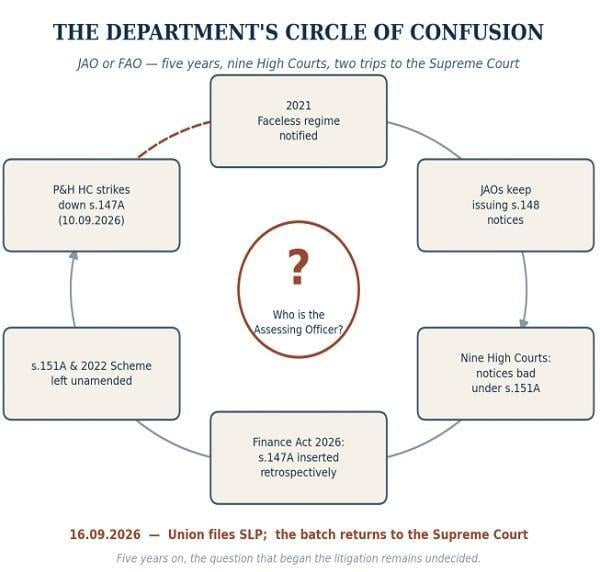
Figure The litigation cycle: five years on, the founding question remains undecided.
5. Analysis
The ratio is narrower than the headlines suggest. Parliament’s competence to enact validating legislation was not doubted. What failed was the technique. An amendment to Section 151A, or rescission of the 2022 Scheme, would in all likelihood have survived scrutiny. The provision was introduced, on its own memorandum, to achieve certainty and reduce litigation; it has produced the opposite.
The Supreme Court may dispose of the matter without reaching the constitutional question. If it accepts the contrary High Court line — that Section 151A governs the manner of allocation rather than the source of jurisdiction — the premise of the taxpayer-favourable decisions falls away and Section 147A becomes merely declaratory. Courts ordinarily prefer that route to a declaration of invalidity.
Section 147A cuts both ways. By excluding the NFAC and assessment units from the definition of “Assessing Officer” for Sections 148 and 148A, the provision renders vulnerable every notice issued in the name of the NFAC. Should it be upheld, a mirror class of challenges opens on the reverse fact pattern.
6. Likely Outcome
The revenue-disruption argument is a plea of consequence rather than of law, and invites the standard answer that administrative convenience cannot cure a want of jurisdiction. It has nonetheless prevailed before. In Union of India v. Ashish Agarwal (2022), the Supreme Court exercised its power under Article 142 to preserve approximately 90,000 reassessment notices by deeming them to be notices under Section 148A(b). A comparable equitable disposition is plausible here.
Its limits should, however, be noted. Article 142 can save proceedings; it cannot revive a provision held void. If the Revenue loses on validity, the realistic relief is prospective operation with a cut-off date — past notices protected, the faceless route mandatory going forward.
7. Present Position and Implications:
- The Supreme Court has stayed the order of Punjab and Haryana High Court on 18/09/2026.
- Assessee hold JAO-issued notices should preserve the ground in appeal rather than assume its survival.
- Where a notice or order under Section 148 or 148A was issued in the name of the NFAC or an assessment unit, the converse challenge under Section 147A should be evaluated.
- The controversy now straddles two statutes — the Income-tax Act, 1961 and the Income-tax Act, 2025 — and any ruling will require mapping across both.
8. Concluding Observation
The episode returns to the question with which it began. A defect of jurisdiction that could have been cured by amending a single section was instead met with a deeming definition that left the offending provisions on the statute book. Five years, nine High Courts and two rounds before the Supreme Court later, the identity of the Assessing Officer for the purposes of Section 148 remains unsettled. The case for drafting amendments in plain language, with consequential corrections to every corresponding provision, requires no further illustration.