Toyota Kirloskar Motors Pvt. Ltd. Vs Commissioner of Customs (CESTAT Chennai)
Summary: The CESTAT, Chennai considered three connected appeals arising from common Order-in-Original No. 108828 of 2024 dated 30.08.2024 concerning classification of sensors imported by Toyota Kirloskar Motors Pvt. Ltd. (TKML) and related penalties on co-appellants. The dispute followed DRI investigation into different classifications adopted for identical sensor components during January 2019 to June 2023. The show cause notice dated 27.09.2023 proposed reclassification, recovery of alleged short-paid customs duty with interest, and penalties under Sections 112(a), 114A and 114AA of the Customs Act, 1962.
The confirmed differential-duty figure in the impugned order was ₹53,77,10,133, while ₹12,61,51,401 had been voluntarily deposited during the proceedings. On classification merits, the Tribunal held that the three temperature sensors—Exhaust Gas Temperature, Water Temperature and Inlet Air Temperature—were classifiable under CTI 8533 4030 as thermistors because the Department had not established by technical evidence that the imported assemblies themselves performed the conversion or calibration necessary to constitute complete thermometers under Heading 9025; Heading 9031, being residuary, could not be preferred. The Oxygen, Air-Fuel Ratio and Nitrogen Oxide sensors were held classifiable under CTI 9027 1000 as gas-analysis apparatus. The Sensor Assy Brake Pedal was held classifiable under CTI 9031 8000, while the Retainer Ultrasonic Sensor was held classifiable under CTI 8708 9900. The Sensor Speed was held classifiable under CTI 8543 7099 because it detected magnetic-field variation and generated an electrical/digital signal, while the ECU subsequently determined wheel speed.
The Tribunal therefore set aside the impugned classifications for all nine sensors and allowed the classifications declared by the appellant. On the separate issue concerning 36 sensors for which no differential duty had been demanded, the Tribunal held that Section 28 could not be used merely to alter the classification forming part of a completed assessment where no duty was sought to be recovered. It relied on the statutory scheme of Sections 2(2), 17 and 28 and the distinction between assessment/reassessment and subsequent recovery proceedings, while clarifying that the Department could examine classification afresh at the assessment stage of a subsequent Bill of Entry. On four other goods—Sensor Ultrasonic, Sensor Height Control, Sensor Light Control and Cable Sub-Assy Spiral W/Sensor—the Tribunal did not finally determine the alternative FTA exemption claim.
It remanded the claim to the Original Authority for fresh consideration, including the plea of revenue neutrality, after providing an opportunity of oral and written submissions, with proceedings to be completed within 90 days from receipt of the order. The differential IGST demand of ₹18,474 relating to Cover for Rain Sensor and Holder Battery Current Sensor was set aside in the peculiar facts and circumstances. The extended-period demand concerning Sensor Assy Accelerator Pedal, Sensor Clamp Skid Control, Plate Crank Angle Sensor and Sensor Knock was held barred by limitation because the Department had not established collusion, wilful misstatement or suppression of facts with intent to evade duty; the normal-period demand, if any, remained governed by the impugned order. The Tribunal also set aside confiscation, redemption fine and penalties imposed on the appellant and co-appellant.
Finally, relying on the statutory change to Section 3(12) of the Customs Tariff Act, 1975 with effect from 16.08.2024, the Tribunal held that no interest was payable on the IGST portion relating to the earlier period. The impugned order was accordingly modified to the stated extent and the appeals were disposed of with consequential relief, if any, in accordance with law. The Tribunal also addressed the parties’ reliance on foreign customs rulings and regulations, observing that such private rulings could not be treated as binding authorities and could not even be relied upon persuasively without first establishing that the statutory provisions, policy conditions and factual circumstances were pari materia with Indian law. In deciding classification, it applied the General Rules for Interpretation, relevant Section and Chapter Notes and the Harmonised System Explanatory Notes, and reiterated that goods must be classified in the condition in which they are imported and that the burden lies on Revenue when it seeks to displace the importer’s declared classification. For the temperature sensors, the decisive distinction was between a thermistor supplying a temperature-dependent electrical signal and an imported assembly that itself converts or calibrates that signal into a temperature value. For gas-analysis sensors, the Tribunal treated the objective analytical function of the zirconia-based electrochemical cells as determinative and held that the downstream use of the signal by the ECU did not change the tariff character.
For the brake-pedal sensor, the Tribunal considered its measurement of pedal position and movement and held that the sensor itself did not perform the braking function. For the ultrasonic retainer, it found the component specially moulded and dedicated to motor-vehicle use and distinguished decisions concerning articles expressly covered as parts of general use. For the speed sensor, it emphasised that the imported article did not itself calculate, indicate or display wheel speed. In the Section 28 issue, the Tribunal recognised that Section 28 can be invoked where incorrect classification has resulted in non-levy or short-levy and differential duty is being recovered, but distinguished a case where the show cause notice merely seeks to change a completed nil-duty assessment without proposing recovery.
On revenue neutrality, it stated that an alternate exemption must actually be available to the assessee at the relevant time, or the duty must be immediately available as credit to the same assessee; hypothetical neutrality would not suffice, and abuse, fraud or defective Certificates of Origin could defeat the plea. The Tribunal nevertheless remanded the four FTA claims because the foundational facts and legal conditions had not been examined by the Original Authority. On limitation, it recognised that repeated changes in classification and the importer’s AEO Tier-3 status could warrant scrutiny but were not, by themselves, proof of collusion, wilful misstatement or suppression with intent to evade duty. The Tribunal also held that the amendment to Section 3(12) of the Customs Tariff Act expressly incorporating interest operated from 16.08.2024, whereas the relevant imports preceded that date.
Cases Discussed
- Commissioner of Customs Vs Canon India Pvt. Ltd. 2024 (390) E.L.T. 545 (S.C.)
- Assistant Director Of Income Tax Vs Green Emirate Shipping And Travels [(2006) 100 ITD 203 (MUM) / [2006] 286 ITR 60 (MUM)]
- Union Of India And Anr Vs Azadi Bachao Andolan And Anr [AIR 2004 SUPREME COURT 1107]
- Commissioner of Customs, New Delhi Vs Sony India Ltd. [2008 (231) E.L.T. 385 (S.C.)]
- HPL Chemicals Ltd. v. Commissioner of Central Excise, Chandigarh [2006 (197) E.L.T. 324 (S.C.)]
- Cummins Technologies India Pvt. Ltd. Vs Commissioner of Customs [2025 (9) TMI 139 (CESTAT-Mumbai)]
- L.G. Electronics India Pvt. Ltd. Vs Commissioner of Customs [2025 (9) TMI 1175 (S.C.)]
- Hyundai Motors Vs Commissioner of Customs, Chennai [2025 (6) TMI 608 (CESTAT Chennai)]
- Valeo India Pvt. Ltd. Vs Commissioner of Customs (Sea Port–Import), Chennai [2024 (4) TMI 484 – CESTAT CHENNAI]
- Nirlon Ltd. Vs CCE, Mumbai [2015 (320) E.L.T. 22 (S.C.)]
- Unichem Laboratories Ltd. Vs Collector of Central Excise, Bombay [(2002) 7 SCC 145]
- Share Medical Care Vs Union of India [(2007) 4 SCC 573 / 2007 (209) E.L.T. 321 (S.C.)]
- Mahindra & Mahindra Ltd. v. Union of India [2022 (10) TMI 212 – BOMBAY HIGH COURT]
- Flextronics Technology India Pvt. Ltd. Vs. Commissioner of Customs [2025 (3) TMI 695 – CESTAT CHENNAI]
FULL TEXT OF THE JUDGMENT/ORDER OF CESTAT CHENNAI
All these appeals arise out of a common Order in Original No. 108828 of 2024 dated 30.8.2024 passed by the Commissioner of Customs (Import), Chennai, hence they were heard together and are disposed by this common order.
Factual Matrix
2. The appellant, M/s. Toyota Kirloskar Motors Pvt. Ltd. (TKML), are manufacturers of passenger and multi-utility vehicles in India. They are the Indian subsidiary of M/s. Toyota Motor Corporation, Japan and have imported various sensors, including Exhaust Gas Temperature Sensors, Water Temperature Sensors, Nitrogen Oxide Sensors, Oxygen Sensors and Air-Fuel Ratio Sensors, from their group companies through various ports and inland container depots. The imports were investigated by the DRI, Bangalore Zonal Unit, on the allegation of mis-declaration/misclassification of the imported goods. Upon investigation, it was observed that TKML had classified identical components bearing the same part numbers under different Customs Tariff Headings at different points of time, allegedly resulting in short-payment of customs duty. A Show Cause Notice dated 27.09.2023 was accordingly issued, covering the period January 2019 to June 2023, proposing reclassification of the imported goods, recovery of the alleged short-paid duty with applicable interest, and imposition of penalties under Sections 112(a), 114A and 114AA of the Customs Act, 1962. After adjudication, the Commissioner passed the impugned order, leading to the present appeal. 3. Ld. Advocate Shri T. Viswanathan appeared for the appellants and Ld. Authorized Representative Shri Anoop Singh appeared for the respondent.
Submissions made by the Appellant
3.1 Shri T. Viswanathan the Ld. Counsel for the appellants at the outset submitted tabulated information with respect to the differential duty demanded. The same is reproduced below for ease of reference:
| Particulars | Differential Duty Amount including IGST involved (in INR) |
|---|---|
| Demand proposed in the SCN | 55,15,43,810 |
| Demand confirmed in the OIO | 53,77,10,133 |
| Demand dropped in the OIO | 1,38,33,676 |
| Demand Appropriated (OIO read with the Corrigendum) | 5,31,72,770 |
| Total voluntary deposits of duties made by Appellant during course of proceedings including Rs. 5,31,72,770 | 12,61,51,401 |
He stated that the duty demanded for the normal period was from 27.09.2021 to 27.09.2023 (Rs 37.44 Cr) and from 27.09.2018 to 27.09.2021 (Rs 16.32 Cr) for the extended period. He further referred to a product-wise flow chart depicting the treatment of the impugned goods, which was subsequently enclosed with their letter dated 13.03.2026, after conclusion of the public hearing. Of the 19 goods for which duty was confirmed in the impugned order, and shown in the flow chart, the ld. Counsel has advanced arguments on merits with respect to 9 items at the Bar.
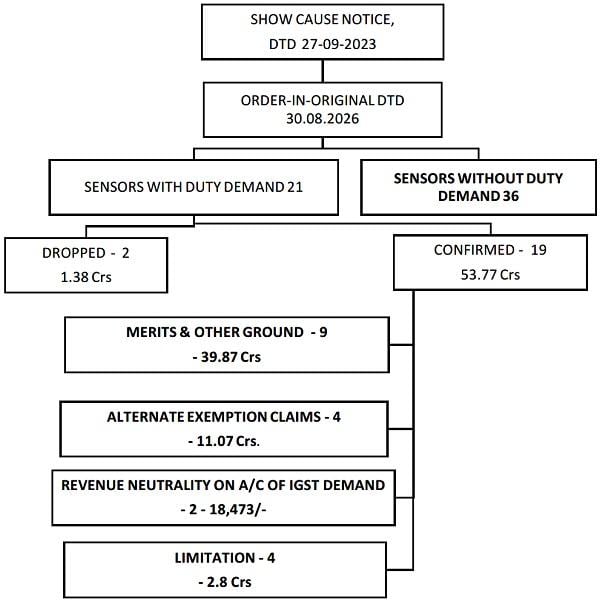
As per Appeal Memorandum
The final letter dated 13.03.2026, submitted after conclusion of the public hearing, referred to above, is in slight variance with their Appeal Memorandum, as per which the dispute relates to the classification of 52 types of sensors, instead of 57 stated in the flow chart. Out of this the demand of differential duties is stated to be relating to 21 types of sensors. Further the re-classification of 31 types of sensors did not result in any demand of differential duties. Out of the 21 types of sensors where demand has been confirmed, submissions relate respect to 16 types of sensors. No submissions are being made in the case of the remaining 5 types of sensors, wherein the ld. Commissioner or the Appellant has accepted the classification confirmed in the impugned order. He further made specific submissions on the following issues:
I. Classification on Merits
The submissions in respect of the nine items were further set out in tabular form in Annexure III to the aforesaid letter. The gist of the submissions are extracted below:
A. Temperature Sensors
1. Sensor Exhaust Gas Temperature [EGT Sensor]
EGT sensor is a thermistor-based device which exhibits change in resistance due to change in temperature. It is installed in the exhaust system before the Selective catalytic reduction (SCR) chamber and before the Diesel particulate filter (DPF) in order to detect the temperature of the exhaust gas. Temperature variations cause the resistance of the sensor to vary, which in turn alters its voltage. Based on this output voltage, the Engine Control Unit (ECU) measures the actual temperature of the exhaust gas. This temperature is required to manage the after treatment of exhaust gases to control emission of NOx gases and to safeguard thermally sensitive parts in the exhaust system such as the DPF. The appellant has sought to classify the goods under CTI 8533 4030, with alternative classification under 9025 1190. The Department has finalised the classification under CTI 9031 8000.
2. Sensor water Temperature
Water Temperature Sensor detects the engine coolant temperature. It is essentially a thermistor whose resistance value changes according to the temperature & consequently voltage and current changes in the circuit. These changes in the electrical parameters are calibrated to measure the temperature. Changes in the coolant temperature are thus measured by the changes in the thermistor resistance value. This temperature measurement is done to ensure that the engine runs at an optimum temperature to provide the best performance. The appellant has sought to classify the goods under CTI 8533 4030. The Department has finalised the classification under CTI 9031 8000.
3. Sensor Inlet Air Temperature
The sensor is basically a thermistor. It is a sensor to monitor the temperature of the intake air entering engine to regulate the fuel injection. The IAT sensor has a direct bearing on the air density and volume changes and hence, the fuel injection needs regulation based on this factor to maintain optimum efficiency. This part is performing the temperature measurement by virtue of being a thermistor which is basically a resistor whose resistance changes depending on the temperature variation. This change in resistance and resultant electrical parameters is measured to read the temperature of inlet air. This is installed at the entry of the inlet air cleaner. The appellant has sought to classify the goods under CTI 8533 4030. The Department has finalised the classification under CTI 9031 8000. Common submission of the Appellant for Temperature Sensors:
a. It is submitted that the temperature sensors are thermistors, i.e. resistors whose resistance varies with temperature, and are specifically classifiable under CTH 8533 40 30, covering thermistors. The HSN Explanatory Notes to Heading 8533 expressly include non-linear thermistors. The minor electrical circuitry merely facilitates transmission of the thermistor’s output and does not alter its essential character. Reliance is placed on Commission Implementing Regulation (EU) No. 709/2013, Subros Ltd. Vs Commissioner of Customs, 2018 (363) E.L.T. 849 (Tri.-Del.), and US Customs Rulings NY I85509 and NY I85730, wherein thermally sensitive resistors/temperature sensors were classified under Heading 8533.
b. Alternatively, the sensors are classifiable under CTH 9025, as electrical resistance-based thermometers, which are specifically covered by the HSN Explanatory Notes to Heading 9025. The sensors independently measure temperature and transmit the corresponding signal to the ECU. Reliance is placed on US Customs Ruling NY 882918 dated 04.03.1993, concerning EGT sensors. This alternative classification is duty-neutral.
c. Classification under CTH 9031 is unsustainable, as it is a residuary heading covering measuring or checking instruments not specified or included elsewhere. The subject sensors are specifically covered under CTH 8533, and alternatively under CTH 9025. The fact that the sensor incorporates minor electrical components does not convert it into a general measuring or checking instrument under Heading 9031. The HSN Notes to Heading 9031 relating to apparatus for testing or regulating vehicle motors do not cover a simple temperature sensor which merely detects temperature and transmits a signal to the ECU.
d. The settled principle is that a specific entry must prevail over a residuary/general entry, and recourse to a residuary heading is permissible only when the goods cannot be classified under a specific heading. Reliance is placed on Hamdard (Wakf) Laboratories Vs Commissioner, Commercial Tax, U.P. – 2026-VIL-20-SC; CCE Vs Uni Products India Ltd. – 2020 (372) E.L.T. 465 (S.C.); Mauri Yeast India Pvt. Ltd. Vs State of U.P. – 2008 (225) E.L.T. 321 (S.C.); and Dunlop India Ltd. Vs Union of India – 1983 (13) E.L.T. 1566 (S.C.). Accordingly, the subject temperature sensors, being thermistors specifically covered under CTH 8533, are classifiable under CTI 8533 4030, and classification under the residuary CTH 9031 is not warranted.
B. Gas Analysis Sensors
4. Sensor Air Fuel Ratio and Sensor Oxygen
Both the sensors measure the residual oxygen content in the exhaust gases, and this information is transmitted to the ECU in the form of an electric current in order to optimize the performance of the engine (fuel economy & emission) by controlling the fuel quantity and valve timing. This sensor is in the exhaust pipe between exhaust manifold & catalytic converter to assess the emission performance of the engine. This sensor employs Zirconium Dioxide probe coated with a thin layer of porous Platinum to form a solid state electro-chemical cell which does the measurement by the generation of current caused by conversion of Carbon Monoxide to Carbon Dioxide in presence of oxygen in the exhaust gases. The appellant has sought to classify the goods under CTI 9027 1000 . The Department has finalised the classification under CTI 9031 8000.
5. Sensor Nitrogen Oxide
The sensor is employed as a part of OBD (On Board Diagnostics) system and helps in controlling the emission performance of the engine by controlling the operational parameters. This NOx sensor is fitted in the exhaust pipe of the vehicle and measures the quantum of various oxides of Nitrogen by employing reactions in the electrochemical cells.
The first cell electrochemically pumps out the oxygen to improve the measurability of the nitrogen oxides in subsequent cells. These cells use YSZ (Yttrium Stabilized Zirconium) oxide for such reactions. The appellant has sought to classify the goods under CTI 9027 1000 . The Department has finalised the classification under CTI 9031 8000. Common Submissions made by the Appellant for Gas Analysis Sensors
a. The sensors analyse exhaust gases and are specifically classifiable under CTH 9027 10 00, covering instruments and apparatus for physical or chemical analysis, including gas or smoke analysis apparatus. They operate on the principle of electrochemical reaction to detect the concentration/presence of gases such as NOx and oxygen. This classification is supported by Cummins Technologies India Pvt. Ltd. Vs Commissioner of Customs [2025 (9) TMI 139 (CESTAT- Mumbai)], wherein NOx sensors were held classifiable under CTI 9027 10 00, and by US Customs Rulings HQ 11262310 and NY J88011. The Department’s contention that the sensors merely measure a specific gas and therefore fall under CTH 9031 is untenable. The sensors detect and analyse the composition of exhaust gases and transmit the resulting signal to the ECU for further action. They therefore perform the function contemplated by Heading 9027.
b. CTH 9031 is a residuary heading covering measuring or checking instruments not specified elsewhere in Chapter 90. Since gas analysis apparatus are specifically covered under CTH 9027, resort to CTH 9031 is unwarranted. The principle that a residuary entry can be invoked only where no specific entry applies, and that a specific entry must prevail over a general/residuary entry, is settled by Hamdard (Wakf) Laboratories (supra); Uni Products India Ltd. (supra); Mauri Yeast India (supra); and Dunlop India (supra). Accordingly, the gas analysis sensors, being specifically covered under CTH 9027, are classifiable thereunder and not under the residuary CTH 9031.
c. The Department itself has contended in Cummins (supra) that gas analysis sensors are classifiable under CTH 9027 and has similarly classified NOx sensors under CTH 9027 in OIO No. JAM-CUSTM-PRV- COM-003-24-25 dated 23.08.2024. The Department cannot adopt inconsistent classifications for similarly situated importers. Reliance is placed on Volvo India Pvt. Ltd. Vs CC, Nhava Sheva, 2004 (174) E.L.T. 36 (Tri.-Mumbai) and Damodar J. Malpani Vs CCE, 2002 (146) E.L.T. 483 (S.C.), recognising the requirement of uniformity in assessment.
d. Even if the Department’s classification under CTI 9031 8000 is accepted, the relevant sensors remain eligible for preferential duty where supported by valid Certificates of Origin. The Sensor Air Fuel Ratio is covered under Sl. No. 791 of Notification No. 69/2011, while the Sensor Oxygen is covered under Sl. No. 791 of Notification No. 69/2011 and Sl. No. 1556 of Notification No. 46/2011. The Appellant had also claimed FTA benefit for Sensor Oxygen under CTH 9027, Sl. No. 1538 of Notification No. 46/2011. Reclassification by itself cannot defeat the preferential rate where the alternative classification is also covered by the relevant notification and valid COOs are available. Reliance is placed on Hyundai Motors Vs Commissioner of Customs, Chennai [2025 (6) TMI 608 (CESTAT Chennai)].
C. Other Sensors
6. Sensor Assy Brake Pedal
It is a non-contact type sensor that uses a Hall IC to detect the amount of depression of the brake pedal and converts this depression into voltage signals. This signal is used by the onboard ECU to decide various other functions. This sensor senses the amount of the depression of the brake pedal and the rate of the depression with respect to time to differentiate between normal braking and panic braking. This sensor also aids in air bag deployment (Panic braking sensing) in conjunction with other supporting sensors. This sensor is also facilitating the information or the signals towards optimization of regenerative braking in HEV & PHEV (Hybrid vehicles). The appellant has sought to classify the goods under CTI 9031 8000. The Department has finalised the classification under CTI 8708 3000.
Submissions made by the Appellant
a. The Department proposes classification under CTI 8708 3000 on the ground that the product not only measures brake pedal depression but also translates the driver’s input into electrical signals through the hall effect, mounting bracket and protective housing. However, CTH 9031 covers measuring or checking instruments, appliances and machines. Since the sensor measures the amount and rate of brake pedal depression and relays that information to the onboard ECU, it is appropriately classifiable under CTI 9031 8000. CTH 9031 being residual within Chapter 90, the relevant competing headings must first be examined. The subject goods are not covered by CTH 9025, 9026 or 9027. The sensor merely generates electrical signals proportionate to pedal travel. The ECU performs the interpretation, comparison and control logic. The sensor’s essential function therefore remains measurement, satisfying CTH 9031.
b. Once the sensor is classifiable under CTH 9031, it stands excluded from Section XVII and CTH 8708 by virtue of Note 2(g) to Section XVII. CTI 8708 3000 covers “Brakes and servo-brakes; parts thereof.” The HSN Explanatory Notes refer to brakes and their parts such as plates, drums, cylinders, mounted linings, oil reservoirs for hydraulic brakes, servo-brakes and parts thereof. The subject sensor is not a brake part of the kind contemplated under CTH 8708. A “part” must be an essential component without which the whole cannot function. Reliance is placed on CEE Vs Insulation Electrical (P) Ltd., [2008 (224) E.L.T. 512 (S.C.)]. The sensor does not perform the braking function. Even without it, the brakes continue to function. Therefore, it cannot be treated as a part of brakes merely because it has a connection with the braking system. The scope of classification under CTI 8708 3000 cannot be extended to goods that are connected with braking but are not brake parts. Reliance is placed on CC, Chennai Vs Hyundai Transys India Pvt. Ltd. [2026 (1) TMI 441 – CESTAT Chennai].
c. In light of the above, the subject sensor is correctly classifiable under CTI 9031 8000 and not under CTI 8708 3000. Consequently, the proposed reclassification fails and the demand is liable to be set aside.
7. Retainer Ultrasonic Sensor
It is a plastic part used to hold the ultrasonic sensors in position and attached to the inner surface of the bumper. Basically, this part is a holder made of plastic which holds or provides the mounting for the ultrasonic sensor and then this holder is fitted into the bumper of the vehicle, that is why it is called a retainer as it retains the sensor in the fixed position. The appellant has sought to classify the goods under CTI 8708 9900. The Department has finalised the classification under CTI 3926 9099.
Submissions made by the Appellant
a. The product is a plastic retainer used to hold ultrasonic sensors in position. It is specially designed for use as an internal component of a motor vehicle and therefore merits classification under CTI 8708 9900. CTH 8708 covers parts and accessories of motor vehicles of headings 8701 to 8705. The product satisfies the three tests under the HSN Explanatory Notes to Section XVII: it is not excluded by Note 2 to Section XVII; it is suitable for use solely or principally with motor vehicles; and it is not more specifically covered elsewhere in the Nomenclature.
b. Chapter 39 covers plastics and articles thereof; however, Note 2(t) specifically excludes parts of vehicles falling under Section XVII. The retainer is not an article of general use. It is solely and principally designed for use in automobiles and, therefore, Rule 3(a) cannot be invoked to classify it under the general plastic article heading. Reliance is placed on Flextronics Technologies Pvt. Ltd. Vs Commissioner of Customs, Chennai [2024 (2) TMI 1509 – CESTAT Chennai], where tailor-made mobile phone covers were classified under the specific heading for mobile phones rather than the general plastic heading. Accordingly, since the retainer is specifically designed for use with an ultrasonic sensor as part of a motor vehicle, it is classifiable under CTH 8708 and not CTI 3926 9099.
c. The goods originate from Thailand, the Philippines and Singapore and are accompanied by valid Certificates of Origin. At import, the Appellant classified them under CTH 8708 and claimed benefit under Sl. No. 1478 of Notification No. 46/2011. Without prejudice, even if the Department’s proposed classification under CTI 3926 9099 is accepted, the goods remain eligible for FTA exemption under Sl. No. 496 of Notification No. 46/2011. Therefore, the demand is liable to be set aside on this ground as well. Reliance is placed on Hyundai Motors (supra).
d. The Retainer Sensor Ultrasonic is correctly classifiable under CTI 8708 9900. In any event, it is eligible for FTA exemption even under the Department’s proposed classification; hence, the demand is liable to be set aside.
8. Sensor Speed
It is mounted to the axle hub and bearing assembly near the rotating encoder, which consists of N and S poles that are arranged in an alternating sequence. The active sensor uses the hall effect wherein a sensing element is exposed to the magnetic field of a rotating encoder. The sensor converts the changes in the magnetic field resulting from the wheel’s rotation into a digital signal and transmits this pulse signal to appropriate electronic control unit such as the Anti-lock braking system which does the calculations to arrive at the wheel speed. The appellant has sought to classify the goods under CTI 8543 7099. The Department has finalised the classification under CTI 9031 8000.
Submissions made by the Appellant
a. The sensor uses the hall effect to generate a waveform indicating rotational speed. CTH 8543 covers electrical machines and apparatus having individual functions. The speed sensor performs an independent electrical function by converting changes in magnetic field into digital signals relayed to the ECU. Reliance is placed on US Cross Rulings Nos. N216101 dated 17.05.2012, N281447 dated 21.12.2016 and N321130 dated 01.09.2021, where wheel speed sensors were classified under CTH 8543.
b. The sensor is not classifiable under CTH 9031. The submissions made in respect of the EGT sensor on exclusion from CTH 9031 apply equally to the present goods.
c. The Appellant imported the goods under CTH 8543, 9031 and 9032 and availed FTA benefit under Sl. Nos. 1450, 1556 and 1559 of Notification No. 46/2011. Assuming, without admitting, that classification under CTH 8543 is not accepted, the matter remains revenue neutral as the same FTA benefit is available for goods under CTH 9031, as confirmed by the Department. Reliance is placed on Hyundai Motors (supra), which held that preferential duty benefit may be claimed, subject to valid COO, irrespective of subsequent classification change. Since the speed sensor originates from Thailand and is covered by valid COO, the Department’s proposed classification under CTI 9031 8000 is eligible for FTA exemption under Sl. No. 1556 of Notification No. 46/2011. The demand is therefore liable to be set aside on this ground alone.
II. Reclassification under Section 28, where no duty has been demanded – 36 Sensors
The Appellants submit that Section 28 cannot be invoked merely to reclassify the 36 sensors in respect of which no duty demand has been raised. A duty demand is a jurisdictional prerequisite for proceedings under Section 28. Since the SCN itself proposes no demand for these goods, the proposed reclassification is without statutory authority. Any change to the assessment ought to have been pursued by challenging the assessment through an appeal under Section 128 of the Customs Act or modifying the same through review of the order in terms of Section 129D of the Customs Act.
III. Revenue-neutrality of reclassification – FTA benefit
The Appellants submit that the goods imported from Japan and Thailand, i.e. (1) Sensor Ultrasonic; (2) Sensor Height Control; (3) Sensor Light Control and (4) Cable Sub-Assy Spiral W/Sensor, though reclassified by the Department, remain eligible for nil/concessional duty under alternate entries of the applicable FTA notifications, namely Notifications Nos. 46/2011 and 69/2011. The consequential demand of ₹10,78,62,162/- is therefore revenue neutral and unsustainable. Reliance is placed on L.G. Electronics India Pvt. Ltd. Vs Commissioner of Customs [2025 (9) TMI 1175 (S.C.)], and Hyundai Motors (supra).
IV. Differential IGST – availability of ITC
The differential IGST demand of ₹18,474/- is fully available as input tax credit, in the case of Cover for Rain Sensor and Holder Battery Current Sensor, hence causes no revenue loss. Reliance is placed on Nirlon Ltd. Vs CCE, Mumbai – 2015 (320) E.L.T. 22 (S.C.); International Auto Ltd. Vs CCE – 2005 (183) E.L.T. 239 (S.C.); Narayan Polyplast Ltd. – 2005 (179) ELT 20 (SC) and Narmada Chematur Pharma. – 2005 (179) ELT 276 (SC).
V. Extended period of limitation
The Appellants submit that the extended period under Section 28(4) is not invocable in the absence of collusion, wilful misstatement or suppression of facts. The classification was adopted bona fide on the basis of technical literature and tariff interpretation, and the very fact that different Customs formations have adopted different classifications demonstrates the interpretational nature of the dispute. Reliance is placed on Cummins Technologies (supra); Mahindra & Mahindra Ltd. Vs CCE – 2000 (125) E.L.T. 477 (Tribunal)]; G.M. Pens International – 2025 (393) E.L.T. 93 (Tri. – Del.); Coastal Energy Pvt. Ltd. – 2009 (247) E.L.T.159 (Mad.); Densons Pultretaknik – 2003 (155) E.L.T. 211 (S.C.) and Midas Fertchem Impex Pvt. Ltd. – 2023 (384) E.L.T. 397 (Tri. – Del.). The Appellants further submit that the goods were properly described in the Bills of Entry and differential duty of ₹12,61,51,401/- was voluntarily paid, evidencing absence of intent to evade duty. The differential IGST is also revenue neutral as the same is available as ITC.
VI. Confiscation and redemption fine
The Appellants submit that the goods are not liable to confiscation under Section 111(m), as there was no misdeclaration of value or description; the dispute is essentially one of tariff classification. Further, redemption fine of ₹20,05,05,000/- under Section 125 cannot be imposed when the goods are no longer available for confiscation. Reliance is placed on Northern Plastic Ltd. Vs Collector – 1998 (101) E.L.T. 549 (S.C.); Weston Components Ltd. Vs CC – 2000 (115) E.L.T. 276 (S.C.) and the decisions in Suryadev Alloys and Power (P) Ltd. Vs Principal Commissioner of Customs, Chennai – 2025 (8) TMI 1356- CESTAT CHENNAI, and Flextronics Technology India (supra).
VII. Penalties on the Appellant
The Appellants submit that penalties under Sections 114A and 114AA are unsustainable in the absence of evidence of collusion, wilful misstatement, suppression or deliberate falsification. The dispute concerns interpretation and classification of technologically sophisticated goods, and mere adoption of a classification different from that proposed by the Department does not establish mens rea or misdeclaration. Reliance is placed on H.M.M. Ltd. – 1995 (76) E.L.T. 497 (S.C.); Hindustan Steel Ltd. – 1978 (2) E.L.T. J159 (S.C.); Northern Plastic (supra); Suvidh Overseas – 2025 (12) TMI 690 – CESTAT CHENNAI; Xiaomi Technology India Pvt. Ltd. – 2025 (11) TMI 1120 – CESTAT CHENNAI; and Naam Exports – 2022 (382) E.L.T. 251 (Tri. – Chennai).
VIII. Differential IGST – interest and penalty
Without prejudice, the Appellants submit that interest and penalty on the differential IGST are not sustainable, even for the normal period as the relevant provisions had not been incorporated for the period in question. Reliance is placed on Mahindra & Mahindra Ltd. (supra), affirmed by the Supreme Court, and Suryadev Alloys and Power (supra); along with A.R. Sulphonates Pvt. Ltd. [2025 (4) TMI 578 – BOMBAY HIGH COURT; and Flextronics Technology India (supra). Submissions on behalf of the Co-Appellants
IX. Penalty under Section 112(a) – classification dispute
The Co-Appellants submit that their respective roles were confined to classification and indirect-tax compliance. The classification was adopted on the basis of available technical literature and the understanding of the goods. Since classification is an interpretational exercise and the Department itself has adopted differing classifications for similar sensors, no penal consequence can follow in the absence of deliberate misdeclaration. Reliance is placed on International Exim Agency, Paras H. Shah, Him Logistics Pvt. Ltd. and Chakiat Agencies.
X. Absence of confiscation and mens rea
Since the goods are not liable to confiscation under Section 111(m), penalty under Section 112(a) cannot be sustained. In any event, there is no evidence of any positive or deliberate intent on the part of the Co-Appellants to misclassify the goods. Their statements consistently disclosed the basis on which classification was undertaken. Reliance is placed on Hindustan Steel Ltd. (supra).
XI. Official capacity and absence of personal gain
The Co-Appellants further submit that they acted in their official capacity as employees and that no personal gain has been attributed to them. Penalties on employees cannot be sustained merely on account of their official roles, particularly where the dispute concerns interpretation of classification or exemption provisions. Reliance is placed on Komatsu India Pvt. Ltd., Gammon India Ltd., Carpenter Classic Exim Pvt. Ltd. and Sterlite Industries (India) Ltd.
XII. Penalty under Section 114AA
The Co-Appellants submit that Section 114AA requires positive evidence of knowingly or intentionally making, signing or using a document containing a false or incorrect material particular. No such evidence has been produced. Mere adoption of a classification subsequently found unacceptable by the Department cannot amount to falsification of documents. Reliance is placed on Sree Ayyangar Spinning & Weaving Mills Ltd., CC v. Sri Krishna Sounds and Lightings and Orion Enterprises.
XIII. Prayer
Accordingly, the Appellants submit that the demands, interest, confiscation, redemption fine and penalties imposed on the Appellant and the Co-Appellants are unsustainable and pray that the impugned order be set aside with consequential relief.
Submissions made by the Respondent-Revenue
3.2 Shri Anoop Singh ld. Authorized Representative appeared for the respondent. He submitted that:
A. Investigation
DRI investigation indicated that M/s TKML classified identical imported sensors, including EGT, water-temperature, oxygen, air-fuel-ratio and NOx sensors, under different Customs Tariff Headings during January 2019–June 2023, resulting in alleged short-payment of customs duty. He further took us through the impugned order relating to the classification of the impugned goods under dispute and submitted as under.
B. Sensor Exhaust Gas Temperature
The Exhaust Gas Temperature (EGT) sensor is fitted to the exhaust manifold to measure the temperature of the exhaust gas. It is made of a chromium-manganese thermistor assembly. However, the imported item is not just a thermistor. It also includes the housing, electrical connectors, and an electrical circuit. The thermistor senses changes in temperature by changing its electrical resistance. This change is converted into an electrical signal and sent to the ECU (Engine Control Unit). The ECU uses this information to control fuel combustion, engine performance, air-fuel mixture, and particulate-filter regeneration. Therefore, the thermistor is only one part of the complete EGT sensor. The imported item is a complete temperature-measuring device and cannot be treated simply as a thermistor under CTI 85334030. The item also does not perform physical or chemical analysis under CTH 9027, does not automatically regulate a system under CTH 9032, and does not fall within the specific instruments covered by CTH 9025. Since the imported item is a complete measuring device, it is appropriately classifiable under CTI 9031 8000. The contrary view stated on 19-06-2023—that a measuring instrument must show a readable or graduated result—is not supported by the WCO Explanatory Notes to Heading 90.31. These notes also cover equipment used for testing and regulating motor-vehicle systems. Therefore, classification of the EGT sensor under CTH 8533, 9027, or 9032 is not appropriate. Such classification allegedly resulted in the importer receiving benefits under Notifications Nos. 24/2005-Customs and 50/2017-Customs that were not legally available.
C. Sensor Nitrogen Oxides
An electrical sensor downstream of the catalytic converter that measures exhaust NOx concentration. Its feedback enables the ECU to regulate urea injection for SCR, thereby limiting emissions and supporting fuel economy and engine performance. The NOx sensor, part of the SCR system, uses electrochemical cells to measure NOx and oxygen concentrations in vehicle exhaust and sends the results for emission control. It is not the industrial gas-analysis apparatus contemplated by Heading 90.27, nor an instrument of Heading 9025 or an automatic controller of Heading 9032. It is therefore appropriately classifiable under CTH 9031 8000 as a measuring or checking instrument not elsewhere specified. Heading 8708 is also inapplicable because Section XVII covers vehicle parts only when they are not more specifically included elsewhere; this sensor is specifically covered by Heading 9031.
D. Sensor Air-Fuel Ratio
Both sensors monitor exhaust oxygen and transmit data to the engine-management system to optimise the air-fuel mixture and ignition timing. The oxygen sensor measures through voltage, while the air-fuel-ratio sensor uses current and supports finer emission control. An electrical sensor in the exhaust manifold that measures residual oxygen and sends real-time data to the ECU for maintaining the correct air-fuel ratio. They measure rather than analyse exhaust gases and are not the industrial gas-analysis apparatus described in Heading 90.27. Both are therefore appropriately classifiable under CTH 9031 8000.
E. Sensor Assembly Accelerator Pedal
This assembly comprises the accelerator pedal and position sensors that detect pedal movement and control throttle opening. As an assembly of motor-vehicle parts, it is appropriately classifiable under CTH 8708 9900.
F. Retainer Ultrasonic Sensor
These plastic components mount and hold ultrasonic sensors. Section Note 2(b) of Section XVII excludes plastic goods similar to “parts of general use,” including mountings of Heading 8302, from classification as motor-vehicle parts. The definition is heading-based and applies even to specialised components used solely with vehicles, as supported by Spire India v. CCE, 2006 (200) ELT 539 (T), and Kirloskar Pneumatic Co. Ltd. v. CC, 1997 (90) ELT 428 (T). Accordingly, the retainer and clip are classifiable under CTH 39269099.
G. Sensor Inlet Air Temperature
The IAT sensor measures intake-air temperature so that the ECU can adjust the fuel-air mixture. Although it contains a thermistor, its circuitry is essential to transmit the measurement to the ECU; the complete device cannot therefore be treated as a thermistor under CTH 85334030. Its predominant function is measurement, making CTH 9031 8000 the appropriate classification.
H. Sensor Water Temperature
A negative-temperature-coefficient thermistor assembly in the coolant line. It measures coolant temperature and signals the ECU to adjust engine parameters for optimum operating temperature and performance. The engine-coolant-temperature sensor uses a thermistor within a protective housing, together with connectors, wiring, mounting provisions and sealing components, to measure coolant temperature and signal the ECU. Because its function depends on the complete assembly, not the thermistor alone, classification under CTH 85334030 is inappropriate. Its predominant measuring function places it under CTH 9031 8000.
I. Sensor Speed
The speed sensor uses Hall-effect technology to measure rotational or vehicle speed. It is therefore classifiable under CTH 9031 8000 as a measuring instrument not elsewhere specified.
J. Sensor Assembly Brake Pedal
The brake-pedal sensor assembly detects pedal position and movement and transmits corresponding signals to the ECU or brake-control module. Its functions extend beyond measurement to braking-force control, coordination with ABS and ESC, regenerative braking and brake-light activation. As an integrated assembly comprising sensors, Hall-effect circuitry, connectors, mounting bracket and housing, it is appropriately classifiable under CTH 8708 3000 as a motor-vehicle part.
The ld. A.R. prayed that the appeal may be rejected.
Analysis and Findings
4. We have carefully gone through the oral and written submissions made by the parties to the dispute. The following issues have been raised by the Appellant:
I. Classification of 9 Sensors on merits
A. Temperature Sensors (3 sensors)
B. Gas Analysis Sensors (3 sensors)
C. Other Sensors (3 sensors)
II. Reclassification under Section 28, where no duty has been demanded – 36 Sensors
III. Revenue-neutrality of reclassification – FTA benefit
IV. Differential IGST – availability of ITC
V. Extended period of Limitation
VI. Confiscation, Redemption Fine and Penalties On Appellant and Co-Appellants
4.1 We find that the Appellant has relied on foreign Rulings and Regulations, without showing whether the Tariff on which they are based are pari materia to the Indian Customs Tariff. In any case these Rulings are also private tax ruling and cannot formally be cited as an authority by another taxpayer/ appellant in their own judicial proceedings. Each Ruling is an authority in the setting of its own facts and will not help advance other appellants cause in their case before judicial fora. The Income Tax Appellate Tribunal – Mumbai, in the case of Assistant Director Of Income Tax Vs Green Emirate Shipping And Travels [(2006) 100 ITD 203 (MUM) / [2006] 286 ITR 60 (MUM)], while examining Rulings given by Indian Authorities, after referring to the Hon’ble Supreme Court’s judgment in Union Of India And Anr Vs Azadi Bachao Andolan And Anr [AIR 2004 SUPREME COURT 1107], held that the Authority for Advance Rulings, not being a part of the judicial hierarchy, cannot lay down a binding precedent for anyone – the Revenue, the assessees or the appellate authorities – except for the assessee who sought the Ruling and its jurisdictional authority. This according to us, would be applicable with greater force to foreign Rulings, where the law is not even shown to be pani matenia to the applicable domestic law.
4.2 We are of the opinion that such a Ruling cannot be relied upon even for its persuasive value unless it is first shown that the statutory provisions, policy conditions and factual circumstances considered in that decision are pari materia with those in the case before us. Otherwise, it would amount to relying on an unverified premise. In the absence of such a foundation, the decision may have little or no bearing on the issue before us. We, therefore, do not find it necessary to examine the decisions so relied upon. We now take up the issues sequentially:
I. Classification of 9 sensors on merits
5.1 We have examined the competing classifications in the light of the General Rules for Interpretation of the Import Tariff, the relevant Section and Chapter Notes, the Harmonised System Explanatory Notes and the judicial authorities cited by both sides.
5.2 Under Rule 1, classification is to be determined according to the terms of the headings and the relevant Section and Chapter Notes, and Rule 6 applies at the subheading level. The goods have to be classified in the condition in which they are imported, having regard to their objective characteristics and function. In Commissioner of Customs, New Delhi Vs Sony India Ltd. [2008 (231) E.L.T. 385 (S.C.)], the Supreme Court held, that it is a settled position in law that the goods would have to be assessed in the form in which they are imported and presented to the customs and not on the basis of the finished goods manufactured after subjecting them to some process after the import is made.
5.3 It is equally settled that where Revenue seeks to depart from the classification declared by the importer, the burden of establishing the proposed classification lies upon Revenue. The Supreme Court in HPL Chemicals Ltd. v. Commissioner of Central Excise, Chandigarh, [2006 (197) E.L.T. 324 (S.C.)], held that classification is a matter of chargeability and that Revenue must adduce proper evidence when it seeks to classify the goods under a heading different from that claimed by the assessee
A. Temperature Sensors – General
5.4 In the present case relating to ‘Temperature Sensors’, the imported articles incorporate a thermistor, housing, electrical connections and associated components. The thermistor changes its electrical resistance according to the exhaust temperature, and the resulting electrical signal is transmitted to the ECU. The material question is whether the imported article itself performs the function of measuring/converting the temperature, or whether it merely provides a temperature-dependent resistance signal which is subsequently processed by the ECU.
5.5 CTH 8533 specifically covers electrical resistors, and other variable resistors, other than heating Resistors. CTI 8533 4030 specifically covers thermistors. A heating resistor is a resistor specifically designed to convert electrical energy into heat. Whereas a thermistor is a temperature-sensitive resistor, not ordinarily a heating resistor. The Indian tariff accordingly contains a specific description for thermistors which indicates that it is not normally to be treated as a heating resistor.
5.6 On the other hand, CTH 9025 covers hydrometers, thermometers and pyrometers etc. It would apply where the imported article itself constitutes a thermometer, including an electrical-resistance thermometer, rather than merely a thermistor whose resistance varies with temperature.
5.7 CTH 9031 is a residual provision for measuring or checking instruments not specified or included elsewhere in Chapter 90. It cannot be invoked where the goods are specifically covered by Heading 9025, nor can the mere fact that the sensor is used in an automotive control system convert it into a Heading 9031 instrument. Likewise, the fact that the ECU subsequently uses the signal for fuel control, emission control or particulate-filter regeneration does not make the sensor itself an automatic regulating or controlling apparatus under Heading 9032.
5.8 We are of the opinion that the mere presence of housing, connectors, wiring, mounting arrangements or protective components does not, by itself, transform a thermistor into a thermometer. What is decisive is the function of the complete article as imported. If the imported sensor merely senses temperature through the resistance change of the thermistor and transmits the resulting electrical signal to the ECU, while the ECU performs the conversion, calibration or interpretation necessary to determine the actual temperature, the article remains appropriately classifiable as a thermistor under CTI 8533 4030.
5.9 Conversely, Heading 9025 would become applicable if the evidence establishes that the imported assembly itself incorporates the necessary circuitry or electronics to convert the sensed resistance into a calibrated temperature value and thereby constitutes a complete temperature-measuring instrument. A physical display or graduated scale is not, by itself, essential to a modern electronic thermometer; however, there must be evidence that the imported article itself performs the temperature-measuring function rather than merely supplying a raw temperature-dependent electrical signal.
5.10 In the present case, the Department has not established, by technical evidence, that the electrical circuitry incorporated in the imported EGT sensor performs such conversion or calibration. The assertion that the circuitry is necessary to transmit the signal to the ECU does not, by itself, establish that the sensor is a complete thermometer. The subsequent use of the signal by the ECU for engine- management functions likewise cannot determine the tariff classification of the imported sensor.
5.11 Accordingly, on the evidence available, the imported article is not appropriately classifiable under CTH 9031. It is also not classifiable under Heading 9025. Department has not established that the imported assembly itself performs the temperature-measuring/ conversion function. In the absence of such evidence, and having regard to the specific tariff description of thermistors under CTI 8533 4030, the goods are correctly classifiable under CTI 8533 4030.
6. Product wise classification
6.1 Exhaust Gas Temperature (EGT) Sensor
The EGT sensor contains an NTC thermistor whose resistance changes with exhaust-gas temperature. The housing, fixing arrangement, heat-resistant cable and connector serve installation and signal transmission. On the stated construction, and in the absence of evidence that the internal circuitry independently converts or calibrates the signal into a temperature value, the essential character remains that of a thermistor. Accordingly, as discussed above, the department has not been able to establish the correctness of classification of the impugned article. In the absence of such evidence, Revenue has not been able to dislodge the classification of CTI 8533 4030 adopted by the appellant and is hence sustained. Heading 9025 would apply only if the imported unit itself functions as a complete temperature-measuring instrument. CTH 9031 being a residual provision cannot be preferred over a specific heading.
6.2 Engine Coolant/Water Temperature Sensor
The NTC thermistor, together with its housing, connector, wiring and sealing components, senses coolant temperature and transmits the resulting electrical signal to the ECU. Revenue has not been able to demonstrate that these components, by themselves, are a separate measuring instrument. Hence on the stated facts and discussion above, the goods as classified by the Appellant under CTI 8533 4030 merits acceptance.
6.3 Inlet Air Temperature (IAT) Sensor
The IAT sensor operates through a thermistor whose resistance varies with intake-air temperature, with the ECU using the signal for engine control. Its automotive use and downstream function do not determine its tariff classification. For reasons discussed, the goods remain classifiable under CTI 8533 4030 as declared by the Appellant.
B. Gas Analysis Sensors – General
7. Heading 9027 covers instruments and apparatus for physical or chemical analysis, including gas or smoke analysis apparatus, with CTI 9027 1000 specifically covering gas or smoke analysis apparatus. Heading 9031 is a residuary provision for measuring or checking instruments not specified or included elsewhere in Chapter 90. Accordingly, where the goods are specifically covered by Heading 9027, Heading 9031 cannot be preferred. The decisive consideration is the function and objective characteristics of the imported goods. The sensors in question use zirconia-based electrochemical cells to determine the concentration of particular constituents in exhaust gas. The fact that they transmit the resulting electrical signal to the ECU, or are installed in a motor vehicle, does not alter their intrinsic analytical function.
8. Product wise classification
8.1 Oxygen and Air-Fuel Ratio Sensors: Both sensors determine the oxygen content of exhaust gas using zirconium-dioxide electrochemical elements with platinum electrodes. The difference between conventional oxygen sensors and wide-band air-fuel-ratio sensors lies principally in their method and range of measurement. Both analyse an identified constituent of exhaust gas and are therefore specifically covered by CTI 9027 1000. CTH 9031 being a residual provision cannot be preferred over a specific heading.
8.2 Nitrogen Oxide Sensor: The NOx sensor uses zirconia-based electrochemical cells to determine the concentration of nitrogen oxides in exhaust gas. Its signal may subsequently be used by the ECU to control the SCR/urea-dosing system, but that downstream use does not change the sensor’s analytical function. It is accordingly classifiable under CTI 9027 1000. The issue is also supported by Cummins Technologies (supra), wherein NOx and allied exhaust-gas sensors were treated as gas-analysis apparatus under CTI 9027 1000. The settled principle that a specific tariff entry prevails over a residuary entry is also reflected in Dunlop India Ltd. (supra), Mauri Yeast India (supra), Uni Products India Ltd. (supra), and Hamdard (Wakf) Laboratories (supra). Accordingly, Oxygen Sensor, Air-Fuel Ratio Sensor and Nitrogen Oxide Sensor are classifiable under CTI 9027 1000. The alternative claims applicable only to residuary CTH 9031 therefore do not survive for consideration.
C. Other Sensors
9. Sensor Assy Brake Pedal
We find that the imported Sensor Assy Brake Pedal uses a Hall-effect integrated circuit to detect pedal position and movement and generates a corresponding electrical signal. The ECU or brake-control module subsequently uses this signal for braking, ABS/ESC, regenerative braking and other vehicle functions. The sensor itself neither applies braking force nor automatically regulates the braking system. Pedal position and its rate of change are measurable physical quantities. In the absence of a more specific Chapter 90 heading, the assembly is therefore classifiable under CTI 9031 8000 as another measuring or checking instrument. Having been classified as an article of Chapter 90, the sensor is excluded from the expression “parts” under Note 2(g) to Section XVII and consequently cannot be classified under Heading 8708, the sensor does not itself constitute or perform the braking function covered by CTI 8708 3000. Accordingly, the Sensor Assy Brake Pedal is classifiable under CTI 9031 8000, and classification under CTI 8708 3000 is rejected.
10. Retainer Ultrasonic Sensor
We have considered the rival submissions and find that the article is a specially moulded plastic retainer fixed inside a vehicle bumper to hold an ultrasonic sensor in its required position. Revenue invokes Note 2(b) to Section XVII and CTI 3926 9099; the Appellant claims CTI 8708 99 00, relying on its dedicated automotive use and Note 2(t) to Chapter 39. Note 2(b) excludes plastic goods only when they are similar to tariff-defined “parts of general use.” Revenue has not demonstrated that this sensor retainer is a general-purpose or interchangeable mounting. The Appellants claim that the goods are suitable solely or principally for motor vehicles; are not proved to be excluded by Note 2 to Section XVII, and are not more specifically covered elsewhere, thus needs to be upheld. They therefore fall under Heading 8708 and, by Note 2(t) to Chapter 39, stand excluded from Heading 3926. Spire India [2006 (200) E.L.T. 539 (Tri.-Mumbai)], and Kirloskar Pneumatic [1997 (90) E.L.T. 428 (Tri.-Delhi)], concerned goods expressly covered as parts of general use and are distinguishable. Flextronics Technologies (supra), though arising under a different tariff structure, supports classification by the article’s specialised identity rather than by its constituent plastic alone. We hence hold that the Retainer Ultrasonic Sensor is classifiable under CTI 8708 9900 as an “other” part or accessory suitable for use solely or principally with motor vehicles. Classification under CTI 3926 9099 is set aside.
11. Sensor Speed
11.1 We have considered the rival submissions. The imported article is mounted near the rotating encoder of the wheel hub and bearing assembly. The encoder has alternating N and S poles and, through the Hall effect, the sensor detects the changes in the magnetic field caused by rotation. It converts these changes into a digital pulse signal which is transmitted to the ABS/ECU. The ECU thereafter performs the necessary calculations to determine the wheel speed. The said functional characteristics are material for determining the classification. The sensor itself does not calculate, indicate or display the speed of the wheel. It merely detects changes in the magnetic field and converts them into an electrical signal, from which the ECU subsequently determines the wheel speed. Heading 9031 covers measuring or checking instruments, appliances and machines not specified or included elsewhere in Chapter 90. In our view, the imported sensor cannot be regarded as a measuring instrument merely because the signal generated by it is ultimately used by the ECU for determining wheel speed. The measurement is performed only after processing of the signal by the ECU and is not undertaken by the sensor itself.
11.2 The Revenue’s contention that the goods are a type of position sensor used for measuring vehicle speed does not alter the above conclusion. Classification has to be determined having regard to the function performed by the imported article itself. In the present case, that function is detection of magnetic-field variation and conversion thereof into an electrical/digital signal, and not measurement or indication of speed. Heading 8543 covers electrical machines and apparatus having individual functions, not specified or included elsewhere in Chapter 85. The impugned sensor is an electrical apparatus having an individual function of detecting changes in magnetic field and generating a corresponding electrical signal. It is not shown to be more specifically covered elsewhere in Chapter 85. Accordingly, on the evidence available, the department has not been able to establish the correctness of classification of the impugned article. In the absence of such evidence, the appellants classification as CTI 8543 7099 is more appropriate. Heading 9025 would apply only if the imported unit itself functions as a complete temperature-measuring instrument. CTI 9031 8000 is hence not sustainable. Hence the appellant’s claim under CTI 8543 7099 is accordingly accepted.
II.Reclassification under Section 28, where no duty has been demanded – 36 Sensors
12. The Appellants submit that Section 28 cannot be invoked merely to reclassify the 36 sensors in respect of which no duty demand has been raised. A duty demand is a jurisdictional prerequisite for proceedings under Section 28. Since the SCN itself proposes no demand for these goods, the proposed reclassification is without statutory authority. Any change to the assessment ought to have been pursued by challenging the assessment through an appeal under Section 128 of the Customs Act or modifying the same through review of the order in terms of Section 129D of the Customs Act.
12.1 We have considered the rival submissions. The limited issue is whether the classification of the 36 sensors, for which the show cause notice does not propose any demand of differential duty, can be altered in proceedings initiated under Section 28 of the Customs Act, 1962. 12.2 Section 2(2) of the Customs Act defines “assessment” to include determination of the dutiability of goods and the amount of duty, tax, cess or other sum payable and expressly includes provisional assessment, self-assessment, re-assessment and any assessment in which the duty assessed is nil. Classification of goods is an integral part of such assessment. Thus, the fact that no duty is payable does not mean that there is no assessment. A nil-duty assessment is expressly recognised by the statute as an assessment.
12.3 Section 17 provides the statutory mechanism for assessment and re-assessment. The importer or exporter is required to self-assess the duty and the proper officer may, on verification, examination or testing, re-assess the duty where the self-assessment is found to be incorrect. Where such re-assessment is contrary to the self- assessment and is not accepted by the importer or exporter, the proper officer is required to pass a speaking order under Section 17(5). The power under Section 17, however, operates in the course of assessment of the imported or export goods. Once the assessment process has culminated and the goods have been cleared, a completed assessment cannot be reopened merely because another officer subsequently forms a different opinion regarding classification. A statutory source of power is necessary for such reopening or modification. The issue came up for consideration by a Coordinate Bench of this Tribunal at New Delhi in the case of M/s Samsung India Electronics Pvt. Ltd. Vs Principal Commissioner of Customs, Air Cargo Complex (Import), [FINAL ORDER NO. 51665/2023, dated: 20.12.2023 / 2023 (12) TMI 1155 – CESTAT NEW DELHI]. It held as under:
“17. After the duty is assessed on the imported goods and the duty is paid, the proper officer clears the goods for home consumption under Section 46. Once this action is completed, they cease to be imported goods, they cease to be dutiable goods and the importer ceases to be the importer. Sections 2(14), 2(25) and 2(26) which explain this legal position read as follows.
2. Definitions
(14) “dutiable goods” means any goods which are chargeable to duty and on which duty has not been paid;
(25) “imported goods” means any goods brought into India from a place outside India but does not include goods which have been cleared for home consumption;
(26) “importer”, in relation to any goods at any time between their importation and the time when they are cleared for home consumption, includes any owner, beneficial owner or any person holding himself out to be the importer;
18. This process of self-assessment by the importer and re-assessment by the proper officer comes to an end once an order permitting the clearance of goods for home consumption is issued under Section 46. Thereafter, the goods cease to be imported goods or dutiable goods and no duty can be assessed. The only exception is when the goods are cleared for home consumption on provisional assessment in which case the assessment concludes after the assessment is finalized and an order is passed by the officer. Provisional assessment is not relevant to this appeal.
19. Assessment concludes the determination of the liability of the importer to pay duty and is similar to a decree under the Civil Procedure Code, 1908 [CPC]. Section 2 (2) of CPC defines decree as “It means the formal expression of an adjudication which conclusively determines the rights of the parties with regard to all or any of the matters in controversy in the suit.” Assessment differs from decree inasmuch as the determination of what is due as Revenue by the importer is not made by a Court of law but is determined through a quasi-judicial process by the ‘proper officer‘ who re-assesses the duty or is self-determined by the importer. Just like a decree in Civil suits, there is a provision for appeal against assessment. It is appealable by both sides to the Commissioner (Appeals) under section 128 and also to further higher judicial fora. The Commissioner (Appeals) does not assess but either affirms, modifies or annuls the assessment order. In this process, the Commissioner (Appeals) may also decide the issue of classification of the goods.”
(emphasis added)
12.4 The Hon’ble Supreme Court, in its three Judge review judgment in Commissioner of Customs Vs Canon India Pvt. Ltd. [2024 (390) E.L.T. 545 (S.C.)], examined the changes introduced in Section 17 by the Finance Act, 2011, vis-à-vis the unamended provision, and held as under:
“89. . .
(d) Scheme of Section 17(5): The old Section 17(5) requires the proper officer to provide a speaking order within 15 days of the date of assessment of duty if the same is contrary to the claim of the assessee or is not accepted in writing by the assessee. The new Section 17(5) is analogous to the old sub-section (5) except that it requires a speaking order within 15 days from the date of the “re-assessment” of duty. Such change shows the legislative intent to transfer the process of “assessment” under the old Section 17 to the stage of “re-assessment” under the new Section 17 and replace the “assessment” to be done by the proper officer under the old Section 17 with the process of “self-assessment”.
90. These changes highlight that the competence of the proper officer to conduct “assessment” is completely taken away by the legislature vide the amendment to Section 17. The new Section 17 empowers the proper officer to perform the functions of verification of self-assessment and subsequent re-assessment, if found necessary. However, such re-assessment is not a mandatory function on the same footing as “assessment” under the old Section 17. Therefore, in our considered view the scope of the functions of the proper officer under the new Section 17 is limited.”
*****. *****. *****
96. The proceedings under Section 28 are subsequent to the completion of the process set out in Section 17 of the Act, 1962. The procedure envisaged Review Petition No. 400 of 2021 Page 91 of 161 under Section 28 is in the nature of a quasi-judicial proceeding with the issuance of the show cause notice by the proper officer followed by adjudication of such notices by the field customs officers. It is also worth noting that in the case of DRI, the proceedings under Section 28 start only after an investigation has been undertaken by DRI. This is reaffirmed by Circular No. 4/99-Cus dated 15.02.1999 and Circular No. 44/2011-Customs dated 23.11.2011. Therefore, the nature of review under Section 28 is significantly different from the nature of assessment and reassessment under Section 17. The ambit of Section 28 has also been restricted to the review of assessments and re-assessments done under Section 17 for ascertaining if there has been a short-levy, non-levy, part payment, non-payment or erroneous refund.
(emphasis added)
12.5 This Tribunal in Valeo India Pvt. Ltd. Vs Commissioner of Customs (Sea Port–Import), Chennai, [2024 (4) TMI 484 – CESTAT CHENNAI / Final Order No. 40393/2023, Dated: 10.04.2024], speaking through one of us while sitting as a Single Member [Shri M. Ajit kumar – Member (Technical)], held that classification is an integral part of assessment and that, after the assessment process is completed, the assessment cannot simply be amended except under a statutory provision authorising such action. The CTH plays a crucial role in the assessment of imported goods. It helps classify goods into specific categories. The effective customs duty rates are determined based on the CTH. Some tariff headings may be subject to preferential treatment under trade agreements or special arrangements. They also helps enforce regulations related to health, safety, environment, and other aspects. The Tribunal also noted that the self-assessment itself constitutes an assessment and is appealable under Section 128. It held that once an assessment attains finality under Section 17, the proper officer becomes functus officio, and cannot review or reassess the assessment in the absence of a specific statutory power to do so. The Tribunal also observed that any alteration of substantive rights and liabilities already determined must follow the more rigorous and transparent appellate process, with statutory safeguards relating to limitation, review and further appeal.
12.6 The question, therefore, is whether, in the absence of any duty sought to be recovered in respect of the 36 sensors, Section 28 can nevertheless be invoked to alter the classification forming part of a completed assessment under Section 17 or whether the Revenue is required to pursue the appellate remedy under Section 128.
12.7 Section 28 is a specific provision for recovery of duty not levied, not paid, short-levied, short-paid or erroneously refunded. Thus, where an incorrect classification has resulted in non-levy or short-levy of duty, Section 28 can undoubtedly be invoked, and determination of the correct classification would be incidental to determination and recovery of the differential duty. In such a situation, Section 128 cannot be regarded as an invariably mandatory precursor to proceedings under Section 28. The mere fact that an assessment has already been made does not, by itself, bar recourse to Section 28. [See Union of India Vs Jain Shudh Vanaspati Ltd., – 1996 (86) E.L.T. 460 (S.C.) and ITC Ltd. Vs Commissioner of Central Excise, Kolkata-IV, – 2019 (368) E.L.T. 216 (S.C.)]. However the position is different where no duty is sought to be recovered. In such a case, a distinction has to be made between re-assessment undertaken to determine and recover duty under a statutory provision and a mere change in the classification of goods already assessed, where no duty or other liability under Section 28 is proposed to be recovered.
12.8 In the present case, the show cause notice proposes reclassification of the 36 sensors but does not raise any demand of differential duty in respect of them. There is, therefore, no allegation that duty on these goods was not levied, not paid, short-levied or short-paid. It seeks, in substance, to alter the classification forming part of an assessment which has already been completed. Re-assessment is not an independent source of power. It must be undertaken under a statutory provision conferring such power. Section 17 of the Customs Act provides for verification of self-assessment and re-assessment, where the proper officer does not accept the self-assessment. Section 2(2) expressly includes self-assessment, re-assessment and an assessment in which the duty assessed is ‘nil’ within the definition of “assessment”. Hence a nil-duty assessment is also an assessment and consequently, changing the classification of goods covered by such assessment amounts to altering/reassessing the assessment made. This may have effect on the taxability and importability of the goods, as discussed above, altering substantive rights and liabilities already determined. Once the assessment or re-assessment under Section 17 is completed and the goods cleared from Customs control, the proper officer becomes functus officio and cannot review or alter the assessment except under a specific statutory provision empowering such action. The Supreme Court in Canon India (supra), has clarified that the functions of assessment and re-assessment under Section 17 and recovery of duty under Section 28 are distinct. Section 28 provides a subsequent quasi-judicial mechanism for determination and recovery of duty which has not been levied, has not been paid, has been short-levied or short-paid, or has been erroneously refunded. Applying the above principles, we find that the proposed reclassification of the 36 sensors, in respect of which no differential duty is demanded, is beyond the scope of the Section 28 proceedings.
12.9 Accordingly, the proposal to reclassify the 36 sensors, in respect of which no duty demand has been raised, merits to be set aside. We however make it clear that this finding does not preclude the Department from examining the correct classification of these goods in accordance with law at the stage of assessment of any subsequent Bill of Entry. Each Bill of Entry constitutes a fresh assessment, and the classification declared therein is liable to be examined in accordance
with law at that stage, where fresh grounds exist for departing from the classification adopted in the earlier assessment. [See: Warner Hindustan Ltd. Vs Commissioner — 1999 (113) E.L.T. 24 (SC)]
III. Revenue-neutrality after reclassification – FTA benefit
13. The Appellants has stated that with respect to (1) Sensor Ultrasonic; (2) Sensor Height Control; (3) Sensor Light Control and (4) Cable Sub-Assy Spiral W/Sensor, though reclassified by the Department, remain eligible for nil/ concessional duty under alternate entries of FTA notifications Nos. 46/2011 and 69/2011, hence the consequential demand of ₹10,78,62,162/- is revenue neutral and unsustainable. They have not challenged the classification of the goods finalised in the impugned order. Reliance is placed on L.G. Electronics (supra), and Hyundai Motors (supra). They have stated that the benefit was denied by the Original Authority without examining the merits of their submission, merely because the exemption benefit was not claimed at the initial stage, which is not legally sustainable.
13.1 We are of the opinion that revenue-neutrality, involves a question of fact and law and mainly presupposes;
i. the availability of an alternate exemption to the assessee itself, that will completely extinguish the duty liability, with the assessee establishing that the eligibility/ conditions was applicable to the goods at the relevant time – hypothetical neutrality would not suffice; and/or,
ii. duty was payable, but the same duty was immediately available as credit to the same assessee. [See: CCE Vs Textile Corporation Marathwada Ltd. – 2008 (231) E.L.T. 195 (S.C.)]. Further where the duty demanded is revenue neutral as per scenario (ii) and is fully available as credit to the same assessee with the eligibility of such credit not being in dispute, the absence of any economic benefit from non-payment of duty is a material circumstance against the allegation of intention to evade duty and consequently the invocation of the extended period and penalty. [See: Nirlon Ltd. Vs CCE, Mumbai (supra)]. However a plea of revenue neutrality cannot be accepted in a cases of abuse of law or procedure, like where the claim to preferential tariff treatment is itself tainted by fraud, the importer cannot claim that the duty impact is neutral. Therefore, if the Certificates of Origin are found to be invalid, manipulated, or procured by misdeclaration, or if the goods do not satisfy the applicable Rules of Origin etc, the benefit is inadmissible. [See: Trafigura India Private Limited Vs Union Of India – 2023-TIOL-737-HC-AHM-CUS]
13.2 It is also a settled principle of law that an assessee cannot be denied the benefit of an exemption notification to which it is otherwise entitled merely because the benefit was not claimed at the initial stage, except perhaps where fraud or other disentitling circumstances are established. In Unichem Laboratories Ltd. Vs Collector of Central Excise, Bombay [(2002) 7 SCC 145], the Hon’ble Supreme Court held that, in the absence of any prescribed time limit for claiming an exemption, the benefit thereof may be claimed subsequently and must be extended if the notification is otherwise applicable. The same principle was reaffirmed in Share Medical Care Vs Union of India [(2007) 4 SCC 573 / 2007 (209) E.L.T. 321 (S.C.)], where the Court held that failure to claim an exemption at the initial stage does not preclude an assessee from claiming it subsequently. Significantly, the Court also held that where the assessee is otherwise eligible under another applicable category of the exemption notification, the benefit cannot be denied merely because exemption was earlier claimed under a different category.
13.3 As the foundational issues of fact and law were not examined and determined by the Original Authority, the matter requires to be examined afresh on merits by it. The Hon’ble Karnataka High Court in Assistant Commissioner of Commercial Taxes (Audit) Vs Kapsons Online Pvt. Ltd., [NC:2026:KHC:4310-DB, dated: 21.01.2026], held that an appellate Tribunal cannot assume the original authority’s jurisdiction by considering fresh material and deciding foundational facts not examined by the said Authority. This principle is consistent with the observations of the Hon’ble Supreme Court in Ramakant Ambalal Choksi Vs Harish Ambalal Choksi & Ors. [2024 INSC 913], relying, inter alia, on Shyam Sel & Power Ltd. Vs Shyam Steel Industries Ltd., [(2023) 1 SCC 634] and Monsanto Technology LLC Vs Nuziveedu Seeds Ltd., [(2019) 3 SCC 381].
13.4 Accordingly, the issue merits to be remanded to the Original Authority to determine the Appellants’ entitlement under the alternative FTA notification as submitted by them, in accordance with law. The plea of revenue neutrality shall also be decided by the Authority, consequentially.
IV. Differential IGST – availability of ITC
14. The Appellant contends that the differential IGST demand of Rs 18,474/- relating to two items i.e. (i) Cover for Rain Sensor and (ii) Holder Battery Current Sensor, is revenue neutral, as the corresponding IGST is available as input tax credit. We find that the Appellant has accepted the classification of the goods as done in the impugned order. We are of the opinion that revenue neutrality, does not by itself extinguish a substantive duty liability and needs to be established, as discussed above. However, considering the low tax amount involved in the dispute we do not feel it necessary to remand the matter for examination and in the peculiar circumstances accept the Appellants plea.
V. Extended period of limitation
15. The Appellant has stated that demand in the case of four items i.e (i) Sensor Asst Accelerator Pedal, (ii) Sensor Clamp Skid Control, (iii) Plate Crank Angle Sensor and (iv) Sensor Knock is hit by limitation. They have not challenged the classification of the goods.
15.1 Per contra Revenue has stated that in the case of:
i. Sensor Assy Accelerator Pedal, the appellant has classified the item under different CTIs viz. 8537 1000, 8708 1090, 8708 9900, 9027 1000, 9032 8910, 9032 9000.
ii. Sensor Clamp Skid Control, the impugned item is rightly classifiable under CTI 7326 9099, and that the differential duty on account of above mis-classification under CTI to the tune of Rs.1,359/-is payable by the importer.
iii. Plate Crank Angle Sensor, the appellant has accepted that the impugned item merits classification under CTI 8409 9941/8409 9191 and paid an amount of Rs. 260/- for the Bills of Entry which were within two years of notice period.
iv. Sensor Knock, the importer has classified the impugned item under different CTl’s viz., 9031 8000, 9032 8990 and 9032 9000.
15.2 We have considered the submissions of the Revenue. Under the self-assessment regime introduced w.e.f. 08.04.2011, the importer is required to correctly declare the description, classification, value, rate of duty and eligibility for availing an exemption. Reliance on the classification indicated by a foreign supplier does not absolve M/s TKML of this statutory obligation, and repeated adoption of different classifications for the same goods, is a red flag and may warrant scrutiny of the action. However, for invoking the extended period under Section 28(4) of the Customs Act, 1962, mere wrong classification or breach of the obligation under Section 17 is insufficient. The Revenue must establish, by cogent evidence, collusion, wilful misstatement or suppression of facts etc with intent to evade duty.
15.3 The law in this regard is settled by the Hon’ble Supreme Court in Easland Combines, Coimbatore Vs. CCE [2003 (152) E.L.T. 39 (S.C.)], and Uniworth Textiles Ltd. Vs CCE [2013 (288) E.L.T. 161 (S.C.)], wherein it was held that the extended period requires a positive act indicating wilful default. Further, in State of Kerala Vs M.K. Mathew [AIR 1978 SC 1571], the Apex Court held that suspicion, however strong, cannot substitute legal proof.
15.4 In the present case, the Revenue has relied on the changing pattern of classification adopted by M/s TKML along with its enhanced responsibility due to its AEO Tier-3 status. It is true that with greater trust by the department and higher levels of facilitation comes greater responsibility, by the Tier-3 importer. These circumstances, by themselves, however do not establish deliberate suppression or wilful misstatement with intent to evade duty. The presumption of innocence is a background assumption of our legal system. The Bills of Entry contained the relevant particulars and were self-assessed under the statutory scheme. The subsequent adoption of a different classification cannot by itself, without sufficient evidence, either direct or circumstantial, raising adverse inference, establish a charge of suppression or wilful misstatement. As discussed something more is required. The decision in Keihin Automotive Systems India Pvt. Ltd. [2020 (371) E.L.T. 737 (Tri.-Del.)], is distinguishable on facts and cannot be read to mean that every repeated wrong classification under self-assessment automatically attracts the extended period.
15.5 Accordingly, in the absence of sufficient evidence of collusion, wilful misstatement or suppression of facts with intent to evade duty, the extended period under Section 28(4) is not invocable. The demand raised by invoking the extended period is barred by limitation and is, accordingly, set aside. We make it clear that the demand falling within the normal period of limitation for the goods under consideration here, shall stand governed by the impugned order.
VI. Confiscation, Redemption Fine and Penalties.
16. In view of our findings recorded above, the confiscation and imposition of fine on goods along with penalties on the appellant and co-appellant are not sustainable. The same are accordingly liable to be set aside.
VII. Interest on IGST
17. The Appellant has stated that interest and penalty on the differential IGST are not sustainable, even for the normal period as the relevant provisions had not been incorporated in law for the period in question. We find that the issue was examined by this Bench in Flextronics Technology India (supra), cited by the Appellant. Relevant portion of the same is reproduced below:
“No Interest or Penalty is leviable in the absence of machinery provision
6. The Appellant submits that IGST is levied under Section 3(7) of CTA. However, the CTA has limited provisions, and it borrows various provisions from the Customs Act for implementation of its provisions. Section 3(12) of the CTA, which is the borrowing provision with regard to IGST, did not borrow provisions of interest from the Customs Act. Therefore, it is submitted that interest cannot be recovered for non-payment of IGST which is chargeable under Section 3 of the CTA.
6.1 Section 3(12) of the Customs Tariff Act, 1975, as it stood just prior to the Finance (No 2) Act 2024 been notified on 16th August 2024, is extracted below for ease of reference:
3(12) The provisions of the Customs Act, 1962 (52 of 1962) and the rules and regulations made thereunder, including those relating to drawbacks, refunds and exemption from duties shall, so far as may be, apply to the duty or tax or cess, as the case may be, chargeable under this section as they apply in relation to the duties leviable under that Act.
While interest is compensatory in character, the Sub-Section above did not make any reference to interest. Although the Section 3(12) as it stood above is an inclusive one and should be given a broad meaning, Constitutional Courts have held that demand for interest can be made only if the legislature has specifically intended the collection of interest.
6.2 We find that the Hon’ble Bombay High Court in Mahindra & Mahindra Ltd. v. Union of India, [2022 (10) TMI 212 – BOMBAY HIGH COURT], has examined an identical issue regarding interest. It was held that there is no substantive provision in Section 3 of Customs Tariff Act, 1975 requiring payment of interest and in the absence of specific provisions for levy of interest, same cannot be levied or charged. The relevant portion of the decision is extracted below:
“34. Section 9A(8) of the Customs Tariff Act, 1975 which borrowed provisions from Customs Act, 1962 did not borrow provisions relating to interest and penalty. The Hon’ble Courts, in judgments cited supra, held that in view of no specific borrowing, no interest and penalty can be imposed on anti-dumping duty. Later on, Finance (No.2) Act, 2004 amended sub-section (8) of Section 9A suitably to include interest and penalty. However, similar amendments have not been made to Section 3(6) of the Customs Tariff Act, 1975 relating to CVD, i.e., additional duty equal to excise duty or Section 3A(4) of Customs Tariff Act, 1975 relating to SAD, i.e., special additional duty or surcharge under Section 9(3) of the Finance Act, 2000.
35. Further, Section 12 of the Customs Act, 1962 levies duty on goods imported into India at such rates as may be specified in the Customs Tariff Act, 1975. In Customs Tariff Act, 1975, Section 2 provides the rates at which duties of customs are to be levied under the Customs Act, 1962 are as specified in the first and second schedules of the Customs Tariff Act, 1975. In Section 12 of the Customs Act, 1962 there is no reference to any specific provision of Customs Tariff Act, 1975.
…
37. In view of the above, imposing interest and penalty on the portion of demand pertaining to surcharge or additional duty of customs or special additional duty of customs is incorrect and without jurisdiction.”
The said decision has been affirmed by the Hon’ble Supreme Court in Union of India v. Mahindra and Mahindra [2023 (8) TMI 135 – SC ORDER].
6.3 We also notice that Section 3(12) of the Customs Tariff Act has been substituted, vide Finance (No 2) Act 2024 which was notified on 16th August 2024, specifically including ‘interest’ among others measures. The new subsection is reproduced below.
“(12) The provisions of the Customs Act, 1962 and all rules and regulations made thereunder, including but not limited to those relating to the date for determination of rate of duty, assessment, non-levy, short-levy, refunds, exemptions, interest, recovery, appeals, offences and penalties shall, as far as may be, apply to the duty or tax or cess, as the case may be, chargeable under this section as they apply in relation to duties leviable under that Act or all rules or regulations made thereunder, as the case may be.11. (emphasis added)
The legislature having now incorporated ‘interest’ into the Customs Tariff Act, 1975, the same can be demanded for non-payment of IGST only after the substitution of the said sub-section as above, from 16.08.2024 and not on the impugned goods which were imported before that date. The appellants prayer hence succeeds on this issue.
17.1 We find that the demand for the normal period in this case is up to 27.09.2023. Having set aside all penalties, the issue of interest on IGST demanded for the normal period needs to be decided. As stated in our Order above, ‘interest’ can be demanded for non-payment of IGST only from 16.08.2024. Since the impugned period is prior to the said date, no interest is payable on the IGST demanded.
Conclusion
18. In view of the foregoing findings, the impugned order is modified to the following extent:
A. The classification of (i) Sensor Exhaust Gas Temperature; (ii) Sensor Water Temperature; (iii) Sensor Inlet Air Temperature; (iv) Sensor Air Fuel Ratio; (v) Sensor Oxygen; (vi) Sensor Nitrogen Oxide; (vii) Sensor Assy Brake Pedal; (viii) Retainer Ultrasonic Sensor; and (ix) Sensor Speed, as finalised in the impugned order, is set aside and the classifications declared by the appellant allowed, for the reasons recorded above.
B. The reclassification of 36 sensors under Section 28 of the Customs Act, 1962, in respect of which no differential duty has been demanded, is set aside. This, however, shall not preclude the Department from determining the correct classification of these goods in accordance with law at the stage of assessment of any subsequent Bill of Entry, as observed above.
C. The appellant’s claim for benefit under the alternative FTA notifications in respect of (i) Sensor Ultrasonic; (ii) Sensor Height Control; (iii) Sensor Light Control; and (iv) Cable Sub-Assy Spiral W/Sensor is remanded to the Original Authority for fresh consideration, after affording the appellant a reasonable opportunity to make submissions, both oral and written. The proceedings shall be completed within 90 days from the date of receipt of this order. The appellant shall extend necessary cooperation. The plea of revenue neutrality shall also be considered and decided consequentially.
D. The differential IGST demand of Rs. 18,474/- in respect of (i) Cover for Rain Sensor and (ii) Holder Battery Current Sensor is set aside, in the peculiar facts and circumstances of the case.
E. The plea of limitation in respect of (i) Sensor Assy Accelerator Pedal; (ii) Sensor Clamp Skid Control; (iii) Plate Crank Angle Sensor; and (iv) Sensor Knock is accepted. The demand relating to the extended period in respect of these goods is accordingly set aside as barred by limitation. The demand falling within the normal period of limitation for the said goods, if any, shall stand governed by the impugned order.
F. The confiscation/ fine imposed on the goods and penalties imposed upon the appellant and co-appellant as per the impugned order are set aside.
G. No interest is payable on the IGST portion being demanded, for reasons stated above.
The appellant shall be entitled to consequential relief, if any, in accordance with law. The appeals are disposed of accordingly.
(Order pronounced in open court on 08.09.2026)