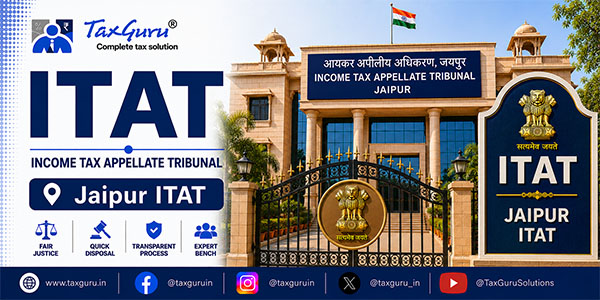
Aman Dani Vs ITO (ITAT Jaipur)
CPC Cannot Manufacture an Exception Missing from the Act — Section 87A Rebate Allowed on STCG Tax u/s 111A
The Jaipur Bench of the ITAT has held that a resident individual governed by the new tax regime for AY 2024-25 is entitled to rebate u/s 87A against tax payable on short-term capital gains u/s 111A, provided the total income does not exceed ₹7 lakh. The statute applicable to the year contained no express prohibition against allowing the rebate on tax computed at the special rate u/s 111A.
The assessee, Aman Dani, filed the return for AY 2024-25 on 21.07.2024 under the new tax regime u/s 115BAC, declaring a total income of ₹4,54,020. The income included short-term capital gains from listed securities falling u/s 111A.
The gross STCG was stated to be ₹2,45,610. After the applicable computation and adjustment, tax was calculated on taxable STCG of ₹1,53,461 at the special rate of 15%, resulting in a tax liability of ₹23,019. Since the total income was below ₹7 lakh, the assessee claimed an equivalent rebate u/s 87A.
CPC processed the return u/s 143(1) on 23.09.2024, accepting the returned total income but denying the rebate of ₹23,019. The assessee filed a rectification application u/s 154, but CPC rejected it without modifying the earlier computation.
The CIT(A) upheld CPC’s action. According to the CIT(A), the proviso inserted in section 87A by the Finance Act, 2023 allowed rebate only against tax computed under the normal slab rates prescribed u/s 115BAC(1A).
The CIT(A) reasoned that section 115BAC operates subject to the provisions of Chapter XII, which contains sections 111A, 112 and 112A. Since capital gains under these provisions are taxed at specified special rates, the related tax was considered different from tax computed under the slab rates of section 115BAC. On this reasoning, rebate u/s 87A was restricted to normal-rate tax.
As the assessee had no tax payable on the normal-rate income and the entire tax of ₹23,019 arose from STCG u/s 111A, the CIT(A) held that no rebate was available.
Before the Tribunal, the assessee contended that the interpretation adopted by CPC and the CIT(A) introduced an exception which did not exist in the legislation. The applicable proviso to section 87A granted a rebate to a resident individual whose total income chargeable under the new regime did not exceed ₹7 lakh. It did not state that tax payable at a special rate should be excluded.
The Tribunal noted that the issue had already been decided in favour of taxpayers by several Benches. Particular reliance was placed upon ITO v. Rajshree Kothari, ITA No. 399/Jpr/2026, dated 20.08.2026, besides decisions in Pranay M. Kothari v. DCIT, Manojbhai C. Kamdar v. ITO, Jayshreeben Jayantibhai Palsana v. ITO and Basty Keshava Shenoy v. ITO.
These decisions held that section 87A grants a rebate from the amount of income-tax computed on the assessee’s total income. The provision, as applicable to AY 2024-25, did not distinguish between tax calculated at normal slab rates and tax calculated at the special rate u/s 111A.
The Tribunal found the contrast with section 112A particularly significant. Section 112A(6) expressly provides that the section 87A rebate cannot reduce the tax payable on specified long-term capital gains. Parliament had thus enacted an explicit restriction wherever it intended to protect special-rate tax from the rebate.
No corresponding exclusion existed in section 111A. The absence of such language could not be supplied through administrative interpretation, a return-processing algorithm or an explanatory circular.
The Tribunal further observed that section 115BAC(1A) determines the slab-rate regime but does not, by itself, override the rebate provision contained in Chapter VIII. The words “subject to the provisions of this Chapter” preserve the operation of the special rates in Chapter XII; they do not automatically make the tax calculated at those rates ineligible for a rebate under another Chapter.
Reference was also made to the Bombay High Court’s decision in The Chamber of Tax Consultants v. Director General of Income-tax (Systems), dated 24.01.2025. The High Court had directed the Department to modify the return utility to enable taxpayers to make the rebate claim. Though it did not conclusively decide the substantive interpretation, it affirmed that system restrictions could not prevent taxpayers from asserting statutory rights.
The Departmental Representative could not cite any contrary judgment of the jurisdictional High Court or the Supreme Court.
Following the consistent Tribunal view, the Jaipur Bench reversed the CIT(A)’s order and directed CPC/AO to allow the rebate of ₹23,019 u/s 87A. The assessee’s appeal was allowed.
Author’s Comments
The controversy arose because the return utility treated special-rate income as automatically excluded from the section 87A rebate. The statutory text for AY 2024-25, however, did not contain that exclusion. Software may calculate tax, but it cannot legislate a restriction.
The express bar in section 112A(6) is central to the interpretation. Parliament specifically denied the rebate against tax on specified LTCG. Had it intended the same consequence for STCG u/s 111A, it could have used similar language. The omission is difficult to overcome merely by referring to the general structure of the new regime.
The CIT(A)’s view that section 87A applied only to slab-rate tax also overlooked the distinction between computing tax and granting a rebate from the tax so computed. Section 111A determines the rate applicable to STCG; section 87A thereafter operates upon the resulting income-tax liability, unless expressly prohibited.
The Bombay High Court’s utility decision should not be overstated. It permitted the claim to be made but left its legal validity to the assessing and appellate authorities. The Tribunal has now supplied that substantive adjudication.
The ruling concerns the law applicable to AY 2024-25. A later legislative amendment, made by the Finance Act, 2025, expressly restricting rebate against special-rate income applies prospectively from AY 2026-27. It cannot be imported backwards to deny a claim for a year when the prohibition was absent.
The principle is uncomplicated: where the Act creates an exception for section 112A but not for section 111A, CPC cannot insert the missing words through code.
Cases Discussed
- ITO v. Rajshree Kothari, ITA No. 399/JPR/2026, order dated 20.08.2026.
- Pranay M Kothari v. DCIT, ITA No. 3469/Chny/2025, dated 23.03.2026.
- Manojbhai C. Kamdar v. ITO, ITA No. 572/RJT/2025.
- Jayshreeben Jayantibhai Palsana v. ITO, ITA No. 1014/Ahd/2025, dated 12.08.2025.
- Basty Keshava Shenoy v. ITO, ITA No. 3134/Bang/2025.
- Venkatachalam Venkatraman v. ITO, ITA No. 1431/Chny/2025, dated 20.08.2025.
- The Chamber of Tax Consultants v. Director General of Income-tax (Systems), Bombay High Court, dated 24.01.2025.
- Avni Milanbhai Maniya, CIT(A)-1, Nagpur, appellate order dated 27.05.2025.
- Beena Manishbhai Fofaria, A.Y. 2024-25.
FULL TEXT OF THE JUDGMENT/ORDER OF ITAT JAIPUR
The present appeal has been filed by the assessee against the order passed by the Office of the Commissioner of Income Tax, Appeal Addl./JCIT(A) Hyderabad 03(hereinafter referred to as “Ld. CIT(A)”), dated 25.03.2026 under Section 250of the Income Tax Act, 1961 (hereinafter referred to as “the Act”).
2. The grounds raised read as under:-
1. REJECTION OF THE REQUEST FOR RECTIFICATION OF APPARENT MISTAKE-That the ld. AO was not justified in law and on facts of the case in not rectifying the apparent mistake as the appellant requested to reprocess the return to allow rebate u/s.87A as only option available on the system
2. That the ld. Addl CIT(A) was not justified in law and on facts of the case in holding the rectification order passed by the ld.AO in order and in sustaining the same.
3. DISALLOWANCE OF REBATE U/S 87A-The Id. Lower Authorities were not justified in law and on facts of the case in restricting the same to the tax on balance income taxable at slab rate and not allowing the full rebate as claimed u/s 87A on total income including Short Term Capial /Gain chargeable at special rates.
4. PRAY The appellant prays your honours indulgence to add, alter, amend andor withdraw any grounds of appeal on OR before hearing.?
3. The solitary issue in the present appeal relates to denial of rebate of tax claimed by the assessee u/s 87A of the Act, on the taxes paid on income earned on short term capital gain. The denial of rebate was made by the CPC while processing the return of income filed by the assessee, in the intimation made u/s 143(1) of the Act. The assessee had filed her return of income declaring total income of Rs.4,54,020/- on 21.07.2024. The return was processed by the AO, CPC u/s 143(1) of the Act, vide intimation/order dated 23.09.2024, computing the total income as returned. However, the rebate of Rs.23,019/- claimed by the assessee u/s 87A of the Act.
4. The assessee filed a rectification application u/s 154 of the Act to the CPC but the same was also dismissed. Aggrieved by the same the assessee preferred appeal to the Ld. CIT(A) who upheld the dismissal of assesses rectification application by CPC. Relevant findings of the Ld.CIT(A) are at para 5 to 5.11 of his order asunder:-
5. ANALYSES OF THE FACTS AND ADJUDICATION OF THE GROUNDS
Accordingly, after considering the grounds of appeal, statement of facts and written submissions filed by the appellant, the appeal is adjudicated in the subsequent paragraphs of this order.
5.1 Ground No 2 the appeal relates to the issue of disallowance of rebate of Rs. 23,019/- claimed by the appellant u/s 87A of the Act in the intimation issued u/s 143(1) of the Act and the subsequent rejection of the rectification application filed u/s. 154 of the Act.
5.2 The appellant filed return of income on 21.07.2024 under new tax regime u/s 115BAC of the Act and declared total income of Rs. 4,54,020/-. The total income consists of Short-Term Capital Gains u/s. 111A of the Act to the tune of Rs. 2,45,610/-, chargeable to tax at special rate of 15%. Accordingly, the tax on income taxable at normal rates was computed at Rs. 0/- and tax on income taxable at special rate was computed at Rs. 23,019/-. Thus, the total tax was computed at Rs. 23,019/- by the appellant in the ROI filed. The appellant has thereafter claimed rebate u/s 87A of the Act of Rs. 23,019/- on the basis that total income of the appellant chargeable to tax does not exceed seven hundred thousand rupees.
5.3 In the intimation issued u/s 143(1) of the Act, the rebate of Rs. 23,019/-claimed by the appellant was disallowed. Subsequently, the rectification application filed by the appellant was disposed of vide intimation u/s. 154 of the Act dated 11.11.2024, without making any modification to the adjustment made in the intimation issued u/s. 143(1). The computation of the 87A rebate given in the intimation u/s. 154 is as under
Computation of 87A Rebate
| Sl. No. | Particulars | Amount |
|---|---|---|
| 01 | Total income as computed | 4,54,020 |
| 02 | Less: Income chargeable at special rates | 2,46,171 |
| 03 | Balance income taxable at slab rate and thus eligible for 87A rebate (1-2) | 2,07,849 |
| 04 | Eligible 87A rebate on the income as per Sr no 3 | 0 |
5.4 During the appellate proceedings, the appellant submitted that the CPC erroneously disallowed rebate of Rs. 23,019/- u/s. 87A, even though the appellant ‘s total income is Rs. 4,54,020/-, which is below Rs. 7,00,000 under the new tax regime u/s 115BAC(1A). It is argued that Section 87A does not prohibit rebate onShort-Term Capital Gains taxable u/s 111A, unlike Section 112A(6) which specifically restricts rebate in case of Long-Term Capital Gains. Since no such restriction exists for STCG u/s 111A, the appellant claims the rebate was legally allowable and the denial is unjustified and based on incorrect interpretation of law.
5.5 The contention of the appellant that he is entitled to rebate u/s 87A of the Act on gains taxable under section 111A is not acceptable in view of the proviso inserted in section 87A of the Act by the Finance Act, 2023 w.e.f. 01.04.2024. The said proviso is reproduced below for ready reference:
Provided that where the total income of the assessee is chargeable to tax under sub-section (1A) of section 115BAC, and the total income-
1. does not exceed [seven] hundred thousand rupees, the assessee shall be entitled to a deduction from the amount of income-tax (as computed before allowing for the deductions under this Chapter) on his total income with which he is chargeable for any assessment year, of an amount equal to one hundred per cent of such income-tax or an amount of [twenty-five] thousand rupees, whichever is less,
2. exceeds [seven] hundred thousand rupees and the income-tax payable on such total income exceeds the amount by which the total income is in excess of [seven] hundred thousand rupees, the assessee shall be entitled to a deduction from the amount of income-tax (as computed before allowing the deductions under this Chapter) on his total income, of an amount equal to the amount by which the income-tax payable on such total income is in excess of the amount by which the total income exceeds seven hundred thousand rupees.]
5.6 In terms of the above proviso to section 87A of the Act, the rebate u/s 87A of the Act can be given only with respect to the total income on which the tax is computed/ determined u/s 115 BAC of the Act. The provisions of section 115BAC of the Act is an overriding provision but is subject to the provisions of Chapter XII of the Income Tax Act, 1961. Section 111A, 112 and 112A of the Act are included under Chapter XII of the Income Tax Act, 1961 and therefore, the tax computed/determined u/s 111A, 112 and 112A of the Act at specified/special rates under these sections is different from the tax computed at normal rates as per provisions of section 115BAC of the Act.
5.7 Accordingly, after the insertion of proviso to section 87A of the Act by the Finance Act, 2023 w.e.f. 01.04.2024 the rebate u/s 87A of the Act will be admissible to the extent of tax computed/ determined at normal rates which is computed/ determined as per provisions of section 115BAC of the Act. The tax iscomputed/ determined on short-term capital gains as per provisions of section 111A of the Act and the same is therefore not admissible for rebate u/s 87A of the Act
5.8 The appellant relied on several judicial precedents in support of his claim. However, the CBDT in its circular dated 19.09.2025 clarified that incomes chargeable to tax at special rates as specified under various provisions of Chapter XII of the Act are not included while determining the chargeability to tax under section 115BAC(1A) of the Act. Further, the clause (b) of prioviso to section 87A is applicable to incomes chargeable to tax u/s. 115BAC(1A) of the act. The relevant excerpt from the circular is produced below for reference.
Circular No. 15/2025
F. No. 275/09/2025-IT(Budget)
Government of India
Ministry of Finance
Department of Revenue
Central Board of Direct Taxes
New Delhi, 17th September, 2025
Subject: Order under section 119 of the Income-tax Act, 1961 for waiver of interest payable under section 220(2) due to late payment of demand, in certain cases – reg.
The provisions of section 115BAC(1A) of the Income-tax Act, 1961 (the Act) are subject to the other provisions of Chapter XII of the Act. Therefore, incomes chargeable to tax at special rates as specified under various provisions of Chapter XII of the Act are not included while determining the chargeability to tax under section 115BAC(1A) of the Act. Further, the clause (b) of proviso to section 87A is applicable to incomes chargeable to tax under section 115BAC(1A) of the Act.
2. It is noticed that in certain cases, the returns had already been processed and rebate was allowed under section 87A of the Act on incomes chargeable to tax at special rates. In such cases, rectifications have to be carried out to disallow such rebate, which has been incorrectly allowed. Such rectifications will result in demands getting raised. If the payments of such demands raised are delayed then the same are liable for charging of interest under section 220(2) of the Act.
3. In order to mitigate the genuine hardship arising to such taxpayers on account of interest payable under section 220(2) of the Act, the Central Board of Direct Taxes (“the Board”), in exercise of its powers conferred under section 119 of the Act, directs that the interest payable under section 220(2) of the Act shall be waived in such cases where the payment of the demands raised is made on or before 31.12.2025.
4. In such cases, if a taxpayer fails to pay the demand raised as a result of rectification order passed by the CPC on or before 31.12.2025, the interest shall be charged under section 220(2) of the Act from the day immediately following the end of the period mentioned in sub-section (1) of section 220 of the Act.
5. Hindi version shall follow.
(Rajendra Kumar Meena)
Under Secretary, IT-Budget
CBDT
5.9 In view of the foregoing discussion, the appellant having opted for new tax regime u/s 115BAC of the Act for the impugned AY 2024-25 is not entitled to claim rebate u/s 87A of the Act on the tax computed/ determined at special rates on short-term capital gains. Accordingly, the appellant is found to be not entitled to claim rebate u/s 87A of the Act on the tax computed/determined at Rs. 23,019/-as per provisions of section 111A of the Act on the taxable short term capital gain of Rs. 1,53,461/-.
5.10 In view of above, the disallowance of rebate of Rs. 23,019/- u/s 87A of the Act in the intimation issued u/s 143(1) of the Act, and the subsequent rejection of the rectification application filed u/s. 154 of the Act is found to be in order and sustained.
5.11 In Ground Nos 1 & 3 are general in nature and need no separate adjudication.
5. I have heard both the parties .The issue of claim of rebate u/s 87A of the Act on the Short Term Capital Gains has been decided by the ITAT in number of decisions in favour of the assessee. In the recent decision, in the case of ITO Vs. Rajshree Kothariin ITA No.399/JPR/2026 order dated 20.08.2026, the ITAT has held the assessee eligible to claim rebate u/s 87A of the Act on the Short Term Capital Gains referring to several decisions of the ITAT holding as under:-
…….
6. Before us, at the outset itself ld. counsel for the assessee pointed out that this issue has been dealt in various decisions of the ITAT ruling consistently in favour of the assessee as under:-
i) Pranay M Kothari Vs. DCIT in ITA No.3469/Chny/2025
ii) Manojbhai C. Kamdar Vs. ITO in ITA No.572/RJT/2025
iii) Jayshreeben Jayantibhai Palsana Vs. ITO in ITA No.1014/Ahd/2025
iv) Basty Keshava Shenoy Vs. ITO in ITA No.3134/Bang/2025
7. Before us, ld. DR was unable to distinguish the decisions, referred to by ld. Counsel for the assessee as above, nor she was able to draw my attention to any contrary decision of either the Jurisdictional High Court or the Hon’ble Apex Court in this regard.
8. We have gone through the orders of the ITAT, referred to by the ld. Counsel for the assessee, and have noted that it has been consistently held that the provisions of Section 87A of the Act provide rebate on the entire tax liability computed on the “total income” without drawing any distinction between income taxable at normal rates, and income taxable at special rates, i.e. short term capital gain taxable at rates specified u/s 111A of the Act. The findings of the ITAT in the case of Pranay M Kothari Vs. DCIT in ITA No.3469/Chny/2025 dated 23.03.2026 at para 7 to 9 of the order as under:-
……….
7. We note that an identical issue came up for consideration before this Tribunal in the case of Venkatachalam Venkatraman v. ITO [ITA No.1431/Chny/2025, order dated 20.08.2025]. The Tribunal therein held that the provisions of section 87A of the Act provide rebate on the entire tax liability computed on the “total income” without drawing any distinction between income taxable at normal rates and income taxable at special rates. It was accordingly concluded that rebate u/s.87A of the Act is available even in respect of such incomes taxed under special provisions. The relevant findings are extracted below for ease of reference:-
“5.0 been concluded that to claim the rebate total income is to be computed after excluding any special rate income so as to determine the final tax liability. We have noted that the view taken by the Ld.CIT(A) of assessee filing return u/s 115BAC and consequently ineligible for rebate is not in order. The only controversy in this case is whether rebate u/s.87A is available on all the incomes or there is any exclusion. We have noted that the provisions of section 87A do not provide for such an exclusion. The first proviso to section 87A includes an exemption qua total income falling u/s 115BAC (1A) however the impugned amendment has been brought by Finance Act 2024 w.e.f 01.04.2025. The present AY-2024 25 would not be hit by the same. We have noted that Hon’ble Bombay High Court in the case of Rajiv G Shah supra has held that “…there is no indication in the plain language of Section 87A that any category of income or tax should be excluded from the computation. If the total income is within the threshold prescribed, rebate cannot be denied….”. It istrite law that when provisions of the statute granting any benefit to the tax payer are unambiguously clear, no different interpretation thereof can be adopted. Accordingly, we are of the view that the assessee is entitled for claim of rebate u/s 87A. The orders of lower authorities are therefore set aside and the Ld.AO is directed to allow the assessee its claim of rebate u/s 87A. All the grounds of appeal raised by the assessee are therefore allowed.”
8. Further, we find support from the decision of the Coordinate Bench in JayshreebenJayantibhai Palsana Shingala Sheri ITO [ITA No.1014/Ahd/2025, order dated 12.08.2025), where it was held as under:-
“5.8 The amended first proviso to Section 87A [inserted by the Finance Act, 2023 w.e.f. A.Y. 2024-25] provides:
“Where the total income of the assessee is chargeable to tax under sub section (1A) of section 115BAC and the total income
(a) does not exceed seven hundred thousand rupees, the assessee shall be entitled to a deduction…’
5.9 This provision applies to any resident individual whose total income does not exceed Rs.7,00,000 and who is assessed under section 115BAC(1A). The statute does not draw any distinction between normal income and income chargeable at special rates, nor does it contain any express exclusion for tax arising under section 111A.
5.10 By contrast, the legislature has inserted an express bar on availability of section 87A rebate in section 112A(6), which states:
(6) Where the total income of an assessee includes any long-term capital gains referred to in sub-section (1), the rebate under section 87A shall be allowed from the income-tax on the total income as reduced by tax payable on such capital gains.
5.11 The absence of a corresponding clause in section 111A is legally significant and supports the principle that when the legislature intended to deny rebate in respect of special income (as in section 112A), it has done so expressly. In contrast, the absence of any exclusion in section 111A or in section 87A must be construed in favour of the assessee.
5.12 At this point we discuss the interplay of Section 115BAC(1A) with Chapter XII where the scope is Confined to Computation of Tax Rates. Section 115BAC(1A) opens with the phrase:
“Notwithstanding anything contained in this Act but subject to the provisions of this Chapter…”
5.13 The purpose of this clause is to enable the computation of income tax under the concessional rate regime, subject to existing special rate provisions under Chapter XII, such as sections 111A, 112, 112A, etc. This clause governs the computation of tax and does not ipso facto affect eligibility to rebates or deductions unless specifically restricted. Section 87A is not part of Chapter XII; it is an independent rebate provision under Chapter VIII of the Act. Therefore, the overriding clause in section 115BAC(1A) does not derogate or modify section 87A, unless section 87A itself provides for exclusion, which, in the present case, it does not. Thus, section 87A operates on the total tax computed, whether it includes tax at slab rates or special rates, and applies so long as the total income threshold is met.
5.14 The CIT(A) placed strong reliance on the Explanatory Memorandum to the Finance Bill 2025, which clarified that rebate under section 87A is not available on tax arising from special rate incomes, including those under section 111A. However, we find this reliance to be misplaced for two reasons:
-Firstly, the Finance Bill 2025 itself proposes to insert new restrictions on rebate under section 87A w.e.f. A.Y. 2026-27, which implies that the existing law (i.e., as applicable to A.Y. 2024-25) does not contain such a restriction.
-Secondly, the Explanatory Memorandum cannot override the plain language of the statute. It is a tool of interpretation, not a source of substantive law.
Therefore, the prospective amendment in the Finance Act 2025 supports the view that under the unamended provision applicable for A.Y. 2024-25, rebate under section 87A cannot be denied merely because tax arises under section 111A.
5.15 In the recent judgment dated 24.01.2025 in the case of The Chamber of Tax Consultants vs. Director General of Income Tax (Systems) [TS 5026-HC-2025(Bombay)-O], the Hon’ble Bombay High Court considered the issue of system-based denial of 87A rebate on STCG under section 111A for assessees who had opted for 115BAC(1A). While the Hon’ble Court refrained from interpreting the substantive provisions, it held that the assessee must be allowed to claim rebate under section 87A, and it is for the quasi-judicial authority to decide on merits.
Thus, the Hon’ble High Court clearly held that the CPC utility or system configuration cannot override statutory rights, and that each case must be adjudicated on its own merits. We at the Tribunal, being such a quasi-judicial authority, are therefore duty-bound to examine the claim in light of the statutory framework and not be influenced by automated denial or procedural logic adopted by the CPC.
5.16 The assessee has also relied on an appellate order dated 27.05.2025 passed by CIT(A)-1, Nagpur in the case of Avni Milanbhai Maniya, wherein on identical facts the CIT(A) allowed the claim of rebate under section 87A in respect of STCG taxable under section 111A. We also note that such decision was taken by the JCIT/AddI.CIT(A) relying on the decision of Beena ManishbhaiFofaria for the A.Y. 2024-25. While not binding, the said appellate order affirms that divergent views exist and such benefit has been allowed in similar factual circumstances.
5.17 In view of the above discussion, we find that the assessee is a resident individual and the total income declared for the assessment year 2024-25 does not exceed Rs. 7,00,000. It is also an admitted position that the assessee has exercised the option to be assessed under the new tax regime in accordance with the provisions of section 115BAC(1A) of the Act. On a plain reading of the statutory provisions, there exists no express bar either in section 87A or section 111A for denial of rebate in respect of tax payable on short-term capital gains arising from transfer of listed equity shares taxable at special rates under section 111A. The legislative intent is further clarified by the subsequent amendment proposed in the Finance Bill, 2025, which is prospective in nature and thereby reinforces that no such restriction was in force during the relevant assessment year. The denial of rebate under section 87A by the CPC, Bengaluru, appears to be based solely on system-driven logic and not on any statutory mandate. Moreover, the interpretation adopted by the CIT(A) in upholding such denial is, in our considered view, not in consonance with the plain and unambiguous language of the law as applicable for A. Y. 2024-25.”
9. Respectfully following the ratio laid down in the above cases, we hold that the assessee in the instant case is entitled to rebate u/s.87A of the Act for the impugned assessment year, notwithstanding that the total income includes taxable long term capital gains chargeable at special rates. The AO is accordingly directed to allow the rebate of Rs.25,000/- claimed by the assessee u/s.87A of the Act and recompute the tax liability. Thus, the grounds of appeal raised by the assessee are allowed.
9. The ITAT in the other decisions has also reiterated the proposition of law as above. The decision rendered by the ITAT in the cases above, squarely applies to the facts of the present case, following which, we hold that there is no infirmity in the order of the Ld.CIT(A) holding the assessee entitled to rebate u/s 87A of the Act on the taxes paid on short term capital gain.
……..
6. Before me, ld. DR was unable to draw my attention to any contrary decision of either the Jurisdictional High Court or the Hon’ble Apex Court in this regard.
7. I therefore hold that the Ld. CIT(A) has grossly erred in holding the assessee ineligible to rebate u/s 87A of the Act on the taxes paid on short term capital gain. The CPC/ AO is directed to allow the claim of rebate u/s 87A of the Act amounting to Rs.23,019/-.
8. In effect, the appeal of the assessee is allowed.
Order pronounced in the Open Court on 11.09.2026