
Mulanandishwar Souharda Pattin Sahakari Niyamita Bagewadi Vs ITO (ITAT Bangalore)
Bangalore ITAT Admits Additional Evidence Under Rule 29-Cash Book and Audited Accounts Crucial to Explain Cash Deposits; Matter Restored to AO
The Bangalore ITAT admitted additional evidence produced by a co-operative society for the first time before the Tribunal and restored the entire matter to the AO for fresh adjudication, holding that the evidence was crucial for determining the source of cash deposits.
The dispute principally concerned an addition of ₹10.46 lakh under Section 69A. The assessee also raised an additional ground concerning an addition of ₹2.27 lakh under Section 40(a)(ia). Before the Tribunal, the assessee filed an application under Rule 29 of the Income-tax (Appellate Tribunal) Rules, 1963, seeking admission of a 26-page paper book containing the cash book for 28.10.2016 to 02.01.2017, audited balance sheet in Kannada and its English translation.
The assessee explained that its staff was not conversant with e-proceedings, due to which it could not properly represent its case or furnish the relevant documents before the lower authorities. The additional evidence was sought to establish that the cash deposits in question were duly accounted for in its books. This explanation was also reflected in the assessee’s Rule 29 application reproduced in the Tribunal’s order.
The ITAT observed that Rule 29 permits additional evidence where it is required to enable the Tribunal to pass an order or where there exists “substantial cause” for its production. Since the cash book and audited balance sheet were directly relevant to determining the source of the cash deposited in the assessee’s bank account, the Tribunal found sufficient reason for their earlier non-production and admitted the additional evidence.
However, since these documents had been produced for the first time before the ITAT, neither the AO nor the CIT(A) had an opportunity to examine them. Both parties also accepted that the assessee had not been able to properly represent its case before the lower authorities. The Tribunal therefore considered it appropriate, “in the interest of justice, equity & fair play,” to remit the entire dispute to the AO for fresh adjudication in accordance with law.
The AO was directed to provide a reasonable opportunity of hearing, while the assessee was directed to produce all the additional evidence along with any further books, records and documents necessary to substantiate its claim. The Tribunal also cautioned that if the assessee defaults again, it would not be entitled to further leniency.
FULL TEXT OF THE ORDER OF ITAT BANGALORE
This appeal at the instance of the assessee is directed against the order of the ld. CIT(A)/NFAC dated 07.08.2025 vide DIN & Order No. ITBA/NFAC/S/250/2025-26/1079370582(1) passed u/s 250 of the Income Tax Act, 1961 (in short “the Act”) for the assessment year 2017-18.
2. The assessee has raised the following grounds of appeal:-
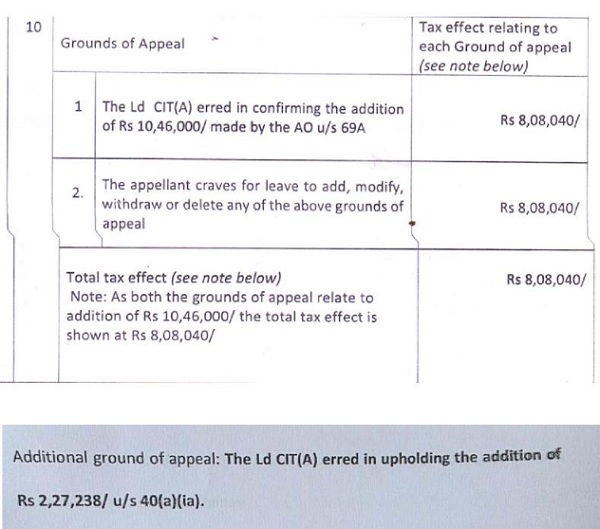
3. Before us, the assessee has filed an application dated 06.12.2025 under Rule 29 of the Income-Tax (Appellate Tribunal) Rules, 1963 praying for admission of additional evidence by enclosing a paper book containing 26 pages enclosing therewith copy of cash book for the period 28.10.2016 to 02.01.2017, copy of audited balance sheet (in Kannada) & copy of English translated balance sheet. A copy of the application praying for admission of additional evidence dated 06.12.2025 is reproduced below for ease of reference and convenience:-
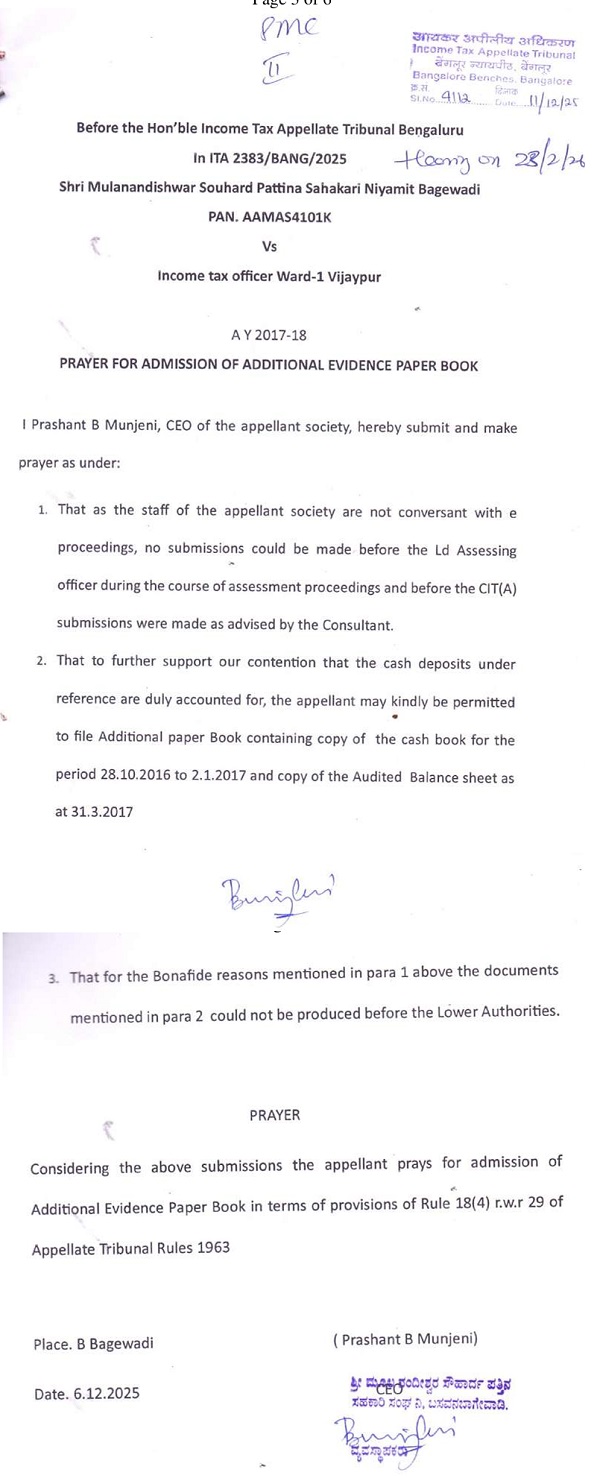
3.1 According to Rule 29 of the I.T. Rules, 1963¸ generally the parties to the appeal shall not be entitled to produce additional evidence either oral or documentary before the Tribunal but if the Tribunal requires any document to be produced to enable it to pass orders or for any other substantial cause, or, if the income tax authorities have decided the case without giving sufficient opportunity to the assessee to adduce evidence either on points specified by them or not specified by them, the Tribunal for reasons to be recorded, may allow such document to be produced or may allow such evidence to be adduced. In the present case, the cash book, audited balance sheet could not be produced before the lower authorities as the staff of the assessee society was not conversant with the e-proceedings. Before us, the ld. A.R. of the assessee vehemently submitted that these additional evidences are crucial for deciding the issue on merits i.e. the sources of cash deposits into the bank account of the assessee. This being so, we find good and sufficient reason in not submitting the additional evidences before both the lower authorities. Accordingly, we admit these additional evidences as in our opinion these are essential for adjudication of the issue in the present appeal.
4. Now having admitted the additional evidences, we are of the considered opinion that these additional evidences are filed for the first time before this Tribunal and both the authorities below have no occasion to examine these additional evidences. Further, before us, both the parties fairly conceded that the assessee society could not represent its case before both the authorities below. Before us, the ld. AR of the assessee vehemently submitted that the assessee society could not represent its case before the AO as the staff of the assessee was not conversant with e-proceedings, accordingly, all the notices issued by the AO went unattended & prayed to remit the entire issues in dispute to the file of the AO. This being so, in the interest of justice, equity & fair play & as requested by the ld. AR of the assessee, we deemed it fit & proper to remit entire issues in dispute to the file of the AO to decide a fresh in accordance with law. Needless to say, a reasonable opportunity of being heard must be granted to the assessee. The assessee is also directed to produce all the additional evidences filed before us along with any other relevant documents/record/accounts to substantiate its claim or as may be required by the AO for the completion of the assessment proceedings. We make it clear that in case of further default, the assessee shall not be entitled for any leniency. It is ordered accordingly.
5. In the result, the appeal filed by the assessee is partly allowed for the statistical purposes.
Order pronounced in the open court on 10th Aug, 2026





