
Nongmeikapam Nando Singh Vs ITO (ITAT Guwahati)
ITAT Condones 1,659-Day Delay; BSNL VRS Compensation Held Eligible for Section 10(10B) Exemption
The Kolkata–Guwahati ITAT condoned a delay of 1,659 days in filing appeals by several former BSNL employees, holding that the delay was caused by bona fide ignorance of the availability of exemption under section 10(10B) for compensation received under the BSNL VRS-2019 Scheme. The Tribunal observed that once judicial precedents clarified the legal position, the assessees promptly pursued their claims and should not be denied a lawful exemption on technical grounds.
The Tribunal noted that the CIT(A) erred in refusing to condone the delay and in dismissing the appeals without examining the merits. Relying on a series of Tribunal decisions, including Harish Kumar (Chandigarh ITAT) and Jayeshkumar Tulsidas Sutaria (Ahmedabad ITAT), it held that compensation received under the BSNL VRS-2019 Scheme qualifies for exemption under section 10(10B), subject to the statutory conditions. It further observed that the Income-tax Department should not collect tax on income that is otherwise exempt under the Act merely because the assessee failed to claim the exemption in the original return. Accordingly, the Tribunal condoned the delay, restored the benefit of exemption and allowed all the appeals.
Cases Discussed
- Ramesh Bhimshankar Budwatrao V. ITO, Ward 2(1), Solapur, ITA No. 1890/PUN/2026
- Shivnandan Narendra Sanvordekar V. Income-tax Officer Ward 1(1), Panaji, ITA Nos. 141 and 142/PAN/2026
- Shri Sekar Gnanaprakasam V. The Deputy Commissioner of Income Tax, Circle 2(1), Trichy, ITA Nos. 1608 & 1609/CHNY/2026
- Renuka Narasimha Prabhu V. ITO Ward 1(1), Karnataka, ITA No. 992/BANG/2026
- Prathibha Jgadish Unawane V. ITO, Ward 1(1), Kolhapur, ITA Nos. 1117 and 1118/PUN/2026
- Sameer Yadram Sharma V. Income-tax Officer Ward 1(1), Aurangabad, ITA Nos. 864 and 865/PUN/2026
- Bajirao Shankar Jagdale V. Income-tax Officer, [2026] 185 taxmann.com 451 (Mumbai – Trib.)
- Jayeshkumar Tulsidas Sutaria V. Income-tax Officer, [2026] 183 taxmann.com 587 (Ahmedabad – Trib.)
- Shraddha Pralhad Arote V. Income-tax Officer Ward 2, Ahmednagar, ITA Nos. 262 and 261/PUN/2026
- Meghmala Sudhir Pathak V. Income-tax Officer Ward 2(1), Nashik, ITA Nos. 290 and 293/PUN/2026
- Rajendra Himmatrao Patil V. Income-tax Officer Ward 1(4), Jalgaon, ITA Nos. 302 and 303/PUN/2026
- Suman Nandlal Raval V. The Income Tax Officer, Ward 1, Gandhinagar, ITA Nos. 2389 & 2390/Ahd/2025
- Harish Kumar V. Income-tax Officer (Chandigarh – Trib.), [2025] 175 taxmann.com 379
- NTPC Ltd. v. CIT (SC), (1998) 229 ITR 383
- Jute Corporation of India Ltd. v. CIT (SC), (1991) taxmann.com 30 (SC)/(1991) 57 ELT 176 (SC)
FULL TEXT OF THE ORDER OF ITAT GUWAHATI
All these 64 appeals filed by the different assessee against the orders passed u/s 250 of the Income Tax Act, 1961 by the Ld. Addl./Joint Commissioner of Income Tax (Appeals) (hereinafter referred to as “the Act”). On going through the grounds of all the assessees, we noticed that the issues raised by the different assessees are common in nature except the quantum involved in all the appeals and heard together. Therefore, we are passing a common order for all the appeals. For the sake of convenience, we are first taking up appeal bearing ITA No. 380 /GTY/2026 for AY 2020-21 against the order passed by the Ld. Addl./Joint Commissioner of Income Tax (Appeals)-4, Hyderabad [hereinafter referred to as “the Ld. CIT(A)] dated 29th April, 2026, DIN & order No. ITBA/APL/S/250/2026-27/1088695090(1) on the following grounds of appeal:
(1) On the facts and in the circumstances of the case and in law, the Learned Commissioner of Income Tax (Appeals) erred in refusing to condone the delay in filing the appeal without properly appreciating that the delay occurred solely on account of the Appellant’s bona fide ignorance regarding the availability of exemption under Section 10(10B) of the Income-tax Act, 1961 and lack of legal knowledge. The Ld. CIT(A) failed to appreciate that such circumstances constitute sufficient and reasonable cause within the meaning of Section 249(3) of the Act and therefore the delay deserved to be condoned.
2. On the facts and in the circumstances of the case and in law, the Learned CIT(A) ought to have admitted the new claim which was not made in the return of income, without appreciating that the appellate authorities possess wide and plenary powers to grant lawful reliefs even if such claims were not made in the return of income. The Ld. CIT(A) failed to follow the binding principles laid down in CBDT Circular No. 14 (XL-35) of 1955 and the judicial Page 1 of 3 precedents of the Hon’ble Supreme Court and various High Courts which mandate that legitimate relief should not be denied merely on technical grounds.
3. On the facts and in the circumstances of the case and in law, the Learned CIT(A) erred in dismissing the appeal at the threshold without adjudicating the issue on merits, despite the fact that the Appellant’s case is squarely covered by the decision of the Hon’ble ITAT in the case of Harish Kumar v. ITO in ITA No. 42/Chd/2025, and Jayesh Kumar Tulsidas Sutaria vs. Income-tax Officer [2026] 183 taxmann.com 587 (Ahmedabad- Trib.)[17-02-2026] wherein compensation received under the BSNL VRS-2019 scheme was held to be fully exempt under Section 10(10B) of the Act. The Ld. CIT(A) failed to consider that the Appellant had a legitimate and legally sustainable claim which required adjudication on merits.
4. On the facts and in the circumstances of the case and in law, the Learned CIT(A) failed to appreciate that the Appellant had received compensation under the duly approved “BSNL VRS 2019” scheme which satisfies the conditions prescribed and is therefore eligible for exemption under Section 10(10B) of the Act. The Ld. CIT(A) ignored relevant judicial precedents including the recent decision of the Hon’ble ITAT Chandigarh in Harish Kumar v. ITO (ITA No. 42/Chd/2025 dated 30.05.2025) wherein identical benefits received under the BSNL VRS-2019 scheme were held to be eligible for exemption. The impugned order passed by the Ld. CIT(A) is therefore contrary to law and liable to be set aside.
5. On the facts and in law, the Appellant is entitled to a refund of excess tax paid pursuant to erroneous payment made on account of incorrect professional advice.
2. Since we are taking to the ITA No. 380/GTY/2026 first as lead case and the decisions for Assessment Year 2020-21 will apply mutatis mutandis in others appeals except the quantum involved therein.
ITA No. 380/GTY/2026 (AY 2020-21)
3. Briefly stated the facts of the case are that the assessee is a Telecom Office Assistant under the Central Government, Department of Telecom (DoT) filed his return of income on 30.11.2020 declaring at income of Rs. 23,35,050/- under the guidance of a professional Accountant and claimed benefit under section 10 of the Income Tax Act. The return was processed u/s 143(1) of the Act accepting the return of income filed by the assessee. Upon formation of Bharat Sanchar Nigam Limited called as BSNL henceforth a PSU effective 1st Oct 2000 after carving out some of the functions of Department of Telecom DoT the employees and officers of DOT were faced to work in BSNL on a deemed deputation basis. Thereafter the appellant was absorbed in BSNL as per Presidential Order of DOT dated 28th Nov 2005 with retrospective effect from 1st Oct 2000. In the meantime, dated 23rd Oct 2019 BSNL Voluntary Retirement Scheme VRS 2019 was approved by the Union Cabinet. Following the Cabinet’s decision, the Scheme was officially notified on 4th Nov 2019 and was open for the employees from that date till 3rd Dec 2019. BSNL launched this Scheme to right size its workforce by offering a golden handshake package including Pension Ex Gratia and others before their normal superannuation. Ex gratia was given calculating 60 days salary being basic and DA for each completed years of service or remaining months’ salary whichever is less as per DPE guidelines. The appellant availed this Scheme and was compensated accordingly some of the payments in relation to Leave Encashment was from DoT. Like the appellant approximately 80000 or more employees and officers of BSNL were under this mass scale restructuring process of the Company to achieve significant workforce reduction with ongoing process for pay revision and benefit finalizations for the retirees. The entire payment was discharged in two phases one in the financial year 2019-20 and the balance in the financial year 2020- 21. The appellant received the compensations in the forms of Ex Gratia amounting to Rs.14,45,593/- in AY 2020-21 and an amount of Rs.31,72,102/- in AY 2020-21 as part of the benefits under the said Scheme. The ld. Assessing Officer assessed the total income of the assessee for AY 2020-21 dated 28.08.2021 at Rs.23,35,050/-.
4. Against the intimation order passed by the Assistant Director of Income Tax, Centralized Processing Centre, Bengaluru, (hereinafter ‘Assessing Officer’) u/s. 143(1) of the Income Tax Act, 1961 (hereinafter referred to as “the Act”) dated 28.08.2021 for the Assessment Year (AY) 2020-21, the assessee instituted the appeal before the Ld. CIT(A) electronically on 13.04.2026 vide Form No.35 with a delay of 1659 days. The assessee filed an affidavit before the ld. CIT(Appeals) in support of his delay in filing appeal which was beyond the stipulated time limit prescribed under section 249(2) of the Income Tax Act. The ld. Addl./JCIT(Appeals) did not condone the delay and without condoning the delay dismissed the appeal of the assessee and without going into merits of the case as there was no sufficient cause for condonation of the delay in filing of the appeal as well as negligent attitude on the part of the appellant by mentioning that this case is not fit for condonation of delay within the specified time limit before him. On being aggrieved, the assessee preferred appeal before the ITAT.
5. At the time of hearing before the Tribunal, the Ld. Counsel for the assessee has filed written case laws supporting the case of the assessee and relying on the following judgments:
1. Harish Kumar V. Income-tax Officer – [2025] 175 com 379 (Chandigarh – Trib.);
2. Jayeshkumar Tulsidas Sutaria V. Income-tax Officer – [2026] 183 com 587 (Ahmedabad – Trib.);
3. Suman Nandlal Raval V. The Income Tax Officer, Ward 1, Gandhinagar. [ITA Nos.2389 & 2390/Ahd/2025];
4. Shraddha Pralhad Arote V. Income-tax Officer Ward 2, Ahmednagar – [262 and 261/PUN/2026] 20-21, 2122;
5. Meghmala Sudhir Pathak V. Income-tax Officer Ward 2(1), Nashik – [290 and 293/PUN/2026] 20-21, 21-22;
6. Rajendra Himmatrao Patil V. Income-tax Officer Ward 1(4), Jalgaon – [302 and 303/PUN/2026] 20-21, 21-22;
7. Bajirao Shankar Jagdale V. Income-tax Officer -[2026] 185 com 451 (Mumbai – Trib.);
8. Prathibha Jgadish Unawane V. ITO, Ward 1 (1), Kolhapur – [1117 and 1118/PUN/2026] 20-21, 21-22;
9. Sameer Yadram Sharma V. Income-tax Officer Ward 1(1), Aurangabad- [864 and 865/PUN/2026] 20-21, 2122;
10. Renuka Narasimha Prabhu V. ITO Ward 1(1), Karnataka – [ITA 992/BANG/2026] 2020-21;
11. Shri Sekar Gnanaprakasam V. The Deputy Commissioner of Income Tax, Circle 2(1), Trichy – [ITA Nos.: 1608 & 1609/CHNY/2026] 2020-21, 21-22;
12. Shivnandan Narendra Sanvordekar V. Income-tax Officer Ward 1(1), Panaji -[141 and 142/PAN/2026] 2021, 21-22;
13. Ramesh Bhimshankar Budwatrao V. ITO, Ward 2(1), Solapur – [1890/PUN/2026] 21-22.
6. The ld. Counsel for the assesse stated that the CIT(Appeals) dismissed the appeal of the assessee mentioning that the appeal is not admitted for adjudication as it is delayed and not filed within the time limit provided and no sufficient cause has been provided by the appellant for the delay. It was also the submission of the ld. Counsel for the assessee that the ld. Assessing Officer assessed total income of the assessee at Rs.23,35,050/- as assessee’s undisclosed income as the assessee has not furnished any details or plausible explanation and without going into merit of the case dismissed the appeal of the assessee. He, therefore, pleaded before the Bench to set aside the order passed by the ld. Addl./JCIT(Appeals) and allow the appeal of assessee.
7. On the other hand, it was the submission of the ld. Departmental Representative that the assessee failed to offer any explanation/supporting documents in respect of the grounds of appeal raised by him before the ld. Assessing Officer as well as ld. Addl./JCIT(Appeals). The assessee also not filed any documentary evidence in support of delay in filing appeal before the ld. CIT(Appeals) and for this reason, ld. Addl./JCIT(Appeals) dismissed the appeal of assessee for not furnishing satisfactory explanation before him within the stipulated period of time. The Addl./JCIT(Appeals) was of the opinion that the assessee has not been able to show any ‘sufficient cause’ for not presenting the appeal within the prescribed period, within the meaning of section 249(3) of the Act, read with Section 5 of The Limitation Act. The ld. D.R. has also filed his compendium of precedents cited on the Law of Limitation, which is as under:-
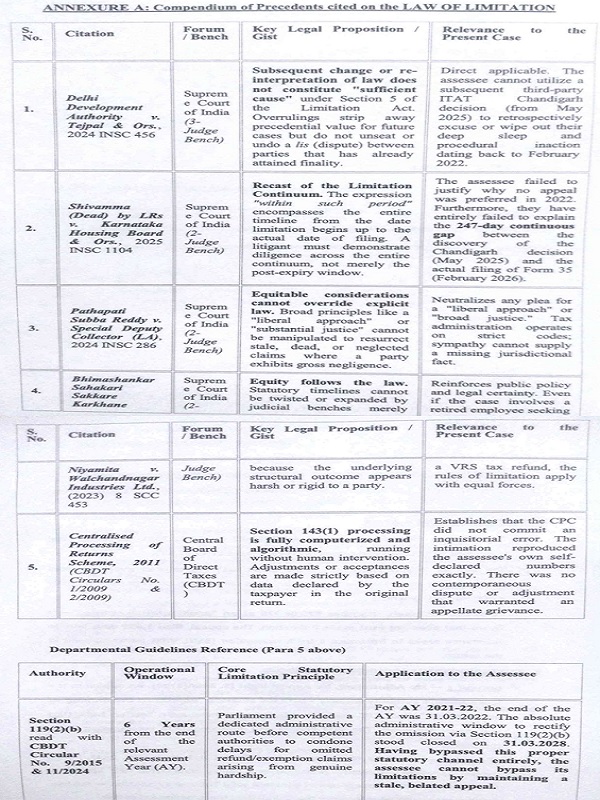
Therefore, he pleaded to uphold the order passed by the revenue authorities.
8. Considering the rival submission, we noted that the ld. Addl./JCIT (A) did not condone the delay observing that there is no reasonable cause provided by the assessee for delay in filling the appeal. Here in the case on hand the assessee filed appeal after the judgement passed by the Co-ordinate bench of the ITAT Chandigarh on the similar set of facts and the co-ordinate bench has allowed the appeal of the assessee . The case of the assessee is also similar then why the assessee should deprive from not giving benefit of section 10(10B) of the Act. The assessee is also an employee of the BSNL and took VRS and got compensation as per the scheme framed by the BSNL. In the series of the judgements as relied by the ld. Counsel noted supra, the Co-ordinate bench has allowed the appeal of the assessee. Considering the condonation application submitted before the ld. CIT(A) noted supra we condone the delay before the ld. Addl./JCIT(A). The ld. DR could not bring any materials against the above judgement that the Revenue has filed any appeal before the hire forum. The Ld. DR has relied on the judgement of Hon’ble Apex Court in the case of Delhi Development Authority vs and others 2024 INSC 456 is not applicable on the principle of parity of the same organisation. In one side, the Income Tax Department has given benefit on the same set of facts and accepted the judgement of the co-ordinate bench of the ITAT and on the other side the ld. DR is referring the judgement of the Hon’ble Apex Court which of the other organization. Although there is there is no cause of action arose from the order of the CPC-Bengaluru. The Income Tax Act itself has not given right to collect Tax on the compensation amount received, then the Income Tax Department should not collect tax on the exempt income as per section 10(10B) of the Act. The case law relied by the Ld. DR does not support the arguments of the ld.
DR. However, the co-ordinate Bench of the ITAT, Ahmedabad Bench in the case of Jayeshkumr Tulsidas Sutaria Vs. ITO reported in (2026) 183 taxmann.com 587 (Ahmedabad-Trib) in ITA No. 2387 & 2388/AHD/2025 order dated 17.02.2026 has dealt with the similar issue condoning the delay and accepting the appeal of the assessee, the return was processed u/s 143(1) of the Act and there was no any demand in 143(1) processing. The Coordinate Bench has allowed the appeal of the assessee. For the sake of convenience, we are reproducing the entire judgment which is as under:
“The captioned two appeals have been filed by the Assessee against the orders passed by the learned Commissioner of Income Tax (Appeals) / National Faceless Appeal Centre (NFAC), Delhi, vide orders dated 14.10.2025, for the Assessment Years 2020-21 and 2021-22. Since the issues involved in both the appeals are common and identical, we extract the grounds of appeal raised in ITA No.2387/Ahd/2025 for Assessment Year 2020-21 for the purpose of adjudication. The decision rendered in the said appeal shall apply mutatis mutandis to the other appeal bearing ITA No. 2388/Ahd/2025 for Assessment Year 2021-22.
The assessee has raised the following grounds of appeal:
1. The Ld. CIT(A) has erred in law in holding that the appellant’s grievance does not emanate from the Intimation u/s 143(1) and in directing the appellant to seek condonation and file a revised return, Ignoring the settled legal position that appellate authorities are fully empowered to entertain and adjudicate a new claim even if not made in the return of income. The refusal to consider the exemption u/s 10(108) is contrary to the binding decisions of the Hon’ble Supreme Court in Jute Corporation of India Ltd. v. CIT (1991 taxmann.com 30 (SC)/(1991) 57 ELT 176 (SC)|04-09-1990), NTPC Ltd. v. CIT (1998) 229 ITR 383 (SC) and the Hon’ble Bombay High Court in Pruthvi Brokers & Shareholders Pvt. Ltd, which categorically hold that filing a revised return is not mandatory for making a new claim. The finding of the CIT(A) is therefore illegal, perverse and liable to be set aside
2. The Ld. CIT(A) has erred in dismissing the appeal as “not maintainable” on the incorrect assumption that the issue does not arise from the intimation u/s 143(1), without appreciating that the said Intimation has assessed VIRS compensation without granting exemption u/s 10(100). This has resulted in an adverse tax consequence, thereby giving rise to a valid, appealable grievance under section 246A. The conclusion of the CIT(A) is contrary to facts and law.
3. The Id. CIT(A) has erred in refusing to adjudicate the exemption claim u/s 10(108) on merits, thereby violating section 250(6) mandating a reasoned and speaking order on each ground of appeal. The impugned order is nonspeaking, arbitrary, contrary to statutory requirements, and deserves to be quashed.
4. The Ld. CIT(A) has committed a serious error in law by directing the appellant to approach the PCIT for condonation and filing of a revised return, thereby unlawfully bypassing and abandoning his own statutory appellate jurisdiction. The powers vested in the CIT(A) under section 251 are wide and Include the authority to entertain and allow a fresh legal claim. in contrast, the PCIT acting under section 119(2)(b) cannot adjudicate or grant exemption u/s 10(108). The impugned direction amounts to abdication of duty, rendering the order bad in law.
5. The Ld. CIT(A) has failed to appreciate that the appellant received compensation under the duly approved “BSNL VRS-2019” scheme, which fully satisfies the conditions prescribed under Rule 2BA and is eligible for exemption u/s 10(108). The CIT(A) ignored relevant judicial precedents, including the recent decision of the Hon’ble ITAT Chandigarh in Harish Kumar vs. ITO (ITA No. 42/CHD/2025, dated 30.05.2025), wherein identical BSNL VRS-2019 benefits were held eligible for exemption. The order is therefore contrary to law and merits reversal.
6. The learned CIT(A) erred in refusing to consider the exemption u/s 10(108) merely because it was not claimed in the return, in complete disregard of CBDT Circular No. 14 of 1955, which obligates tax authorities to grant all lawful reliefs even if not claimed by the assessee. The impugned order is therefore contrary to binding CBDT directions and bad in law.”
3. The assessee was employed with Bharat Sanchar Nigam Limited (BSNL), a Government of India enterprise. BSNL notified the Voluntary Retirement Scheme (VRS) 2019 on 04.11.2019, which was duly approved and implemented by the employer. The assessee opted for the scheme and accordingly received compensation under the VRS, as per the terms laid down by BSNL. It is submitted that the assessee had not been paid regular salary for several months prior to opting for the scheme and was under severe financial and professional uncertainty. In view of these circumstances, the assessee opted for the scheme as a measure of financial security. The compensation received by the assessee was in the nature of compensation under the BSNL VRS-2019 scheme. The compensation amount received under the scheme was offered to tax in the return of income due to lack of awareness regarding the exemption available under section 10(10B) of the Income-tax Act, 1961. The employer had also deducted tax at source on the said amount. No exemption was claimed in the original or revised return of income. The CPC, Bengaluru issued an intimation under section 143(1) for the said year without granting any exemption, and no rectification or appeal was initiated at that time. It was only upon learning about the recent judgment of the Hon’ble ITAT Chandigarh Bench in the case of Harish Kumar vs. ITO Ward 5(5), Chandigarh (ITA No. 42/CHD/2025, dated 30.05.2025) that the assessee became aware that the compensation received under the BSNL VRS-2019 scheme is eligible for exemption under section 10(10B), subject to compliance with Rule 2BA.
4. Aggrieved by the orders of the Assessing Officer, the assessee carried the matter in appeal before the Ld.CIT(A), who dismissed the appeal of the assessee by observing as follows:
“…The Appellant was employed with Bharat Sanchar Nigam Limited (BSNL), a Government of India enterprise. BSNL had notified the Voluntary Retirement Scheme (VRS) 2019 on 04.11.2019, which was duly approved and implemented by the employer. The Appellant opted for this scheme and accordingly received compensation under the VRS, as per the terms laid out by BSNL. The compensation amount received under the scheme was offered to tax by the appellant in the return of income due to lack of awareness about the availability of exemption under Section 10(10B) of the Income Tax Act. 1961. The employer had also deducted TDS on the said amount. No exemption was claimed in the original or revised return for the year by the appellant. The CPC, Bengaluru issued an intimation u/s 143(1) for the said year without granting any exemption, and no rectification or appeal was initiated at that time. The issue on this appeal pertains to exemption u/s 10(10B) of the Income Tax Act.
The appellant in his written submission has stated that it was only upon learning about the recent judgment of the Hon’ble ITAT Chandigarh, in the case of Harish Kumar vs. ITO Ward 5(5), Chandigarh (ITA No. 42/CHD/2025, dated 30.05.2025), that the Appellant came to know that the compensation received under the BSNL VRS 2019 scheme is eligible for full exemption u/s. 10(10B), subject to Rule 2BA compliance.
The grievance raised in the grounds of appeal does not emanate from the order appealed against. It is not a case where the appellant claimed exemption u/s.10(10B) and it was denied by the Assessing Officer. The appellant having omitted to claim relief in the return of income can claim the relief by filing the revised return. In cases where the time limit for filing the revised return has expired, the appellant may seek condonation of delay from the jurisdiction PCIT and then proceed with filing the revised return. The issue raised in grounds of appeal does not emanate from the order of intimation u/s.143(1). Hence, the appeal is dismissed…
” 5. Aggrieved by the orders of the Ld.CIT(A, the assessee is in further appeal before us.
6. The Ld. Counsel for the assessee submitted that due to lack of awareness of the legal provisions at the time of filing the return of income, the assessee inadvertently offered the compensation received under BSNL VRS-2019 to tax. Subsequently, based on the decision of the Hon’ble ITAT Chandigarh Bench in Harish Kumar vs. ITO Ward 5(5), Chandigarh (ITA No. 42/CHD/2025 dated 30.05.2025), wherein compensation under the same BSNL VRS-2019 scheme was held to be exempt under section 10(10B), the assessee now seeks exemption of such compensation. We find that the assessee filed the claim before the Ld. CIT(A) and since the income of the assessee is not taxable, the assessee is eligible for the refund of the TDS.
7. In the result, both the appeals of the assessee are allowed.”
9. The above judgments relied by the Ld. Counsel supports the case of the assessee on the similar set of facts. Respectfully following the judgment cited (supra), we allow the appeal of the assessee.
10. In the result, all 64 appeals filed by the different assessees are allowed in above terms.
11. A common order passed shall be kept in the respective case files.
Order pronounced in the open Court on 31/07/2026.






