
Section 8 Company vs. Trust vs. Society: Choosing the Right Legal Structure for a Non-Profit Organisation in India
This article provides an overview of the legal framework governing non-profit organisations in India by comparing Section 8 Companies, Trusts and Societies. It explains that each structure operates under a distinct statutory framework with different registration procedures, governance models, regulatory oversight and compliance requirements. The discussion outlines the features of Section 8 Companies under the Companies Act, 2013, Trusts governed by applicable trust laws, and Societies registered under the Societies Registration Act, 1860 or corresponding State laws. It also discusses governance, separate legal identity, compliance obligations, funding considerations, tax registrations under Sections 12AB and 80G of the Income-tax Act, 1961, FCRA compliance, and factors to consider when selecting an appropriate organisational structure. The article states that there is no universally superior legal form and that the choice should depend on the organisation’s objectives, governance requirements, proposed activities, funding strategy, compliance capability and long-term plans. It further addresses common misconceptions relating to tax exemptions, CSR funding and foreign contributions, and concludes that governance, transparency, financial discipline and statutory compliance are important considerations irrespective of the legal structure adopted.
Understanding the Legal Framework, Registration, Governance and Compliance Requirements under Indian Law
Background
India has a long-standing tradition of philanthropy and voluntary service. Charitable institutions, educational establishments, religious organisations, healthcare institutions, social welfare groups and community-based organisations have played an important role in promoting public welfare and socio-economic development.
With increasing regulatory oversight and growing emphasis on accountability, transparency and institutional governance, charitable activities are now commonly undertaken through formally registered organisations. A recognised legal structure not only provides legal identity but also facilitates better governance, financial discipline, continuity of management and public confidence.
In India, non-profit organisations are generally established in one of three legal forms—a Section 8 Company, a Trust, or a Society. Although each structure is intended to promote charitable or public welfare objectives, they differ significantly in their governing laws, registration procedures, management framework, regulatory oversight and statutory compliance requirements.
Accordingly, selecting an appropriate legal structure at the planning stage is one of the most important decisions for founders. The choice influences not only the manner in which the organisation will be governed but also its credibility, fundraising capability, long-term sustainability and ability to comply with the applicable legal framework.
Introduction
Individuals intending to establish a charitable institution frequently face an important question:
- Should the organisation be registered as a Section 8 Company, a Trust or a Society?
- 1. Importance of Selecting the Appropriate Legal Structure
- 2. Understanding a Section 8 Company
- 3. Understanding a Trust
- 4. Understanding a Society
- 5. Registration and Governing Legal Framework
- 6. Governance and Management Structure
- 7. Separate Legal Identity and Perpetual Succession
- 8. Compliance Requirements
- 9. Funding, Tax Registration and CSR Considerations
- 10. Factors to Consider Before Choosing a Legal Structure
- 11. Which Structure May Be More Appropriate?
- 12. Common Misconceptions
- 13. Key Takeaways
- 14. Conclusion
Should the organisation be registered as a Section 8 Company, a Trust or a Society?
There is no universally correct answer. Each of these legal structures has been created to meet different organisational needs and operates within a distinct statutory framework. The appropriate choice depends upon various factors, including the nature of the proposed activities, governance expectations, geographical area of operation, anticipated funding sources, administrative capabilities and long-term objectives.
A decision taken at the inception of the organisation can have significant long-term implications. While an appropriate legal structure facilitates effective governance and smooth administration, an unsuitable choice may result in avoidable compliance issues, operational limitations or the need for future restructuring.
This article presents an overview of the legal framework governing Section 8 Companies, Trusts and Societies in India. It explains the principal features of each structure, highlights their important distinctions and discusses the factors that should ordinarily be considered before selecting an appropriate organisational form.
The discussion is intended solely for educational and awareness purposes and may be useful for students, Chartered Accountants, Company Secretaries, Advocates, bankers, Insolvency Professionals, NGO promoters, entrepreneurs and other readers interested in understanding the legal framework governing non-profit organisations.
Although a Section 8 Company, a Trust and a Society are all established to promote charitable and public welfare objectives, they differ significantly in their governing laws, management framework, regulatory oversight, compliance obligations and operational flexibility. Accordingly, the choice of legal structure should be guided by the organisation’s objectives, proposed activities, governance requirements, funding strategy and long-term vision, rather than by any perception that one form is universally superior. The following discussion examines these aspects in detail to assist founders and stakeholders in making an informed decision.
1. Importance of Selecting the Appropriate Legal Structure
Registration is only the beginning of establishing a non-profit organisation. The legal structure selected at the time of formation determines how the organisation will be governed, regulated and administered throughout its existence.
The chosen structure influences several important aspects, including:
- the management and decision-making framework;
- ownership and administration of assets;
- statutory compliance obligations;
- transparency and accountability;
- succession of management;
- institutional credibility; and
- eligibility to approach donors, financial institutions, Government authorities and Corporate Social Responsibility (CSR) contributors.
Founders should therefore avoid selecting a legal structure merely because it has been adopted by another organisation. Every charitable institution has different objectives, governance requirements and future expansion plans. The most suitable structure should always be determined after considering the proposed activities, expected scale of operations, compliance capability and long-term vision of the organisation.
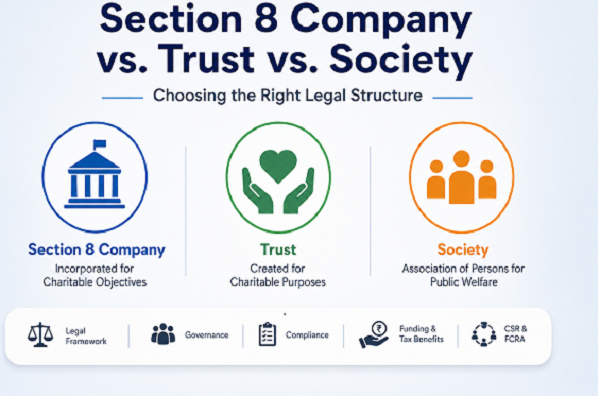
A carefully considered decision at the planning stage can minimise future legal and administrative challenges and provide a strong foundation for sustainable growth.
2. Understanding a Section 8 Company
A Section 8 Company is incorporated under Section 8 of the Companies Act, 2013 for promoting charitable or not-for-profit objectives. Such companies are generally established for activities relating to education, healthcare, science, research, social welfare, environmental protection, art, culture, sports and other objects beneficial to society.
Unlike a commercial company, a Section 8 Company cannot distribute profits or dividends among its members. Any income or surplus generated must be applied solely towards furthering the objects specified in its Memorandum of Association.
Being incorporated under the Companies Act, 2013, a Section 8 Company enjoys the status of a separate legal entity with perpetual succession. It may own property, enter into contracts, institute or defend legal proceedings in its own name and continue its existence irrespective of changes in its members or directors.
Its affairs are managed by a Board of Directors and regulated by the Ministry of Corporate Affairs through the office of the Registrar of Companies. The statutory framework governing companies requires maintenance of prescribed records, periodic meetings, preparation of financial statements and filing of statutory returns. Although these compliance requirements are comparatively more extensive than those applicable to other non-profit structures, they also promote transparency, accountability and institutional governance.
Consequently, organisations proposing to undertake activities on a larger scale, seek institutional grants or CSR funding, or establish a professionally managed institution often consider a Section 8 Company to be an appropriate legal structure.
3. Understanding a Trust
A Trust is one of the oldest and most widely recognised legal forms for carrying out charitable and religious activities in India.
Broadly, a Trust is created when a person, known as the settlor or author of the trust, transfers property or assets to one or more trustees to be held and administered for specified charitable or public purposes.
Private trusts are generally governed by the provisions of the Indian Trusts Act, 1882, whereas public charitable and religious trusts are primarily regulated by the applicable State laws and judicial principles.
The administration of a Trust is governed principally by its Trust Deed, which defines its objectives, powers and responsibilities of trustees, management of trust property and other operational provisions. Trustees occupy a fiduciary position and are expected to administer the trust honestly, prudently and exclusively for achieving its stated charitable objects.
Trusts are commonly established for charitable hospitals, educational institutions, scholarships, religious organisations, community welfare programmes and family-managed philanthropic activities. Their management framework is generally less formal than that of a company, making them suitable in situations where comparatively simple administration and continuity through trustees are preferred.
4. Understanding a Society
A Society is a membership-based organisation formed by individuals who voluntarily associate for promoting charitable, educational, literary, scientific, cultural, social or other public welfare objectives.
Societies are generally registered under the Societies Registration Act, 1860 or the corresponding legislation enacted by the respective States.
Unlike a Trust, which is administered by trustees, a Society functions through its members and is managed by an elected Governing Body or Managing Committee. This democratic framework encourages collective participation in decision-making and provides an organised mechanism for periodic change in management through elections conducted in accordance with its governing documents.
Societies are widely used for establishing educational institutions, research organisations, cultural associations, professional bodies, sports clubs, resident welfare associations and various community development organisations.
Since management is based upon participation by members rather than trustees alone, a Society may be particularly suitable where collective administration and democratic governance are regarded as important organisational objectives.
5. Registration and Governing Legal Framework
Although a Section 8 Company, a Trust and a Society are all established to pursue charitable or public welfare objectives, they are governed by different statutes and are registered before different authorities.
A Section 8 Company is incorporated under the provisions of the Companies Act, 2013 and the applicable Companies (Incorporation) Rules, 2014. Registration is carried out electronically through the Ministry of Corporate Affairs (MCA), and the organisation comes into existence only after the issuance of a Certificate of Incorporation by the Registrar of Companies.
A Trust is generally created by executing a Trust Deed specifying its objectives, trustees, powers, duties and the manner in which the trust is to be administered. Depending upon the applicable State laws, the Trust Deed may require registration with the designated authority. While private trusts are generally governed by the Indian Trusts Act, 1882, public charitable and religious trusts are primarily regulated by the respective State laws.
A Society is registered under the Societies Registration Act, 1860 or the corresponding State legislation. Registration is generally granted by the Registrar of Societies after submission of the Memorandum of Association, Rules and Regulations and other prescribed documents.
Irrespective of the organisational form selected, registration provides legal recognition and establishes the statutory framework within which the organisation is expected to function.
6. Governance and Management Structure
Governance is one of the most significant distinguishing features among these three legal structures.
A Section 8 Company follows a corporate governance model. Its affairs are managed by a Board of Directors whose powers, duties and responsibilities are governed by the Companies Act, 2013 and the constitutional documents of the company. The requirement to conduct Board meetings, maintain statutory records and comply with prescribed filing requirements contributes to greater transparency and accountability.
A Trust is administered by its Trustees, who hold and manage the trust property for the benefit of the charitable purposes specified in the Trust Deed. Trustees occupy a fiduciary position and are expected to act honestly, prudently and in the best interests of the trust and its beneficiaries.
A Society functions through an elected Governing Body or Managing Committee. Since its management is membership-driven, decisions are generally taken collectively in accordance with the Memorandum of Association and Rules and Regulations. Periodic elections promote accountability and enable broader participation in the administration of the organisation.
While the governance framework differs in each structure, effective administration ultimately depends upon responsible management, transparency in decision-making and adherence to statutory requirements.
7. Separate Legal Identity and Perpetual Succession
One important consideration while selecting a legal structure is whether the organisation enjoys an independent legal identity.
A Section 8 Company is recognised as a separate legal entity distinct from its members. It enjoys perpetual succession, enabling it to continue irrespective of changes in its directors or members. It may own property, enter into contracts, sue or be sued in its own name and continue its operations without interruption.
Trusts and Societies also provide continuity for charitable activities, although the legal principles governing their existence differ depending upon the applicable statutes and judicial interpretations. In practice, all three structures facilitate continuity beyond the lifetime of the founders, thereby enabling long-term charitable initiatives.
8. Compliance Requirements
Compliance should not be viewed merely as a statutory obligation but as an essential element of good governance.
Among the three organisational forms, a Section 8 Company generally has comparatively higher compliance responsibilities. Depending upon the applicable provisions of the Companies Act, 2013, it may be required to maintain statutory registers, proper books of account, prepare financial statements, hold Board and general meetings where applicable, and file prescribed returns with the Ministry of Corporate Affairs.
Trusts and Societies also have continuing statutory obligations under the respective laws governing their registration. These may include maintaining proper records, preparing accounts, filing prescribed returns and complying with the provisions contained in their governing documents and the applicable State legislation.
Failure to comply with statutory requirements may adversely affect the organisation’s credibility and may also result in regulatory consequences. Consequently, founders should carefully assess their ability to comply with the legal obligations associated with the chosen organisational structure before registration.
9. Funding, Tax Registration and CSR Considerations
Financial sustainability is essential for the effective functioning of every non-profit organisation. Whether funds are received through public donations, grants, philanthropic contributions or Corporate Social Responsibility (CSR) initiatives, donors increasingly expect transparency, accountability and sound governance.
It is important to understand that registration as a Section 8 Company, Trust or Society does not automatically confer exemption from income tax or entitle donors to claim tax deductions.
Where eligible, organisations may obtain registration under the Income-tax Act, 1961, including registration under Section 12AB and approval under Section 80G, subject to fulfilment of the prescribed statutory conditions.
Similarly, organisations proposing to receive foreign contributions are required to comply with the provisions of the Foreign Contribution (Regulation) Act, 2010 (FCRA) and obtain the necessary registration or prior permission, wherever applicable.
Corporate entities undertaking CSR activities generally prefer implementing agencies that maintain proper governance standards, transparent accounting practices and satisfactory compliance records. While a Section 8 Company is often perceived as having a structured governance framework because of its regulation under the Companies Act, well-managed Trusts and Societies with sound governance practices may also command equal confidence among donors and funding agencies.
Ultimately, institutional credibility depends less upon the legal structure adopted and more upon the organisation’s governance standards, financial discipline, transparency and consistent compliance with applicable laws.
10. Factors to Consider Before Choosing a Legal Structure
Selecting the legal structure of a non-profit organisation should be viewed as a strategic decision rather than merely a registration formality. Although a Section 8 Company, Trust and Society are all recognised legal vehicles for charitable activities, each possesses distinct characteristics that may make it more suitable for a particular organisation.
Before making a decision, founders should carefully evaluate:
- the nature and objectives of the proposed activities;
- the anticipated geographical area of operation;
- the preferred governance and management framework;
- the expected sources of funding, including public donations, grants and CSR contributions;
- the organisation’s ability to comply with ongoing statutory requirements; and
- long-term expansion plans and succession of management.
A thoughtful assessment at the planning stage reduces the likelihood of future restructuring and enables the organisation to function efficiently within the applicable legal framework.
11. Which Structure May Be More Appropriate?
There is no universally superior legal structure for every non-profit organisation. The appropriate choice depends upon the objectives, operational requirements and long-term vision of its founders.
A Section 8 Company may be more appropriate where:
- professional governance is a priority;
- activities are expected to expand across multiple States;
- institutional grants or CSR funding are likely to be sought;
- greater transparency and accountability are considered essential; and
- the promoters are willing to comply with comparatively higher statutory requirements.
A Trust may be more appropriate where:
- charitable or religious activities are intended to be managed by a limited number of trustees;
- the founders prefer a comparatively flexible management structure;
- the objectives are stable and long-term in nature; and
- continuity through trustees is considered desirable.
A Society may be more appropriate where:
- the organisation is membership-driven;
- democratic participation in management is important;
- educational, cultural, scientific or community development activities are proposed; and
- periodic election of the governing body is considered appropriate.
The decision should therefore be based upon the specific requirements of the organisation rather than the popularity of a particular legal form.
12. Common Misconceptions
Several misconceptions continue to exist regarding the legal framework governing non-profit organisations.
One common misconception is that registration as a Section 8 Company, Trust or Society automatically entitles the organisation to income-tax exemption. In reality, registration under the relevant organisational law and registration under the Income-tax Act are separate legal processes governed by different statutory provisions.
Similarly, it is often assumed that every registered non-profit organisation is automatically eligible to receive CSR funding or foreign contributions. In practice, such eligibility depends upon compliance with the applicable legal requirements, including the provisions governing CSR implementation and the Foreign Contribution (Regulation) Act, 2010, wherever applicable.
Another misconception is that one legal structure is always superior to the others. Each structure has been created by law to meet different organisational needs. The suitability of a particular structure depends upon factors such as governance expectations, scale of operations, funding requirements and compliance capability.
Accordingly, the decision should be based upon a careful evaluation of legal, administrative and operational considerations rather than commonly held assumptions.
13. Key Takeaways
The following broad principles may assist founders while selecting an appropriate legal structure:
1. There is no single legal structure that is suitable for every non-profit organisation.
2. The choice should be guided by the organisation’s objectives, governance expectations, proposed activities, funding strategy and long-term plans.
3. A Section 8 Company generally provides a structured corporate governance framework but involves comparatively higher compliance obligations.
4. A Trust is widely used for charitable, religious and philanthropic activities where management through trustees is considered appropriate.
5. A Society offers a democratic governance model that is particularly suitable for membership-based organisations.
6. Registration alone does not automatically confer tax exemptions, eligibility for CSR funding or permission to receive foreign contributions.
7. Good governance, transparency, financial discipline and statutory compliance contribute significantly to the credibility and sustainability of every non-profit organisation, irrespective of its legal structure.
14. Conclusion
Section 8 Companies, Trusts and Societies all play an important role in promoting charitable, educational, cultural, scientific, religious and social welfare activities in India. Although they pursue similar public welfare objectives, each operates within a distinct legal framework and follows its own governance model, regulatory requirements and compliance obligations.
Rather than attempting to identify the “best” legal structure, founders should determine which structure is most appropriate for their proposed activities, governance expectations, funding requirements and long-term organisational objectives.
A well-informed decision at the formation stage can minimise future legal and administrative challenges, strengthen institutional governance, enhance public confidence and contribute to the sustainable growth of the organisation.
Ultimately, the long-term success of a non-profit organisation depends not merely upon the legal structure adopted but upon the integrity of its management, transparency in its operations, prudent financial management and continued commitment to serving society in accordance with its stated objectives.
******
References
This article is based upon the broad legal framework contained in the following enactments and official sources, as amended from time to time:
1. The Companies Act, 2013.
2. Companies (Incorporation) Rules, 2014.
3. The Societies Registration Act, 1860 and the corresponding State enactments.
4. The Indian Trusts Act, 1882 (primarily relating to private trusts).
5. The Income-tax Act, 1961, including the provisions relating to charitable institutions under Sections 12AB and 80G.
6. The Foreign Contribution (Regulation) Act, 2010.
7. Notifications, circulars and guidance issued by the Ministry of Corporate Affairs, Central Board of Direct Taxes and other competent authorities.
****
About the Author: Ashok Kakkar is an Advocate, Insolvency Professional and former Chief Manager of Punjab National Bank with over four decades of professional experience in banking, finance, credit management, recovery, insolvency and legal practice. He holds M.Com., LL.B., LL.M. and CAIIB qualifications and regularly writes educational articles on banking, finance, insolvency, company law and allied legal subjects with the objective of promoting legal and financial awareness.
Disclaimer: This article has been prepared solely for educational, academic and general awareness purposes. It presents a broad overview of the legal framework governing Section 8 Companies, Trusts and Societies in India and should not be construed as legal, tax, financial or professional advice. Although every effort has been made to ensure the accuracy of the information contained in this article, the applicable laws, rules, regulations, notifications and judicial pronouncements are subject to amendment and interpretation from time to time. Readers are therefore advised to refer to the latest statutory provisions and official notifications and, where necessary, obtain professional advice before taking any decision based on the contents of this article. The views expressed are personal and intended solely for educational purposes. The author disclaims any liability arising from reliance placed upon this article.








Sh.Ashok Kakkar Advocate and Former Chief Manager of Punjab National Bank has beautifully elaborated a trust,a Society and Sectoon 8 companies formed for non Profitable purpose such as charitable religious, social Welfare activities and,Educational purposes. wish him Succeess and good health in his life.
Informative article, but in many states registered societies are being pushed by Income Tax department to get registered under their respective State Trust Act to continue their tax exemption under 12AB. If it is that compulsory then what is the point of making Society a separate legal entity? Why is there burden of registration under two acts?
Thank you, TaxGuru Editorial Team, for publishing my article. I sincerely appreciate the opportunity to contribute to such a respected professional platform. I hope this article helps readers understand the key differences between a Section 8 Company, Trust, and Society, and assists them in selecting the most appropriate legal structure for a non-profit organisation. I look forward to contributing more articles on topics relating to banking, finance, insolvency, and corporate law.
Ashok Kakkar