Understanding CIRP & CIIRP under IBC: From Established Resolution to Creditor-Led Early Intervention
The Insolvency and Bankruptcy Code (Amendment) Act, 2026 has introduced a new Chapter IV-A of Part II of the IBC, comprising Sections 58A to 58K, dealing with the Creditor-Initiated Insolvency Resolution Process (CIIRP). The material explains that CIRP remains the principal corporate insolvency resolution mechanism and may be initiated by a financial creditor under Section 7, an operational creditor under Section 9, or the corporate debtor under Section 10. CIIRP is described as an additional creditor-led mechanism intended to facilitate earlier intervention in eligible cases, address delays in conventional insolvency proceedings and preserve enterprise value. The framework does not replace CIRP but is intended to complement it by providing another route for dealing with corporate financial distress. The material states that specified financial creditors may initiate CIIRP subject to conditions and requirements under the Code and applicable regulatory framework. It also discusses the relevance of CIIRP for financial creditors, Resolution Professionals and corporate debtors, while noting that its practical contours will depend on applicable rules, regulations, notifications and judicial interpretation.
- Introduction
- CIRP and CIIRP under the IBC: Evolution, Differences, Benefits and Practical Implications
- 1. CIRP: The Established Insolvency Resolution Mechanism
- 2. How Does CIRP Operate?
- 3. The Practical Challenge: Timing Matters
- 4. Why Was CIIRP Introduced?
- 5. What Is CIIRP?
- 6. CIRP and CIIRP: What Is the Difference?
- 7. CIIRP Does Not Replace CIRP
- 8. What Could CIIRP Mean for Financial Creditors?
- 9. What Does It Mean for Resolution Professionals?
- 10. What Does It Mean for Corporate Debtors?
- 11. A Practical Perspective: CIRP and CIIRP Are Complementary
- 12. Key Takeaways
- Conclusion
Introduction
The Insolvency and Bankruptcy Code, 2016 (IBC) brought a fundamental change in the manner in which corporate financial distress is addressed in India. The emphasis shifted from fragmented recovery proceedings and prolonged litigation towards a structured process aimed at resolution, preservation of enterprise value and continuation of viable businesses as going concerns.
The Corporate Insolvency Resolution Process (CIRP) has remained the principal mechanism under the IBC for dealing with corporate insolvency. However, experience with the functioning of the Code has also highlighted practical concerns such as delays in admission, litigation at different stages, procedural complexity and erosion of enterprise value during prolonged distress.
The Insolvency and Bankruptcy Code (Amendment) Act, 2026 has introduced a new Chapter IV-A dealing with the Creditor-Initiated Insolvency Resolution Process (CIIRP). The new framework is intended to provide an additional creditor-led route for dealing with financial distress at an earlier stage.
The important question, therefore, is not whether CIIRP will replace CIRP. It will not. The more relevant question is whether CIIRP can provide creditors with an additional and more timely mechanism to intervene before deterioration in the financial condition of a corporate debtor results in further erosion of value.
This article explains CIRP and CIIRP, highlights their principal differences and considers their practical significance for creditors, Resolution Professionals, corporate debtors and other stakeholders.
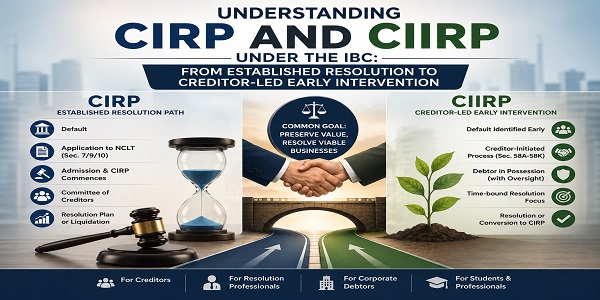
CIRP and CIIRP under the IBC: Evolution, Differences, Benefits and Practical Implications
1. CIRP: The Established Insolvency Resolution Mechanism
CIRP is the principal corporate insolvency resolution mechanism under the IBC.
It is designed to deal with a corporate debtor that has committed a default and provides a structured process through which the affairs of the corporate debtor are managed during insolvency resolution.
CIRP may be initiated by:
-
- a financial creditor under Section 7;
- an operational creditor under Section 9; or
- the corporate debtor itself under Section 10.
Once the application is admitted by the Adjudicating Authority, the insolvency resolution process commences and the statutory framework governing the process comes into operation.
The broad objective is not simply recovery of individual debts. The underlying objective is resolution of the corporate debtor as a going concern, maximisation of value and balancing the interests of stakeholders.
2. How Does CIRP Operate?
The principal stages of CIRP broadly include:
1. Filing of an insolvency application before the NCLT;
2. Admission of the application;
3. Commencement of the CIRP and imposition of the statutory moratorium;
4. Appointment of an Interim Resolution Professional;
5. Public announcement and submission of claims by creditors;
6. Verification and collation of claims;
7. Constitution of the Committee of Creditors;
8. Appointment or confirmation of the Resolution Professional;
9. Invitation and evaluation of resolution plans;
10. Approval of a suitable resolution plan by the Committee of Creditors and the NCLT; and
11. Liquidation where resolution within the statutory framework does not succeed.
Over the years, CIRP has developed into a mature legal framework supported by substantial judicial interpretation and regulatory guidance.
3. The Practical Challenge: Timing Matters
One of the most important lessons emerging from the experience of CIRP is that timing is critical in insolvency resolution.
A financially distressed business does not remain static while legal proceedings continue. Customers may move away, suppliers may reduce credit, employees may leave, working capital may become scarce and the value of assets may deteriorate.
Consequently, a delay at the initial stage may have consequences much beyond the delay itself.
Admission proceedings before the NCLT, litigation by parties, challenges to maintainability and other procedural issues can sometimes result in significant time being consumed before the resolution process can effectively move forward.
This creates what may broadly be described as an “admission bottleneck”.
The concern is particularly important where the corporate debtor is still capable of being revived but requires timely intervention.
The fundamental insolvency principle is therefore simple: the earlier a viable business can be stabilised, the greater may be the possibility of preserving its enterprise value.
4. Why Was CIIRP Introduced?
The 2026 amendment introduces the Creditor-Initiated Insolvency Resolution Process through Chapter IV-A of Part II of the IBC, comprising Sections 58A to 58K.
The new framework seeks to provide an additional route for creditor-led intervention in eligible cases.
The rationale behind such a mechanism can be understood from the practical difficulties associated with delayed resolution.
If creditors have sufficient information regarding financial distress and default, an early intervention mechanism may help prevent the corporate debtor from reaching a stage where its business value has substantially deteriorated.
The broad objectives of CIIRP include:
-
- early intervention after default;
- preservation of enterprise value;
- reduction of unnecessary procedural delay;
- providing creditors with an additional resolution mechanism;
- facilitating a structured pathway towards resolution; and
- reducing the possibility that a viable business becomes unviable merely because intervention occurs too late.
The statutory framework also contemplates eligibility criteria and conditions to be specified through the appropriate notifications and regulatory framework. Therefore, the practical operation of CIIRP will need to be understood along with the applicable rules, regulations and notifications as they develop.
5. What Is CIIRP?
CIIRP stands for Creditor-Initiated Insolvency Resolution Process.
It is a new statutory mechanism introduced under Chapter IV-A of the IBC.
The important distinction is that CIIRP is conceived as a creditor-led early intervention mechanism, rather than merely another version of the existing CIRP.
The 2026 framework contemplates that specified financial creditors may initiate CIIRP in respect of eligible corporate debtors, subject to the conditions and requirements prescribed under the Code and the applicable regulatory framework.
This is significant because it introduces another approach to dealing with corporate financial distress.
Instead of waiting for the distress of the corporate debtor to deepen and subsequently relying upon the conventional CIRP route, the new framework seeks to facilitate earlier creditor intervention in appropriate cases.
6. CIRP and CIIRP: What Is the Difference?
Although both mechanisms operate under the IBC and are intended to facilitate resolution of corporate financial distress, their approach is different.
CIRP is the established and principal corporate insolvency resolution process. It has a mature statutory, regulatory and judicial framework and may be initiated by financial creditors, operational creditors or the corporate debtor, subject to the requirements of the Code.
CIIRP, on the other hand, is a newly introduced creditor-initiated framework under Chapter IV-A. Its emphasis is on early creditor intervention and a more focused mechanism for eligible cases.
The distinction can therefore be understood in terms of their underlying approach:
CIRP: Default → Application → NCLT admission → CIRP → Resolution
CIIRP: Default → Creditor-led intervention in an eligible case → CIIRP framework → Resolution or further action as prescribed
The second model is intended to address the possibility that waiting for the conventional insolvency process to commence may result in unnecessary loss of enterprise value.
7. CIIRP Does Not Replace CIRP
This point deserves particular emphasis.
The introduction of CIIRP does not make CIRP redundant.
CIRP continues to be the principal corporate insolvency resolution mechanism under the IBC. CIIRP is an additional statutory route intended to complement the existing framework.
This distinction is important for professionals and creditors because the two mechanisms should not be viewed as competing alternatives in every situation.
The appropriate mechanism would depend upon the nature of the corporate debtor, the eligibility conditions, the circumstances of default, the financial position of the business and the objectives of the creditors.
8. What Could CIIRP Mean for Financial Creditors?
For banks and other financial creditors, the most significant potential advantage of CIIRP is timely intervention.
A creditor’s interest is not necessarily served by waiting until the borrower becomes completely financially distressed.
Where a business remains commercially viable but is experiencing financial stress, early intervention may provide an opportunity to preserve:
- operating assets;
- customer relationships;
- working capital arrangements;
- employee capability;
- business goodwill; and
- overall enterprise value.
From a banking perspective, this is important because recovery is often influenced not only by the amount outstanding but also by the value of the underlying business.
A delayed resolution may result in a lower realisable value even where the original business was viable.
CIIRP therefore has the potential to become an important tool for creditors, particularly where early action can prevent further deterioration.
9. What Does It Mean for Resolution Professionals?
The emergence of CIIRP also expands the professional landscape for Insolvency Professionals.
Resolution Professionals will need to understand not only the established CIRP framework but also the new statutory and regulatory architecture governing CIIRP.
The role of the Insolvency Professional in any creditor-led mechanism requires particular attention to:
- independence;
- transparency;
- statutory compliance;
- communication with creditors;
- protection of enterprise value;
- proper documentation; and
- coordination among stakeholders.
As the regulatory framework evolves, professionals will also need to remain updated with IBBI regulations, notifications, forms and judicial interpretation.
The IBBI has already undertaken regulatory work relating to the operationalisation of the new CIIRP framework, demonstrating that the statutory introduction of CIIRP is only one part of the process; its practical contours will also depend upon the subordinate regulatory framework.
10. What Does It Mean for Corporate Debtors?
For corporate debtors, the introduction of CIIRP reinforces an important lesson: financial distress should be addressed early rather than after the business has substantially deteriorated.
Insolvency resolution should not automatically be equated with liquidation.
The broader philosophy of the IBC is to provide an opportunity for viable businesses to be resolved and continued as going concerns.
Corporate debtors should therefore focus on timely engagement with creditors, accurate financial reporting, transparent disclosure and early identification of financial stress.
For promoters and management, the emergence of creditor-led mechanisms also makes it increasingly important to recognise financial distress before it becomes irreversible.
11. A Practical Perspective: CIRP and CIIRP Are Complementary
The real significance of the 2026 amendment may ultimately be judged not merely by the creation of another statutory process but by whether it improves the timing and quality of insolvency resolution.
CIRP has already created a strong institutional framework for dealing with corporate insolvency.
CIIRP potentially adds another layer by enabling creditors to intervene at an earlier stage in eligible cases.
The success of the new framework will therefore depend upon how effectively the statutory provisions, regulations, creditors, Insolvency Professionals and adjudicating authorities work together.
It will also depend upon whether the new mechanism actually reduces delay without creating another layer of procedural complexity.
12. Key Takeaways
The introduction of CIIRP represents an important development in the evolution of India’s insolvency framework.
The key points may be summarised as follows:
- CIRP remains the principal corporate insolvency resolution mechanism under the IBC.
- CIRP has a mature statutory, regulatory and judicial framework.
- CIIRP has been introduced through the new Chapter IV-A.
- CIIRP is intended to facilitate creditor-led early intervention in eligible cases.
- The principal rationale is timely action and preservation of enterprise value.
- CIIRP does not replace CIRP; it provides an additional route.
- Financial creditors may potentially benefit from an earlier intervention mechanism.
- Resolution Professionals will need to familiarise themselves with the new framework and its evolving regulations.
- Corporate debtors should recognise financial distress at an early stage and engage constructively with creditors.
- The practical contours of CIIRP will evolve as the regulatory framework, notifications and judicial interpretation develop.
Conclusion
The IBC has undergone continuous evolution since its enactment in 2016. CIRP established a structured and creditor-driven mechanism for dealing with corporate insolvency, but practical experience has demonstrated that delay can itself destroy value.
The introduction of CIIRP through the 2026 amendment reflects an attempt to address this concern by providing an additional creditor-initiated pathway for eligible cases.
The real test of CIIRP will not merely be the number of cases initiated under the new framework. Its success will ultimately depend upon whether it enables creditors to intervene at the right time, preserve enterprise value and facilitate viable resolution without unnecessary procedural delay.
For bankers, financial creditors, Resolution Professionals, corporate debtors and other stakeholders, understanding the distinction between CIRP and CIIRP is therefore becoming increasingly important.
The evolution of insolvency law is ultimately about one central objective: timely intervention, preservation of value and resolution of viable businesses.
#IBC 2016,# IBC Amendment 2026, #CIRP, #CIIRP, #Insolvency Resolution, #Corporate Insolvency, #Resolution Professional, #NCLT
*****
Disclaimer: This article is intended solely for educational and general awareness purposes. It does not constitute legal, financial, or professional advice. Readers are advised to refer to the latest provisions of the Insolvency and Bankruptcy Code, applicable rules and regulations, IBBI notifications and circulars, and judicial pronouncements before relying upon any information for a specific matter.
About the Author: Ashok Kakkar is an Advocate, Insolvency Professional and former banker with extensive experience in banking, finance, insolvency and legal matters. He writes on the Insolvency and Bankruptcy Code, banking law, corporate restructuring and related subjects with the objective of sharing practical knowledge and making complex professional subjects easier to understand.