Income Tax : The Income Tax Act 2025 introduces mandatory reporting of high-value gifted immovable properties exceeding ₹45 lakh. The amendme...
Income Tax : Clause 43 in Tax Audit Form No. 26 requires auditors to verify remittances reported in Part-D of Form 145. Incorrect classificatio...
Income Tax : The new Income Tax Act, 2025 significantly reduces the number of statutory sections and reorganises tax compliance procedures effe...
Income Tax : The new law defines strict conditions for reopening assessments using specified information categories. It ensures transparency an...
Income Tax : The reform consolidates TDS provisions into a structured system and introduces digital compliance mechanisms. It enhances clarity,...
Income Tax : Rules 307–311 of the Draft Income-tax Rules, 2026 outline how pension funds must purchase annuities, restrict commutation, preve...
Income Tax : Draft Income-tax Rules 2026 prescribe definitions, trust conditions, investment rules, and limits on employer contributions for ap...
Income Tax : Draft Income-tax Rules 2026 outline procedures for provident fund recognition, penalties for assigning PF interest, and tax treatm...
Income Tax : Draft Income-tax Rules 2026 require provident fund nominations to favour family members and mandate annual account reporting by tr...
Income Tax : Rule 333 mandates electronic tax payments for companies and specified taxpayers, while the draft rules also prescribe detailed dep...
Income Tax : Rule 81 prescribes dataset construction, weighted averages, and a 35th–65th percentile arm’s length range when multiple compar...
Income Tax : The latest amendment excludes income arising from transfer of pre-2017 investments from GAAR scrutiny. It reinforces the protectio...
Income Tax : CBDT introduced Income-tax Rules, 2026 to operationalize the Income-tax Act, 2025. The rules standardize procedures on valuation, ...
The Income Tax Act 2025 introduces mandatory reporting of high-value gifted immovable properties exceeding ₹45 lakh. The amendment significantly expands the SFT framework and increases scrutiny of property transactions without consideration.
Clause 43 in Tax Audit Form No. 26 requires auditors to verify remittances reported in Part-D of Form 145. Incorrect classification of non-taxable foreign payments may invite tax department inquiries and litigation.
The new Income Tax Act, 2025 significantly reduces the number of statutory sections and reorganises tax compliance procedures effective from FY 2026-27. The reforms introduce new forms, revised reporting systems, and simplified compliance mechanisms.
The new law defines strict conditions for reopening assessments using specified information categories. It ensures transparency and limits arbitrary reassessment powers.
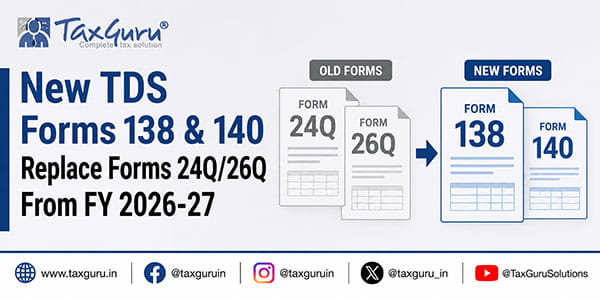
The reform consolidates TDS provisions into a structured system and introduces digital compliance mechanisms. It enhances clarity, reduces errors, and improves reporting efficiency.
The framework outlines mandatory disclosures and timelines for opting into safe harbour. Key takeaway: strict compliance is essential to gain tax certainty.
The article explains how safe harbour rules simplify transfer pricing compliance. It highlights that eligible transactions are accepted without scrutiny if conditions are met.
Form 41 is now compulsory for non-residents claiming DTAA benefits, replacing Form 10F. The update mandates online filing and ensures standardized disclosure for availing treaty benefits.
The new rules replace old form numbers with a structured sequence across categories. The update simplifies compliance and improves clarity in tax filings.
The update outlines revised compliance forms, timelines, and penalties under the new rules. It highlights a structured transition from existing provisions to a stricter and more automated compliance framework.