SC Landmark Ruling: Mechanical Invocation of Fraud Cannot Extend Limitation under Section 74 of the CGST Act
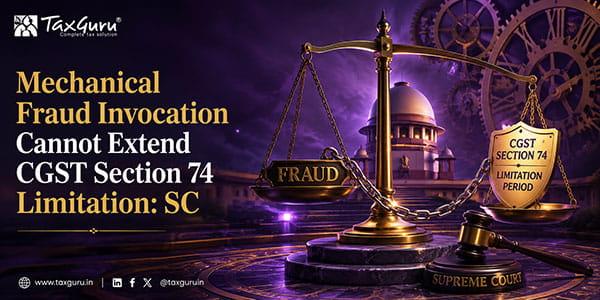
Summary: The Supreme Court in M/s G.R. Infra Projects Limited v. The State of Madhya Pradesh & Ors. set aside a Show Cause Notice dated June 13, 2025 issued under Section 74 of the CGST Act read with the MPGST Act for FY 2018-19. The Court noted that the notice was otherwise beyond the limitation applicable under Section 73 and held that a bland recital of “fraud or concealment of facts”, without disclosing in the notice itself the material leading to that inference, could not justify invocation of the extended limitation under Section 74. The Court refused to consider the Revenue’s attempt to elaborate the allegations through its counter affidavit. It held that the allegations forming the basis for invoking the extended limitation must emanate from the notice itself and that the statutory expressions cannot be mechanically used without explaining the basis for the allegation. The Court also relied on the principle recognised in Uniworth Textiles Ltd. v. Commissioner of Central Excise, Raipur. The High Court’s order and the impugned SCN were accordingly set aside, and the Revenue was directed to desist from further proceedings pursuant to the SCN.
Facts:
M/s G.R. Infra Projects Limited (“the Petitioner”) is engaged in the design and construction of roads and highway projects and is registered under the CGST Act and the MPGST Act. Summons under Section 70 of the CGST Act was issued to the authorised signatory of the Petitioner covering the business for the FYs 2017-18 to 2020-21, and the premises of the Petitioner were searched by the GST officials in the month of August 2022 under Section 67 of the CGST Act, during which statements of the Accountant, the Authorised Signatory and the Director were recorded.
Thereafter, a draft notice-cum-investigation report dated March 03, 2025 was prepared and an intimation in Form GST DRC-01A under Rule 142(1A) of the Central Goods and Services Tax Rules, 2017 (“the CGST Rules”) dated April 29, 2025 was issued to the Petitioner. The Petitioner filed preliminary objections dated May 14, 2025, specifically pointing out that the draft notice on which the intimation was based had not been served, whereupon the draft notice was supplied on May 27, 2025 and further objections were filed. Subsequently, the Revenue issued a Show Cause Notice dated June 13, 2025 (“the Impugned SCN”) under Section 74 of the CGST Act raising a demand of tax of Rs. 1,52,56,431/- for the FY 2018-19 on account of mismatch between GSTR-3B and e-way bills for inter-state outward and inward supplies, ineligible Input Tax Credit (“ITC”) in respect of site office, and post-supply cancellation of registration of vendors.
The Petitioner contended that the Impugned SCN was barred by the three-year limitation prescribed under Section 73 of the CGST Act, and that a notice under Section 74 of the CGST Act can be issued only when fraud, wilful misstatement or suppression of facts is alleged, which allegation must emanate from the notice itself, whereas the Impugned SCN contained only vague and bald allegations. The Revenue, on the other hand, sought to elaborate the allegations of fraud and suppression of facts through its counter affidavit filed before the Court.
The Petitioner challenged the Impugned SCN before the Hon’ble Madhya Pradesh High Court, Indore Bench in GR Infra Projects Limited v. The State of Madhya Pradesh and Others [Writ Petition No. 40749 of 2025 dated October 29, 2025], which dismissed the writ petition holding that the Impugned SCN contained specific allegations of fraud and wilful suppression of facts, that the writ court cannot examine at the show cause notice stage whether the proper officer has erroneously invoked Section 74 of the CGST Act, and that the Petitioner had an efficacious alternate remedy, placing reliance upon the judgment of the Hon’ble Supreme Court in State of Maharashtra & Others v. Greatship (India) Limited [(2022) 17 SCC 332]. Aggrieved thereby, the Petitioner preferred the present appeal before the Hon’ble Supreme Court.
Issue:
Whether a Show Cause Notice issued under Section 74 of the CGST Act, which merely recites the words ‘fraud or concealment of facts’ without setting out in the notice itself the material and allegations leading to such inference, can be sustained for invoking the extended period of limitation, when the notice is otherwise barred by limitation under Section 73 of the CGST Act?
Held:
The Hon’ble Supreme Court in Civil Appeal No. 11277 of 2026 held as under:
- Observed that, when an authority has issued a notice or an order, the requirements which make such notice or order valid should be contained in the notice or order itself and cannot be supplanted by a counter affidavit filed in Court. Accordingly, the Court refused to look into the counter affidavit of the State which sought to elaborate the allegations of fraud and suppression of facts.
- Noted that, for the FY 2018-19, the due date for furnishing the annual return under Section 44 of the CGST Act read with Rule 80 of the CGST Rules stood extended to December 31, 2020, and hence the limitation for issuing a notice under Section 73 of the CGST Act expired on December 31, 2023. After excluding the period from March 15, 2020 to February 28, 2022 in terms of the order of the Hon’ble Supreme Court in Re: Cognizance for Extension of Limitation [Suo Motu Writ Petition (C) No. 3 of 2020], the extended period of limitation fell on February 28, 2025. Therefore, the Impugned SCN dated June 13, 2025 was definitely hit by limitation under Section 73 of the CGST Act.
- Observed that, a bare reading of the Impugned SCN indicated that, but for a bland statement of ‘fraud or concealment of facts’, nothing was stated as to how fraud was inferred or how concealment of facts was detected. In fact, the word ‘or’ employed in the notice indicated that even the Assessing Officer was not sure whether the proceedings were on the ground of fraud or concealment of facts.
- Held that, for the extended period of limitation to apply, the allegations which lead to the inference of fraud or concealment resulting in suppression of facts must emanate from the notice itself, and there cannot be a mechanical use of the words ‘fraud, wilful misstatement or suppression of facts’ without listing out the aspects which persuaded the Assessing Officer to conclude that the assessee had employed any of such surreptitious devices. Consequently, there was absolutely no reason to sustain the Impugned SCN and the Hon’ble High Court had erroneously upheld the same. The impugned order of the Hon’ble High Court as well as the Impugned SCN were set aside.
- Directed that, the Revenue shall desist from taking any further proceedings in pursuance of the Impugned SCN.
Our Comments:
Section 73 of the CGST Act governs the determination of tax not paid, short paid, erroneously refunded, or ITC wrongly availed or utilised, for any reason other than fraud, wilful misstatement or suppression of facts, and mandates under Section 73(2) read with Section 73(10) that the notice be issued at least three months prior to the expiry of three years from the due date for furnishing the annual return for the relevant financial year. Per contra, Section 74 of the CGST Act is invocable only where such non-payment or short payment is by reason of fraud, wilful misstatement or suppression of facts to evade tax, and extends the limitation to five years. Explanation 2 to Section 74 further clarifies that ‘suppression’ means non-declaration of facts or information which a taxable person is statutorily required to declare, or failure to furnish information sought in writing, with the intent to evade tax. The ingredients of Section 74 are, therefore, jurisdictional pre-conditions and not a mere matter of form, and the extended period cannot be invoked by a ritualistic incantation of the statutory words.
The present ruling reaffirms a consistent line of precedents under the erstwhile indirect tax regime. In Uniworth Textiles Ltd. v. Commissioner of Central Excise, Raipur [(2013) 9 SCC 753], the Hon’ble Supreme Court held that the burden of proving mala fide conduct for invoking the extended period lies on the Revenue, and specific averments in the show cause notice are a mandatory pre-requisite, absent which the assessee has no opportunity to meet the case of fraud, collusion or wilful misstatement. Similarly, in Commissioner of Central Excise v. H.M.M. Limited [1995 Supp (3) SCC 322], it was held that unless the show cause notice puts the assessee to notice of the specific allegation of suppression, the extended period cannot be invoked, and in Pushpam Pharmaceuticals Company v. Collector of Central Excise, Bombay [1995 Supp (3) SCC 462] and Anand Nishikawa Co. Ltd. v. Commissioner of Central Excise, Meerut [(2005) 7 SCC 749], it was held that suppression must be deliberate and wilful with intent to evade tax, and mere omission or inaction is not sufficient. Under the GST regime, the Hon’ble Allahabad High Court in HCL Infotech Ltd. v. Commissioner, Commercial Tax and Others [Writ Tax No. 1396 of 2024 dated September 27, 2024] and in M/s Varanasi Sangam Expressway Pvt. Ltd. v. Commissioner of State Tax [Writ Tax No. 1028 of 2025 dated October 08, 2025] quashed show cause notices issued under Section 74 which did not contain even a whisper of fraud, wilful misstatement or suppression of facts.
A contrary strand of authority, on which the Hon’ble Madhya Pradesh High Court had relied, flows from State of Maharashtra & Others v. Greatship (India) Limited [(2022) 17 SCC 332], wherein the Hon’ble Supreme Court deprecated the entertainment of writ petitions bypassing the statutory remedy of appeal. The present decision, however, clarifies the boundary between the two lines of authority: where the invalidity of the notice is apparent on its face, being bereft of the jurisdictional foundation of fraud, wilful misstatement or suppression of facts and barred by limitation, the writ court is not obliged to relegate the assessee to the adjudicatory process, since the very assumption of jurisdiction under Section 74 is vitiated. Equally significant is the Court’s reiteration of the settled principle that the validity of a notice must be judged on its own contents, and deficiencies therein cannot be cured through counter affidavits filed in Court.
It is also pertinent to note that, with the insertion of Section 74A in the CGST Act by the Finance (No. 2) Act, 2024, a common limitation period has been prescribed for demands pertaining to FY 2024-25 onwards, irrespective of the existence of fraud, wilful misstatement or suppression of facts. Nevertheless, for the legacy periods up to FY 2023-24, the present ruling will serve as a binding guardrail against the routine invocation of Section 74 to salvage demands that are otherwise time-barred under Section 73, and taxpayers facing similarly worded notices would be well-advised to scrutinise whether the foundational allegations are actually spelt out in the notice itself.
Cases Discussed
- M/s G.R. Infra Projects Limited v. The State of Madhya Pradesh & Ors. (Supreme Court), Civil Appeal No. 11277 of 2026 dated August 19, 2026
- GR Infra Projects Limited Vs State of Madhya Pradesh & Ors. (Madhya Pradesh High Court) [Writ Petition No. 40749 of 2025 dated October 29, 2025]
- State of Maharashtra & Others v. Greatship (India) Limited [(2022) 17 SCC 332]
- Uniworth Textiles Ltd. v. Commissioner of Central Excise, Raipur [(2013) 9 SCC 753]
- Commissioner of Central Excise v. H.M.M. Limited [1995 Supp (3) SCC 322]
- Pushpam Pharmaceuticals Company v. Collector of Central Excise, Bombay [1995 Supp (3) SCC 462]
- Anand Nishikawa Co. Ltd. v. Commissioner of Central Excise, Meerut [(2005) 7 SCC 749]
- HCL Infotech Ltd. v. Commissioner, Commercial Tax and Others [Writ Tax No. 1396 of 2024 dated September 27, 2024]
- M/s Varanasi Sangam Expressway Pvt. Ltd. v. Commissioner of State Tax [Writ Tax No. 1028 of 2025 dated October 08, 2025]
*****
*****
(Author can be reached at [email protected])