Jitesh Prakashchandra Jadav Vs ITO (ITAT Mumbai)
Wrong PAN, a “Non-Filer” Who Had Filed, and No Escaped Income Quantified: Mumbai ITAT Quashes Reassessment
In Jitesh Prakashchandra Jadav v. ITO, the assessee’s return for AY 2010-11 declared income of ₹1.50 lakh. The assessment was reopened through notice under section 148 dated 31 March 2017, resulting in additions of ₹13.80 lakh for cash deposits and ₹35.25 lakh for alleged discrepancies in share transactions.
The Mumbai ITAT found several fundamental defects in the reopening record. The reasons recorded contained a PAN different from the assessee’s PAN and incorrectly stated that the assessee had not filed a return, even though the return had been filed on 3 August 2010 and was acknowledged in the assessment order itself.
The reasons merely referred to broad reporting categories concerning cash deposits, share transactions and TDS under section 194H. They did not identify the bank account, dates, transaction details or the amount of income believed to have escaped assessment.
Since the notice was issued beyond four years, the then-applicable section 149(1)(b) required escaped income of at least ₹1 lakh. However, the reasons did not quantify the alleged escapement, and the corresponding column in the sanction form was left blank. The Tribunal clarified that the value of a reported transaction cannot automatically be equated with income escaping assessment.
Although the Principal Commissioner was legally competent to grant approval under the old section 151, the mere signature on the sanction form could not establish meaningful application of mind. Had the record been properly examined, the wrong PAN, false assertion regarding non-filing of return and absence of quantified escapement could not have remained unnoticed.
Holding that these cumulative defects destroyed the jurisdictional foundation and showed lack of meaningful statutory satisfaction, the Tribunal quashed the section 148 notice and consequential reassessment. Both additions aggregating to approximately ₹49.05 lakh were consequently deleted without examining their merits.
List of Cases Discussed / Relied Upon
- Chitrapur Co-Operative Housing Society Limited Vs ITO (ITAT Mumbai)
- Premium Tower Co-operative Housing Society Ltd. v. CIT
- Totagars Cooperative Sale Society
FULL TEXT OF THE ORDER OF ITAT MUMBAI
This appeal by the assessee is directed against the order dated 17.07.2025 passed by the learned Commissioner of Income-tax (Appeals), National Faceless Appeal Centre, Delhi[hereinafter referred to as “the CIT(A)”], under section 250 of the Income-tax Act, 1961[hereinafter referred to as “the Act”], for the assessment year 2010-11, arising from the assessment order dated 22.12.2017 passed by the Assessing Officer under section 143(3) read with section 147 of the Act.
2. Facts in Brief are such that the assessee filed his return of income for the assessment year 2010-11 on 03.08.2010, declaring total income of Rs.1,50,000/-. On the basis of information available on the I-Tax Net regarding cash deposits and share transactions, the Assessing Officer reopened the assessment by issuing notice under section 148 on 31.03.2017 and, by order dated 22.12.2017 passed under section 143(3) read with section 147 of the Act, assessed the total income at Rs.50,54,620/- after making additions of Rs.13,80,000/- towards unexplained cash deposits under section 68 and Rs.35,24,618/- on account of the difference in share-transaction data. By the impugned order dated 17.07.2025 passed under section 250 of the Act, the learned CIT(A) upheld the validity of the reassessment as well as both additions and dismissed the appeal.
3. Aggrieved thereby, the assessee is in appeal before us, challenging the validity of the reassessment, the aforesaid additions and, alternatively, seeking restriction of the additions to 1% of the disputed amounts. The assessee has raised the following specific grounds of appeal:
1. On the facts and in the circumstances of the case and in law, the Learned CIT(A) erred in upholding the action of the Ld. Assessing Officer in initiating reassessment proceedings under section 148 without any tangible material that came into the possession of the AO post the original assessment. The reopening of the assessment is, therefore, invalid, bad in law, and liable to be quashed.
2. On the facts and in the circumstances of the case and in law, the Learned CIT(A) erred in confirming the reassessment proceedings initiated by the Ld. AO, which were based on mechanical issuance of notice under section 148 and without independent application of mind, relying merely on third-party information or audit reports. The reassessment is thus without jurisdiction and void ab initio.
3. The Learned CIT(A) failed to appreciate that the reopening of assessment under section 147 was made without establishing any live link or rational nexus between the material relied upon and the alleged escapement of income. The “reason to believe” recorded by the Ld. AO was based on mere suspicion or change of opinion, and hence the reopening and reassessment proceedings deserve to be annulled.
4. The Learned CIT(A) erred in confirming the addition of Rs. 35,24,618/-, purportedly based on discrepancy in share transaction data (BSE / Global report), without the Ld. AO invoking any specific provision of the Income Tax Act under which such addition was made. The absence of a statutory basis renders the addition legally unsustainable.
5. The Learned CIT(A) erred in sustaining the addition of Rs. 13,80,000/- as unexplained cash deposits without properly appreciating the explanations and evidences filed by the appellant. The addition is arbitrary, unreasoned, and violates principles of natural justice, and deserves to be deleted in toto.
6. Without prejudice to the appellant’s primary contention that both additions are unjustified and unsustainable in law, the appellant humbly submits that, in the alternative, a reasonable and fair estimation of 1% of the amounts in question-i.e., Rs. 13,80,000/- (alleged cash deposit) and Rs. 35,24,618/- (alleged share transaction difference) may be considered. This is submitted in the interest of equity and justice, acknowledging the possibility of minor discrepancies or documentation lapses.
7. The appellant craves leave to add, amend, alter and/or withdraw any of the grounds of appeal at the time of hearing.
4. The assessee also filed an application seeking admission of the following additional grounds:
1. As per Income Tax Act, issuing a Section 148 notice for cases beyond four years required specific procedural steps. If the escaped income was more than Rs.1 Lakh, the notice was valid only with prior approval from the Principal Chief Commissioner or Principal Commissioner of Income Tax (Pr. CIT) or similar high-ranking authorities without invalid without jurisdiction.
2. Whether mandate that this approval cannot be a mechanical ritual or a rubber stamp. The officer must apply their mind to the reasons recorded. In our case this is not done, the entire reassessment proceedings are void and invalid.
3. Assessing Officer (AO) cannot send a file for approval to reopen a case without first writing down the reasons. By law, the AO must write down why they want to reopen the case. Once this is recorded, the AO can ask for approval to issue a notice without invalid proceeding.
4. The appellant craves leave to add to alter, amend, modify and /or delete any or all of the above said grounds of appeal and the appellant reserves its right to file further submissions in the appeal.
5. The learned Authorised Representative (AR) submitted that the additional grounds raised jurisdictional questions arising from the assessment record and did not require investigation into any fresh facts. Reliance was placed upon the judgment of the Hon’ble Supreme Court in National Thermal Power Co. Ltd. v. CIT (1998) 229 ITR 383 (SC).
6. We find that the additional grounds concern the jurisdiction assumed by the Assessing Officer under sections 147 and 148 and the statutory sanction contemplated under section 151. The reasons recorded and the sanction form are part of the reassessment record. The grounds are, therefore, purely legal grounds capable of adjudication on the basis of the material already available on record. Merely because the application refers to Rule 27 of the Income Tax (Appellate Tribunal) Rules, 1963, instead of Rule 11, would not defeat the substantive prayer for admission of a jurisdictional ground. The additional grounds are accordingly admitted.
7. The learned AR submitted that the assessee had earlier filed a paper book comprising 35 pages on 16.04.2026. The assessee thereafter obtained certified copies of the reopening record from the Assessing Officer after filing a reminder on 19.05.2026. On receipt of these documents, the assessee found several jurisdictional defects and consequently raised the additional grounds.
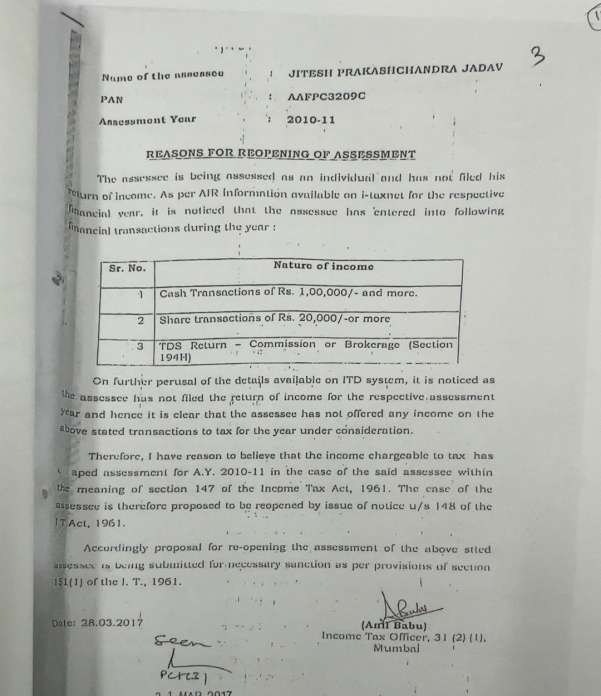
8. The learned AR took us through the reasons recorded for reopening dated 28.03.2017 and submitted that the PAN stated therein was “AAFPC3209C”, whereas the correct PAN of the assessee was “AFVPJ1480P”. It was further submitted that the reasons proceeded on the specific factual premise that the assessee had not filed his return of income. This was demonstrably incorrect because the assessment order itself recorded that the assessee had filed the return on 03.08.2010 declaring income of Rs.1,50,000/-.
9. The learned AR further pointed out that the proposal form for obtaining sanction bore the date 27.03.2017, whereas the reasons for reopening were recorded subsequently on 28.03.2017. The proposal form also stated that no voluntary return had been filed and left blank the column requiring disclosure of the quantum of income which had escaped assessment.
10. Referring to the approval form, the learned AR submitted that the Joint Commissioner had recorded the endorsement “I am satisfied on the reason recorded by AO” on 30.03.2017. The document thereafter contained the name and designation of the Principal Commissioner of Income-tax-31, Mumbai, and a date stamp of 31.03.2017. It was argued that no independent satisfaction of the Principal Commissioner was discernible from the document.
11. The learned AR contended that, since more than four years had expired from the end of the relevant assessment year, approval was required from the Principal Chief Commissioner and that approval by the Principal Commissioner was insufficient. Reliance was placed upon the judgment of the Hon’ble Supreme Court in Union of India v. Rajeev Bansal [2024] 167 taxmann.com 70/301 Taxman 238/469 ITR 46 (SC).
12. At this stage, it would be apposite to reproduce the relevant approval form placed on record by the assessee, containing the proposal of the Assessing Officer and the endorsements of the Joint Commissioner of Income-tax and the Principal Commissioner of Income-tax-31, Mumbai. The same is reproduced below:
–
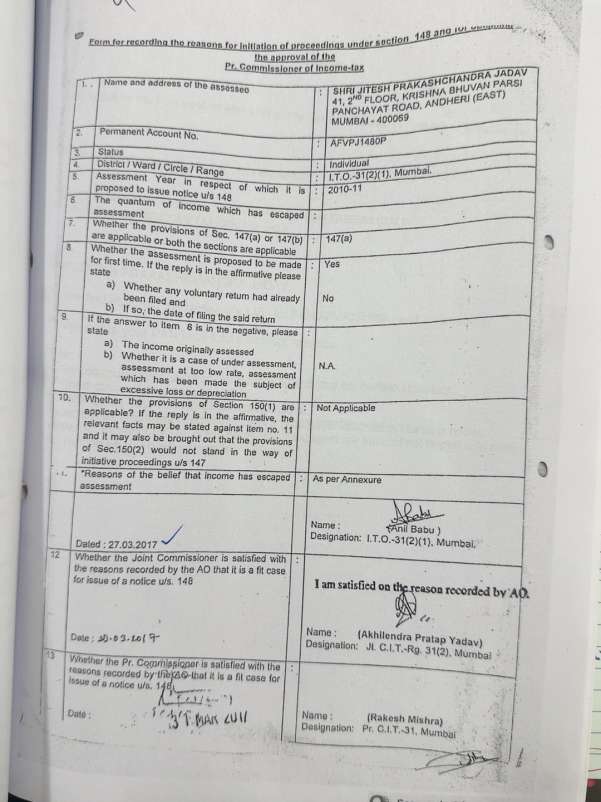
13. A perusal of the aforesaid approval form shows that the proposal bears the date 27.03.2017; the Joint Commissioner of Income-tax recorded the endorsement, “I am satisfied on the reason recorded by AO,” on 30.03.2017; and the form bears the signature of the Principal Commissioner of Income-tax-31, Mumbai, together with the date stamp of 31.03.2017. It is also noticed that the column requiring disclosure of the quantum of income which had escaped assessment has been left blank and the form records that no voluntary return had been filed.
14. The learned Departmental Representative relied upon the orders of the lower authorities and supported the validity of the reassessment proceedings as well as the additions confirmed by the learned CIT(A).
15. We have carefully considered the rival submissions and examined the assessment order, the impugned appellate order, the reasons recorded for reopening, the proposal seeking sanction, the approval form and the material placed in the paper book. We have also considered the judgment of the Hon’ble Supreme Court in Union of India v. Rajeev Bansal [2024] 167 taxmann.com 70/301 Taxman 238/469 ITR 46 (SC).
16. The assessment year under consideration is 2010-11 and the relevant assessment year ended on 31.03.2011. The notice under section 148 was issued on 31.03.2017. It was thus issued after the expiry of four years but within six years from the end of the relevant assessment year. Since the notice was issued before 01.04.2021, the validity of the reassessment has to be examined under sections 147 to 151 as they stood before their substitution by the Finance Act, 2021.
17. At the outset, we deal with the contention that sanction ought to have been granted only by the Principal Chief Commissioner and that sanction granted by the Principal Commissioner was without jurisdiction. Section 151(1), as applicable on the date of issuance of the notice, provided that, after the expiry of four years from the end of the relevant assessment year, notice under section 148 could be issued upon the satisfaction of the Principal Chief Commissioner or Chief Commissioner or Principal Commissioner or Commissioner. The authorities mentioned in the provision were alternatives. The provision did not require sanction exclusively from the Principal Chief Commissioner.
18. The Hon’ble Supreme Court in paragraph 4 of Union of India v. Rajeev Bansal explained the position under the old reassessment regime as under:
“Section 151 required the assessing officer to obtain the sanction of the specified authority before issuing a notice under section 148. In case the notice was issued within four years, the sanctioning authority was the Joint Commissioner. In case the notice was issued after the expiry of four years, the sanctioning authority was the Principal Chief Commissioner, Chief Commissioner, Principal Commissioner or Commissioner.”
19. The Hon’ble Supreme Court reiterated the position in paragraph 74(ii) as follows:
“If income escaping was more than Rupees one lakh: (a) a reassessment notice could be issued within four years after obtaining the approval of the Joint Commissioner; and (b) after four years but within six years after obtaining the approval of the Principal Chief Commissioner or Chief Commissioner or Principal Commissioner or Commissioner.”
20. In the present case, the approval form bears the signature of the Principal Commissioner of Income-tax-31, Mumbai, together with the date stamp of 31.03.2017. The Principal Commissioner was one of the authorities expressly empowered under section 151(1) to grant sanction. We, therefore, reject the contention that the sanction was invalid merely because it was granted by the Principal Commissioner instead of the Principal Chief Commissioner. Additional Ground No.1, to this limited extent, is dismissed.
21. The matter, however, does not rest with the competence of the sanctioning authority. The further question is whether the jurisdictional conditions for reopening were satisfied and whether the sanction was granted after a meaningful examination of the reasons recorded by the Assessing Officer. Paragraph 73 of Union of India v. Rajeev Bansal explains the purpose of section 151 in the following terms:
“Section 151 imposes a check upon the power of the Revenue to reopen assessments. The provision imposes a responsibility on the Revenue to ensure that it obtains the sanction of the specified authority before issuing a notice under section 148. The purpose behind this procedural check is to save the assesses from harassment resulting from the mechanical reopening of assessments.”
22. The reasons recorded by the Assessing Officer bear the date 28.03.2017. The name of the assessee is correctly stated therein as Shri Jitesh Prakashchandra Jadav. However, the PAN mentioned in the reasons is “AAFPC3209C”, whereas the correct PAN of the assessee, as appearing in the return, assessment order, appellate order and approval form, is “AFVPJ1480P”. The reasons thus contain a PAN different from the PAN of the assessee whose assessment was sought to be reopened.
23. The reasons further record that the assessee had not filed his return of income for the assessment year under consideration. On this premise, the Assessing Officer inferred that the assessee had not offered any income arising from the reported transactions to tax. This foundational assertion is demonstrably incorrect. The assessment order itself records that the assessee filed his return of income on 03.08.2010 declaring total income of Rs.1,50,000/-. The same incorrect statement that no voluntary return had been filed also appears in the proposal seeking approval.
24. It is, therefore, not a case where the Assessing Officer examined the return already filed and formed a belief that particular transactions or income had not been disclosed therein. The reasons proceed on the materially different and factually incorrect assumption that no return had been filed at all. The conclusion regarding escapement was drawn substantially from that incorrect premise. The reasons recorded cannot subsequently be supplemented by referring to the assessment proceedings or the material gathered after issuance of the notice.
25. We also find that the reasons merely refer to cash transactions of Rs.1,00,000/- and above, share transactions of Rs.20,000/- or more and TDS information relating to commission or brokerage under section 194H. These are broad reporting categories or thresholds. The reasons do not disclose the identity of the bank account, the dates and amounts of the cash deposits, the particulars of the share transactions, the value of the transactions or the amount of income which was believed to have escaped assessment.
26. This omission assumes greater significance because the notice was issued after the expiry of four years. Under section 149(1)(b), as applicable at the relevant time, a notice beyond four years could be issued only where the income chargeable to tax which had escaped assessment amounted to, or was likely to amount to, Rs.1,00,000/- or more. The recorded reasons do not state that the income which had escaped assessment amounted to or was likely to amount to Rs.1,00,000/- or more. A reference to a transaction of a particular value cannot, without further examination, be equated with income chargeable to tax escaping assessment.
27. Consistent with this omission, column 6 of the approval form, which requires disclosure of “the quantum of income which has escaped assessment”, has been left blank. The subsequent additions of Rs.13,80,000/- and Rs.35,24,618/- made in the assessment order cannot retrospectively supply the jurisdictional foundation absent from the reasons recorded before issuance of the notice.
28. The approval record further shows that the proposal form was signed by the Assessing Officer on 27.03.2017, whereas the reasons stated to be annexed to the proposal were recorded on 28.03.2017. The Joint Commissioner recorded his satisfaction on 30.03.2017, and the Principal Commissioner signed the approval form on 31.03.2017. Since the reasons had been recorded before the endorsements of the Joint Commissioner and the Principal Commissioner, the date appearing on the proposal form, by itself and in the absence of the complete movement or dispatch record, is insufficient to hold that the final sanction preceded the recording of reasons. Additional Ground No.3, treated as an independent challenge founded solely upon these dates, is therefore not accepted.
29. Nevertheless, the sequence of dates has to be considered along with the substantive discrepancies appearing in the record. The proposal dated 27.03.2017 referred to reasons contained in an annexure which itself bears the subsequent date of 28.03.2017. The reasons contain an incorrect PAN, wrongly state that no return had been filed and do not quantify the income alleged to have escaped assessment. The proposal repeats the incorrect return-filing status and leaves blank the column relating to the quantum of escaped income.
30. The approval form bears the signature of the Principal Commissioner. We are conscious that the sanctioning authority is not required to write an elaborate order or record detailed reasons while granting administrative approval under section 151. At the same time, the approval cannot be treated as an empty formality. The record must demonstrate that the competent authority considered the reasons and was satisfied that they disclosed a fit case for issuance of notice under section 148.
31. The existence of the Principal Commissioner’s signature cannot cure defects inherent in the reasons recorded by the Assessing Officer. Nor does the signature, by itself, establish meaningful application of mind when the material placed for approval contains an incorrect PAN, an objectively incorrect statement regarding non-filing of the return and no quantification of the income alleged to have escaped assessment. Had the reasons and proposal been examined with the care contemplated by section 151, these foundational discrepancies could not reasonably have remained unnoticed.
32. The defects in the present case are cumulative and go to the root of the jurisdiction assumed under sections 147 and 148. The incorrect PAN may, if considered in isolation, be capable of being regarded as a clerical error. However, when it is read with the incorrect assertion that no return had been filed, the absence of particulars connecting the reported transactions with taxable income, the failure to quantify the alleged escapement and the blank column in the approval form, the record does not disclose a valid and independent formation of belief followed by meaningful statutory satisfaction.
33. The contention of change of opinion cannot, however, be accepted because the material before us does not show that an assessment under section 143(3) had earlier been completed for the relevant assessment year. Nevertheless, even in the absence of an earlier scrutiny assessment, the Assessing Officer was required to form the statutory belief on correct and relevant material. A reassessment cannot be sustained merely because there was no earlier scrutiny when the reasons recorded themselves proceed on materially incorrect facts and do not establish the jurisdictional requirements applicable to a notice issued beyond four years.
34. We accordingly hold that the reasons recorded on 28.03.2017 do not disclose a valid jurisdictional foundation for issuance of notice under section 148 and that the approval granted on those reasons does not satisfy the substantive safeguard contemplated under section 151. Additional Ground No.2 and Ground Nos.1 to 3 of the original appeal are, therefore, allowed to this extent.
35. Consequently, the notice issued under section 148 on 31.03.2017 and the assessment order dated 22.12.2017 passed under section 143(3) read with section 147 of the Act are quashed. The additions of Rs.13,80,000/- and Rs.35,24,618/-, being founded upon the invalid reassessment proceedings, do not survive.
36. In view of our decision on the jurisdictional grounds, Ground Nos.4 to 6 challenging the additions on merits and seeking alternative estimation have become academic and require no separate adjudication. Ground No.7 and Additional Ground No.4 are general in nature and require no adjudication.
37. In the result, the appeal of the assessee is allowed.
Order pronounced in the open court on 21.08.2026.