
Deepak Kanubhai Bhatt Vs Assessing Officer (ITAT Surat)
Failure to Specify Misreporting Clause in Notice: ITAT Deletes ₹3.74 Lakh Section 270A Penalty
The Surat Bench of the Income Tax Appellate Tribunal (ITAT) deleted a ₹3,74,400 penalty under Section 270A imposed following withdrawal of a political donation deduction. In Deepak Kanubhai Bhatt v. Assessing Officer, the Tribunal found that the penalty notice did not identify the specific clause under Section 270A(9)(a) to (f) attracted by the alleged misreporting. The assessee had withdrawn his ₹6 lakh deduction under Section 80GGC in the return filed following reopening, and the Assessing Officer accepted that returned income. Holding the notice defective, the Tribunal allowed the assessee’s appeal.
Case Details
The decision was delivered in ITA No. 81/SRT/2026, concerning Assessment Year 2019–20, on 22 October 2026. The hearing concluded on 29 July 2026.
The Bench comprised Judicial Member Suchitra Kamble and Accountant Member B.M. Biyani. The assessee challenged the order dated 18 November 2025 passed by the Commissioner of Income Tax (Appeals), National Faceless Appeal Centre, Delhi, confirming the penalty.
Political Donation Deduction Withdrawn After Reopening
The assessee filed his original return on 26 June 2019, declaring total income of ₹10,89,220. He claimed a deduction of ₹6 lakh under Section 80GGC for a donation to Apna Desh Party.
Subsequently, the Department received information arising from a search conducted on 7 September 2022 in the case of a group of Registered Unrecognised Political Parties in Ahmedabad.
According to the assessment background recorded in the order, key persons of Apna Desh Party admitted that it facilitated tax evasion through bogus donations and earned commission.
A notice under Section 148 was issued on 18 April 2023. In response, the assessee filed a return on 20 April 2023, withdrawing the donation deduction and declaring income of ₹16,89,220.
Returned Income Accepted, but Penalty Imposed
The reassessment under Section 147 read with Section 144B was completed on 20 December 2024, accepting the income declared in response to the reopening notice.
Nevertheless, the Assessing Officer initiated penalty proceedings for under-reporting of income consequent to misreporting, based on the deduction claimed in the original return.
The assessee responded to the penalty notice and a subsequent show-cause notice. After considering his replies, the Assessing Officer imposed a ₹3,74,400 penalty under Section 270A.
The first appellate authority dismissed the assessee’s appeal, leading him to approach the Tribunal.
Assessee Questions Applicability and Specific Charge
The assessee argued that he had withdrawn the deduction while filing the return in response to the Section 148 notice and had also paid interest.
He emphasised that the Assessing Officer accepted that return without making any further addition. On this basis, he disputed the application of Section 270A(9).
Separately, he challenged the validity of the penalty notice, contending that it did not specify which of the clauses (a) to (f) of Section 270A(9) was invoked.
He relied on Grand Legacy v. DCIT, (2026) (3) TMI 800, ITAT Dehradun.
Revenue Relies on Withdrawal After Detection
The Revenue argued that the deduction was withdrawn only after reopening based on information concerning bogus political donations. It therefore maintained that the surrender was not voluntary and did not erase the original default.
It relied on Gunmala Jain v. Income-tax Officer, [2026] 182 taxmann.com 451 (Jaipur Tribunal), submitting that withdrawal after reopening did not prevent penalty for misreporting.
The Revenue further contended that the assessee had not established the donation’s genuineness or demonstrated a bona fide basis for the original claim.
It also disputed the notice objection, arguing that the assessment and penalty orders sufficiently identified the charge.
Tribunal Finds Notice Failed to Identify Applicable Clause
The Tribunal examined the assessment order and the penalty notice. It noted that the notice referred generally to under-reporting consequent to misreporting, without specifying the particular condition under Section 270A(9)(a) to (f).
The notice reproduced in the order referred to details in the assessment order but did not identify the applicable statutory clause.
The Bench held that the Assessing Officer had not specified which limb was triggered by the original Section 80GGC claim. Consequently, it found that the notice itself was not proper.
It also noted that the assessee had withdrawn the deduction, included the amount in total income, and been assessed on that same income.
Jaipur Ruling Distinguished; Penalty Deleted
The Tribunal held that Grand Legacy applied to the present case.
It distinguished Gunmala Jain, observing that the notice in that case specified the charge under Section 270A(9)(a), whereas such specification was absent here.
Accordingly, the Tribunal concluded that the Section 270A penalty could not be sustained and allowed the appeal.
The ruling turns on the defective notice and the circumstances recorded. It does not uphold the withdrawn donation deduction or establish that withdrawing every disputed claim after reopening automatically eliminates penalty exposure. The distinction was the failure to specify the applicable misreporting clause in the notice.
Cases Discussed
- Grand Legacy Vs DCIT — (2026) (3) TMI 800, ITAT Dehradun; followed. TaxGuru publication link not independently verified.
- Gunmala Jain Vs ITO — [2026] 182 taxmann.com 451 (ITAT Jaipur); distinguished. TaxGuru publication link not independently verified.
- Related TaxGuru reading (not precedents cited in this judgment): Soheb Malik Vs DCIT (ITAT Delhi); Vachan Singh Vs DCIT (ITAT Mumbai).
FULL TEXT OF THE ORDER OF ITAT SURAT
The appeal filed by the assessee is against the order passed by the Commissioner of Income Tax (Appeals), National Faceless Appeal Centre (NFAC), Delhi [in short “CIT(A)”] dated 18.11.2025 for the Assessment Year (in short “AY”) 2019-20.
2. The assessee has raised the following grounds of appeal:
“1) The impugned order passed by the learned Assessing officer as well as the Learned CIT(A) are contrary to the facts and legal proposition and therefore, the impugned both the order deserves to be quashed and set aside in the best interest of justice.
(2) The learned Assessing officer as well as the CIT (A) has committed serious error or law in imposing and upholding the penalty under the provisions of section 270A(9) irrespective of the fact that the deduction was given up by the appellant, on becoming conscious of the fact of modus operandi of the RUPP, and no other addition has been made by the learned Assessing officer.
(3) The learned assessing officer as well as the CIT (A) has erred in passing and upholding the impugned order in disregard of various judicial pronouncements and therefore, the order passed by the learned Assessing officer and learned CIT(A) may please be deleted in the best interest of justice.
(4) The appellant craves for leave to add or amend or alter any of the grounds of appeal.”
3. The assessee filed return u/s 139 of the Income Tax Act, 1961 (in short “the Act”) on 26.06.2019 declaring total income of Rs.10,89,220/-. Subsequently, information was received regarding search and seizure action u/s 132 of the Act in the case of Registered Unrecognized Political Party Group of Ahmedabad on 7.9.2022 wherein the key persons of Apna Desh Party admitted that the party was formed for the sole purpose of aiding and abetting tax evasion and earning commission through bogus donations. In the return filed u/s 139 dated 26.06.2019, assessee claimed deduction u/s 80GGC amounting to Rs. 6,00,000/- on account of donation to Apna Desh Party. The case was reopened and notice u/s 148 dated 18.04.2023 was issued. In response to said notice, the assessee filed return on 20.04.2023 wherein the initial claim of donation u/s 80GGC amounting to Rs.6,00,000/- to Apna Desh Party was withdrawn. The assessment u/s 147 r.w.s. 144B of the Act was completed on 20.12.2024 accepting return of income filed u/s 148 amounting to Rs.16,89,220/-. Subsequently, penalty u/s 270A of the Act was initiated for under-reporting of income which is in consequence of misreporting of the income on account of assessee’s claim of donation u/s 80GGC amounting to Rs.6,00,000/- in the return filed u/s 139. Notice u/s 274 r.w.s. 270A was issued on 20.12.2024 which was responded by the assessee on 04.01.2025. Show Cause Notice was issued on 03.04.2025 which was responded on 04.04.2025 by the assessee. The Assessing Officer after considering assessee’s reply levied penalty of Rs. 3,74,400/- u/s 270A of the Act for under reporting of income as a consequence of misreporting.
4. Being aggrieved by the Penalty Order u/s 270A, the assessee filed appeal before the CIT(A). The CIT(A) dismissed the appeal.
5. The Ld. Authoritised Representative (in short “the Ld. AR”) submitted that the assessee withdraw his claim of donations u/s 80GGC while filing return of income in response to notice u/s 148 of the Act. Thus provisions of sec. 270A(9) will not be applicable. In fact, the assessee also paid interest. The Assessing Officer while passing assessment u/s 147 has accepted the return of income filed by assessee in response to notice u/s.148. The Ld. AR relied upon the decision of Tribunal in case of Grand Legacy Vs. DCIT (2026)(3) TMI 800 – ITAT Dehradun. The Ld. AR further submitted that the notice issued u/s. 274 r.w.s. 270A does not specify charge of the Section that is under which clause from (a) to (f) penalty u/s. 270A was invoked.
6. The Ld. Departmental Representative (in short “Ld. DR”) submitted that the assessee, while filing the original return of income under section 139, claimed deduction of Rs.6,00,000/- under section 80GGC in respect of donation made to Apna Desh Party. Subsequently, on the basis of credible information emanating from the search conducted in the case of Registered Unrecognised Political Parties (RUPPs), it was found that Apna Desh Party was merely an accommodation entry provider issuing bogus donation receipts for enabling wrongful deduction under section 80GGC. Consequent to such information, notice under section 148 was issued. Only thereafter did the assessee file a return in response to the notice withdrawing the deduction claimed under section 80GGC and offering the amount to tax. Penalty proceedings under section 270A were accordingly initiated and penalty for misreporting of income was levied, which has rightly been confirmed by the CIT(A). The issue is now squarely covered in favour of the Revenue by the decision of the Jaipur Bench of the Tribunal in Gunmala Jain v. Income-tax Officer [2026] 182 taxmann.com 451 (Jaipur Trib.), wherein, on identical facts involving bogus political donations claimed under section 80GGC and withdrawn only after reopening under section 148 pursuant to investigation in RUPP cases, the Tribunal categorically held that the reassessed income being higher than the originally assessed income squarely attracts section 270A(2)(c). The Tribunal further held that the withdrawal of deduction in the return filed under section 148 is of no consequence for determining whether there is under-reporting of income and that such subsequent withdrawal does not erase the original default. The Tribunal further examined whether the assessee could claim the benefit of exclusion contained in section 270A(6)(a) and held that such benefit is available only where the assessee offers a bona fide explanation supported by full disclosure of material facts. In that case, as in the present appeal, the assessee merely withdrew the claim without establishing the genuineness of the donation or explaining how the original claim was bona fide. The Tribunal therefore held that withdrawal of the deduction merely “to buy peace of mind” is not a bona fide explanation and consequently the exclusion under section 270A(6) is not available. The Tribunal ultimately upheld the levy of penalty under section 270A(9). In the present case also, the assessee has failed to produce any evidence demonstrating that the donation was genuine or that the claim under section 80GGC was made on the basis of bona fide belief. On the contrary, the material collected during the search clearly established that Apna Desh Party was engaged in providing accommodation entries through bogus political donations and the assessee withdrew the claim only after receipt of notice under section 148. Therefore, the surrender cannot be regarded as voluntary. It was a clear case of withdrawal after detection and the original return undoubtedly contained a false claim resulting in under-reporting of income and misrepresentation of facts attracting section 270A(9)(a). The Ld. DR further submitted that both the assessment order and the penalty order specifically record that penalty proceedings were initiated for under-reporting of income in consequence of misreporting of income by way of misrepresentation of facts. Thus, the specific charge has been clearly mentioned and the assessee’s plea regarding absence of a definite charge is factually untenable. The Jaipur Bench in Gunmala Jain (supra) has also rejected an identical contention after examining the assessment order and penalty notice. In view of the above facts, the Ld. DR submitted that the statutory provisions and the direct decision of the Jaipur Bench of the Tribunal in Gunmala Jain v. ITO (supra), which is based on an identical factual matrix, the penalty levied under section 270A(9) has been rightly confirmed by the CIT(A). The order of the CIT(A) is well reasoned and does not call for any interference. The appeal filed by the assessee therefore deserves to be dismissed.
7. We have heard both the parties and perused all the relevant material available on record. It is pertinent to note that the assessee after reopening assessment u/s.147, withdrew the claim of donation in response to notice u/s.148 of the Act. Extract of para 4 of assessment order is as follows:
“4. Conclusion Drawn: The issue under consideration i.e. bogus deduction claim made u/s 80GGC of the Act has duly been examined and it has been noticed although the assessee claimed the same in his ITR filed u/s 139 of the Act but has not claimed the same in his latest ITR as mentioned above. Therefore, no adverse inference is drawn with regard to it and the total income declared by the assessee in his ITR filed in response to the notice u/s 148 of the Act is accepted.
Here it is pertinent to mention that the deduction claimed by the assessee under section 80GGC of the Act in his ITR filed u/s 139 of the Act has been found bogus and by making the aforesaid bogus claim as deduction u/s 80GGC of the Act in his ITR filed under section 139 of the Act, the assessee has under reported his income which is in consequence of misreporting thereof as per the provisions of Section 270A of the Act. Accordingly, penalty proceeding u/s 270A of the Act is being initiated against the assessee for under reporting of his income which is in consequence of misreporting thereof.”
The notice issued u/s. 274 r.w.s. 270A does not specify the particular conditions as mentioned in subclause (a) to (f) of Section 270A(9) which is that of under-reporting income which is in consequence of misreporting. Extract of Notice u/s 274 r.w.s. 270A is as follows:
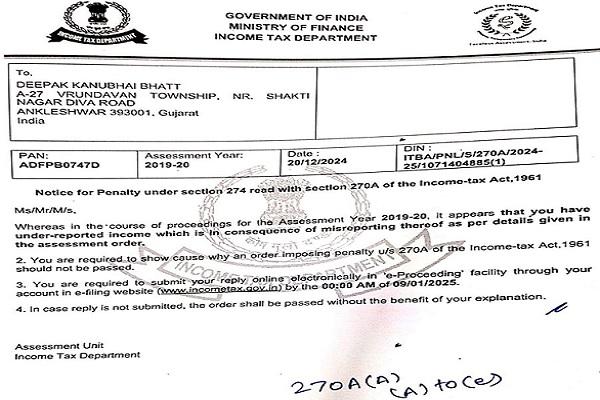
Claiming deduction u/s. 80GGC in the original returns was not specified by the AO as to what limb of section 270A(9) (a) to (f) will trigger. Thus, the notice itself was not proper. Subsequently the assessee withdrew the claim and added the said amount to his total income and same amount was assessed as total income by Assessing officer. The decision of Tribunal in case of Grand Legacy (Supra) is applicable in present case. As related to Ld. DR’s reliance on the decision of Tribunal in case of Gunmala Jain (supra) the notice in that case specified the charge/limb that of clause (a) of Sec. 270A(9). But that is absent in present assessee’s case. The present assessee has withdrawn the claim of 80GGC. Therefore, the decision of Jaipur Tribunal in case of Gunmala Jain will not be applicable in present case. The penalty imposed u/s. 270A does not sustain.
8. In result, appeal of the assessee is allowed.



