Smt. Shashi Jain Vs PCIT (ITAT Kolkata)
The ITAT Kolkata quashed the revision order dated 24.06.2020 under Section 263 for Assessment Year 2015-16. The assessee had declared income of Rs.2,69,870, and the Assessing Officer accepted the return following limited scrutiny of her property purchase. The Principal Commissioner considered the assessment erroneous because a jointly purchased property had consideration of Rs.31,24,430 against assessed market value of Rs.1,04,85,500, proposing to tax the assessee’s half-share of the difference, Rs.36,80,535, under Section 56(2)(vii)(b).
The assessee explained that the agreement fixing the consideration was executed on 30.01.2008 and cheque payments totalling Rs.5 lakh had been made in 2006, although the conveyance deed was registered on 02.12.2014. The Tribunal found that the Assessing Officer had made enquiries into the purchase during limited scrutiny. It also noted the Principal Commissioner’s inconsistent reliance on clauses (a) and (b) of Explanation 2 to Section 263 without identifying precisely why the enquiry was deficient.
On the substantive issue, the Tribunal held that the amended Section 56(2)(vii)(b) could not be applied merely because registration occurred in Financial Year 2014-15 when the agreement was concluded in 2008. The Tribunal considered the original provision introduced in 2009 and the later Finance Act, 2013 amendment, as well as the provisos addressing different agreement and registration dates. The revision was quashed and the assessee’s appeal allowed.
FULL TEXT OF THE ORDER OF ITAT KOLKATA
This appeal filed by the assessee is against the revision order of Ld. CIT-15, Kolkata passed u/s. 263 of the Income-tax Act, 1961 (hereinafter referred to as the “Act”), dated 24.06.2020 passed against the order of assessment by ITO, Ward-45(2), Kolkata u/s. 143(3) of the Act dated 07.07.2017 for AY 2015-16.
2. Assessee has taken five grounds of appeal, challenging the invocation of revisionary proceeding u/s. 263 of the Act and order passed thereafter. In the course of appellate proceeding, additional ground has also been raised contending that exercise of power u/s. 263 of the Act by the Ld. Pr. CIT is without looking into the provisions of Section 56(2)(vii)(b) of the Act which was beyond the purview of the Ld. AO as the case was selected for limited scrutiny only with the reason being ‘purchase of property’.
3. From the perusal of the additional ground taken by the assessee, we note that it is more in the nature of peripheral argument on the ground taken by the assessee in the Memo of Appeal. Thus, we do not find appropriate to give a separate finding on this additional ground and is not adjudicated upon.
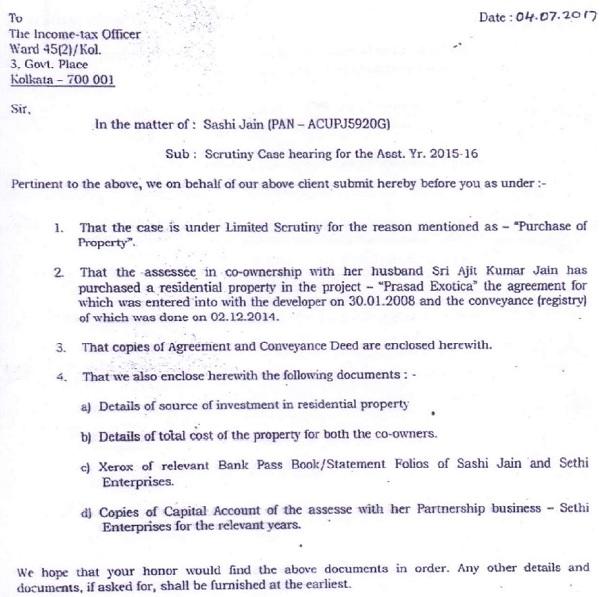
4. Brief facts are that assessee had filed her return of income on 20.03.2016 reporting a total income of Rs.2,69,870/-. From the perusal of notice issued u/s. 143(2) of the Act, it is noted that case of the assessee was selected for limited scrutiny by identification of the issue, “Purchase of Property”. In the course of assessment proceedings, assessee had replied to the AO vide letter dated 04.07.2017 wherein she had furnished all the details and explanations in respect of issue of ‘purchase of property’. The same is reproduced as under:
4.1. Ld. AO completed the assessment by accepting the returned income. Subsequently, Ld. Pr. CIT called for the assessment records and after perusing the same, found that during the year under consideration, assessee had purchased a residential property jointly with Shri Ajit Kumar Jain (spouse of the assessee) from Geeta Promoters Ltd. for a consideration of Rs.31,24,430/- whose market value was assessed at Rs.1,04,85,500/-. According to Ld. Pr. CIT, AO has not assessed the differential amount of Rs.73,61,070/-
(Rs.1,04,85,500 – Rs.31,24,430/-) u/s. 56(2)(vii)(b) of the Act. Since the assessee had purchased the property jointly having 50% share, Rs.36,80,535/- i.e. 50% of Rs.73,61,070/-, according to ld. Pr. CIT should have been added back to the income of the assessee as income from other sources u/s. 56(2)(vii)(b) of the Act. Assessee furnished her detailed reply explaining the facts of the case and the position of law in respect of applicability of Section 56(2)(vii)(b) of the Act vide her reply dated 16.12.2019 which has been reproduced in the impugned order.
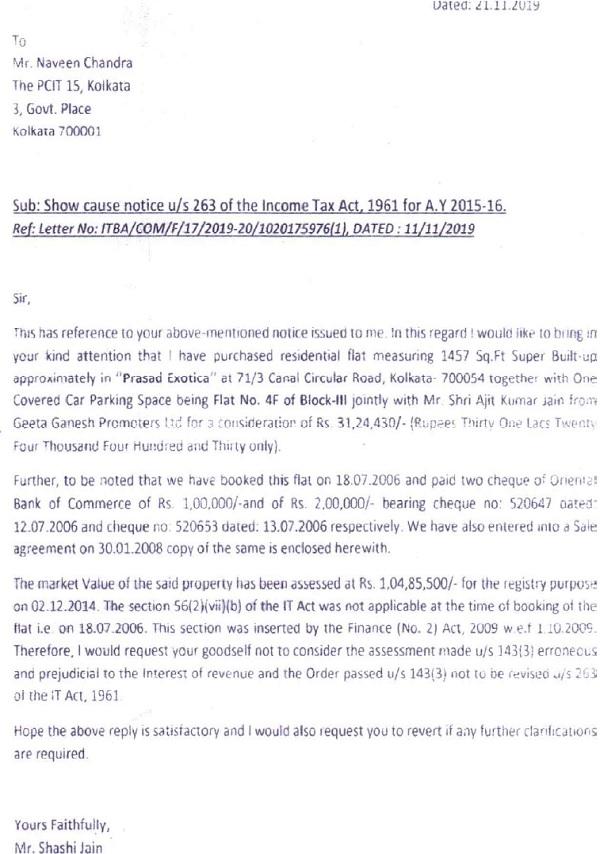
4.2. We note that assessee had furnished a detailed explanation on her transaction of purchase of property even before the Ld. Pr. CIT vide letter dated 21.11.2019 dealing with the facts of the transaction as well as the position of law applicable on the said transaction. The same is extracted below:
4.3. Ld. Pr. CIT did not find favour with the assessee on the submissions made before him and drew his consideration that the assessment order passed u/s. 143(3) of the Act by Ld. AO dated 07.07.2017 is erroneous insofar as it is prejudicial to the interest of revenue within the meaning of section 263(1) and its explanation 2, clause (a) of the Act. He thus, directed the Ld. AO for a fresh assessment order in accordance with the relevant provisions of law. Aggrieved, assessee is in appeal before the Tribunal.
5. We have heard the rival contentions and perused the material on record. We note that the moot point under consideration is applicability of Section 56(2)(vii)(b) of the Act in respect of purchase transaction of the property under consideration. In this respect, we first take note of the fact that case of the assessee was selected for limited scrutiny for which the issue identified was for purchase of property as noted above. Assessee had furnished the relevant details and documents in respect of her transaction for purchase of property jointly with her spouse Shri Ajit Kumar Jain. In the said reply, assessee had stated that she had purchased a residential property in the project “Prasad Exotica” for which an agreement for sale was entered with the developer on 30.01.2008 and the conveyance deed was registered on 02.12.2014. For these details, assessee had also furnished the source of investment in the said property which is extracted below:
5.1. From the above details of investment made by the assessee it was pointed that three payments on 12.07.2006, 26.08.2006 and 29.08.2006 totalling to Rs. 5 lacs were paid by cheque from the capital account of the partnership firm M/s. Sethi Enterprise, of which the assessee is a partner. According to the assessee, these payments were made prior to the date of agreement for sale which was entered into between the developer and the assessee on 30.01.2008. It was submitted that although registry of the conveyance deed for the property was executed in the FY 2014-15 but the agreement to purchase the said property was executed in FY 2007-08 for which a part payment was made by cheque as stated above, therefore, provisions ofSection 56(2)(vii)(b) of the Act are not applicable in the present case of the assessee.
From the decision drawn by Ld. Pr. CIT, we note that there are twofold contentions which have been dealt with, first being in respect of Ld. AO has failed to make adequate and proper enquiries to ascertain the true nature and period of transfer for purchase of property and the second one relating to applicability of Section 56(2)(vii)(b) of the Act when the agreement to purchase the property was executed in the FY 2007-08 though the registry of the conveyance deed was executed in FY 2014-15.
6.1. On the first fold of contentions, we note that in para 4.2, Ld. Pr. CIT has referred to clause (a) to (d) of Explanation (2) to Section 263 and concluded that this case clearly falls under clause (b) to Explanation (2) to section 263 of the Act. However, in subsequent paragraphs 7 and 8, Ld. Pr. CIT refers to clause (a) of Explanation (2) to Section 263 of the Act and held that Ld. AO had failed to conduct “adequate” and “proper” enquiry in this respect. On going through the two clauses i.e. clause (a) and (b) of Explanation (2) to Section 263 of the Act, we note that clause (a) refers to a situation where order is passed without making enquiry or verification which should have been made and clause (b) refers to a situation where order is passed allowing any relief without enquiry into the claim. It is important to note that the assessment was under limited scrutiny on the issue of purchase of property as stated above. Ld. AO had enquired into the transaction of purchase of property by the assessee and necessary details and explanations and corroborative evidence are placed on record. Ld. Pr. CIT while invoking his power u/s. 263 of the Act observed that Ld. AO did not make proper enquiry. It is not clear as to what in the opinion of Ld. Pr. CIT is “proper enquiry”. By using such expression, it principally suggests that Ld. AO did conduct an enquiry. However, in the opinion of Ld. Pr. CIT, the enquiry was not proper for which nothing is stated in clear terms as to how and why the enquiry was not proper. Further, we note that reference has been made to two separate clauses to Explanation (2) to Section 263 which dealt with two different situations. It leads us to believe about the indecisiveness on the part of the Ld. Pr. CIT.
7. On the second fold of the contentions, let us first understand the position of law from the relevant provisions of Section 56(2)(vii) which are reproduced as under. The pre-amended provision of section 56(2)(vii)(b) of the Act inserted by Finance (No.2) Act, 2009 w.e.f. 01.10.2009 is as under:
“(b) any immovable property, without consideration, the stamp duty value of which exceeds fifty thousand rupees, the stamp duty value of such property.”
7.1. Subsequently, sub-clause (b) was substituted by the Finance Act, 2013 w.e.f. 01.04.2014 and the amended provision is as under:
“Income from other sources.
56.(1) .
(2) In particular, and without prejudice to the generality of the provisions of sub-section(1), the following incomes, shall be chargeable to income-tax under the head “Income from other sources”, namely :-
(i)…
(vii) where an individual or a Hindu undivided family receives, in any previous year, from any person or persons on or after the 1st day of October, 2009 [but before the 1st day of April, 2017],-
i. any immovable property,-
ii. without consideration, the stamp duty value of which exceeds fifty thousand rupees, the stamp duty value of such property;
iii. for a consideration which is less than the stamp duty value of the property by an amount exceeding fifty thousand rupees, the stamp duty value of such property as exceeds such consideration:
Provided that where the date of the agreement fixing the amount of consideration for the transfer of immovable property and the date of registration are not the same, the stamp duty value on the date of the agreementmay be taken for the purposes of this sub-clause:
Provided further that the said proviso shall apply only in a case where the amount of consideration referred to therein, or a part thereof has been paid by any mode other than cash on or before the date of the agreement for the transfer of such immovable property.”
7.2. From the above, we note that section 56(2)(vii) was originally introduced in the statute book w.e.f. 01.10.2009 which was not in existence when the impugned agreement to purchase the property was executed i.e. on 30.01.2008. Thus, Section 56(2)(vii) came into existence after the execution of agreement to purchase of property. The purchase consideration of Rs.31,24,430/- was fixed by this agreement for purchase and part payment had already been made on the dates stated above. Accordingly, at the relevant point in time, when the agreement for purchase was executed, there was no such law which necessitated the market value of the property be deemed as consideration price and take the difference as income from other sources. Further, the pre-amended sub-clause (b) dealt with only those situations where the transaction in immovable property is without consideration, which is not so in the present case. Also, the post amended sub-clause (b) which is effective from 01.04.2014 contains proviso whereby the stamp duty value on the date of agreement may be taken if the date of agreement fixing the amount of consideration for the transaction of immovable property and the date of registration are not same and part of consideration has been paid by any mode other than cash on or before the date of the agreement for the transaction of such immovable property.
7.3 The pre amended law evidently did not cover a situation where an immovable property was received by an individual or HUF for a consideration, whether adequate or inadequate, whether consideration was less than the stamp duty valuation by an amount exceeding Rs.50,000/-. In other words, the pre-amended law which was applicable up to A.Y. 2013-14 never contemplated such a situation and it was only in the amended law, specifically made applicable from A.Y. 2014-15 that any receipt of the immoveable property with inadequate consideration has been subjected to the provisions of Sec. 56(2)(vii)(b) but not before that. Hence, applicability of the said provision in such cases, could not be insisted in the assessment years prior to a A.Y. 2014-15. Having said this, in this case, there was a valid and lawful agreement entered by the parties long back in A.Y. 2008-09 only, when the subject property was transferred and substantial obligations were discharged. The law contained in section 56(2)(vii)(b) as stood at that point of time, did not contemplate a situation of a receipt of property by the buyer without inadequate consideration. Hence, we are of considered view that ld. Pr.CIT erred in applying the said provision. Because of the mere fact that the flat was registered in the year 2014 falling in A.Y. 2015-16, the amended provision of Section 56(2)(vii)(b)(ii) cannot be applied.
7.4. Hence, we are not in agreement with the view taken by the ld. Pr.CIT holding the applicability of section 56(2)(vii)(b)(ii) in the facts and circumstances of the case and therefore we hold that the assessment order, subjected to revision u/s 263, is not erroneous and prejudicial to the interest of the revenue. Therefore, considering the totality of facts and circumstances of the case, the impugned order passed u/s 263 of the Act by the Ld. Pr. CIT, is quashed. Grounds taken by the assessee are allowed.
8. In the result, appeal of the assessee is allowed.
Order pronounced in the open court on 27th March, 2023.