
Sh. Jagjeet Singh Vs DCIT ACIT (ITAT Amritsar)
Summary: ITAT Amritsar quashed the revisionary orders passed under Section 263 for AYs 2017-18 and 2018-19 in the case of Sh. Jagjeet Singh. The assessee’s assessments had been reopened on the basis of a ledger account found and seized during a search conducted on the Homeland Group. The Tribunal held that where the entire reassessment was founded on material discovered during search on another person, the appropriate statutory course was proceedings under Section 153C and not reassessment under Section 147. The Tribunal relied on DCIT Vs Dinakara Suvarna and held that the AO had erred in invoking reassessment proceedings under Section 147. Consequently, the subsequent action founded upon the invalid assessment was without jurisdiction. The Tribunal also accepted the assessee’s contention regarding the unsigned reasons recorded for reopening and noted that the cases relied upon on this issue were applicable. Independently, on the merits of Section 263, the Tribunal found that the Revenue had failed to establish that the AO’s order was erroneous and prejudicial to the interests of Revenue. The record showed that documents had been furnished and examined during assessment proceedings, while the assessment of Kapil Romanna had also been available before the assessee’s reassessment was completed. Mere allegation of non-application of mind was therefore insufficient. Holding that the PCIT’s findings were infirm and contrary to the factual record, the Tribunal concluded that it was not a fit case for invoking Section 263 and quashed the revisionary order. Both assessee appeals were allowed.
Cases Discussed
- Great Eastern Shipping Co. Ltd. v. National Faceless Assessment Centre/National e-Assessment Centre, [2023] 157 taxmann.com 442 (Bombay High Court) — Relied upon by the assessee on the proposition that unsigned or draft reasons cannot constitute final reasons recorded by the Assessing Officer; the Tribunal found the authorities relied upon on this issue applicable.
- DCIT v. Sri Dinakara Suvarna, [2023] 151 taxmann.com 489 (Supreme Court) — Relied upon and followed for holding that where reassessment was founded on material discovered during search, proceedings were required under Section 153C rather than Section 147.
- ITO v. Arun Kumar Kapoor, [2011] 16 taxmann.com 373 (ITAT Amritsar) — Relied upon by the assessee on applicability of Section 153C to material found during search.
- Surinder Singh, 2012 (9) TMI 1109 (ITAT Amritsar) — Relied upon by the assessee in support of the Section 153C jurisdictional objection.
- G. Koteswara Rao v. DCIT, [2015] 64 taxmann.com 159 (ITAT Visakhapatnam) — Relied upon by the assessee regarding the appropriate statutory proceedings where material is found during search.
- Kiran Singh v. Chaman Paswan, 1954 (4) TMI 48 (Supreme Court) — Relied upon for the principle that an order passed without jurisdiction is a nullity and its invalidity may be challenged whenever it is sought to be enforced or relied upon.
- PCIT v. Badal Prakash Jindal, [2023] 150 taxmann.com 483 (Orissa High Court) — Followed by the Tribunal for holding that consequential revisionary proceedings cannot survive where the foundational reassessment is without jurisdiction.
- Keshab Narayan Banerjee v. CIT, [1999] 238 ITR 694 (Calcutta High Court) — Relied upon for invalidity of Section 263 proceedings arising from a jurisdictionally defective reassessment.
- Meerut Roller Flour Mills (P.) Ltd. v. CIT, [2019] 110 taxmann.com 170/[2019] 267 Taxman 18 (Allahabad High Court) — Relied upon for the proposition that Section 263 cannot be invoked where the AO had made enquiries and applied his mind.
- CIT v. Nirav Modi, [2017] 77 taxmann.com 15 (Supreme Court) — Relied upon in support of the proposition that revision is not sustainable where the AO had conducted proper enquiries and adopted a view on the material.
- Geevee Enterprises v. Addl. CIT, 99 ITR 375 (Delhi High Court) — Cited by the assessee while addressing the distinction between absence of enquiry and an assessment made after enquiry.
- CIT v. Max India Ltd., (2007) 295 ITR 282 (Supreme Court) — Relied upon for the twin requirements that an assessment order must be both erroneous and prejudicial to Revenue before Section 263 jurisdiction can be exercised.
- Malabar Industrial Co. Ltd. v. CIT, (2000) 243 ITR 83 (Supreme Court) — Relied upon for the principle that Section 263 cannot be invoked merely because the Commissioner prefers another permissible view; the order must satisfy both statutory conditions of error and prejudice.
FULL TEXT OF THE ORDER OF ITAT AMRITSAR
The captioned both the appeals have been filed by the assessee against the order dated even dated 05.03.2024 passed u/s 263 of the Act by the Ld. Pr. Commissioner of Income Tax-01, Amritsar, (hereinafter referred to as “the PCIT”) arising out of assessment orders dated 24.03.2022, passed U/s 147 r.w.s 144B of the Act, in respect of Assessment Year 2017-18 and 2018-19.
2. The appellant assessee has raised the following common grounds of appeal:
“1. That the order passed u/s 263 by the Ld. PCIT is illegal, bad in law and without jurisdiction. The order passed by the Ld. AO u/s 147 r.w.s 144B is neither erroneous nor prejudicial to the interests of the revenue.
2. That the order u/s 263 by the Ld. PCIT is illegal, bad in law and without jurisdiction as the Ld. PCIT has failed to consider the replies furnished in response to notice issued u/s 263.
3. That the order u/s 263 passed by the PCIT is illegal and bad in law since the very assessment order passed u/s 147 is without jurisdiction. That the order passes u/s 147 is bad in law as the same has been completed on the basis of unsigned reasons recorded.
4. That the order u/s 263 passed by the PCIT is illegal and bad in law since the very assessment order passed u/s 147 is without jurisdiction. That the order passes u/s 147 is bad in law since, it is framed by considering alleged material found during search as mentioned in para 2 of order u/s 263 and the proper course of action if any was u/s 153C and not 147.
5. That the order passed u/s 263 is bad in law since, the same is based upon incorrect facts in as much the Ld. PCIT has pointed out that the order passed u/s 147 is erroneous as the same has been passed by the Assessing Officer without considering the statement of Sh. Kapil Romanna. That the revision order passed u/s 263 is contrary to the findings of the AO in the case of Sh. Kapil Romanna u/s 153A.
6. That the order passed u/s 263 is bad in law since the PCIT has failed to conduct his own inquiry before passing order u/s 263.
7. That the order passed u/s 263 is bad in law since the Ld. PCIT has erred in not appreciating that powers of revision u/s 263 cannot be invoked merely because the Assessing Officer did not write specific reasons for accepting the explanation of the assessee.
8. That the Ld. PCIT has erred in invoking explanation 2 of section 263(1) as the explanation does not authorize unfettered powers to the CIT to revise each and every order passed by the AO if in his opinion the same has been passed without making enquiries/ verification which should have been made.
3. Briefly, the facts of the case are that the assessee is a pediatrician doctor by profession, in Bathinda and he is serving the community through his establishment, “The Chandigarh Children & Maternity Hospital.” The assessee had filed its income tax return for the AY 2017-18 on 14.10.2017 declaring income of Rs. 61,92,130/- There was a search operation conducted u/s 132 of the Act in the case of Homeland Group on 26.02.2020. During the search, a copy of the ledger account of Sh. Jagjeet Singh was found and seized from the premises of Sh, Kapil Romana (M/s Homeland Group). Consequently, case of the appellant was reopened u/s 147 of the I T Act after getting approval u/s 151 of the I T Act, 1961 and notice u/s 148 of the I T Act, 1961 was issued on 30.03.2021 requiring the assessee to file income tax return. In response to the notice u/s 148, the appellant filed the return of income on 18.05.2021 declaring total income of Rs. 61,92,130/-. The assessment for the AY 2017-18 was completed vide order passed u/s 147 r.w.s 144B on 24.03.2022 whereby the returned income of Rs. 6192130/- was accepted by the AO.
4. The Ld. PCIT initiated proceedings under section 263 of the Act vide show cause notice u/s 263 vide letter No. 2607 on 22.02.2022 seeking to revise the assessment order passed on 24.03.2022 with a view that the assessment order is erroneous and prejudicial to the interest of revenue and alleged that the AO had failed to carry out necessary inquiries and verification on the issue of unexplained cash transactions recorded in the ledger account which showed cash credits totaling to Rs. 1,50,69,500/- during the demonetization period in November 2016, with Sh. Kapil Romana charging a commission of Rs. 19,59,035 and crediting interest of Rs. 3,87,926. The PCIT in show cause notice u/s 263 has pointed out that the AO while passing the order has failed to bring on record the treatment of entries appearing in the ledger account seized in the assessment records of Kapil Romanna. It was also stated that the appellant has relied upon the provisions of the evidence act which are not applicable in income tax. Accordingly, the Pr. CIT passed the order under section 263 of the Act on 05.03.2024.
5. In ground no. 3 the appellant challenged that the order u/s 263 passed by the PCIT is illegal and bad in law since the very assessment order passed u/s 147 is without jurisdiction as the order passes u/s 147 was bad in law as it was completed on the basis of unsigned reasons recorded.
6. The Ld. Counsel Sh. Rohit Kapoor for the appellant has drawn the attention of the bench towards reasons to believe and the same is part of Assesse Paper Book (in short “APB”) at page nos. 6-8. The relevant snapshot is reproduced as under: – 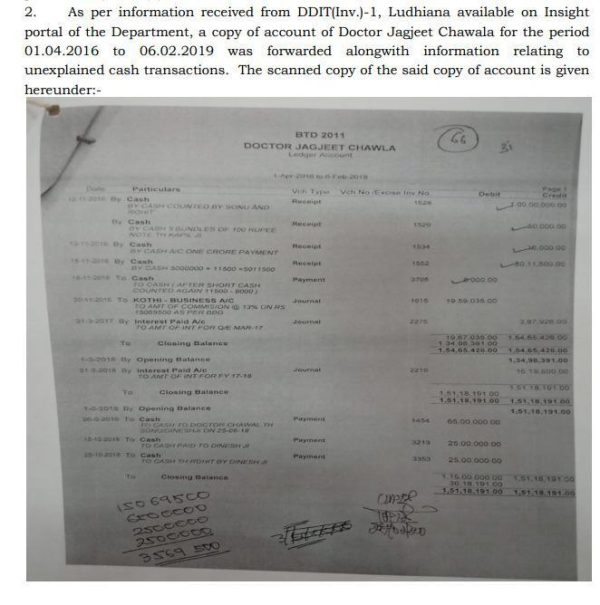 –
– 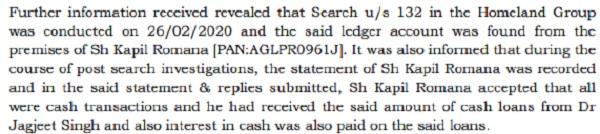 7. From the above reasons recorded, the AR explained that the case was reopened only based on the document unearthed during search on Kapil Romanna (Homeland Group).Subsequently, notice u/s 143(2) was issued on 25.06.2021 and the assessee was provided with the copy of reasons recorded for the purpose of reopening of the case u/s 148. The assessee filed his objections against the reasons recorded vide letter dated 23.09.2021 which were disposed off vide order dated 29.12.2021.Further, the appellant was issued notice u/s 142(1) on 23.11.2021 and the appellant furnished his reply on 14.12.2021 in which he submitted documents namely; income tax return, copies of bank statements, copy of audit report, copy of cash book, etc. That the appellant further clarified that he had no connection with the transactions mentioned in the reasons recorded for reopening the case and he denied giving any cash loan to Mr. Kapil Romana (Homeland Group) in any of the years. Objections were raised to the reasons recorded and it was categorically stated that the appellant has nothing to do with transactions appearing on the ledger account seized from the premises of Kapil Romanna. It was also submitted that the transactions do not include any cheque amount and as such, it cannot be presumed that the transactions were entered into by the appellant.
8. The Ld. AR submitted that after thorough verification of the reply and documents furnished by the assessee, the assessment for the AY 2017-18 was completed vide order passed u/s 147 r.w.s 144B on 24.03.2022 whereby the returned income of Rs. 6192130/- was accepted by the AO with the findings that the disputed transaction by the PCIT did not pertain to the appellant and the view taken by the AO is a plausible view after verification of facts. During the hearing, the Counsel of the assessee Mr. Rohit Kapoor, Chartered Accountant filed the written submission, dated 25.06.2024 which is kept on the record. The counsel contended that the order passed by the learned Pr. CIT is infirm and perverse to the facts on record as the Assessment order passed by the learned Assessing Officer on 24.03.2022 (in short “the AO”) was not erroneous.
9. Per Contra, the Ld. DR relied on the impugned order.
10. We have heard both the sides, perused the material on record, written submissions filed and case law cited before us. Admittedly, the original assessment order passed u/s 147 r.w.s 144B was invalid in as much as the assessment was framed based on unsigned reasons. The Ld. AR argued that that the revision order passed u/s 263 is bad in law, because the original proceedings bad in law being based on unsigned reasons recorded by the AO. Consequently, all the subsequent proceedings would be rendered invalid and void ab initio.
10.1 The counsel of the assessee further placed reliance upon the judgment of HIGH COURT OF BOMBAY in the case of Great Eastern Shipping Co. Ltd. 157 taxmann.com 442 to emphasize that unsigned or draft reasons cannot be regarded as the final reasons recorded by the AO and that the absence of signed reasons violates procedural norms and undermines the foundational principles of fairness, transparency, and accountability in assessment proceedings. The AR further relied upon the following case laws: –
a) [2023] 157 taxmann.com 442 (Bombay) HIGH COURT OF BOMBAY Great Eastern Shipping Co. Ltd. v. National Faceless Assessment Centre/ National e- Assessment Centre
b) 2022 (6) TMI 178 – ITAT DELHI YOUNG INDIAN, 5A, HERALD HOUSE, BAHADURSHAH ZAFAR MARG, NEW DELHI VERSUS ACIT (E), CIRCLE 1 (1), NEW DELHI.
c) 2015 (10) TMI 2633 – ITAT MUMBAI MAHENDRA C. GALA R. SANGHVI & CO. VERSUS ACIT-19 (3), MUMBAI
d) 2019 (1) TMI 695 – ITAT VISAKHAPATNAM SRI SESHA SAI TOWNSHIP P. LTD. VERSUS ASST. COMMISSIONER OF INCOME TAX, CENTRAL CIRCLE, VIJAYAWADA
10.2 From the copy of reasons recorded (APB, Pgs. 7), it is evident that the reasons recorded are indeed unsigned. Furthermore, the cases relied upon by the counsel of the assessee were perused and have been found appropriate in the present case.
11. Apropos ground no 4, the AR of the appellant raised legal ground that the revision order passed u/s 263 was bad in law on the basis of the fact that the original order passed u/s 147 r.w.s 144B was non-jurisdictional in as much as the assessment was framed by considering material found during search on Homeland Group and the proper course of action was u/s 153C and not section 147. It was also submitted that if original proceedings are bad in law, then the subsequent proceedings are invalid
11.1 The Ld. AR submitted that assessment order under section 147 is framed based on material allegedly discovered during a search and the reasons recorded (APB, Pg. 7). The AR contended that in view of the assessment having been framed based on material found during search, the assessment proceeding in the case of the assessee could only be initiated in accordance with the provisions of section 153C of the income tax act, 1961 and not 147. In this regard the AR relied upon the following case laws: –
a) [2023] 151 taxmann.com 489 (SC) SUPREME COURT OF INDIA Deputy Commissioner of Income-tax v. Sri Dinakara Suvarna*
b) [2011] 16 taxmann.com 373 (Amritsar) IN THE ITAT AMRITSAR BENCH Income-tax Officer v. Arun Kumar Kapoor
c) 2012 (9) TMI 1109 – ITAT AMRITSAR INCOME TAX OFFICER, WARD 1 (4), KATHUA VERSUS SURINDER SINGH
d) [2015] 64 taxmannom 159 (Visakhapatnam – Trib.) G. Koteswara Rao v. Deputy Commissioner of Income-tax, Central Circle-1, Visakhapatnam*
e) [2021] 127 taxmann.com 188 (Visakhapatnam – Trib.)Smt.Samanthapudi Lavanya v. Assistant Commissioner of Income Tax, Central Circle, Vijayawada*
f) 2020 (4) TMI 289 – ITAT DELHI M/S. SAURASHTRA COLOR TONES PVT. LTD. VERSUS THE INCOME TAX OFFICER, WARD – 22 (4), DELHI.
11.2 Thus, the original assessment framed u/s 147 being without jurisdiction, as such, the revisions proceedings u/s 263 are void. In this regard the AR relied upon the principle of law enshrined in the legal maxim “sublatofundamentocadit opus” which means that when the cause (foundation) is removed, the effect (consequent action) ceases. The AR interpreted the maxim to imply that in view of the original order passed u/s 147 being non-jurisdictional, the order passed u/s 263 arising out of the non-jurisdictional order u/s 147 is a nullity. The legal maxim is supported by the judgment of apex court in the case of Kiran Singh vs. Chaman Paswan [1954 (4) TMI 48 – SUPREME COURT], an order passed by an authority without jurisdiction is a nullity, and its invalidity can be challenged whenever and wherever it is sought to be enforced or relied upon. The AR further relied upon the following case laws: –
a) HIGH COURT OF ORISSA Principal Commissioner of Income-tax v.Badal Prakash Jindal* [2023] 150 taxmann.com 483 (Orissa)/[2023] 293 Taxman 350
b) Keshab Narayan Banerjee v. Commissiner of Income-tax, [1999] 238 ITR 694 (CAL.) HIGH COURT OF CALCUTTA.
c) 2024 (2) TMI 745 – ITAT RAIPU ANIL NACHRANI RAIPUR VERSUS THE PRINCIPAL COMMISSIONER OF INCOME TAX, (CENTRAL), BHOPAL
d) 2023 (3) TMI 1145 – ITAT AHMEDABAD SHRI JIGNESH LILACHAND SHAH VERSUS THE PR. CIT-3, AHMEDABAD
e) 2005 (12) TMI 240 – ITAT LUCKNOW-A Other Citation: ITD 099, 621, TTJ 101, 450, INDER KUMAR BACHANI (HUF). VERSUS INCOME-TAX OFFICER 3 (4), KANPUR.
f) [2018] 91 taxmann.com 199 (Allahabad – Trib.) IN THE ITAT ALLAHABAD BENCH Hari Mohan Das Tandon (HUF) v. Principal Commissioner of Income- tax, All.
g) 2004 (6) TMI 258 – ITAT COCHIN Other Citation: ITD 094, 131, TTJ 098, 440, [2005] 94 ITD 131 (COCH.) PAUL JOHN, DELICIOUS CASHEW CO. VERSUS INCOME-TAX OFFICER.
h) [2021] 133 taxmann.com 188 (Raipur – Trib.) Minimax Commerce (P.) Ltd v. ACIT i) 2017 (5) TMI 631 – ITAT KOLKATA M/S. CLASSIC FLOUR & FOOD PROCESSING PVT. LTD. VERSUS C.I.T., KOL-IV, KOLKATA
11.3 The cases relied upon by the counsel of the assessee are perused and have been found appropriate in the present case. From the reasons recorded as well as from the show cause notice issued u/s 263, it is noticed that the whole case has been framed based on the material found during the search and in our view, the course of action was required to be taken u/s 153C and not u/s 148 of the Income Tax Act 1961.
12. Apropos Ground no 1, 2 and ground No 8, the learned counsel, Mr. Rohit Kapoor further pointed out that invoking section 263 was unwarranted as the assessment order was not prejudicial to the interest of the revenue.
12.1 The Ld. Counsel submitted that appellant has no connection with the transactions mentioned in the reasons recorded for reopening the case regarding the transactions appearing in the ledger account found during the course of search on Homeland Group and it was totally denied that he has given any cash loan to Mr. Kapil Romana (Homeland Group) in any of the years.
12.2 The AR referred to the notice issued u/s 142(1) on 23.11.2021 and the reply furnished on 14.12.2021 in which he submitted documents namely: income tax return, copies of bank statements, copy of audit report, copy of cash book, etc. The AR emphasized the fact that the appellant duly furnished the requisite documents which were duly examined during the course of assessment proceedings. As such, the allegation of the PCIT that the AO failed to make any enquiry is not applicable and against the facts and circumstances of the present case.
12.3 The counsel of the assessee further placed reliance upon the case of Meerut Roller Flour Mills (P.) Ltd v Commissioner of Income tax 110 taxmann.com 170 (Allahabad)/[2019] 267 Taxman 18 to support the contention that where there was due application of mind by the Assessing Officer after making proper enquiries jurisdiction under section 263 could not be exercised. Further reliance was placed upon the following case laws: –
A) [2017] 77 taxmann.com 15 (SC) SUPREME COURT OF INDIA CIT v. Nirav Modi*
B) CIT v Hindustan Marketing & Advertising Co. Ltd.196 Taxman 368
C) Copy of judgment of ITAT, Amritsar Bench SMT. ANITA MALPOTRA V. INCOME-TAX OFFICER 109 TTJ 76
D) Loil Continental Foods Ltd. vs. Pr. CIT in ITA No. 577/Chd/2019 Chd- Trib.
E) Commissioner of Income Tax vs. Anil Kumar Sharma 194 taxman 504
12.4 We have perused the cases relied upon by the counsel which have been found appropriate in the present case on the issue of enquiries being made by the AO.
12.5 The Ld. AR contended that as all the documents were submitted before the AO and PCIT, as such, the jurisdictional provisions as laid down in the act have duly been complied with by the assessee. The AR argued that the condition to hold an assessment order being erroneous could be proved only if the AO had not made any enquiry which is not applicable in present case. In this regard the AR relied upon the order passed by Delhi High Court in Geevee Enterprises v. Addl. CIT 99 ITR 375 (Del.), in which it was held that order would be erroneous only when the AO makes no enquiries during assessment proceedings. The AR argued that for the purpose of invoking provisions of section 263, it is necessary that the assessment order is erroneous and prejudicial to the interests of the revenue.
12.6 It is pertinent to mention here that the view of Ld. AO being a plausible view, the assessment order could not be considered erroneous or prejudicial to interest of revenue. In this regard, the assessee has relied upon the case of CIT v/s Max India Ltd. (2007) 295 ITR 282 (SC) to support the contention that in order to invoke section 263, it is a judicial requirement to satisfy twin conditions as per statute as under:
(i) The order of the Assessing Officer sought to be revised is erroneous; and
(ii) it is prejudicial to the interests of the Revenue.
If any one of them is absent i.e. if the assessment order is not erroneous but it is prejudicial to the Revenue, Sec.263 cannot be invoked.
12.7 Meaning thereby that, the provision u/s 263 cannot be invoked to correct each, and every type of mistake or error committed by the Assessing Officer; it is only when an order is erroneous as also prejudicial to revenue’s interest, then the provision will be attracted. An incorrect assumption of the fact or an incorrect application of law will satisfy the requirement of the order being erroneous. The phrase ‘prejudicial to the interest of the Revenue’ must be read in conjunction with an erroneous order passed by the AO. For example, if the AO has adopted one of the two or more courses permissible in law and it has resulted in loss of revenue, or where two views are possible and AO has taken one view with which the CIT does not agree, it cannot be treated as an erroneous order, prejudicial to the interest of the Revenue, unless the view taken by the AO is held to be unsustainable in law. This view gets supports from Malabar Industrial Co. Ltd. v/s CIT (2000) 243 ITR 83 (SC) and following other case laws relied upon by the assessee: –
A) [2023] 152 taxmann.com 565 (Delhi) HIGH COURT OF DELHI Principal Commissioner of Income-tax v. H.T.L Ltd.*
B) [2022] 141 taxmann.com 512 (Gujarat) HIGH COURT OF GUJARATPrincipal Commissioner of Income-tax v. Shukla Dairy (P.) Ltd.*
C) [2021] 130 taxmann.com 496 (Gauhati) HIGH COURT OF GAUHATICMJ Breweries (P.) Ltd. v. Union of India
D) [2022] 145 taxmann.com 590 (Calcutta) HIGH COURT OF CALCUTTA Principal Commissioner of Income-tax v. Reeta Lakhmani*
(E) Malabar Industrial Co. Ltd. v/s CIT (2000) 243 ITR 83 (SC) in which it has been stated as under: –
(F) [2024] 161 taxmann.com 213 (Pune – Trib.) IN THE ITAT PUNE BENCH ‘A’ Bajaj Housing Finance Ltd. v. Principal Commissioner of Income-tax
(G) [2024] 162 taxmann.com 664 (Patna – Trib.) IN THE ITAT, PATNA Gyan Infrabuild (P.) Ltd. v. Principal Commissioner of Income-tax
13. Having examined the facts of the present case, after perusal of the submissions and citations placed on record, we find that the whole case has been framed based on material found during the search. Meaning thereby, the course of action was required to be taken u/s 153C and not u/s 148. This view has been accepted by the Hon’ble Apex Court in the case of Deputy Commissioner of Income-tax v. Sri Dinakara Suvarna (Supra). In our view, the AO has erred in invoking the reassessment proceedings u/s 147 and as such, the subsequent cause of action based on invalid order is held to be without jurisdiction. Our view gets support from the judgment delivered by Hon’ble Orissa High Court in the case of Badal Prakash Jindal reported in [2023] 150 taxmann.com 483.
14. The revenue in the present case has not been able to prove as to how the order passed by the Assessing officer was erroneous and prejudicial to the interests of the revenue as the PCIT has not been able to prove non-application of mind by the AO particularly considering the fact that the order of Kapil Romanna was passed on 29.09.2021 and that the order of the appellant u/s 147 was passed on 24.03.2022 after considering the order of Kapil Romanna. It has been stated by the AO of Kapil Romanna in the said order passed u/s 153A that he has failed to identify the parties from whom the unsecured loan was raised. It is also mentioned that no PAN No, address and other details were furnished by Kapil Romanna. Consequently, Kapil Romanna has never identified the parties from whom the loan was raised, and the addition has been made in his hands u/s 68. In our view, mere allegation that the AO has passed the order without application of mind would not be legally justified to set aside the assessment order by way of invoking section 263 of the Act.
15. Considering the factual matrix and the judicial precedents, we do not concur with the PCIT that the AO did not verify the transactions appearing in the ledger account seized during search on Homeland group and that the order was passed without application of mind. Accordingly, we hold that the Ld. PCIT finding, and observation are infirm and perverse to the facts on record. Therefore, we hold that this is not a fit case for invoking the provisions of section 263 of the Act.
16. In the above view, we hold that the order passed under section 263 is bad in law and it is quashed.
17. The facts and issues in ITA number 278/Asr/2024in respect of the assessment year 2017-18 are identical to the facts and issues involved in the ITA number279/Asr/2024 in respect of the assessment year 2018- 19.Therefore, our findings and observation given in ITA number 278/Asr/2024 shall be applicable to the issues involved in ITA number 279/Asr/2004 in mutatis mutandis, ordered accordingly.
18. In the result, both the appeals filed by the assessee are allowed. Order pronounced in the open court on 10.07.2024




