Prabhavathi & Ors. Vs Managing Director (Supreme Court of India)
The Supreme Court considered appeals arising from the judgment and order dated 1 October 2020 passed by the High Court of Karnataka at Bengaluru in MFA No.2162 of 2018 connected with MFA No.4016 of 2018. The High Court proceedings arose from the judgment and award dated 12 December 2017 passed by the IX Additional Small Causes and Additional MACT, Bangalore (SCCH-7) in M.V.C. No.3858/2016.
The case related to a motor accident dated 6 June 2016 involving the deceased, Boobalan, aged 38 years. The deceased was travelling on his motorcycle from Krupanidhi Junction towards Madivala when a BMTC Bus bearing registration No. KA-01/F-9555 collided with him. It was alleged that the bus driver drove rashly and negligently, resulting in the death of Boobalan at the spot due to grievous injuries.
The appellants, being the dependents of the deceased, filed a claim petition before the Motor Accident Claims Tribunal seeking compensation of Rs.3,00,00,000/-. They stated that the deceased was the sole earning member of the family and was employed as an Executive in the Housekeeping Department at Hotel Royal Orchid, Old Airport Road, Bengaluru, earning up to Rs.70,000 per month.
The Tribunal, by order dated 12 December 2017, held that the accident occurred due to the rash and negligent act of the BMTC bus driver. Considering the last drawn salary of the deceased as Rs.62,725 per month, the Tribunal awarded compensation of Rs.75,97,060 with interest at 9% per annum.
Both parties challenged the Tribunal’s award before the High Court. The claimants argued that the deceased’s monthly income should have been assessed at Rs.70,000 based on the bank statement (Ex. P.21). The respondent challenged the award by contending that there was no negligence on the part of the bus driver, that the deceased was not a permanent employee, that income should have been considered as notional income, and that the interest rate of 9% was excessive.
The High Court, by order dated 1 October 2020, partly allowed the appeal. It assessed contributory negligence at 75% on the bus driver and 25% on the deceased, holding that both vehicles were driven at high speed and contributed to the accident. The High Court also reduced the monthly income assessment to Rs.50,000 and enhanced the compensation to Rs.77,50,000 with interest at 6% per annum.
The claimant approached the Supreme Court challenging the finding of 25% contributory negligence attributed to the deceased and the assessment of income.
The Supreme Court disagreed with the High Court’s finding regarding contributory negligence. It held that the Tribunal had correctly considered the evidence on record and the Spot Mahazar (Ex. P3) and found no sufficient evidence indicating negligence on the part of the deceased. The Tribunal had relied on the oral evidence of P.W.1 and concluded that the accident occurred due to the rash and negligent driving of the offending vehicle.
The Court held that the High Court’s finding of 25% contributory negligence against the deceased was erroneous. Referring to the principles laid down in Jiju Kuruvila v. Kunjunjamma Mohan and followed in Kumari Kiran v. Sajjan Singh and Ors., the Court observed that in the absence of direct or corroborative evidence, negligence cannot be presumed merely because both vehicles were allegedly driven at high speed.
The Supreme Court also considered the issue of income assessment. It noted that motor accident compensation proceedings are governed by the principle of preponderance of probability and strict rules of evidence applicable in criminal trials do not apply. The Court referred to Sunita v. Rajasthan SRTC and Rajwati alias Rajjo & Ors. v. United India Insurance Company Ltd. & Ors. in this regard.
The Court held that the High Court was not justified in assessing the deceased’s monthly income at Rs.50,000. Considering the Tribunal’s finding based on the pay slip (Ex.P.16), the Supreme Court affirmed the monthly income of Rs.62,725.
The Supreme Court recalculated the compensation and allowed the civil appeals. The award dated 12 December 2017 passed by the MACT, as modified by the High Court order dated 1 October 2020, was modified accordingly. The Court directed that interest would be paid as awarded by the Tribunal.
FULL TEXT OF THE SUPREME COURT JUDGMENT/ORDER
Leave Granted
2. The present appeals are directed against the Judgment and Order dated 1st October 2020, passed in MFA No.2162 of 2018 C/W MFA No.4016 of 2018 by the High Court of Karnataka at Bengaluru, which in turn, was preferred against the judgment and order dated 12th December 2017 in M.V.C No. 3858/2016 passed by the IX Additional Small Causes and Addl.
MACT, Bangalore (SCCH-7).
3. The brief facts giving rise to these appeals are that on 6th June 2016 the deceased, namely, Boobalan, aged 38 years, was travelling on his motorcycle from Krupanidhi Junction towards Madivala. The driver of the BMTC Bus (offending vehicle) bearing registration No. KA-01/F-9555 collided with the deceased, driving his vehicle in a rash and negligent manner, resulting in his death on the spot due to the grievous injuries sus- tained.
4. The Appellants (dependents of the deceased) filed a claim petition before the Tribunal seeking compensation of Rs.3,00,00,000/-, submitting therein that the deceased was the only earning member of the family, working as an Executive inthe Housekeeping Department at Hotel Royal Orchid, Old Air- port Road, Bengaluru; and earning upto Rs.70,000/- per month.
5. The Tribunal, by its Order dated 12th December 2017, after considering the last drawn salary of the deceased as Rs.62,725/- per month, awarded the Appellants an amount of Rs.75,97,060/- along with interest @ 9% per annum and held that the accident occurred due to rash and negligent act of the driver of the BMTC Bus.
6. Being aggrieved with the amount of compensation awarded, both parties filed an appeal before the High Court. The appellant challenged the same on the ground that the Tribunal incorrectly determined the monthly income of the deceased as Rs.62,725/- per month, whereas the proven income as per the bank statement (Ex. P.21) should be assessed at Rs.70,000/- per month. On the other hand, the respondent challenged the assessment on the ground that there was no negligence on the part of the driver of the bus; instead of considering the notional income wrongly considered the income to the tune of Rs.62,725/- as the deceased was not a permanent employee and the interest @ 9% was excessive.
7. The High Court, vide the impugned order dated 1st October 2020, allowed the appeal and determined the contributory negligence at 75% on the driver of the bus and 25% on the deceased by relying upon the statements and documentary evidence on record and came to the conclusion that the accident occurred due to the rash and negligent driving of both the deceased and the driver of the offending vehicle as both were driving at high speed and further assessed the monthly income of the deceased as Rs.50,000/- per month and awarded an enhanced amount of Rs.77,50,000/- @ 6% interest per annum.
8. Yet dissatisfied, the claimant-appellant is now before us. The significant point raised by the appellant is that the High Court wrongly assessed contributory negligence of the deceased to the extent of 25%.
9. We have heard the learned counsel for the parties.
10. We are unable to agree with the view taken by the High Court on the 25% contributory negligence of the deceased and 75% upon the driver of the bus. We find ourselves to agree with the view taken by the Tribunal on this issue. The Tribunal rightly, after considering the evidence on record and on perusal of the Ex. P3 Spot Mahazar, came to the conclusion that there wasn’t any sufficient evidence on record, indicating that the accident occurred due to negligent driving on the part of the deceased, and after considering the oral evidence of P.W.1, held the cause of the accident to be rash and negligent on the part only of the offending vehicle.
11. Thus, in our considered view, the contributory negligence taken by the High Court at 25% of the deceased is erroneous. We advert to the principles laid down in Jiju Kuruvila v. Kun-jujamma Mohan1, where it was held that in the absence of any direct or corroborative evidence on record, it cannot be assumed that the accident occurred due to the rash and negligent driving of both the vehicles. This exposition came to be followed in Kumari Kiran v. Sajjan Singh and Ors.2. In the present case, therefore, on an allegation simpliciter, it cannot be presumed that the accident occurred due to rash and negligent driving of both vehicles, for having driven at high speed.
12. Another point to be considered was that the claimants- appellants approached the High Court seeking an enhancement of compensation awarded by the Tribunal, stating therein that the deceased was earning Rs.70,000/- per month working as an Executive Housekeeper at Hotel Royal Orchid, whereas the High Court assessed the income as Rs.50,000/- per month.
13. It is the settled law that under the Motor Vehicle Act, 1988 it is established that in compensation cases, the strict rules of evidence used in criminal trials do not apply. Instead, the standard of proof is based on the preponderance of probability.
This Court in Sunita v. Rajasthan SRTC3 observed that:
“22. It is thus well settled that in motor accident claim cases, once the foundational fact, namely, the actual occurrence of the accident, has been established, then the Tribunal’s role would be to calculate the quantum of just compensation if the accident had taken place by reason of negligence of the driver of a motor vehicle and, while doing so, the Tribunal would not be strictly bound by the pleadings of the parties. Notably, while deciding cases arising out of motor vehicle accidents, the standard of proof to be borne in mind must be of preponderance of probability and not the strict standard of proof beyond all reasonable doubt which is followed in criminal cases.”
The exposition came to be reiterated in Rajwati alias Ra-jjo & Ors. v. United India Insurance Company Ltd. & Ors.4, wherein it was observed that :
“20. It is well settled that Motor Vehicles Act, 1988 is a beneficial piece of legislation and as such, while dealing with compensation cases, once the actual occurrence of the accident has been established, the Tribunal’s role would be to award just and fair compensation. As held by this Court in Sunita (Supra) and Kusum Lata (Supra), strict rules of evidence as applicable in a criminal trial, are not applicable in motor accident compensation cases, i.e., to say, “the standard of proof to be borne in mind must be of preponderance of probability and not the strict standard of proof beyond all reasonable doubt which is followed in criminal cases”.
14. In our considered view, the High Court was not justified in assessing the monthly income of the deceased at Rs.50,000/-, as this amount is relatively low, particularly in the background of the fact that the accident occurred on 6th June, 2016 and the Tribunal has evidently recorded that the last drawn salary of the deceased as per Pay Slip (Ex.P.16) to be Rs.62,725/- per month. Therefore, we affirm the findings of the Tribunal assessing the income of the deceased to be Rs.62,725/- per month.
15. As a result of the discussion above, the compensation now payable to the claimant-appellant is recalculated as follows:
CALCULATION OF COMPENSATION
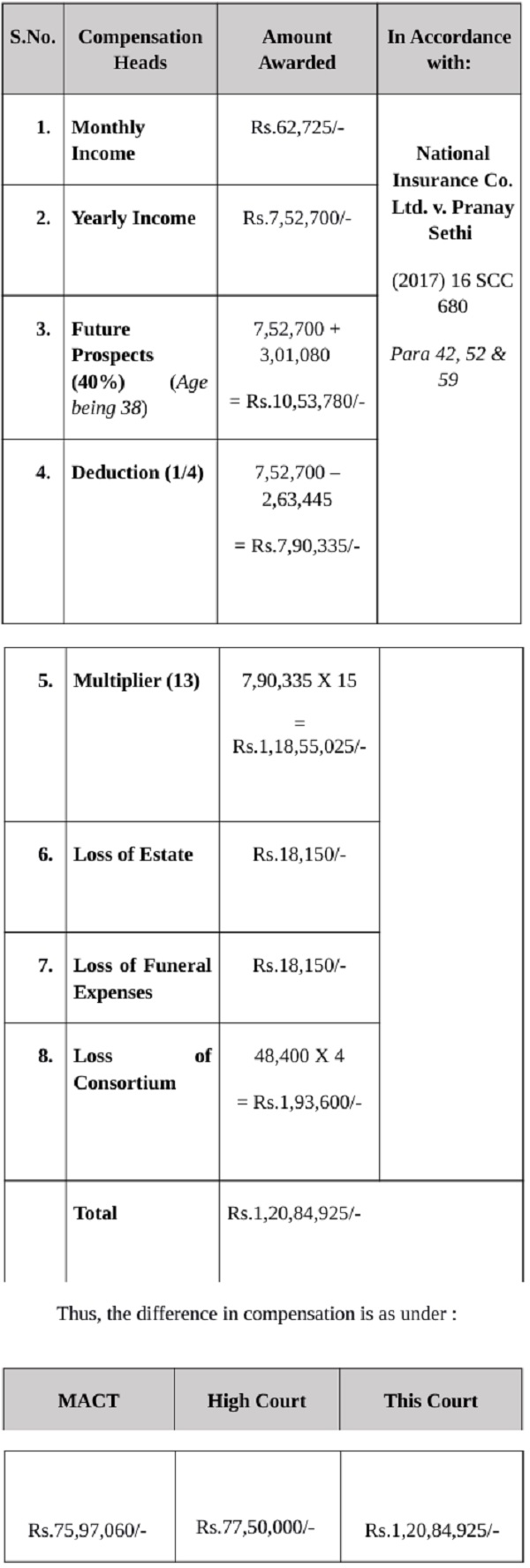
16. The Civil Appeals are allowed in the aforesaid terms. The impugned Award dated 12th December, 2017 in M.V.C.No. 3858/2016 passed by IX Additional Small Causes and Addl. MACT, Bangalore (SCCH-7), as modified by the High Court vide the impugned order dated 1st October, 2020, passed in MFA No.2162 of 2018 C/W MFA No.4016 of 2018, stands modified accordingly. Interest is to be paid as awarded by the Tribunal.
Pending application(s), if any, shall stand disposed of.
Notes:
1 (2013) 9 SCC 166
2 (2015) 1 SCC 339
3 (2020) 13 SCC 468
4 2022 SCC OnLine SC 1699