AJR Oil And Gas Engineering Services Pvt. Ltd. Vs DCIT (ITAT Mumbai)
Summary: The Mumbai ITAT considered whether professional income of ₹1,05,00,000/- could be taxed in AY 2017-18 merely because the payer, DAS Offshore Ltd., had accounted for the expenditure and deducted TDS under section 194J during that year. The assessee-company was incorporated on 28.02.2017 and had entered into a consultancy agreement with DAS Offshore Ltd. on the same date. It maintained that no consultancy services were rendered, no invoice was raised and no payment became due up to 31.03.2017. The services were rendered subsequently and the first invoice was raised on 03.04.2017, with the corresponding income recognised and offered to tax in AY 2018-19. The Tribunal also noted that reconciliation of the audited books with Form 26AS for three years showed aggregate receipts of ₹15.72 crore matching in both records, demonstrating that the differences were timing differences rather than suppression of income.
The Tribunal held that under the mercantile system of accounting, income accrues only when an enforceable right to receive it crystallises. Mere expectation of income, unilateral accounting treatment by the payer or deduction of TDS cannot determine the year of taxability in the recipient’s hands. The Revenue had produced no correspondence, work-completion certificate, invoice, contractual milestone or other evidence showing that services had been rendered or that the assessee had acquired a vested and enforceable right to receive the consideration before 31.03.2017. Relying on the principles discussed in CIT v. Dinesh Kumar Goel and E.D. Sassoon & Co. Ltd., the Tribunal observed that the right to receive consideration must arise from rendering the services and that no enforceable debt had arisen by 31.03.2017. It further applied Accounting Standard-9, noting that revenue from services is recognised when services are actually rendered.
The ITAT further noted that the disputed ₹1.05 crore had already been offered to tax in AY 2018-19 and this fact was not disputed by the Revenue. Taxing the identical income again in AY 2017-18 would result in taxation of the same income twice. Referring to Laxmipat Singhania v. CIT, the Tribunal reiterated that the same income cannot, unless specifically authorised by statute, be subjected to tax twice. It also relied on CIT v. Excel Industries Ltd. to observe that where income is admittedly taxable in the succeeding year and the applicable tax rate remains the same, a dispute concerning merely the year of taxability is largely academic. Accordingly, the Tribunal held that no enforceable right to receive ₹1.05 crore had accrued during the previous year relevant to AY 2017-18 and deleted the entire addition. Having granted complete relief on merits, it refrained from adjudicating the additional jurisdictional grounds and left them open. The assessee’s appeal was consequently allowed.
Cases Discussed
- Laxmipat Singhania vs. CIT, 72 ITR 291 (SC) – relied upon for the principle that, unless specifically authorised by statute, the same income cannot be subjected to taxation twice.
- CIT vs. Dinesh Kumar Goel [2011] 331 ITR 10 (Delhi High Court) – relied upon for the proposition that income accrues when the right to receive crystallises through rendering of services and for the principles of revenue recognition under Accounting Standard-9.
- E.D. Sassoon & Co. Ltd. v. CIT, 26 ITR 27 (SC) – referred to for the principle that accrual requires creation of a debt and acquisition of a right to receive payment.
- CIT vs. Excel Industries Ltd. [2013] 38 taxmann.com 100 (SC) – relied upon where the income was admittedly taxable in the succeeding year and the dispute concerned only the year of taxability.
- CIT v. Nagri Mills Co. Ltd. [1958] 33 ITR 681 (Bombay High Court) – quoted in Dinesh Kumar Goel on disputes concerning the year of taxation where the applicable tax rate remains the same.
- CIT v. Vishnu Industrial Gases (P) Ltd., ITR No. 229 of 1988, dated 06.05.2008 (Delhi High Court) – referred to in the extract from Dinesh Kumar Goel concerning disputes over the year in which tax is leviable.
FULL TEXT OF THE ORDER OF ITAT MUMBAI
1. This appeal filed by the assessee is against the order of ld. CIT(A)/National Faceless Appeal Centre vide DIN: ITBA/NFAC/S/250/2025-26/1082666630(1), dated 17.11.2025 passed against the assessment order by the National Faceless Assessment Centre Delhi, u/s 147 r.w.s. 144 r.w.s. 144B of the Income-tax Act (hereinafter referred to as the “Act”), dated 18.02.2025 for the Assessment Year 2017-18.
2. Assessee has raised the following grounds of appeal:
1. No Accrual of Income in AY 2017-18
On the facts and in the circumstances of the case and in law, the Ld. CIT(A) erred in confirming the addition of 1,05,00,000/- as income accrued in AY 2017-18, ignoring that the Appellant rendered no services, raised no invoices, and received no payment in FY 2016-17. The Appellant was incorporated only on 28 February 2017, and no right to receive any income had crystallized as on 31 March 2017. Hence, no income was taxable under Section 5 r.w.s. 145 of the Income tax Act in AY 2017-18.
2. Crystallization Required Under Mercantile System
The Ld. CIT(A) failed to appreciate that under the mercantile system of accounting, income accrues only when the right to receive becomes enforceable and crystallized. As work commenced and invoices were raised only on 03 April 2017, the corresponding income was rightly recognized and offered in AY 2018-19.
3. TDS Deduction by Payer Not Conclusive of Accrual
The Ld. CIT(A) erred in treating the payer’s (DAS Offshore Ltd.) unilateral provisioning and deduction of TDS under section 194J in FY 2016-17 as conclusive of income accrual in the Appellant’s hands, overlooking that such credit entries in the payer’s books do not determine taxability for the recipient.
4. Double Taxation of Same Income should be impermissible
The addition of 1,05,00,000/- in AY 2017-18 results in impermissible double taxation of the same income, which has already been offered to tax in AY 2018-19. Such double taxation is contrary to the principles laid down by the Hon’ble Supreme Court in Laxmipat Singhania v. CIT [1969] 72 ITR 291 (SC).
5. Evidentiary Value of Tax Audit Report
The Ld. CIT(A) erred in disregarding the Tax Audit Report filed for AY 2018-19, wherein the tax auditor certified under Clause 27(b) of Form 3CD that no prior period income was recorded. In the absence of any contrary material, the audit report is a valid evidentiary document supporting the Appellant’s claim.
6. Invalid Reassessment and absence of tangible material and borrowed satisfaction
The Ld. CIT(A) erred in upholding reassessment u/s 147 which was initiated solely based on TDS data from Form 26AS/Insight Portal, without any independent verification or tangible material to form a reason to believe that income had escaped assessment. The reopening is based on borrowed satisfaction, without proper inquiry into the Appellant’s actual books, bank account, or service commencement, and is thus invalid in law.
7. Relief from Double Taxation without prejudice
Without prejudice, if any portion of the addition is sustained in AY 2017-18, appropriate directions may kindly be issued to refund or adjust taxes already paid on the same income in AY 2018-19 so as to prevent double taxation.
8. Grant of TDS Credit in correct year without prejudice
Without prejudice, the Ld. CIT(A) erred in not issuing appropriate directions to allow credit for TDS deducted in AY 2017-18 in AY 2018-19, which is the correct year of accessibility as per Rule 37BA.
2.1. Before us, assessee has filed additional grounds as under, challenging the validity of the reassessment proceedings.
1. The Ld. CIT(A) has erred in law and in facts in not appreciating that the reopening of assessment u/s 148 of the Act and passing the reassessment order u/s 147 of the Act is invalid and bad in the eyes of law.
2. The Ld. CIT(A) has erred in law and in facts in not appreciating that the assessment has been reopened by issue of notice u/s 148 of the Act by the jurisdictional officer instead of National Faceless Assessment Centre which is contrary to the express provisions of s. 151A of the Act.
3. The Ld. CIT(A) has erred in law and in facts in not appreciating that the approval taken u/s. 151 of the Act for the purpose of passing the order u/s 148A(d) of the Act is invalid and bad in the eyes of law.
4. The Ld. CIT(A) has erred in law and in facts in not appreciating that the order passed is in violation of principles of natural justice and hence the same is invalid and bad in the eyes of law.
2.2. Assessee submitted that these additional grounds raise pure questions of law arising from the material already available on record and require no fresh investigation into facts. Having considered the rival submissions, we find that the additional grounds challenge the jurisdictional issues which go to the root of the assessment and can be raised at any stage of appellate proceedings provided they can be decided on the basis of facts already available on record. Therefore, the same are admitted for adjudication.
3. Brief facts as culled out from the records are that assessee company was incorporated on 28.02.2017. The dispute pertains to an amount of ₹1,05,00,000/-, which according to ld. Assessing Officer had accrued during the previous year relevant to AY 2017-18 on account of professional services rendered to DAS Offshore Ltd. for which assessee had entered into a consultancy agreement with it on 28.02.2017. The relevant portion of the consultancy agreement is as extracted below:
ARTICLE 4- DURATION OF AGREEMENT
4.1 The term of this Agreement shall be for a period of minimum four (4.5) months from the date hereof 1.e. up to 30th June 2017.
ARTICLE 5-FEES
5.1 In consideration of the provision and performance of the Services, COMPANY shall pay CONSULTANT a remuneration of INR 3,50,00,000/- (Three crore Fifty Lacs only) excluding all taxes.
ARTICLE 6-TAXES
6.1 CONSULTANT shall invoice for the applicable taxes to the ‘FEES’ Indicated in article 5 above separately.
ARTICLE 7-PAYMENT TERMS
7.1 The payment shall be made on the dates as below:
28th February 2017 05% of the fees plus all applicable taxes
31 March 2017
25% of the fees plus all applicable taxes
30th April 2017
25% of the fees plus all applicable taxes
31 May 2017
25% of the fees plus all applicable taxes
30th June 2017
31 July 2017
10% of the fees plus all applicable taxes
10% of the fees plus all applicable taxes
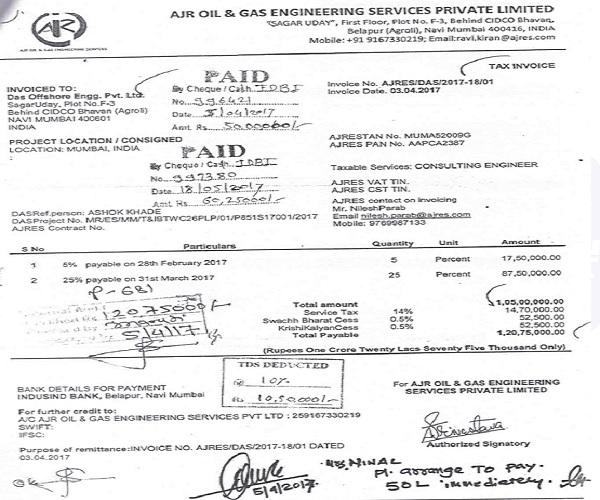
3.1. The services were rendered in the subsequent year and the invoice was raised in the subsequent year, i.e. on 03.04.2017. The said invoice is extracted below:
3.2. Assessee also submitted the invoice-wise break-up of revenue recognized in the books of account in respect of DAS Offshore Ltd., as placed in the Paper Book. The said statement, prepared on the basis of the books of account and supported by the corresponding tax invoices, clearly demonstrates that the revenue from the consultancy contract was recognized progressively upon raising of invoices after commencement of the contractual services. The break-up of invoices placed on record is reproduced hereunder for ready reference:
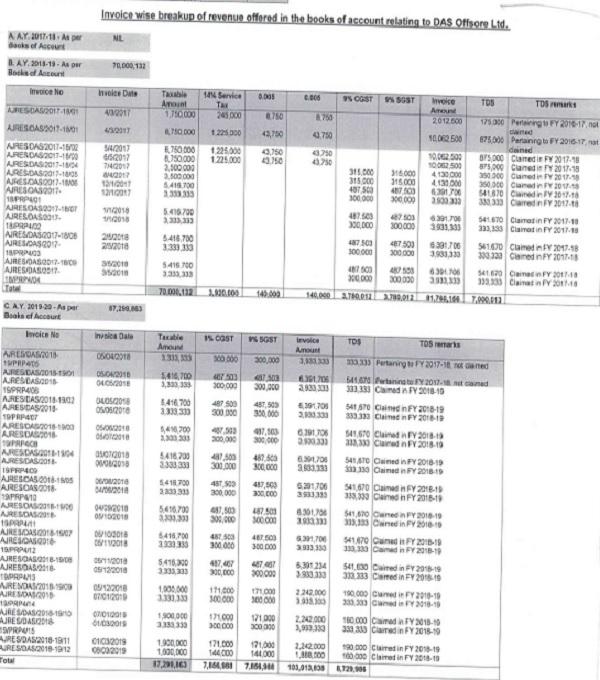
3.3. The above extract demonstrates that the assessee consistently followed mercantile system of accounting by recognizing revenue only upon crystallization of the right to receive, evidenced by issuance of invoices. Revenue has not disputed either the genuineness of the invoices or the correctness of the books of account maintained by the assessee. Nor has any material been brought on record to establish that the corresponding services had been rendered before 31.03.2017. On the contrary, the invoice-wise recognition of revenue fully supports the assessee’s stand that no income had accrued during the Assessment Year 2017-18.
3.4. Ld. Assessing Officer however, rejected the explanation furnished by the assessee on the grounds that DAS Offshore had accounted for the expenditure on accrual basis in Assessment Year 2017-18 and deducted TDS accordingly. Aggregate receipts of Assessment Year 2017-18 and Assessment Year 2018-19 reflected in Form 26AS exceeded the turnover disclosed by the assessee for these two years. Aggrieved, assessee went in appeal before the ld. CIT(A), who confirmed the addition by holding that deduction of tax under section 194J coupled with the accounting treatment adopted by the payer i.e. DAS Offshore, established accrual of income in the hands of assessee. Aggrieved, assessee is in appeal before the Tribunal.
4. We have carefully considered the rival submissions and perused the material available on record. The issue before us is whether the amount of ₹1,05,00,000/- could be said to have accrued to the assessee during the previous year relevant to AY 2017-18 merely because DAS Offshore Ltd. deducted tax at source under section 194J and reflected the amount in its books of account. The admitted position emerging from the record is that the assessee company was incorporated only on 28.02.2017. It is the consistent stand of the assessee that no services had been rendered till 31.03.2017, no invoice had been raised and no payment had become due. The work admittedly commenced only thereafter and the invoice was raised on 03.04.2017. The corresponding income was duly recognised in the books and offered to tax in AY 2018-19. A complete reconciliation of turnover and Form 26AS for 3 years clearly establishes that there is no suppression of income and that the differences are purely timing differences. The total receipts of 15.72 crores spanning in 3 years as per the financial statements is matching with the Form 26AS. The summary of the same is as under:
| A.Y. | Revenue as per audited Books of Account | Receipts as per Form 26AS | Difference | Tax Rate |
| 2017-18… (Page 47 and 50 of PB) | 1,05,00,000 | (1,05,00,000) | 25% | |
| 2018-19…(Page 47 and 54 of PB) | 7,00,00,132 | 6,82,50,165 | 17,49,967 | 25% |
| 2019-20… (Attachment and Page 58) | 8,72,99,863 | 7,85,49,830 | 87,50,033 | 25% |
| Total | 15,72,99,995 | 15,72,99,995 |
4.1. Under the mercantile system of accounting, income accrues only when the assessee acquires an enforceable right to receive the same. Mere expectation of income or unilateral accounting treatment adopted by the payer cannot constitute accrual within the meaning of section 5 read with section 145 of the Act. In the present case, except for the deduction of tax by DAS Offshore Ltd., Revenue has not brought any material on record to establish that any services had actually been rendered prior to 31.03.2017 or that the assessee had acquired a vested and enforceable right to receive the consideration during the relevant previous year. No correspondence, work completion certificate, invoice or contractual milestone evidencing completion of services before 31.03.2017 has been brought on record. It is equally well settled that deduction of tax at source is merely a machinery provision for collection of tax. The deductor’s accounting treatment or deduction of tax cannot determine the year of taxability in the hands of the recipient. Taxability has to be determined independently with reference to the charging provisions of the Act.
4.2. Another important aspect which cannot be ignored is that the assessee has already offered the impugned amount to tax in AY 2018-19, being the year in which the services were actually rendered and the invoice was raised. This factual position has not been disputed by the Revenue. Taxing the identical income once again in AY 2017-18 would undoubtedly result in taxation of the same income twice, which is impermissible in law. Hon’ble Supreme Court in Laxmipat Singhania vs. CIT 72 ITR 291 (SC) has held that unless specifically authorised by statute, the same income cannot be subjected to taxation twice. The Tax Audit Report for AY 2018-19 also certifies that no prior period income has been recognised and the Revenue has not brought any material on record to discredit the said report.
4.3. Our aforesaid conclusion is further fortified by the decision of the Hon’ble High Court of Delhi in CIT vs. Dinesh Kumar Goel [2011] 331 ITR 10 (Del) wherein, after referring to the decision of the Hon’ble Supreme Court in E.D. Sassoon & Co. Ltd., Hon’ble Court reiterated that income can be subjected to tax only when the right to receive has accrued by rendering of services. The Hon’ble High Court observed as under:
“11. Section 5 of the Act gives the ‘scope of total income. Sub-section (1) thereof, with which we are concerned, reads as under:
“(1) Subject to the provisions of this Act, the total income of any previous year of a person who is a resident includes all income from whatever source derived which (a) Is received or is deemed to be received in India in such year by or on behalf of such person; or
(b) Accrues or arises or is deemed to accrue or arise to him in India during such year; or
(c) Accrues or arises to him outside India during such year.”
As is clear from reading of clause (b) above, even when the income accrues or arises or is deemed to accrue or arise to assessee in India during previous year, that is to be taxed in that year. It is important, therefore, that receipt of a particular amount in the relevant year should be an “income” under the aforesaid provision. What is the relevant yardstick is the time of accrual or arisal for the purpose of its taxation, viz., in order to be chargeable, the income should accrue or arise to assessee during the previous year. If income has accrued or arisen, even if actual receipt of the amount is not there, it would be chargeable to tax in the said year. Though the amount may be received later in the succeeding year, the income would be said to accrue or arise if there is a debt owed to assessee by somebody at that moment. From this, it follows that there must be the “right to receive the income on a particular date, so as to bring about a creditor and debtor relationship on the relevant date”. The Court further explained that a right to receive a particular sum under the agreement would not be sufficient unless the right accrued by rendering of services and not by promising for services and where the right to receive is interior to rendering of service, the income, therefore, would accrue on rendering of services.”
4.4. The ratio laid down by the Hon’ble Delhi High Court squarely applies to the facts of the present case as assessee had admittedly not rendered the consultancy services before 31.03.2017. The Consultancy Agreement merely contemplated rendering of services over a period extending up to 30.06.2017 and the first invoice itself was raised only on 03.04.2017. Therefore, no enforceable debt had come into existence as on 31.03.2017 and consequently no income can be said to have accrued during the relevant previous year.
4.5 Our aforesaid conclusion also receives support from the decision of the Hon’ble Supreme Court in CIT vs. Excel Industries Ltd. [2013] 38 taxmann.com 100 (SC), wherein the Hon’ble Apex Court observed that where the income is admittedly taxable in the succeeding year and the rate of tax remains the same, the controversy regarding the year of taxability is largely academic. Hon’ble Court observed:
32. Thirdly, the real question concerning us is the year in which assessee is required to pay tax. There is no dispute that in the subsequent accounting year, assessee did make imports and did derive benefits under the advance license and the duty entitlement pass book and paid tax thereon. Therefore, it is not as if the Revenue has been deprived of any tax. We are told that the rate of tax remained the same in the present assessment year as well as in the subsequent assessment year. Therefore, the dispute raised by the Revenue is entirely academic or at best may have a minor tax effect. There was, therefore, no need for the Revenue to continue with this litigation when it was quite clear that not only was it fruitless (on merits) but also that it may not have added anything much to the public coffers.
4.6. In the present case also, the Revenue has not disputed that the impugned amount has already been offered to tax in Assessment Year 2018-19. It is also not the case of the Revenue that the applicable rate of tax for the assessee-company differed between the two assessment years. Therefore, the controversy raised by the Revenue is merely with regard to the year in which the income ought to be assessed and not regarding its taxability. The observations of the Hon’ble Supreme Court in Excel Industries Ltd. (supra) fully support the case of the assessee.
4.7. We also find considerable force in the observations made by the Hon’ble Delhi High Court in CIT vs. Dinesh Kumar Goel (supra), while dealing with Accounting Standard-9 relating to Revenue Recognition. In this regard, Hon’ble Court held as under:
“25. Reading of the aforesaid (AS) 9 makes it clear that revenue is recognized only when the services are actually rendered. If the services are rendered partially, revenue is to be shown proportionate with the degree of completion of the services. This really clinches the issue in favour of assessee.
26. Though our discussion on the issue is complete, the parting comments freed to be made. The receipts relate to the unexecuted packages, which are not shown in the instant year would be shown in the succeeding year. Rate of tax in respect of companies remains the same in all these years. Therefore, the Revenue does not lose anything, as it would receive the tax on this income in the succeeding year. Still issues are raised and much outcry is made for nothing.
27. In a decision rendered about 50 years ago, the Bombay High Court, speaking through Chief Justice Tendolkar in CIT v. Nagri Mills Co. Ltd [1958] 33 ITR 681 observed as under: “We have often wondered why the Income-tax authorities, in a matter such as this where the deduction is obviously a permissible deduction under the Income-tax Act, raise disputes as to the year in which the deduction should be allowed. The question as to the year in which a deduction is allowable may be material when the rate of tax chargeable on assessee in two different years is different; but in the case of income of a company, tax is attracted at a uniform rate, and whether the deduction in respect of bonus was granted in the assessment year 1952-53 or in the assessment year corresponding to the accounting year 1952, that is in the assessment year 1953-54, should be a matter of no consequence to the Department; and one should have thought that the Department would not fritter away its energies in fighting matters of this kind. But, obviously, judging from the references that come up to us every now and then, the Department appears to delight in raising points of this character which do not affect the taxability of assessee or the tax that the Department is likely to collect from him whether in one year or the other.”
28. In this Court, in its decision in ITR No. 229 of 1988 dated 6-5-2008 entitled CIT v. Vishnu Industrial Gases (P) Ltd. had quoted the aforesaid passage and thereafter remarked that the situation does not seem to have changed over the last fifty years and the Revenue continue to agitate the question whether tax is leviable in a particular year or in some other year. Alas! The aforesaid words of wisdom of Bombay High Court reminded to the Revenue Authorities more than two years ago again have not made any dent on the psyche of the Revenue.
4.8. The aforesaid observations, in our considered view, apply with all force to the facts before us. The Consultancy Agreement itself demonstrates that the remuneration was payable for the provision and performance of consultancy services extending over the contractual period. The Revenue has not produced any material to establish that the corresponding services had actually been rendered before 31.03.2017. The first invoice was admittedly issued only on 03.04.2017. Therefore, in terms of Accounting Standard-9 as well as the settled principles governing accrual of income, the impugned amount could not have been recognised as income for Assessment Year 2017-18. Further, the assessee has admittedly offered the said income in Assessment Year 2018-19 and, therefore, no prejudice whatsoever is caused to the Revenue.
5. In view of the foregoing discussion, the Consultancy Agreement, the contemporaneous Tax Invoice dated 03.04.2017, the Tax Audit Report for Assessment Year 2018-19 and the settled legal position emanating from the decisions of the Hon’ble Supreme Court in E.D. Sassoon & Co. Ltd., Laxmipat Singhania and Excel Industries Ltd., (supra) as also the judgment of the Hon’ble Delhi High Court in Dinesh Kumar Goel, (supra) leave no manner of doubt that the assessee had not acquired any enforceable right to receive the impugned amount during the previous year relevant to Assessment Year 2017-18. Consequently, the addition of ₹1,05,00,000/- cannot be sustained and is deleted. Grounds raised by the assessee in this regard are allowed.
5.1. Since we have already deleted the impugned addition on merits, the relief claimed by the assessee stands granted in entirety. Therefore, adjudication of the additional grounds challenging the assumption of jurisdiction would be merely academic and would not have any bearing on the ultimate tax liability of the assessee for the year under consideration. Accordingly, while admitting the additional grounds as they involve pure questions of law, we refrain from adjudicating the same on merits and leave them open to be urged in an appropriate circumstance, if so required.
6. In the result, appeal of the assessee is allowed.
Order is pronounced in the open court on 04 August, 2026