
Nandan Steels and Power Limited Vs Central Circle (ITAT Raipur)
₹11.18 Crore Share-Capital Addition Falls on Jurisdiction and Evidence
Reassessment Fails, Addition Also Deleted on Merits
The Raipur Tribunal held that reassessment proceedings initiated beyond four years were invalid because the recorded reasons did not allege any failure by the assessee to disclose fully and truly all material facts.
Separately, it examined the merits and directed deletion of the ₹11.18 crore addition under section 68 concerning share application money received from two group companies.
The assessee thus succeeded on two independent aspects: the jurisdictional requirement for reopening and the evidence supporting the investments.
The Tribunal formally described the appeal as partly allowed, while leaving other legal grounds unadjudicated.
Original Scrutiny Assessment Had Already Been Completed
The company filed its return for assessment year 2012-13 on 17 September 2012, declaring income of ₹71,14,680.
Its case was selected for scrutiny through CASS. During those proceedings, the company’s general manager and authorised representative appeared before the Assessing Officer, and books of account were produced.
The original assessment under section 143(3) was completed on 31 March 2015, determining total income at ₹74,14,680.
Subsequently, the Assessing Officer received information from the Investigation Wing concerning share investments from Kolkata-based companies. A notice under section 148 was issued on 30 March 2019, beyond four years from the end of the relevant assessment year.
The consequential reassessment, completed on 30 December 2019, added ₹11.18 crore under section 68. The CIT(A) confirmed the action.
Recorded Reasons Omit the Essential Disclosure Failure
Before the Tribunal, the assessee challenged the reopening through additional grounds, including non-application of mind, change of opinion, borrowed satisfaction and non-compliance with the first proviso to the then-applicable section 147.
The Tribunal noted that the original scrutiny assessment was an undisputed fact. Nevertheless, the reopening reasons did not refer to that completed assessment.
More decisively, the reasons did not allege that the assessee had failed to disclose material facts fully and truly.
The Tribunal observed that information concerning the investments was available in the balance sheet and books, which had been produced during the original proceedings. The Assessing Officer had not identified in the recorded reasons any relevant disclosure failure concerning those investments.
Jurisdictional High Court Precedent Applied
The Tribunal relied on Hariom Ingots and Power (P) Ltd. v. PCIT & Ors. (2022) 444 ITR 306, decided by the Chhattisgarh High Court.
That decision required the Assessing Officer, when reopening an assessment beyond four years in the relevant circumstances, to record the conclusion that the assessee had failed to disclose fully and truly the necessary material facts.
The Tribunal also referred to Hindustan Lever Ltd. v. R. B. Wadkar (268 ITR 332) and First Source Solutions Ltd. v. ACIT (438 ITR 139) of the Bombay High Court, together with supporting Delhi Tribunal decisions.
Applying these authorities, it held the section 148 notice bad in law and the consequential assessment void ab initio.
Investors’ Own Reassessments Support the Transactions
The Tribunal then examined the section 68 addition independently.
The investments came from Debdaru Vinmay Pvt. Ltd. and DKS Tradecom Pvt. Ltd. The Assessing Officer himself recognised these entities as sister concerns belonging to the same Hi-tech group.
A significant fact was that the Department had also investigated the investor companies through their own reassessment proceedings.
For Debdaru Vinmay’s assessment year 2012-13, reopening was based on information from the Raipur Investigation Wing concerning its payment of ₹5.38 crore to Nandan Steels and Power Limited. After verification, the Kolkata Assessing Officer accepted its returned income.
The Tribunal also noted Debdaru Vinmay’s earlier-year reassessment and DKS Tradecom’s reassessment for assessment year 2012-13, in which the returned income was accepted.
On these facts, it found the allegation that the recipient had failed to establish the investors’ identity, creditworthiness and transaction genuineness unsustainable.
Documentary Evidence Discharges Section 68 Onus
The assessee had furnished the investors’ memoranda and articles of association, ROC certificates, income-tax returns, audited financial statements, bank statements, assessment orders and board resolutions.
The Tribunal found that the Assessing Officer had pointed out no defect in these documents.
Considering the documentary record together with the investors’ completed assessments, it held that the assessee had discharged its onus concerning identity, creditworthiness and genuineness.
The Assessing Officer’s reference to an Investigation Wing report did not justify the addition on the evidence examined. The Tribunal directed deletion of the ₹11.18 crore addition.
Author’s Comments
The jurisdictional finding concerns the pre-amendment reassessment framework governing the 2019 notice. It should not be mechanically applied to notices issued under later statutory provisions.
On merits, the decision is stronger than a case supported merely by PAN details and banking channels. The Tribunal considered extensive documents and the Department’s verification of the investor companies, including scrutiny of the relevant payment.
An investor’s assessment does not automatically settle every section 68 dispute. Here, its significance arose from the specific investigation and the unrebutted supporting record.
An investigation report may trigger enquiry, but the final addition must withstand both the statutory jurisdiction test and the evidence produced.
Cases Discussed
1. Hariom Ingots and Power (P) Ltd. Vs Principal Commissioner of Income Tax & Ors. (Chhattisgarh High Court), (2022) 444 ITR 306 — Relied upon as the jurisdictional High Court authority for the proposition that where reopening takes place beyond four years after an assessment under section 143(3), the Assessing Officer must record the assessee’s failure to disclose fully and truly all material facts necessary for assessment.
2. First Source Solutions Ltd. Vs ACIT (Bombay High Court), 438 ITR 139 — Relied upon for holding that reopening beyond four years requires failure by the assessee to disclose fully and truly material facts; where the recorded reasons contain no such allegation, the section 148 notice is without jurisdiction.
3. RMP Holding (P) Ltd. Vs ITO (ITAT Delhi), ITA No. 7243/Del/2019, AY 2011-12 — Relied upon for the proposition that a section 148 notice issued after four years following an original section 143(3) assessment is invalid where the recorded reasons contain no allegation of failure to disclose fully and truly all material facts.
4. Sumangal Techpark (P) Ltd. Vs ITO (ITAT Delhi), ITA No. 3840/Del/2019, AY 2010-11 — Relied upon on the mandatory character of the first proviso to section 147 and the requirement that the Assessing Officer identify the particular facts or material allegedly not fully and truly disclosed.
5. Hindustan Lever Ltd. Vs R. B. Wadkar (Bombay High Court), 268 ITR 332 — Relied upon for the principle that recorded reasons must themselves disclose the alleged failure to make a full and true disclosure; reasons cannot subsequently be supplemented by inference, affidavit or oral submissions.
FULL TEXT OF THE JUDGMENT/ORDER OF ITAT RAIPUR
This is an appeal filed by the assessee against the order of the Learned Commissioner of Income Tax (Appeals), Raipur-3 [Ld.CIT(A)], passed u/s. 250 of the Income Tax Act, 1961 (‘the Act’) for AY 2012-13 on 07.10.2025, emanating from the Assessment Order u/s 143(3) r.w.s. 147 of the Act, dated 30.12.2019.
2. The assessee has raised the following grounds of appeal :
“1. The order of the Learned Commissioner of Income Tax, Appeal, Raipur-3 is bad in law and facts.
2. The Learned Commissioner of Income Tax, Appeal, Raipur-3 has erred in confirming initiating of proceeding u/s 147 of the Income Tax Act, 1961.
3. The Learned Commissioner of Income Tax, Appeal, Raipur-3 has erred in confirming Share Application Money received from group companies of Rs 11,18,00,000/- as unexplained cash credit u/s 68 of the Income Tax Act.
4. For that, other grounds if any would be urged at the time of the hearing.”
3. The assessee has also raised the following Additional Grounds :
“Additional Ground of Appeal No. 1:
On the facts and in the circumstances of the case, the impugned reassessment proceedings are bad in law and liable to be quashed as the same are vitiated by mere change of opinion and non-application of mind on the part of the Learned AO, inasmuch as the case of the assessee company had already been subjected to earlier assessment proceedings wherein the relevant facts and transactions were duly examined; however, while initiating the present proceedings, the Learned AO failed to consider this vital fact and do not even make reference to such earlier proceedings, thereby clearly demonstrating that the belief regarding escapement of income has been formed mechanically and without due application of mind, rendering the assumption of jurisdiction under section 147 invalid and the reassessment proceedings void ab initio.
Additional Ground of Appeal No.2:
On the facts and in the circumstances of the case, the assessment order passed u/s 143(3) r.w.s 147 of the Income Tax Act, 1961 dated 30.12.2019 pertaining to Α.Υ 2012-13 is illegal, bad-in-law and void-ab-initio inasmuch as the reassessment proceedings initiated after the expiry of four years from the end of the relevant assessment year is barred by limitation as the mandatory precondition of recording satisfaction about any failure on the part of the assessee to disclose fully and truly any material facts in terms of first proviso to Section 147 of the Income Tax Act, 1961 by the Learned AO has not been fulfilled, consequently, the entire proceedings are bad-in-law and void-ab-initio. It is prayed that the assessment order passed u/s 143(3) r.w.s. 147 may kindly be declared as illegal, bad-in-law and void-ab-initio and consequential enhancement of Rs. 11,18,00,000/- made to the total income may kindly be directed to be deleted.
Additional Ground of Appeal No. 3:
On the facts and in the circumstances of the case the reassessment proceedings initiated u/s 147 of the Income-tax Act 1961 pursuant to notice issued u/s 148 dated 30.03.2019 are illegal bad in law and void-ab-initio inasmuch as the original assessment for the year under consideration had been completed u/s 143(3) vide order dated 31.03.2015 after conducting a complete scrutiny of the relevant issues and the reassessment has been initiated without bringing on record any fresh tangible or corroborative material subsequent to the completion of the original assessment and is therefore based on a mere change of opinion on the same set of facts and documents already examined during the original assessment proceedings consequently the assumption of jurisdiction under section 147 is invalid and the reassessment proceedings deserve to be quashed.
Additional Ground of Appeal No. 4:
On the facts and in the circumstances of the case the reassessment proceedings initiated u/s 147 of the Income-tax Act 1961 are illegal bad in law and void ab initio inasmuch as the same have been initiated on the basis of borrowed satisfaction derived from information received from the Learned DDIT (Inv.)-1 Raipur without any independent application of mind by the Learned AO to the facts of the assessee’s case and therefore the formation of belief regarding escapement of income is mechanical and not in accordance with law rendering the assumption of jurisdiction under section 147 invalid and the reassessment proceedings liable to be quashed. Thus, it is most humbly prayed before your honor to kindly admit the aforesaid Additional Grounds of Appeal.”
Submission of Ld. AR for the Assessee :
4. The Ld. AR filed factual and legal paper books. Ld. AR read out the reasons recorded for reopening by the Assessing Officer (AO). Ld. AR submitted that in the case of the assessee initially original assessment order was passed on 31.03.2015 for AY 2012-13 (pages 2 and 3 of the paper book), assessing the total income at Rs.7414680/-. Ld. AR submitted that during the original assessment proceedings, books of account were produced which fact has been recorded in the original assessment order. Ld. AR submitted that in the reasons recorded the AO has not pointed out any fault on the part of the assessee hence notice u/s 148 is bad in law, which is issued after 4 years.
4.1 The relevant of the written submissions filed by the Ld. AR are reproduced here as under :
“4.1.1 Completion of Scrutiny Assessment for the Year under Consideration:
It is respectfully submitted that the assessee company was subjected to a comprehensive scrutiny assessment for the year under consideration which was conducted by the then Learned AO after examining all relevant facts and the assessment was completed in a reasoned manner, the scrutiny proceedings involved evaluation of all aspects of the assessee’s income and accordingly the assessment was finalized vide order dated 31.03.2015 copy whereof is placed at page no. 1 to 4 of the Paper Book wherein the then Learned AO after applying his mind to the facts and applicable legal provisions made a conscious determination of the total income of the assessee company, the said assessment reflects that the revenue had full opportunity to examine and verify the correctness of the income declared and all issues were duly adjudicated upon therefore any subsequent reopening of the assessment for the same year without valid jurisdiction or beyond the statutory limitation is contrary to the principle of finality of assessment and is liable to be quashed as impermissible in law.
4.1.2 Failure of the Learned AO to consider prior completed assessment demonstrates Non-Application of Mind:
It is respectfully submitted that the Learned AO while issuing notice u/s 148 dated 30.03.2019 for the year under consideration has failed to take note of a fundamental and vital fact that the assessee’s case had already been subjected to a comprehensive scrutiny assessment completed earlier vide order dated 31.03.2015 and the reasons recorded for reopening do not even refer to or acknowledge the said completed assessment. The omission to consider such a crucial jurisdictional fact clearly demonstrates that the alleged satisfaction regarding escapement of income has been formed mechanically and without due application of mind. It is a settled position oflaw that reopening u/s 148 is an exceptional power which can be exercised only on the basis of conscious and reasoned satisfaction founded on relevant material and failure to consider the prior completed assessment which is a decisive jurisdictional fact amounts to non-application of mind rendering the belief of escapement wholly arbitrary and unsustainable in law. Therefore the notice issued u/s 148 dated 30.03.2019 is without jurisdiction and any assessment framed pursuant thereto is liable to be quashed as the statutory requirement of independent application of mind has not been satisfied and the reopening has been carried out in a mechanical and perfunctory manner.
The assessee is placing reliance on the following judicial pronouncements:
| Sl. NO. | TITLE | CITATION | AUTHORITY | Following Page No. of the LPB |
|---|---|---|---|---|
| Argument: Failure of the AO to consider prior completed assessment demonstrates Non-Application of Mind. | ||||
| 1. | Realization Stock & Equity Pvt. Ltd. vs. ITO | W.P.A. 5273 of 2022 | Hon’ble High Court of Calcutta | 2 to 4 |
| 2. | Hemanshu Ramniklal Shah vs. ITO | (2025) 482 ITR 138 (Guj.) | Hon’ble High Court of Gujarat | 5 to 17 |
| 3. | RMP Holding (P) Ltd. vs. ITO | ITA No. 7243/Del/2019 | Hon’ble ITAT Delhi Bench | 18 to 63 |
| 4. | Sumangal Techpark (P) Ltd. vs. ITO | ITA No.3840/Del/2019 | Hon’ble ITAT Delhi Bench | 64 to 85 |
| 5. | Garg Zevar Palace Pvt. Ltd. vs. ITO | ITA No. 9542/Del/2019 | Hon’ble ITAT Delhi Bench | 86 to 98 |
4.2.1 Statutory Requirement under First Proviso to Section 147:
It is respectfully submitted that an assessment completed u/s 143(3) of the Act can be reopened u/s 147 only upon strict fulfillment of the conditions precedent prescribed under the first proviso to Section 147 text whereof is placed at page no 1 of the Legal Paper Book which mandates that where reopening is sought beyond four years from the end of the relevant assessment year there must be a clear and specific satisfaction recorded by the Learned AO regarding failure on the part of the assessee to disclose fully and truly all material facts necessary for assessment.
4.2.2 No Failure to Disclose Material Facts by the Assessee:
In the present case no such satisfaction has been recorded in the reasons to believe and the entire addition has been made by treating the share capital issued by the assessee company as unexplained cash credits whereas as a matter of fact the said share capital duly forms part of the audited financial statements of the assessee company which were placed on record and specifically examined by the Learned AO during the course of complete scrutiny proceedings u/s 143(3) completed vide order dated 31.03.2015 thus, all primary facts were fully and truly disclosed by the assessee and there is no allegation much less any finding regarding failure on the part of the assessee as required under the first proviso.
The assessee is placing reliance on the following judicial pronouncements:
| Sl. NO. | TITLE | CITATION | AUTHORITY | Following Page No. of the LPB |
|---|---|---|---|---|
| Argument: Where assessment stood completed u/s 143(3) and Notice u/s 148 is issued beyond 4 years from the end of the relevant AY, in the absence of any allegation of failure to disclose material facts, the reopening beyond four years is a clear jurisdictional nullity and is liable to be quashed. | ||||
| 1. | Hariom Ingots And Power Pvt. Ltd. Vs The Principal Commissioner Of Income Tax, Raipur | 2022 (4) TMI 344 | The Hon’ble Jurisdictional High Court of Chhattisgarh | 99 to 102 |
| 2. | Jayant Avinash Dave Versus ACIT | 2025 (1) TMI 826 | The Hon’ble Bombay High Court | 103 to 115 |
| 3. | Imperial Consultants And Securities Ltd. Vs. DCIT, Circle-6 (1) (2) | 2024 (12) TMI 1217, dated 20.12.2024 | The Hon’ble Bombay High Court | 116 to 152 |
| 6. | PCIT -2 Vs. L&T LTD | 2019 (1) TMI 1698 | The Hon’ble Bombay High Court | 153 to 154 |
| 7. | Avanindra Nath Agrawal vs. DCIT | ITA No. 128/RPR/2025 | The Hon’ble ITAT Raipur bench | 155 to 162 |
| 8. | Shri Shivam Ventures Ltd. vs. ACIT | ITA No. 204/RPR/2022 | The Hon’ble ITAT Raipur bench | 163 to 174 |
| 9. | DCIT vs. Usha Devi Singhania | ITA Nos. 269 & 270/RPR/2025 | The Hon’ble ITAT Raipur bench | 175 to 201 |
4.3.2 Requirement of Fresh Tangible Material:
It is a settled position of law that once a regular assessment has been completed after due enquiry, the Assessing Officer cannot reopen the assessment merely on a change of opinion or to review the earlier decision and Section 147 mandates the existence of fresh tangible material coming into the possession of the Assessing Officer subsequent to the original assessment to justify formation of belief regarding escapement of income, however, in the present case neither the reasons recorded nor the reassessment order disclose any such fresh tangible material.
4.3.3 Absence of New Material in Reasons to Believe
The reasons to believe do not make any reference to any fresh tangible material coming into the possession of the Learned AO after completion of the original assessment proceedings during which the audited financial statements were duly placed on record thereby clearly indicating that the reassessment has been initiated on the basis of already available and examined material which amounts to reliance on stale documents.
4.3.4 Reassessment based on mere change of opinion is impermissible and vitiates jurisdiction u/s 147:
It is respectfully submitted that the present reassessment proceedings have been initiated merely on a change of opinion, which is impermissible in law. It is well settled that reopening u/s 147/148 of the Income-tax Act, 1961 can be validly exercised only on the basis of a bona fide “reason to believe” founded on tangible material indicating escapement of income, and not on a mere reappraisal of material already on record. In the present case, the reasons recorded are mechanical,perfunctory, and devoid of independent application of mind, as no fresh tangible material, external input, or new information has come to the possession of the Learned Assessing Officer subsequent to the original scrutiny assessment. The reopening is thus based solely on the same set of facts and material already examined during the original assessment, which amounts to an impermissible review in the guise of reassessment.
It is further submitted that the assessee’s case was earlier subjected to detailed scrutiny wherein all material facts were duly disclosed and examined. In absence of any new material, the formation of belief is vitiated and cannot sustain assumption of jurisdiction u/s 147. Accordingly, the notice issued u/s 148 and the consequential reassessment proceedings are void ab initio, without jurisdiction, and liable to be quashed in entirety as being a mere change of opinion.
The assessee is placing reliance on the following judicial pronouncements:
| S. NO | TITLE | CITATION | AUTHORITY | PAGE NO. of LPB |
|---|---|---|---|---|
| Argument: Reassessment Initiated on Mere Change of Opinion Without Any Fresh Tangible Material is Bad in Law and Liable to be Quashed | ||||
| 1. | Marico Limited VS. ACIT 12(3)(2) | 2019 (1) TMI 122 | The Hon’ble Bombay High Court | 202 to 211 |
| 2. | ITO, Ward 16(2) vs. TechSpan India Private Ltd. & Anr. | 2018 (4) TMI 1376 | The Hon’ble Supreme Court of India | 212 to 223 |
| 3. | CIT v. Kelvinator of India Ltd. | 2010 (1) TMI 11 | The Hon’ble Supreme Court of India | 224 to 228 |
| 4. | CIT, Delhi VS. Kelvinator Of India Limited | 2002 (4) TMI 37 | The Hon’ble Delhi High Court | 229 to 248 |
| 5. | ACIT, Mumbai and Ors. Vs. ICICI Securities Primary Dealership Ltd. | 2012 (8) TMI 754 | The Hon’ble Supreme Court of India | 249 to 253 |
| 6. | Kalyanji Mavji & Co. CIT West Bengal-II | [1976] 102 ITR 287 SC | The Hon’ble Supreme Court | 254 to 267 |
| 7. | Indian & Eastern Newspaper Society vs. CIT, Delhi | [1979] 119 ITR 996 (SC) | The Hon’ble Supreme Court | 268 to 278 |
4.5.3 Onus Cast Upon the Assessee u/s 68 – Identity & Creditworthiness of the Investors and Genuineness of the Transaction:
i. Identity:
The Learned ACIT-6(2), Kolkata and the Learned ITO-6(1), Kolkata had passed assessment orders in the case of the shareholder, namely DebdaruVinimay Pvt. Ltd., for AY 2011-12 and AY 2012-13 dated 14.12.2018 and 18.11.2019 respectively, copies whereof are placed at Page Nos. 63 to 67 and 68 to 73 of the Paper Book. Similarly, the Learned ITO-1(4), Kolakata had passed assessment order in the case of the shareholder, namely DKS Tradecom Pvt. Ltd. for AY 2012- 13 dated 13.11.2019, copy whereof are placed at Page Nos. 152 to 159 of the Paper Book. The said assessment orders conclusively prove the identity of the shareholders company, as the same was duly assessed by the Income Tax Department and its existence as a distinct taxable entity stood accepted and acknowledged by the Revenue itself. It is respectfully submitted that the assessee has duly established the identity of the shareholder by placing on record the assessment orders passed in the shareholder’s own case, thereby evidencing that the shareholders are duly existing and assessed tax entities.
The assessee is placing reliance on the following judicial pronouncements:
The assessee is placing reliance on the following judicial pronouncements:
| Sl. NO. | TITLE | CITATION | AUTHORITY | Following Page No. of the LPB |
|---|---|---|---|---|
| Argument: If investor is assessed then identity and existence cannot be doubted. | ||||
| 1. | PCIT vs. M/s Paradise inland Shipping Pvt. Ltd. | SLP (Civil) Diary No(s). 12644/2018 | Hon’ble Supreme Court of India | 358 |
| 2. | PCIT vs. M/s Paradise inland Shipping Pvt. Ltd. | Tax Appeal No. 66 of 2016 | Hon’ble Bombay High Court | 359 to 367 |
ii. Creditworthiness:
As regards the creditworthiness of the shareholders, the same stands conclusively demonstrated from their audited financial statements, which disclose substantial net worth, availability of funds and sufficient financial strength to support the impugned investment. The relevant financial particulars of the investors evidencing creditworthiness, are summarized herein below :
| Sl. | Name of Investor | F.Y | Tangible Networth (Rs.) | Remarks |
|---|---|---|---|---|
| 1 | Debdaru Vinimay Pvt. Ltd. | 2011-12 | 16,26,67,640/- | The tangible net worth comprising of share capital and reserve and surplus of the investor company was more than Rs. 16.26 crores whereas the amount of Investment made in the assessee company is Rs. 5.38 Crores. The said Net Worth is evident from the audited financial statements of the said investor company which is placed on Page No. 25 to 37 of the Paper Book. |
| 2 | DKS Tradecom Pvt. Ltd. | 2011-12 | 8,86,99,026/- | The tangible net worth comprising of share capital and reserve and surplus of the investor company was more than Rs. 8.86 crores whereas the amount of Investment made in the assessee company is Rs. 5.80 Crores. The said Net Worth is evident from the audited financial statements of the said investor company whereof is placed on Page No. 127 to 132 of the Paper Book. |
It is respectfully submitted that this investment made by the investor companies in the assessee company was effected entirely through normal banking channels and not in cash. The funds were remitted from the bank account of the investor company directly to the bank account of the assessee company through duly identifiable banking transactions, the details whereof are available on record. The very fact that the investor companies was able to remit the investment amount through its bank account unequivocally establishes that it possessed sufficient bank balance and adequate financial resources to make the impugned investment. Thus, the transaction stands fully corroborated by contemporaneous banking records, leaving no room for any adverse inference regarding the creditworthiness of the investor companies or the genuineness of the investment.
iii. Genuineness:
It is further respectfully submitted that the genuineness of the impugned share application transactions stands fully established from the fact that the entire consideration was remitted by the investor companies through normal banking channels. The payments were made through duly identifiable banking instruments and were credited directly into the bank account of the assessee company. Moreover, the said documentary evidence conclusively establishes the source, trail and receipt of funds, thereby leaving no scope for any doubt regarding the genuineness of the transactions. Copies of the relevant bank account statements of the investor companies and the assessee company evidencing the aforesaid transactions are placed in the Paper Book as per the details set out herein below:
| S. No. | Name of the Company | Copy of Bank Account Statement reflecting the transaction is placed on following Pages of the Paper Book | Copy of Audited Financial Statement reflecting the investment in the assessee company is placed in following pages of the Paper Book |
|---|---|---|---|
| 1. | Debdaru Vinimay Pvt. Ltd. | 38 to 53 | 25 to 37 |
| 2. | DKS Tradecom Pvt. Ltd. | 133 to 149 | 127 to 132 |
| 3. | Nandan Steel & Power Limited | 161 to 190 | NA |
In support of the aforesaid proposition, reliance is placed on the following judicial pronouncements:
| Sl. NO. | TITLE | CITATION | AUTHORITY | Following Page No. of the LPB |
|---|---|---|---|---|
| Argument: Once the share application money is received from the shareholder whose identity is proved then no addition can be made in the assessment of the assessee company | ||||
| 1. | CIT Vs. M/s Lovely Exports (Pvt.) Ltd. | CC 11993/2007 | Hon’ble Supreme Court of India | 368 to 369 |
| 2. | Commissioner Of Income Tax Vs. Orissa Corporation (P) Ltd. | (1986) 159 ITR 78 (SC) | Hon’ble Supreme Court of India | 370 to 375 |
| 3. | PCIT Vs. M/s. Aditya Birla Telecom Ltd. | ITA No. 1502 OF 2016 | Hon’ble High Court of Bombay | 376 to 388 |
| 4. | ACIT Vs. Venkateshwar Ispat Pvt. Ltd. | [2009] 319 ITR 393 (Chhattisgarh) | Hon’ble High Court of Chhattisgarh | 389 to 391 |
| Argument: The A.O of shareholder to examine creditworthiness and not A.O of the assessee | ||||
| 5. | CIT vs. M/s Dataware Pvt. Ltd. | ITA No. 263 of 2011 | Hon’ble Calcutta High Court | 392 to 397 |
| 6. | Anjani Associates vs. ITO | (2019) 197 TTJ 44 (Raipur) | Hon’ble ITAT, RAIPUR BENCH | 398 to 414 |
| Argument: Net-worth of the Shareholder is sufficient to prove the creditworthiness of the Shareholder. | ||||
| 7. | PCIT vs. M/s. Chain House International (P) Ltd., M/s. Rohit Chain Co. (P) Ltd., Bharat Securities Ltd. | Special Leave Petition (Civil) Diary No(s). 30489/2019 Diary No(s). 3083/2019 | Hon’ble Supreme Court of India | 415 to 491 |
| 8. | PCIT vs. Goodview Trading Pvt. Ltd. | (2016) 97 CCH 0381 DelHC | Hon’ble Delhi High Court | 492 to 497 |
| 9. | CIT vs. Gangeshwari Metal Pvt. Ltd. | ITA. 597/2012 | Hon’ble Delhi High Court | 498 to 503 |
| Argument: Bank statement is enough to prove the source. | ||||
| 10. | Gaurav Triyugi Singh vs. Income Tax Officer | (2020) 107 CCH 0481 MumHC | Hon’ble Mumbai High Court | 504 to 512 |
| Argument: Mere low income in the ITR is not the criteria for evaluating the creditworthiness. | ||||
| 11. | CIT Vs. Vrindavan Farms Pvt. Ltd. | ITA 71/2015 | Hon’ble High Court of Delhi | 513 to 516 |
| 12. | PCIT Vs. Goodview Trading Pvt. Ltd. | (2016) 97 CCH 0381 DelHC | Hon’ble Delhi High Court | 492 to 497 |
| 13. | Gaurav Triyugi Singh vs. Income Tax Officer | (2020) 107 CCH 0481 MumHC | Hon’ble Mumbai High Court | 504 to 516 |
| Argument: Issuance of Share at premium is an commercial decision. | ||||
| 14. | CIT vs. M/s Gagandeep Infrastructure Pvt. Ltd. | Income Tax Appeal No. 1613 of 2014 | Hon’ble High Court of Bombay | 517 to 523 |
| 15. | PCIT Vs. M/s Chain House International (P) Ltd., M/s. Rohit Chain Co. (P) Ltd., Bharat Securities Ltd. | [2018] 408 ITR 561 (MP) | Hon’ble Madhya Pradesh High Court | 415 to 491 |
| Argument: No addition merely based on perception of culpability | ||||
| 16. | Principal Commissioner of Income Tax Vs. Himachal Fibers Limited | (2018) 98 taxmann.com 172 (Delhi) | Hon’ble High Court of Delhi | 524 to 526 |
| Argument: No addition warranted merely by referring to surrounding circumstances Burden to prove that apparent is not real lies on the Revenue | ||||
| 17. | CIT Vs. BEDI & CO. PVT. LTD. | (1980) 125 ITR 560 | Hon’ble Supreme Court of India | 527 to 531 |
| 18. | BEDI & CO. PVT. LTD. Vs. CIT | (1980) 48 CCH 0387 Kar HC | Hon’ble High Court of Karnataka | 532 to 535 |
| Argument: Burden of the revenue to establish that cash emanated from the coffer of the assessee company | ||||
| 19. | CIT Vs. Value Capital Services Pvt. Ltd. | Income Tax Appeal No. 348 of 2008 | Hon’ble High Court of Delhi | 536 to 538 |
Submission of Ld. DR :
5. The Ld. DR relied on the order of the Assessing Officer and CIT(A). The Ld. DR submitted that AO had received information from DDIT (Inv.) regarding receipt of share capital from Calcutta (Kolkata) based company. Based on the said information, the AO reopened the assessment. The Ld. DR submitted that the investment received by the assessee is from Calcutta (Kolkata) based shell companies. Ld. DR submitted that hence addition may be sustained.
Findings and Analysis :
6. We have heard both the parties and perused the records. Assessee has challenged the validity of notice u/s 148 of the Act. Assessee had raised this ground before the Ld. CIT(A) also.
6.1 In this case, assessee had filed return of income for AY 2012-13 on 17.09.2012, declaring total income at Rs.71,14,680/-. Notice u/s 143(2) was issued on 06.08.2013 as the case was selected for scrutiny through CASS. The assessee’s general manager and authorized representative appeared before the AO Dy. Commissioner of Income Tax-2(1), Raipur. Books of account were produced during the scrutiny proceedings before the Dy. Commissioner of Income Tax-2(1), Raipur. The AO-Dy. Commissioner of Income Tax-2(1), Raipur passed an order u/s 143(3) on 31.03.2015 for AY 2012-13 assessing the income at Rs.74,14,680/-. These facts have not been disputed by the Ld. DR.
6.2 The Dy. Commissioner of Income Tax-2(1), Raipur, (AO) issued notice u/s 148 on 30.03.2019. The reasons recorded before issuing notice u/s 148 have been reproduced in the re-assessment order at page 2. The said reasons are reproduced here as under :
“Credible information has been received from DDIT (Inv) – 1, Raipur. It was observed that assessee company has received share premium from two Kolkata based Private Limited companies at face value of Rs. 10 and premium of Rs. 90, details of which are as under.
| Sr. No. | Name and PAN of Allottee | Address | Date of allotment of shares | No. of shares allotted | Share Capital | Share Premium | Total amount Received |
|---|---|---|---|---|---|---|---|
| 1 | Debdaru Vinimay P. Ltd. | 161/1, M.G. Road, Room No-40, Kolkata 700 007. | 20.03.2012 | 5,38,000 | 53,80,000 | 4,84,20,000 | 5,38,00,000 |
| 2 | DKS Tradcom P. Ltd. | 161/1, M.G. Road, Room No-40, Kolkata 700 007. | 20.03.2012 | 5,80,000 | 58,00,000 | 5,22,00,000 | 5,80,00,000 |
| Total | 11,18,00,000 | ||||||
From the return of income filed by both the companies for A.Y 2012-13, it is seen that share premium was raised by allotting its shares to number of Kolkata based private limited companies and almost equal amount showing as investment in unlisted equity i.e private limited companies, the source of which was share capital / premium raised by issuing shares to different Kolkata based private limited companies.
Preliminary verifications made have shown that M/s Debdaru Vinimay Private Ltd. and DKS Tradecom P. Ltd. has nominal paid-up capital, high reserves and surplus on account of receipt of huge shares premium, no dividend income, private companies as majority shareholders, low turnover and operating income, nominal expenses and minimum fixed assets, which are all key elements of shell companies.
On the basis of above discussion and on perusal of records available with this office, including Income Tax Returns, Audit Report, 360 degree profiles, I have reason to believe that the amount of atleast Rs.11,38,00,000/- chargeable to tax has escaped assessment for A.Y 2012-13 within the meaning of Explanation 2(c) of Section 147 of the Income-tax Act, 1961.”
6.3 Thus, on reading the reasons recorded by the AO, it is observed that nowhere AO has referred to the original assessment order passed in the case of assessee for AY 2012-13 on 31.03.2015. Nowhere in the reasons recorded the AO has alleged any non-disclosure of material by the assessee.
6.4 Section 147 of the Act is reproduced here as under :
“Income escaping assessment.
147. If the Assessing Officer has reason to believe that any income chargeable to tax has escaped assessment for any assessment year, he may, subject to the provisions of sections 148 to 153, assess or reassess such income and also any other income chargeable to tax which has escaped assessment and which comes to his notice subsequently in the course of the proceedings under this section, or recompute the loss or the depreciation allowance or any other allowance, as the case may be, for the assessment year concerned (hereafter in this section and in sections 148 to 153 referred to as the relevant assessment year) :
Provided that where an assessment under sub-section (3) of section 143 or this section has been made for the relevant assessment year, no action shall be taken under this section after the expiry of four years from the end of the relevant assessment year, unless any income chargeable to tax has escaped assessment for such assessment year by reason of the failure on the part of the assessee to make a return under section 139 or in response to a notice issued under sub-section (1) of section 142 or section 148 or to disclose fully and truly all material facts necessary for his assessment, for that assessment year:
Provided further that nothing contained in the first proviso shall apply in a case where any income in relation to any asset (including financial interest in any entity) located outside India, chargeable to tax, has escaped assessment for any assessment year:
Provided also that the Assessing Officer may assess or reassess such income, other than the income involving matters which are the subject matters of any appeal, reference or revision, which is chargeable to tax and has escaped assessment.
Explanation 1.—Production before the Assessing Officer of account books or other evidence from which material evidence could with due diligence have been discovered by the Assessing Officer will not necessarily amount to disclosure within the meaning of the foregoing proviso.
Explanation 2.—For the purposes of this section, the following shall also be deemed to be cases where income chargeable to tax has escaped assessment, namely :—
(a) where no return of income has been furnished by the assessee although his total income or the total income of any other person in respect of which he is assessable under this Act during the previous year exceeded the maximum amount which is not chargeable to income-tax ;
(b) where a return of income has been furnished by the assessee but no assessment has been made and it is noticed by the Assessing Officer that the assessee has understated the income or has claimed excessive loss, deduction, allowance or relief in the return ; (ba) where the assessee has failed to furnish a report in respect of any international transaction which he was so required under section 92E;
(c) where an assessment has been made, but—
(i) income chargeable to tax has been under assessed ; or
(ii) such income has been assessed at too low a rate ; or
(iii) such income has been made the subject of excessive relief under this Act ; or
(iv) excessive loss or depreciation allowance or any other allowance under this Act has been computed;
(ca) where a return of income has not been furnished by the assessee or a return of income has been furnished by him and on the basis of information or document received from the prescribed income-tax authority, under sub-section (2) of section 133C, it is noticed by the Assessing Officer that the income of the assessee exceeds the maximum amount not chargeable to tax, or as the case may be, the assessee has understated the income or has claimed excessive loss, deduction, allowance or relief in the return;
(d) where a person is found to have any asset (including financial interest in any entity) located outside India.”
(emphasis supplied)
6.5 Thus, as per proviso to section 147 of the Act, no notice u/s 148 shall be issued after a lapse of 4 years from the end of the relevant assessment year where assessment order u/s 143(3) has been passed unless assessee has failed to disclose fully and truly all material facts necessary for his assessment.
6.6 In this case, admittedly, assessment order for AY 2012-13 was passed u/s 143(3) on 31.03.2015. Notice u/s 148 has been issued on 30.03.2019, meaning after expiry of 4 years from the end of the assessment year. Therefore, as per section 147 proviso, no notice u/s 148 could have been issued unless assessee had failed to disclose fully & truly all material facts. We have already reproduced the reasons recorded. In the reasons recorded nowhere the AO has alleged that assessee had failed to disclose all material facts. Rather, during original assessment proceedings books of account were produced. The information regarding the investment received by the assessee is easily available in the balance sheet and books of account. Thus, the AO has failed to bring on record in the reasons recorded that assessee has failed to disclose all material facts regarding investments.
6.7 The Hon’ble High Court of Chhatisgarh in the case of Hariom Ingots and Power (P) Ltd. Vs. Principal Commissioner of Income Tax & Ors., (2022) 444 ITR 306 (Chattisgarh) has held as under : Quote,
“6………..Proceedings of reassessment has been initiated against company after lapse of 4 years of submission of return, which is not in dispute. Under first proviso to Section 147 of the I.T. Act, for starting the reassessment proceedings after lapse of 4 years, Assessing Officer has to record his conclusion that there was failure on the part of assessee in not disclosing fully and truly all material facts necessary for assessment of that particular assessment year, which is not appearing from the reading of the Annexure i.e. reasons for issuance of notice.
7. Considering the aforementioned facts and circumstances of the case, reason assigned for issuance of notice and provisions mentioned therein, in the opinion of this Court, there was no reason/ground available with Assessing Officer to issue notice under Section 148 of the I.T. Act. Issuance of notice under Section 148 of the I.T. Act to petitioner is not in accordance with the first proviso to Section 147 of the I.T. Act, therefore, it is not sustainable, which is liable to be quashed and it is hereby quashed.” Unquote.
6.8 The Hon’ble Bombay High Court has held in the case of Hindustan Lever Ltd vs R B Wadkar, 268 ITR 332 (Bombay) as under:
Quote, “20. The reasons recorded by the Assessing Officer nowhere state that there was failure on the part of the assessee to disclose fully and truly all material facts necessary for the assessment of that assessment year. It is needless to mention that the reasons are required to be read as they were recorded by the Assessing Officer. No substitution or deletion is permissible. No additions can be made to those reasons. No inference can be allowed to be drawn based on reasons not recorded. It is for the Assessing Officer to disclose and open his mind through reasons recorded by him. He has to speak through his reasons. It is for the Assessing Officer to reach to the conclusion as to whether there was failure on the part of the assessee to disclose fully and truly all material facts necessary for his assessment for the concerned assessment year. It is for the Assessing Officer to form his opinion. It is for him to put his opinion on record in black and white. The reasons recorded should be clear and unambiguous and should not suffer from any vagueness. The reasons recorded must disclose his mind. Reasons are the manifestation of mind of the Assessing Officer. The reasons recorded should be self-explanatory and should not keep the assessee guessing for the reasons. Reasons provide link between conclusion and evidence. The reasons recorded must be based on evidence. The Assessing Officer, in the event of challenge to the reasons, must be able to justify the same based on material available on record. He must disclose in the reasons as to which fact or material was not disclosed by the assessee fully and truly necessary for assessment of that assessment year, so as to establish vital link between the reasons and evidence. That vital link is the safeguard against arbitrary reopening of the concluded assessment. The reasons recorded by the Assessing Officer cannot be supplemented by filing affidavit or making oral submission, otherwise, the reasons which were lacking in the material particulars would get supplemented, by the time the matter reaches to the Court, on the strength of affidavit or oral submissions advanced.
21. Having recorded our finding that the impugned notice itself is beyond the period of four years from the end of the assessment year 1996-97 and does not comply with the requirements of proviso to section 147 of the Act, the Assessing Officer had no jurisdiction to reopen the assessment proceedings which were concluded on the basis of assessment under section 143(3) of the Act. On this short count alone the impugned notice is liable to be quashed and set aside.” Unquote.
6.9 The Hon’ble Bombay High Court in the case of First Source Solutions Ltd. v/s ACIT, 438 ITR 139 (Bom) has held as under:
Quote, “11. Therefore, when the assessment is sought to be reopened after the expiry of period of four years from the end of the relevant year, the proviso to section 147 stipulates a requirement that there must be a failure on the part of the assessee to disclose fully and truly all material facts necessary for his assessment for that year. This stipulation does not govern a notice for reopening within a period of four years. In the case at hand, as noted earlier, there is not even a whisper about what fact was not disclosed. In our view, therefore, the notice to reopen under section 148 of the said Act itself was issued without jurisdiction. Consequently, the order passed also cannot be sustained.” Unquote.
6.10 The ITAT, Delhi in the case of RMP Holding (P) Ltd. Vs. ITO in ITA No.7243/Del/2019 for AY 2011-12 has held as under :
“Quote, “39. The various other decisions relied on by the ld. Counsel also support his case to the proposition that where there is no allegation in the reasons recorded that there is failure on the part of the assessee to disclose fully and truly all material facts necessary for assessment u/s 147 of the Act, the notice issued u/s 148 after a period of four years from the end of the relevant assessment year in a case where original assessment has been framed u/s 143(3) of the Act is illegal and invalid since proceedings are without jurisdiction.” Unquote.
6.11 ITAT, Delhi in the case of Sumangal Techpark (P) Ltd. VS. ITO in ITA No. 3840/Del/2019 for AY 2010-11 has held as under :
Quote, “13. From the above, it is clear that there is no observation or allegation by the AO that there was failure on the part of the assessee in disclosing fully and truly all material facts relevant for its assessment during the original assessment proceedings. Now, we proceed to adjudicate the legal ground of the assessee in this regard.
14. On careful consideration of the rival submissions, we are of the view that the ld. Sr. DR has not controverted some undisputable facts that the original assessment proceedings were completed u/s 143(3) of the Act and scrutiny assessment order was passed on 30.11.2012 for AY 2011-12. It is also not in dispute that the AO initiated reassessment proceedings u/s 147 by issuing notice by recording reasons and issuing notice u/s 148 of the Act on 26.03.2017 i.e., beyond four years from the end of relevant assessment year. Therefore, as per requirement of mandatory provisions i.e., proviso to section 147, the AO is required to make specific allegation to identify the particular facts not fully and truly disclosed by the assessee and compliance of the said mandatory provision solely depends on verification of facts/material disclosed by the assessee in the course of assessment proceedings and from perusal of the reasons recorded. In a case the AO did not disclose anything on the evidences furnished during the original assessment proceedings and failed to identify the particular facts or material which were not fully and truly disclosed by the assessee, then, the initiation of reassessment proceedings beyond the period of four years from end of relevant assessment year has to be held as void ab initio and bad in law as per various judgements including the judgement of the Hon’ble jurisdictional High Court of Delhi in the case of Dushyant Kumar Jain (supra) and in the case of CIT vs. Usha International Ltd. (supra). Our conclusion also gets support from the judgement of the coordinate Bench of the ITAT in the case of M/s AST Pipe Pvt. Ltd. (supra) as there is no allegation by the AO in the relevant and concluding part of the reasons recorded available at page 15 of the reasons. Therefore, we conclude that the initiation of reassessment proceedings u/s 147 of the Act and issuance of notice u/s 148 of the Act is void ab initio and bad in law being initiated without complying with the mandatory provisions of first proviso to section 147 of the Act.” Unquote.
7. In the case of the assessee, the AO has not alleged any failure on the part of the assessee to disclose fully and truly all material facts. Admittedly, notice u/s 148 has been issued after a lapse of 4 years from the end of the assessment year. Therefore, the proviso to section 147 has not been complied. Therefore, respectfully following the Hon’ble Jurisdictional High Court, Hon’ble Bombay High Court, ITAT (supra), we hold that notice u/s 148 is bad in law. In the result, the consequential assessment order is void-ab-initio. Accordingly, Additional Ground No. 2 raised by the assessee is allowed.
8. In this case, AO has issued notice u/s 148 as AO had information that assessee company has received share premium from to Kolkata based company. The details are as under :
| Sr. No. | Name and PAN of Allottee | Address | Date of allotment | No. of shares allotted | Share Capital | Share Premium | Total amount Received |
|---|---|---|---|---|---|---|---|
| 1 | Debdaru Vinimay Pvt. Ltd. | 161/1, M.G. Road, Room No-10, Kolkata-700007. | 20.03.2012 | 5,38,000 | 53,80,000 | 4,84,20,000 | 5,38,00,000 |
| 2 | DKS Tradecom Pvt. Ltd. | 161/1, M.G. Road, Room No-10, Kolkata-700007. | 20.03.2012 | 5,80,000 | 58,00,000 | 5,22,00,000 | 5,80,00,000 |
| Total | 11,18,00,000 | ||||||
9. In response to notice u/s 148, the assessee filed return of income on 13.04.2019 declaring total income at Rs.74,14,680/-, which was the assessed income u/s 143(3) for AY 2012-13 vide order dated 31.03.2015. The AO issued notice u/s 143(2) 05.07.2019 and notices 142(1) of the Act. The assessee filed elaborate submissions during the reassessment proceedings.
10. After considering the submissions of the assessee, the AO in paras 16 and 17 of the order held as under :
“16. The reply of the assessee has been considered but is not accepted. The assessee is under a legal obligation to prove the genuineness of the transaction, the identity of the creditors, and credit-worthiness of the investors who should have the financial capacity to make the investment in question, to the satisfaction of the A.O., so as to discharge the primary onus. As the enquiries and investigations have revealed that the identity of the shareholders are dubious or doubtful, and that they lack creditworthiness, then the genuineness of the transaction is not established. In such a case, the assessee would not have discharged the primary onus contemplated by Section 68 of the Act.
17. The assessee has failed to establish the creditworthiness of the funds received from Debdaru Vinmay Pvt. Ltd. and DKS Tradecom Pvt. Ltd. The genuineness of the transactions also has not been proved by the assessee.”
11. The assessee filed an appeal before the Ld. CIT(A), who confirmed it.
12. In the case of the assessee, in the reassessment order the main allegation of the AO is that assessee has failed to prove identity of the impugned shareholders, which according to the AO was dubious, according to the AO the impugned shareholders lack creditworthiness and assessee failed to prove genuineness of the transactions.
13. In these backgrounds, we have to understand the documents and evidences filed by the assessee during reassessment proceedings.
13.1 It is an admitted fact by the AO that Debdaru Vinmay Pvt. Ltd. and DKS Tradecom Pvt. Ltd. are sister concern of the assessee company. The AO in the assessment order has mentioned that assessee Nandan Steel and Power Limited, Debdaru Vinmay Pvt. Ltd. and DKS Tradecom Pvt. Ltd. are Hi-tech Group Companies.
13.2 During the assessment proceedings the assessee filed MoA, Articles of Association, ROC certificate, copy of income tax return, Copy of Audited Financials, copy of bank statements, copy of Board Resolutions for Debdaru Vinmay Pvt. Ltd. and DKS Tradecom Pvt. Ltd. These facts are mentioned in the assessment order.
14. The most important fact is that in the case of Debdaru Vinmay Pvt. Ltd. for AY 2012-13, ITO, Ward-6(1), Kolkata had issued notice u/s 148 on 30.03.2019 based on the information provided by ADIT (Inv.), Raipur that Debdaru Vinmay Pvt. Ltd. had paid Rs.5,38,00,000/- to Nandan Steels and Power Limited. The ITO, Ward-6(1), Kolkata verified the issue and completed the reassessment proceedings accepting returned income of Debdaru Vinmay Pvt. Ltd. for AY 2012-13. The entire assessment order for AY 2012-13 is scanned and reproduced here as under :
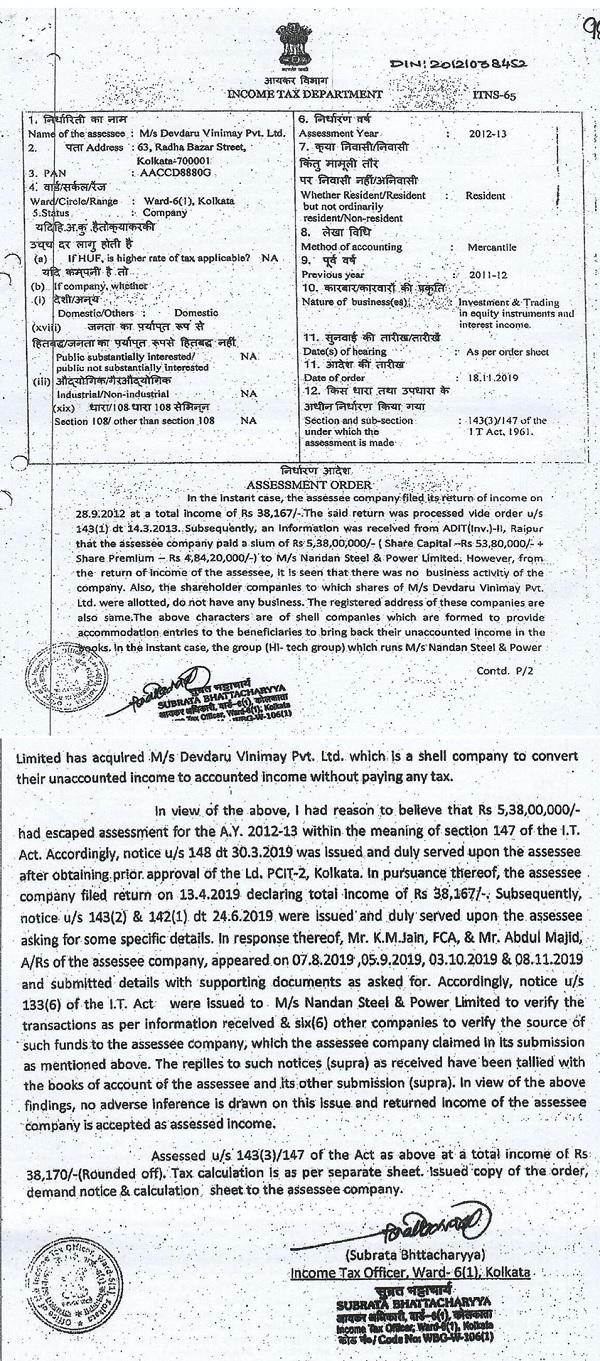
14.1 Thus, the Income Tax Department in the case of Debdaru Vinmay Pvt. Ltd. after verifying the issue had accepted returned income of the Debdaru Vinmay Pvt. Ltd.
15. Similarly, for AY 2011-12 notice u/s 148 was issued in the case of Debdaru Vinmay Pvt. Ltd. on the allegation of accommodation entry. Reassessment order was passed in the case of Debdaru Vinmay Pvt. Ltd. by ITO, Ward-6(2), Kolkata on 14.12.2018 only making the addition u/s 14A of Rs.2,70,750/- meaning by holding that there was no accommodation entry.
16. Similarly, ITO, Ward-1(4), Kolkata has issued notice u/s 148 on 22.03.2019 in the case of DKS Tradecom Pvt. Ltd. Reassessment order was passed for AY 2012-13 on 13.11.2019 in the case of DKS Tradecom Pvt. Ltd. accepting returned income.
17. Thus, the Income Tax Department has completed scrutiny assessment in the case of Debdaru Vinmay Pvt. Ltd. and DKS Tradecom Pvt. Ltd. and accepted returned income. In these facts the identity, creditworthiness and genuineness of the amounts paid by the Debdaru Vinmay Pvt. Ltd. and DKS Tradecom Pvt. Ltd. have been duly verified by the ITO, Kolkata and completed the assessment. In these facts once ITO, Kolkata issued notice u/s 148 based on the information provided by the ADIT (inv.), Raipur and then after completing the investigation accepted return of income of Debdaru Vinmay Pvt. Ltd. and DKS Tradecom Pvt. Ltd., it is incorrect on the part of the DCIT, Circle-2(1), Raipur to allege that Nandan Steels and Power Limited had failed to prove the identity, creditworthiness and genuineness of the Debdaru Vinmay Pvt. Ltd. and DKS Tradecom Pvt. Ltd. Therefore, there is no merits in the addition made by the AO in the case of the assessee.
18. Even otherwise assessee had filed during the assessment proceedings the MoA, Articles of Association, ROC certificate, copy of income tax return, copy of Audited Financials, copy of bank statements, copy of assessment orders, copy of Board Resolutions for Debdaru Vinmay Pvt. Ltd. and DKS Tradecom Pvt. Ltd. No defect has been pointed out by the AO in these documents. Therefore, assessee had fulfilled the onus casted on it, to prove identity, creditworthiness and genuineness of the transactions. AO has merely referred that there was some report from ADIT (Inv.), Raipur.
19. For all the reasons discussed above, we do not find any merit in the addition made by the AO u/s 68 of the Act. Accordingly, we direct the AO to delete the addition.
20. In the result, Ground No. 3 raised by the assessee is allowed.
21. Assessee has raised certain other legal grounds, however, since we have held that notice u/s 148 is bad in law, we do not intend to adjudicate those grounds. Accordingly, those additional grounds raised by the assessee are dismissed as un-adjudicated.
22. In the result, the appeal of the assessee is partly allowed.
Order pronounced in the open Court on 6th October, 2026




