NPG Rice Mill Pvt. Ltd. Vs PCIT (ITAT Kolkata)
₹33.55 Crore Allegation, No Proven Error: Section 263 Revision Quashed
The controversy
Information from an investigating agency may warrant examination, but it does not automatically establish that an assessment is erroneous and prejudicial to the interests of the Revenue.
In this case, the Principal Commissioner invoked section 263 on allegations that the assessee had short-delivered PDS atta and sold the diverted quantity outside its books. The estimated unaccounted sale proceeds were ₹33,54,97,028.
The Kolkata Tribunal quashed the revision after finding that the Assessing Officer had conducted enquiries, the seized documents did not establish the alleged diversion, and the PCIT had failed to address the assessee’s supporting evidence.
Assessment followed by revision
The assessee operated two units in West Bengal, carrying on rice and atta milling. It was empanelled with the State Government for converting wheat into fortified atta or PDS atta, receiving milling charges in cash and kind.
It filed its return for assessment year 2017-18 declaring income of ₹1,85,17,911.
Reassessment proceedings commenced with a notice under section 148 dated 30 July 2022. During their pendency, the assessee underwent an income-tax search on 21 December 2022, following which its case was centralised.
The Assessing Officer sought information concerning stock, sales, advances, deposits and related transactions. The reassessment was completed on 30 May 2023, accepting the returned income.
The PCIT subsequently passed a revision order dated 26 March 2026, setting aside the assessment for fresh examination.
The allegation of short delivery
The PCIT referred to seized material recording cash receipts, payments and transportation particulars. He also relied upon information supplied by the Enforcement Directorate, following its search on 11 October 2023.
Based on statements referred to in that information, the PCIT estimated short delivery of PDS atta at 25.55%, translating into alleged unaccounted sales of ₹33.55 crore.
According to him, the Assessing Officer’s failure to bring this amount to tax rendered the reassessment erroneous and prejudicial.
The assessee disputed both the factual allegation and the jurisdiction to revise the assessment.
Enquiry had already been conducted
The Tribunal found that the Assessing Officer had examined the assessee’s cash transactions, milling charges and related matters, cross-verified them with the books, and consciously concluded that no adverse inference was required.
This was therefore not a case of lack of enquiry.
Relying upon CIT v. Gopal Sharma [2024] 160 taxmann.com 227 (Calcutta), the Tribunal distinguished lack of enquiry from an allegation that the enquiry was inadequate.
It also referred to J.L. Morrison and Gabriel India Ltd., recognising that an assessment does not become erroneous merely because the order lacks an elaborate discussion of explanations already examined.
Loose sheets lacked the necessary linkage
The Tribunal independently examined the seized material relied upon by the PCIT.
The document titled “MD SIR CASH LIST” consisted of Excel sheets containing amounts and references to individuals. The Tribunal found nothing establishing that these entries represented the assessee’s unrecorded sales or short delivery of PDS atta.
Other loose sheets recorded vehicle numbers and figures but were considered dumb and non-speaking in relation to the allegation.
The PCIT had also referred to electronic records supposedly showing short delivery, but those records were neither reproduced nor placed before the Tribunal.
Drawing support from V.C. Shukla and Common Cause, the Tribunal found that the uncorroborated entries did not justify treating the Assessing Officer’s view as legally unsustainable.
Contrary evidence could not be ignored
The assessee produced the CBI Court’s order dated 27 August 2024, containing observations regarding the absence of material directly linking it to the alleged short supply.
The Tribunal also considered delivery documents signed by government-appointed distributors and inspectors, quality-control records, and a No-Dues Certificate from the Food and Supplies Department supporting full delivery.
The director’s alleged admission had been retracted. Further, the GST proceedings had been dropped by an order dated 4 February 2025.
These materials supported the assessee’s explanation. The Tribunal held that the PCIT had erred in disregarding the court’s findings while mechanically following the ED information.
Revisionary jurisdiction failed
Applying Malabar Industrial Co. Ltd. v. CIT [2000] 243 ITR 83 (SC), the Tribunal reiterated that both statutory conditions must coexist: the assessment must be erroneous, and that error must cause prejudice to the Revenue.
The PCIT had not demonstrated either through cogent material. The assessee’s explanations remained uncontroverted, while the revision rested on surmises, conjectures and presumptions.
The Tribunal accordingly quashed the section 263 proceedings and the consequential revision order. The appeal was allowed.
Author’s comments
The decision demonstrates that the magnitude of an allegation cannot substitute for proof of a revisable assessment error. Information from another agency must be tested against the assessment record and the taxpayer’s explanation.
Equally, the ruling does not make agency information irrelevant or every loose sheet inadmissible. The decisive shortcomings were the absence of corroboration and linkage, the enquiries already conducted, and the PCIT’s failure to examine contrary evidence.
The court and GST developments were supporting circumstances; the section 263 decision ultimately rested on the income-tax record.
Section 263 permits correction of an established error. It does not permit a fresh assessment merely because a serious allegation remains to be proved.
Cases Discussed
- CIT v. Gopal Sharma [2024] 160 taxmann.com 227 (Calcutta) — relied upon for the distinction between lack of enquiry and inadequate enquiry.
- PCIT v. Techno Tracom (P) Ltd. (2024) 461 ITR 47 (Calcutta) — relied upon regarding contemporaneous material forming part of the record.
- Sunil Kumar Sharma v. DCIT (2023) 146 taxmann.com 553 (Karnataka) — cited concerning the evidentiary value of seized material.
- ITO v. D.G. Housing Projects Ltd. [2012] 20 taxmann.com 587 / [2013] 212 Taxman 132 (Mag.) / 343 ITR 329 (Delhi) — Commissioner must himself establish error where the AO has already conducted enquiry.
- DIT v. Jyoti Foundation [2013] 38 taxmann.com 180 / 219 Taxman 105 (Mag.) / 357 ITR 388 (Delhi) — relied upon on inadequate enquiry and the Commissioner’s obligation to establish error.
- CIT v. J.L. Morrison & Co. Ltd. [2014] 366 ITR 593 (Calcutta) — assessment cannot be revised for lack of enquiry when the AO has conducted necessary enquiry and applied his mind.
- CIT v. Anil Bhalla (2010) 322 ITR 191 (Delhi) — relied upon concerning loose-sheet notings and corroboration.
- CIT v. Ashish Rajpal [2009] 180 Taxman 623 / [2010] 320 ITR 674 (Delhi) — referred to regarding the limits of Section 263 jurisdiction.
- CIT v. R.K. Construction Co. [2008] 175 Taxman 165 / [2009] 313 ITR 65 (Gujarat) — referred to regarding revisionary jurisdiction.
- CIT v. Gabriel India Ltd. [1993] 203 ITR 108 (Bombay) — an assessment does not become erroneous merely because it does not contain an elaborate discussion of an enquiry already conducted.
- Common Cause (A Registered Society) v. Union of India — relied upon regarding the evidentiary value of uncorroborated loose sheets.
- CBI v. V.C. Shukla (1998) 3 SCC 410 (Supreme Court) — relied upon for the proposition that loose-sheet entries require independent corroboration.
- Malabar Industrial Co. Ltd. v. CIT [2000] 109 Taxman 66 / 243 ITR 83 (Supreme Court) — both error and prejudice to Revenue must coexist before Section 263 can be invoked.
FULL TEXT OF THE ITAT KOLKATA ORDER
This is an appeal preferred by the assessee against the Revisionary order passed by the ld. Pr. Commissioner of Income Tax [hereinafter referred to as the “Ld. PCIT”] dated 26.03.2026 for the AY 2017-18.
2. The only issue raised by the assessee in various grounds of appeal is against the invalid exercise of revisionary jurisdiction by the ld. PCIT under section 263 of the Income Tax Act and therefore the order passed under section 263 of the Act dated 26.03.2026 is invalid and ab initio void.
3. The facts in brief are that, the assessee is engaged in the business of milling of atta and rice and conducts the milling work from its two units in West Bengal. The assessee was empaneled with the State Government for milling wheat into fortified atta or PDS atta for which it receives milling charges in cash and kind. The assessee had filed its return of income for AY 2017-18 on 30.10.2017 declaring total income at Rs.1,85,17,911/-. Later on, reassessment proceedings were initiated against the assessee under section 148A of the Act which culminated into an order u/s 148A(d) and consequently notice dated 30.07.2022 was issued u/s 148 of the Act. In response to the notice, the assessee filed its return of income on 31.08.2022 declaring total income as originally returned. During the pendency of the reassessment proceedings, the assessee was subjected to search and seizure action u/s 132 of the Act on 21.12.2022 and subsequent dates. The case of the assessee was thereafter centralized to Central Circle, Kolkata. It was brought to our notice that, subsequent to centralization, the AO vide notice u/s 142(1) of the Act had enquired into the transactions of the assessee including the details of its stock, goods sold, details of advances and deposits made, details of which has been placed at Pages 113-117 of Paper book. The AO thereafter completed the reassessment u/s. 147 of the Act vide order dated 30.05.2023 accepting the returned income.
4. Thereafter the ld. PCIT issued notice under section 263 of the Act dated 12.01.2026 to the assessee to explain as to why the assessment framed under section 143(3) of the Act dated 22.03.2021 should not be revised/set aside on account of being erroneous in so far as prejudicial to the interest of revenue. According to him, the material seized from the premises of NPG Group revealed cash payments and cash receipts including payment of transportation charges. This according to the ld. PCIT suggested that, the assessee was making out of books purchases and sales. He further observed that, later on the assessee was subjected to search action by the Enforcement Directorate on 11.10.2023, in the course of which, statements of the Managing Director of the assessee, Mr. Bakibur Rahman and Mr. Abdul Mandal were recorded, which revealed that the assessee had engaged in short delivery of PDS atta which was then partly sold in the open market. The Ld. PCIT also referred to another statement of Shri Netai Ghosh which was recorded on 30.11.2023. The Ld. PCIT observed that the information shared by the Enforcement Directorate contained estimates of the short delivery of PDS atta, which in his view, had been otherwise sold by the assessee in open market. On the basis of third-party statements referred to by the Enforcement Directorate in their information, the ld. PCIT estimated short delivery of the total PDS atta at 25.55% for the relevant AY 2017-18, which in his opinion, yielded unaccounted sale proceeds of Rs.33,54,97,028/-. The ld. PCIT thus observed that the AO had failed to treat the aforesaid amount as the business income of the assessee which rendered the reassessment order dated 30.05.2023 to be erroneous and prejudicial to the interest of the revenue.
5. The assessee replied to the show-cause notice vide written submissions dated 06.03.2026, the copies of which are filed at pages no. 59 to 112 of the paper books annexing several documents/evidences in support of its averments and contentions that the order passed by the ld. AO is neither erroneous nor prejudicial to the interest of the revenue and, therefore, the impugned show-cause notice deserved to be dropped. The Ld. PCIT was however not convinced with the explanation of the assessee and he set aside the assessment order under section 147/143(3) of the Act to the file of ld. AO, holding that the assessee had engaged in short delivery of PDS atta sale value of which was estimated at Rs.33,54,97,028/- vide order dated 26.03.2026 passed u/s 263 of the Act.
6. The assessee has taken various alternative arguments qua the separate grounds in the grounds of appeal. However, we deem it fit that all these contentions and arguments are summarized and directed against the exercise of invalid jurisdiction under section 263 by the ld. PCIT thereby passing a revisionary order, which is invalid and void ab initio and therefore are dealt with together.
7. The first argument of the ld. AR was that the order passed u/s 263 of the Act was without jurisdiction as the reassessment order dated 30.05.2023 was neither erroneous nor prejudicial to the interests of the revenue. He submitted that though the reassessment proceedings were initiated prior to the said search and seizure u/s 132 of the Act, the case of the assessee was subsequently centralized and the assessment was completed by the DCIT, Central Circle 3(1), Kolkata. The Ld. AR thus submitted that the AO had gone through the relevant materials seized in the course of search, made necessary enquiries inter alia including the alleged cash transactions/deposits of the assessee as well as the milling charges received by the assessee and only after considering all these facts, he had taken a plausible and correct view accepting the transactions entered into by the assessee as he did not find any evidence of undisclosed sales, which is evidenced by the findings recorded in the reassessment order itself. He thus submitted that the Ld. PCIT had erred in holding the assessment order as erroneous and prejudicial to the interests of the revenue for lack of enquiry. In support of his argument, ld. AR relied on the decision of the Hon’ble Calcutta High Court in the case of CIT v. J.L. Morrison & Co. Ltd. [2014] 366 ITR 593, wherein the Hon’ble Court has held that where the assessee’s claim is allowed by the ld. Assessing Officer after conducting necessary enquiry and application of mind, then the order of assessment cannot be considered and held to be erroneous and prejudicial to the interest of revenue under section 263 of the Act on the ground of lack of enquiry or non-enquiry.
8. The ld. AR further argued that the revision proceedings have been initiated by the Ld. PCIT merely on the basis of the fact that search and seizure proceedings were conducted by the Enforcement Directorate on the assessee without considering that no adverse material was unearthed by the Enforcement Directorate during the said action. In support of his submissions, the Ld. AR referred to the order dated 27.08.2024 passed by the Ld. CBI Court, copy of which has been placed at Page 68 to 102 of Paper book. He submitted that the Ld. CBI Court in paragraph 12 of the said order had specifically held that, from the facts and material available on record, there were no reasons to believe for conducting the search on the assessee and arresting its director u/s 17 and 19 of the Prevention of Money Laundering Act, 2002. Referring to Paragraph 49 of the same order, he pointed out that the Ld. CBI Court specifically found that none of the statements made by any accused including any distributor or dealer or ration shop owner gave any adverse statement against the assessee and its director which would link them to the short supply of PDS atta and purchasing the same back through middlemen. The Ld. AR thereafter submitted that the Ld. CBI Court had also relied on the fact that the delivery of fortified atta is taken from the mills of the assessee on the basis of delivery orders issued by the Food & Supplies Department to the Government appointed distributors and dealers and that the delivery is made in the presence of an Inspector from the Food & Supplies Department who also endorses his signature on the same to ensure that full quantity of atta is delivered. He submitted that, the Ld. CBI Court also examined the quality control certificates which showed that the atta delivered by the assessee was in conformity of the government prescribed quality standards. According to him, these facts had not been controverted by the Enforcement Directorate before the Ld. CBI Court or thereafter. The Ld. AR also relied on the No-Dues Certificate dated 01.03.2024 issued by the District Controller, Food and Supplies Department which showed that the assessee had made complete delivery for all the period prior to the said date and the meagre quantity of atta to be delivered pertained to the then current cycle.
9. The Ld. AR thereafter pointed out that, even the statement of the Director, on which the entire case rested had been retracted by him in his bail application which was the very first opportunity available to the said director and therefore in the absence of the any corroborating evidence, and having regard to the findings rendered by the Ld. CBI Court, no adverse inference could be drawn against the assessee. It was also contended by the Ld. AR that the statement of Shri Netai Ghosh referred to by the Ld. PCIT was of no relevance as it was recorded pursuant to a separate search action, and it was also not shown that, he had stated anything adverse relating to the assessee.
10. The Ld. AR thus submitted that, there was no adverse material brought out in the impugned order which would show that the assessee had engaged in short delivery of atta or had earned unaccounted income from sale of the same. The Ld. AR asserted that, though these facts were brought to the notice of ld. PCIT, he chose to ignore the same. According to him, such inaction of the ld. PCIT was unjustified as these contemporaneous orders also formed part of ‘record’ and for this he relied on the decision of the Hon’ble jurisdictional Calcutta High Court in PCIT v Techno Tracom (P) Ltd (2024) 461 ITR 47.
11. Thereafter, the ld. AR took us through the relevant screenshots of the seized electronic data which was extracted by the ld. PCIT in the impugned order to allegedly justify the information of Enforcement Directorate. He submitted that, the seized document titled ‘MD SIR CASH LIST’ which was heavily extracted by the ld. PCIT, were only loose sheets wherein there were alleged scribblings in the name of Director of the assessee, Mr. Bakibur Rahman, who had also been subjected to search along with the assessee. He argued that, the contents of these loose sheets did not in any manner suggest that the said transactions represented unaccounted cash sales or expenses pertaining to the assessee. It was claimed that, these loose sheets in absence of any corroborative evidence was not reliable. For this, he relied on the decision of the Hon’ble Supreme Court in CBI vs V. C. Shukla (1998) 3 SCC 410, the Hon’ble Delhi High Court in CIT v Anil Bhalla (2010) 322 ITR 191 (Del) and the Hon’ble Karnataka High Court in Sunil Kumar Sharma v DCIT (2023) 146 taxmann.com 553 (Kar). Similarly, it was shown that, the transportation documents referred to by the ld. PCIT were shown to contain nothing adverse against the assessee. He further submitted that, the ld. PCIT also did not specify any specific seized material which contained the name of the assessee or suggested any short delivery of PDS atta. The Ld. AR submitted that during the course of the reassessment proceedings, the entire seized material was before the AO who has specifically considered the cash deposits and cash transactions of the assessee as well as the milling charges received by the assessee, which is evident from the reassessment order dated 30.05.2023 which proves that there was no failure on the part of the AO to examine the same. He therefore vehemently contended that the reference to the seized material was an eye-wash to justify the action taken u/s 263 of the Act.
12. In view of the above, he submitted that when the specific issue raised by the Ld. PCIT had been met with relevant explanations along with evidences disproving the specific allegation, then it was incumbent upon the ld. PCIT to himself independently deal with the objections and record his own satisfaction to prove that the AO’s order was in fact erroneous and prejudicial to the interests of the Revenue for the reasons set out in the SCN. Without doing so, the ld. PCIT cannot merely set aside the assessment order directing AO to pass the order of assessment afresh, effectively giving the AO a second innings without establishing that the assessment order was erroneous as well as prejudicial to the interests of the Revenue. The ld. A.R. in support of his argument relied on the decision of the Jurisdictional High Court in CIT v Gopal Sharma (2024) 160 taxmann.com 227(Cal) and Hon’ble Delhi High Court in the cases of ITO v. D G Housing Projects Ltd. [2012] 20 taxmann.com 587/[2013] 212 Taxman 132 (Mag.)/[2012] 343 ITR 349 and DIT v. Jyoti Foundation [2013] 357 ITR 488 (Delhi).
13. To further buttress his submissions, the Ld. AR also brought to our notice that the assessee had also been subjected to search and seizure by the GST department on 02.12.2020 whereafter the assessee was subjected to adjudication proceedings u/s 73 and 74 of the CGST Act and show cause notices in this regard were issued. It was shown that these proceedings were also finally dropped vide the order dated 04.02.2025 u/s 74 of the CGST Act which was also after the said search by the Enforcement Directorate and the bail order dated 27.08.2024. This contemporaneous fact, according to him, further supported the assessee’s case that the allegation of short delivery or atta and subsequent unaccounted sales was baseless. The Ld. AR further submitted that, there was no seizure of any unaccounted cash or asset from the premises of the assessee or its directors which would otherwise corroborate generation of such magnitude of alleged unaccounted income of Rs. 33.24 crores in the AY 2017-18.
14. The last argument of the Ld. AR was that, since the information received from Enforcement Directorate was never before the AO or formed part of his assessment records, the action of the AO, at that material time, while framing the reassessment dated 30.05.2023 cannot be held to be erroneous and prejudicial to the interests of the Revenue.
15. Per contra, the Ld. DR vehemently relied on the revision order passed u/s 263 of the Act by the Ld. PCIT. The Ld. DR contended that the assessee had perpetrated a scam and as such it would not be possible for the Ld. PCIT to point out any discrepancy in the books of the accounts of the assessee. Referring to Para 58 of the bail order dated 27.08.2024, she submitted that the Court had categorically observed that it did not want to touch upon the merits of the case as it may cause prejudice to further investigation and therefore the ld. PCIT had rightly ignored this order while completing the revisionary proceedings u/s 263 of the Act. She further submitted that the seized material extracted by the Ld. PCIT in the impugned order had not been examined by the AO which rendered the assessment order to be erroneous and prejudicial to the interests of the Revenue. She therefore submitted that the revision order be upheld by dismissing the appeal of the assessee.
16. The Ld. AR in his rejoinder took us through Paragraphs 56 to 59 of the bail order and submitted that the observations made in Para 58, which was relied upon by the ld. DR, related to other millers and persons against whom specific statements were made and to whom the scam was attributable and not the assessee. He submitted that the CBI Court had found that though the acts were performed by others but the Enforcement Directorate has made the assessee the scapegoat and thus gave relief to the assessee and its director after finding that there was no tangible or credible evidence against the assessee. He thus submitted that the contention put forth by the ld. DR was devoid of any rationale and merit.
17. After hearing the rival contentions and perusing the material as placed before us, we find that in the case in hand the Ld. PCIT invoked jurisdiction u/s 263 of the Act on the allegation that there was failure to conduct enquiries into the seized material which the AO was required the AO to make, which in his view, was corroborated the subsequent information shared by the Enforcement Directorate that the assessee was short delivering PDS atta, and it was selling it outside the books of accounts. According to Ld. PCIT therefore the assessment order suffered from lack of enquiry & application of mind to the facts as also by incorrect application of applicable legal provisions to the facts of the case. As a result, in the opinion of Ld. Pr. CIT, AO’s order was erroneous and therefore liable for revision u/s 263 of the Act.
18. Before we proceed to adjudicate the issue at hand, we have to first examine the scope of revisional jurisdiction u/s. 263 of the Act. It is well settled that the revisionary power under Section 263 of the Act is not unfettered. The Hon’ble Supreme Court in Malabar Industrial Co. Ltd. v. CIT [2000] 109 Taxman 66 / 243 ITR 83 (SC) has held that the Commissioner may assume jurisdiction only when two conditions are satisfied together. Firstly, the order of the Assessing Officer must be erroneous. Secondly, the error must have caused prejudice to the interests of the Revenue. If either condition is absent, the jurisdiction under Section 263 cannot be invoked. On the first condition, an assessment order can be called “erroneous”, (a) where the Assessing Officer has proceeded on an incorrect assumption of fact or law; (b) where the order was passed in breach of the principles of natural justice; (c) where the order shows no application of mind; or (d) where the Assessing Officer failed to make any enquiry into the issue before him. The second condition is equally important. The Hon’ble Apex Court explained that the words “prejudicial to the interests of the Revenue” must be read together with the word “erroneous”. The Commissioner therefore has to show that the error has actually caused a loss to the Revenue. The Hon’ble Apex Court explained that, not every loss of revenue flowing from an assessment order amount to prejudice and where the AO has adopted one of the courses permissible in law, the order cannot be revised merely because it has led to a loss of revenue. Likewise, where two views are possible and the Assessing Officer has taken one of them, the Commissioner cannot substitute his own view just because he disagrees with the view of the AO. Such an order can be revised only if the view taken by the Assessing Officer is unsustainable in law or based upon incorrect facts.
19. In the instant case we find that in the SCN, the Ld. PCIT had set out specific reasons for which he had considered the AO’s order to be erroneous in so far as prejudicial to the interests of the Revenue. It is noticed that, the assessee had submitted before the Ld. PCIT detailed explanations supported by evidences to demonstrate that the SCN had proceeded on assumption of some incorrect facts and wrong interpretation of applicable legal provisions. The assessee also explained that before completion of assessment, the AO had indeed made enquiries in relation to the issues raised in the notice and the order u/s 147/143(3) of the Act was passed only after considering the outcome of the enquiry. According to Ld. AR, on receipt of the objections from the assessee, the Ld. PCIT ought to have examined the assessment records and conducted his own enquiry and thereafter should have recorded his own finding proving that the explanations furnished by the assessee is factual or legal infirm because of which he found that the view adopted by the AO was unsustainable in law making his order as erroneous within the meaning of Section 263 of the Act. In our opinion, once the ld. PCIT initiates the proceedings u/s 263 of the Act for specific reasons and these reasons are met by the assessee, then it is incumbent upon the ld. PCIT to himself independently deal with the objections and record his own satisfaction to show that the AO’s order is in fact erroneous and prejudicial to the interests of the Revenue for the reasons out in the SCN. The ld. PCIT in such a situation cannot merely set aside the assessment order directing AO to pass the order of assessment afresh, without establishing that the initial order was erroneous as well as prejudicial to the interests of the Revenue. In this regard, it is pertinent to refer to the observations and the decision rendered by the Hon’ble Delhi High Court in the case of ITO v. D.G. Housing Projects Ltd. [2012] 20 taxmann.com 587/[2013] 212 Taxman 132 (Mag.)/343 ITR 329, which is reproduced below:
“19. In the present case, the findings recorded by the Tribunal are correct as the CIT has not gone into and has not given any reason for observing that the order passed by the Assessing Officer was erroneous. The finding recorded by the CIT is that “order passed by the Assessing Officer may be erroneous”. The CIT had doubts about the valuation and sale consideration received but the CIT should have examined the said aspect himself and given a finding that the order passed by the Assessing Officer was erroneous. He came to the conclusion and finding that the Assessing Officer had examined the said aspect and accepted the respondent’s computation figures but he had reservations. The CIT in the order has recorded that the consideration receivable was examined by the Assessing Officer but was not properly examined and therefore the assessment order is “erroneous”. The said finding will be correct, if the CIT had examined and verified the said transaction himself and given a finding on merits. As held above, a distinction must be drawn in the cases where the Assessing Officer does not conduct an enquiry; as lack of enquiry by itself renders the order being erroneous and prejudicial to the interest of the Revenue and cases where the Assessing Officer conducts enquiry but finding recorded is erroneous and which is also prejudicial to the interest of the Revenue. In latter cases, the CIT has to examine the order of the Assessing Officer on merits or the decision taken by the Assessing Officer on merits and then hold and form an opinion on merits that the order passed by the Assessing Officer is erroneous and prejudicial to the interest of the Revenue. In the second set of cases, CIT cannot direct the Assessing Officer to conduct further enquiry to verify and find out whether the order passed is erroneous or not.”
20. The above view is also supported by the following decisions:
i. DIT v. Jyoti Foundation [2013] 38 taxmann.com 180/219 Taxman 105 (Mag.)/357 ITR 388 (Delhi)
ii. CIT v. Ashish Rajpal [2009] 180 Taxman 623/[2010] 320 ITR 674 (Delhi)
iii. CIT v. R.K. Construction Co. [2008] 175 Taxman 165/[2009] 313 ITR 65 (Guj.)
21. Having broadly discussed the settled judicial principles, we now proceed to examine whether for the reasons set out in notice, the Ld. PCIT was able to justify his finding in the impugned order that the AO’s order was indeed erroneous and prejudicial to the interests of the Revenue. It is observed from the records that, the case of the assessee was reopened by issue of notice u/s 148 of the Act dated 30.07.2022, during the pendency of which search action u/s 132 of the Act was conducted on 21.12.2022, pursuant to which the case of centralized to the charge of DCIT, CC-3(1), Kolkata and latter completed the assessment after examining the seized material vide order u/s 147/143(3) dated 30.05.2023. We observe that, the AO had made enquiries by issuing notice u/s 142(1) of the Act calling for the details of the assessee’s stock, goods sold, advances and deposits, and the cash deposits, cash transactions and milling charges. It is seen that, the AO after perusing the replies of the assessee had discussed the modus operandi of the business of the assessee, cash collections etc. in the assessment order, and observed as under:-
‘…. the assessee-company had purchased Paddy and Wheat from local markets and sold finished goods i.e. rice and flour to various retailers, whole sellers etc. Thereafter, the said cash such received from sale proceeds are deposited in the bank accounts of assessee company. Further, from FY 2016-17 KMS (Kharif Marketing Season) i.e. October 2016 onwards the Government changed policy and started supplying paddy and wheat from its own sources and pays only crushing charges of paddy and wheat into rice and flour to the assessee-company. As a result, there is no cash requirement to purchase paddy and wheat on behalf of Government, so the assessee-company gradually paid off the cash credit limit of Oriental Bank of Commerce in the financial year 2016-17 and onwards by depositing cash received against cash sale of finished goods into bank. The transaction in bank accounts were corroborated by duly audited books of accounts, cash book, cash flow statements by the assessee company.’
22. The above facts show that the AO did make enquiries into the assessee’s cash transactions, milling charges and other related aspects. He cross-verified them with the books of account and then consciously concluded that no adverse inference was called for. This is therefore not a case of lack of enquiry. We find that this distinction between ‘lack of enquiry’ and ‘inadequate enquiry’ was examined by the Hon’ble jurisdictional High Court in CIT v. Gopal Sharma (supra) and it was held that the assessment cannot be branded erroneous merely because the enquiry is said to be inadequate.
23. The Ld. DR had contended that the above findings were not elaborate and it was not discernible whether the AO had corroborated the same with the material seized in the course of search. We are however unable to accept this plea in light of the decisions of the Hon’ble Jurisdictional High Court in the case of J.L. Morisson (Supra) and Hon’ble Bombay High Court in the case of Gabriel India Ltd. (203 ITR 108) wherein it was held that, where the ITO has made enquires and assessee has given explanation, then the decision of the ITO could not to be held to be erroneous simply because his order did not make elaborate discussion in this regard.
24. We now turn our attention to the alleged seized material referred to by the ld. PCIT in his order on the basis of which he observed that there was no enquiry conducted by the AO, to allege non-enquiry. We have, with the assistance of the ld. AR, gone through each item of seized material extracted by the ld. PCIT in the impugned order and it is seen that, none of it suggests any allegation of short delivery of PDS atta or collection of any unaccounted sale proceeds. For instance, the document titled “MD SIR CASH LIST” on which much emphasis was laid by the ld. PCIT is extracted hereunder:-
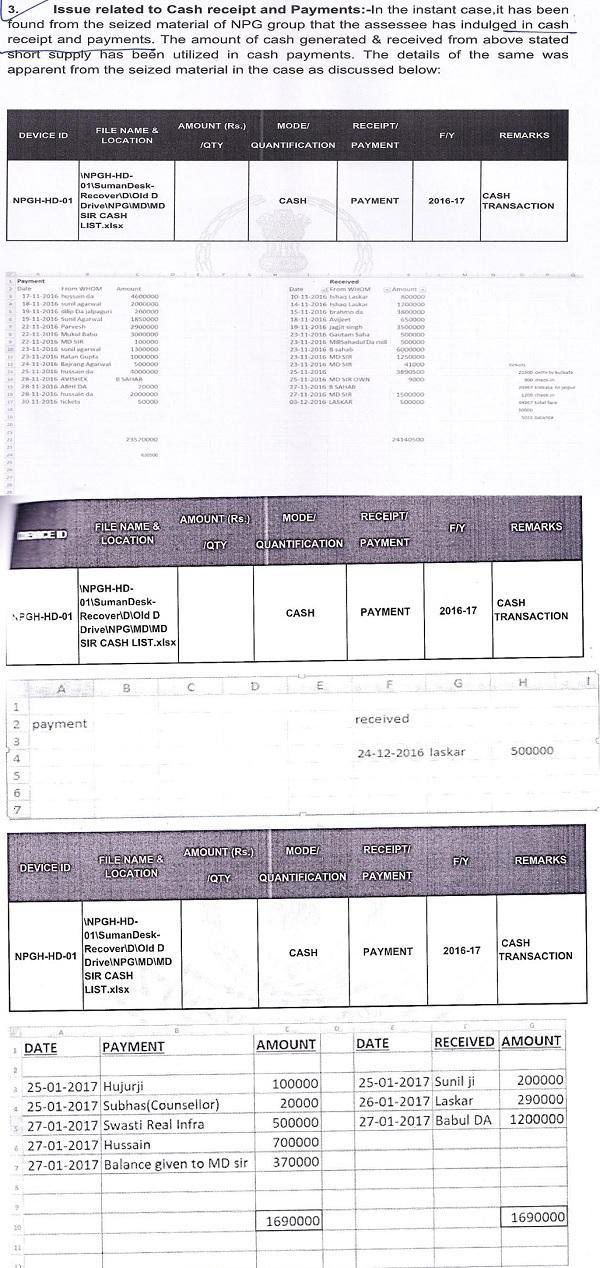
25. Having perused the above, we find these to be excel sheets containing scribblings of amounts running into few lacs which were seized from the laptop from an office employee. In our opinion, the above scribblings can at best be attributed to the individual whose name/abbreviation is mentioned therein, but there is nothing contained therein which suggested any out of books sales or short delivery of PDS atta by the assessee. There is also force in the submission of the Ld. AR that, these loose sheets without any independent corroboration does not carry evidentiary value, as held by the Hon’ble Supreme Court in the cases of V.C. Shukla (supra) &Common Cause (A Registered Society) (supra).In our opinion therefore, the action of the AO in disregarding these loose sheets and contents thereof was a plausible view and cannot be faulted with or be treated as a view taken which is unsustainable in law.
26. Similarly, we have gone through the loose sheets referred to by the ld. PCIT at Pages 7 to 10 of his order and notice that it only contains vehicle numbers with some digits noted below the same. The loose sheets do not contain anything adverse to the assessee and rather is found to be dumb and non-speaking. Significantly, the ld. PCIT was also unable to link any specifics of the contents of the seized material with the information shared by the Enforcement Directorate relating to alleged short delivery of PDS atta. We may add that at paragraph 16.3 of the impugned order, the ld. PCIT has made references to seized electronic records which supposedly contain details of short delivery of PDS atta, but none of these electronic records has been brought on record or extracted in the impugned order, nor any such material was placed by the ld. DR before us. Having gone through the seized material referred to by the ld. PCIT in the impugned order to allege non-enquiry, it is observed that the said material had no linkage with the impugned issue at hand. There was also no corroboration or linkage with the information shared by the Enforcement Directorate. On these facts therefore, we find that the foundational premise on which the ld. PCIT sought to revise the assessment order by alleging non-enquiry into the seized material was factually unfounded and is not borne out from the records placed before us. We note that the ld. PCIT did not carry out any exercise/examination of the explanation put forth by the assessee and instead reiterated the allegations levelled in the SCN to set aside the matter to the file of the AO. In our opinion, such action of the Ld. PCIT was invalid and the case of the assessee finds support from the decision of the Hon’ble Delhi High Court in the case of D G Housing Projects Ltd. (supra) and Jyoti Foundation (supra).
27. It is seen that the allegations levelled in the SCN and findings of the ld. PCIT regarding short delivery of PDS atta and the approximation of its short delivery at 25.55% rested not on any material seized in the course of search but the information provided by the Enforcement Directorate. Upon going through the impugned order, it is observed that, the estimates shared by the Enforcement Directorate rested solely from the statements recorded by them at the time of the search conducted upon the Director of the assessee on 11.10.2023. It is noticed that, the statement taken from the Director of the assessee, Shri Bakibur Rahman wherein he had allegedly admitted to short delivery of PDS atta had been retracted and such retraction dated 20.02.2024 was considered by the Ld. CBI Court which by its order dated 27.08.2024 had discharged both the assessee and its director.
28. The Ld. AR also pointed out that the CBI Court had recorded a categorical finding that there was no grounds or reason with the Enforcement Directorate to have conducted the action in the first place and that even none of the adverse statements of any persons or any seized material directly linked the assessee to the allegation of short delivery of PDS Atta, and the relevant Paras 12 & 49 is reproduced hereunder:-
12. I failed to comprehend through the lens of a prudent man as to the existence of ‘’reason to believe’’ from the above facts and materials for conducting search u/s. 17 in the premises of NPG Rice Mill, and arresting its owner, Bakibur Rahman in exercise of power u/s. 19 of the Act,2002! …..
49. Now, coming back resuming to the case at hand, it appears that the total value of the recovered PDS Atta (4,633.3 k.g.) in connection with the 4 FIRs of Nadia District namely, Kotwali PS (2 FIRs), Nabadwip PS and Dhubulia PS which the petitioner is allegedly linked with is not even exceeding Rs.2,00,000/- (Rupees two lakh) in the whole. Admittedly, none of the accused persons of those cases has made any inculpatory statement which gives even any linkling about any involvement of accused, Bakibur Rahaman or his Mills namely, NPG Rice and Flour Mills in the alleged PDS scam. Admittedly, the distributor/s, dealer/s or the ration shop owner/s did not give any statement with respect to short supply or purchasing back through middlemen or supplying poor quality Atta in the PDS.
29. The Ld. AR had explained to us the entire modus operandi of the production and supply of PDS Atta. It is noticed that, firstly entries are made in the production Register, documenting the input quantity, output quantity (atta produced), date, batch information, and losses or byproducts, if any. Thereafter, the government-appointed inspectors or certified third parties conduct quality checks to ensure compliance with nutritional standards and safety norms and issue quality certification. Once quality checks are completed, the delivery of atta is made. It was further shown to us that, the delivery Orders accompany each consignment, validating the handover and linking it to the original wheat issuance. Once delivered, the Assessee raises invoices, supported by the Delivery Challan and Freight Charges ledger, recording dispatched quantities and associated logistics costs and also for milling charges from the State Government. The Ld. AR thus pointed out that, there was no possibility for the assessee to make any kind of short sale of PDS atta and make any kind of out of book purchases or sales, as the deliveries were also made in the presence of government appointed inspectors. The Ld. AR contended that all these documents, registers, goods movement details entries etc. are found and seized in the course of search and upon corroborating the same with the books of accounts, and being satisfied with the same, that the AO had completed the assessment u/s 147/143(3) of the Act. It is noticed by us that the CBI Court had also inter alia considered the Delivery Orders issued for delivery of the atta and found that the same were bearing signatures of the government distributors and also the inspector in charge of the Food & Supplies Department, Government of West Bengal which had not been contested by the Enforcement Directorate. Further, the atta delivered by the Assessee was subjected to testing by the Regional Quality Control Laboratory (“RQCL”) and Directorate of Inspection and Quality Control showing sufficient compliance with the WBPDS (Maintenance & Control) Orders, 2013. Thereafter, the full delivery of fortified atta was supported by the No Dues certificate issued by the Food & Supplies Department and therefore there was no evidence of short delivery of atta, as was being alleged by the Enforcement Directorate. The relevant findings are noted to be as follows:-
52. Conversely, in order to satisfy the twin conditions of Section 45 of the PML Act,2002, I find that the petitioner has produced the documents duly signed by the Distributor(s)/Dealer(s) and the Inspector of Food & Supplies confirming the delivery of the full quantity as per the delivery order/s during the relevant period by the petitioner or his Mill/s to the Distributor/s. ‘’A man may lie but a document will never lie’’ is a well-known principle or golden rule in the journey of truth followed by almost all courts across the Globe!
53. Further, so far as the allegation of poor-quality food grain is concerned, the petitioner has produced documents of the RQCL which go to show that prior to delivery of the PDS commodity to the Distributors by NGP, it had followed and complied with the provisions of the WBPDS (Maintenance & Control) Orders,2013, and only after getting the test report/s, of sample/s from the Government authorized lab, the same were delivered to the Distributors.”
30. We observe that the above order of the CBI Court was passed much prior to the exercise of revisionary jurisdiction by the ld. PCIT u/s 263 of the Act and the same was also brought on record by the assessee before the ld. PCIT. In our opinion therefore, the ld. PCIT had erred in disregarding the same and mechanically following the information shared by the Enforcement Directorate sans the above findings of the CBI Court.
31. Upon query from the Bench as to whether the above referred order contained anything adverse which would suggest that the assessee was involved in any wrongdoing, the ld. DR had referred to Paragraph 58 of the bail order. To this, the Ld. AR in his rejoinder pointed out that, the Revenue had selectively picked up few sentences from the order which was divorced from the actual facts. It was shown to us that, Para 58 did not pertain to the assessee but some other accused person and that this was discernible from the findings recorded in the same paragraph itself. Having gone through the same in its entirety, the contention of the ld. DR is found to be unsustainable and is thus rejected.
32. The ld. AR had also placed before us the details regarding the search action conducted by the GST authorities upon the assessee and it was shown that the GST proceedings were ultimately dropped by order dated 04.02.2025, post the search action of Enforcement Directorate and the above bail order. This material development lends support to the ld. AR’s contention that, even the GST authorities did not discover any evidence of alleged short delivery of PDS atta or otherwise they would have issued notice for non-payment of GST on the alleged undisclosed sales. The submissions of the ld. AR are also corroborated by the surrounding circumstances placed before us which reveal that, there was no unaccounted cash or asset or unexplained jewellery of such magnitude unearthed in the course of search conducted upon the assessee, which would otherwise corroborate the allegation of undisclosed sales levelled against the assessee.
33. Considering the above fasts and for the reasons discussed above, we are of the considered opinion, the relevant facts and seized material were available with the AO, who after taking into account all the facts of the case has taken a plausible view and did not draw any adverse inference against the assessee. Therefore, in our opinion, the ld. PCIT is not justified in exercising the revisionary jurisdiction under section 263 of the Act setting aside the assessment to the ld. AO for alleged non-enquiry. Also, the ld. PCIT was unable to demonstrate with cogent material that there was any short delivery of PDS atta or any unaccounted sales, as alleged in the information shared by Enforcement Directorate. As noted above, the allegations levelled by the ld. PCIT were specifically addressed by the assessee, which remained uncontroverted in the impugned order and instead his findings are found be based on surmises, conjectures and presumptions and not backed by any cogent material. As such in light of the decisions (supra), the assessment order dated 30.05.2023 cannot be said to be erroneous and prejudicial to the interests of the revenue. Considering the facts of the case and the decisions as referred to above, we are inclined to quash the revisionary proceedings u/s. 263 of the Act and also the consequent order passed thereto.
34. In the result, the appeal of the assessee is allowed.
Order pronounced on 06.10.2026.