
Antriksh Engineers Construction Corporation Vs ACIT (ITAT Delhi)
The Delhi Bench of the Income Tax Appellate Tribunal (ITAT) decided a batch of appeals filed by various assessees belonging to the Antriksh Group against orders passed by the Commissioner of Income Tax (Appeals), Gurgaon, arising from assessments framed under Sections 153A, 153C, 143(3) and related provisions of the Income Tax Act for Assessment Years 2008-09 to 2015-16.
The cases originated from a search conducted on 5 February 2014 at the residential and business premises of the Antriksh Group, Dwarkadhis Buildwell Group and certain partners. The Assessing Officer (AO) completed assessments by making several additions, which were largely confirmed by the CIT(A). The assessees challenged the assessments before the Tribunal on multiple legal and factual grounds.
A principal issue before the Tribunal was the validity of approvals granted under Section 153D. The assessees argued that the approvals accorded by the Joint Commissioner of Income Tax were mechanical, consolidated in nature, and granted without application of mind. The approvals covered numerous cases and assessment years without indicating separate consideration of each year, movement of files, examination of appraisal reports, or reasons supporting the approval.
The Tribunal examined various judicial precedents relied upon by the assessees, including decisions of the Orissa High Court, Allahabad High Court, Bombay High Court, Delhi High Court and the Delhi Tribunal. It noted that courts had consistently held that approval under Section 153D is a mandatory safeguard and cannot be treated as an empty formality. The approving authority must independently apply its mind to the material and draft assessment orders.
The Tribunal observed that the approvals in the present cases did not demonstrate consideration of assessment records or search material, contained no reasons and did not provide separate approvals for individual assessment years. It held that such approvals were mechanical and suffered from total non-application of mind. Consequently, the approvals under Section 153D were quashed, and the assessment orders founded upon them were held to be vitiated, void ab initio and liable to be quashed.
The Tribunal further dealt with assessments relating to completed or unabated years. It observed that in certain cases, no notice under Section 143(2) had been issued within the prescribed period, resulting in the assessments attaining finality prior to the search. Relying upon the principle that completed assessments can be interfered with under Section 153A only on the basis of incriminating material found during search, the Tribunal noted that additions had been made without reference to any such material. Accordingly, those assessments were also quashed.
Another issue concerned assessments framed under Section 143(3) read with Section 144, despite the Revenue relying upon documents allegedly unearthed during search. The Tribunal observed that satisfaction for initiating proceedings under Section 153C had been recorded during Assessment Year 2016-17. Consequently, the relevant six-year period fell within the scope of Section 153C. Since mandatory procedures under Section 153C had not been followed, the assessments framed under Section 143(3) read with Section 144 were held to be without jurisdiction and were quashed.
The Tribunal also examined cases where additions had been made under Section 153A on the basis of material allegedly obtained from searches conducted on third parties. It found that no incriminating material belonging to the concerned assessee had been seized during the search. The Tribunal held that where material pertains to another person, the Revenue must follow the procedure prescribed under Section 153C, including recording satisfaction and transferring material to the jurisdictional Assessing Officer. Failure to comply with these requirements rendered the assumption of jurisdiction under Section 153A invalid. The related assessments were accordingly quashed.
On the merits of additions relating to real estate projects, the Tribunal considered the rejection of the Project Completion Method (PCM) adopted by the assessees and the AO’s application of the Percentage Completion Method (POCM). The assessees had consistently followed PCM for recognising revenue from real estate projects, recognising income only upon completion of projects. The AO, however, estimated income by applying a rate of 20% to advances received from customers.
The Tribunal noted that the Revenue had not identified any defects in the books of account nor recorded findings regarding incorrectness or incompleteness of the accounts. It observed that the assessees had consistently followed PCM and that no material had been brought on record to establish that adoption of POCM would more accurately reflect profits. Holding that rejection of the regularly followed accounting method was unjustified, the Tribunal deleted the additions made by estimating income at 20% of advances received.
The Tribunal also considered additions relating to alleged unaccounted receipts and payments based upon loose papers seized during the search. According to the Revenue, certain rough notings found at the premises of individuals associated with the group represented cash receipts and cash payments outside the books of account. The AO apportioned such alleged transactions among different entities and made additions accordingly.
The Tribunal observed that the loose papers contained rough notings and scribblings without signatures, dates, narration or any reference to the assessee companies. No independent inquiry had been conducted, no statements had been recorded to corroborate the alleged transactions, and no evidence had been produced linking the assessees with the contents of those documents. Relying upon judicial precedents, the Tribunal held that unauthenticated loose sheets lacking corroborative evidence could not constitute admissible evidence for making additions. Since the additions were based merely on assumptions and presumptions without supporting material, they were deleted.
In another issue involving estimation of income, the Tribunal considered additions made on the premise that one of the assessees had executed a real estate project. The assessee contended that it neither owned the land nor developed the project and had merely transferred the relevant agreements and booking amounts to other entities. Observing that the assessee had not executed the project and that amounts received had been passed on to the entities that ultimately developed it, the Tribunal held that the additions were unsustainable and deleted them.
The Tribunal also dealt with additions under Section 69A relating to cash deposits made by one of the assessees. During appellate proceedings, the assessee furnished documentary evidence including records of agricultural income, Form-J issued by mandi authorities, land ownership documents, cultivation records and cash books showing availability of funds. The Tribunal found that these documents substantiated the assessee’s ownership of agricultural land, agricultural activities and the availability of cash balances. Since the Revenue had not identified any defects in the evidence or conducted inquiries disproving the agricultural activities, the additions were held to be unsustainable and deleted.
Ultimately, the Tribunal allowed the assessees’ legal challenges relating to defective approvals under Section 153D and invalid jurisdiction exercised under Sections 153A and 143(3). It also granted relief on several substantive additions concerning revenue recognition methods, alleged unaccounted transactions based on loose papers, estimated income and unexplained cash deposits. The appeals filed by the assessees were partly allowed.
FULL TEXT OF THE ORDER OF ITAT DELHI
The instant appeals filed by the assessees are directed against the orders all passed by the Ld. Commissioner of Income-tax (Appeals)-3 Gurgaon [hereinafter referred to as the Ld. CIT(A)] under Section 250 of the Income Tax Act, 1961 (hereinafter referred to as ‘the Act’) arising out of the Assessment Orders passed by the ACIT, Central Circle-1, Gurgaon (hereinafter referred to as ‘the Ld. AO’) under various Sections of the Act for Assessment Years 2008-09 to 2015-16. Further details in respect of the orders of the authorities below are as under:-
| Appeal No. & Assessment Year | Date of Order of the CIT(A) | Date of Order of the AO | Section under which the AO passed the Assessment Order |
| 8842 to 8846/DEL/2025, 2010-11 to 2014-15 | 30.10.2025 | 29.03.2016 | 153A(1)(b) |
| 8851 to 8855/DEL/2025, 2011-12 to 2015-16 | 12.11.2025 | 29.03.2016 (29.12.2017 For AY 2015-16) | 153A(1)(b) (143(3) for 2015-16) AY |
| 8911 & 8912/DEL/2025, 2013-14 & 2014-15;
8847 to 8850/DEL/2025, 2008-09 to 2010-11 & 2012-13 |
07.11.2025 | 29.03.2016 | 153A(1)(b) |
| 8856 to 8862/DEL/2025, 2008-09 to 2014-15 | 07.11.2025 | 29.03.2016 | 153A(1)(b) |
ITA No.8842/Del/2025 for AY 2010-11
2. By and under the authorization of Director of Income-tax (Inv.), Chandigarh under Section 132(1)(A) of the Act, a search was carried out on 05.02.2014 at the residential as well as business/office premises of Antriksh group and Dwarkadhis Buildwell group of cases and the partners of the assessee firm, namely, Mr. Rajbir Singh Goyat and Rakesh Kumar Yadav. During the course of search operation, some incriminating documents/informations relating to the assessees were claimed to have been found and seized. The jurisdiction of the assessees transferred to the Circle by and under the order under Section 127 of the Act passed by the Pr. CIT, Delhi-21, by and under the letter being F.No.Pr.CIT-21, Centralization of case/2015-16/1283 dated 28.10.2015. Since the entire bunch of appeals are arising out of the same search conducted on Antriksh group on 05.02.2014 and finalized on identical issues, these are heard analogously and are being disposed of by common order.
3. In the instant case of Antriksh Engineers Construction Corporation, the documents unearthed during the course of search claimed to have a bearing on the determination of total income of Antriksh Engineers Construction Corporation for AYs 2008-09 to 2013-14 and, therefore, comprehensive satisfaction note mentioning incriminating documents seized during the course of search having a bearing on the assessee has been recorded on 15.12.2015 and in terms of provisions of Section 153A(1) r.w.s. 153C of the Act, notice dated 15.12.2015 was issued and served upon the assessee directing filing of the return of income within 20 days from the date of receipt of the notice pursuant to which the assessee, by and under a letter dated 23.12.2015, submitted the copy of return of income for AYs 2010-11 filed on 29.09.2010 with a returned income of Rs.1,33,72,341/-. Relevant to mention that the assessment was originally made under Section 143(3) of the Act on 31.12.2012 at total income of Rs.1,44,90,570/-.
4. Thereafter, notice under Section 143(2) and 142(1) of the Act dated 08.01.2016 along with detailed questionnaire was issued directing furnishing necessary information and documents. Since adjournment was sought for further notice under Section 144 and 142(1) dated 25.02.2016 was issued and, finally, upon considering several replies filed by the assessee explaining the seized documents, the assessment was finalized upon making addition of Rs.3,50,32,390/- in each year of AYs 2010-11 to 2014-15 which was further confirmed by the First Appellate Authority and, hence, the instant appeal before us.
5. Different assessees have raised certain common grounds of appeal.
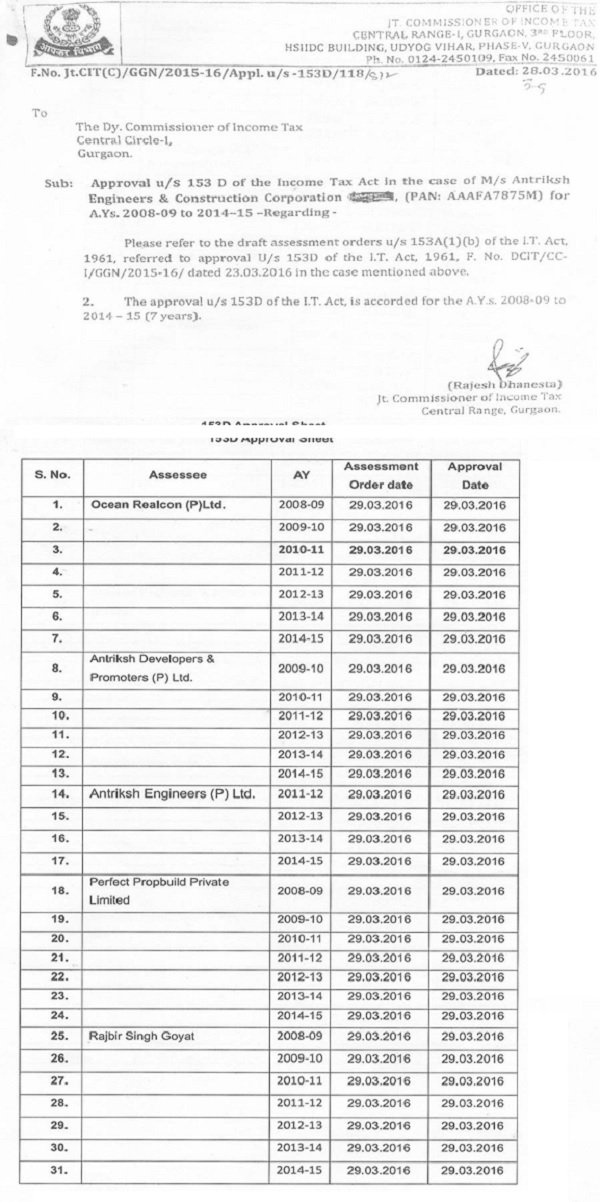
6. At the time of hearing of the instant appeal, the Ld. Sr. Counsel, Shri Ved Jain, raised the ground of maintainability of the proceedings on the count that approval under Section 153D of the Act obtained by the AO in the matters is mechanical in nature and the same is, therefore, invalid and the assessment is, thus, liable to be quashed. According to him, the approval under Section 153D of the Act issued by the JCIT, Central Range, Gurgaon is without application of mind. In this regard, he has relied upon the communication dated 28.03.2016 issued by the JCIT, Central Range, Gurgaon dated 28/29.03.2016 written to the DCIT, Central Circle-1, Gurgaon, wherein the draft assessment orders under Section 153A(1)(b) of the Act was referred for approval under Section 153D of the Act and approval under Section 153D of the Act was accorded for AY 2008- 09 to 2014-15 (seven years). The copy of the said letter dated 28/29.03.2016 along with approval sheet have been duly filed before us wherefrom it is evident that approval for total 59 cases were accorded by the JCIT copy whereof are reproduced hereinbelow:-
–
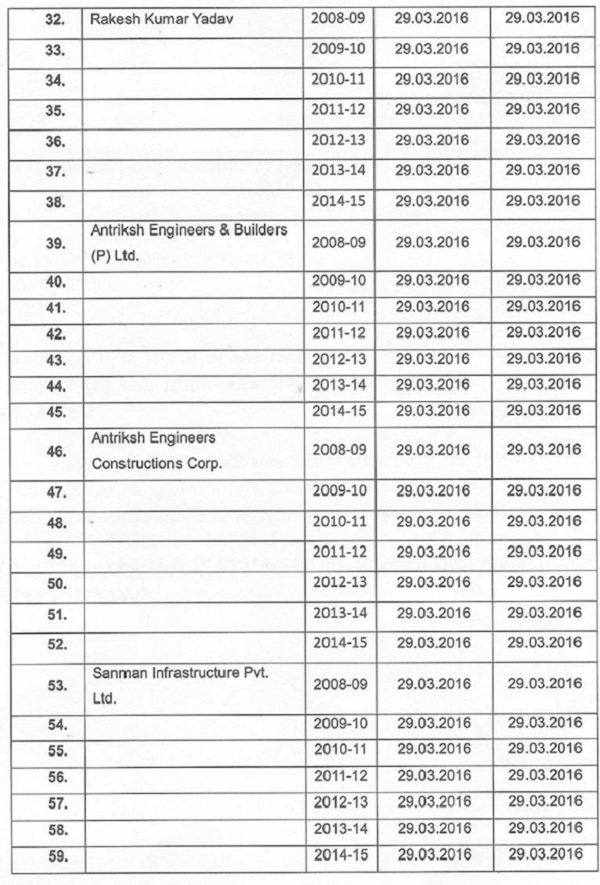
7. Relying upon the aforesaid approval under Section 153D of the Act, it was vehemently argued by the Ld. AR that the same is not a valid approval nor tenable in law as the same is a consolidated approval, a mechanical one, without application of mind would be invalid in the eyes of law. It was further argued by him that no movement of file is reflecting from the approval, neither sanction for each year has been given separately nor it establishes appraisal report is seen and, therefore, approval was granted mechanically without application of mind by the JCIT, Central Circle, Gurgaon, fact of which has not been able to be controverted by the Ld. DR as it is evident that the approval is a consolidated one. The Ld. AR, in support of his submission relied upon the following judgements passed by different judicial forum:-
(iii) Hon’ble Supreme Court vide its order dated 09.08.2024 dismissed the Special Leave Petition in the above referred case;
(v) Hon’ble Bombay High Court in the case of Pr. CIT, Central-4 vs. Citron Infraprojects Limited, SVP Global Textiles Limited, Helios Mercantile Limited, Shri Vallabh Pittie South West Industries Limited, dated 26.11.2025;
(vi) The Hon’ble Delhi High Court in the case of Shiv Kumar Nayyar, 2024 (6) TMI 29, dated 15.05.2024;
8. The judgement passed by the Hon’ble Orissa High Court in ACIT, Bhubaneshwar vs. Serajuddin & Co. (supra) quashing the assessment on mechanical approval granted under Section 153D of the Act was upheld by the judgement passed by the Hon’ble Apex Court dated 13.12.2012 passed in the appeal filed by the Revenue in Diary No.46858/2023 dated 13.12.2023. He has also relied on the judgement passed by the Hon’ble Allahabad High Court in the case of PCIT vs. Siddarth Gupta, reported in 2022 (12) TMI 1021, dated 12.12.2022 passed in favour of the assessee quashing the entire assessment order on the basis of the invalid consolidated approval granted under Section 153D of the Act which was appealed against by the Revenue in the Hon’ble Apex Court and the Hon’ble Apex Court on 09.08.2024 has been pleased to dismiss the said appeal. Further, the judgement passed by the Hon’ble Allahabad High Court in PCIT vs. Subodh Agarwal reported in 2023 (2) TMI 1072 dated 12.12.2022 has also been relied upon. The judgement passed by the Hon’ble Bombay High Court in the case of PCIT vs. Citron Infraprojects Limited and Others dated 26.11.2025 as relied upon wherein the consolidated approval was held to be invalid. The Ld. AR further relied upon the judgement passed by Hon’ble jurisdictional High Court in the case of Shiv Kumar Nayyar, reported in 2024 (6) TMI 29 dated 15.05.2024, holding that the approval under Section 153 of the Act is to be granted for each assessment year independently. The judgement passed by the Coordinate Bench in the case of Shri Dheeraj Chaudhary vs. ACIT, CC-8, Delhi, 2025 (9) TMI 1372, dated 12.09.2025 was also relied upon. Relevant to mention that the issue was referred to the consideration of the Hon’ble Third Member and the judgement passed in favour of the assessee rejecting the approval granted in a consolidated manner was upheld. The Ld. Sr. Counsel has also brought to the notice of the Bench that upon insertion of Section 292BC by the Finance Act, 2026 which has been given retrospective effect from 01.04.2021 but since the approval under Section 153 of the Act has been granted in the instant case on 29.03.2016, much prior to the effective date of 01.04.2021, even the retrospective operation of Section 292BC of the Act cannot be invoked to validate or cure any defect in approvals pertaining to assessment years falling prior to 01.04.2021. Therefore, Section 292BC is clearly inapplicable on the facts of the present case and the judgement passed by the jurisdictional High Court and other High Courts and the Coordinate Bench on the issue of approval and thus, the assessment orders, therefore, are liable to be quashed as was the crux of his submissions.
9. We note that the Ld. DR has not been able to controvert such factual or legal aspect of this matter during the protracted hearing of the matter.
10. Under these facts and circumstances of the matter, we have considered the judgements as relied upon by the Ld. AR on the ground of approval granted under Section 153D of the Act. In all the matters the approval was found to be invalid in view of this particular fact that the said approval does not speak of movement of any file, neither given approval for each year separately nor assigned any reasons for such approval; the same was found to be a product of total non-application of mind by the order approving authority.
11. In the case of Dheeraj Chaudhary, the Coordinate Bench has been pleased to quash the assessment proceedings upon approval granted under Section 153D of the Act, holding the same mechanical in nature with the following observations:
“ 22. As rightly pointed out by learned counsel for the Assessee there is not even a token mention of the draft orders having been perused by the Additional CIT. The letter simply grants an approval. In other words, even the bare minimum requirement of the approving authority having to indicate what the thought process involved was is missing in the aforementioned approval order. While elaborate reasons need not be given, there has to be some indication that the approving authority has examined the draft orders and finds that it meets the requirement of the law. As explained in the above cases, the mere repeating of the words of the statute, or mere “rubber stamping” of the letter seeking sanction by using similar words like ‘see’ or ‘approved’ will not satisfy the requirement of the law. This is where the Technical Manual of Office Procedure becomes important. Although, it was in the context of Section 158BG of the Act, it would equally apply to Section 153D of the Act. There are three or four requirements that are mandated therein, (i) the AO should submit the draft assessment order “well in time”. Here it was submitted just two days prior to the deadline thereby putting the approving authority under great pressure and not giving him sufficient time to apply his mind; (ii) the final approval must be in writing; (iii) The fact that approval has been obtained, should be mentioned in the body of the assessment order.
23. In the present case, it is an admitted position that the assessment orders are totally silent about the AO having written to the Additional CIT seeking his approval or of the Additional CIT having granted such approval. Interestingly, the assessment orders were passed on 30th December 2010 without ITA Nos. 6158, 6159, 6160, 6214, 6215 & 6216/Del/2018 Dheeraj Chaudhary mentioning the above fact. These two orders were therefore not in compliance with the requirement spelt out in para 9 of the Manual of Official Procedure.
24. The above manual is meant as a guideline to the AOs. Since it was issued by the CBDT, the powers for issuing such guidelines can be traced to Section 119 of the Act. It has been held in a series of judgments that the instructions under Section 119 of the Act are certainly binding on the Department. In Commissioner of Customs v. Indian Oil Corporation Ltd. 2004 (165) E.L.T. 257 (S.C.) the Supreme Court observed as under:
“Despite the categorical language of the clarification by the Constitution Bench, the issue was again sought to be raised before a Bench of three Judges in Central Board of Central Excise, Vadodara v. Dhiren Chemicals Industries: 2002 (143) ELT 19 where the view of the Constitution Bench regarding the binding nature of circulars issued under Section 37B of the Central Excise Act, 1944 was reiterated after it was drawn to the attention of the Court by the Revenue that there were in fact circulars issued by the Central Board of Excise and Customs which gave a different interpretation to the phrase as interpreted by the Constitution Bench. The same view has also been taken in Simplex Castings Ltd. v. Commissioner of Customs, Vishakhapatnam 2003 (5) SCC 528. The principles laid down by all these decisions are: (1) Although a circular is not binding on a Court or an assessee, it is not open to the Revenue to raise the contention that is contrary to a binding circular by the Board. When a circular remains in operation, the Revenue is bound by it and cannot be allowed to plead that it is not valid nor that it is contrary to the terms of the statute.”
(2) Despite the decision of this Court, the Department cannot be permitted to take a stand contrary to the instructions issued by the Board.
(3) A show cause notice and demand contrary to existing circulars of the Board are ab initio bad (4) It is not open to the Revenue to advance an argument or file an appeal contrary to the circulars.”
25. For all of the aforementioned reasons, the Court finds that the ITAT has correctly set out the legal position while holding that the requirement of prior approval of the superior officer before an order of assessment or reassessment is passed pursuant to a search operation is a mandatory requirement of Section 153D of the Act and that such approval is not meant to be given mechanically. The Court also concurs with the finding of the ITAT that in the present cases such approval was granted mechanically without application of mind by the Additional CIT resulting in vitiating the assessment orders themselves.
26. The question of law framed is therefore answered in the affirmative i.e., in favour of the Assessee and against the Department.
ITA Nos. 6158, 6159, 6160, 6214, 6215 & 6216/Del/2018 Dheeraj Chaudhary
27. The appeals are accordingly dismissed, but in the circumstances, with no order as to costs.”
11. The SLP was dismissed with the following observations:
“Having regard to facts and circumstances of the case, we are not inclined to interfere in the matter. The Special Leave Petition is dismissed.”
12. It was further considered in that particular judgment that the assessment order must contain the fact of seeking approval by the Assessing Officer from the Additional Commissioner of Income Tax and such approval has been duly given. In the absence of mentioning of this particular fact the orders were found to be not in compliance with the requirement spelt out in paragraph 9 of officials procedure reproduced in paragraph 23 therein.
13. The contention made by the Ld. D.R. in that matter that since the entire documents were already available to the Additional CIT in the file sent for approval, there was no need for exchange of the said document prior to the grant of formal approval under Section 153D of the Act as also made before us by the Ld Dr was ultimately not accepted by the Court.
14. We have further considered the judgment passed by the Hon’ble Apex Court in the case of PCIT Vs. Anuj Bansal whereby and where under the order passed by the Hon’ble Delhi High Court ITA Nos. 6158, 6159, 6160, 6214, 6215 & 6216/Del/2018 Dheeraj Chaudhary quashing the assessment order on the ground of mechanical approval granted under Section 153D of the Act has been upheld. The Honble Delhi High Court passed orders in the following manner:
“6. The appellant/revenue via this appeal seeks to assail the order dated 29.04.2022 passed by the Income Tax Appellate Tribunal [in short, “Tribunal’]
7. The Tribunal has via the impugned order set aside the additions made qua the income of the respondent assessee inter alia, on the ground that there was no application of mind by the Additional Commissioner of Income Tax (In short, “ACIT”] in granting approval under Section 153D of Income Tax Act 1961 [in short, the Act’].
8. To be noted, an assessment order was framed qua the respondent/assessee under Section 153A, read with Section 143(3) of the Act.
8.1. This order was carried in appeal by the respondent/assessee, right up till the Tribunal.
9. Insofar as the Assessing Officer (AO) was concerned, he made certain additions against the returned income.
9.1 The respondent had declared an income amounting to Rs 87,20,500/-However, while making the additions, strangely, the AO noted that the returned income was Rs. 11,00,460/-.
10. There were two additions made by the AO. The first addition was made qua cash deposited in the bank amounting to Rs. 15,04,35,000/-. The second addition was made with regard to cash introduced via an entry operator i.e. one, Mr. Vipin Garg The amount added qua this aspect was pegged at Rs.1,54,07,100/-.
11. Despite these additions, which would have taken the assessed income well beyond what was crystallised by the AO i.e. 1.65,07,560, the ACIT failed to notice the error.
12. This aspect was brought to the fore by the Tribunal in the impugned order. The Tribunal thus concluded there was a complete lack of application of mind, inasmuch as the ACIT who granted approval, failed to notice the said error.
ITA Nos. 6158, 6159, 6160, 6214, 6215 & 6216/Del/2018 Dheeraj Chaudhary 12.1 More particularly, the Tribunal notes that all that was looked at by the ACIT, was the draft assessment order.
13. In another words, it was emphasised that the approval was granted without examining the assessment record or the search material. The relevant observations made in this behalf by the Tribunal in the impugned order are extracted hereafter:
“17.1 However, in the present case, we have no hesitation in stating that there is complete non application of mind by the Learned AddI. CIT before granting the approval. Had there been application of mind, he would not have approved the draft assessment order, where the returned income of Rs.87,20,580/-. Similarly, when the total assessed income as per the AO comes to Rs.16,69,42,560/-, the Addl. CIT could not have approved the assessed income at Rs. 1.65,07,560 had he applied his mind The addition of Rs.15,04,35,000/- made by the AO in the instant case is completely out of the scene in the final assessed income shows volumes.
17.2 Even the factual situation is much worse than the facts decided by the Tribunal in the case of Sanjay Duggal (supra) In that case, at least the assessment folders were sent whereas in the instant case, as appears from the letter of the Assessing Officer seeking approval, he has sent only the draft assessment order without any assessment records what to say about the search material. As mentioned earlier, there are infirmities in the figures of original return of income as well as total assessed income and the Addl. CIT while giving his approval has not applied his mind to the figures mentioned by the AO Therefore, approval given in the instant case by the AddI. CIT, in our opinion, is not valid in the eyes of low. We therefore, hold that approval given u/s 153D has been granted in a mechanical manner and without application of mind and thus it is invalid and bad in low and consequently vitiated the assessment order for want of valid approval u/s 153D of the Act.
In view of the above discussion, we hold that the order passed u/s 153A r.w.s. 43(3) has to be quashed, thus ordered accordingly. The ground raised by the Assessee is accordingly allowed”
[Emphasis is ours]
14. In this appeal, we are required to examine whether any substantial question of law arises for our consideration.
15. Having regard to the findings returned by the Tribunal, which are findings of fact, in our view, no substantial question of law arises for our consideration. The Tribunal was right that there was absence of application of mind by the ACIT in granting approval under Section ITA Nos. 6158, 6159, 6160, 6214, 6215 & 6216/Del/2018 Dheeraj Chaudhary 153D. It is not an exercise dealing with a immaterial matter which could be corrected by taking recourse to Section 292B of the Act.
16. We are not inclined to interdict the order of the Tribunal.” 16
15. While dismissing the SLP preferred by the revenue, the Hon’ble Apex Court observed as follows:
“Having regard to peculiar facts of these cases, we are not inclined to interfere in the matters. Hence, the Special Leave Petitions are dismissed.”
16. Having heard the Ld. Counsels appearing for the parties, having regard to the facts and circumstances of the case, the order of approval issued by the Additional Commissioner of Income Tax appearing at page 72 of the paper book filed before us found to be invalid in view of this particular fact that the said approval does not speak of movement of any file. Neither given approval for each year separately nor assigned any reason for such approval; the same is nothing but a product of total non-application of mind by the order approving authority. Further that the impugned order of approval dated 27.12.2016 has been issued on the same day when the draft assessment orders in respect of these assessment years have been placed before him and in hot haste the approval has been granted. The same does not establishes review of the assessment records and search materials by the Additional CIT too; the same is, thus, a mechanical approval and hence the judgments relied upon by the Ld AR as discussed above are found to be rightly applicable. Respectfully relying upon the ratio laid down by the Hon’ble Apex Court in these matters mentioned above, in the case in hand the ITA Nos. 6158, 6159, 6160, 6214, 6215 & 6216/Del/2018 Dheeraj Chaudhary approval since granted mechanically, without application of mind by the Additional Commissioner that too without assigning any reason, in our considered view, is invalid and thus deserves to be quashed. With the aforesaid observation we, therefore, quash the impugned approval dated 27.12.2016. The assessment orders are also, therefore, vitiated, void-ab-initio and thus, quashed. The assessee’s appeal, is, therefore, allowed. As the appeal is allowed on this ground all other grounds taken by the assessee become academic and no order needs to be passed.,
17. The order passed in this matter is applied mutatis mutandis in all the other appeals preferred by the assessee on the identical facts.
18. In the result, all the appeals preferred by the assessee are allowed.”
12. The Ld. Third Member, while upholding the order passed the Judicial member, observed as follows:-
“22. I noted that the common thread discussed by Hon’ble Orissa High Court in the case of Serajuddin & Co. (supra), by Hon’ble Delhi High Court in the case of Anuj Bansal (supra) and by Hon’ble Allahabad High Court in the case of Sapna Gupta (supra) is that the requirement of previous approval of assessment by the Additional CIT/Joint CIT in terms of provisions of Section 153D of the Act being an inbuilt protection against any arbitrary or unjust exercise of power by the Assessing Officer, casts a very heavy duty on the said high ranking authority to see to it that the requirement of the previous approval, envisaged in the Section is not turned into an empty formality. Needless to say that before granting approval, the Additional CIT/Joint CIT, as the case may be, must have before him the material on the basis whereof an opinion in this behalf has been formed by the Assessing Officer and the approval must reflect the application of mind to the facts of the case. The CBDT ITA Nos. 6158, 6159, 6160, 6214, 6215 & 6216/Del/2018 Dheeraj Chaudhary itself recognized the importance of this provision and the above laid down principle and hence issued Manual of Office Procedure in February, 2023 in exercise of powers under Section 119 of the Act. Vide Para 9 of Chapter 3 of Volume-II (Technical), a clear procedure is devised i.e., how an approval is to be granted for draft assessment for passing of assessment order in search cases. According to the Manual, the Assessing Officer should submit the draft assessment order for such approval well in time along with docketed in the order sheet, a copy of the draft assessment order, covering letter filed in the relevant miscellaneous records folder. Even, it is noted that due opportunity of being heard should be given to the assessee by the supervisory officer giving approval to the proposed block assessment, at least one month before the time barring date. It is further noted that once such approval is granted, it must be in writing and filed in the relevant folder indicating above after making due entry in the order sheet. This is the mandate provided in the office manual of the Department. In view of above, I am of the view that the ‘approval’, as mandated u/s 153D of the Act, signifies a product of human thoughts based on the given set of facts and interpretation of the applicable law. It provides equality in treatment and thus prevents bias, prejudice and arbitrariness. It also prevents and avoids inconsistent and divergent views. The power of approval to the specified authority i.e., Superior authority has been envisaged with the objectives that no illegality or biasness, to either of the sides i.e., the assessee or the Revenue, remains.
23. In the present case before me, the above procedure is not at all followed as is evident from the proposal sent by the Assessing Officer as reproduced in Paragraph 10. It means that the approval granted is ITA Nos. 6158, 6159, 6160, 6214, 6215 & 6216/Del/2018 Dheeraj Chaudhary mechanical in manner and without application of mind by the approving authority i.e., by the Additional CIT.
Now, in view of the above discussion and legal position, I answer the question as under:-
Question framed by the Bench Answer to the Question As to whether under the present facts In the given facts and circumstances of and circumstances of the matters, the the case and discussion carried above, approval granted by the ACIT, dated the approval granted by Additional CIT 27.12.2016 under Section 153D of the dated 27.12.2016 u/s 153D of the Act is Income Tax Act, 1961 are sustainable not sustainable in the eyes of law.
in the eyes of law or not.
In terms of the above, I concur with the decision of learned Judicial Member quashing the above assessments.”
13. Having heard the Ld. Counsels appearing for the parties and having regard to the facts and circumstances of the matter, we do not hesitate to hold that as the approval does not speak of movement of any file, neither given each year separately nor assigned any reason for such approval, the same is found to be a mechanical approval and, therefore, liable to be quashed as the same suffers from non-application of mind by the order approving authority. Once the approval is quashed, the assessment orders are also, therefore, vitiated and void ab initio and, therefore, quashed. The appeal on this score itself is allowed.
14. This ground of appeal raised by the assessee in all the appeals preferred before us are, therefore, allowed.
ITA No.8851/Del/2025 (Antriksh Engineers Pvt. Ltd. vs. ACIT), AY: 201112.
15. Further, common ground of appeal has been raised by the assessee in some of the matters wherein assessment has been challenged. As in the Antriksh Engineers Private Limited, the assessment orders for Assessment Year 2011-12 and 2012-13 are unabated/completed assessment years and no addition can be made in the absence of any incriminating material and, therefore, the same is liable to be quashed as is the crux of the ground raised by the assessee before us.
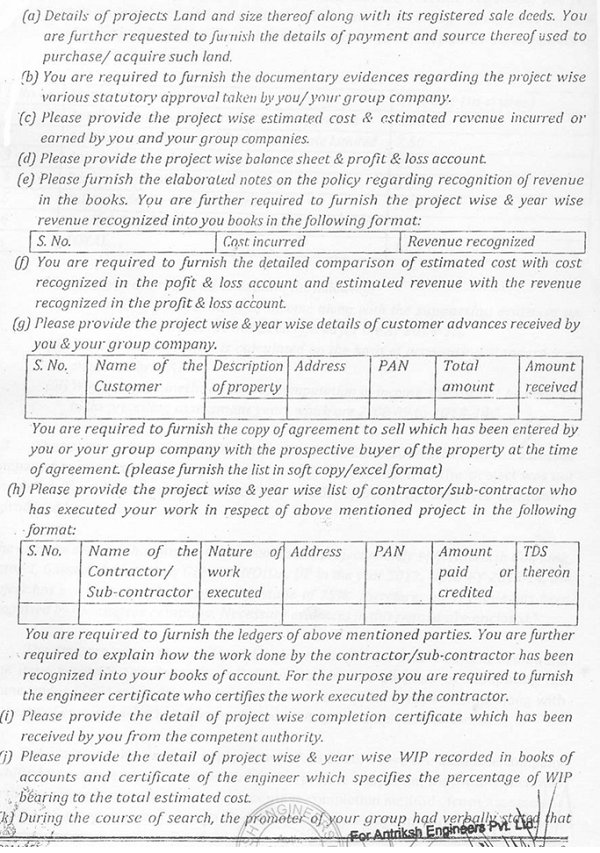
16. In this matter, the assessee has filed original return of income for AY 2011-12 on 29.09.2011 and thus, the last date of issuance of notice under Section 143(2) was 30.09.2012. However, no such notice under Section 143(2) have been issued within the prescribed period. As on the date of search on 05.02.2014 therefore, the assessment for the concerned assessment year has attained finality meaning thereby that completed assessment could not be disturbed in the assessment made under Section 153A of the Act in the absence of any incriminating material found during the course of search. No satisfaction has been recorded by the Ld. AO of the searched person that incriminating material belonging to the assessee was found during the course of search. In that matter, during the course of search and post search inquiry, it was found that the group has executed various residential projects at Gurgaon, Noida and Haridwar, the details whereof are mentioned in the order passed by the Ld. AO. Certain details in respect of those properties including the registered deed of sales, project-wise various statutory approvals taken by the group, project-wise estimated cost and estimated revenue incurred or earned by the assessee, project-wise balance sheet and Profit & Loss Account, the policy regarding recognition of revenue in the books of account were sought for. The documents were called for in the following manner:-
–
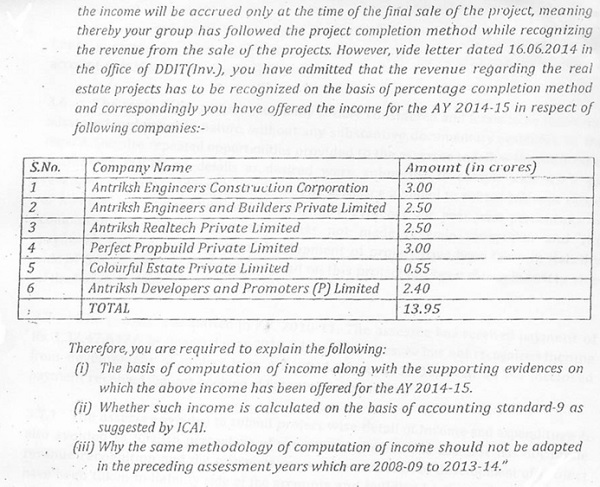
17. The reply was duly filed by the assessee on 26.02.2016 which was not found to be correct as per the Revenue. Show cause was issued on 14.03.2016 on the same issue requiring documents/information required for the purpose of computing income under POCM related to each year under consideration along with certificate of engineer. The assessee company shifted its revenue recognition from Project Completion Method as applied upto AY 2013-14 to Percentage Completion Method from AY 2014-15 along with calculation of details of Percentage Completion method were duly furnished. Audited financial statement for AY 2014-15 was filed. The Ld. AO made sole addition of 20% of advances received during the years in the absence of any incriminating material which is evident from the following observation made by the Ld. AO:-
18. Under these facts and circumstances of the matter, the Ld. Counsel appearing for the assessee relied upon the judgement passed by the Hon’ble Delhi High Court in CIT Central-3 vs. Kabul Chawla, reported in 2015 (90) MI 80-Delhi High Court, wherein it was held that the completed assessment can be interfered with by the Ld. AO while making assessment under Section 153A of the Act only on the basis of some incriminating material unearthed during the course of search. As it is evident from the above observation made by the Ld. AO that sole addition of 20% of advance received by the assessee during the year under consideration has been made which is not on the basis of any incriminating material, claimed to have been found during the search, rather, no incriminating material has been referred while making this addition in the hands of the assessee, the same is not sustainable as submitted by the Ld. Counsel appearing for the assessee supported by the judgement passed by the Hon’ble Delhi High Court in the case of Kabul Chawla (supra) is found to be acceptable and, therefore, the entire proceedings is vitiated and, thus liable to be set aside.
19. The identical ground raised by the assessee in other matters are also held in favour of the assessee by quashing the respective assessments.
20. A common ground of appeal has been raised in some of the appeals challenging the order passed under Section 143(3) r.w.s 144 of the Act for AY 2014-15 as invalid as the same is contrary to section 153C of the Act. It is the case of the Revenue that the assessment was framed under Section 143(3) r.w.s. 144 of the Act on the basis of certain documents unearthed during the course of search conducted on Antriksh group on 05.02.2014. As it is the settled principle of law that the period of six years for the purpose of invoking Section 153C of the Act which has to be construed from the assessment year relevant to the previous year in which satisfaction for issuance of notice under Section 153C of the Act was recorded. It is an admitted fact that the satisfaction was recorded for issuance of notice only on 15.12.2015, i.e., in AY 2016-17 and, therefore, the period of six years of which the assessment proceedings have to be initiated under Section 153C of the Act were from AY 2010-11 to 2015-16. In that view of the matter, the assessment year 2014-15 is also covered under the provision of Section 153C of the Act and the same assessment should have been framed upon issuance of notice under Section 153C of the Act only. As the assessment under Section 2014-15 has been framed under Section 143(3) r.w.s. 144 of the Act without complying the mandatory provisions of law envisaged under Section 153C of the Act, the entire proceeding is vitiated, not sustainable in the eyes of law; assumption of jurisdiction by the Ld. AO is without provision of law and, therefore, the entire proceeding is liable to be quashed as the ground taken by different assessees and further reiterated by the Ld. Counsel appearing for the assessee at the time of hearing of the matter which has not been able to be controverted by the Ld. DR is found to be acceptable.
21. In this regard, the Ld. AR further relied upon the judgement passed by the Coordinate Bench in the case of Raja Varshney vs. DCIT, Central Circle-31, New Delhi, ITA No.1459/Del/2024 dated 26.09.2024 whereby and whereunder the assessment order holding the assessment for AY 2021-22 which has been wrongly framed under Section 143(3) of the Act ignoring the mandatory provisions of Section 153C of the Act was quashed. The following judgements were also found to have been passed on the same ratio:-
(i) ITAT Delhi in the case of Akanksha Gupta VS. ACIT, Central Circle-04, Delhi, 2024 (7) TMI 1133, dated 10.07.2024;
(ii) ITAT Delhi in the case of DCIT, CENTRAL CIRCLE-19, DELHI v. BENNETT WILLIAMSON ENGINEERS LTD, DELHI, 2024 (5) TMI 905, dated: – 02.01.2024.
(iii) ITAT Mumbai in the case of DIWAKAR N. SHETTY v. DY. CIT, CENTRAL CSRC LE – 6 (1), MUMBAI, 2020 (11) TMI 560, Dated: – 30-9-2020.;
(iv) ITAT Delhi in the case of M/S SPLENDOR LANDBASE LIMITED v. ACIT, CIRCLE-9 (1), NEW DELHI, 2020 (1) TMI 85 – ITAT DELHI, Dated: – 31.12.2019;
(v) Hon’ble Delhi High Court in the case COMMISSIONER OF INCOME TAX-14 VERSUS SHREE JASJIT SINGH, 2015 (8) TMI 982 – DELHI HIGH COURT, Dated. – August 11, 2015;
(vi) Furthermore, the above-mentioned Delhi High Court judgement was affirmed by the Hon’ble Supreme Court in the case of COMMISSIONER OF INCOME TAX 14 VERSUS JASJIT SINGH, 2023 (10) TMI 572 – SUPREME COURT, Dated: – September 26, 2023.
22. Considering the entire aspect of the matter, we, therefore, respectfully relying upon the judgement passed by different judicial forum, quashed the entire assessment proceedings initiated against the assessee under Section 143(3) r.w.s. 144 of the Act for AY 2014-15.
23. Similar ground raised by the other assessees are also allowed.
24. A common ground has also been raised challenging the assessment order for AY 2014-15 on the basis of the material found during the course of search conducted in the case of a third person ought to have been completed upon following the procedure prescribed under Section 153C of the Act and not under Section 153A r.w.s. 143(3) of the Act. As the search was conducted on 05.02.2014 as per Panchnama appearing at pages 20-22 of the paper book. No incriminating document or material pertaining to the assessee particularly in the case of Antriksh Engineers Pvt. Ltd., was found or seized during the course of search as it is evident from the Panchnma placed before us. In that view of the matter, the material relied upon by the Ld. AO for making addition in the hands of the assessee has been sourced from the third party searches and without recording any satisfaction or invoking the mandatory provision of Section 153C of the Act.
25. Where any material is found during the course of search which belongs to or pertains to a person other than the one person as referred to in Section 153A of the Act, the only recourse available to the Ld. AO is to reopen in accordance with the Section 153C of the Act which further requires recording of satisfaction by the search team and then handing over such material to the AO having jurisdiction over such other person. In the case of Antriksh Engineers Private Ltd., the assessment has been framed under Section 153A of the Act on the basis of the alleged incriminating material which, admittedly, does not belong to the assessee and, therefore, in the absence of compliance with the mandatory provisions of Section 153 of the Act, assumption of jurisdiction under Section 153A of the Act is wholly invalid as the case made out by the assessee seems to be acceptable in view of the following judgements relied upon:-
(i) ITAT Delhi in the case of Vikas Jain, ITA No. 1316/Del/2023, dated 23.04.2025;
(ii) Delhi High Court in the vase of PCIT (Central) – 3 Versus Anand Kumar Jain (HUF), Satish Dev Jain, Sajan Kumar Jain, 2021 (3) TMI 8 – DELHI HIGH COURT, Dated, February 12, 2021;
(iii) ITAT Delhi in the case of Divya Exim Pvt. Ltd. C/o. Kapil Goel, Adv., Renu Jain C/O. Kapil Goel, Adv., Nisha Jain C/o.Kapil Goel, Adv. Versus DCIT Central Circle 25 New Delhi, 2024 (1) TMI 750 – ITAT DELHI, Dated: -15-1-2024;
(iv) ITAT Chennai in the case of DCIT Central Circle-2 (4), Chennai-34 Versus M/s. Pearl Printers And Publishers (P) Ltd. And (Vice-Versa), 2024 (6) TMI 899 – ITAT CHENNAI, Dated, 3-6-2024;
(v) M/S. VETRIVEL MINERALS, M/S. VIJAY CEMENTS, MR. S. VAIKUNDARJAN VERSUS THE ASSISTANTCOMMISSIONER OF INCOME TAX, CENTRAL CIRCLE-2, 2021 (10) TMI 1020 – MADRAS HIGH COURT, Dated: – 3-8-2021;
(vi) M/S. RATHI BARS LIMITED VERSUS ACIT, CENTRAL CIRCLE 16, NEW DELHI., 2022 (3) TMI 151 – ITAT DELHI, Dated: – 28-22022;
(vii) ITAT Delhi in the case of Pushpa Devi Bajaj v. DCIT, Central Circle-32, Delhi, ITA No. 816/Del/2023 dated, 04.12.2023;
(viii) ITAT Ahmedabad in the case of A.C.I.T, Central Circle-1 (2), Ahmedabad Versus M/S. Real Marketing Private Limited; Neminath Traders Pvt. Ltd. And M/s Real Marketing Private Limited Versus ITO, Ward-5(3) , Ahmedabad, 2023 (5) TMI 1050 – ITAT AHMEDABAD, Dated: -19-5-2023;
(ix) ITAT Visakhapatnam in the case of Sri Goluguri Nagi Reddy Versus ACIT, Central Circle-1, Rajahmundry, 2023 (3) TMI 199-ITAT VISAKHAPATNAM, Dated February 28, 2023;
(x) ITAT Delhi in the case of M/S Indo Autotech Ltd., M/s Admach Auto India Ltd. Versus The Dy. C.I.T. Central Circle -25 Faridabad, 2022 (7) TMI 331 – ITAT DELHI, Dated: – July 6, 2022;
(xi) ITAT Bangalore in the case of M/s. P. Shyamaraju And Co. India Private Limited Versus The Deputy Commissioner Of Income-Tax, Central Circle 2 (2) Bangalore. And The Assistant Commissioner Of Income-Tax, Central Circle 2 (3) Bangalore. Versus M/s. P. Shyamaraju And Co. India Private Limited, 2022 (5) TMI 38 – ITAT BANGALORE, Dated: – April 25, 2022;
(xii) ITAT Cuttack in the case of Kothakota Rama Rao Versus ACIT, Central Circle-1, Bhubaneswar, 2020 (12) TMI 8 – ITAT CUTTACK Dated:- August 31, 2020;
(xiii) ITAT Delhi in the case of Mr. Trilok Chand Chaudhary Versus ACIT, Central Circle-26, New Delhi, 2019 (9) TMI 95 – ITAT DELHI, Dated, August 20, 2019; and
(xiv) ITAT Kolkata in the case of Shri Krishna Kumar Singhania, Shri Ajay Kumar Singhania, Smt. Kasak Singhania, Shri Vijay Kumar Singhania and Smt. Ruchi Singhania Versus DCIT, CC-3 (3), KOLKATA, 2018 (1) TMI 131 – ITAT KOLKATA, Dated 6.12.2017
26. The above fact has not been able to be controverted by the Ld. DR and, therefore, respectfully relying upon the ratio laid down in the above judgements in the absence of compliance with the mandatory procedure prescribed under Section 153C of the Act, assumption of jurisdiction under Section 153A of the Act is wholly invalid and, therefore, the entire assessment is without jurisdiction, void ab initio and liable to be quashed.
27. With the aforesaid observations, we quash the entire assessment proceedings.
28. Identical ground raised by the assessees in other matters are also held in favour of the assessee by quashing the respective assessments.
29. Even otherwise, we have decided to deal with the matter on merits.
Antriksh Engineers Construction Corporation (ITAs No. 8842 to 8846/DEL/2025 (5), Assmt. Years: 2010-11 to 2014-15)
30. Addition of 20% of advances received during the year under consideration is the subject matter before us. The assessee, engaged in the business of real-estate development, had undertaken development of real-estate projects. In terms of the accounting policy, the assessee adopted Projection Completion Method (PCM) for recognizing revenue from such projects. The revenue is recognized only when the project reaches completion and the risk and rewards of ownership are substantially transferred. As the project has not reached completion during the relevant years, i.e., AYs 2011-12 to 2014-15, no revenue was recognized in the Profit & Loss Account. Subsequently, on 05.02.2014, when the search was completed and proceedings under Section 153C of the Act was initiated wherein no incriminating material was found during the course of search as we have already observed in the foregoing paragraphs while dealing with other grounds of appeal. Questioning the method of revenue recognition followed by the assessee, a show cause notice was issued as to why the Percentage Completion Method (POCM) should not be applied for recognizing the revenue. Certain details were also directed to be furnished by the assessee. Though the assessee explained that it has consistently followed the Project Completion Method which is recognized method of accounting for real-estate projects for AYs 2011-12 to 2013-14 and no revenue, therefore, was required to be recognized during the year with the following observations, the Ld. AO made the addition of Rs.8,21,82,816/-, i.e., upon taking the net income @ 20% of the amount of booking received by the assessee company during the relevant year 2010-11:-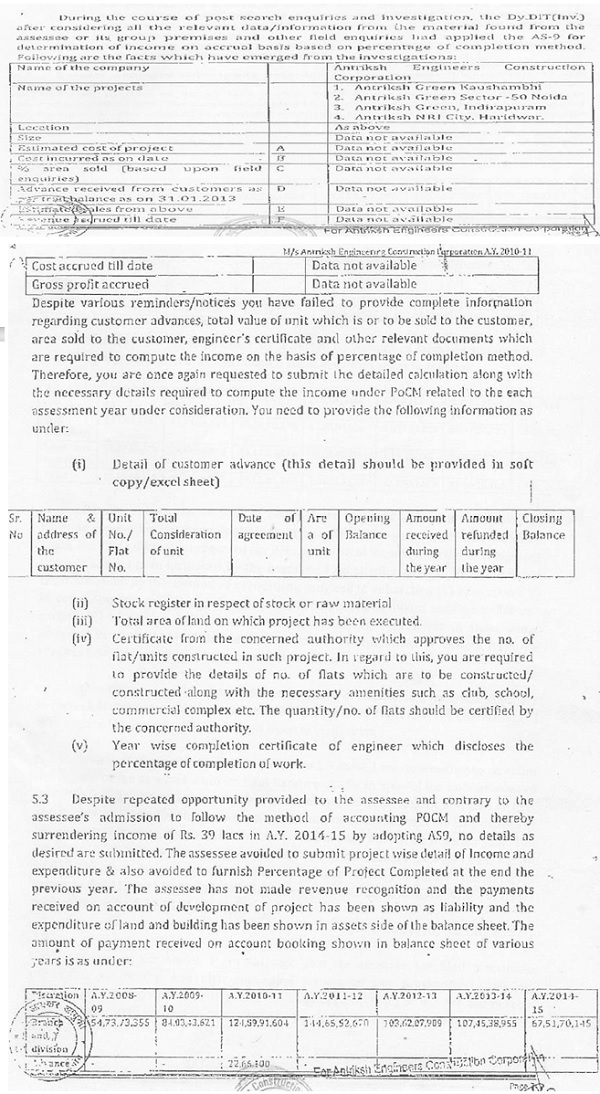
–
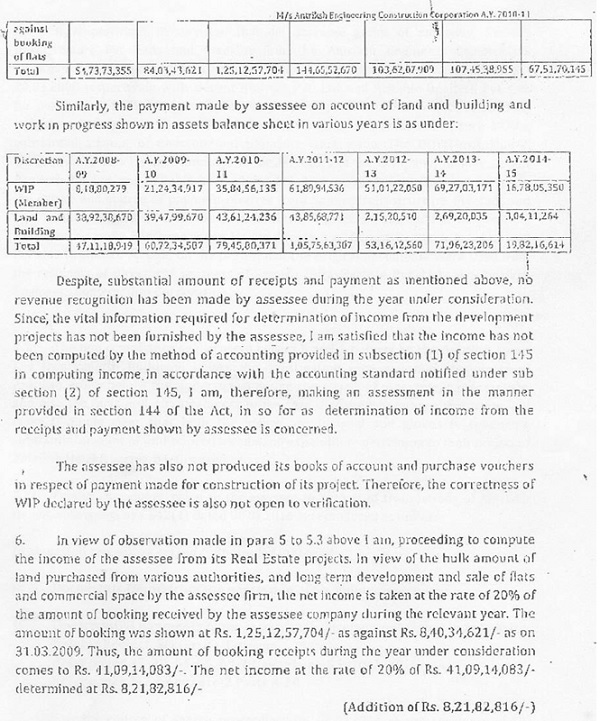
31. This particular rejection of method followed by the assessee and estimating income by applying a rate of 20% on the advanced received during the year and addition made thereupon by the Ld. AO was further confirmed by the First Appellate Authority. Hence, the instant appeal before us.
32. It is the case of the assessee that the assessee has consistently followed the Project Completion Method (PCM) for recognizing the revenue from its projects since inception under which revenue is recognized only upon completion of the method, fact of which was duly submitted before the Ld. AO along with documents though the same was not figuring out in the order passed by the Ld. AO, but, from the order passed by the Ld. CIT(A). It further appears that during the assessment proceedings, the assessee had specifically submitted that the assessee is recognizing revenue under the Project Completion Method and no revenue was, therefore, required to be recognized during the year under consideration as the project had not been completed.
33. At the time of hearing of the instant appeal, the Ld. Sr. Counsel Shri Ved Jain on this particular aspect of the matter submitted before us that the Project Completion Method which is followed by the assessee in its real-estate business is a recognized and accepted method of accounting, particularly, in the case of real-estate developers. In this regard, he has further relied upon a judgement passed by the Hon’ble Supreme Court in the case of CIT vs. Bilahari Investment (P) Ltd., reported in (2008) 299 ITR 1 (SC) whereby and where under it was held that recognition of income under the mercantile system can be achieved through different methods of accounting and the method consistently followed by the assessee cannot be disturbed unless it results in distortion of profits. Relevant to mention that the Revenue has not been able to show that had the Percentage Completion Method of accounting is followed by the assessee instead of Project Completion Method, the profit would have been otherwise. He has further relied upon a judgement passed by the Hon’ble Apex Court in the case of CIT vs. Hyundai Heavy Industries Co. Ltd., reported in (2007) 291 ITR 482 (SC), wherein the Project Completion Method as a valid method for recognizing income in long-term contracts has been recognized. Under these facts and circumstances of the mater, the Ld. AR vehemently submitted that since the assessee consistently followed PCM, the Ld. AO was not justified in disregarding the same and arbitrarily estimating income. It is also a fact as it appears from the orders passed by the authorities below which was reiterated by the Ld. AR that the addition made by the Ld. AO is not sustainable as the books of account of the assessee were rejected without recording any satisfaction regarding correctness of or completeness of the accounts. Unless there is a clear observation as to the incorrectness or incompleteness or unreliability in the accounts maintained by the assessee, in the instant case, the POCM followed by the assessee the same cannot be rejected as further urged by the ld. AO which has not been able to be controverted by the Ld. DR. The ld. AR further relied upon the judgement passed by the Coordinate Bench in the group case of DCIT vs. Reliable Realtech Pvt. Ltd., in ITA No.4808/Del/2019, reported in 2024 (2) TMI 637 (ITAT, Delhi), order dated 09.02.2024, a copy whereof has also been handed over to us. While dealing with the identical facts and the grounds raised by the Revenue therein, the Coordinate Bench has been pleased to observe as under:-
“9. We have given careful thought to the submission of the parties and perused the records. It is not in dispute that the assessee company is in the business of real estate as stated by the Ld. AO in the last sentence of para 2 of the assessment order. It is also admitted by the Ld. AO that notes to the account of the assessee mentioned that sale of land/flat is recognised when the possession of the land/flat is handed over to the buyer and company has adopted Project Completion Method for revenue recognition. In his statement recorded under section 132(4) of the Act during search the main promoter Shri Shiv Kumar Garg stated on 07.03.2014 that though substantial bookings have been received in respect of Antriksh Heights project but the income will accrue on the basis of final sale i.e. on Project Completion Method. It is observed that during assessment proceedings it was submitted by the assessee that it obtained the license from DTCP Haryana. On that basis the construction was started and following the Project Completion Method for recognition of revenue and whatever expenses were incurred were debited to work in progress account. The project is not yet completed and all expenditure were carried forward as WIP and this method of accounting was found to be acceptable to the department. The factual matrix of the case narrated by the Ld. CIT(A) in para 5.1.1 of his appellate order reveals that the assessee has been filing return since AY 2008-09 following consistently the Project Completion Method. The Ld. AR contended that even in search no incriminating material has been found so as to disturb the method of accounting consistently followed by the assessee. Nothing convinced the Ld. AO as he was prompted to taka a different view based on the Guidance Note issued by ICAI regarding “Accounting of real estate transactions, 2012” (read with AS-9). The Ld. AO has referred the said Note in para 3.7 of assessment order. We have looked into it. Para 5.1 thereof says that the Percentage Completion Method should be applied where the economic substance is similar to construction contracts and para 5.2 says that this method is applied when the outcome of the project can be estimated reliably. None of these features is attributable to the facts of the assessee’s case.
10. The Ld. CIT(A) has recorded the finding that the assessee is a builder and not a contractor and that in view of the stipulations of the agreement it cannot be said that significant risks and rewards on ownership had been transferred to buyer prior to execution of the sale deed. It is stipulated in the agreement to sell that no property during construction shall stand transferred or deemed to be transferred to the allottee(s) and the apartments under construction shall continue to be sole property of the owner and it is only the duly completed apartment there in the property that shall be transferred on registration of the Apartment in his name. The Ld. AR’s contention is that the assessee has neither conflicted Guidance note on Accounting for Real Estate Transactions (Revised 2012) while following Project Completion Method for revenue recognition nor ICDS-III is applicable to the assessee. These contentions of the assessee could not be refuted by the Revenue.
11. The Ld. DR mentioned the decision of Hon’ble Rajasthan High Court in PCIT vs. Panchsheel Colonizers (P) Ltd. (2019) 111 com 459 (Raj.) wherein Hon’ble High Court upheld Tribunal’s order that in case of assessee, engaged in the business of real estate development, addition could not be made by the Ld. AO on the basis of Percentage Completion Method. The Ld. DR pointed out that against the said decision SLP filed by the Revenue has been granted by the Hon’ble Supreme Court which is reported in PCIT vs. Panchsheel Colonizers (P) Ltd. (2019) 111 taxmann.com 460 (SC). It may be stated that although SLP has been granted, it is open to the Hon’ble Supreme Court to revoke or withdraw the leave, in limine, either suo moto as held in Govindrajulu Mudaliar (A) vs. CIT (1958) 34 ITR 807 (SC) or on objection taken later, if on later consideration the Hon’ble Supreme Court holds that leave ought not to have been given as held in India Aluminium Co. Ltd. vs. CIT (1961) 43 ITR 532 (SC).
12. The Ld. CIT(A) has followed the decisions of Hon’ble Delhi High Court in Paras Buildtech India Private Limited vs. CIT (supra) and Sabh Infrastructure Ltd. (supra). We do not find any reason to interfere with the decision of the Ld. CIT(A). We uphold it and reject appeal of the Revenue being without any substance.”
34. As it appears from the above, in that particular case, the AO alleged that the income should be recognized by applying Percentage Completion Method instead of Project Completion Method as has been done in the instant case before us. Under these facts and circumstances of the matter, the Coordinate Bench has been pleased to observe that a real-estate developer cannot be forced to adopt Percentage Completion Method in the absence of any defect in the accounts and, therefore, there was no justification in changing the method of accounting regularly followed by the assessee. The deletion of addition made by applying Percentage Completion Method by the Ld.CIT(A) was, therefore, upheld in the appeal preferred by the Revenue.
35. Thus, having regard to the entire aspect of the matter, when the AO has not been able to point out any defect in the books of account or in the absence of recording of incorrectness or incompleteness of the accounts, addition on ad hoc rate of 20% on the advances received demonstrating estimation is arbitrary having no legal basis and in spite of the judgement passed by the Hon’ble Apex Court, rejection of Percentage Completion Method followed by the assessee is not found to be sustainable and, therefore, deleted.
36. Identical grounds raised by all other assessees are, accordingly, decided applying this decision mutatis mutandis.
37. Addition on account of unaccounted receipts and unaccounted payments have been challenged before us by the assessee in some cases. We are taking ITA No.8842/Del/2025 for AY 2010-11 in the matter of Antriksh Engineers Construction Corporation is taken as the lead case.
38. During the course of search, certain loose papers/documents were found and seized from the premises of Shri Rakesh Kumar Yadav and Shri Rajbir Singh Goyat containing rough notings scribblings and do not belong to the assesseee firm. The Ld. AO has arbitrarily picked up certain figures from such loose papers and treated the same as unaccounted receipts and unaccounted payments as alleged and added in the hands of the assessee which was further confirmed by the First Appellate Authority. Hence, the instant appeal before us.
39. The cash receipts and payments made in respect of Antriksh Heights as per the document seized from the residential premises of Shri Rakesh Kumar Yadav and Shri Rajbir Singh Goyat are as follows:-
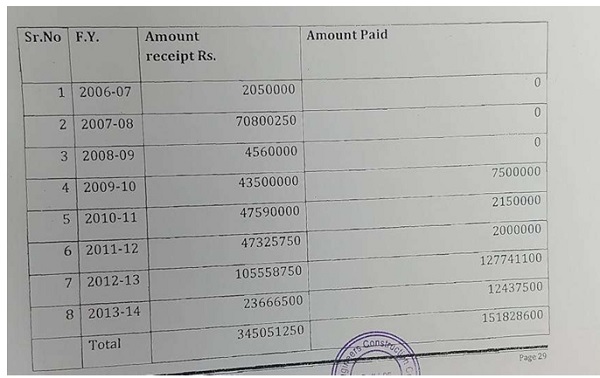
40. This cash receipts and payments are not recorded in the books of account and, therefore, Antriksh Group is receiving unaccounted receipts from their different projects in cash outside the books of account. Similarly, while making payments of cash etc., out of books of account is also unaccounted. The assessee as per MOU 368762 sq. ft. purchased in Antriksh Heihgts at Sector 84, Gurgon. In the absence of any concrete evidence of unaccounted cash receipt by the assessee, the Ld. AO bifurcated the unaccounted cash receipt and cash payment between M/s Sanman Infrastructure Pvt. Ltd. and Antriksh Engineering Construction Corporation Pvt. Ltd., the assessee before us, on the basis of ratio of FSI purchased by these two parties calculated unaccounted receipts as follows:-
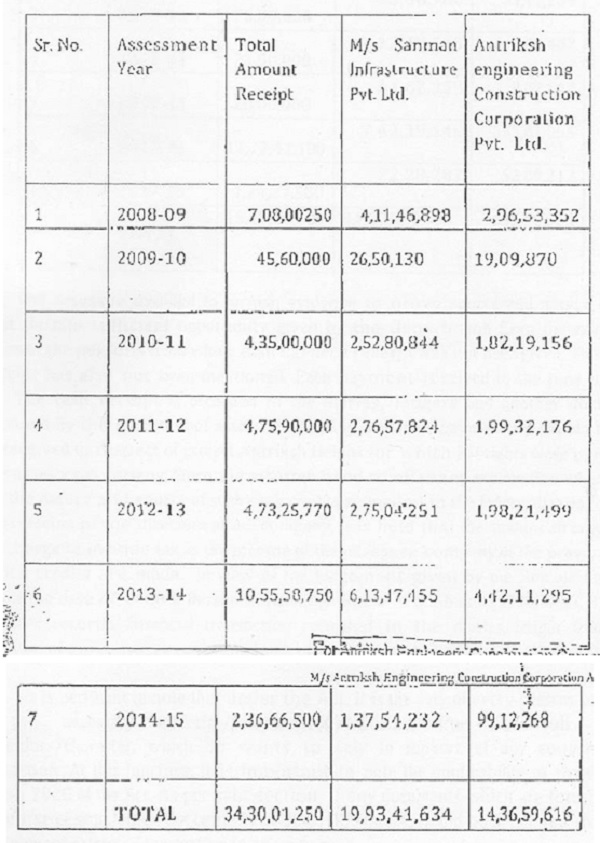
40.1 The Ld. AO calculated Rs.1,82,19,156/- as unaccounted cash receipt by the assessee.
40.2 Similarly unaccounted cash payment made by the assessee was also calculated in the following manner:-
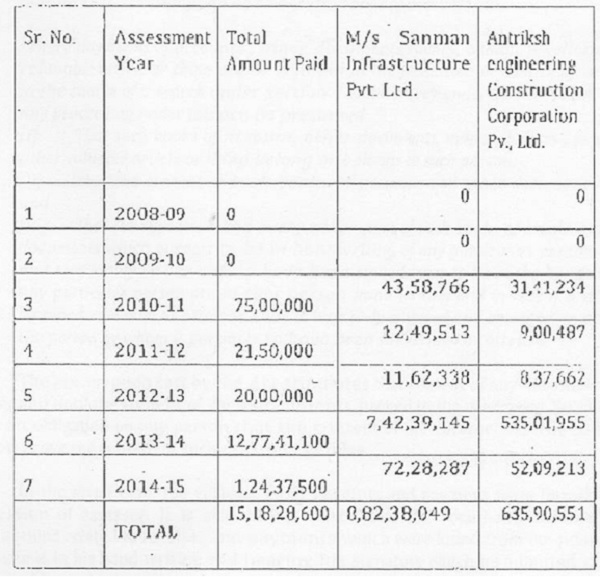
41. Similarly, in the same manner the AO calculated the unaccounted cash payment made by the assessee in the case of Antriksh Heights to the tune of Rs.31,41,234/- appearing at page 34 of the order passed by the Ld. AO. Similarly, on the basis of the said document the unaccounted receipt of the assessee out of the project of Antriksh Green was calculated by the Ld. AO to the tune of Rs.1,78,31,500/- and the unaccounted payment made by the assessee in respect of Antriksh Green project at Rs.41,68,750/- appearing at page 34 and 35 of the order passed by the Ld. AO.
42. Under these facts and circumstances of the matter we have considered the following judgements relied upon by the Ld. AR in the above matter wherein it has been held that the addition cannot be made merely on the basis of unauthenticated and unverified loose sheets having no evidentiary value in the eyes of law in the absence of corroborative material:-
(i) Supreme Court in the case of Common Cause (A Registered Society) vs. UOI, [2017] 77 com 245;
(ii) Karnataka High Court in the case of DCIT vs. Sunil Kumar Sharma [2024] 159 com 179 dated 22.01.2024;
(iii) The SLP in the above case has been dismissed vide citation [2025] 180 com 293 on 27.10.2025; and
(iv) ITAT Delhi in the case of Dheeraj Chaudhary vs. ACIT [2026] 183 com 477, dated 11.02.2026.
42.1 Further, we have considered the judgement passed by the Coordinate Bench in the case of ACIT vs. Dheeraj Chaudhary (supra) wherein relying upon the judgement passed by the Hon’ble Apex Court in the case of Common Cause, a registered Society (supra) the Bench has been pleased to hold that the loose sheet of papers found during the course of search are wholly irrelevant as evidence being not admissible under Section 34 of the Evidence Act so as to constitute evidence with respect to the transactions mentioned therein being uncorroborated with books of accounts. In fact, the following observations has been made:-
“10. The Hon’ble Supreme Court in the case of Common Cause (A Registered Society) and Others vs. Union of India and Others in Writ Petition Civil Appeal No. 505 of 2015 has observed as under:-
“16. With respect to the kind of materials which have been placed on record, this Court in V.C. Shukla’s case (supra) has dealt with the matter though at the stage of discharge when investigation had been completed but same is relevant for the purpose of decision of this case also. This Court has considered the entries in Jain Hawala diaries, note books and file containing loose sheets of papers not in the form of “Books of Accounts” and has held that such entries in loose papers/sheets are irrelevant and not admissible under Section 34 of the Evidence Act, and that only where the entries are in the books of accounts regularly kept, depending on the nature of occupation, that those are admissible It has further been laid down in V.C. Shukla (Supra) as to the value of entries in the books of account, that such statement shall not alone be sufficient evidence to charge any person with liability, even if they are relevant and admissible, and that they are only corroborative evidence. It has been held even then independent [A.Y 2015-16] Shri Dheeraj Chaudhary vs ACIT evidence is necessary as to trustworthiness of those entries which is a requirement to fasten the liability.”
11. It is apparent from the aforesaid law mandated by the hon’ble Supreme Court that the loose sheet of papers found in the search, in the case of the assessee, are wholly irrelevant as evidence being not admissible u/s 34 of the Evidence Act so as to constitute evidence with respect to the transactions mentioned therein, being uncorroborated with any books of account. They are merely rough sheets, without any dates and wherever dates are mentioned, they do not pertain to the impugned year. Considering the facts of the case in totality, we do not find any merit in the additions made by the Assessing Officer, based on the above seized rough sheets. Therefore, we direct the Assessing Officer to delete the impugned additions. Ground 5 is allowed.
12. Ground 6 pertain to loan taken by the assessee from Muthoot Finance Ltd. The CIT(A) upheld the same stating that no details of security for such loan was give by the assessee. We find that the said cash was taken as loan from Muthoot Finance Ltd against security of jewellery. Neither the AO examined that the same is not reflected in assessee’s books of account as claimed by the assessee nor the CIT(A) examined the same. We are therefore of the view that the said addition is not sustainable in law. Accordingly, we direct the AO to delete the said addition. Ground 6 is allowed.”
43. The loose papers unearthed during the course of search at the premises of Shri Rakesh Kumar Yadav and Rajbir Singh Goyat being the sole and primary document relying upon which the unaccounted payment and receipt made by the assessee has been calculated, the same are merely dumb document containing rough notings without any narration, date, signature or reference to the assessee company. Neither the name of the assessee appears on such documents nor has any material been brought on record to establish any nexus between the assessee and the alleged transactions noted therein. The calculation merely on the basis of unauthenticated and unverified loose sheets having no evidentiary value, is not sustainable and the addition made thereon is arbitrary, erroneous and liable to be set aside in view of the judgements relied upon by different judicial forum as argued by the Ld. Counsel Mr. Ved Jain is found to be acceptable. No statement of any person has been recorded to support the alleged transaction neither independent inquiry or verification has been carried out by the Ld. AO while making additions as also submitted by him.
43.1 Alternative argument was also advanced by the Ld. Sr. Counsel appearing for the assessee without prejudice to the above submission that even if the loose papers, for the sake of argument, pertained to the assessee, no addition of the entire amount can be made. At best, only the profit element embedded in such alleged transactions could be brought to tax. Further that as per the well settled principle of law in case of allegation of unaccounted receipts/payments are made only the income component embedded therein can be assessed and not the entire gross amount. Since the AO made addition of the entire figures claimed to have been mentioned in the loose papers without any cogent evidence on record representing the whole amount as undisclosed income of the assessee, the same is unsustainable in the eye of law and, therefore, liable to be deleted.
43.2 The Ld. DR relied upon the order passed by the Ld. AO and not been able to controvert the above submission made by the Ld. AR
44. The case before us is identical to that of the judgement relied on by the Ld. AR and, therefore, respectfully relying upon the same when the additions in the instant case is made purely on assumption, presumption on surmise and conjecture basis without any corroborative evidence on record alleging unaccounted receipts and unaccounted payments made by the assessee is found to be not sustainable in the eyes of law and, therefore, deleted.
45. This ground will also apply mutatis mutandis to other appeals
46. Addition of estimation of income is another common ground raised by different assessees.
47. ITA No.8842/Del/2025 (AY :2010-11) in the case of Antriksh Engineers Corporation is taken as lead case.
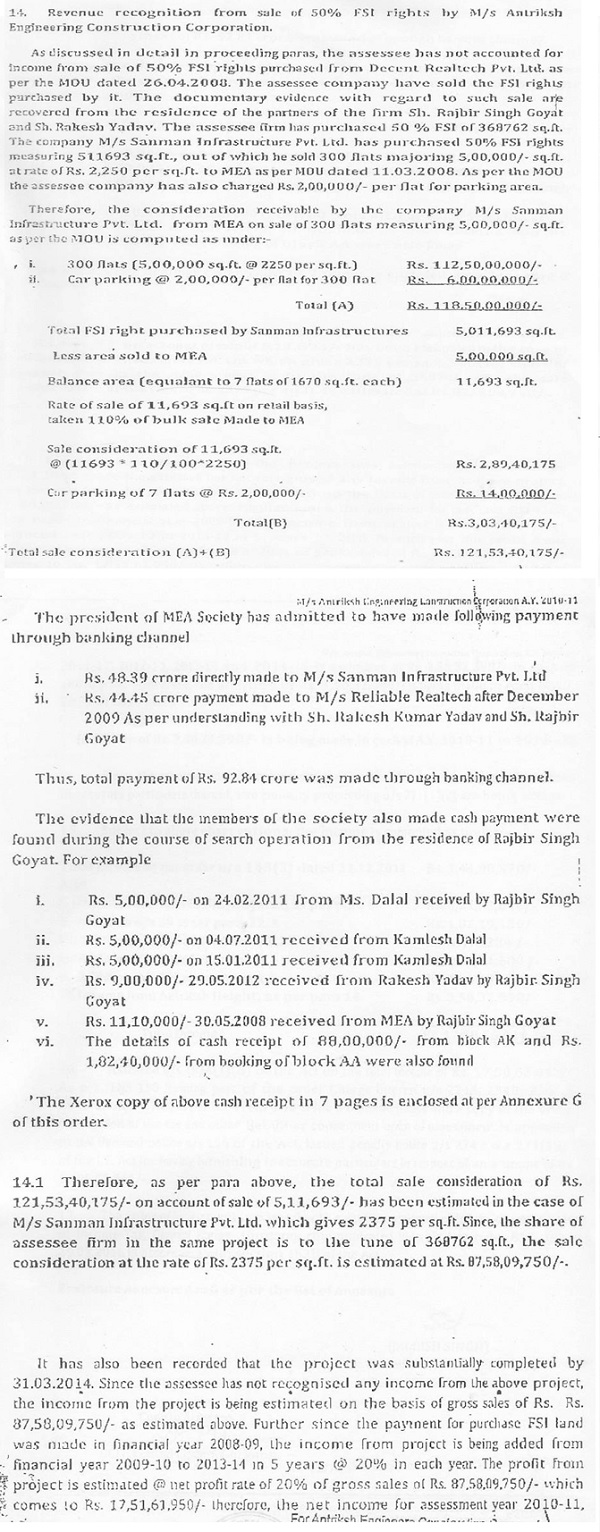
48. While making addition to the tune of Rs.3,50,32,390/-, the Ld. AO observed as follows:-
–
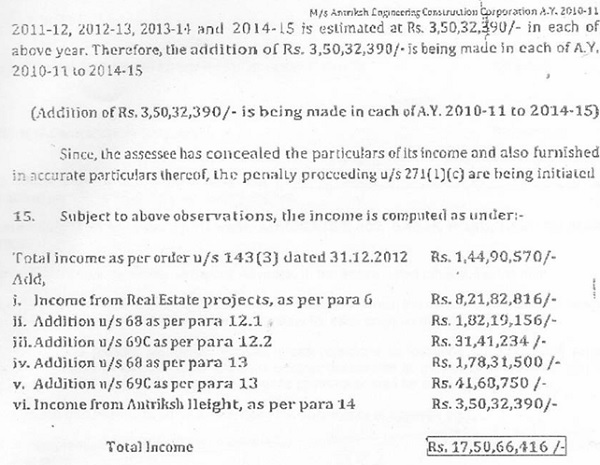
49. The assessee has submitted as follows in respect of estimation of income at 20% of the gross receipts:-
“(F-3) Estimation of Income firm at the rate of 20% of the gross receipts is untenable as the Assessee firm has not executed the project
71. It is submitted that the project Antriksh Heights was developed on 24 acres of land owned by M/s Decent Realtech Private Limited (M/s Decent) and M/s Reliable Realtech Private Limited (M/s Reliable). M/s Decent owned 13.42 acres and M/s Reliable owned 11.87 acres of land. The promoters of the two companies were Garg family (also known as Dwarkadish Group).
72. The above additions have been made in the hands of the assessee firm under the impression that the assessee had purchased 50% FSI of the project from M/s Reliable as per the MOU dated 20.03.2008 and independently sold it to Ministry of External Affairs Employees Welfare Society (MEAEWS). Further, the sister concern of the assessee company M/s Sanman Infrastructure Pvt. Ltd. had purchased 50% FSI of the project from M/s Decent as per the MOU dated 26.04.2008. The promoters of both the companies are Rakesh Kumar Yadav and Shri Rajbir Singh Goyat (Antriksh Group).
73. In this regard, it is submitted that the assessee entered into a construction agreement/MOU dated 11.03.2008 with the Ministry of External Affairs Employees Welfare Society, for construction and sale of 300 flats, pursuant to which booking amounts/advance was received by the assessee company in the year 2008 and 2009 which was duly recorded in its books of accounts.
74. However, subsequently, due to legal issues arising particularly the title of the ownership of the land not being in the name of the assessee company, the assessee had to opted out of the MOU and had subsequently terminated the MOU with M/s Reliable on 04.01.2010 and had transferred the agreement with Ministry of External Affairs Employees Welfare Society as well as the amounts received till the year 2009, to M/s Reliable and M/s Decent.
75. Ultimately, the project was taken up for development and sale by M/s Reliable in collaboration with M/s Decent. The same is clear from the following-
-
-
- The license to develop the residential housing project was also obtained by M/s Reliable from the government of Haryana. The fact has been acknowledged by Id. AO in the assessment order.
- Accordingly, the assessee firm was neither the owner of the land nor it developed the project.
- Further, only the initial payments were received by the assessee firm from MEAEWS as per the MOU with them, however, the amounts received from the society were transferred to M/s Decent and M/s Reliable.
-
76. In view of the fact, the addition made in each of the year by computing the profit of the total project and then allocating to different 5 years merely on the basis of assumption is untenable. The assessee has not executed the project and hence, the additions on the basis of this ground are liable to be deleted.”
50. We note that the Ld. CIT(A) relied upon the order passed by the Ld. AO which is further relied upon by the Ld. DR before us. But, having regard to the assessee firm being neither the owner of the land nor the developer of the project and initial payment received by the assessee from MEAEWS as per MoU with them the amounts received from the Society were transferred to M/s Decent and M/s Reliable as the land owner, the addition is found to be not sustainable and deleted.
51. The assessee is not pressing the ground of on money in the transaction with Logics Infra Developers Pvt. Ltd. and, therefore, the same is dismissed as not pressed.
ITANo.8856/Del/2025, for AY 2008-09 (Rakesh Kumar Yadav)
52. Cash deposit made by the assessee in the year under consideration has been added as unexplained money under Section 69A of the Act on the basis of the entries appearing in the bank statement. In this regard, during the appellate proceedings, before the Ld. CIT(A) following documents were furnished as additional evidence under Rule 46A of the Act whereupon remand report was also called for:-
- Ledger account reflecting agricultural income of Rs. 6,50,380/- earned by the assessee.
- Copies of Form-J evidencing sale of agricultural produce in the mandi
- Purchase deeds of agricultural land establishing ownership of agricultural land
- Land records (Jamabandi/Khasra details) proving that the assessee was in possession and cultivation of agricultural land
- Cash book reflecting availability of sufficient cash balance
53. It appears that the above evidences which are also part of the record before us, cannot raise any doubt in regard to the ownership of the assessee on the agricultural land engaged in agricultural activities. The purchase deeds and the statement further proves the same. The Form J issued by Mandi authorities constitutes primary evidences of sale of agricultural produce reflecting the quantity sold and sale proceeds received by the assessee. Further cash book produced before the Ld. CIT(A) reflecting the availability of sufficient cash balance with the assessee comprising of cash generated from agricultural activities and opening cash balance available with the assessee as well. The source of cash deposit made by the assessee cannot, therefore, be doubted. We find that the Ld. AO has not pointed out any defect on the documentary evidences as above, neither any inquiry has been conducted in order to disprove the agricultural activities of the assessee. We note that the remand report proceeds on presumptions basis without any corroborative evidence. The addition, therefore, confirmed by the Ld. CIT(A) in the absence of contrary evidence is found to be erroneous, not sustainable and, therefore, liable to be deleted.
54. This ground of appeal is applied to all the respective years of appeals filed by different assessee.
55. In the result, appeals filed by the Assessees are partly allowed.
Order pronounced in the open court on 05.06.2016.




