Bharat Explosives Limited Vs DCIT (ITAT Agra)
Section 68 Addition Does Not Automatically Justify Penalty Where the Explanation Is Bona Fide
The controversy
The Agra Tribunal deleted a penalty of ₹16,50,000 under section 271(1)(c) arising from additions concerning public fixed deposits under section 68.
Although the company’s evidence had not been accepted as sufficient to explain the credits in the quantum proceedings, the Tribunal found that its explanation could not be regarded as wholly unacceptable or lacking bona fides. The company had furnished depositors’ names, addresses and supporting details, and claimed that some entries represented renewal of earlier deposits.
The Tribunal distinguished an addition under a deeming provision from the separate question of whether the facts warranted a penalty.
Public deposits and the section 68 addition
The assessee was a public limited company that filed its return declaring nil income and reported a loss of approximately ₹7.96 crore in its profit and loss account.
Its books reflected fixed deposits aggregating to ₹2,64,34,000. During assessment, confirmations were sought from the depositors. Certain deposits remained unconfirmed, and the Assessing Officer added ₹56,35,000 under section 68, citing deficiencies in proof of the creditors’ creditworthiness and the genuineness of the transactions.
The disputed list contained 234 fixed-deposit entries, with individual amounts ranging from ₹3,000 to ₹50,000. Some persons had made deposits on more than one occasion.
The first appellate authority granted relief of ₹2,53,000. In the quantum appeal, the Tribunal confirmed ₹23,98,000 and restored ₹29,84,000 to the Assessing Officer to verify the claim that these were renewals of old deposits involving no fresh receipt during the relevant year.
The Assessing Officer subsequently added the restored amount again, holding that the renewal claim had not been established despite opportunities.
Penalty followed the sustained additions
The Assessing Officer levied ₹16,50,000 as penalty on the surviving deposits aggregating to ₹53,82,000.
The penalty dispute had an extended appellate history. In an earlier round, the Tribunal directed consideration of the assessee’s jurisdictional objection concerning absence of the requisite satisfaction for initiating penalty.
In the order now challenged, the CIT(A) rejected that objection and maintained the penalty. The CIT(A) also declined to reconsider other grounds, stating that they had already been decided in the earlier appellate order.
Before the Tribunal, the assessee challenged both the jurisdictional basis and the substantive justification for penalty.
What the company had disclosed
The company explained that the deposits were accepted from the public at large under a fixed-deposit scheme governed by the Companies (Acceptance of Deposits) Rules, 1975.
It had furnished particulars including depositors’ names and addresses, FDR numbers, deposit amounts, maturity dates and maturity amounts, together with application forms and other supporting records.
The assessee submitted that the depositors were not personally known to it. It also relied on the receipt and repayment of deposits through account-payee cheques, with interest payments made through the same banking mode.
Its case was that complete facts and evidence had been placed on record, while the dispute concerned whether that evidence met the degree of proof required by the Assessing Officer.
The Tribunal examined these circumstances separately from the outcome of the quantum proceedings.
Inadequate proof did not establish concealed income
The Tribunal acknowledged that the explanations had not been accepted as sufficient under section 68 and that the additions had survived the relevant proceedings.
However, it noted that acceptance of the deposits from the public under the company’s deposit scheme was not disputed by the Assessing Officer.
More importantly, there was no other information from an external source or enquiry by the Assessing Officer showing that the company had introduced its own undisclosed income through these deposits.
The Tribunal also examined particulars supplied concerning fresh deposits and renewals. It noticed sample entries recording renewal dates in FY 2004-05, preceding the year under appeal.
These particulars supported its conclusion that the explanation concerning earlier deposits could not simply be dismissed as entirely unacceptable or non-bona fide.
Reliance Petroproducts applied
The Tribunal relied on CIT v. Reliance Petroproducts (P.) Ltd., 322 ITR 158 (SC) in holding that the penalty was unsustainable on the facts before it.
It directed deletion of the entire ₹16,50,000 penalty and allowed the assessee’s appeal.
Since relief had been granted on the substantive penalty ground, the other grounds—including the objections concerning satisfaction and the penalty notices—became academic and were left open. Thus, the Tribunal did not cancel the penalty on the defective-notice argument.
Author’s comments
Failure to establish a credit conclusively in assessment does not make penalty an automatic consequence. This decision turns on the company’s disclosures, supporting particulars and the Tribunal’s finding that its explanation retained bona fides.
The absence of confirmations was relevant to the section 68 addition. For penalty, however, the Tribunal also considered whether the available evidence justified treating the explanation as false or lacking good faith.
The ruling should not be presented as a blanket exemption from penalty whenever an addition is made under section 68. Nor did the use of banking channels independently resolve the dispute. The cumulative facts and the acceptability of the explanation were decisive.
Its practical value lies in preparing a separate penalty defence rather than merely repeating the quantum arguments. The disclosures made, supporting records and circumstances explaining evidentiary gaps must be identified.
The addition survived, but the penalty did not—because an unsuccessful explanation was not, on these facts, a dishonest one.
Cases Discussed
- CIT v. Reliance Petroproducts (P.) Ltd., 322 ITR 158 (SC) — Relied upon in deleting penalty.
- Sundaram Finance Ltd. v. ACIT, 403 ITR 407 (Mad.) — Cited in CIT(A)’s reasoning on penalty notice.
- Amtex Software Solutions Pvt. Ltd. v. ACIT, 418 ITR 99 (Mad.) — Cited in CIT(A)’s reasoning.
- CIT v. Sri Durga Enterprises, 44 taxmann.com 442 (Kar.) — Cited in CIT(A)’s reasoning.
- CIT v. Sudev Industries Ltd., 94 taxmann.com 373 (Delhi) — Cited in CIT(A)’s reasoning.
- CIT v. Smt. Kaushalya & Others, 216 ITR 660 (Bom.) — Cited in CIT(A)’s reasoning.
- CIT v. Mithila Motors, 149 ITR 751 (Pat.) — Cited in CIT(A)’s reasoning.
- Kantamani Venkata Narayana & Sons v. Addl. ITO, 63 ITR 638 (SC) — Mentioned in quoted CIT(A) order.
- Maharaj Garage & Company v. CIT, 400 ITR 292 (Bom.) — Cited in CIT(A)’s reasoning.
- Madhushree Gupta & British Airways v. Union of India, 317 ITR 143 (Delhi) — Relied upon in assessee’s submissions.
FULL TEXT OF THE ORDER OF ITAT AGRA
This appeal is directed against the impugned order dated 17.03.2026 passed in appeal No CIT (Appeal) 2, Agra/10591/2018-19 by the NFAC (hereinafter referred to as the Commissioner of Income Tax), u/s. 250 of the Income Tax Act, 1961 (hereinafter referred to as the “Act”) for the A.Y. 2006-07, wherein ld. CIT (A) has dismissed assessee’s appeal.
2. The assessee is a public limited company and during the year had filed a return of income at nil and had a net loss as profit as per profit & loss account amounting to Rs.7,96,26,000/-. During the year, the AO noted that the assessee had claimed borrowings of money through FDRs and total FDRs were shown at Rs.2,64,34,000/-. Confirmations were called from the assessee in all cases and the AO noted that the confirmations were received in few cases and FDRs to the tune of Rs.56,35,000/- were remained unconfirmed. As per the list of the said depositors, in whose cases, confirmations were not received, it includes Sr. No. 1 to 234 (on page no 9-11 of the assessment order) wherein certain persons have made fixed deposits of various amounts on more than one occasion. At a glance of the above list of 234 FDRs, it is seen that the amount in the FDRs varied from Rs.3,000/- to Rs.50,000/- on various dates. The AO in absence of proof regarding the creditworthiness of the creditors and the confirmations of the transactions of Rs.56,35,000/- claimed to be received as FDRs, considered the same as not genuine and added the same to the income of the assessee u/s. 68 of the Act. The assessment was completed at a total income of Rs.7,38,02,263/- and penalty proceedings u/s. 271(1)(c) were initiated for separate consideration. The relevant para No. 6 of the assessment order initiating penalty proceedings is reproduced as under :
“6. Assessment is made on total income at (-) Rs.7,38,02,263/-round off Rs.7,38,02,260/-. Issue notice of demand and challan. Penalty proceedings u/s. 271(1)(c) of the Income-tax Act, 1961 are initiated for separate consideration.”
2.1 Aggrieved with the said order, the assessee filed an appeal before the learned CIT(A), who allowed the relief of Rs.2,53,000/- and confirmed the balance addition. The assessee again went in appeal before the Tribunal wherein this Bench of the Tribunal by an order dated 09.07.2013 in ITA No. 385/Agr/2012 confirmed the addition of Rs.23,98,000/- and set aside the balance addition of Rs.29,84,000/- to the file of the AO to verify the claim of the assessee that the said fixed deposits were renewed and therefore, no credit was received during the year and the addition to that extent may be deleted. The AO passed the set aside assessment order u/s. 143(3) r.w.s. 254 of the Act dated 05.02.2015, wherein the AO noted that the assessee despite given various opportunities, failed to prove that the sum of Rs.29,84,000/- related to the fixed deposits received not during the year, but it was only renewal of the old deposits. In view of these facts, the AO again added the sum of Rs.29,84,000/-.
2.2 Thereafter, the AO initiated the penalty proceedings and passed an order on 27.04.2015 levying penalty of Rs.16,50,000/- in respect of the FDRs amounting to Rs.53,82,000/- wherein the assesee failed to establish the identity and creditworthiness of the depositors.
2.3 Aggrieved with the said order, the assessee filed an appeal before the Tribunal, wherein the Tribunal by its order dated 09.08.2017 in ITA No. 93/Agr/2017, set aside the order of the learned CIT(A) and restored the matter to the file of the AO to decide the legal ground No. 4, challenging the jurisdiction of the AO to initiate proceedings u/s. 271(1)(c) of the Act on the ground that the AO did not record any satisfaction with respect thereto. It was held by the Tribunal that it was not decided by the learned CIT(A) while disposing and dismissing the appeal of the assessee.
2.4 Pursuant to the said order, the learned CIT(A) vide order dated 17.03.2026 (against which the present appeal of the assessee was heard), dismissed the appeal of the assessee. The relevant findings of the learned CIT(A) are reproduced as under:
“ 5. FINDINGS AND DECISION
5.1 The Hon’ble ITAT vide its order dated 09.08.2017 in ITA no. 93/Agra/ 2017 has restored the matter to the undersigned for decision on the appellant’s contention that the penalty order u/s 271(1)(c) was passed by the AO without jurisdiction. The Hon’ble ITAT has stated that CIT(A) in his order dated 28.10.2016 order no. A.No.129/CIT(A)-2/Agra/DCIT-6/Jhansi/2015-16 has not decided ground no. 4 of the appeal filed before him by the appellate company. The said Ground no.04 is as follows:
“4. without prejudice to the earlier grounds the levy of penalty was without jurisdiction in the absence of requisite ‘satisfaction’ being recorded by the AO.”
In pursuance to the directions of the Hon’ble ITAT the said ground is decided as under:
5.2 Facts of the case are as under:
“2. Facts of the case are that during the course of assessment proceedings, it was noticed that the assessee has claimed borrowings of money through FDRs. Total FDRs shown at Rs.2,64,34,000/- confirmation were called from assessee in all cases. Separate letters were issued to all depositors to examine the genuineness of assessee’s claim. In few cases, confirmations were received. However, assessee failed to prove the genuineness of transactions claimed to be received as FDRs and to establish the identity, creditworthiness of the depositors to the extent of Rs.56,35,000/-. Since the FDRs amounting to Rs.56,35,000/-remained unconfirmed, addition to this extent was made to the income of the assessee and penalty proceeding u/s 271 (1)(c) of the Income Tax Act, 1961 were initiated and a show cause notice dated 24.12.2008 was issued.
3. Aggrieved with the above assessment, assessee preferred to file appeal before the Commissioner of Income-tax (Appeals), Agra. Hon’ble Commissioner of Income-tax (Appeals), Agra allowed the relief to the assessee to the extent of Rs.2,53,000/- with the following observation:
“I am conscious of the fact that the appellant is a limited company and it had invited deposits from the public at large. But, still, it has to prove the identity of the depositor and genuineness of the transaction which the assessee has failed to do.”
4. Assessee again went in appeal before the Hon’ble Income-tax Appellate Tribunal, Agra from where it was allowed a relief of Rs.29,84,000/- and Rs.23,98,000/- (Rs.53,82,000- Rs.29,84,000) sustained by the CIT(A) was confirmed and matter pertaining to addition of Rs. 29,84,000/- was set aside to the file of AO.”
5.3 I have carefully considered the appellant’s submission and the material available on record including the penalty order. It is evident from record that the AO has initiated penalty proceedings u/s 271(1)(c) vide the assessment order dated 24.12.2008. It is evident from the assessment order that the penalty has been initiated for the addition of Rs 56,35,000/- made on account of unexplained cash credits u/s 68 of the Act. Section 271 nowhere mandates that the recording of satisfaction is a must in specific terms and words. In absence of such specific provision if penalty proceeding is initiated by the AO without specifically recording his satisfaction, it cannot be said to be invalid or illegal, or improper exercise of jurisdiction. It is established law that satisfaction of the Assessing Officer must reflect from the order either with the expressed words recorded by the AO himself or by his overt act and action. In the appellant’s case, there is no confusion whatsoever why the penalty proceedings u/s 271(1)(c) have been initiated. Therefore, I am of the opinion that the appellant’s contention that the penalty notice is invalid is not correct. The argument that the penalty notice is invalid was never made before the AO. There is plethora of judicial decisions wherein it is held that the penalty notice cannot be held as invalid for the reason that the grounds on which penalty is proposed to be levied was not specified in the notice.
In the case of Sundaram Finance Ltd vs ACIT (2018) 403 ITR 407 / 170 DTR 8/304 CTR 846/93, the Hon’ble Madras High Court held that when the taxpayer has understood the import and purport of the penalty notice and has participated in the proceedings, then the levy of penalty is valid. The Hon’ble Court also held that where assessee not been put to any prejudice due to the defect in the notice then not showing the nature of default in the penalty notice is protected u/s 2928 of the Act. Similarly, the Hon’ble Madras High Court in Amtex Software Solutions Pvt Ltd v. ACIT (2019) 418 ITR 99 (Mad) (HC) has held that the penalty notice, not specifying the charge could be rectified and was not invalid. The writ to quash the notice was held to be not maintainable.
The Hon’ble Karnataka High Court in CIT vs Sri Durga Enterprises (2014) 44 taxmann.com 442 / [2015] 231 Taxman 886 (Kar) effectively reviewed its earlier decision and held that where taxpayer responded to the penalty notice issued by the AO in letter and spirit and participated in the proceedings then in light of the provisions of Section 292B, notice issued under section 148 was held to be valid. It was held that where a notice issued or purported to have been issued in pursuance of any provisions of this Act, shall not be deemed to be invalid mainly by reason of any mistake, defect or omission in such notice, if such notice is in substance and effect in conformity with or according to the intent and purpose of this Act.
The Hon’ble Delhi High Court in the case of CIT v. M/s Sudev Industries Limited [2018] 94 taxmann.com 373/256 Taxman 317 (Delhi) held that any notice, order, proceedings, etc, will not be invalid on account of any mistake, defect or omission if in substance and effect it is in conformity with and in accordance with the intent and purpose of the Act. The Hon’ble Delhi High Court has laid down that a Defective notice/summon, if it serves the intent and purpose of the Act, ie. to inform the assessee and when there is no confusion in his mind about initiation of proceedings under Section 147/148 of the Act, the defective notice is protected under Section 292B.
The Hon’ble Bombay HC in CIT v. Smt. Kaushalya & Others [1994] 75 Taxman 549/ [1995] 216 ITR 660 (Bom), held that the issuance of notice is an administrative device for informing the assessee about the proposal to levy penalty in order to enable him to explain as to why it should not be done and mere mistake in the language used or mere non-striking of the inapplicable portion cannot by itself invalidate the notice.
In CIT v. Mithila Motors [1984] 16 Taxman 224/149 ITR 751 (Pat), relying on the decision in Kantamani Venkata Narayana & Sons v. Addl. ITO [1967] 63 ITR 638 (SC), wherein it was clarified that a mistake in the notice does not invalidate the penalty proceedings, it was held that even granting that the notice u/s. 274 was defective or bad in law, the penalty proceedings would not fail as no prejudice had been caused to the assessee and that all that is required is that the assessee should be given an opportunity of show cause, and no statutory notice has been prescribed in this behalf. Hence, it is sufficient if the assessee was aware of the charges he had to meet and was given an opportunity of being heard. A mistake in the notice would not invalidate penalty proceedings.
The Hon’ble Bombay High Court in the case of M/s Maharaj Garage & Company, v. CIT [2017] 85 taxmann.com 86/ [2018] 400 ITR 292 (Bombay) held that-
“ The requirement of Section 274 of the Income Tax Act for granting reasonable opportunity of being heard in the matter cannot be stretched to the extent of framing a specific charge or asking the assessee an explanation in respect of the quantum of penalty proposed to be imposed, as has been urged. The assessee was supplied with the findings recorded in the order of re-assessment, which was passed on the same date on which the notice under Section 271(1)(c) was issued, initiating the proceedings of imposing the penalty. The assessee had sufficient notice of the action of imposing penalty. It was thus concluded, that there was no jurisdictional error or unjust exercise of power by the authority.”
Therefore, after considering the facts of the case and the ratio of decisions on the issue as discussed above, I am of the opinion that the objections raised by the appellant are baseless. Therefore, the objections raised by the appellant in ground no. 04 in the appeal no. CIT(Appeal) 2, Agra/10591/2018-19 are frivolous and baseless and are therefore rejected. Thus, the said ground no. 4 is hereby dismissed.
6. Other grounds of appeal no. 1, 2, 3 & 5 were already adjudicated by the earlier CIT(A), Agra vide order dated 28.10.2016. All these grounds were dismissed by the Hon’ble CIT(A), Agra. Therefore, fresh adjudication of these grounds is not required.
7. In the Result, the Appeal is dismissed.”
3. Aggrieved with the said order, the assessee is in appeal before us on the following grounds:
“1. That the learned CIT (Appeals) erred both on facts and in law in sustaining the penalty of Rs. 16,50,000/- imposed by the AO u/s 271(1)(c) of the Income Tax Act 1961 (“The Act”).
2. The Ld. CIT(A) erred in law in upholding the levy of penalty on the issue of jurisdiction, without considering the submissions made by the assessee during the course of the proceedings.
3. That the learned CIT(A) further erred in not deciding Grounds 1,2, 3 & 5 raised in the Appeal on the wrong premise, that as these had already been dismissed earlier by the CIT(A) Agra, a fresh adjudication was not required.
4. That non adjudication of the Grounds adverted to in (3) above, tantamounted to non-compliance with the directions of the Hon’ble ITAT, whereby the matter on merits was kept open to be raised afresh.
5. The Assessee reserves to itself, the right to add, alter, amend, substitute and/or withdraw any Ground(s) of Appeal on or before the date of hearing.”
4. At the time of hearing, the learned AR filed a written submission, which is reproduced as under:
“Short synopsis of the written submissions
It is emphasized at the outset, that the submissions on each of the Grounds are independent and without prejudice to each other.
Ground 2 (Recording of satisfaction and validity of the Notice issued u/s 274/271(1)(c) of the Act)
1. Penalty u/s 271(1)(c) envisages twin conditions vis (1) Satisfaction and (2) issue of notice u/s 274 rws 271 (1)(c), which is valid as per law.
2. Recoding of satisfaction has to be discernible from the Assessment Order and it precedes the issue of the statutory notice u/s 274/271(1)(c) and not post thereof.
3. The satisfaction must relate to the facts of the case and the reasoning of the AO must prima facie be precise and clear as to the limb of Section 271 (1) (c) attracted, i.e. whether concealment of particulars of income or furnishing of inaccurate particulars. There is no scope for any confusion or casual approach on the part of the AO.
4. The notice for penalty u/s 274 rws 271 (1) (c) should indicate the limb of Section 271(1)(c) under which the assessee is put on notice and any defect therein nullifies all subsequent proceedings.
5. Section 271(1B) introduced with retrospective effect from 01.04.1989 deems a direction in an assessment order for initiation of penalty proceedings to constitute satisfaction, but such direction should be valid as per law and conform to the provisions of Section 274 and 271(1) (c) of the Act.
Reverting to the facts of the present case
Submissions:
1. The Assessment order dated 24.12.2008 does not indicate specifically, any malafides on the Part of the Appellant vis-a-vis the addition in question. In other words, the overall sense gathered from the order does not point to any lapse or wrong doing on the Part of the Appellant, which should attract the Provisions of Section 271(1)(c) of the Income Tax Act 1961 (“the Act”) (Pages 55 to 64 of the PB)
2. To the above is coupled the fact that the Printed notice dated 24.12.2008 u/s 274/271 of the act, is vague and ambiguous, whereby the relevant limb under which the Penalty is proposed has not been spelt out. In other words, even if one were to refer to Section 271 (1B) without Prejudice to every other argument, the requirement embedded therein is not met in the Present Case (Page 141 of the PB)
3. The issue by the AO of an appeal effect order/ assessment order dated 05.02.2015 refers to the term “furnishing inaccurate particulars of income”, whereas the Penalty notice dated 16.03.2015 mentions both limbs and the Penalty order dated 27.04.2015 once again reverts back to “furnishing of inaccurate Particulars” (Pages 7 to 10 and Page 51 of the PB)
4. Without Prejudice to (3) above the initiation of Penalty u/s 271(1)(c) vis-a-vis jurisdiction has to be examined with reference to the initial assessment order and not the order giving appeal effect.
Judgements Relied upon:
1. Madhushree Gupta & British Airways Vs. Union of India 317 ITR 143 (Delhi)
2. KPC Medical College and Hospital Vs. Pr. CIT (Central) (2025) 173 com 581 (Calcutta)
3. CIT (Central-3) Vss. Shyam Sunder Jindal (2024) 462 ITR 501 (Delhi) SLP discussed in Pr. CIT (Central-3) Vs. Shyam Sunder Jindal (2025) 172 taxmann.com 164
4. CIT Vs. Times Global Broadcasting Ltd. (2025) 172 taxmann.com 786 (Bombay)
5. CIT Vs. Quippo Telecom Infrastructure (P) Ltd (2025) 175 taxmann.com 503 (Delhi)
6. CIT Vs. Gragerious Projects (P.) Ltd (2025) 475 ITR 546 (Delhi)
7. CIT Vs. Unitech Reliable Projects (P) Ltd. (2024) 462 ITR 307 (Delhi) SLP discussed in (2024) 166 taxmann.com 135.
8. The Delhi Building & Others Construction Welfare Trust Board Vs. Deputy Director of Income Tax (E) (2025) 175 com 1053 (Delhi-Trib.)
9. Escorts Kubota Ltd. Vs. Addl. CIT, Special Range – 3 ITA No.
There are innumerable judgements both of the Hon’ble High Courts and Benches of the Hon’ble ITAT taking the view on the question of jurisdiction in favour of the assessee, and by far very few to the contrary, but following the maxim of adopting the view which is in favour of the assessee, the Appellant deserves to succeed on the legal ground.
The Judgements relied upon by the Ld. CIT (A) are distinguishable on facts.
In conclusion, your honour’s may be pleased to cancel the penalty imposed u/s 271(1)(c) of the Act on the legal ground espoused aforesaid.”
5. On the other hand, learned Sr. DR supported the orders of the authorities below.
6. We have heard both the parties and perused the material on record. The assessee is a public limited company. In this regard, on perusal of para 5 of the order dated 09.07.2013 of this tribunal with respect to the quantum appeal of the assessee in ITA No. 385/Agr/2012, we note that the ld. Authorised Representative submitted that the assessee had taken fixed deposit as per the scheme under the Companies (Acceptance of Deposits) Rules, 1975 and that it was explained before the CIT(A) that the assessee is a public limited company having in its books approximately 459 FDR accounts aggregating Rs.2,64,34,000/-. The Ld. AR further submitted that there was fixed deposit scheme which was open to public at large and the amounts were received through banking channel and assessee had to accept the particulars given in the application form as correct. It was further submitted that all the payments were by account payee cheques and even the interest payments were in the same mode. In this regard, para no. 5 of the said order is reproduced as under:
“5. The ld. Authorised Representative submitted that the assessee has taken fixed deposit as per the scheme under the Companies (Acceptance of Deposits) Rules, 1975. The ld. Authorised Representative drew our attention on page nos.86 & 87 of the Paper Book where details of scheme have been placed. Ld. Authorised Representative drew our attention on page no.6 of assessee’s Paper Book where copy of Auditor’s report has been placed. Ld. Authorised Representative pointed out clause 6 of Auditor’s report and submitted that as per Auditor’s observation the assessee company did not accept any deposit from public during the year under consideration. Therefore, the provisions of section 58A, 58AA or any other relevant provisions of Companies Act, 1956 and Rules framed thereunder were not applicable. Ld. Authorised Representative further submitted with reference to page no.14 of assessee’s Paper Book where schedule of unsecured loans has been placed. Ld. Authorised Representative pointed out that the unsecured loan for the year ended 2005 was Rs.265.97 lacs which have been slightly reduced to Rs.264.34 lacs at the year ended 2006 i.e. the year under consideration. Ld. Authorised Representative submitted that these support to the fact that the amount was not received in the year under consideration. Ld. Authorised Representative drew our attention to page no.2 where copy of submission made before the CIT(A) vide letter dated 04.03.2010 has been placed. Ld. Authorised Representative submitted that it was explained before the CIT(A) that the assessee is a public limited company having in its books approximately 459 FDR accounts aggregating Rs.2,64,34,000/-. He further submitted that there was fixed deposit scheme which was open to public at large. The amounts were received through banking channel and assessee has to accept the particulars given in the application form as correct. It was further submitted that the address of the depositors were not doubted as per record of the assessee but case of the A.O is that he did not receive any response or letters sent came back un-served, he did not confront the assessee or make any further effort to contact the depositors by issuing summon under section 131 of the Act. In the absence of all these, the assessee cannot be held liable for addition under section 68. It is also submission of the ld. Authorised Representative that these fixed deposits were through brokerage and the assessee has paid brokerage of Rs.4,00,000//-. Ld. Authorised Representative submitted that the assessee has submitted complete details of these depositors including FDR numbers, names and addresses, Scheme of FDR, amount, maturity date and maturity amount etc. These details have been placed at page nos.89 to 154 of the assessee’s Paper Book. Ld. Authorised Representative submitted that the assessee vide letter dated 14.12.2010 submitted before the CIT(A) that the confirmations in respect of fixed deposits have not been received till date since the matter was a few years old and most of the depositors have taken refunds. However, the assessee submitted before the CIT(A) that still the assessee is making efforts to contact them but the number is quite long and the matter is time consuming. It was also submitted that all deposits have come under the fixed deposit scheme of the company and none of the fixed deposit holders are personally known to the company. It was submitted that all the payments were by account payee cheques and even the interest payments were in the same mode. Ld. Authorised Representative submitted that remand report furnished by the A.O. has been placed at page no.156 & 157 of the Paper Book. The assessee has replied to the remand report vide letter dated 10.11.2010 of which copy is placed at page nos.158 & 159 of assessee’s Paper Book. Ld. Authorised Representative while concluding his submission submitted that the assessee in support of its arguments had produced voluminous details in respect of the FDRs such as copies of application forms, copies of FDRs. Which were renewed, cancelled FDRs. As also evidence showing the mode by which the amounts were received as also the mode of repayment is by account payee cheques. These documents contained complete names and addresses of the depositors.”
6.1 In this regard, in ground no. 3 of the appeal before the Ld. CIT (A), the assessee had contended as under:
“The penalty u/s 271(1)(c) was not exigible since the appellant had placed on record complete facts and evidence and it was debatable between the parties as to what was the acceptable degree of proof.”
6.2 The same was dismissed by the Ld. CIT (A) by order dated 17.03.2026 (subject matter of this appeal) stating that this ground along with ground nos. 1, 2 and 5 were already adjudicated by the earlier CIT (A) Agra vide order dated 28.10.2016 where in all these grounds were dismissed and therefore fresh adjudication of these grounds were not required. However, on perusal of the order dated 09.08.2017 in assessee’s own case for the same assessment year on this very issue in ITA no. 93/Agr/2017 the Tribunal had no occasion to discuss the above ground no. 3 as reproduced above as no such ground was before the Tribunal.
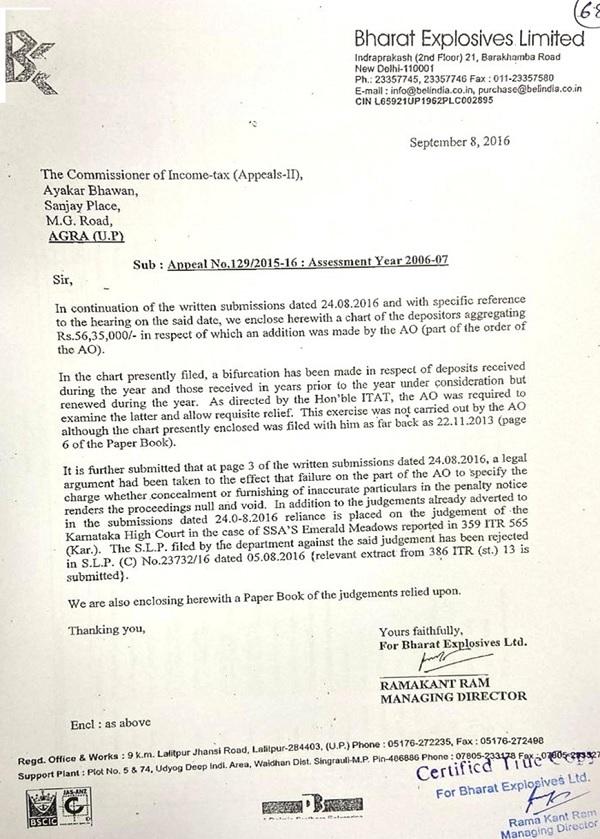
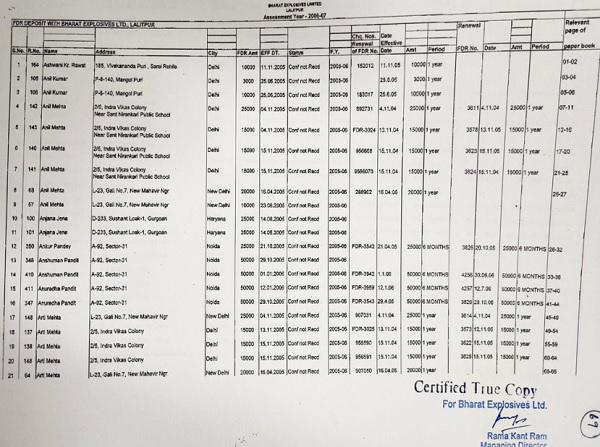
6.3 In this regard, as noted above, the assessee is public limited company and had accepted fixed deposits as per the scheme under the Companies (Acceptance of Deposits) Rules, 1975 and furnished the complete list of the depositors along with their complete addresses. In this regard, the assessee submits that none of the depositor was personally known to the assessee and the assessee had discharged its onus of proving that the amounts were received from the depositors. However, as discussed above, the same was not considered adequate and the addition of Rs. 23,98,000/- was confirmed by this Tribunal vide order dated 09.07.2013 in ITA no. 385/Agr/2012 and further the balance addition of Rs. 29,84,000/- was restored by this Tribunal to verify the claim of the assessee that the balance deposit of Rs. 29,82,000/- were renewal of old deposits. However, the said sum of Rs. 29,82,000/- was again added by the AO vide order dated 05.02.2015 u/s 254/143(3) of the Act, where in the AO noted that the assessee despite several opportunities given, the assessee failed to establish that the balance deposit of Rs. 29,82,000/- were renewal of old deposits as claimed by the assessee. However, the issue in this appeal is as to whether on the submission of the said details which was not found to be satisfactory by the AO and addition was made as discussed above then whether the assessee would be liable to levy of penalty u/s 271(1)(c) of the Act or not on the said addition. On this we take note of the fact that the deposits of Rs 53,82,000/- on which the AO has levied penalty was accepted by the assessee from public at large under the Companies (Acceptance of Deposits) Rules, 1975 which has not been disputed by the AO. However, in absence of confirmation from the said depositors the amount of fixed deposits were added and confirmed as discussed above u/s 68 of the Act where the assessee failed to explain the credit entries by way of the receipts on account of FDR received by the assessee as per the provisions of section 68 of the Act, which is a deeming provision. However, there is no other information on record either on account of any external source or by any enquiry done by the AO which shows that the assessee had introduced its undisclosed income by way of the fixed deposits of Rs. 53,82,000/-. Further, we also note that the assessee vide letter dated 08.08.2016 before the ld. CIT (A) to Agra had filed the details wherein, a bifurcation of deposits received during the year and those received in year prior to year under consideration but renewed during the year, which was submitted by the assessee before the AO on 22.11.2013 and according to the assessee that as directed by the Tribunal, the AO was required to examine the said renewal and to allow the requisite relief which was not carried by the AO. The said letter and the relevant details are placed on page no. 68 to 78 of the paper book. In this regard, the relevant extract of the said letter (placed on page no. 68 of the paper book) and page no. 1 (placed on page no. 69 of the paper book) of the said details on a sample basis is reproduced below which shows that in the FDRs at Serial. No. 4,7 and 17 the date of renewal is indicated 04.11.2004 which pertains to FY. 2004-05 relevant to AY. 2005-06 whereas the present appeal is for AY. 2006-07.
—
6.4 Therefore, in the given facts of the case, the submission of the
assessee that it furnished the complete name and address of the depositors and other details in this regard to substantiate its claim and that some of the deposits were renewal of old deposits not relating to AY. 200607 cannot be said to be totally unacceptable and not bona fide.
6.5 Therefore, considering the above facts the levy of penalty u/s 271(1)(c) of the Act levied by the AO is not tenable in this case. In this regard, reliance is placed on the decision of the Hon’ble Apex Court in the case of CIT Vs Reliance Petroproducts (P) Ltd: 322 ITR 158 (SC) wherein on similar facts the Hon’ble Court held that penalty u/s 271 (1)( c) of the Act was not leviable. Accordingly, the levy of penalty of Rs. 16,50,000/- by the AO u/s 271 (1)(c) of the Act is deleted. Ground no. 1 of the appeal is allowed. In view of ground no. 1 of the appeal allowed, the other grounds of appeal become academic and are left open in this case.
7. In the result, the appeal of the assessee is allowed.
Order pronounced in the Open Court on- 12.10.2026