DCIT Vs Artificial Limb Manufacturing Corporation of India (ITAT Lucknow)
Summary: The Income Tax Appellate Tribunal, Lucknow Bench “A”, dismissed the Revenue’s appeal against relief granted to Artificial Limb Manufacturing Corporation of India (ALIMCO) for Assessment Year 2014-15. Following a TDS verification survey on 18 January 2017 and proceedings initiated under sections 201(1) and 201(1A) of the Income-tax Act, 1961, the Assessing Officer had treated ALIMCO as an assessee in default and raised an aggregate demand of ₹2,80,84,059, comprising ₹2,80,81,413 and ₹2,646. The Addl./Joint CIT(A)-4, Bengaluru, by order dated 6 February 2025, deleted the disputed demand while partly allowing the assessee’s appeal.
The Revenue argued that ALIMCO had failed to supply the requested evidence despite adequate opportunities during the original proceedings. It also objected that the appellate authority had admitted additional evidence without granting the Assessing Officer an effective opportunity to comment, contrary to rule-46a -section-2504.html” title=”Rule 46A admission of additional evidence in appeal” Rule 46A of the Income-tax Rules, 1962. The Department sought reversal of the appellate order and restoration of the matter to the Assessing Officer for fresh adjudication.
ALIMCO responded that it had furnished details on several occasions and that the final request, dated 17 March 2021, required extensive employee-wise information by 22 March 2021 during the COVID-19 period. Although it sought additional time, the Assessing Officer passed the order on 26 March 2021. On merits, the corporation submitted that section 192A concerns payment of accumulated provident fund balances to employees rather than an employer’s regular contributions. Its recognised provident fund contributions were stated to remain within 12% of basic salary plus dearness allowance, while the EPFO pension component represented 8.33% of the relevant pay.
For gratuity and leave encashment, ALIMCO explained that premiums were paid directly to Life Insurance Corporation of India on an actuarial valuation basis to fund future employee benefits, without direct payments to employees or directors. It similarly described its LIC-administered superannuation scheme, to which it contributed 10% of basic salary plus dearness allowance. The first appellate authority relied on the recognised provident fund trust documentation, LIC confirmation and employee TDS certificates, and concluded that the disputed employer contributions did not give rise to the alleged withholding default on the facts presented.
The Tribunal found that the CIT(A) had extensively examined the dispute and recorded detailed findings after providing adequate opportunity to the parties. Crucially, the Revenue produced no adverse material rebutting the findings that the contributions went to the recognised provident fund, EPFO or LIC rather than directly to employees, and identified no material showing that contributions exceeded the applicable statutory limits. It therefore rejected the Revenue’s grounds, including its challenge concerning the appellate proceedings, and dismissed ITA No. 59/LKW/2026. The order does not establish an unrestricted exemption for all employer contributions irrespective of their nature or limits.
Cases Discussed
- MMTC Limited Vs Employees Provident Fund Organisation, (2013) LLR 347; W.P.(C) Nos. 7949/2005, 2045/2006 and 11906/2006; 14/02/2013 (Delhi High Court) — The decision is cited in the CIT(A)’s reproduced discussion regarding employer provident fund obligations. The ITAT did not separately analyse this precedent.
FULL TEXT OF THE ORDER OF ITAT LUCKNOW
This appeal, by the Revenue, is directed against the order of the Learned Addl/Joint Commissioner of Income tax (Appeals)- 4, Bengaluru dated 06.02.2025, pertaining to the assessment year 2014-15. The Revenue has raised the following grounds of appeal: –
“1. On the facts and in the circumstances of the case and in law, the learned ADDL. Commissioner of Income Tax (Appeals) erred in deleting the demand of Rs. 2,80,84,059/-for which the deductor assessee was treated as assessee in default u/s 201(1)/201(1A) of the Income Tax Act, 1961 without appreciating that the deductor was provided sufficient opportunity to submit details/documents during the proceeding u/s 201(1)/201(1A), however, it failed to do so.
ITA No.59/LKW/2026 Page 2 of 13
2. On the facts and in the circumstances of the case and in law, the learned ADDL. Commissioner of Income Tax (Appeals) erred in admitting the additional evidences submitted by the deductor assessee during appeal proceedings without providing opportunity to the AO to offer comments thereon under Rule-46A .
3. On the facts and in law, the order passed by the learned ADDL. CIT(A) under section 250 of the Act is bad in law and is liable to be quashed.
4. The appellant craves leave to add, alter, amend, vary, and/or withdraw any or all of the above grounds of appeal at or before the time of hearing.”
2. The facts in brief are that a Tax Deduction at Source (“TDS”) verification survey under section 133A(2A) of the Income Tax Act, 1961 (“Act”, for short) was conducted by the Revenue on 18.01.2017 at the premises of the assessee. Thereafter, a notice under sections 201(1)/201(1A) of the Act dated 01.05.2019 was issued and duly served upon the deductor-assessee. In response thereto, the assessee furnished the requisite details and tendered its explanation. The Assessing Officer (“AO”, for short), after examining the material placed on record and considering the submissions made by the assessee, treated the assessee as an assessee in default under sections 201(1)/201(1A) read with sections 206C(6A)/206C(7) of the Act and raised a demand of Rs.2,80,81,413/- and Rs.2,646/- respectively. Accordingly, the aggregate demand raised by the AO amounted to Rs.2,80,84,059/-. Aggrieved against the impugned tax demand, the assessee preferred an appeal before the Ld. CIT(A) who after considering the submissions partly allowed the appeal of the assessee. Thereby, the impugned demand raised by the Assessing Authority was deleted. Aggrieved, the Revenue is in appeal before this Tribunal.
3. Apropos to the grounds of appeal, the Ld. Departmental Representative for Revenue vehemently argued that the Ld. Addl. CIT(A) was not justified in passing the impugned order. He submitted that sufficient opportunities were afforded to the assessee during the proceedings u/s 201(1) and 201(1A) of the Act to furnish the requisite details and supporting documents. However, the assessee failed to comply with the statutory notices and did not furnish the requisite evidence before the Assessing Officer. It was further submitted that the ld. CIT(A) admitted additional evidence furnished by the assessee during the appellate proceedings without providing an effective opportunity to the Assessing Officer to examine the same and offer his comments thereon as required under Rule 46A of the Income Tax Rules, 1962 (“Rules”, for short). He, therefore, submitted that the order of the ld. CIT(A) deserves to be set aside and the matter may be restored to the file of the Assessing Officer for fresh adjudication.
4. On the other hand, Ld. Counsel for the assessee reiterated the submission as made in the synopsis. For the sake of clarity, the synopsis of the assessee is reproduced as under: –
“Order u/s-201/201A for Non-deduction of TDS on:
Employers Contribution to Provident Fund
Employers Contribution to Pension Fund (EPFO)
Employers Contribution to Gratuity & Leave Encashment Fund
Employers Contribution to Pension Fund (LIC)
Survey conducted in January 2017. Bulk of information and data was provided and scrutinized. submissions and details submitted on various occasion including on 01.05.2019, 26.05.2019, 13.01.2021, 23.01.2021, 01.02.2021, 24.02.2021 and 22.02.2021. Last notice issued on 17.03.2021-seeking bulk of information and details of all the employees of the corporation upto 22.03.2021. Request letter submitted on 22.03.2021 to allow time to submit such bulk information in desired format. Inspite of COVID period and limitations extended by CBDT, order was passed on 26.03.2021 without affording proper opportunity.
MERITS:
1. Default alleged u/s 192A of the Act Pertains to Payment of accumulated balance due to an employee by the fund or trust. Does not apply to contribution by employers.
2. Employers Contribution to PF:
(a) As per section-17(1)(vi), It is taxable as per Rule 6 of part A of the fourth schedule only when contribution made by the employer exceeds twelve percent of the salary.
(b) No such finding by the learned A.O.
(c) No payment to employee. payment only to the recognized. Provident fund @ 12% of basic salary plus DA. No direct payment, no question of TDS.
3. Employers Contribution to Pension Fund A/c (EPFO)
(a) Part of recognized provident fund. Rule 6 of Part A of fourth schedule applies. Contribution is only 8.33% of Basic plus DA.
Statutory payment directly to the recognized fund. No payment to (b) employee.
4. Employers Contribution to Gratuity Fund & Leave Encashment-
(a) The assessee has taken gratuity and leave encashment policy from LIC. Premium is paid to LIC on the basis of actuarial valuation. This enables the corporation to pay gratuity etc. to the employees only when they retire.
(b) No payment to an employee or director. Payment to LIC is only to create fund for future obligations of the corporation.
5. Employers Contribution to Pension Fund (LIC):
(a) The corporation had taken ALIMCO Employees Superannuation Scheme from LIC
(b) The corporation paid 10% of basic salary plus DA to the pension fund maintained by LIC. This enables pension payments to employees by LIC post-retirement.
(c) Such contribution is eligible for deduction u/s-80CCD (2) in the hands of the employee and is thus not taxable or liable for TDS
6. Payments to Directors: Similar provisions and law apply to similar payments in respect of directors of the corporation.”
5. The Ld. Counsel for the assessee submitted that the Assessing Officer (“AO”) grossly erred in treating the assessee as an assessee in default and consequently passing the order under sections 201(1) and 201(1A) of the Income Tax Act, 1961 (“Act”, for short). He further contended that the impugned order passed by the Assessing Authority suffers from patent illegality and is, therefore, unsustainable in the eyes of law. He further submitted that the Assessing Authority was not justified in raising the impugned demand in respect of Employers Contribution to Provident Fund, Employers Contribution to Pension Fund, Employers Contribution to Gratuity Fund & Leave Encashment and Employers Contribution to Pension Fund. He further submitted that the Assessing Officer had erroneously treated the payments made to the Directors and the employer’s contributions towards Provident Fund, Pension Fund, Gratuity Fund and Leave Encashment as payments liable for deduction of tax at source. The Ld. Counsel contended that no amount in respect of the aforesaid employer’s contributions was paid directly to the employees. Rather, the contributions were deposited with the LIC Pension Fund, Employees’ Provident Fund Organization (EPFO) and duly recognized Gratuity Fund, in accordance with the applicable provisions of law. He, therefore, submitted that the AO was not justified in treating the assessee as an assessee in default under section 201(1) of the Act and consequently charging interest under section 201(1A) of the Act
6. We have heard the rival submissions and perused the material available on record. We find that the Ld. CIT(A) has extensively examined the issue in dispute and recorded detailed findings of fact and provided adequate opportunity to the parties. He decided the dispute by observing as under:–
“5. The Appellant, known as “ALIMCO” is established by the Government of India for carrying out the activities of “relief of poor”, “Medial relief and education etc. as per objects set forth in its Memorandum of Associations. The Appellant has been granted a license under section 25 of the Companies Act and is also registered u/s. 12AA of the Income tax Act, 1961. On 18.01.2017 a survey/verification of TDS for financial year 2013- 2014 was conducted by the Dy. Commissioner of Income tax (TDS). Kanpur at the premises of Appellant. On finding certain discrepancies with respect to TDS deduction, proceedings under section 201/(1A) of the Act was initiated by the AO. During the course of the proceedings, on noticing that the Appellant had failed to deduct TDS on salary paid to the employees, passed order dated 26.03.2021 u/s. 201(1)/201(1A) of the Act, 1961 by treating the Appellant as assessee-in-default and raising a demand of Rs. 2,80,84,059/-, Aggrieved by the same, the Appellant has filed the instant appeal.
5.1 Ground No 1 to 5: Demand of Rs. 2,80,84,059/- under section 192A of the Act:
Since the Appellant has been held as assessee-in-default for non-deduction of TDS us 102A of the Act in respect of Employers contribution to recognized Provident Fume Employers contribution to Pension Fund (as part of Provident Fund). Employers contribution to Gratuity Fund & leave Encashment and Employers Contribution to Pension Fund (LIC) it is imperative to examine the provisions of the said section. Section 192A reads as under:
192A. Payment of accumulated balance due to an employee Notwithstanding anything contained in this Act, the trustees of the Employees’ Provident Fund Scheme, 1952, framed under section 5 of the Employees Provident Funds and Miscellaneous Provisions Act, 1952 (19 of 1952) or any person authorized under the scheme to make payment of accumulated entrance due to employees, shall, in a case where the accumulated balance due to an employee participating in a recognized provident fund is includible in tis total income owing to the provisions of rule 8 of Part A of the Fourth Schedule not being applicable, at the time of payment of the accumulated balance due to the employee, deduct income-tax thereon at the rate of ten per cent
Provided that no deduction under u this section shall be made where the amount such payment or, as the case may be, the aggregate amount of such payment to the payee is less than [fifty] thousand rupees.”
5.1.1 Employer’s Contribution to Provident Fund: Contribution is made to the Provident Fund for the employee’s welfare by the employee and the employer. The deduction on this contribution made is available under section 80C of the Act. Provident fund is a kind of security fund in which the employees contribute a part of their part and the employer also contributes on behalf of their employees. Section 10/11 and 10(12) of the Income Tax Act, 1961 defines the exemption on the amount add the provident fund. Additionally, the amount allowed as a deduction on controlling to the provident fund is dealt in section 80C of the Income Tax Act. The types provident funds are:
i. Recognised Provident Fund (RPF) as recognised by Commissioner of Income Tet under EPF and Miscellaneous Provision Act, 1952. It applies to enterprises employing at least 20 employees.
2. Unrecognised Provident Fund (UPF) is not recognised by the Commissioner of Income Tax. The employers and employees start these schemes.
3. Public Provident Fund (PPF) under Public Provident Fund Act, 1968 is another system of contributing to the provident fund. Self-employed people can also take part in this scheme. A minimum contributing limit of Rs. 500 per annum and a maximum of Rs. 150000 per annum are set
4. Statutory Provident Fund (SPF) is meant for employees of Government or Universities or Educational Institutes affiliated to university.
5.1.1.1 The Employees’ Provident Fund (EPF) is a savings scheme designed to help Individuals build a retirement corpus. While it encourages savings, it is subject to taxation under Section 192A of the Income Tax Act. This section mandates Tax Deducted at Source (TDS) on premature withdrawals from the EPF, However, there are several deductions and exemptions available that can help individuals optimize their EPF benefits and minimize tax abilities.
5.1.1.2 Section 192A of the Income Tax Act deals with the Tax Deducted at Source (TDS) on premature withdrawals from the Employees’ Provident Fund (EPF). This 192A section mandates that the Employees’ Provident Fund Scheme, 1952, must deduct TDS if an employee withdraws their EPF balance without meeting the conditions specified under Rufe 8, Part A of the Fourth Schedule. Introduced through the Finance Act 2015, section 192A of the Income Tax Act 1961 requires that tax be deducted at the time of EPF payment. The deducted TDS must be deposited with the government by the entrusted deductors within a week of the following month in which the tax is deducted. However, for TDS deducted in March, the deposit deadline is on or before April 30th.
5.1.1.3 Employer’s contribution to the EPF account of an employee is exempt upto 12% of the ‘PF Salary’. Any excess contribution by employer over and above 12% of ‘PF Salary’ is taxable in hands of employee. However, an overall cap on exemption limit was introduced in the Union Budget 2020. Effective from 1st April 2020, any employer’s contribution to Provident Fund (PF), NPS and superannuation exceeding INR 0.75 mn a year is taxable as perquisites in the hands of the employee under section 17(2)(vii) of IT Act, 1961 under the head “Income from Salary. Necessary withholding to be done by the employer on the same and required to be reported in Employee’s Form 16 and Form 12BA.
5.1.1.4 As per Finance Notification (31 Aug 2021) released by CBDT, the interest relating to the contribution in Provident Fund exceeding a specified limit of Rs.2.50,000/- shall be a part of taxable Income of the subscriber. This is application with effect from 01 April 2022 for the financial year 2021-2022.
5.1.1.5 Thus, Employer’s Contribution to Provident Fund is chargeable to tax as per rule to Part A of the Fourth Schedule of the Income Tax Act, 1961 which prescribes as under “Employer’s annual contributions, when deemed to be income received by employee
That portion of the annual accretion in any previous year to the balance at credit of an employee participating in a recognised provident fund as consists of
(a) contributions made by the employer in excess of twelve per cent, of the part of the employee, and
interest credited on the balance to the credit of the employee in so far as it coeds one third of the salary of the employee or is allowed at a rate exceeding such rate as may be fixed by the Central Government in this behalf notification in the official Gazette, shall be deemed to have been received the employee in that previous year and shall be included in his total income that previous year, and shall be liable to income-tax [*].”
5.1.1.6 The Appellant has paid 12% of Basic Salary plus DA (minus Employees Pension Scheme share) towards Employer’s Contribution to Provident Fund in accordance with the EPF Act and within prescribed limit of Part A of the Fourth Schedule of the Income Tax Act, 1961. ALIMCO ECPF Trust is a recognized Provident Fund Trust. The copy of recognition letter no. 67/(3)/75/2775 dated 09/02/1977 of ALIMCO ECPF Trust is reproduced hereinunder:
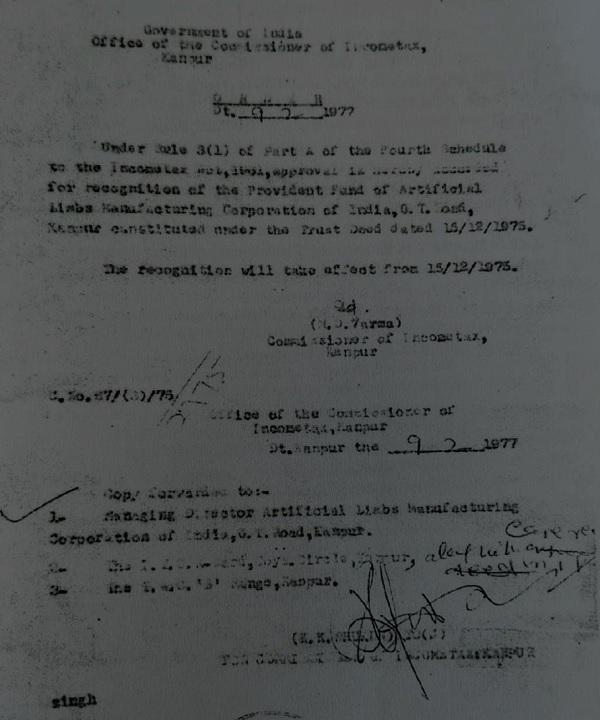
5.1.1.7 No payment has been made by the Appellant to the Employees directly. Hence, Provisions of TDS are not applicable on Employer’s contributions towards Provident Fund and there is no TDS liability on payment of Employer’s Contribution to Provident Fund.
5.1.1.8 EPFO is part of recognized Provident Fund Trust. As stated above Employer’s Contribution to Provident Fund is chargeable to tax as per rule 6 of Part A of the Fourth Schedule of the Income Tax Act, 1961. Provisions of TDS are not applicable on Employer’s contributions towards Pension Fund (EPFO). As per Section 6 A of The Employees Provident Funds and Miscellaneous Provisions Act, 1952, the Employer is liable to deposit 8.33% of Basic plus DA from employer’s constatation in Employee’s Pension Scheme. It is a statutory dues paid by assessee to Employees Provident Fund Organization. On attaining the age of 58 years the Employer get the pension from Employees Provident Fund Organization directly. The relevant extract of The Employees Provident Funds and Miscellaneous Provisions Art, 1952 is reproduced hereinunder:
employer will pay EPF, contribution il contractor fails to deposit; MMTC Friend Fund Organization, 2013 LLR 347 (Del HC)
A. Employees’ Pension Scheme (1) The Central Government may, by in the Official Gazette, frame a scheme to be called the Employees’ Scheme for the purpose of providing for-
(a)superannuation pension, retiring pension or permanent total disablement pension to the employees of any establishment or class of establishments to which this Act applies; and
(b) widow or widower’s pension, children pension or orphan pension payable to the beneficiaries of such employees.
Notwithstanding anything contained in section 6, there shall be as soon as may be after framing of the Pension Scheme, a Pension fund which there shall be paid, from time to time, in respect of every e who is a member of the Pension Scheme-
(a) such suns from the employer’s contribution under section 6, not exceeding eight and one-third per cent, of the basic wages, dearness allowance and retaining allowance, if any, of the concerned employees, as may be specified in the Pension Scheme
i The Employees’ Provident Funds and Miscellaneous Provisions Act, 1952 (Sec 6A)
(b) such sums as are payable by the employers of exempted establishments under sub-section (6) of section 17;
(c) the net assets of the Employees’ Family Pension Fund as on the date of the establishment of the Pension Fund;
(d) such sums as the Central Government may, after due appropriation by Parliament by law in this behalf, specify.
5.1.1.9 Further, the provisions of TDS are not applicable on Employer’s contributions to Gratuity Fund and Leave Encashment. The Appellant has taken Gratuity Policy and Leave Encashment Policy from Life Insurance Corporation of India (LIC). The payment of Gratuity and Leave Encashment Fund was made to LIC on the basis of actuarial valuation done by LIC. No payment was made to any employee or director of the company. Further, the payment of Leave Encashment was also made to LIC on basis of actuarial valuation. Hence, there is no TDS liability on payment of Employer’s contributions towards Gratuity Fund and Leave Encashment.
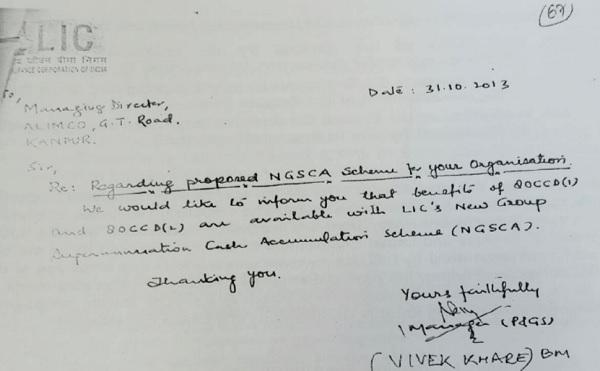
5.1.2 Contribution to Pension Fund (LIC): The provisions of TDS are also not applicable on Employer’s Contribution to Pension Fund (LIC). The Appellant had availed ALIMCO Employees Superannuation Pension Scheme from LIC. The Appellant has paid 10% of Basic Salary plus DA as employer contribution to pension fund maintained by LIC. Such amount paid to LIC is included in the salary of Individual Employees on which the Employee gets deduction under section 80CCD(2) ” target=”_blank” rel=”noopener”>section 80CCD (2) of Income Tax Act, 1961. On retirement, Employees get pension from LIC directly which is taxable as income of individual. The confirmation letter from LIC regarding the same is reproduced hereinunder:
5.1.3 section 192 ” target=”_blank” rel=”noopener”>Section 192(1) reads as under:
“192(1) Any person responsible for paying any income chargeable under the rad “Salaries” shall at the time of payment, deduct income-tax [*] on the amount payable at the average rate of income tax [*] computed on the basis of the frates in force] for the financial year in which the payment is made, on estimated income of the assessee under this head for that financial year.”
The Appellant has also furnished TDS certificate issued to few of the employees which this that the Salary, Dearness allowances and Perks & Allowance except certain certain allowance are reflected in individual TDS certificates of employees and directors under the head “Income from Salaries”.
5.1.4 in view of the facts mentioned above, the addition made by the AO is hereby delisted and the grounds of appeal are allowed.
5.2 Ground No 6: Initiation of penalty under section 2710 of the Act:
Since the AD had held the Appellant to be assessee-in-default, the AD was well within his powers to recommend penalty under section 2710 of the Act. Hence this ground of appeal is dismissed.
5.3 Ground No 7 & 8: General
Ground No. 7 & 8 are general in nature and does not require any separate adjudication
6. In the result, the appeal is Partly allowed.”
7. The above finding on facts is not rebutted by the Assessing Officer by bringing any adverse material on record. It is not rebutted by AO that no payment was made directly to the employees but it was paid to the EPFO a recognized trust to Provident Fund. Further, the Employers Contribution to Pension Fund, Employers Contribution to Gratuity Fund & Leave Encashment and Employers Contribution to Pension Fund were made to LIC duly recognized fund in this regard. The Revenue has also not pointed to any material to demonstrate that the contributions made by the assessee exceeded the limits prescribed under the relevant provisions of law. In the absence of any such material, we find no merit in the grounds raised by the Revenue. Accordingly, the grounds raised by the Revenue are hereby rejected.
8. In the result, the appeal of the Revenue in ITA. No.59/LKW/2026 is dismissed.
Order pronounced in the open Court on 28/10/2026.