
The article discusses a computational issue in the Government ITR Utility and certain private tax software for Assessment Year 2026-27 concerning the interaction of the amended Section 112 and Section 54F. It explains that the Finance (No. 2) Act, 2024 introduced taxation of long-term capital gains on land and building transferred on or after 23 July 2024 at 12.5% without indexation, while the second proviso to Section 112(1)(a) provides that, for eligible resident individuals and HUFs, the tax payable should not exceed the amount payable under the earlier indexed method. The article states that Section 54F prescribes a formula-based exemption linked to the amount of capital gain and illustrates, through an example, that the exemption differs under indexed and non-indexed computations. It contends that the present ITR Utility appears to require only one Section 54F exemption figure and uses it for both methods instead of recomputing the exemption separately. The author states that this issue should be examined by the Directorate of Systems, CBDT and private software developers, suggesting that the utility compute the exemption independently under both methods before comparing the tax liability, and notes that the views expressed are personal.
Section 54F Computation under the Amended Section 112 – A Possible Computational Error in the Government ITR Utility and Private Tax Software (AY 2026-27)
The Finance (No 2) Act 2024 introduced a new mechanism under section 112 for taxation of long-term capital gains on land and building transferred on or after 23 July 2024. The person is now required to pay tax at 12.5% without indexation. However, the second proviso to section 112(1)(a) protects the taxpayer (resident individual /HUF) by providing that the tax payable should not exceed the tax that would have been payable under the earlier indexed method. Although the intention of the law is clear, the computation mechanism adopted by the Government ITR Utility and, apparently, by many private tax software packages raises an important issue when exemption under section 54F is involved.
Section 54F itself provides a formula-based exemption. It does not say that the exemption is equal to the amount invested. The exemption is:
Exemption = Capital Gain × Amount Invested ÷ Net Consideration.
Therefore, the exemption is directly linked with the amount of capital gain. If the capital gain changes, the exemption also changes automatically.
Consider the following actual example:
Sale consideration: ₹54,00,000
Long-term capital gain without indexation: ₹28,62,975
Long-term capital gain with indexation: ₹6,30,393
Investment in new residential house: ₹18,29,900
Applying section 54F independently:
Without indexation:
Eligible exemption = ₹9,70,177
Taxable LTCG = ₹18,92,798
Tax @12.5% = ₹2,36,600
With indexation:
Eligible exemption = ₹2,13,622
Taxable LTCG = ₹4,16,771
Tax @20% = ₹83,354
Thus, under the second proviso to section 112(1)(a), the tax payable should be restricted to ₹83,354 because it is lower than ₹2,36,600.
The issue starts with the present ITR Utility. The utility asks the taxpayer to enter only one figure of exemption under section 54F as shown in the following screenshot.
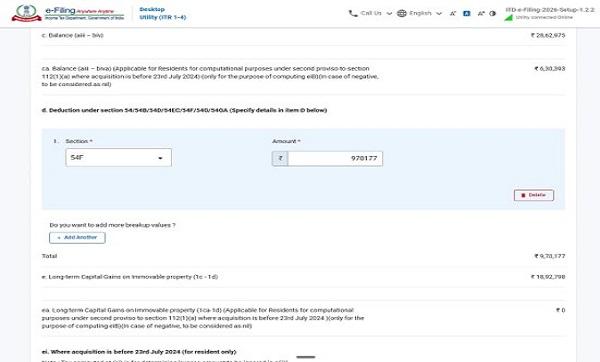
In the above example, the user enters ₹9,70,177. Thereafter, the utility appears to use this same figure for both computations instead of recomputing the exemption separately under the indexed and non-indexed methods.
In my respectful view, this is not consistent with section 54F. The statute requires the exemption to be calculated by applying the prescribed formula. Since the capital gain differs under the two methods, the exemption must also differ. It is a derived figure and not a fixed user-input figure.
The relevant provisions may be read together. Section 54F prescribes the formula-based exemption linked with ‘capital gain’. The second proviso to section 112(1)(a) merely provides a comparison of tax payable under the new and old methods. It does not override or modify the computation mechanism under section 54F. Therefore, before comparing the tax under both methods, the eligible exemption under section 54F should first be recomputed separately under each method.
If the utility simply uses one manually entered exemption amount for both methods, the comparison contemplated by section 112 may not produce the legally correct result. The same concern may also apply to many private tax computation software packages if they have adopted the same programming logic.
This issue deserves immediate examination by the Directorate of Systems, CBDT and by private software developers. The ideal solution is that the utility should ask only for the investment amount and other relevant particulars and should itself compute the exemption independently under both methods before comparing the tax liability.
The views expressed in this article are personal and intended to encourage discussion on the correct interpretation of the amended provisions. A clarification from CBDT would help ensure uniform implementation of the law and avoid incorrect tax computation in genuine cases.





The provisions under section 54F(1)(b):
“if the cost of the new asset is less than the net consideration in respect of the original asset, so much of the capital gain as bears to the whole of the capital gain the same proportion as the cost of the new asset bears to the net consideration, shall not be charged under section 45:”
Thus, the exemption is proportionate to the “Capital Gain” as accrued on the original asset.
Computation: The computation of capital gains, as provided under section 48 is without indexation. This is the only method of calculating capital gains. There are no two methods of calculation/computation.
Rate: The rate of tax on long term capital gains is provided under section 112 as 12.5%. This is the only rate provided for the calculation of tax on capital gains.
• The confusion appears to arise from the indexation benefit provided to the resident individual/HUF to benefit from the old 20%-with-indexation computation. Section 112 does not change nor provide an alternate method of computation or the rate of capital gain.
• The grandfathering benefit is only for the limited purpose of “ignoring the excess income-tax”, rather than changing the amount of capital gain or even the rate.
The provisions under section 112(1)(a), 2nd proviso:
Provided further that in the case of transfer of a long-term capital asset, being land or building or both, which is acquired before the 23rd day of July, 2024, where the income-tax computed under item (B) exceeds the income-tax computed in accordance with the provisions of this Act, as they stood immediately before their amendment by the Finance (No. 2) Act, 2024, such excess shall be ignored;
• Therefore, the capital gain has to be calculated only without indexation where exemption is to be claimed and there is no confusion nor a mistake in the utility.
• These indexation benefits are provided only to ignore the excess capital gains when the tax is paid on the long term-capital gains only on the sale of property (land or building). However, the provisions under section 54F are only for the sale of any long-term capital asset other than residential property. Thus, this confusion should not arise for section 54F at all.