Summary: The GST framework for post-sale discounts has undergone a major change effective from 1 November 2026, following Notification No. 03/2026–Central Tax dated 26 October 2026, which brings Sections 153 and 154 of the Finance Act, 2026 into operation. The amendments to Section 15(3)(b) and Section 34(1) of the CGST Act, 2017 remove two longstanding conditions for reducing taxable value through post-supply discounts: the requirement for a prior agreement entered into before or at the time of supply and the requirement to specifically link discounts with the original invoices. Under the revised provisions, suppliers may issue GST credit notes for year-end discounts, turnover incentives, volume rebates and similar commercial arrangements, provided recipients reverse the input tax credit attributable to those discounts. The article compares the earlier and amended provisions, explains the credit note and ITC reversal process, and illustrates the financial consequences through an example involving a ₹1 crore discount and ₹18 lakh GST adjustment. It also examines the continued relevance of the statutory credit note reporting deadline, GSTR-1 and GSTR-3B compliance, accounting software configuration, reconciliation of buyer ITC reversals and the alternative of financial or commercial credit notes without GST adjustment. Businesses should update their documentation and internal controls to ensure that reductions in output tax liability are supported by compliant credit notes and corresponding recipient ITC reversals.
1. What is the Big Change?
When a supplier gives a discount to a buyer after selling goods or services (for example, a year-end target bonus or volume rebate), adjusting GST on that discount used to be very difficult.
Before 1st November 2026, to reduce output tax liability on a post-sale discount under Section 15(3)(b), two strict rules applied:
- Written Agreement Rule: The discount scheme had to be agreed upon in writing before or at the time of sale.
- Invoice Tagging Rule: The discount had to be linked directly to each individual past invoice.
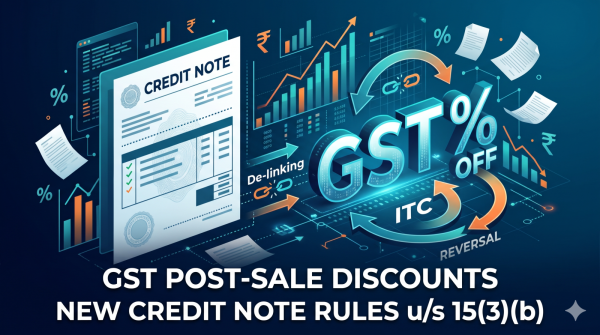
Effective 1st November 2026, these two restrictions have been removed. Suppliers can now issue a single GST Credit Note under Section 34(1) for post-sale discounts without needing prior written contracts or invoice-by-invoice linking—as long as the buyer reverses the corresponding Input Tax Credit (ITC).
2. Quick Comparison: Before vs. After 1st November 2026
| Feature | Old Rules (Pre-Nov 2026) | New Rules (Post-Nov 2026) |
|---|---|---|
| Prior Written Agreement | Compulsory. If no prior agreement existed, no GST adjustment was allowed. | No longer required. Discounts decided after the sale qualify. |
| Invoice Tagging | Compulsory. Credit notes had to list exact original invoice numbers. | No longer required. Bulk/consolidated credit notes can be issued. |
| GST Credit Note Usage | Restricted mainly to returned goods, price mistakes, or defective items. | Broadened to directly cover all post-sale commercial discounts. |
| Buyer ITC Reversal | Mandatory. | Retained. The buyer must still reverse the tax credit. |
| Time Limit | 30th November following the end of the financial year. | Unchanged (30th November timeline still applies). |
3. How the New Process Works Step-by-Step
┌──────────────────────────────────────────────┐
│    1. Supplier gives a Post-Sale Discount    │
└──────────────────────┬───────────────────────┘
                       │
                       ▼
┌──────────────────────────────────────────────┐
│  2. Supplier issues a GST Credit Note        │
│     (No prior agreement or invoice tags)     │
└──────────────────────┬───────────────────────┘
                       │
                       ▼
┌──────────────────────────────────────────────┐
│  3. Buyer reverses the ITC in GSTR-3B        │
│     (Table 4(B) - Eligible/Ineligible ITC)   │
└──────────────────────┬───────────────────────┘
                       │
                       ▼
┌──────────────────────────────────────────────┐
│  4. Supplier reduces Output Tax Liability    │
│     in GSTR-1 and GSTR-3B                    │
└──────────────────────────────────────────────┘
4. Simple Example
Scenario
ABC Paints sells paint throughout the year to a local dealer, Apex Traders. At the end of the year, Apex Traders hits a target goal, so ABC Paints grants a ₹10,000,000 target bonus with 18% GST (₹1,800,000).
Under the Old System
Because ABC Paints did not put this exact discount scheme in a contract before the year started, and could not link it across hundreds of separate daily invoices, they could not issue a GST credit note. They had to issue a financial/commercial credit note without adjusting GST. The ₹1,800,000 tax remained unadjusted.
Under the New System (Post-Nov 2026)
1. Supplier (ABC Paints): Issues one consolidated GST Credit Note for ₹10,000,000 (taxable value) + ₹1,800,000 (GST). ABC Paints validly reduces its output tax liability in GSTR-1 & GSTR-3B by ₹1,800,000.
2. Buyer (Apex Traders): Reverses ₹1,800,000 ITC in Table 4(B) of its GSTR-3B return.
3. No Hassle: Neither party needs to pull out old contract files or tag hundreds of invoice numbers.
5. Practical Action Points for Businesses & Tax Professionals
1. Update Accounting & ERP Systems: Configure billing software to generate bulk GST Credit Notes for target schemes without forcing line-item invoice mapping.
2. Focus Audits on ITC Reversal: Tax authorities will focus on checking whether the buyer reversed the ITC via GSTR-2B matching, rather than asking for original agreements.
3. Commercial Credit Notes Option: If a buyer cannot or will not reverse the ITC, suppliers can still use standard financial/commercial credit notes (without GST adjustment) as before.