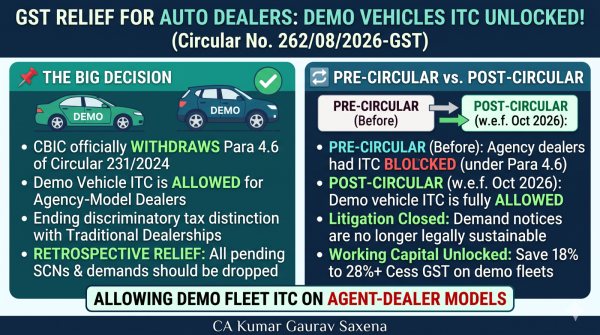
Summary: The Central Board of Indirect Taxes and Customs (CBIC), through Circular No. 262/08/2026-GST dated 26 October 2026, has clarified that input tax credit on demonstration vehicles purchased by authorised automobile dealers operating under the dealer-agency model is not blocked merely because the manufacturer directly sells vehicles to customers. The clarification withdraws paragraph 4.6 of Circular No. 231/25/2024-GST dated 10 September 2024, which had previously denied credit on such vehicles where dealers provided marketing, test-drive and facilitation services without selling new vehicles on their own account. The withdrawal addresses a significant distinction between traditional dealership arrangements and manufacturer-led agency models. The Board examined the commercial function of demo vehicles and recognised that both dealership models use them for the same purpose: enabling prospective customers to experience vehicles before purchasing similar models. These vehicles are generally purchased against GST invoices, capitalised in the dealer’s books, retained for demonstration and subsequently sold after the prescribed holding period. CBIC further clarified that the expression “further supply of such motor vehicles” under Section 17(5)(a)(A) of the CGST Act, 2017 covers vehicles used to promote further supplies of similar vehicles and is not restricted to the resale of the identical demonstration vehicle. Accordingly, the earlier restriction based solely on the dealer-agency business model has been withdrawn. The clarification carries important implications for automobile dealers, manufacturers, GST litigation teams and finance professionals. Dealers may reassess disputed input tax credit claims, pending notices and earlier reversals while examining statutory conditions under Section 16, depreciation restrictions, relevant limitation periods and the tax treatment of subsequent vehicle disposals. It also provides a basis for reviewing capital expenditure and working capital positions in dealership networks operating through agency arrangements.
Circular Reference: Circular No. 262/08/2026-GST dated 26th October 2026
Issuing Authority: GST Policy Wing, Central Board of Indirect Taxes and Customs (CBIC)
Statutory Basis: Issued under Section 168(1) read with Section 17(5)(a)(A) of the CGST Act, 2017
Key Action: Official withdrawal of Paragraph 4.6 of Circular No. 231/25/2024-GST dated 10th September 2024.
- 1. Context & Detailed Technical Background
- The 2024 Controversy (Para 4.6 of Circular 231/25/2024-GST)
- 2. Statutory Interpretation & Board's Legal Reasoning
- Commercial & Operational Parity
- Legal Construction of "Such Motor Vehicles"
- Formal Withdrawal
- 3. Comparative Analysis: Pre-Circular vs. Post-Circular
- Financial Takeaways for CFOs
- 4. Action Plan for CAs, Tax Advocates & Finance Heads
1. Context & Detailed Technical Background
In the automotive retail ecosystem, demo vehicles (test-drive cars) are essential capitalized assets used by dealers to demonstrate features and drive sales. Under Section 17(5)(a)(A) of the CGST Act, 2017, Input Tax Credit (ITC) on motor vehicles with a seating capacity of up to 13 persons is blocked unless the vehicles are used for making specified taxable supplies, including the “further supply of such motor vehicles.”
The 2024 Controversy (Para 4.6 of Circular 231/25/2024-GST)
On 10th September 2024, the CBIC issued Circular No. 231/25/2024-GST. While it allowed ITC for traditional dealers who buy and sell vehicles on their own account, Paragraph 4.6 drew a restrictive distinction for the “Dealer-Agency Model”.
Under the agency model—widely adopted by luxury car manufacturers, electric vehicle (EV) OEMs, and modern retail networks—the Original Equipment Manufacturer (OEM) sells vehicles directly to the ultimate customer on a tax invoice, while the dealer acts as an authorized agent/facilitator providing marketing and test-drive services.
In Para 4.6, the Board took the view that because an agency dealer does not sell the vehicle on their own account, they are merely providing marketing/agency services. Consequently, tax officers held that demo vehicles purchased by agency dealers were not used for “further supply of such motor vehicles,” resulting in widespread tax demand notices blocking 18% to 28%+ Cess ITC.
2. Statutory Interpretation & Board’s Legal Reasoning
Representations from the automotive trade highlighted that Para 4.6 created an unfair, discriminatory environment between traditional dealership networks and agency models. Re-examining the matter, the CBIC issued Circular No. 262/08/2026-GST on 26th October 2026, withdrawing Para 4.6 based on three key legal grounds:
Commercial & Operational Parity
In both traditional and agency models, demo vehicles serve the exact same commercial purpose: facilitating test drives so prospective buyers can experience the product before purchase. In both models, the vehicles are:
- Purchased from the manufacturer on valid GST invoices.
- Capitalized as capital assets in the dealer’s books of accounts.
- Mandatorily retained for a specified demonstration period.
- Eventually sold as used vehicles at written-down value with applicable GST.
- Treated identically under the Central Motor Vehicles Rules, 1989.
Denying ITC to one business model while allowing it to another was recognized as fundamentally discriminatory.
Legal Construction of “Such Motor Vehicles”
Section 17(5)(a)(A) uses the specific phrase “further supply of such motor vehicles” rather than “the said motor vehicle.” The Board clarified that the term “such” refers to motor vehicles of similar nature/category used to promote and effectuate further sales, rather than restricting credit strictly to the exact individual unit purchased.
Formal Withdrawal
Paragraph 4.6 of Circular No. 231/25/2024-GST stands withdrawn. ITC on demo vehicles is not blocked under Section 17(5)(a) for dealers operating under the dealer-agency model.
3. Comparative Analysis: Pre-Circular vs. Post-Circular
| Parameter / Aspect | Pre-Circular Regime (Para 4.6 of Circular 231/2024) | Post-Circular Regime (Circular 262/08/2026-GST) | Impact on Auto Dealers & OEMs |
|---|---|---|---|
| Traditional Dealership Model (Dealer buys/sells on own account) | ITC on demo vehicles was ALLOWED under Section 17(5)(a)(A). | ITC remains ALLOWED. | Status Quo maintained. |
| Dealer-Agency Model (OEM bills customer directly; Dealer holds demo fleet) | ITC BLOCKED: Taxed as non-eligible service overhead under Para 4.6. | ITC ALLOWED: Para 4.6 withdrawn; credit unblocked under Section 17(5)(a). | MASSIVE VICTORY: Restores level playing field for direct-agency sales models. |
| Legal Basis for Rejection | Department asserted agency dealers do not make “further supply” on their own account. | Board confirmed demo vehicles promote further supply of similar vehicles across both models. | Eliminates artificial distinction between agency and buy-sell models. |
| Pending Audit & SCN Status | High litigation risk; audit teams issued SCNs under Section 73/74 to reverse ITC. | SCNs become non-tenable; pending department proceedings must be dropped or decided in favor of dealers. | Significant reduction in pending indirect tax litigation. |
Financial Takeaways for CFOs
1. Working Capital Liberation: Authorized dealers operating under agency models (especially in luxury car, commercial vehicle, and EV segments) can now claim full ITC (typically 18% to 28% + applicable Compensation Cess) on demo fleet procurements.
2. Capital Expenditure Relief: Demo fleets represent a significant capital outlay for dealership networks. Unblocking ITC reduces net capital procurement costs by 18%–28%.
3. Subsequent Sale Alignment: When demo vehicles are decommissioned and sold at written-down values, tax is discharged under Section 18(6) or applicable margin rules. Allowing input credit ensures the supply chain remains free of cascading tax costs.
4. Action Plan for CAs, Tax Advocates & Finance Heads
1. Review Pending Show Cause Notices (SCNs): Immediately file supplementary submissions in pending audit, SCN, or appellate proceedings citing Circular No. 262/08/2026-GST to seek closure of demands raised under Para 4.6.
2. Re-evaluating Past Reversals: For past tax periods where ITC on demo vehicles was reversed under protest or kept unavailed due to Circular 231/2024, evaluate eligibility to reclaim credit subject to statutory time limits under Section 16(4).
3. Fixed Asset & Accounting Software Alignment: Ensure demo fleet assets are correctly tagged in ERP systems to claim ITC seamlessly upon purchase while tracking tax liability upon eventual disposal.