#AD
Introduction:
If you run a sole proprietorship, a small retail shop, a freelance consultancy, or a local service business, GST compliance can feel like something meant for “bigger” companies. But the moment your turnover crosses the prescribed threshold, or you start selling across state lines, or you want to list on e-commerce platforms, GST registration becomes mandatory, not optional. For proprietors setting up their business, understanding sole proprietorship registration online India requirements can also help ensure that the business structure and tax registrations are handled correctly from the beginning.
The challenge for most proprietors isn’t understanding why they need GST registration, it’s navigating how. Which documents count as proof of business address when you don’t have a formal office? Is your Aadhaar enough, or do you need a separate PAN for the business? What happens if your application gets sent back for clarification?
- What Is GST Registration for Sole Proprietors?
- Who Needs GST Registration as a Sole Proprietor?
- Step-by-Step Process for GST Registration Online
- Step 1: Visit the GST Portal and Initiate Registration
- Step 2: Fill Part A of the Application (Form GST REG-01)
- Step 3: Complete Part B Using the TRN
- Step 4: Upload Required Documents
- Step 5: Verification via Aadhaar Authentication or e-Sign
- Step 6: Application Reference Number (ARN) Generation
- Step 7: GSTIN Issuance
- Documents Required for GST Registration (Sole Proprietor)
- GST Registration: Sole Proprietorship vs. Private Limited Company
- Fees and Time Taken for GST Registration
- Common Mistakes to Avoid
- Risks of Not Registering for GST When Required
- Case Study: Avoiding Rejection Due to Address Mismatch
- Compliance Checklist for GST Registration (Sole Proprietor)
- Conclusion
- Why Choose Zolvit
What Is GST Registration for Sole Proprietors?
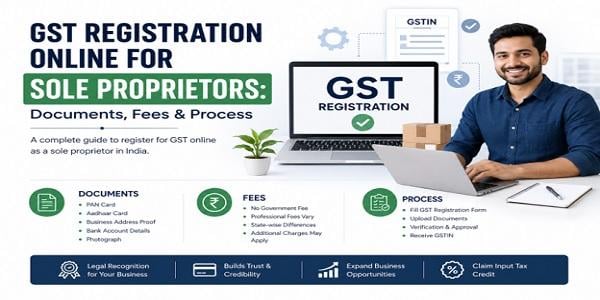
GST registration for a sole proprietor is the process of obtaining a Goods and Services Tax Identification Number (GSTIN) for a business owned and run by a single individual, once the business meets the turnover threshold or other mandatory registration criteria under the CGST Act. Since a proprietorship has no separate legal identity from its owner, the GST registration is issued in the proprietor’s name, using their PAN as the base identifier.
Unlike a company or LLP, a proprietorship doesn’t need separate incorporation before applying for GST, the proprietor’s individual PAN and business details are sufficient to register. This makes it important to understand the requirements for sole proprietorship registration online India before proceeding with GST registration or other business-related registrations.
Did You Know? A single individual can hold multiple GST registrations under the same PAN if they operate different business verticals or operate from multiple states, each requiring a separate GSTIN, even though the underlying proprietor is the same person.
Who Needs GST Registration as a Sole Proprietor?
GST registration is mandatory for a sole proprietorship if:
- Annual turnover exceeds the prescribed threshold limit (₹40 lakh for goods suppliers in most states; ₹20 lakh for service providers; lower threshold of ₹10 lakh applies in certain special category states, verify current thresholds on the GST portal, as these are notified by the government and can be revised)
- The business makes inter-state supply of goods or services, regardless of turnover
- The proprietor sells through e-commerce platforms (e.g., Amazon, Flipkart)
- The business is involved in reverse charge mechanism (RCM) transactions
- Voluntary registration is opted for, even below the threshold, to claim input tax credit
Even if your turnover is below the threshold, voluntary GST registration can be beneficial if you deal with GST-registered businesses that require GST-compliant invoices for input tax credit.
Step-by-Step Process for GST Registration Online
Step 1: Visit the GST Portal and Initiate Registration
Go to the official GST portal (www.gst.gov.in) and navigate to Services → Registration → New Registration.
Step 2: Fill Part A of the Application (Form GST REG-01)
Enter basic details:
- Legal name of the proprietor (as per PAN)
- PAN of the proprietor
- Mobile number and email ID (for OTP verification)
- State and district of business
Upon successful OTP verification, a Temporary Reference Number (TRN) is generated.
Step 3: Complete Part B Using the TRN
Log in using the TRN and fill in detailed business information:
- Trade name (if different from proprietor’s legal name)
- Business constitution, select “Proprietorship”
- Principal place of business address
- Details of goods/services supplied (HSN/SAC codes)
- Bank account details
- Authorised signatory details (the proprietor themselves)
Step 4: Upload Required Documents
Upload scanned copies of documents in the prescribed format and size (as specified on the portal).
Step 5: Verification via Aadhaar Authentication or e-Sign
Complete Aadhaar-based e-KYC authentication for faster processing, or submit the application using a Digital Signature Certificate (DSC) or e-sign (EVC via OTP).
Step 6: Application Reference Number (ARN) Generation
Once submitted, an ARN is generated, which can be used to track application status.
Step 7: GSTIN Issuance
If the application and documents are in order, the GSTIN and GST Registration Certificate are issued electronically. If the officer raises a clarification query, you must respond within the stipulated time to avoid rejection.
Documents Required for GST Registration (Sole Proprietor)
| Document | Purpose |
|---|---|
| PAN Card of the Proprietor | Primary identity proof for registration |
| Aadhaar Card | Identity verification / e-KYC authentication |
| Passport-size Photograph | Proprietor’s photo for the application |
| Proof of Business Address | Electricity bill, rent agreement, or property tax receipt (with NOC if rented) |
| Bank Account Proof | Cancelled cheque, bank statement, or passbook front page |
| Business Registration Proof (if any) | Shop & Establishment license, MSME/Udyam registration (not mandatory but supports the application) |
Accepted document formats and any additional requirements should be verified on the GST portal at the time of application, as these can be updated.
GST Registration: Sole Proprietorship vs. Private Limited Company
| Feature | Sole Proprietorship | Private Limited Company |
|---|---|---|
| Legal Identity | No separate legal entity from proprietor | Separate legal entity |
| PAN Used | Proprietor’s individual PAN | Company’s PAN |
| Registration Prerequisite | None (no separate incorporation needed) | Requires Certificate of Incorporation first |
| Documents Required | Simpler (individual-based) | More extensive (MOA, AOA, board resolution, etc.) |
| Liability | Unlimited personal liability | Limited liability |
| Compliance Burden | Lower | Higher (ROC filings, audits, etc.) |
Fees and Time Taken for GST Registration
| Process Stage | Fee | Approximate Time |
|---|---|---|
| GST Registration (Government Fee) | Nil, GST registration is free of cost on the GST portal | Nil |
| Document Preparation & Filing (if via a professional) | Varies by service provider | 1–2 days |
| ARN Generation | Free | Immediate upon submission |
| GSTIN Issuance (if no clarification sought) | Free | 3–7 working days |
| GSTIN Issuance (if clarification sought) | Free | Additional 7–15 working days |
While the government does not charge a fee for GST registration itself, professional/consultancy charges may apply if you engage a service provider for end-to-end assistance.
Common Mistakes to Avoid
- Using an address proof that doesn’t match the declared principal place of business
- Uploading low-resolution or improperly cropped documents, leading to rejection
- Selecting the wrong business constitution (e.g., selecting “Individual” instead of “Proprietorship” where applicable)
- Mismatched name spelling between PAN, Aadhaar, and the application form
- Delaying response to a clarification notice, which can lead to automatic rejection of the application
- Choosing incorrect HSN/SAC codes, affecting tax rate applicability later
Risks of Not Registering for GST When Required
- Penalty of 10% of the tax due (minimum ₹10,000) for failure to register when liable, or higher penalties in cases of deliberate tax evasion
- Inability to issue GST-compliant invoices, restricting business with GST-registered clients
- Ineligibility to claim input tax credit on purchases
- Legal action and interest on unpaid tax for the period of non-compliance
- Restrictions on listing your business on e-commerce platforms, most of which mandate GST registration regardless of turnover
Exact penalty provisions are governed by Section 122 of the CGST Act and related notifications, verify current provisions before citing specific figures.
Latest News: The GST Network (GSTN) has continued refining the online registration process, including expanded Aadhaar-based biometric authentication requirements in select states to curb fraudulent registrations, proprietors in affected states may be required to visit a GST Suvidha Kendra for biometric verification as part of the process. (Verify current applicability for your state on the GST portal before applying.)
Case Study: Avoiding Rejection Due to Address Mismatch
Rakesh, a proprietor running a small home-based tailoring business in Chennai, applied for GST registration using his electricity bill as address proof. However, the bill was in his father’s name, not his own, and he hadn’t uploaded a consent letter or NOC. His application received a clarification notice, delaying registration by nearly two weeks. Once he submitted a simple NOC from his father along with the electricity bill, his application was approved promptly. The takeaway: when the address proof isn’t in the applicant’s name, a supporting NOC or rent/consent agreement is essential from the outset.
Compliance Checklist for GST Registration (Sole Proprietor)
- Turnover and inter-state supply status assessed against threshold limits
- PAN and Aadhaar details ready and matching across documents
- Business address proof (with NOC, if applicable) prepared
- Bank account proof available
- Correct business constitution (“Proprietorship”) selected
- Accurate HSN/SAC codes identified for goods/services
- Aadhaar authentication or DSC/e-sign ready for submission
- ARN tracked until GSTIN issuance
Conclusion
GST registration for a sole proprietor is a relatively straightforward, document-driven process, but small errors like mismatched names, incorrect address proof, or wrong business classification can lead to delays or rejection. Understanding when registration becomes mandatory, preparing the right documents in advance, and responding promptly to any clarification requests can help you get your GSTIN without unnecessary back-and-forth. For anyone exploring sole proprietorship registration online India, getting the basic business and tax registrations right from the outset can help establish a smoother compliance process. Since GST compliance directly affects your ability to invoice clients, claim input tax credit, and sell across platforms, it’s worth treating this as a foundational business step rather than an afterthought.
If you’re unsure whether your proprietorship needs GST registration, it’s best to consult Zolvit’s tax experts before you proceed.
Why Choose Zolvit
- Expert CAs and tax consultants for accurate, error-free GST registration
- End-to-end document preparation and filing support
- Fast processing with proactive tracking of ARN and clarification notices
- Affordable, transparent pricing with no hidden charges
- Ongoing GST compliance support, returns, invoicing, and advisory
- Dedicated support throughout the registration process
CTA: Ready to get GST-registered without the hassle?
Consult Zolvit’s tax experts today for quick, accurate GST registration and ongoing compliance support.