Summary: GSTN issued an advisory on 1 October 2026 introducing a “Multistate Registration” facility on the common portal to simplify applications for taxpayers seeking registration in more than one State or Union Territory under the same PAN. The facility generates a Master TRN through which Common Registration Information (CRI), including business, promoter or partner, authorised signatory, representative and goods and services details, can be entered once. Individual TRNs are then generated for the selected States, while State-specific information, premises details and Aadhaar authentication continue to be completed separately. The facility therefore reduces repetitive data entry but does not create a single national GST registration or common GSTIN. Section 25(1) of the CGST Act continues to require registration in every State or Union Territory in which a person is liable to register. Practical questions remain regarding the 15-day Master TRN period, editing of common information, availability to existing registrants, separate ISD registration and State-wise biometric Aadhaar authentication. Businesses should therefore prepare premises documentation in advance, carefully complete the common information and separately track each State application and ARN.
What the facility does
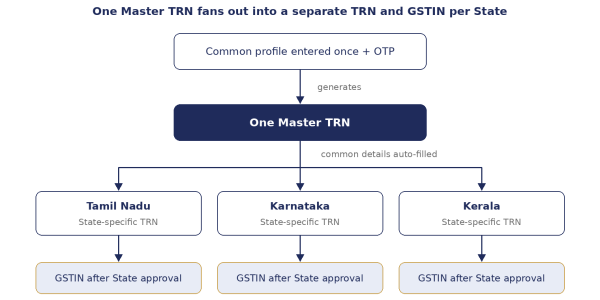
A new “Multistate Registration” tab has been placed on the portal homepage. A taxpayer who needs registration in more than one State or UT under the same PAN selects those States there, and a Master TRN is generated.
Using the Master TRN, the applicant fills the Common Registration Information (CRI) once. This covers business details, promoter or partner details, authorised signatory, authorised representative, and goods and services. On submission, an individual TRN is generated for each State with this information already filled in. The applicant then completes the rest State by State: principal place of business, additional places of business, State-specific information and Aadhaar authentication.
For now the facility is open only to Normal Taxpayers.
What has not changed
The law is where it was. Section 25(1) of the CGST Act still requires registration in every State from which taxable supplies are made. The advisory creates no common registration and no common GSTIN. There will be as many applications as there are States, each going to its own jurisdictional officer and each liable to its own query, physical verification or rejection.
Anyone who has handled a multi-State registration knows that typing promoter details five times was never the real difficulty. The difficulty is the premises: rent agreements, NOCs, electricity bills and the notices that follow. That part is untouched.
Points the advisory does not answer
1. The 15 days. The advisory says the Master TRN “is required to be submitted within 15 days”. It does not say what happens on lapse, or whether each individual TRN then gets its own validity.
2. Editable common information. The CRI “remains editable” in each individual TRN. If it is changed in one State’s application, will the change travel to the others? If not, the same PAN may carry different details in different States.
3. Existing registrants. Most businesses going multi-State already hold a GSTIN in their home State. The advisory does not say whether they can use the facility for the additional States alone.
4. ISD. An entity with offices in several States will usually need an Input Service Distributor registration as well. Since only Normal Taxpayers are covered, that application apparently has to be filed separately.
5. Aadhaar authentication. It is to be done in each State’s application. Where an application is marked for biometric verification, the advisory is silent on where the promoter or signatory must appear.
What I am advising clients
Collect the premises documents for every State before generating the Master TRN, since the 15 days presumably run from that point. Fill the common information carefully, because five applications will inherit any mistake. Do not edit common fields at State level unless there is a real reason, such as a different authorised signatory for that State. Track each ARN separately and expect the grants to come on different dates.
Conclusion
This is a useful step and GSTN deserves credit for it. It saves time and reduces clerical errors across applications. But it is a data-entry facility, not a single registration. A clarification on the points above, particularly for existing registrants and the 15-day limit, would make it far more useful.
Disclaimer: The views expressed are personal and based on the GSTN advisory dated 1 October 2026. Readers should refer to the law and the portal before acting.