Summary: GSTN has introduced a new “Multi-State Registration” facility on the GST Common Portal, reported on 1 October 2026, enabling businesses to apply for GST registrations in several States or Union Territories through one common application process. The applicant selects the required States/UTs, completes a common business profile and receives a single Master Temporary Reference Number (TRN), following which separate State-specific TRNs are generated with the common information auto-filled. The facility reduces repeated data entry but does not replace the existing State-wise GST registration framework: each State continues to process the application separately and issue its own GSTIN under Section 25 of the CGST Act, with separate verification and subsequent GST compliance. Only one registration in a particular State/UT can be sought through one Master TRN, while a second registration within the same State under Rule 11 requires a separate application. Businesses should therefore carefully verify the common profile because any error may flow into every State-specific application, while State-specific details, documents and applicable authentication requirements must still be completed separately.
What’s new
Businesses can now apply for GST registration in several States or Union Territories through one application on the GST Portal. A new option called “Multi-State Registration” has been made available on the GST Common Portal, reported on 1 October 2026.
The option sits on the portal’s home page next to the existing “Register” and “Login” buttons, and can be accessed at reg.gst.gov.in/registration/
The applicant fills a common business profile once. A single Master TRN (Temporary Reference Number) is generated for all selected States, and that profile is auto-filled into separate State-specific TRNs.
Earlier process vs new process
| Point | Earlier | Now (Multi-State Registration) |
|---|---|---|
| Applications | One separate application for each State | One common application for all selected States |
| TRN | Separate TRN for each State | One Master TRN, then one State-specific TRN per State |
| Business details | Typed again in every application | Common profile entered once, auto-filled in each State TRN |
| Entry point | Services > Registration > New Registration | “Multi-State Registration” on the portal home page |
| States per application | One | Many, but only one registration per State under one Master TRN |
How to apply
The flow starts with two steps — User Credentials, then OTP Verification — and ends with one Master TRN for all selected States.
1. Go to www.gst.gov.in and click “Multi-State Registration” on the home page.
2. User Credentials: enter the basic details (PAN, legal name, e-mail, mobile) and select all the States/UTs where registration is needed.
3. OTP Verification: verify the OTPs sent to the mobile number and e-mail.
4. A single Master TRN is generated for all selected States/UTs.
5. Fill the common profile carefully. It is copied into every State-specific application.
6. On submission, a State-specific TRN is generated for each State, with the common details already filled.
7. Log in with each State TRN and complete the State-specific parts (place of business, documents, jurisdiction, State-specific information), then submit with DSC/EVC.
Example: a business needing registration in Tamil Nadu, Karnataka and Kerala selects all three States. It gets one Master TRN and then three State TRNs, one for each State.
Note: Steps 2 and 7 are based on the existing REG-01 process and early reports. Field-level details should be confirmed on the portal or from the official GSTN advisory.
At a glance
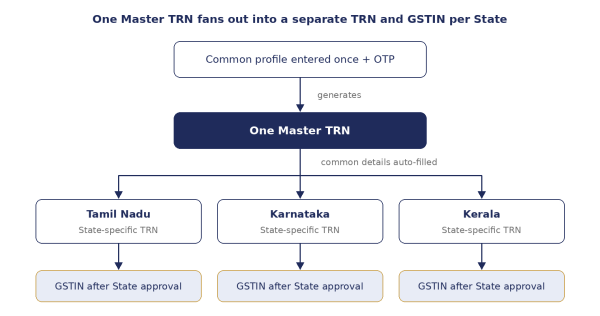
One application creates one Master TRN, which splits into a TRN for each State; each State then verifies and grants its own GSTIN.
Key conditions and what has not changed
The facility changes the application process only. The law on registration stays the same.
- One registration per State per Master TRN: many States can be selected, but only one registration can be applied for in a particular State/UT using one Master TRN. A second registration in the same State (under Rule 11) needs a separate application.
- Accuracy of the common profile: all details entered at the Master TRN stage flow into every State TRN. One mistake gets copied into all States.
- Separate GSTIN for each State: each State still issues its own GSTIN under Section 25 of the CGST Act. Each GSTIN is a distinct person.
- State-wise verification: each State application is still processed by that State’s jurisdictional officer. Document checks, Aadhaar authentication and physical verification apply as usual.
- Compliance after registration: separate returns, separate ITC, taxable inter-State stock transfers and cross-charge continue for each GSTIN.
- Different from the September 2026 facility: GSTN had earlier (from 1 September 2026) allowed details of an existing active GSTIN to be auto-populated into a new REG-01 under the same PAN. Multi-State Registration is meant for applying in several States at once. Whether existing GSTIN holders and first-time applicants can both use it should be confirmed from the official advisory.
Who benefits and practical tips
The facility helps any business that needs GSTINs in two or more States at the same time.
- New companies starting operations in several States together.
- Businesses opening branches, warehouses or depots in new States.
- E-commerce sellers using marketplace warehouses in different States.
- Service providers with offices across States.
Before applying
- Finalise the list of States where registration is actually needed.
- Keep place-of-business proof ready for each State (rent agreement or NOC, electricity bill, ownership document).
- Check promoter/director, authorised signatory and bank details once, since they flow into all States.
- Keep the authorised signatory available for Aadhaar authentication in each State.
- Track each State TRN separately, as each has its own validity and status.
Points still to be clarified officially
- Validity period of the Master TRN and the State TRNs.
- Whether all State applications must be submitted together or can be submitted one by one.
- Whether any field of the common profile can be changed for one State only.
- Whether separate ARNs are issued per State.
Conclusion
Multi-State Registration saves time and reduces repeated data entry for businesses expanding across States. However, each State still grants its own GSTIN after its own verification, and compliance continues separately for each. Getting the common profile right at the start is now more important than ever, because any error is repeated in every State.