Seven Seas Lights Pvt. Ltd Vs Assistant Commissioner (Delhi High Court)
The Delhi High Court, in the matter of Seven Seas Lights Pvt. Ltd Vs Assistant Commissioner, Shahdara Division, CGST, Delhi East Commissionerate, addressed a writ petition challenging a confirmed GST demand of ₹28,86,238/- for the tax period April 2020 to March 2021. The core issue before the Court was whether the Petitioner Company was denied the fundamental principle of natural justice—the opportunity to be heard—due to alleged non-service of the Show Cause Notice (SCN) and subsequent hearing notices.
Background and Petitioner’s Claim
The Petitioner, Seven Seas Lights Pvt. Ltd., was registered under the GST regime since July 1, 2017. The dispute arose from an SCN dated November 25, 2024, issued by the Assistant Commissioner, raising a demand of ₹25,99,696/- on the grounds of excess availment of Input Tax Credit (ITC). This SCN eventually culminated in the impugned final order dated February 20, 2025, confirming the higher demand.
The company’s e-mail domain, ‘7seaslights.com,’ had expired prior to the issuance of the SCN.
The company had undergone a change in directors.
The company had moved its GST registration from Delhi to Maharashtra.
Consequently, the Petitioner claimed that it had no knowledge of the proceedings and the confirmed demand until an authorised representative visited the Delhi GST Department in June 2025, specifically for the purpose of business closure and cancellation of registration. The central plea was that the matter should be remanded back to the adjudicating authority to allow the company an opportunity to present its defense on the merits of the ITC demand.
Department’s Defence and Court’s Initial Stance
During the initial hearing on July 14, 2025, the Senior Standing Counsel (SSC) for the CGST Department, Mr. Shubham Tyagi, contended that both the SCN and the personal hearing notices had been dispatched through e-mail and registered post. Since no reply was received and no one attended the personal hearing, the department proceeded to pass the final order. The Court, at this prima facie stage, acknowledged that the matter might warrant a remand if the Petitioner could successfully demonstrate non-receipt of the registered post or email notices. An order was issued directing the Department to file an affidavit regarding the service details and placed a moratorium on any coercive steps against the Petitioner in the interim.
High Court’s Finding on Effective Service
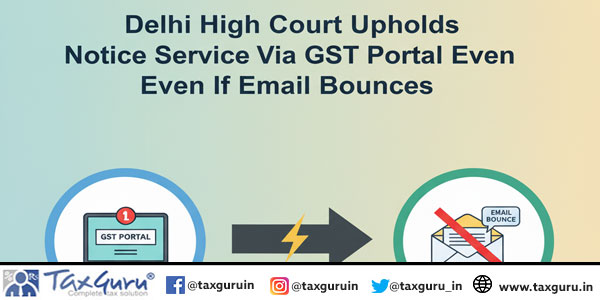
The subsequent Counter-Affidavit filed by the CGST Department provided the critical factual clarification. The Department confirmed that the Show Cause Notice, the hearing notice, and the final impugned order were all uploaded on the GST portal. The affidavit further disclosed that the email notifications had, in fact, bounced back.
Upon reviewing the complete record, the High Court focused on the mandatory and statutorily prescribed method of communication under the GST regime. While acknowledging the Petitioner’s explanations—the shift in business location, the change of directors, and the inability to access the portal—the Court ultimately sided with the Department’s position on service validity. The Court observed that since the notices and the final order were uploaded on the GST portal, the CGST Department could not be held at fault. The Court unequivocally stated that the Petitioner Company ought to have accessed the portal at the relevant time and gained knowledge of the notices.
Based on this finding that service had been effectively executed through the official portal, the Delhi High Court held that the Petitioner Company had failed to satisfy the Court that it was not served with the requisite notices. Accordingly, the primary prayer of the Petitioner for the matter to be remanded back to the adjudicating authority was denied.
Judicial Precedents and Exceptional Relief
No external judicial precedents or previous rulings were cited within the body of the High Court’s judgment itself. However, the Court’s holding on two key aspects establishes a strong procedural precedent relevant to GST compliance:
- Validity of Portal Service: The ruling reinforces the principle that uploading documents to the common GST portal constitutes effective, legally-valid service. This places a mandatory and ongoing burden on the registered taxpayer to monitor the portal for all official communications, regardless of email failures or internal administrative changes (like changes in directors or physical location).
- Discretionary Power in Limitation: The more consequential procedural relief came in the second part of the ruling. Despite denying the remand, the Court recognized the underlying injustice—that the Petitioner had genuinely not had the opportunity to defend itself on the merits of the substantial tax demand.
Invoking its inherent power under writ jurisdiction to secure justice, the Court permitted the Petitioner to approach the Appellate Authority to avail its statutory appellate remedy. Crucially, the final order dated February 20, 2025, meant the statutory limitation period for filing an appeal had already expired. The Court acknowledged that the Petitioner acquired knowledge of the order only in June 2025.
FULL TEXT OF THE JUDGMENT/ORDER OF DELHI HIGH COURT
1. This hearing has been done through hybrid mode.
2. The present writ petition has been filed challenging the impugned order dated 20thFebruary, 2025 passed by the Respondent No. 1 – Assistant Commissioner, Shahdara Division, CGST, Delhi East Commissionerate. Vide the impugned order a demand to the tune of Rs. 28,86,238/- has been confirmed against the Petitioner in respect of Tax Period April 2020 to March, 2021.
3. The brief facts of the case are that the Petitioner Company is stated to have registered with the GST Department in Delhi, having received the GST Registration with effect from 1st July, 2017. On 25th November, 2024 a show cause notice was issued by the Respondent No. 1 raising a demand of Rs. 25,99,696/- on the ground of excess availment of Input Tax Credit. The said notice fixed the last date of reply as 25th December, 2024. However, no date for personal hearing was provided in the said show cause notice.
4. The case of the Petitioner Company is that although the said show cause notice was issued by the Respondent, the same was never served upon the Petitioner Company. Further, the Directors of the Petitioner Company changed and the Petitioner Company had moved its GST registration from Delhi to Maharashtra. Therefore, no show cause notice is stated to have been served upon the Petitioner Company and consequently no personal hearing was availed of, though the same appears to have been granted.
5. Puneet Rai, ld. Counsel for the Petitioner Company submits that the domain name, ‘7seaslights.com’ on which the Petitioner’s e-mail address was created had expired prior to issuance of the show cause notice and hence, the same was not received even via e-mail. It was only when the Petitioner Company’s authorised representative visited the office of the Delhi GST Department for the purpose of closure of business and cancellation of registration that he learnt of the impugned orders that had been passed.
6. Thus, the main ground that the present writ petition hinges on is that the Petitioner Company has not been provided an opportunity to be heard on merits. Ld. Counsel on behalf of the Petitioner, in fact, submits that the demand of Input Tax Credit is also explainable by the Petitioner upon an opportunity before the adjudicating officer being granted.
7. On the last date of hearing e., 14th July, 2025, Mr. Shubham Tyagi, ld. Senior Standing Counsel for the CGST Department had submitted that the show cause notice and the personal hearing notices had been served both through e-mail and registered posts, and there was no reply nor any attendance of the personal hearing. The ld. SSC had sought time to seek instructions as to whether the registered post notices and the e-mails have been bounced back or not. Considering the submissions of the parties, the Court had directed as under:
“7. At the prima facie stage this Court is of the opinion that this may be a case where the matter deserves to be remanded back to the adjudicating officer if the Petitioner is able to satisfy that he did not receive either the registered post notices or the notices through e-mail.
8. Let the Department seek instructions and file an affidavit in respect of the service of the show cause notice and the personal hearing notices.
9. No coercive steps shall be taken in the meantime”
8. The Counter affidavit has now been filed by the CGST Department which shows that the show cause notice, the hearing notice and the impugned order were all uploaded on the GST portal. The email had, however, bounced back.
9. The case of the Petitioner Company is that the business had shifted from Delhi to Maharashtra and the directors had also changed. This could be the reason why the Petitioner could not access the portal. However, since the notices and the impugned order was uploaded on the GST portal, the CGST Department cannot be said to be at fault. The Petitioner Company ought to have accessed the portal at the relevant time and gained knowledge of the notices.
10. Thus, in view of the above, the Petitioner Company has failed to satisfy the Court that it was not served with the notices. Accordingly, the prayer of the Petitioner Company for the matter to be remanded to the adjudicating authority cannot be acceded to.
11. Under these circumstances, since the Petitioner Company has not had the opportunity to defend itself on merits, the Court is inclined to permit the Petitioner Company to approach the Appellate Authority for availing its appellate remedy.
12. It is noted that the impugned order is of 20thFebruary, 2025, and thus the limitation for filing the appeal has already expired. However, the fact remains that the knowledge of the impugned order was acquired by the Petitioner only in June, 2025 when the Petitioner visited the Delhi GST Department. Accordingly, the Petitioner is permitted to file an appeal by 31st October, 2025 along with the necessary pre deposit.
13. If the appeal is filed by the said date, it shall not be dismissed on the ground of limitation and shall be entertained and adjudicated on merits.
14. Needless to add any observation which is made by this Court shall not have any bearing in the final adjudication of the matter.
15. The petition is disposed of in these terms. Pending applications, if any, are also disposed of.