Summary: The Unified Payments Interface (UPI) has transformed India’s retail landscape by making cashless transactions commonplace, but recurring social media rumours about heavy charges on QR code payments have created uncertainty among small traders, retailers, and independent professionals. The article explains the distinction between standard bank-to-bank UPI transactions and payments involving Prepaid Payment Instruments (PPI), such as digital wallets, gift cards, and prepaid vouchers. Under the core UPI framework, Person-to-Person (P2P) transfers and standard Person-to-Merchant (P2M) bank-to-bank payments through QR codes are described as free of transaction costs, with merchants receiving the invoice value without deductions. The article identifies the PPI framework as the source of much of the confusion and explains that an interchange fee of up to 1.1% may apply to qualifying wallet transactions above ₹2,000 at designated commercial merchant locations. It distinguishes this interchange fee from a customer surcharge, explaining that the fee is settled among relevant payment service providers, wallet issuers, and acquiring banks. It further states that small neighbourhood merchants using standard peer-to-merchant QR codes do not incur these wallet interchange costs on regular settlements. The article advises traders and professionals not to impose additional charges on customers for digital payments, to review settlement terms where specialised payment gateways are used, and to promote financial literacy for transparent collections and book maintenance. It concludes with a disclaimer that specific merchant gateway integrations should be verified with the relevant acquiring banks or payment solution providers.
The Reality of Bank-to-Bank UPI: 100% Free
The Unified Payments Interface (UPI) has transformed India’s retail landscape, making cashless transactions an everyday norm. However, recurring rumours across social media platforms suggest that accepting QR code payments will now attract heavy transaction charges. This misinformation creates unwarranted hesitation among small traders, retailers, and independent professionals.
To maintain clarity and regulatory awareness, businesses must understand the framework established by the National Payments Corporation of India (NPCI) and the Reserve Bank of India (RBI).
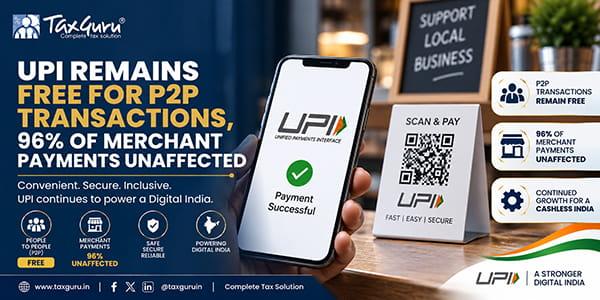
- Person-to-Person (P2P): Transfers between individual bank accounts remain entirely free of transaction costs.
- Person-to-Merchant (P2M): Payments made by a customer from their bank account directly to a merchant’s bank account via standard QR codes incur zero Merchant Discount Rate (MDR) or transaction fees.
Whether a customer spends ₹10 or ₹50,000 using direct bank-to-bank UPI, the merchant receives the exact invoice value without deductions.
Where Do Charges Actually Apply? Understanding the PPI Framework
The confusion largely stems from guidelines governing Prepaid Payment Instruments (PPI), such as digital wallets, gift cards, or prepaid vouchers linked to UPI.
| Parameter | Bank-to-Bank UPI | PPI (Wallet) via UPI |
|---|---|---|
| Transaction Route | Customer Bank to Merchant Bank | Customer Wallet to Merchant Bank |
| Threshold for Fees | Not Applicable | Above ₹2,000 |
| Interchange Fee | Nil (0%) | Up to 1.1% (capped by category) |
| Applicable Payee | Regular Retailers / Small Merchants | Large Onboarded Merchants |
| Impact on Consumer | No extra cost | No extra cost |
Key statutory clarifications:
1. Wallet Interoperability: An interchange fee of up to 1.1% applies exclusively when a customer pays using a wallet (PPI) for transactions exceeding ₹2,000 at designated commercial merchant locations.
2. Interchange, Not Customer Surcharge: This fee is settled between the payment service provider, wallet issuer, and acquiring bank. It cannot be legally passed down as an arbitrary surcharge to retail consumers.
3. Small Merchants Exempt: Local neighbourhood stores operating standard static or dynamic peer-to-merchant QR codes do not incur these wallet interchange costs on regular settlements.
Advisory for Traders and Professionals
- Do Not Impose Illegal Surcharges: Retailers should avoid asking customers for additional fees (e.g., ₹5 or ₹10 extra) for digital settlements, as this breaches payment aggregator service agreements and consumer trust.
- Review Settlement Terms: Large commercial entities using specialized payment gateways should periodically audit their monthly merchant statements to differentiate between standard UPI inflows and third-party wallet settlements.
- Promote Financial Literacy: Clearing client and vendor ambiguities regarding digital collections prevents operational bottlenecks and supports transparent, documented book maintenance.
******
Disclaimer: This article provides general regulatory insight based on prevailing NPCI circulars and RBI directions. Specific merchant gateway integrations should be verified directly with respective acquiring banks or payment solution providers.