The International Financial Services Centres Authority (IFSCA) published the Artificial Intelligence in the GIFT IFSC: Adoption, Maturity & Governance – Survey Report (July 2026) presenting findings of the IFSC AI Survey 2026 on AI adoption, maturity and governance across regulated entities in GIFT IFSC. The report states that the ecosystem has progressed from AI exploration in 2025 to early-stage operationalisation in 2026, with Generative AI achieving the deepest engagement and Agentic AI emerging as the next frontier. It notes that 65% of entities are exploring or have implemented Generative AI, 31% have invested in or are scaling AI spending and 29% plan investments. Operational efficiency and process automation are identified as the leading drivers, while data quality, regulatory clarity, data privacy and protection remain key considerations. The report highlights increasing use of off-the-shelf and vendor AI solutions, expanding governance frameworks, human-in-the-loop oversight, formal audits, and growing AI talent. It also outlines AI use cases across document intelligence, service automation, productivity, engineering, risk, underwriting and analytics, sector-wise adoption trends, and concludes that entities seek regulatory clarity and principles-based guidance as IFSCA intends to continue developing regulatory frameworks supporting innovation, market integrity and consumer trust.
Artificial Intelligence
in the GIFT IFSC
Adoption, Maturity & Governance
Survey Report – July 2026
INTERNATIONAL FINANCIAL SERVICES CENTRES AUTHORITY
Introduction and Executive Summary
The International Financial Services Centres Authority (IFSCA) is a unified regulator for financial products, financial services and financial institutions in India’s International Financial Services Centres (IFSCs). Currently, GIFT IFSC is the maiden IFSC in India. As part of its mandate to develop a world-class financial centre while advancing innovation and safeguarding stability, IFSCA periodically assesses how emerging technologies are reshaping the regulated landscape.
This report presents the findings of the IFSC AI Survey 2026, which maps the adoption, maturity and governance of Artificial Intelligence across the regulated ecosystem.
Artificial Intelligence (AI) has rapidly shifted from a frontier technological exercise into a core computational layer reshaping global financial landscape. AI in the IFSC is in confident, accelerating transition. In a single year the respondent base doubled, Generative AI entered the institutional mainstream, and entities settled into a pragmatic, efficiency-first approach — while governance and assurance build in step.
Overall, the findings indicate that the GIFT IFSC ecosystem has moved from AI exploration in 2025 to early-stage operationalization in 2026, marking a significant increase in AI maturity while highlighting the need for governance, talent development, and regulatory guidance.
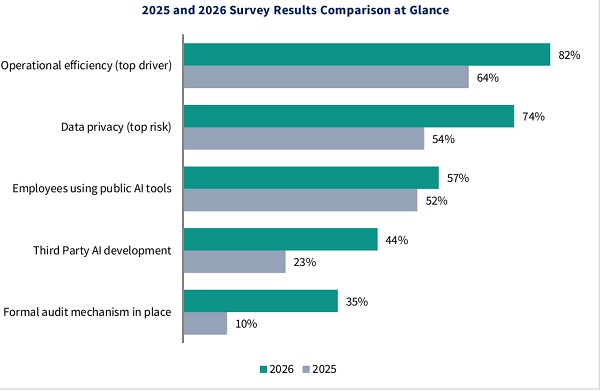
2025 → 2026 at a glance
AI in IFSC | Survey Report 2026
Key Findings
- AI adoption is broad and advancing. Entities are exploring and piloting across all three AI technology classes – Predictive AI, Gen AI and Agentic AI. With 65% of entities already exploring/ implemented, Gen AI has achieved the deepest engagement whereas Agentic AI represents the next frontier, with early movers already piloting.
- Investment is gaining momentum. 31% of entities have invested in or are actively scaling AI spend, with a further 29% planning investment, a clear sign of growing institutional commitment.
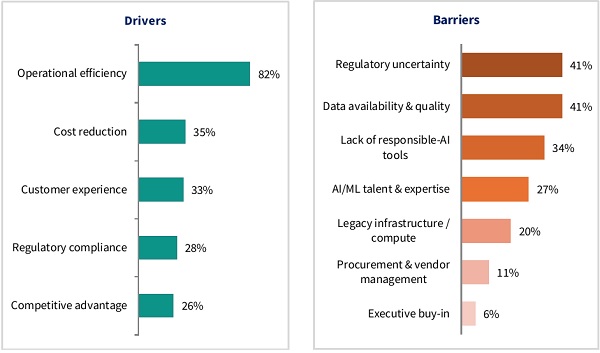
- Operational excellence leads the agenda. Operational efficiency and process automation is the standout driver, cited by 82% of entities, well ahead of all other motives. AI in the IFSC is used for productivity gains across internal operations, risk and compliance.
- Employee AI use is widespread. 57% of entities cited that their employees are using AI tools, including widely used platforms. Entities are actively developing usage policies suited to their risk and compliance environments.
- Governance frameworks are actively developing. Entities are building AI accountability structures at pace, with a range of approaches tailored to organisational size and model. Human-in-the-loop oversight is the most widely adopted production safeguard.
- Data stewardship is the top priority. Data privacy and protection is the highest rated concern, reflecting the IFSC ecosystem’s commitment to responsible and compliant AI
Survey Design and Methodology
A structured web questionnaire was designed, covering adoption, drivers, capabilities, risk, governance and outlook. The survey drew roughly double the participation compared to 2025.
Both multiple-choice and open-ended questions were included. All responses are anonymised and analysed only in aggregate. No entity-specific data is disclosed. Free-text examples are paraphrased or generalised to preserve confidentiality. Percentages are rounded, multi-select items sum to more than 100%.
Limitations
- Voluntary participation and self-selection. Participation was voluntary. Entities already engaged with AI may have been likelier to respond, which can overstate ecosystem-wide adoption.
- Self-reported data. Responses reflect respondents’ own assessments and were not independently audited or verified by IFSCA.
- Uneven sample size. While the sample doubled year-on-year, sub-group counts remain small.
- Point-in-time snapshot. Findings on AI capabilities and entity practices represent the position at the time of the survey.
The State of AI Adoption
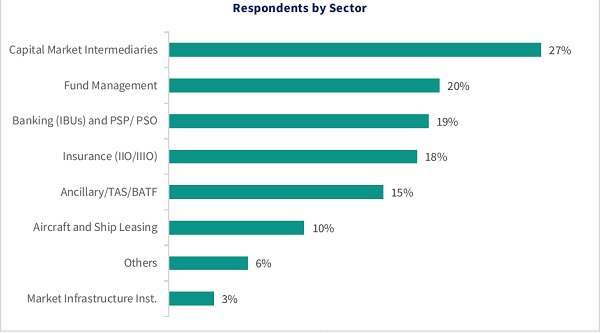
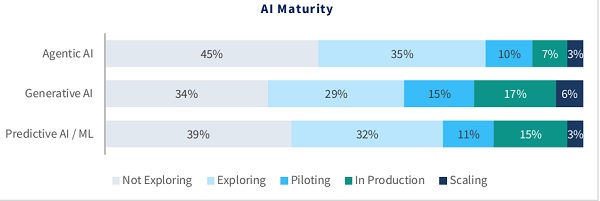
With responses spanning verticals – fund managers, capital-market intermediaries, banking units, insurers, finance, leasing and fintech, the ecosystem shows strong and growing engagement across all three AI technology classes. Generative AI demonstrates the deepest penetration, with close to two-thirds of entities at least exploring it and 17% already running it in production, ahead of Predictive AI and ML on the production metric. This reflects a notable acceleration from 2025, when AI engagement was characterised predominantly as early-stage and exploratory.
Agentic AI, AI systems capable of autonomous decision-making and action, represents the next wave of adoption. While 45% are not yet exploring it, a meaningful cohort has already moved to piloting or production, positioning the IFSC in forefront in emerging technology class.
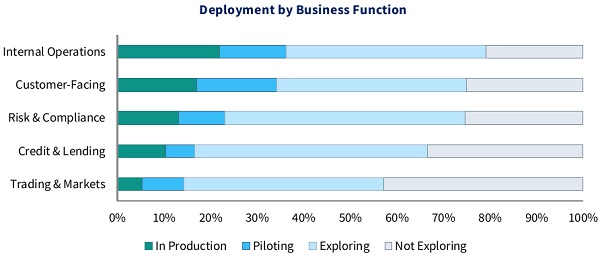
By business function, AI activity is strongest in Risk & Compliance, covering AML-CFT, KYC and fraud detection, and Internal Operations including HR, legal support and IT. Customer-facing applications represent a strong and growing third category. With production deployments and maturity of workflow automation, the use cases are developed for delivering efficiency.
Drivers, Barriers & Investment
With responses spanning across verticals – fund managers, capital-market intermediaries, banking units, insurers, finance, leasing and fintech, the ecosystem shows strong and growing engagement across all three AI technology classes.
Operational efficiency is the standout driver and widened its lead since 2025 (64% → 82%). Cost reduction, customer experience, and regulatory compliance form a strong second tier. The main barriers are data quality and regulatory clarity, a lack of executive buy-in is the least-cited, implying that leadership intent is not the obstacle.
Investment in AI across the IFSC is on a clear growth trajectory. A combined 60% of entities have already invested, are scaling, or are actively planning AI investment, with the remaining 40% continuing to assess the optimal approach for their business model and scale. Among entities that have committed budgets, the most common allocation is 1–5% of their IT spend.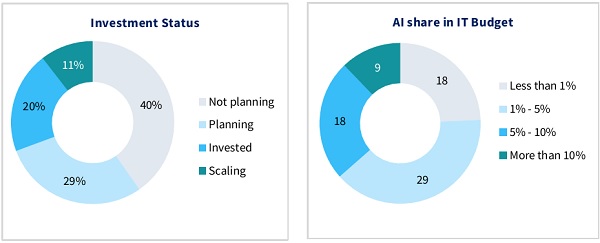
How AI Is Built
The IFSC ecosystem’s approach to building AI reflects the pragmatism of a diverse, global financial centre. Off-the-shelf SaaS tools and customised vendor solutions, including retrieval-augmented and fine-tuned applications, are the most commonly adopted approaches, allowing entities to move quickly with managed risk. Sourcing capability from parent organisations is also significant, enabling IFSC entities to leverage group-wide investments in AI infrastructure and models. In-house model development from scratch.
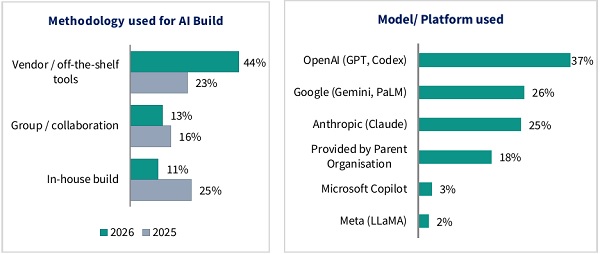
The clearest year-on-year shift is in delivery wherein entities have moved decisively toward vendor and off-the-shelf tools (23% → 44%) as managed offerings matured, while building in-house has narrowed. OpenAI leads foundation-model adoption at 37% of entities, with Google and Anthropic closely behind. The ecosystem draws on a healthy mix of providers, reflecting the diversity.
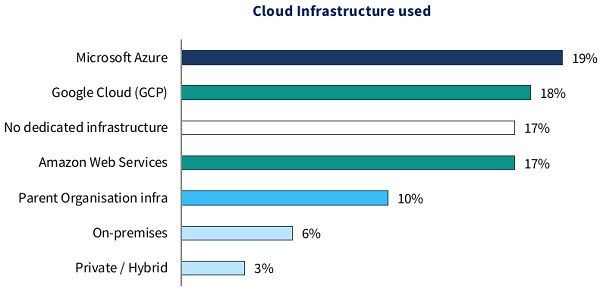
Microsoft Azure, Google Cloud and AWS anchor the cloud infrastructure picture where dedicated environments are in use. The plurality using parent-group or no dedicated infrastructure reflects the operational efficiency of leveraging established group-wide platforms.
AI talent profiles across the IFSC are evolving in line with the maturity of the ecosystem. 44% of entities have dedicated AI technical staff in place or draw on specialist teams within the group.
On data governance, one-in-four entities have formal data-governance controls and privacy-compliance frameworks in place. Encouragingly, several entities reported mature governance approaches including strict data compartmentalisation and continuous validation, and ISO/IEC 42001 certification.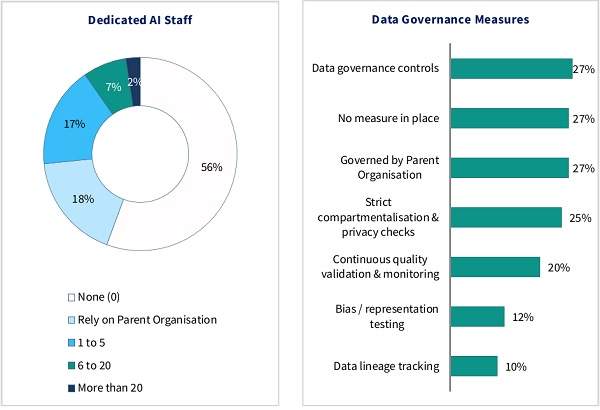
Risk, Governance & Use
Risks
Data privacy and protection is the highest-rated technical consideration, cited by 74% of entities, a reflection of the IFSC ecosystem’s strong commitment to data stewardship and compliance. Model drift, data integrity and reliability of AI outputs form a closely clustered second group, areas where entities are actively putting in place validation and monitoring controls. Awareness of explainability and fairness considerations, while currently lower-ranked, is expected to grow as entities move to higher-impact, customer-facing deployments.
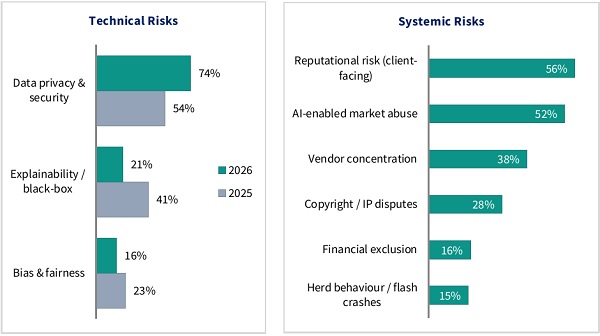
At the system level, entities give greatest weight to reputational dimensions of AI deployment in client-facing contexts (56%) and to the importance of market integrity (52%). Vendor concentration and IP considerations feature prominently. The risk landscape reflects a sophisticated and alert ecosystem, with entities proactively identifying and managing the systemic dimensions of AI adoption.
Governance
AI governance frameworks across the IFSC are developing at pace, with entities adopting accountability structures suited to their scale, business model and group structure. Where AI governance is formally assigned, it most commonly sits with a parent-group or a Chief Data/Technology Officer, reflecting the practical reality of how global financial groups organise AI responsibilities. A growing cohort of entities has established dedicated AI Governance Committees or CAIO roles, signalling an increasing commitment to structured and independent AI oversight.
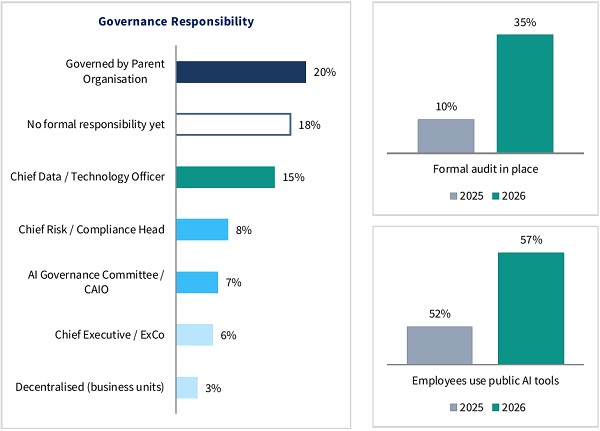
Formal audit has tripled in share, from 10% in 2025 to 35% in 2026 whereas everyday use of public AI tools is widespread and increasingly managed (52% → 57%), shifting from informal use toward, monitored access.
AI in practice: use cases
- Document intelligence. Contract and agreement summarisation, intelligent document retrieval, automated statement-of-account processing, PII redaction, and data extraction with verifiable source referencing.
- Service automation. Internal AI helpdesks, enterprise chatbots, voice assistants, and AI-driven query and complaint handling.
- Productivity and engineering. Enterprise GenAI assistants for drafting, research and summarisation, AI coding assistants, and early agentic task-organisation tools deployed with human oversight.
- Risk, underwriting and analytics. Machine learning for creditworthiness assessment, persistency prediction and customer segmentation, fraud monitoring systems, guarantee and policy vetting with anomaly alerts, and AI-assisted underwriting decision support.
Looking Ahead
Entities take a measured, evidence-based view of AI’s workforce impact. The most widely held (32%) expectation is that AI will drive significant re-skilling and job transformation rather than large net reductions. A further 10% expect AI to generate net new roles through new product lines and capabilities.
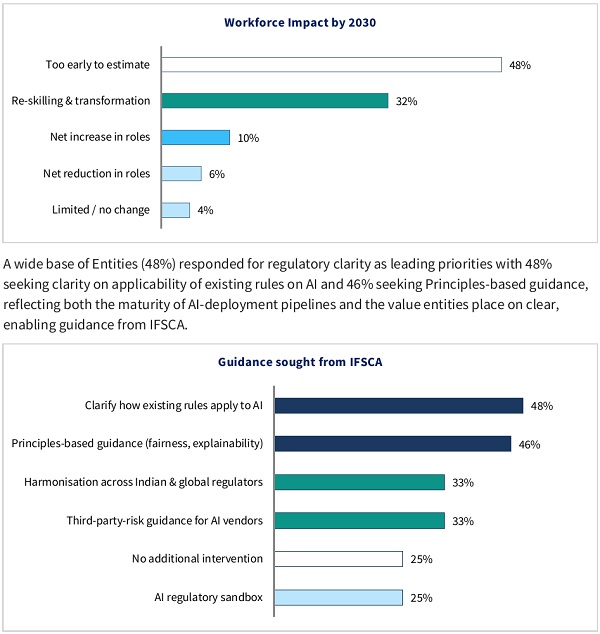
A wide base of Entities (48%) responded for regulatory clarity as leading priorities with 48% seeking clarity on applicability of existing rules on AI and 46% seeking Principles-based guidance, reflecting both the maturity of AI-deployment pipelines and the value entities place on clear, enabling guidance from IFSCA.
Status in Major Sectors
Banking
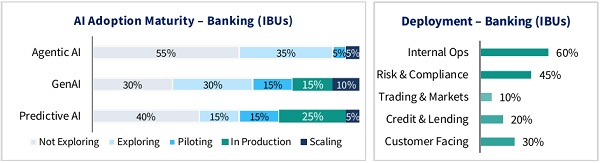
Banking units show AI adoption concentrated in internal operations and risk/compliance, with limited movement into credit, lending or trading workflows. Maturity is uneven across AI types. GenAI and Predictive AI show meaningful traction (around half of banks exploring or beyond) and Agentic AI shows momentum.
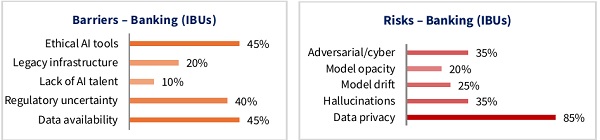
Adoption is constrained less by talent (many institutions lean on parent-organisation resources and staff) and more by data availability/quality and a lack of responsible-AI tooling. Data privacy dominates technical-risk concerns.
Fund Management
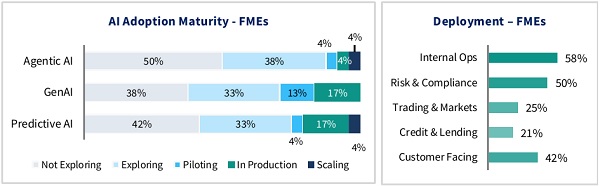
Fund Management Entities (FMEs) remain in an early adoption phase. Across Predictive, GenAI and Agentic AI combined, more than half of responses fall in ‘Not Exploring’ or ‘Exploring’, with very few entities scaled or in full production for any AI type. Where AI is used, it concentrates on internal operations and risk/compliance.
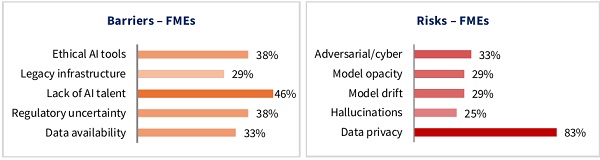
Unlike Banking, the leading barrier here is a lack of in-house AI/ML talent, ahead of regulatory uncertainty and a lack of responsible-AI tooling, pointing to capability gaps rather than datafr inastructure as the primary constraint for fund managers. Data privacy again tops technical-risk concerns, the highest proportion of any sector after Banking
Insurance
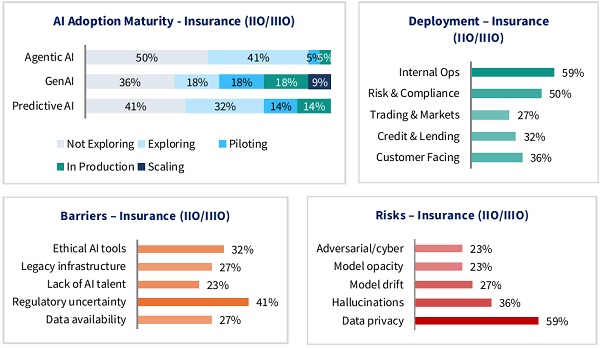
Insurance entities show an early-stage maturity profile similar to FME, with deployment again concentrated in internal operations and risk/compliance. Maturity is broadly similar across the three AI types, though GenAI shows the most advanced footprint with few insurers already have it in production or scaling, more than for Predictive or Agentic AI.
Regulatory uncertainty is the leading adoption barrier, ahead of a lack of responsible-AI tooling. Technical-risk perception is more evenly spread than in other sectors with data privacy leading as top risk.
Capital Markets Intermediaries
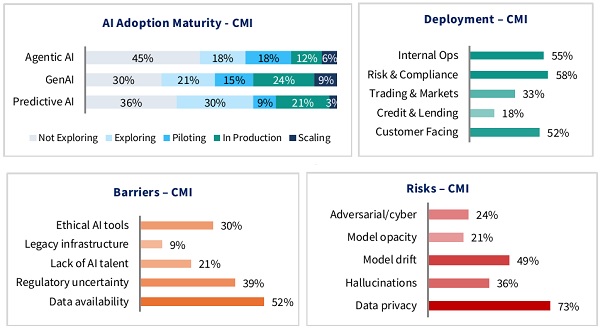
Capital Market Intermediaries (CMI) show the broadest functional footprint of any sector: Risk & Compliance, Internal Operations and Customer-Facing applications are all in active use, with Trading & Markets also meaningfully represented.
CMI is also the most advanced sector by maturity, where majority of the respondents have Generative AI in production, and over a third have moved Predictive AI or GenAI beyond the exploration stage, well ahead of Banking, FME or Insurance on this measure.
Data availability and quality are the leading barriers, ahead of regulatory uncertainty, suggesting infrastructure and data-readiness gaps are more pressing here than policy clarity alone. Technical-risk concerns are dominated by data privacy, but CMI stands out for elevated concern around model drift, close to double the rate seen in Banking or Insurance.
Conclusion
The IFSC moves through 2026 with broad, deepening AI adoption, Generative AI in the mainstream, and tangible gains in efficiency, compliance and client service. The survey captures an ecosystem that has moved with real momentum: adoption has broadened across all AI technology classes, Generative AI has entered the institutional mainstream, and entities are delivering tangible results, particularly in operational efficiency, compliance and client service.
Governance frameworks are building in parallel with adoption, reflecting the IFSC’s culture of responsible innovation. Entities are making thoughtful choices about how to deploy AI, leveraging group expertise, proven platforms and structured human oversight, and are actively investing in the talent and data infrastructure that will sustain this growth.
The survey reflects a collaborative relationship between IFSC entities and IFSCA. Entities look to the Authority for principled, enabling guidance. IFSCA intends to continue developing regulatory frameworks that supports innovation, preserves market integrity and consumer trust, and positions the IFSC as a global benchmark in financial services.
Tracked year-on-year, this survey is IFSCA’s ongoing commitment to have an objective view of how AI adoption and governance are advancing across the ecosystem and equipping the Authority to calibrate its support as the technology and its applications continue to evolve.