Commissioner of Customs Vs J.B. Pen Mart (CESTAT Kolkata)
Summary: The Customs, Excise and Service Tax Appellate Tribunal (CESTAT), Kolkata, dismissed the Revenue’s appeals concerning the classification and valuation of imported ice-making and ice-cream-making machinery. The respondent, M/s J.B. Pen Mart, had imported six consignments between December 2017 and May 2018, declaring the goods under Customs Tariff Heading (CTH) 8438 80 90. However, the Customs Department reclassified the machinery under CTH 8418 69 90 and enhanced the declared assessable values, resulting in an aggregate differential customs duty demand of ₹12,27,374.98. The Commissioner of Customs (Appeals) set aside the revised classification and valuation, prompting the Revenue to approach the Tribunal.
The Tribunal examined the mandatory requirements of Section 17(5) of the Customs Act, 1962, which requires a speaking order when reassessment differs from the importer’s self-assessment, unless the importer accepts the reassessment in writing. In the present case, no speaking order had been issued explaining the revised tariff classification or enhanced valuation. Although the importer paid the additional customs duty, the payment was made under protest to avoid demurrage and fulfil business commitments. The Tribunal held that such payment could not be treated as written acceptance of reassessment. Relying on judicial precedents, including HPL Chemicals Ltd. v. Commissioner of Central Excise, Commissioner of Customs (Port), Kolkata v. Radha Trading and Sigma Power Products Pvt. Ltd., it concluded that failure to follow the prescribed reassessment procedure and principles of natural justice rendered the Department’s action unsustainable.
Regarding tariff classification, the Tribunal considered the distinction between machinery used for manufacturing ice cream and equipment principally designed for refrigeration. The Revenue relied on the HSN Explanatory Notes and an advance ruling concerning Mitora Machinex Pvt. Ltd. to support classification under CTH 8418. However, the respondent produced earlier appellate orders dated 11 May 2012, 3 December 2018 and 23 July 2025, supporting classification under CTH 8438. The Tribunal also noted that the Department had treated comparable machinery as classifiable under heading 8438 in earlier proceedings and had permitted subsequent imports by the respondent under that heading. In view of these inconsistent departmental positions, the absence of a speaking order and the earlier classification decisions, the Tribunal held that the Revenue could not selectively apply different tariff headings to comparable goods. Accordingly, it upheld classification under CTH 8438 for the disputed imports.
On the separate issue of customs valuation, the Tribunal found that the Department had failed to disclose any reliable evidence, comparable import data or legally sustainable methodology justifying enhancement of the declared transaction values. The assessing authority had neither established valid grounds for rejecting the invoice values nor issued the speaking order required under Section 17(5). The Tribunal agreed with the Commissioner (Appeals) that arbitrary enhancement without supporting evidence violated the Customs Valuation Rules, 2007, and the principles governing transaction value under Section 14 of the Customs Act. It also noted the Revenue’s inconsistent approach to pursuing appeals despite the monetary limits under the National Litigation Policy. Consequently, CESTAT Kolkata upheld the Commissioner (Appeals)’ orders, set aside the reassessment under CTH 8418 and the enhanced customs valuation, and dismissed all the Revenue’s appeals. The order was pronounced on 15 October 2026.
Cases Discussed
- HPL Chemicals Ltd. Vs Commissioner of Central Excise, Chandigarh — 2006 (197) ELT 324 (SC): Revenue bears the burden of proving a different tariff classification.
- Commissioner of Customs (Port), Kolkata Vs Radha Trading — Final Order No. 75656/2024 dated 22.03.2024 (CESTAT Kolkata): Reassessment without the required speaking order.
- Sigma Power Products Pvt. Ltd. — 2017-TIOL-597-HC-KOL-CUS (Calcutta High Court): Speaking-order requirement under Section 17(5).
- Mittal Processors Pvt. Ltd. — 2013 (293) ELT 384 (CESTAT Mumbai): Reassessment and speaking-order procedure.
- Commissioner of Customs (General & CFS) Vs Radhey Shyam Ratanlal — 2017 (358) ELT 965 (CESTAT Mumbai): Absence of recorded reasons for valuation enhancement.
- Eicher Tractors Ltd. Vs Commissioner of Customs, Mumbai — 2000 (122) ELT 321 (SC): Transaction-value principles.
- Commissioner of Customs, New Delhi Vs DM International — 2013 (289) ELT 169 (CESTAT Delhi): Evidence required for enhancement of customs value.
- Dunlop India Vs Union of India — 1983 (13) ELT 1566 (SC): Cited regarding acceptance of enhanced value.
- Commissioner of Customs, ICD Vs Polyglass Acrylic Mfg. Co. Pvt. Ltd. — 2015 (322) ELT 794 (SC): Assumptions insufficient to reject transaction value.
- Commissioner of Customs, ICD, New Delhi Vs K.D. Exports — 2008 (227) ELT 494 (CESTAT Delhi): Cited on enhancement of customs value.
- R.C. International — 2009 (243) ELT 729 (CESTAT Delhi): Cited on enhancement of customs value.
- Milk Foods Ltd. — Citation not supplied: Composite ice-cream-making machinery classification.
- Mitora Machinex Pvt. Ltd. — Advance ruling cited by Revenue; ruling number not supplied.
FULL TEXT OF THE ORIGINAL ORDER OF CESTAT KOLKATA
The issue involved in the present case is the dispute regarding the classification of imported “Ice Making Machinery / Equipment”. The respondent self-assessed the imported “Ice Making Machinery / Equipment” under CTA 8438 80 90 whereas Revenue Revenue has proposed the classification of the imported “Ice Cream Machine” under CTA 8418 69 90.There was also a proposal of Revenue for enhancement of value of the imported goods. Hence, Re-assessment in terms of Section 17(5) of the Customs Act 1962 was taken up by the Customs.In respect of the six (6) Bills of Entry in question the Revenue went ahead to hold that it imported goods would fall under CTA 8418 69 90. The details of re-valuation and duty demand are as per the following Table:
| Sl No | Bill of Entry | Date | Declared Value | Declared Duty | Re-determined Value | Re-determined Duty | Difference in Value | Difference in Duty | Remark |
|---|---|---|---|---|---|---|---|---|---|
| 1 | 4584973 | 27.12.2017 | 927484.93 | 259340.42 | 1597174.73 | 607301.00 | 669689.80 | 347960.58 | Group assessment + Examination |
| 2 | 5410601 | 01.03.2018 | 659730.40 | 182976.00 | 1102392.45 | 425083.00 | 442662.05 | 242107.00 | Group assessment + Examination |
| 3 | 5410620 | 01.03.2018 | 1183973.41 | 345067.00 | 1410222.90 | 548150.00 | 226249.49 | 203083.00 | Group assessment + Examination |
| 4 | 6584477 | 29.05.2018 | 1251476.03 | 348005.21 | 1251476.03 | 490877.00 | 0.00 | 142871.79 | Group assessment + Examination |
| 5 | 6355410 | 12.05.2018 | 699658.59 | 171346.39 | 701023.78 | 270315.00 | 1365.19 | 98968.61 | Group assessment + Examination |
| 6 | 6441198 | 18.05.2018 | 1119782.25 | 288888.00 | 1240507.29 | 481272.00 | 120725.04 | 192384.00 | Group assessment + Examination |
| 1460691.57 | 12,27,374.98 | ||||||||
2. Being aggrieved by the CTH 8418 69 90 for classifying the imported machine as Ice Cream Machine, the appellant filed their appeals before the Commissioner (Appeals). Vide the impugned OIAs, the Commissioner (Appeals), has set aside the revised classification and valuation and consequent Customs Duty. Being aggrieved, the Revenue is in appeal before the Tribunal.
3. The Ld AR appearing for the Revenue reiterates the detailed Grounds taken by in the Appeal. He makes further submissions as under:
4. The Explanatory Note to Chapter 84 makes it clear the Ice Cream Machine will fall under 8418 only. This is required to be considered and not the earlier orders of the Commissioner (Appeals).
5. In the case of Mitora Machinex Pvt Ltd the Authority on Advance Rulings has held that the Ice Cream Machine would fall under CTA 8418 only.
6. The Respondent has made a point that the value in the present litigation is much less than the threshold limit specified under the National Litigation Policy. The Revenue submits that since this is a case of classification, irrespective of the amount involved, the Revenue can file their appeal before the Tribunal.
7. In view of the above submissions, it is prayed that the Revenue‟s appeal may be allowed.
8. The Ld Consultant, appearing for the Respondent makes the following submissions:
9. The appellant imported the consignments vide above mentioned bills of entry directly from an exporter/manufacturer/representative of manufacturer under their invoice and filed the above mentioned Bill of Entry on self-assessment. Further at the time of self-assessment the appellant classified the said goods under CTH 8438. 80.90. However, the assessing officer re-assessed the goods and classified the same under CTH 8418.69.90 as Ice Making Machinery’ and levied IGST@ 28% under Notification No. 01/2017. As such the appellant paid the said excess duty arising out of the re-assessment of the said bills of entry (mentioned supra) in order to save the port demurrage and to fulfill the business commitment. However, the appellant submits the letter dated 18.01.2018 before the lower authority wherein the same submits that the excess duty so paid is under protest and disputed the enhancement of value and the classification made in the subject bills of entry. No assessment order was passed under section 17(5) of the Customs Act 1962.
10. The respondent in their submission has clearly shown the practice of assessment of the imported goods, i.e., “Ice Making Machinery / Equipment” wherein it is clearly shown that in all over India the “Ice Making Machinery / Equipment” are being assessed under CTH 8438 80 90 and “Ice Cream Maker” are assessed under CTH 8418 69 90.The detail reference is placed at[Page No. 77 – 88 of Annexure D]of the Written Submission.
11. It is submitted that at present there is no difference of duty leviable either for Heading 8438 80 90 or for Heading 8418 69 90. Moreover, the involved duty difference amount in the present case is only Rs. 12,27,374.98/- for the six appeal petitions. It is less than the monetary limit as decided by the Board.
12. The present issue of classification of imported “Ice Making Machinery / Equipment” have been decided on three occasions by Ld. Commissioner of Customs (Appeals) vide his Order-in-Appeal bearing Nos. (a) KOL / CUS / CKP / 97 / 2012 dated 11.05.2012 in the matter of M/s. Arim Ice Cream Industries P. Ltd., (b) KOL / CUS / PORT / DC / 274 / 2025 dated 23.07.2025. in the matter of M/s. J B Pen Mart and (c) KOL / CUS (Port) / AA / 2011 – 2016 / 2018 dated 03.12.2018. in the matter of M/s. J B Pen Mart. Out of the above decisions, department has disputed the decision of the Commissioner of Customs (Appeals) in the case of M/s. J B PEN MART decided vide Order-in- Appeal No. KOL / CUS (Port) / AA / 2011 – 2016 / 2018 dated 03.12.2018. Department also arbitrarily enhanced the value without the Provisions of Customs Act, 1962. read with CVR, 2007. Department has also erred to cite any value of comparable goods at the time of arbitrary enhancement.
13. It is seen that the Appellate Commissioner of Customs, Kolkata Zone in the case of M/s. Arim Ice Cream Industries P. Ltd. had decided identical issue of classification and department did not obtain any “STAY” against the said Order-in-Appeal No. KOL / CUS / CKP / 97 / 2012 dated 11.05.2012. accepting the decision, but in the present case department has again reopened the same issue knowing very well that the issue in question is already been decided by the Appellate Commissioner of Customs, Kolkata Zone finally vide his Order-in- Appeal No. KOL / CUS / CKP / 97 / 2012 dated 11.05.2012. It is not all, the same importer, M/s. J B PEN MART imported the same goods and re-assessed the same under CTA 8438 80 90 and department again disputed the same and re-assessed the goods under CTA 8418 69 90. On appeal, Ld. Commissioner of Customs (Appeals), vide Order-in-Appeal No. KOL / CUS (Port) / AA / 2011 – 2016 / 2018 dated 03.12.2018, has set aside the order of department and decided the classification again under CTA 8438 80 90 after discussing the issue in detail vide his Order-in-Appeal No., supra.
14. Copies of all Order-in-Appeal bearing Nos. (a) KOL / CUS / CKP / 97 / 2012 dated 11.05.2012., (b) KOL / CUS / PORT / DC / 274 / 2025 dated 23.07.2025. and (c) KOL / CUS (Port) / AA / 2011 – 2016 / 2018 dated 03.12.2018. are collectively annexed at Annexure A, B & C with original copy of Written Submission.
15. For that in the case of M/s Payodhi Foods Pvt. Ltd. where Deputy Commissioner of Customs (Gr. VA) vide his order no. KOL/CUS/DC/5A/12/2008A dated 30.07.2008 confirmed the assessment of ice-cream making machinery/equipment under heading 8434.20.00 and department approved the said order. However when CRAD raised the objection in this regard, Commissioner of Customs vide his Review Order No. KOL/CUS/PORT/REVIEW/03/09 dated 16.01.2009 held as follows:
“Milking machine and dairy machine classifiable under CTH 8434 are exempt from Addl. Duty of Customs (Countervailing Duty) in terms of C.E. Notification No. 06/2006-CE dated 01.03.2006 (Sl. No. 11). However ice cream making machinery/equipment classifiable under CTH 8438 is not exempted from the countervailing duty.
The consignment of ‘ice cream candy making machine’ imported (June 2007 by M/s Payodhi Food Pvt. Ltd.) was classified under CTH 8434 treating the goods as ‘Dairy Machine’. Scrutiny revealed that the machinery imported was a ice cream candy making machine classifiable CTH 8438 and thus was not eligible for exemption from levy of countervailing duty under above notification 06/2006-CE. The mis-classification and in correct grant of exemption benefit resulted in short levy of duty amounting to Rs. 24,66,811/-. ”
16. From the report of the Chartered Engineer there is no doubt to the fact that the imported goods are correctly identifiable and classifiable as “Ice Cream Making Machine” and these are not “Ice Cream Maker” as claimed by Revenue. The Revenue in the present case has erred in interpreting the Heading 8418 & 8438. Revenue has also failed to appreciate the difference between “Ice Cream Machine” and “Ice Cream Maker”.
17. The value has been enhanced without following the procedure prescribed under CVR 2007 and without any corroborative evidence towards enhancement.
18. Heard both the sides. Perused the Appeal papers and the other documents submitted by both the sides.
19. The Revenue has taken the ground that the Commissioner (Appeals) is in error in holding the classification in favour of the CTA adopted by the appellant. They also aggrieved by the fact that the Commissioner (Appeals) has held the enhancement of value as legally not sustainable.
20. On the other hand the Respondent defending the impugned OIA, have made the following points:
(a) The CTH of the imported consignments were arbitrarily changed from 8438 to 8418 without following the principles of natural justice.
(b) No order under Section 17(5) was passed towards change of CTH as well as enhancement of the value.
(c) Due to urgency to meet the market requirement, the appellant was forced to pay the higher Customs Duty, which was done “under protest”.
(d) On two occasions, in 2012 [prior to the present proceedings] and in 2024 / 2024 [subsequent to these proeedings], the Commissioner (Appeals) have taken the same stand that the goods are to be classified under 8438. No further appeal has been filed by the Customs Dept. Hence, these decisions have attained finality.
(e) Subsequent clearances in October 2018 in respect of the present appellant have been allowed to be done under CTA 8438.
(f) In 2008, the Commissioner has rejected the claim of one importer classify the goods under 8434 and he has held the same to be falling under 8438.
(g) All these instances point out that the Department itself was carrying the belief that the goods would be classifiable under CTH 8438 till their view was suddenly changed in the present 6 cases.
(h) Even if all the Bills of Entry and the differential Customs Duty of Rs.12.27 lacs, is considered, the same falls much short of the threshold limit for filing appeals before the Tribunal
21. We first take up the point raised by the appellant about non- following the procedure under Section 17 (5) of the Customs Act 1962. The relevant portion is extracted below:
“Where any re-assessment done under sub-section (4) is contrary to the self- assessment done by the importer or exporter regarding valuation of the goods, classification exemption or concessions of duty availed consequent to any notification issued therefore under the Act and in cases other than those where the importer or the exporter, as the case may be, confirms his acceptance of the said re-assessment in writing, the proper officer shall pass a speaking order on the re assessment within fifteen days from the date of re-assessment of the bill of entry or the shipping bill as the case may be.”
22. Admittedly, no Order was passed under Section 17(5). No opportunity was given to the appellant to submit documentary evidence towards their defence. Again, admittedly, the appellant paid the Customs Duty as per the revised classification and revised enhanced value. These are being taken as „confirmation of acceptance‟ by the Revenue. However, factual details prove otherwise. In order to cut down the demurrage and other charges and meet immediate requirement, importers go by the revised CTA and enhanced value. This is the case here also as has been submitted by them. This is fortified by the fact that they have submitted a letter stating the Customs Duty is being paid „Under Protest‟. Further they have filed their appeal before the Commissioner (Appeals) against the Bills of Entry carrying the revised Classification and Valuation. All these factual details clarify that there was never any „confirmation of acceptance‟ given by the appellant.
23. Now we look into the findings of the Commissioner (Appeals) on this issue, which is reproduced below:
6. After going through the appeal petitions against the said bills of entry, I find that the appellant at the time of self-assessment under Sec 17 (1) of the Act has classified the goods (as imported) under CTH 8438.90.90 covers ‘parts [of other machinery)’ for the bill of entry vide No. 4584973 dated 27 12.2017 contrary to its relief claimed under CTH 8438.80.90 as mentioned in the petition so filed. I also find that the lower authority rejected the said classification and re-classified the same under CTH 8418.69.90 without going through the basic description of the imported goods. I have also gone through the checklist as submitted by the appellant wherein the description against the CTH 8438.90.90 was declared as Ice Cream Machine Accordingly the CTH as declared in checklist doesn’t conform with the description as provided under Import Tariff and should be classifiable cither under CTH 8438.80.90 (as claimed by the appellant) or under CTH 8438 80 90 as re-classified by the lower authority
The acceptance of the appellant regarding the wrong filing of classification at the time of self-assessment and to classify the same under CTH 8438.80.90 (as relief claimed by the appellant in present appeals) cannot be ignored. Moreover, the lower authority also did not take into cognizance the fact that the goods declared under CTH 8438.90.90 are not in conformity with the description as per CTA, 1975 and failed to provide any advice to the appellant in this regard. I also find that the lower authority in the impugned bills of entry had altogether changed the classification of the goods under CTH 8418.69.90 As such, I am legally responsible to examine the claim of the appellant under CTH 8438.80.90 for the bill of entry No. 4584973 dated 27 12.2017 which is also a bonafide mistake on the part of the appellant.
I also find that the description given by appellant under the impugned bill of entry is neither questioned nor changed by the lower authorities after examination and finalization of assessment. Moreover, only the declared classification has been changed and the value was enhanced. In this regard, I find that the determination of tariff heading and applicable rate of duty is the ultimate job of customs authorities as has been held by Hon’ble Supreme Court in the case of HPL Chemicals Ltd vs Commissioner of Central Excise. Chandigarh as reported in 2006 (197) ELT 324 wherein it was held as follows:
“29. This apart, classification of goods is a matter relating to chargeability and the burden of proof is squarely upon the Revenue. If the Department intends to classify the goods under a particular heading or sub-heading different from that claimed by the assessee, the Department has to adduce proper evidence and discharge the burden of proof. In the present case the said burden has not been discharged at all by the Revenue. On the one hand, from the trade and market enquiries made by the Department, from the report of the Chemical Examiner, CRCL and from HSN, it is quite clear that the goods are classifiable as “Denatured Salt falling under Chapter Heading No. 25.01. The Department has not shown that the subject product is not bought or sold or is not known or is dealt with in the market as Denatured Salt. Department’s own Chemical Examiner after examining the chemical composition has not said that it is not denatured salt. On the other hand, after examining the chemical composition has opined that the subject matter is to be treated as Sodium Chloride.”
24. In the case of Commissioner of Customs (Port), Kolkata Vs. Radha Trading, vide Final Order No.75656/2024 dated 22.03.2024, this Bench has held as under:
2. The facts of the case are that the respondent filed various bills of entries declaring the goods as imported „Mixed lot of Polyester Knitted Fabrics‟ from the manufacturers of China and sought clearances of the goods. The Proper Officer re-assessed the same and enhanced the declared value and demanded duty accordingly. The respondent paid the excise duty to avoid demurrage and detention charges and challenged the said order before the Ld.Commissioner(Appeals) on the ground that no order under section 17(5) of the Customs Act, 1962 hasbeen passed by the adjudicating authority for enhancement of the declared value. Further, no reasons has been stated or no evidence has been produced for rejection of the declared value. The Ld.Commissioenr(Appeals) examined the issue in detail and held that the transaction value cannot be rejected without any evidence or reasons. Therefore, he rejected the enhancement of declared value by the respondent. Aggrieved from the said order, the Revenue is before us.
5. We find that after filing the Bills of Entry declaring the value of the imported goods the Proper Officer sought to assess the goods under section 17(4) of the Customs Act, 1962 and assessed accordingly. In terms of section 17(5) of the Customs Act, 1962, the Proper Officer is duty-bound to pass a speaking order for enhancement of the declared value within 15(fifteen) days of the passing of the order under section 17(4). Admittedly, no such order was passed by the adjudicating authority after passing the order under section 17(4) of the Act. Therefore, on this ground itself the enhanced value is not sustainable. Moreover, the Ld.Commissioner(Appeals) has examined the issue in detail and observed as under:-
“8. In the instant cases, the appellant imported mixed lot of Polyester Knitted Fabric, for which they declared the value in the bills of 3 Customs Appeal No.76519 of 2018 entry. The values declared by the appellant in the impugned Bills of entry, as mentioned on previous page, were enhanced by the assessing officer. The appellant paid duty in respect of impugned Bills of entry in order to clear the goods early to avoid heavy demurrage.
9. I observe that the appellant did not receive assessment order u/s 17(5) of the Customs Act, 1962 (hereinafter, referred to as “the Act”). I note that Section 17(5) of the Act states that:
“Where any re-assessment done under sub-section (4) is contrary to the self-assessment done by the importer or exporter regarding valuation of the goods, classification exemption or concessions of duty availed consequent to any notification issued therefore under the Act and in cases other than those where the importer or the exporter, as the case may be, confirms his acceptance of the said re-assessment in writing, the proper officer shall pass a speaking order on the re assessment within fifteen days from the date of re-assessment of the bill of entry or the shipping bill as the case may be.” In the instant case, I note that no speaking order has been issued in terms of the said Section 17(5) of the Act, ibid. This by itself is contrary to the provisions of the Act.
However, Section 17(5) of the Customs Act, 1962 stipulates that a speaking order has to be passed within 15 days if the re-assessment is done contrary to appellant’s claim unless the said re-assessment is accepted by the importer in writing. It is on record that the bills of entry were re-assessed. Naturally, the speaking orders were required to be issued within 15 days thereof as per Section 17(5) of the Customs Act, 1962. There is no dispute that no speaking order was passed in this case. In the circumstances, in absence of a valid speaking order as per Section 17(5) of the Customs Act, 1962 for re-assessment made by the department contrary to appellant’s claim, re-assessment is liable to be set aside.
Hon’ble High Court at Calcutta in the matter of M/s. Sigma Power Products Pvt. Ltd. [2017-TIOL-597-HC-KOL-CUS] held as under:
“The order made by the proper officer on the bills of entry in changing the classification and value enhancement is an order of re-assessment attracting the provisions of sub section (5) of section 17 of the Act as urged by the appellant what who appears to be the case from the affidavit filed by the Revenue. Hence, the conclusion has to be that the proper officer was required to pass a speaking order on the re-assessment within 15 days of the re-assessment of the bills of entry.
No speaking order was passed.
In the circumstances, we have no hesitation to set aside the re assessment.
In view of the aforesaid, there is no scope for a contrary finding. The writ petition thus succeeds to that extent.”
Similar order was also passed by Hon’ble Tribunal in the matter of C.C. -vs- M/s Mittal Processors Pvt. Ltd. (2013(293) E.L.T. 384 (Tri Mumbai)). Therefore, the impugned re- assessments are liable to be set aside on this ground alone.
14. I find that that there were no ground in respect of the present appeals to doubt the transaction value and to assess the duty liability on the enhanced value, as done by the assessing authority.
15. Further the appellant’s consent, even if any, to accept the enhanced value, due to Incurring heavy demurrage etc. did not confer any right on assessing officer to determine value un-statutorily as has been held in the following decisions:
i. Commissioner of Customs, ICD, New Delhi -vs- K.D. Exports [2008 (227) ELT 494 (tri-Del)]. ii. M/s. R. C. International (2009(243) ELT729 (Tri- Del)]
26. In view of the above, I set aside the enhancement of values, assess the impugned bills of entry at declared values and allow the appeals filed by the appellant with consequential relief.”
6. On going through the observations made by the Ld.Commissioner(Appeals), we find that it is true that on reasons has been given by the Proper Officer for rejection of transaction value and no order has been passed under section 17(5) of the Customs Act, 1962.
7. In that circumstances, the value declared by the respondent cannot be rejected. Therefore, we do not find any infirmity in the impugned order and the appeal filed by the Revenue is dismissed.
25. Therefore, in the present Appeals, following the ratio of the cited case law, we set aside the revised classification of 8418 and the enhancement of the value on the ground that principle of natural justice was not followed and no speaking order has been issued under Section 17(5) of the Customs Act 1962
26. Next, we take up the point made by the appellant about the Orders In Appeal passed in the past holding that the machines would be classifiable under CTA 8438.
27. In another OIA, The Commissioner (Appeals) subsequent to the period of present dispute, vide OIA No. KOL/CUS/PORT/DC/274/2025 DATED 23.07.2025, has held as under:
The appellant, on the other hand, has argued that the classification of the goods under heading 84388090 is not new and has been consistently accepted in the past in their own case. They have placed reliance on two previous Orders-in- Appeal issued in 2012 and 2018, wherein the same goods were held to be classifiable under heading 8438. The appellant has also pointed out that the 2012 Order-in-Appeal was challenged by the department but no stay has been obtained. Therefore, the said order still holds good and is binding. They have also referred to an Advance Ruling in the case of M/s Mitora Machinex Pvt. Ltd., which supports their classification.
16. I find merit in the appellant’s contentions. The classification of identical goods under heading 8438 has already been upheld by this office in past orders, and the same benefit has been extended to the same importer. The department has not produced any evidence that the previous classification orders have been set aside. Mere pendency of an appeal does not affect the validity of those orders. In absence of a stay or contrary judicial decision, the settled classification should not be disturbed. The Advance Ruling cited by the department does not pertain to this specific importer, and classification may vary based on product configuration and usage.
I find that the goods imported by the appellant are complete Ice Cream Making Machines and Ice Cube Machines, which are specially designed for preparing and dispensing edible products. These machines do not function merely as parts or accessories of any other larger machinery. As per the Explanatory Notes to the HSN and the classification principles under the Customs Tariff, such fully functional machines used for preparing or vending food or beverages are more appropriately covered under heading 8438. The appellant’s classification under CTH 84388090, therefore, appears reasonable and well supported.
18. Further, I find that the department has relied upon heading 8418, which covers refrigerators, freezers, and other similar cooling equipment. However, the machines in question are not ordinary cooling units but are specifically manufactured for the production and delivery of soft serve ice cream and ice cubes. These are not used for general refrigeration purposes. In such cases, heading 8438, which deals with machinery for the industrial preparation of food or drink, is more specific and should be preferred over a general heading like 8418.
19. In view of the above discussion, I am of the opinion that the classification adopted by the appellant under CTH 84388090 is appropriate for the goods in question. The machines are complete units meant for food preparation and vending, and are not general-purpose cooling devices falling under CTH 84186990. Accordingly, I hold that the impugned classification under CTH 84186990 is not sustainable. Therefore, the impugned Order-in-Original is set aside and the appeal filed by the appellant is allowed with consequential relief.
28. It is clear that the Commissioner (Appeals) has gone into all the details and held that the machines would be classifiable under CTH 8438 and not under CTH 8418 as was being canvassed by the Revenue. We are given to understand that no appeal has been preferred against this OIA by the Revenue.
29. On a query from the Bench, the Ld AR after verifying from the concerned appeals Section, has stated that no appeal was preferred in view of the monetary limits specified under National Litigation Policy. If we take this stand of the Revenue as correct, then even in the present case they cannot continue the litigation since the amount involved is less than Rs.12.50 when all the Bills of Entry are taken up together towards differential Duty demand.
30. We also had a look at the one OIA passed prior to the period of the present litigation. Vide OIA No. KOL/CUS/CKP/97/2012 DATED 11.05.2012, the Commissioner (Appeals) has held as under:
5. I have gone through the facts and records of the case and the grounds of appeal and the submissions made at the time of personal hearing. I find that in this case, the appellant filed a bill of entry No. 5940513, dated 07.02.2012 for clearance of one consignment of continuous freezer (S/N 005426/02F), Technostic (S/N RA 1095/01F) and spare parts having total CIF value of EUR 2,65,000.00, wherein the lower authority has rejected the claimed classification of the goods under tariff item 843880 90 which attracts duty @5% Basic + 10% CVD + (2% + 1%) C.E. Cess + (2% + 1%) Cus. Cess + 4% SAD, and instead, has classified the goods under tariff 841869 10 levying duty @ 7.5% basic + 10% CV on ascertained RSP + (2% + 1%) C.E. Cess + (2% + 1%) Cus. Cess + 4% SAD. What has been brought on record before me is that the consignment constitutes the contracted ice-cream making machinery consisting of various inter-connected / fitted parts, components / machines and designed for industrial production / manufacture of ice-cream, a food item. This fact has further been corroborated by an independent chartered Engineer certifying that the impugned goods constitute complete machinery with continuous process for manufacturing of ice-cream/ice-cream. In this regard a reference has been made to Notes 3 and 4 to Section XVI of the Customs Tariff Act, 1975, which reads as follows:-
“3. Unless the context otherwise requires, composite machines consisting of two or more machines fitted together to form a whole and other machines designed for the purpose of performing two or more complementary or alternative functions are to be classified as if consisting only of that component or as being that machine which, performs the principal function
“4. Where a machine (including a combination of machines) consists of individual components (whether separate or interconnected by piping, by transmission devices, by electric cables or by other devices) intended to contribute together to a clearly defined function covered by one of the headings in Chapter 84 or Chapter 85, then the whole falls to be classified in the heading appropriate to that function.”
Perceived from the aforesaid viewpoint/statutory interpretation vis-à-vis the catalogue and technical literature in respect of the impugned goods, I find that the imported goods are correctly classifiable under tariff item 843880 90 in terms of Notes 3 and 4 to Section XVI of the Customs Tariff Act, 1975, particularly when it is a composite ice-cream making machine and that the imported continuous freezer is an integral part of the complete ice-cream making machine. The decision of Hon’ble CESTAT in the case of M/s. Milk Foods Ltd. (supra), is squarely applicable to this case. After having held that the impugned goods merits classification under tariff item 843880 90,I find that the goods in question do not fall within the ambit of notification No. 49/2008-C.E.(NT), dated 24.01.2008, to attract RSP based CV duty.
6. I, therefore, set aside the order of assessment by the lower authority and direct that the goods be assessed under tariff item 843880 90.
31. Here again, the Commissioner (Appeals) has with proper reasoning has held that the goods are classifiable under CTH 843880 90. The Revenue is not in a position as to whether any Appeal was preferred against this OIA.
32. In view of the above OIAs, we find that the issue as to whether the machine is required to be classified under 8438 or under 8418 has reached finality, since both these OIAs have held the CTH to be 8438.
33. In the present OIA, the Commissioner (Appeals) has recorded about one subsequent import by the appellant:
22. I also find that the appellant has submitted the copy of the final assessed bill of entry vide No.8424147 dated 11.10.2018 wherein the identical goods were imported by the appellant and the lower authority has classified the subject goods of the impugned appeals under CTH 8438.90.90 as declared by the appellant. I also find that the department has changed its stance on the classification of the subject goods without any cogent or basic reasoning. It is not a practice that should be adopted by the lower authority while assessing the goods presented before them for the purpose of assessment. I also find that the appellant submitted the data as available on the website www.zauba.com where the identical/similar goods were imported at various ports of India and were classified under CTH 8438. 08.90. Accordingly, I find that the goods so imported by the appellant are to be classified under the CTH 8438 on the said basis and also reliance should be placed on the recent assessment practice carried out regarding the importation of said goods through Kolkata (Port).
34. From the submissions recorded by the Commissioner (Appeals) in the present impugned OIA, we have found some reference to the CTH issue even prior to 2012. The following extract of the OIA is reproduced:
For that in the case of M/s Payodhi Foods Pvt. Ltd. where Deputy Commissioner of Customs (Gr. VA) vide his order no. KOL/CUS/DC/5A/12/2008A dated 30.07.2008 confirmed the assessment of ice-cream making machinery/equipment under heading 8434.20.00 and department approved the said order. However when CRAD raised the objection in this regard, Commissioner of Customs vide his Review Order No. KOL/CUS/PORT/REVIEW/03/09 dated 16.01.2009 held as follows:
“Milking machine and dairy machine classifiable under CTH 8434 are exempt from Addl. Duty of Customs (Countervailing Duty) in terms of C.E. Notification No. 06/2006-CE dated 01.03.2006 (Sl. No. 11). However ice cream making machinery/equipment classifiable under CTH 8438 is not exempted from the countervailing duty.
The consignment of ‘ice cream candy making machine’ imported (June 2007 by M/s Payodhi Food Pvt. Ltd.) was classified under CTH 8434 treating the goods as ‘Dairy Machine’. Scrutiny revealed that the machinery imported was a ice cream candy making machine classifiable CTH 8438 and thus was not eligible for exemption from levy of countervailing duty under above notification 06/2006-CE. The mis- classification and in correct grant of exemption benefit resulted in short levy of duty amounting to Rs. 24,66,811/-. ”
35. This shows that even as early as 2008, the Revenue was classifying the goods under CTH 8438 when the importer sought classification under CTH 8434.
36. As against these documentary evidence produced by the Respondent, the Revenue has brought in the details of the Explanatory Notes, which is reproduced below:
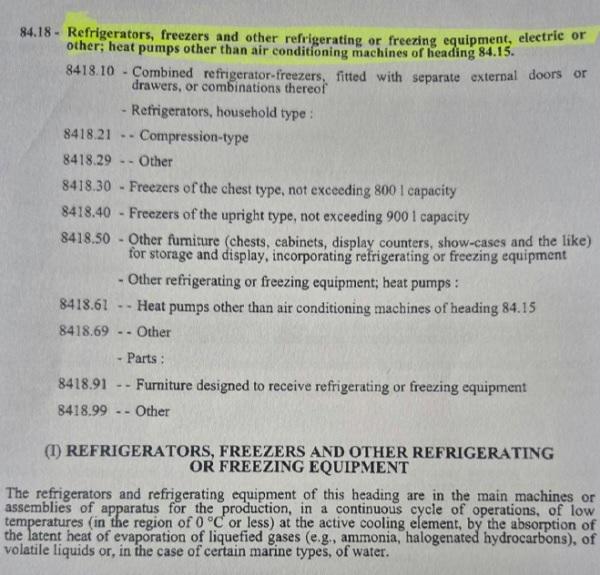
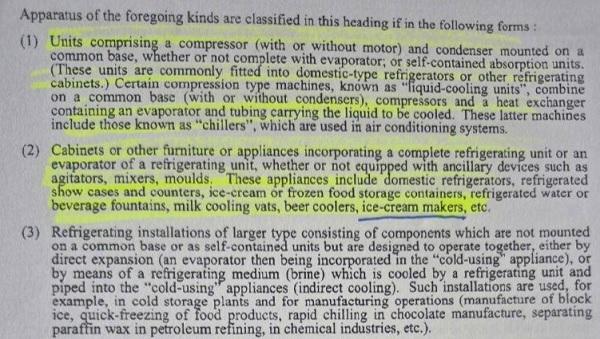
37. As per the Ld AR, the Chapter Notes show that Ice Cream Maker machine is required to be classified under CET 8418 only.
38. We do see some force in the point made by the Ld AR. However, it is also on record that in spite of the Explanatory Notes, the Revenue itself was classifying the machines under CTH 8438 as has been seen from the noting of the Commissioner in 2008 and two OIA passed in 2012 and 2025. The two OIAs have not been further agitated by the Revenue, thereby classification arrived at therein stand accepted by the Revenue. It is also on record that in respect of the present appellant for the subsequent clearance made in October 2018, the Revenue has allowed the clearance of the goods under 8438 as has been noted in the impugned OIA.
39. As we have already noted, the change in CTH has not be adduced to the Explanatory Notes by issuing any Order under Section 17(5), which would have enabled the appellant to putforth any submissions in their defence.
40. Therefore, so far as the Revenue is concerned, in view of the divergent stand taken by them towards the classification, as per us, the benefit of this confusion, in respect of the present appeals, should go to the appellant only. The Revenue cannot be selective to classify the goods under 8438 or at 8418 as per their whims and fancy, by picking and choosing the consignments.
41. In view of the above discussions, we hold that the re- classification of the goods under CTH 8418 by the Revenue in the present case is legally not sustainable. Therefore, we set aside the classification arrived at by the Revenue.
42. Now we take up the issue of value enhancement. As already observed in the earlier paragraphs, no order under Section 17(5) has been passed stating the method / procedure adopted for arriving at the revised enhanced value. As per the case law discussed above, on this ground itself, the enhanced value gets set aside.
43. We have gone through the findings of the Commissioner (Appeals) in the impugned with reference to the enhanced value. Some of the relevant portions are reproduced below:
27. Accordingly, as per the discussions made above and the judicial decisions cited supra regarding the classification of the imported goods are squarely applicable in the instant appeals. As such, I hold that the goods so imported merit the classification under 8438.80.90 as declared by the appellant. Also, I set aside the classification as done by the lower authority without any cogent and definitive reasoning.
28. Further, I also find that the appellant imported “Ice-Cream Machine & Spare Parts” for which they declared the value in the bills of entry. The values declared by the appellants in the impugned bills of entry were enhanced by the assessing officer in accordance with the change in classification of the goods as imported by the lower authority. The appellant paid duty in respect of impugned Bills of entry in order to clear the goods and also requested assessing officer for passing of speaking order. However, no speaking order regarding assessment at enhanced values was passed by the assessing officer.
29. In the instant appeal, the appellant also submits that the lower authority has enhanced the value arbitrarily without giving any opportunity to the appellant to justify the declared value.Alsono substantial evidence has been brought forth by the lower authority regarding the enhancement of value and rejection of the transaction value as declared by the appellant.
30. I also find that at the time of personal hearing, no one appeared on behalf of the respondent/lower authority to sustained the grounds regarding the classification and value of the said imported goods which was enhanced as per the concerned group’s practice. In this regard, I find that the value of the impugned goods imported against the said bills of entry was enhanced without adducing any evidence and as per the rules laid down under Customs Valuation Rules, 2007. I also find that the appellant has requested the lower authority to issue the speaking order regarding the said enhancement under Section 17(5) of the Act and the said duty was paid under protest. However, the lower authority neither issued the speaking order as per the provisions of the Act nor has come forth with any documentary evidence or NIDB data or other sources upon which the lower authority has relied upon to increase the value as declared by the appellant. When the value declared by the importer is proposed to be enhanced by the assessing authority, the procedure to be followed should be consistent with the principles of natural justice as well as the provisions of the Customs Act and the Rules made there under. The proposal for enhancement and the basis for such enhancement require to be made known and opportunity should be given to the importer to give his views before a decision is taken. The Boards instructions contained in Circular No. 91/2003, dated 16-10-03 clearly envisage that only when the assessee accepts for enhancement of the price in writing, the authorities are permitted not to issue speaking orders. This procedure should be followed in the interests of both the assessee and the department.
31. Also, as per the evidence and statement on record, I find that no logical reasoning has been put forth by the lower authority which leads to the rejection of declared value and enhancement thereof for determination of duty. I find that in the case of Commissioner of Customs (General &Cfs) vs. Radhey Shyam Ratanlal reported in 2017 (358) ELT 965 (Tri.-Mumbai), Hon’ble CESTAT held as follows:
“All that is available on record are the assessed bills of entry without any speaking order commuting the rationale adopted by the ‘proper officer’ to paper. Consequently, we are deprived of wisdom of the ‘proper officer’ in reaching the conclusion that the value be enhanced to US$ 3050. Therefore, no purpose would be served by directing that lack be made good now as the ‘proper officer’ may not, in all probability, be available to do so. It is, therefore, left to us to deal with the resolution of this dispute without this constituent.”
35. In the instant case it is undisputed that the goods in question had been imported from an exporter/manufacturer and the invoice was raised by them. This position has neither been denied nor disputed by the department. It is well settled position in law that the invoice should not be doubted unless the same is found as fake or not genuine. I find that Hon’ble Supreme Court in the case of Eicher Tractors Ltd. vs. Commissioner of Customs, Mumbai [2000 (122) E.L.T. 321 (S.C)] has held as under:
38. I find that that no grounds were given by the assessing officer in respect of the present appeals to doubt the transaction value and to assess the duty liability on the enhanced value, as done by the assessing authority.
40. It is also a settled law that the value cannot be enhanced only on the basis of NIDB data. In the case of COMMISSIONER OF CUSTOMS, NEW DELHI versus DM INTERNATIONAL reported in 2013 (289) E.L.T. 169 (Tri. – Del.) the following has been held: “5. We find that there is no dispute that the customs has power to reject the transaction value and enhance the assessable value in terms of Customs Valuation Rules. However, such rejection of transaction value and enhancement of assessable value has to be on the basis of some evidences on record. Contemporaneous imports have to be considered with reference to quality, quantity and country of origin with the imports under consideration. It has been held in a number of decisions that NIDB data cannot be made the basis for enhancement of value. Commissioner (Appeals) has relied upon various decisions of the Tribunal for holding that any enhancement in assessment value, the transaction value has to be first rejected based on legal permissible ground as indicated in the Valuation Rules. He has also referred to Hon’ble Supreme Court decision in the case of Eicher Tractors Ltd. v. CC – 2000 (122) E.L.T. 321 (S.C.) in support of his finding that transaction value cannot be rejected without clear and cogent evidence produced by the department with regard to quality, import of origin and place and time of import.
41. Further, mere acceptance of the enhanced value by the appellant, or any other importer, does not preclude him from filing an appeal against this arbitrary enhancement of value, and claiming refund on the basis of proper assessment. I observe that Hon’ble Supreme Court of India, in the matter of Dunlop India vs. UOI {1983(13) ELT 1566 (SC)} has held that:
xxxx
43. The assessing authority has failed to prove that the declared value did not reflect the true transaction value. I further observe that mere assumption cannot be the basis for rejection of declared value. In this regard I find that Hon‟ble Supreme Court in case of Commissioner Of Customs, ICD Versus Polyglass Acrylic Mfg Co Pvt Ltd, reported in 2015 (322) E.L.T. 794 (S.C.) has held as under:
xxxxx
45. Therefore any enhancement of declared value without any evidence, document or material is violation of Section 14 of the act. The appellant declared the transaction value and there is nothing on record to suggest that the transaction value declared by the appellant was not the price actually paid for the goods when sold for export to India. There is nothing on record that the buyer and seller of the goods were related or price was not the sole consideration for sale. Also the department has not adduced any evidence that any amount over and above the invoice price was paid by the appellant to the foreign supplier of the imported goods. In view of the above, I find that the rejection of declared value without cogent and justified reasons and its enhancement is not sustainable and hence liable to be set aside.
46. I also observe that the appellant did not receive assessment order under section 17(5) of the Customs Act, 1962. I note that Section 17(5) of the Act states that:
“Where any re-assessment done under sub-section (4) is contrary to the self-assessment done by the importer or exporter regarding valuation of the goods, classification or concessions of duty availed consequent to any notification issued therefore under this Act and in cases other than those where the importer or the exporter, as the case may be, confirms his acceptance of the said re-assessment in writing, the proper officer shall pass a speaking order on the re- assessment, within fifteen days from the date of re-assessment of the bill of entry or the shipping bill, as the case may be.”
Therefore, Section 17(5) of the Customs Act, 1962 stipulates that a speaking order has to be passed within 15 days if the re-assessment is done contrary to appellant’s claim unless the said re-assessment is accepted by the importer in writing. It is on record that the bills of entry were re-assessed. Naturally, the speaking orders were required to be issued within 15 days thereof as per Section 17(5) of the Customs Act, 1962. There is no dispute that no speaking order was passed in this case. In the circumstances, in absence of a valid speaking order as per Section 17(5) of the Customs Act, 1962 for re-assessment made by the department contrary to appellant’s claim, re-assessment is liable to be set aside.
48. From the above it is found that the assessing officer has rejected transaction values without any valid basis/reasons and without following the due procedure as per section 14 and Valuation Rules, especially when there is nothing on record to suggest that the transaction values declared by the appellant were not the price actually paid for the goods when sold for export to India. There is also nothing on record to suggest that the buyer and seller of the goods were related or price was not the sole consideration for sale. Also the respondent has not adduced any evidence that any amount over and above the invoice price was paid by the appellant to the foreign supplier of the imported goods. Therefore in these circumstances, the enhancement of assessable values is liable to be struck down and set aside and the bills of entry in the impugned appeals are to be assessed at values declared by the appellant.
44. We find that against the above detailed findings of the Commissioner (Appeals), placing reliance on various case laws, the Revenue has not brought in any evidence whatsoever as to on what 26 basis the enhanced value was arrived at. They have cited some case laws as to when the value can be enhanced, which looks likes a toothless defence on their part to somehow or the other to cover up their shortcomings at the initial stage when the re-classification and re-valuation was taken up.
45. In view of our foregoing observations on the valuation aspect, we fully concur with the findings of the Commissioner (Appeals) and do not find any reason to interfere with the same.
46. To Summarize:
(a) Non-following of principles of natural justice for arriving at the enhanced value and re-classification of goods by issuing Order under Section 17(5) proves fatal to the Revenue‟s case.
(b) The Revenue cannot pick and choose the course of further appeal filing in respect of the same goods, by not filing Appeals in some case citing National Litigation Policy and filing the appeals in some other cases. This shows that Revenue has no fixed Policy as to what is to done in which case.
(c) Total confusion prevails so far as the classification of the goods in question is concerned. In 2008, 2012, 2018 and 2025 the Revenue has classified the goods in question under CET 8438 and in the present imports during 2017-2018 they have classified the same under CET 8418. In such a scenario of confusion, the benefit of such confusion goes to the appellant. Hence, we hold that the correct classification applicable is CET 8438, in respect of the present appeals.
(d) As has been discussed in detail by the Commissioner (Appeals), no reason has been given for enhancement of the 27 value. Further no details have been given as to how the enhanced value has been arrived at. Hence, we hold that the Commissioner (Appeals) has rightly set aside the enhanced value.
47. As a result, the Appeals filed by the Revenue stand dismissed. (Order pronounced in the open court on 15.10.2026.)