In re Harsh International (CAAR Delhi)
Decorative PVC, PS and PU Wall Panels Classified as Builders’ Ware Under Customs Tariff 3925: CAAR Delhi
Summary: The Customs Authority for Advance Rulings (CAAR), New Delhi, in In re Harsh International, determined the customs tariff classification of nine categories of imported plastic wall panels, mouldings and sheets intended for interior decoration and architectural applications. The applicant sought classification of the goods under Customs Tariff Heading (CTH) 3921, covering other plates, sheets, film, foil and strip of plastics. However, the jurisdictional Commissionerate contended that the majority of the products possessed the characteristics of finished architectural articles and were appropriately classifiable under CTH 3925 as builders’ ware of plastics. In its ruling dated 30 October 2026, the Authority, Shri Rajiv Shankar, classified seven categories of decorative wall panels and mouldings under Tariff Item 3925 90 90, while PS Sheets were classified under 3921 11 00 and PVC Sheets, including UV-coated PVC Sheets, under 3921 12 00. The ruling emphasised the importance of the goods’ physical characteristics, manufacturing process, functional design, degree of working and intended application when determining tariff classification.
The applicant, Harsh International, Ludhiana, proposed to import PVC Wall Panels, PS Mouldings, PS Sheets, PS Wall Panels, PS Wall Panel Sheets, PU Wall Panels, PVS Panels (Foam), PVC Sheets and PVC Sheets (UV). It submitted that these goods were primarily used for interior decoration, wall coverings and ceiling applications and did not perform a structural or load-bearing role. According to the applicant, the products were manufactured from plastic polymers, including polyvinyl chloride, polystyrene and polyurethane, using extrusion and other manufacturing processes. They were presented in sheet or panel form, frequently with decorative surface finishes, cellular construction, interlocking edges or tongue-and-groove profiles. The applicant argued that such features did not automatically convert the products into builders’ ware and that their essential character remained that of plastic sheets or panels covered by Heading 3921.
The applicant relied particularly on Note 10 to Chapter 39 of the Customs Tariff, which defines the scope of plates, sheets, film, foil and strip under Headings 3920 and 3921. It submitted that sheets of regular geometric shape could remain within Heading 3921 even when printed, embossed, coloured, laminated or otherwise surface-worked, provided they had not undergone further working beyond what the tariff provisions permitted. It also contended that Heading 3925 was confined to identifiable builders’ ware and should not encompass every decorative product used in buildings. Merely installing a decorative covering on a wall or ceiling, according to the applicant, did not transform that product into a structural building component.
The jurisdictional Customs Commissionerate disputed the proposed classification. It examined the goods’ actual construction, manufacturing process and intended installation methods. The Department noted that certain panels were manufactured with tongue-and-groove edges, click-lock profiles, moulded shapes, interlocking arrangements and decorative finishes specifically designed for installation on walls and ceilings. These features, in the Department’s view, demonstrated that the products had undergone further working and had acquired the character of finished articles suitable for incorporation into buildings. The Commissionerate consequently advocated classification under Heading 3925, covering builders’ ware of plastics, not elsewhere specified or included. It distinguished ordinary flat plastic sheets from shaped and finished products intended for permanent architectural installation.
The applicant challenged this interpretation in detailed written submissions. It argued that decorative overlays could be installed on existing walls without becoming structural elements and that some products could be removed without materially damaging the underlying surfaces. It also relied upon an earlier CAAR ruling concerning Shri Ganesh International, where comparable decorative wall panels had been examined. The applicant contended that the Department was repeating arguments already considered in the earlier proceedings and that tariff classification should depend on the actual description and physical nature of the imported goods rather than their ultimate location of use. The Authority examined these submissions alongside the competing headings, Chapter Notes, HSN Explanatory Notes and the General Rules for Interpretation.
The Authority distinguished products described as ordinary sheets from goods possessing specialised installation characteristics. It observed that panels with profiled edges, interlocking systems, decorative finishes and dimensions suited for wall or ceiling installation could constitute finished architectural articles rather than merely sheets of plastics. Their classification depended on whether they retained the characteristics of sheets within Chapter Note 10 or had undergone further working that gave them a distinct identity as building products. The Authority also considered the scope of Note 11 to Chapter 39, including its reference to ornamental architectural features such as flutings, cupolas and dovecotes. It rejected the proposition that builders’ ware must necessarily perform a load-bearing function. Decorative architectural components could also fall within Heading 3925 where their characteristics and intended use supported that classification.
After examining the evidence, photographs, manufacturing descriptions, interlocking arrangements and proposed uses, the Authority held that PVC Wall Panels, PS Mouldings, PS Wall Panels, PS Wall Panel Sheets, PU Wall Panels and PVS Panels (Foam) were classifiable under CTH 3925 90 90. The ruling separately identified PS Sheets as classifiable under CTH 3921 11 00 and PVC Sheets, including UV-coated PVC Sheets, under CTH 3921 12 00. The decision therefore did not treat every plastic product used for interior decoration as builders’ ware. Instead, it differentiated products on the basis of their physical form, further processing, edge profiles, functionality and readiness for architectural installation. The advance ruling illustrates that apparently similar plastic products may attract different tariff classifications depending upon their actual specifications and characteristics at the time of import.
Cases Discussed
1. Collector of Customs, Bombay Vs Business Forms Ltd. (Supreme Court); 2002 (142) ELT 18 (SC) — Cited regarding the relevance of Harmonized System Explanatory Notes as an aid to interpreting customs tariff headings.
2. Collector of Central Excise Vs Maharastra Fur Fabrics Ltd. (CEGAT); 2002 (145) ELT 287 — Cited in the applicant’s submissions concerning the interpretation of terms governing tariff classification and the distinction between tariff descriptions.
3. In re Shri Ganesh International (CAAR New Delhi); CAAR/Del/Shri Ganesh/71/2025; 07/10/2025 — Discussed extensively in connection with the classification of decorative PVC, PS and PU wall panels and mouldings. The applicant relied on the earlier ruling, while the Authority examined the similarities and distinctions in the goods and arguments presented.
FULL TEXT OF THE ORDER OF CUSTOMS AUTHORITY FOR ADVANCE RULINGS, NEW DELHI
M/s Harsh International, Hadbast No. 249, Khasra No. 16/25/1-19/5/2-19/6/2-19/7/2-19/14/2-19, Village Tibba, Sahnewal, District Ludhiana, Punjab – 141020, having IEC No. 3011001090 and PAN- CTWPS3716G (the applicant, in short) filed the instant application in Form CAAR-1 before the Customs Authority for Advance Rulings, New Delhi (CAAR, in short) for seeking advance ruling. The complete application was received in the Secretariat of the CAAR, New Delhi on 23.07.2026 (Diary No. 563) along with enclosures in terms of Section 28-I(1) of the Customs Act, 1962 (hereinafter referred to as the ‘Act’).
1.1. The applicant’s submissions are as given below:-
STATEMENT OF RELEVANT FACTS
1.2. The Applicant holds IEC No. 3011001090 and hence satisfies the requirement of clause (c)(i) of Section 28E of the Act. The Applicant is seeking advance ruling on classification of certain commodities mentioned in the succeeding para, for the purpose of import; hence the subject of the Application is well covered under clause (a) of Section 28H(2) of the Act.
1.3. This Application seeks Advance Ruling on the classification of the following items:
(i) PVC Wall Panels
(ii) PS Mouldings
(iii) PS Sheets,
(iv) PS Wall Panels
(v) PS Wall Panel Sheets
(vi) PU Wall Panels
(vii) PVS Panels(Foam)
(viii) PVC Sheets
(ix) PVC Sheets (UV).
These nine items are hereinafter referred to as ‘the subject goods’. The subject goods, for convenience’s sake, can be divided into two categories:
(I) All items except for the item at Sr. No. (ii) i.e. PS Mouldings;
(II) PS Moulding, i.e. mouldings, profiled wall panels and goods with interlocking tongue-and-groove edges, designed to be fitted continuously to create a wall or ceiling surface.
1.4. These goods are used for interior decoration. There is no permanent installation of the subject items; rather, they are temporarily attached to walls through pasting or screwing methods. The installation is so temporary that panels can be removed by hand without damage to the underlying wall structure. The temporary nature of attachment, combined with the ease of removal, clearly distinguishes these products from permanent construction elements and reinforces their character as decorative wall coverings. The subject goods are articles made of polymers of plastics, presented generally in sheet or panel form, and intended to be used for interior decoration and allied applications.
1.5. These commodities have the following characteristics:
(i) These articles are made from plastic such as PVC (Poly vinyl chloride), PS (polymer of styrene) and PU (poly urethanes).
(ii) They are of uniform size and are ready to use, not further worked upon. These commodities are fitted at appropriate places by interior decorators.
(iii) These commodities are re-enforced or combined with other materials that enhance their strength.
(iv) These commodities have cellular structure making them lightweight and suitable for various decorative applications.
(v) When cut, these sheets remain ready to use in their original forms as sheets / panels.
(vi) These commodities are marketed and used exclusively for interior decoration purposes such as wall coverings and ceiling decoration to enhance aesthetic appeal of domestic and / or commercial spaces.
(vii) These commodities are not ‘builders ware’ as these commodities do not serve any structural or construction purpose. These commodities are merely decorative overlays.
(viii) These commodities can be seen as substitute of paints.
(ix) These commodities constitute plates (except mouldings) of regular geometric configuration; and may incorporate surface treatment such as printing, embossing, coloring, or corrugation.
1.6. The competitive headings for classification of the subject items are Heading 3921 and 3925 of the First Schedule to the Customs Tariff Act, 1975. The applicant’s pleading has been that these items merit classification under heading 3921 and further under tariff item depending upon their constituent material.
1.7. It is pertinent to emphasize that these commodities fundamentally differ from construction materials or “builder’s ware” of heading 3925 with respect to their intrinsic purpose, application methodology, and essential characteristics. The Subject Goods do not constitute structural elements within buildings but rather function as decorative finishes applied to pre-existing structural components.
APPLICANT’S INTERPRETATION OF LAW AND/OR FACTS
1.8. The applicant seeks Advance Ruling from the Hon’ble Authority on the classification of the items under heading 3921 and sub-heading / tariff items as mentioned in Table 1 below:
| Sr. No. | Commodity | Tariff item |
|---|---|---|
| i | PVC Wall Panels | 39211200 |
| ii | PS Mouldings | 39121200 |
| iii | PS Sheets | 39121200 |
| iv | PS Wall Panels | 39121200 |
| v | PS Wall Panel Sheets | 39121200 |
| vi | PU Wall Panels | 39211390 |
| vii | PVS Panels (Foam) | 39121200 |
| viii | PVC Sheets | 39211200 |
| ix | PVC Sheets (UV) | 39211200 |
1.9. The competitive headings for determining the classification of these items are 3921 and 3925. At the outset, it may be germane to reproduce these two headings:
| Tariff item | Description of goods |
|---|---|
| 3921 | OTHER PLATES, SHEETS, FILM, FOIL AND STRIP, OF PLASTICS |
| Cellular: | |
| 3921 11 00 | Of polymers of styrene |
| 3921 12 00 | Of polymers of vinyl chloride |
| 3921 13 | Of polyurethanes: |
| 3921 13 10 | Flexible |
| 3921 13 90 | Other |
| 3921 14 00 | Of regenerated cellulose |
| 3921 19 00 | Of other plastics |
| 3921 90 | Other: |
| 3921 90 10 | Thermocol |
| Of polymers of vinyl chloride: | |
| 3921 90 21 | Rigid, lacquered |
| 3921 90 22 | Flexible, lacquered |
| 3921 90 23 | Rigid, metallised |
| 3921 90 24 | Flexible, metallised |
| 3921 90 25 | Rigid, laminated |
| 3921 90 26 | Flexible, laminated |
| 3921 90 29 | Other |
| Of regenerated cellulose: | |
| 3921 90 31 | Rigid, lacquered |
| 3921 90 32 | Flexible, lacquered |
| 3921 90 33 | Rigid, metallised |
| 3921 90 34 | Flexible, metallised |
| 3921 90 35 | Rigid, laminated |
| 3921 90 36 | Flexible, laminated |
| 3921 90 39 | Other |
| Other: | |
| 3921 90 91 | Rigid, lacquered |
| 3921 90 92 | Flexible, lacquered |
| 3921 90 93 | Rigid, metallised |
| 3921 90 94 | Flexible, metallised |
| 3921 90 95 | Rigid, laminated |
| 3921 90 96 | Flexible, laminated |
| 3921 90 99 | Other |
| 3925 | BUILDERS’ WARE OF PLASTICS, NOT ELSEWHERE SPECIFIED OR INCLUDED |
| 3925 10 00 | Reservoirs, tanks, vats and similar containers, of a capacity exceeding 300 l |
| 3925 20 00 | Doors, windows and their frames and thresholds for doors |
| 3925 30 00 | Shutters, blinds (including venetian blinds) and similar articles and parts thereof |
| 3925 90 | Other: |
| 3925 90 10 | Of polyurethane |
| 3925 90 90 | Other |
1.10. The relevant Chapter Notes and Explanatory Notes are as under:
1.10.1. Chapter Note 10 to Chapter 39, which relates to headings 3920 and 3921, is reproduced below:
“10. In headings 39.20 and 39.21, the expression “plates, sheets, film, foil and strip” applies only to plates, sheets, film, foil and strip (other than those of Chapter 54) and to blocks of regular geometric shape, whether or not printed or otherwise surface-worked, uncut or cut into rectangles (including squares) but not further worked (even if when so cut they become articles ready for use).”
1.10.2. The Explanatory Note in HSN to Tariff Heading 3921 is reproduced below:
“This heading covers plates, sheets, film, foil and strip, of plastics, other than those of heading 39.18, 39.19 or 39.20 or of Chapter 54. It therefore covers only cellular products or those which have been reinforced, laminated, supported or similarly combined with other materials. (For the classification of plates, etc. combined with other materials, see the General Explanatory Note.)”
1.10.3. Chapter Note 11 to Chapter 39, which relates to heading 3925, is reproduced below:
“11. Heading 3925 applies only to the following articles, not being products covered by any of the earlier headings of sub-Chapter II:
(a) reservoirs, tanks (including septic tanks), vats and similar containers, of a capacity exceeding 300 l;
(b) structural elements used, for example, in floors, walls or partitions, ceilings or roofs;
(c) gutters and fittings thereof;
(d) doors, windows and their frames and thresholds for doors;
(e) balconies, balustrades, fencing, gates and similar barriers;
(f) shutters, blinds (including Venetian blinds) and similar articles and parts and fittings thereof;
(g) large scale shelving for assembly and permanent installation, for example, in shops, workshops, warehouses;
(h) ornamental architectural features, for example, flutings, cupolas, dovecotes; and
(ij) fittings and mountings intended for permanent installation in or on doors, windows, staircases, walls or other parts of buildings, for example, knobs, handles, hooks, brackets, towel rails, switch-plates and other protective plates.”
1.10.4. The Explanatory Note to Tariff Heading 3925 is reproduced below:
“3925 Builders’ ware of plastics, not elsewhere specified or included
3925.10 – Reservoirs, tanks, vats and similar containers, of a capacity exceeding 300 l
3925.20 – Doors, windows and their frames and thresholds for doors
3925.30 – Shutters, blinds (including Venetian blinds) and similar articles and parts thereof
3925.90 – Other
This heading applies only to the articles mentioned in Note 11 to this Chapter.”
1.11. Perusal of the relevant tariff entries and chapter notes shows that heading 3921 encompasses “OTHER PLATES, SHEETS, FILM, FOIL AND STRIP, OF PLASTICS.” The impugned goods are classifiable under the following tariff items:
(i) 39211100 – commodities made from polymers of styrene
(ii) 39211200 – commodities made from polymers of vinyl chloride (for PVC Wall Panels/PVC Wall Panel Sheets)
(iii) 39219029 – Other (for specific types of reinforced panels)
(iv) 39211390 – Other (for PU Wall Panel)
1.12. Note 10 to Chapter 39 explicitly defines the expression “plates, sheets, film, foil and strip” as applicable only to plates, sheets, film, foil and strip (other than those of Chapter 54) and to blocks of regular geometric shape, whether or not printed or otherwise surface-worked, uncut or cut into rectangles (including squares) but not further worked (even if when so cut they become articles ready for use). Furthermore, the explanatory note to heading 3921 explicitly encompasses plates, sheets, film, foil and strip of plastics that exhibit cellular structure or have undergone reinforcement, lamination, or combination with other materials.
1.13. The Subject Goods perfectly fall within the ambit of the expression “plates, sheets, film, foil and strip” in terms of Chapter Note 10 to Chapter 39 read with the explanatory note in HSN to Tariff Heading 3921.
Deliberation on possibility of classification under heading 3925
1.14. It is respectfully submitted that the Subject Goods are not classifiable under heading 3925 (“Builders’ ware of plastics, not elsewhere specified or included”) for the following reasons:
1.14.1. The text of heading 3925 reads “BUILDERS’ WARE OF PLASTICS, NOT ELSEWHERE SPECIFIED OR INCLUDED”, meaning thereby that even if the subject goods are builders’ wares, even then the subject goods could be classified under heading 3925 if and only if the subject goods are not classifiable under any other heading. In other words, heading 3925 comes into the picture only as a residual alternative. The subject goods are specifically covered under heading 3921; hence the residual heading 3925 has no application in the teeth of the specific heading 3921.
1.14.2. Rule of ejusdem generis in classification issues:
(a) Ejusdem generis means “of the same kind or species” – items of the same class or species. According to this Rule, general words following specific words are to be construed with reference to the words preceding them. Example: if a law refers to automobiles, trucks, tractors, motorcycles and other motor-powered vehicles, “vehicles” would not include airplanes, since the list was of land-based transportation.
(b) There is a plethora of cases wherein this principle has been applied in matters of classification disputes. For instance, the Hon’ble Supreme Court in the case of Commissioner of Trade Tax U.P. v. Kartos International {2011 (268) E.L.T. 289 (S.C.)} observed as under:
“Noscitur a Sociis means that when two words are capable of being analogously defined, then they take colour from each other. The term ejusdem generis is a facet (a small part) of Noscitur a Sociis. The aforesaid principle means that the general words following certain specific words would take colour from the specific words” (Para 29 of the judgment).
The Hon’ble Supreme Court in the case of Collector of Central Excise v. Maharashtra Fur Fabric Ltd. {2002 (145) E.L.T. 287 (S.C.)}, dealing with the subject, observed as under:
“… It is a well-established principle that general terms following particular expressions take their colour and meaning as that of the preceding expressions, applying the principle of ejusdem generis rule, therefore, in construing the words “or any other process”, the import of the specific expressions will have to be kept in mind. It follows that the words “or any other process” would have to be understood in the same sense in which the process, including tentering, would be understood. Thus understood, a process akin to stentering/tentering would fall within the meaning of the proviso and, consequently, the benefit of the notification cannot be availed by the respondent.” (Para 6 of the judgment).
(c) Applying this rule of ejusdem generis to heading 3925, it is seen that Heading 3925 covers builders’ ware of plastics, not elsewhere specified or included. The items named under this heading are: (1) 39251000 – Reservoirs, tanks, vats and similar containers, of a capacity exceeding 300 litres; (2) 39252000 – Doors, windows and their frames and thresholds for doors; (3) 39253000 – Shutters, blinds (including Venetian blinds) and similar articles and parts thereof; (4) 392590 – Others. Thus, the sub-heading 392590 is to be understood in the context of the other items mentioned in the heading.
The subject goods are totally of a different kind than the goods falling under heading 3925. The subject goods do not provide any enclosure, support or storage to any building but serve solely to enhance aesthetic appeal. Further, heading 3925 reads “Builders’ ware of plastics, not elsewhere specified or included”. As per Chapter Note 11 to Chapter 39, it applies only to the listed classes of articles such as reservoirs/tanks of capacity exceeding 300 litres; structural elements used in floors, walls or partitions, ceilings or roofs; gutters and fittings; doors, windows and frames; balconies/balustrades/fencing/gates; shutters/blinds and parts; large-scale shelving for permanent installation; ornamental architectural features (e.g., flutings, cupolas, dovecotes); and fittings and mountings intended for permanent installation on parts of buildings (knobs, handles, hooks, brackets, towel rails, switch-plates and protective plates). The phrase “not elsewhere specified or included” textually subordinates heading 3925 to any more specific provision. The subject plastic panels remain essentially decorative sheets designed for aesthetic wall covering as a substitute of paint and wall papers, temporary in nature and easily removable, lacking structural function, architectural complexity, or permanent integration into building frameworks.
1.14.3. Application of General Rule 3(a) of the General Rules for Interpretation: General Rule for Interpretation 3(a) states that the heading that provides the most specific description shall be preferred to headings providing a more general description. In the instant case, heading 3921 provides the most specific description for the subject goods as “sheets of plastics, cellular or reinforced/combined with other materials,” whereas heading 3925 constitutes a residual classification limited to “builders’ ware not elsewhere specified or included”.
1.14.4. Chapter Note 11(b) to Chapter 39, which references “structural elements used, for example, in floors, walls or partitions, ceilings or roofs,” does not apply to the subject goods due to the following reasons:
(a) Explanatory Note 11(b) must be interpreted within its proper context and in conjunction with Note 10 to Chapter 39, which specifically addresses classification of “plates, sheets, film, foil and strip.” The specific provisions of Chapter Note 10 cannot be superseded by general explanatory notes.
(b) Absence of Structural Function: The term “structural elements” in Chapter Note 11(b) designates components providing structural support or fulfilling construction functions. The Subject Goods provide no structural support and fulfil no construction function whatsoever; they function exclusively to add decorative value to the existing structures.
(c) Essential Character Test: Pursuant to established customs classification principles, goods must be classified according to their essential character. The essential character of the Subject Goods remains that of decorative sheets/panels, not construction elements. Just as paint enhances aesthetic appeal of walls and ceilings without triggering classification as “builder’s ware,” the Subject Goods serve identical decorative purposes. If the department’s logic that the PVC sheets provide structural stability (which they do not) is accepted, then paint should also be classified as “builder’s ware” – an interpretation that is clearly incorrect. Both paint and the decorative panels are applied to existing structures for purely aesthetic purposes.
(d) Product Design and Limitations: The Subject Goods are specifically designed and marketed exclusively for decorative purposes. They lack requisite structural properties, thickness, and engineering specifications necessary for any construction or “builder’s ware” application.
(e) The Subject Goods cannot function as structural elements in the following applications:
-
- Floors: The Subject Goods lack necessary durability, thickness, and load-bearing capacity required for flooring applications. They are neither designed for, marketed for, nor used on floors.
- Walls and Partitions: The Subject Goods are applied to pre-existing walls exclusively for decorative purposes; they do not themselves create walls or partitions. Partitions cannot be constructed using the Subject Goods, as they merely constitute decorative overlays applied to structural elements already in place – functionally equivalent to paint or wallpaper.
- Ceilings and Roofs: The Subject Goods are too lightweight and lack requisite structural integrity to function as ceiling or roof elements. They may be applied to existing ceilings exclusively for decorative purposes, analogous to paint or wallpaper application.
JUDICIAL PRECEDENTS SUPPORTING CLASSIFICATION UNDER CTH 3921
1.15. Reliance is placed by the applicant upon the following:
(i) The Ruling of the Customs Authority for Advance Rulings, New Delhi dated 07.10.2025 in the case of M/s Shri Ganesh International, Sangrur [Ruling No. CAAR/Del/Shri Ganesh/71/2025]. In this order, the Authority allowed the application of M/s Shri Ganesh International, Sangrur, holding that the subject goods merit classification under various tariff items of heading 3921, depending upon the constituent material. Para 6 of the order reads as under:
(ii) The judgment of the Hon’ble CESTAT in the case of Bakelite Hylam Ltd. v. Commissioner of C. Ex., Hyderabad {1997 (91) E.L.T. 165 (Tribunal)}, wherein in paras 7 and 8 it was held as under:
“7. For proper understanding of the scope of the headings, we have to refer to the scope of various entries which answer to the same description by way of form under Chapter 39. It is seen that heading 39.18 covers floor and ceiling coverings and by virtue of Chapter Note 9 the scope of the coverage of the item is restricted to materials in running length of specified width. Heading 39.19 covers self adhesive plates and sheets, films, foils etc., whether or not in rolls. The remaining varieties of plates, sheets, films, foils etc. are covered under tariff heading 3920 and 3921. Heading 3920 covers the non-cellular varieties. Both the tariff entries 3920 and 3921 are covered by Chapter note 10 of Chapter 39. In our view going by the scheme of the tariff and chapter notes the scope of tariff entries 3920 and 3921 has to be read together and if that be done the goods manufactured by the appellants are squarely covered under tariff heading 3921. We are supported in this view by the scheme of the tariff in the HSN on which Central Excise tariff is based. The goods in question as per the HSN note fall under tariff heading 39.21 which corresponds to Central tariff entry 3921. The explanatory note under this heading in HSN read as under:
‘This heading covers plates, sheets, film, foil and strip, of plastics, other than those of heading 39.18, 39.19 or 39.20 or of Chapter 54. It therefore covers only cellular products or those which have been reinforced, laminated, supported or similarly combined with other materials. (For the classification of plates etc., combined with other materials, see the General Explanatory Note).’
According to Note 10 to this Chapter, the expression “plates, sheets, foil and strip” applies only to plates, sheets, film, foil and strip and to blocks of regular geometric shape, whether or not printed or otherwise surface worked (for example, polished, embossed, coloured, merely curved or corrugated), uncut or cut into rectangles (including squares) but not further worked (even if when so cut, they become articles ready for use).
The Ld. Advocate in this context has urged that reliance could not be placed on the HSN notes for interpreting Central Excise tariff entries. We observe that Hon’ble Supreme Court in the case of Wood Craft Products Ltd. 1995 (77) E.L.T. 23 has held under para 18: ‘We are of the view that the Tribunal as well as the High Court fell into the error of overlooking the fact that the structure of the Central Excise Tariff is based on the internationally accepted nomenclature found in the HSN and, therefore, any dispute relating to tariff classification must, as far as possible, be resolved with reference to the nomenclature indicated by the HSN unless there be an express different intention indicated by the Central Excise Tariff Act, 1985 itself. The definition of a term in the ISI Glossary, which has a different purpose, cannot in case of a conflict, override the clear indication of the meaning of an identical expression in the same context in the HSN. In the HSN, block board is included within the meaning of the expression “similar laminated wood” in the same context of classification of block board. Since the Central Excise Tariff Act, 1985 is enacted on the basis and pattern of the HSN, the same expression used in the Act must, as far as practicable, be construed to have the meaning which is expressly given to it in the HSN when there is no indication in the Indian Tariff of a different intention.’
8. In view of the above we hold that the goods namely tiles in square and rectangular shape have been correctly held to be classifiable under tariff heading 3921. Since no pleas in respect of any other aspect have been adduced we uphold the orders of the ld. lower authority and dismiss the appeals.”
QUESTION ON WHICH ADVANCE RULING IS SOUGHT
1.16. The Applicant seeks advance ruling on the following question: Whether the classification of the goods mentioned in Table 1 at para 1.8 above (reproduced in the Prayer of the application) is correct.
1.17. The applicant has also enclosed literature/catalogue of the subject items (Annexure H to the application). The photographs of the goods, as marked by the applicant, are as under:
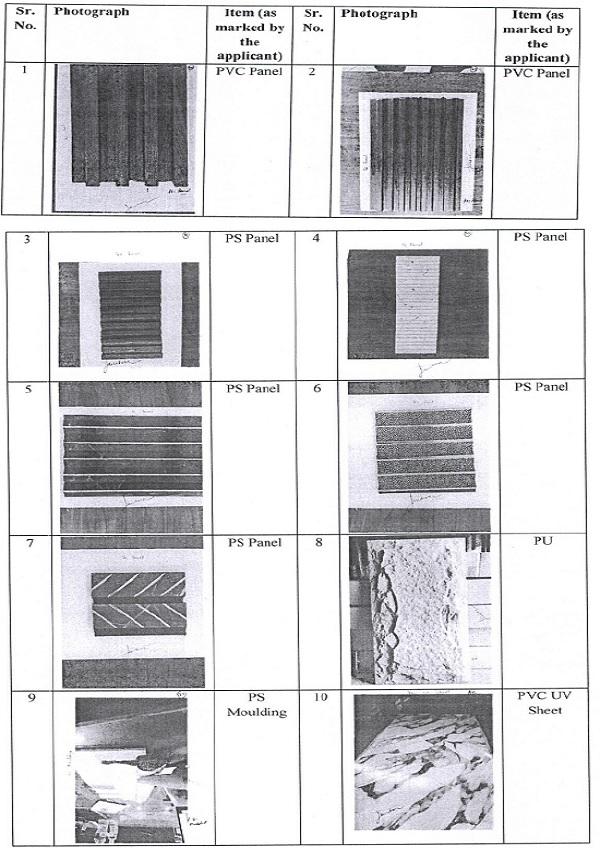
2. Comments of the Port Commissionerate:
2.1. As per the provision of CAAR Regulations, 2021, the complete application of the applicant was forwarded to the concerned Customs Commissionerate vide this office letter F. No. VIII/CAAR/Delhi/Harsh International (Ludhiana)/135/2026/1057 dated 29.07.2026, with a request to furnish the requisite comments in the instant matter.
2.2. The jurisdictional Commissionerate i.e. the Office of the Commissioner of Customs, Ludhiana, vide mail dated 27.08.2026, furnished its comments, which are reproduced as under:-
Brief of the Application
2.2.1. M/s Harsh International (hereinafter referred to as “the Applicant”) has filed an application before the Customs Authority for Advance Rulings (CAAR), New Delhi, seeking an advance ruling on the classification of the goods proposed to be imported, namely “PVC Wall Panels/Sheets/Mouldings, PS wall panels/Panel Sheets, PU wall Panels, PVS Panels(Foam), PVC Sheets, PVC Sheets(UV)”. All items except PS mouldings are hereinafter referred to as “the subject goods”.
2.2.2. The Applicant proposes to engage in the import and trade of the subject goods and has claimed that the same are classifiable under HS Code 3921 and further under tariff (depending upon their constitutional material) of the First Schedule to the Customs Tariff Act, 1975. Accordingly, the Applicant has sought an advance ruling on the correct classification and applicable rate of duty in respect of the subject goods.
Submissions of the Applicant
2.2.3. In Annexure-A to the application, the Applicant has submitted that the subject goods are used for interior decoration. There is no permanent installation of the subject items and are attached to walls through pasting or screwing methods and can be removed without damaged to underlying wall structure. The subject goods are articles made of polymers of plastics, presented in sheet or panel form and intended for interior decoration and allied applications. The Applicant has, inter-alia, made the following claims:
(a) the articles are made from plastic such as PVC (Ply vinyl chloride), PS(Polymer of styrene) & PU(Poly urethane).
(b) goods are of uniform sizes and are either ready for use or not further worked upon;
(c) the goods are reinforced or combined with other materials to enhance strength or functionality;
(d) these are re-enforced or combined with other materials that enhance their strength.
(e) the goods possess a cellular structure making them lightweight and suitable for decorative use;
(f) even after cutting, the goods remain ready for use in their original form as panels or sheets;
(g) the goods are primarily used for interior decoration purposes such as wall coverings and ceiling decoration to enhance the aesthetic appeal of domestic or commercial spaces;
(h) the goods do not serve any structural or constructional purpose and therefore cannot be regarded as builders’ ware;
(i) they can be seen as substitute paints.
(j) These commodities constitute plates (except mouldings) of regular geometric configuration and may incorporate surface treatment such as printing, embossing coloring or corrugation.
2.2.4. On the basis of the above submissions, the Applicant has contended that the subject goods merit classification under CTH 3921 and further under tariff depending upon their constituent material.
2.2.5. The applicant seeks advance ruling for classification of items as mentioned in table below.
| Sr. No. | Commodity | Tariff item |
|---|---|---|
| i | PVC Wall Panels | 39211200 |
| ii | PS Mouldings | 39121200 |
| iii | PS Sheets | 39121200 |
| iv | PS Wall Panels | 39121200 |
| v | PS Wall Panel Sheets | 39121200 |
| vi | PU Wall Panels | 39211390 |
| vii | PVS Panels (Foam) | 39121200 |
| viii | PVC Sheets | 39211200 |
| ix | PVC Sheets (UV) | 39211200 |
Photographs of goods to be imported are as under:
| Photograph Nos. | Product identification |
|---|---|
| 1–2 | PVC Panels |
| 3–7 | PS Panels |
| 8 | PU Panel |
| 9 | PS Moulding |
| 10 | PVC UV Sheet |
Examination of the Applicant’s Claims
2.2.6. The submissions made by the Applicant have been examined in detail with reference to:- the nature and characteristics of the subject goods; – the manufacturing process and extent of working involved; – the relevant Chapter Notes to Chapter 39; – the HSN Explanatory Notes; and – the intended use and manner of installation of the subject goods.
2.2.7 Upon such examination, it is observed that the claims advanced by the Applicant are not supported by the technical characteristics of the goods or the applicable statutory provisions, for the reasons elaborated below.
Nature of Manufacture and Extent of Working
2.2.8 Polyvinyl chloride (PVC) is a high-strength thermoplastic polymer widely used in construction and architectural applications. The manufacture of PVC wall panels involves a series of operations, including:
- extrusion of molten PVC compound through specially designed dies, resulting in panels with three-dimensional and profiled cross-sections;
- formation of hollow or cellular core structures to impart rigidity, insulation and impact resistance;
- formation of interlocking edge profiles and shaping through specially designed dies, followed by decorative surface finishing such as embossing, lamination or UV coating.
2.2.9 Post-extrusion processes further include precision cutting and joint refinement, resulting in non-rectangular, interlocking forms, such as tongue-and-groove or click-lock systems, which are essential for secure and continuous installation.
2.2.10 Likewise, PS Wall Panels are manufactured by extrusion of molten polystyrene through specially designed dies to obtain continuous profiles. The panels are thereafter cut to size and may undergo decorative surface treatments, including embossing, lamination or printing, depending upon the desired finish.
2.2.11. In the case of PU Wall Panels and PVS Panels (Foam), the goods acquire their final shape, dimensions and decorative appearance during the manufacturing process and are presented as finished articles intended for interior architectural applications.
2.2.12. Similarly, PVC Sheets (UV) are provided with specialized UV-coated decorative surfaces to improve durability, appearance and resistance to wear. Such products are marketed as finished interior decorative materials rather than as raw plastic sheets intended for further industrial processing.
2.2.13. Consequently, the finished products are three-dimensional, profiled architectural article specifically designed for installation on walls and ceilings, and not flat plastic sheets or plates. These panels are intended for permanent installation on walls and ceilings as part of the interior architectural framework of buildings. They emerge as finished articles requiring no further manufacturing process before use.
Intended Use and Functional Characteristics
2.2.14. The Applicant has contended that the subject goods are intended for use as decorative wall and ceiling panels. However, the product literature and technical specifications indicate that the goods are specifically designed and manufactured for installation as interior wall and ceiling cladding systems in residential, commercial and institutional buildings. The goods are imported in finished form and are ready for installation without any further manufacturing process.
2.2.15. It is observed that the subject goods perform not only a decorative function but also serve several functional purposes, including:
(i) providing a finished interior surface to walls and ceilings;
(ii) protecting the underlying structure from moisture, dust and abrasion;
(iii) imparting thermal and acoustic insulation, wherever applicable;
(iv) enhancing durability and impact resistance;
(v) concealing surface imperfections, wiring and service lines; and
(vi) facilitating easy cleaning and maintenance.
2.2.16. The Applicant has submitted that the panels can be removed without damaging the underlying wall and therefore do not become part of the permanent structure of the building. This contention is not determinative of tariff classification. The Customs Tariff does not prescribe permanence of installation as a criterion for determining whether an article is “builders’ ware”. The relevant consideration is the objective character, design and intended use of the goods at the time of import.
2.2.17. The fact that the goods are fixed to walls or ceilings by adhesive, screws, clips or interlocking systems demonstrates that they are specifically designed for incorporation into buildings as interior finishing materials. Their removability for repair, replacement or renovation does not alter their essential character as finished building products.
2.2.18. Accordingly, the intended use and functional characteristics of the subject goods indicate that they are finished articles designed for use in buildings and cannot be regarded merely as plastic sheets or panels falling under Heading 3921. Their classification is therefore required to be determined having regard to their objective characteristics, the relevant Chapter Notes and the applicable tariff provisions.
Exclusion from Heading 3921 – Chapter Note 10
2.2.19. The Applicant has claimed classification of the subject goods under Heading 3921, which covers “Other plates, sheets, film, foil and strip, of plastics.” The scope of the said heading is governed by Chapter Note 10 to Chapter 39, which reads as under:
“In headings 3920 and 3921, the expression ‘plates, sheets, film, foil and strip’ applies only to plates, sheets, film, foil and strip (other than those of Chapter 54) and to blocks of regular geometric shape, whether or not printed or otherwise surface-worked, uncut or cut into rectangles (including squares) but not further worked (even if when so cut they become articles ready for use).”
2.2.20. The HSN Explanatory Notes to Heading 3921 reiterate the above position and clarify that the heading covers only plates, sheets, film, foil and strip which are not further worked beyond the processes contemplated under Chapter Note 10.
2.2.21. It is observed from the product literature and technical description furnished by the Applicant that the subject goods are marketed and supplied as PVC Wall Panels, PS Wall Panels, PU Wall Panels, PS Mouldings, PVS Panels (Foam), PVC Sheets and PVC Sheets (UV) intended for installation on walls and ceilings. In particular, the Applicant has itself described the PS Mouldings as “mouldings, profiled wall panels and goods with interlocking tongue-and-groove edges, designed to be fitted continuously to create a wall or ceiling surface.” This description indicates that the goods are presented as finished products for a specific architectural application rather than as ordinary plastic sheets of general use.
2.2.22. The Applicant has not produced any technical evidence to demonstrate that the imported goods remain merely “plates or sheets” within the meaning of Chapter Note 10. On the contrary, the product literature indicates that the goods possess features such as decorative finishes, profiled configurations and interlocking systems intended for direct installation as wall or ceiling cladding.
2.2.23. In view of the above, the Applicant has not established that the subject goods satisfy the description of “plates, sheets, film, foil and strip” contemplated under Heading 3921 read with Chapter Note 10 to Chapter 39. Accordingly, the claim for classification under Heading 3921 is not supported solely by the description of the goods as panels or sheets. The classification is therefore required to be determined having regard to the objective characteristics of each product, the relevant Chapter Notes, the HSN Explanatory Notes and the applicable Rules for Interpretation of the Customs Tariff.
Evidence of Further Working
2.2.24. Interlocking Edge Systems – PVC wall panels are provided with worked edges, which are integral to their function and installation. Common interlocking systems include:
(a) Tongue-and-groove system: One edge of the panel is formed with a projecting tongue, while the opposite edge contains a corresponding groove. During installation, the tongue of one panel fits into the groove of the adjacent panel, forming a continuous and stable surface.
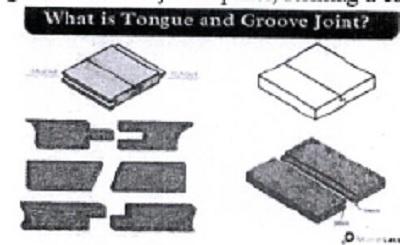
What is Tongue and Groove Joint?
(b) Click-lock system: In this system, precision-engineered edge profiles snap together mechanically, creating a firm and integrated joint without the need for additional fasteners.
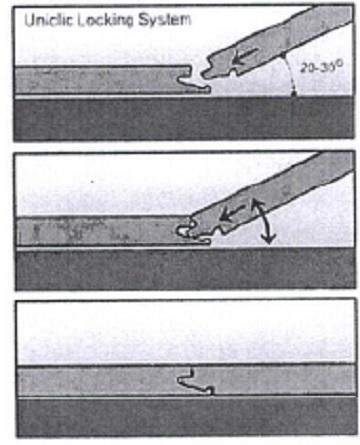
Uniclic Locking System
Mechanism: The edge profiles are precision-engineered to engage and lock with a simple push, creating a secure mechanical fit. Click-lock systems are very easy and fast to install, providing a strong, integrated joint.
2.2.25. Such engineered interlocking systems represent specialised shaping and further working well beyond simple cutting or surface working. These features are essential for permanent installation and continuous alignment of the panels.
2.2.26. It is observed that the Applicant has itself described PS Mouldings as “mouldings, profiled wall panels and goods with interlocking tongue-and-groove edges, designed to be fitted continuously to create a wall or ceiling surface.” This description indicates that the goods are not merely plates or sheets of plastics but are profiled articles specifically engineered for installation as wall or ceiling systems.
2.2.27. Further, the Applicant has itself distinguished these goods from “plates” by describing them as mouldings and profiled wall panels. Such products are manufactured with specific profiles and engineered joints for installation in buildings and cannot be equated with ordinary plates or sheets merely because they are manufactured from plastics.
2.2.28. Therefore, the Applicant’s own description of the goods does not support the claim that all the subject goods are classifiable as “plates or sheets” under Heading 3921. Rather, it establishes that the PS Mouldings are finished profiled articles designed for incorporation into wall and ceiling systems, whose classification is required to be determined on the basis of their objective characteristics and the applicable tariff provisions.
Applicability of Heading 3925 – Builders’ Ware of Plastics
2.2.29 Heading 3925 covers “Builders’ ware of plastics, not elsewhere specified or included.” Chapter Note 11 to Chapter 39 provides that Heading 3925 applies only to the articles specified therein, including, inter alia, structural elements used, for example, in floors, walls or partitions, ceilings or roofs, as well as ornamental architectural features, provided such articles are not covered by any of the preceding headings of Sub-Chapter II.
A. PVC Wall Panels, PS Wall Panels, PU Wall Panels, PVS Panels (Foam) and PS Mouldings
2.2.30 The Applicant has contended that the subject goods do not constitute structural elements of a building, as they neither bear any structural load nor form part of the load-bearing framework of a building. Accordingly, it has been argued that the goods cannot be regarded as “builders’ ware” classifiable under Heading 3925.
2.2.31 The above contention is not acceptable. Chapter Note 11 does not restrict the scope of Heading 3925 only to load-bearing members of a building. The expression “structural elements used, for example, in floors, walls or partitions, ceilings or roofs” is illustrative in nature and covers identifiable building articles intended for incorporation into such parts of a building. Further, Chapter Note 11 specifically includes ornamental architectural features, thereby indicating that the scope of Heading 3925 is not confined only to structural or load-bearing components.
2.2.32 It is observed from the Applicant’s own product literature that PVC Wall Panels, PS Wall Panels, PU Wall Panels, PVS Panels (Foam) and PS Mouldings are specifically designed and marketed for installation on walls and ceilings. In particular, the Applicant has described PS Mouldings as “mouldings, profiled wall panels and goods with interlocking tongue-and-groove edges, designed to be fitted continuously to create a wall or ceiling surface.” Such goods are manufactured with predetermined dimensions, decorative finishes, profiled cross-sections and installation-specific features for use as finished wall and ceiling systems.
2.2.33 Applying Rule 1 of the General Rules for Interpretation, read with Chapter Note 11, the essential character of these goods is derived not merely from the constituent plastic material but from their objective characteristics, engineered design, installation-specific features and intended use as finished wall and ceiling components. In commercial parlance also, these goods are bought and sold as wall panels, ceiling panels and mouldings through dealers in building materials and interior furnishing products and are not understood as ordinary plastic sheets or raw materials.
2.2.34 Accordingly, the objective characteristics, commercial identity and intended use of PVC Wall Panels, PS Wall Panels, PU Wall Panels, PVS Panels (Foam) and PS Mouldings indicate that they are identifiable building products and merit consideration as builders’ ware of plastics under Heading 3925.
B. Ornamental Architectural Features – Chapter Note 11(h)
2.2.35 Chapter Note 11(h) to Chapter 39 expressly provides that Heading 3925 includes “ornamental architectural features, for example, flutings, cupolas, dovecotes.” The inclusion of ornamental architectural features demonstrates that Heading 3925 is intended to cover decorative architectural components incorporated into buildings and is not confined only to structural or load-bearing members.
2.2.36. The Applicant has itself stated in Form CAAR-1 (Statement of Facts) that the subject goods are decorative products designed for aesthetic wall coverings and are primarily used as substitutes for paint and wallpaper. The product literature further indicates that the goods are manufactured with decorative finishes, embossed surfaces, textured profiles and architectural designs intended for installation on walls and ceilings.
2.2.37. Therefore, the Applicant’s own description regarding the decorative and architectural use of the goods supports their consideration as ornamental architectural features within the meaning of Chapter Note 11(h), read with Heading 3925.
C. PVC Sheets and PVC Sheets (UV)
2.2.38. The Applicant has also claimed classification of PVC Sheets and PVC Sheets (UV) under Heading 3921 on the ground that these are merely plates or sheets of plastics.
2.2.39. It is observed that the Applicant has described these goods as decorative sheets intended for wall covering applications. However, the Applicant has not furnished complete technical literature or manufacturing specifications to establish whether the imported goods are merely flat plastic sheets of general use or finished decorative wall-cladding products specifically designed for installation in buildings.
2.2.40. The classification of these products cannot be determined solely on the basis that they are manufactured from PVC or are supplied in sheet form. The relevant consideration is whether, at the time of import, the goods continue to retain the character of “plates or sheets” within the meaning of Chapter Note 10 to Chapter 39 or whether they have acquired the characteristics of identifiable building articles.
2.2.41. The Applicant has also not produced technical evidence regarding the extent of processing, installation characteristics, edge configuration or other objective features necessary to establish that the goods remain within the scope of Heading 3921. In the absence of such evidence, the claim for classification under Heading 3921 cannot be accepted merely on the basis of the description of the goods as “PVC Sheets” or “PVC Sheets (UV).”
Conclusion
2.2.42. As the Applicant’s own product literature indicates that PVC Wall Panels/Sheets/Mouldings, PS wall panels/Panel Sheets, PU wall Panels, PVS Panels(Foam), PVC Sheets, PVC Sheets(UV) are finished products specifically designed for installation on walls and ceilings. Accordingly, having regard to their objective characteristics, commercial identity, design and intended use, the said goods merit consideration under Heading 3925.
3. Record of Personal hearing:
The Authorized Representative (A.R.) of the applicant, Shri Gurmeet Singh Dhillon, Advocate, appeared on 16.09.2026 for the personal hearing conducted in virtual mode and reiterated the submissions made in the CAAR application and in the written submissions/rejoinder filed in response to the comments of the jurisdictional Commissionerate. He requested that the matter be decided on merits. No one appeared on behalf of the Department during the personal hearing.
4. Additional Submission of the Applicant:
4.1. The applicant, vide written submissions/rejoinder dated 13.09.2026, filed in response to the comments of the jurisdictional Commissionerate dated 27.08.2026 and Annexure-A thereto, has submitted as under:-
A. BACKGROUND
4.2. That the Applicant has filed the above-noted Application under Section 28-H of the Customs Act, 1962, seeking an advance ruling on the classification of “PVC Wall Panels, PS Moulding, PS Sheet, PS Wall Panel, PS Wall Panel Sheet, PU Wall Panel, PVS Panel (Foam), PVC Sheet and PVC Sheet (UV)” (“the Subject Goods”) under Chapter Heading 3921 of the First Schedule to the Customs Tariff Act, 1975.
4.3. That vide letter dated 29.07.2026 (F. No. VIII/CAAR/Delhi/Harsh International (Ludhiana)/135/2026/1057), this Hon’ble Authority called for the comments of the jurisdictional Commissionerate. In response, the Office of the Commissioner of Customs, Ludhiana, vide letter File No. GEN/TECH/Misc/32/2026-Tech dated 27.08.2026 has furnished its comments.
4.4. That the Applicant has carefully examined the said letter and Annexure-A and respectfully submits this Rejoinder in response thereto, without prejudice to the submissions already on record in the Application and its Annexures.
B. THE OBJECTIONS IN ANNEXURE-A ARE, IN SUBSTANCE, NOT NEW – EVERY MATERIAL ARGUMENT WAS ALREADY RAISED BY THE SAME COMMISSIONERATE IN THE SHRI GANESH CASE AND SPECIFICALLY REJECTED BY THIS HON’BLE AUTHORITY
4.5. It is respectfully submitted at the very outset that the objections raised in Annexure-A are not new. With only cosmetic variation in language and sequencing, they are substantially the very same objections that were raised by the Department – through the very same jurisdictional Commissionerate, i.e., the Office of the Commissioner of Customs, Ludhiana – in the case of M/s Shri Ganesh International, Near Railway Phatak, Ubhawal Road, Sangrur (Application No. 99/2025), and which stand specifically examined and rejected by this Hon’ble Authority vide Rulings No. CAAR/Del/Shri Ganesh/71/2025 dated 07.10.2025 (F. No. VIII/CAAR/Delhi/Shri Ganesh (Ludhiana)/105/2025) (“the Shri Ganesh Ruling”), barely a matter of months before the present Application.
4.6. It is respectfully submitted that the goods considered in the Shri Ganesh Ruling – “PVC Wall Panels, PS Moulding, PS Sheet, PS Wall Panel, PS Wall Panel Sheet, PU Wall Panel, PVS Panel (Foam), PVC Sheet, PVC Sheet (UV)” – are described in terms materially identical to the Subject Goods in the present Application. The competing headings (3921 and 3925), the governing Chapter Notes (Note 10 and Note 11 to Chapter 39), and the objections raised by the very same Commissionerate are, in all material particulars, the same objections now repeated in Annexure-A.
4.7. It is clarified that both the Department’s original objections and this Hon’ble Authority’s findings on those very objections are recorded within the same Shri Ganesh Ruling – the former at Part 2 (“Comments of the Port Commissionerate”) and as recapitulated by the Authority at Para 5.7, and the latter at Part 5 (“Findings, Discussion & Conclusion”). A complete point-wise comparison is set out in the table below:
Table 1
| Department’s Argument in Shri Ganesh Case | Para & Page of Shri Ganesh Order | This Hon’ble Authority’s Finding / Rejection (Para & Page of the Same Order) |
|---|---|---|
| PVC wall panels are extruded into a three-dimensional hollow-core profile with tongue-and-groove/interlocking features, engineered for secure and continuous installation; they are “finished articles” designed for “permanent installation” providing protection, insulation and moisture resistance – hence not mere plates/sheets. | Paras 2.4.1 & 2.6, Pages 7 & 8; recapitulated at Para 5.7(i), Page 14. | “The department’s assertion regarding ‘permanent installation’ is untenable and contradicts the actual method of application… removed by hand without damage to the underlying wall structure”; further, panels “lack the structural strength necessary for construction applications that would provide building stability or support… serve as substitutes for paint and wallpaper.” Para 5.10(i) & 5.10(iv), Pages 14–15. |
| The engineered interlocking/tongue-and-groove system is specialised shaping and “further working” beyond simple cutting and beyond surface-working, excluding the goods from Note 10 to Chapter 39 and placing them under CTH 3925 (specifically 3925 90, “Other builders’ ware”). | Paras 2.4.4–2.4.6, Page 7; recapitulated at Para 5.7(ii), Page 14. | “The longitudinal interlocking/tongue-and-groove at the edges is an in-line extrusion profile and… does not amount to ‘further working’ of the type exemplified in the Chapter and explanatory notes”; panels “fundamentally maintain their essential rectangular geometric shape… the interlocking edges… serve exclusively aesthetic purposes.” Para 5.12 & Para 5.10(ii)–(iii), Page 15. |
| Heading 3925 covers “structural elements used… in walls” (Note 11(b)/Explanatory Note (b)); PVC wall panels, being designed for permanent installation providing protection, insulation and moisture resistance, “appears to qualify as such structural elements.” | Para 2.6, Page 8; recapitulated at Para 5.7(iii), Page 14. | The panels “remain essentially decorative sheets designed for aesthetic wall covering as a substitute of paint & wall papers, temporarily in nature and easily removable, lacking structural function, architectural complexity, or permanent integration into building frameworks.” Para 5.11 & Para 5.10(iv), Page 15. |
| Goods under CTH 39211100 attract lower duty (BCD 10%) than CTH 3925 (BCD 15%); by seeking the lower-duty heading, “the applicant appears to be attempting to evade Customs duty/IGST.” | Para 2.5, Page 8. | Not pressed further by the Department’s own representative at the personal hearing, who “was asked whether they want to quote any case laws in their support, for which they declined. They have nothing more to add”; independently rebutted without contradiction in the Applicant’s submission that duty rate “is entirely irrelevant to the classification determination”; not relied upon in the Authority’s operative findings. Para 3 (Personal Hearing), Page 8; Para 4.10, Page 11. |
4.8. It will thus be seen that every substantive ground now sought to be re-agitated in Annexure-A already stood specifically raised by the very same Commissionerate, was tested on merits, and was rejected by this Hon’ble Authority on materially identical facts less than a year before the present Application. It is respectfully submitted that the same Commissionerate ought not to be permitted to re-agitate an identical argument in a subsequent application merely by re-sequencing or re-wording it; to hold otherwise would render illusory the consistency that ought ordinarily to attach to this Hon’ble Authority’s Rulings.
C. CHAPTER NOTE 11(h) – “ORNAMENTAL ARCHITECTURAL FEATURES” – IS NOT ATTRACTED TO THE SUBJECT GOODS
4.9. It is fairly acknowledged that Annexure-A additionally invokes Chapter Note 11(h) to Chapter 39, which reads: “(h) ornamental architectural features, for example, flutings, cupolas, dovecotes.” This specific clause was not separately pressed by the Department in the Shri Ganesh matter, and the Applicant accordingly addresses it here on its own merits.
4.10. The principle of ejusdem generis, already applied by the Applicant to Heading 3925 as a whole, applies with equal, if not greater, force to clause (h) specifically. Each of the three statutory examples – flutings, cupolas and dovecotes – is, on examination, an integral structural or architectural part of a building in its own right. It is precisely because they are such structural/built parts of a building that they are correctly placed within Note 11 and Heading 3925 – and not merely because they possess an ornamental quality. This is illustrated below:
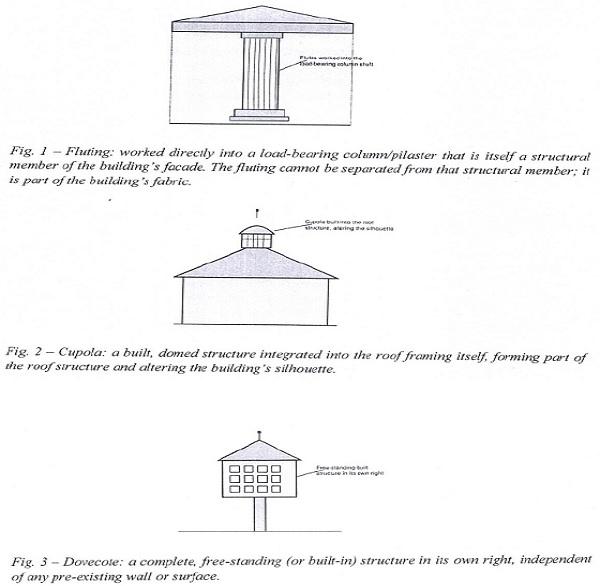
4.11. It is respectfully submitted that all three exemplars share a common genus: each is (i) integral to, or itself constitutes, the physical/structural form of a building or a structural member thereof; (ii) inseparable from that structure without altering the building’s architectural form; and (iii) a bespoke, built or worked architectural component – not a flat, mass-manufactured surface covering applied over an already-complete wall. It is precisely this structural/built character – not mere ornamentation – that places flutings, cupolas and dovecotes within Note 11(h) and, consequently, Heading 3925.
4.12. The Subject Goods share none of these characteristics. They are (a) flat plates/sheets/panels within the meaning of Note 10 to Chapter 39; (b) applied over an already complete, pre-existing wall or ceiling surface rather than being integral to the building’s form; (c) removable by hand without any alteration to the underlying structure, as recorded in the Statement of Facts; and (d) mass-manufactured, standardised, catalogue goods sold in the interior-décor trade as a substitute for paint or wallpaper, rather than bespoke structural/architectural components. This Hon’ble Authority’s own finding in the Shri Ganesh Ruling that such panels lack “architectural complexity” (Para 5.11, Page 15) is directly applicable and, it is respectfully submitted, dispositive of this ground as well.
4.13. It is further submitted that if generic “ornamental” character alone were sufficient to attract Note 11(h), the specific and consistently structural/volumetric examples given by the Legislature would be rendered redundant, and Heading 3921’s specific coverage of cellular and reinforced decorative sheets would be substantially defeated – a result inconsistent with Rule 3(a) of the General Rules for Interpretation and the specific-over-general principle already accepted by this Hon’ble Authority. Tellingly, none of flutings, cupolas or dovecotes is, in ordinary trade parlance, ever described as a “sheet” or “panel”; each is a worked, three-dimensional built form, categorically different from the flat/lightly-profiled decorative sheet goods that are the Subject Goods herein.
D. THE “FUNCTIONAL PROPERTIES” ASSERTED IN ANNEXURE-A ARE UNSUBSTANTIATED
4.14. Annexure-A asserts that the Subject Goods provide moisture, dust and abrasion protection, thermal and acoustic insulation, and concealment of wiring, treating these as evidence of a builders’-ware character. These assertions are made without any technical literature, laboratory report, or other material evidence, and are, at best, incidental properties common to many surface-applied decorative materials that do not, without more, convert a decorative product into “builders’ ware.” The burden of substantiating such a claim, if pressed further, lies on the Department.
E. CLERICAL/TYPOGRAPHICAL CORRECTION TO THE CLASSIFICATION TABLE – AND THE REAL ISSUE FOR DETERMINATION
4.15. On a careful re-examination of the record, the Applicant notices a typographical error in the classification table filed at Paragraph 7 of the Prayer (and repeated in the Statement of Facts/Interpretation of Law), wherein the Tariff Item against Sr. No. vii – “PVS Panel (Foam)” – in Column 3 has been inadvertently mentioned as ‘3921 12 00’, whereas the correct Tariff Item, this being a cellular product of polymers of styrene, is ‘3921 11 00’.
4.16. It is further noted that the identical clerical error (‘3921 12 00’ in place of ‘3921 11 00’) also appears against Sr. Nos. ii to v – PS Moulding, PS Sheet, PS Wall Panel and PS Wall Panel Sheet – all of which are, like Sr. No. vii, cellular products of polymers of styrene, and stand corrected on the same basis. The Applicant most respectfully seeks leave of this Hon’ble Authority to place the following corrected table on record in substitution of the corresponding table filed with the Application:
| Sr. No. | Item / Description | Material | Tariff Item (Corrected) |
|---|---|---|---|
| i | PVC Wall Panels | Vinyl chloride (cellular) | 3921 12 00 |
| ii | PS Moulding | Styrene (cellular) | 3921 11 00 |
| iii | PS Sheet | Styrene (cellular) | 3921 11 00 |
| iv | PS Wall Panel | Styrene (cellular) | 3921 11 00 |
| v | PS Wall Panel Sheet | Styrene (cellular) | 3921 11 00 |
| vi | PU Wall Panel | Polyurethane (cellular) | 3921 13 90 |
| vii | PVS Panel (Foam) | Styrene (cellular) | 3921 11 00 |
| viii | PVC Sheet | Vinyl chloride (cellular) | 3921 12 00 |
| ix | PVC Sheet (UV) | Vinyl chloride (cellular, UV surface-worked) | 3921 12 00 |
4.17. It is respectfully submitted that the real issue for determination by this Hon’ble Authority is whether the Subject Goods, as a class, fall under Heading 3921 or Heading 3925 of the First Schedule to the Customs Tariff Act, 1975. The further six-digit and eight-digit sub-classification within Heading 3921 necessarily depends upon the constituent plastic material of each individual item (styrene, vinyl chloride, polyurethane or other), and, consistent with the approach adopted by this Hon’ble Authority in the Shri Ganesh Ruling (Para 6, Page 15), may be confirmed and verified consignment-wise by the field formation at the time of each import. The Applicant has no objection to a ruling framed in these terms.
F. PRAYER
4.18. In light of the foregoing, the Applicant most respectfully prays that this Hon’ble Authority may be pleased to:
(a) reject the objections raised in Annexure-A to the letter dated 27.08.2026 of the Office of the Commissioner of Customs, Ludhiana, as being, in substance, a repetition of arguments already examined and rejected in Rulings No. CAAR/Del/Shri Ganesh/71/2025 dated 07.10.2025;
(b) hold that Chapter Note 11(h) to Chapter 39 (“ornamental architectural features”) is not attracted to the Subject Goods, for the reasons stated in Part C above;
(c) take the corrected classification table set out at Paragraph 4.16 above (corrected table at para 4.16 above) on record, in substitution of the corresponding table filed with the Application;
(d) allow the Application and rule that the Subject Goods are classifiable under Heading 3921 of the First Schedule to the Customs Tariff Act, 1975, with the specific six-digit/eight-digit Tariff Item depending on the constituent plastic material of each item as verified at the time of import, consistent with the Ruling in M/s Shri Ganesh International; and
(e) pass such other order(s) as this Hon’ble Authority may deem fit and proper in the facts and circumstances of the case.
5. Discussion, Findings & Conclusion:
5.1. Having examined the CAAR-1 application, the comments received from the jurisdictional Customs Commissionerate, rejoinder filed by the applicant, the record of personal hearing and the applicable legal framework, I find the application to be valid in terms of the Customs Act, 1962 and the CAAR Regulations, 2021. I, therefore, allow the application and proceed to determine the classification of the proposed goods on the basis of the information available on record.
5.2. I have taken into consideration all the materials placed on the record of application in Form CAAR-1 together with all annexures, the comments of the jurisdictional Commissioner of Customs Ludhiana, the rejoinder filed by the applicant, the submissions during the personal hearing, the relevant Section Notes and Chapter Notes of the First Schedule to the Customs Tariff Act, 1975, the General Rules for the Interpretation of the Import Tariff (“GRI”), the Harmonized System (“HSN”) Explanatory Notes.
5.3. The question before me in this case is related to the classification of nine goods namely (i) PVC Wall Panels (ii) PS Mouldings (iii) PS Sheets (iv) PS Wall Panels (v) PS Wall Panel Sheets (vi) PU Wall Panels (vii) PVS Panels (Foam) (viii) PVC Sheets (ix) PVC Sheets (UV).
Legal framework and competing headings:
5.4. It is a well-settled principle of law that the classification of goods under the Customs Tariff Act, 1975 is governed by the General Rules for the Interpretation of the Import Tariff (GRI). The General Rules for the Interpretation of the Import Tariff (GRI) have been reproduced below:
“Rule 1: The titles of Sections, Chapters and Subchapters are provided for ease of reference only; for legal purposes, classification shall be determined according to the terms of the headings and any relative Section or Chapter Notes and, provided such headings or Notes do not otherwise require, according to the following provisions :
Rule 2:
(a) Any reference in a heading to an article shall be taken to include a reference to that article incomplete or unfinished, provided that, as presented, the incomplete or unfinished article has the essential character of the complete or finished article. It shall also be taken to include a reference to that article complete or finished (or falling to be classified as complete or finished by virtue of this Rule), presented unassembled or disassembled.
(b) Any reference in a heading to a material or substance shall be taken to include a reference to mixtures or combinations of that material or substance with other materials or substances. Any reference to goods of a given material or substance shall be taken to include a reference to goods consisting wholly or partly of such material or substance. The classification of goods consisting of more than one material or substance shall be according to the principles of Rule 3.
Rule 3: When by application of Rule 2 (b) or for any other reason, goods are, prima facie, classifiable under two or more headings, classification shall be effected as follows :
(a) The heading which provides the most specific description shall be preferred to headings providing a more general description. However, when two or more headings each refer to part only of the materials or substances contained in mixed or composite goods or to part only of the items in a set put up for retail sale, those headings are to be regarded as equally specific in relation to those goods, even if one of them gives a more complete or precise description of the goods.
(b) Mixtures, composite goods consisting of different materials or made up of different components, and goods put up in sets for retail sale, which cannot be classified by reference to 3 (a), shall be classified as if they consisted of the material or component which gives them their essential character, insofar as this criterion is applicable.
(c) When goods cannot be classified by reference to 3 (a) or 3 (b), they shall be classified under the heading which occurs last in numerical order among those which equally merit consideration.
Rule 4: Goods which cannot be classified in accordance with the above Rules shall be classified under the heading appropriate to the goods to which they are most akin.
Rule 5: In addition to the foregoing provisions, the following Rules shall apply in respect of the goods referred to therein :
(a) Camera cases, musical instrument cases, gun cases, drawing instrument cases, necklace cases and similar containers, specially shaped or fitted to contain a specific article or set of articles, suitable for longterm use and presented with the articles for which they are intended, shall be classified with such articles when of a kind normally sold therewith. This Rule does not, however, apply to containers which give the whole its essential character;
(b) Subject to the provisions of Rule 5 (a) above, packing materials and packing containers presented with the goods therein shall be classified with the goods if they are of a kind normally used for packing such goods. However, this provision is not binding when such packing materials or packing containers are clearly suitable for repetitive use.
Rule 6: For legal purposes, the classification of goods in the subheadings of a heading shall be determined according to the terms of those subheadings and any related Subheading Notes and, mutatis mutandis, to the above Rules, on the understanding that only subheadings at the same level are comparable. For the purposes of this Rule the relative Section and Chapter Notes also apply, unless the context otherwise requires.”
5.5. I observe that as per Rule 1 of GRI, the subject products under consideration should be classified in accordance with the terms of the heading or relevant Section or Chapter Notes. Therefore, Section Notes and Chapter notes are relevant for the purposes of determining classification of the subject products.
5.6. Rule 6 provides that the classification of goods in the subheadings of a heading shall be determined according to the terms of those subheadings and any related subheading Notes and, mutatis mutandis, to the preceding Rules, on the understanding that only subheadings at the same level are comparable.
5.7. The applicant has claimed classification of the said goods under tariff heading 3921. The jurisdictional Commissionerate has proposed the classification of said goods under tariff heading 3925. The dispute therefore is whether the said goods are classifiable under 3921 or 3925 and thereafter, what their classification would be at the sub-heading and tariff item level.
5.8. The First Schedule to the Customs Tariff Act, 1975 is aligned with the Harmonized System, and it is settled by the Hon’ble Supreme Court in Collector of Central Excise v. Wood Craft Products Ltd., 1995 (77) E.L.T. 23 (S.C.) that where a tariff entry corresponds to the Harmonized System, the Explanatory Notes are a safe guide to its interpretation.
Scope of Tariff Heading 3921:
5.9. Heading 3921 covers “Other Plates, Sheets, Film, Foil and Strip, of Plastics”. The relevant portion of Heading 3921 is reproduced below:
| Tariff item | Description of goods |
|---|---|
| 3921 | OTHER PLATES, SHEETS, FILM, FOIL AND STRIP, OF PLASTICS |
| Cellular: | |
| 3921 11 00 | Of polymers of styrene |
| 3921 12 00 | Of polymers of vinyl chloride |
| 3921 13 | Of polyurethanes: |
| 3921 13 10 | Flexible |
| 3921 13 90 | Other |
| 3921 14 00 | Of regenerated cellulose |
| 3921 19 00 | Of other plastics |
| 3921 90 | Other: |
| 3921 90 10 | Thermocol |
| Of polymers of vinyl chloride: | |
| 3921 90 21 | Rigid, lacquered |
| 3921 90 22 | Flexible, lacquered |
| 3921 90 23 | Rigid, metallised |
| 3921 90 24 | Flexible, metallised |
| 3921 90 25 | Rigid, laminated |
| 3921 90 26 | Flexible, laminated |
| 3921 90 29 | Other |
| Of regenerated cellulose: | |
| 3921 90 31 | Rigid, lacquered |
| 3921 90 32 | Flexible, lacquered |
| 3921 90 33 | Rigid, metallised |
| 3921 90 34 | Flexible, metallised |
| 3921 90 35 | Rigid, laminated |
| 3921 90 36 | Flexible, laminated |
| 3921 90 39 | Other |
| Other: | |
| 3921 90 91 | Rigid, lacquered |
| 3921 90 92 | Flexible, lacquered |
| 3921 90 93 | Rigid, metallised |
| 3921 90 94 | Flexible, metallised |
| 3921 90 95 | Rigid, laminated |
| 3921 90 96 | Flexible, laminated |
| 3921 90 99 | Other |
5.10. The scope of heading 3921 is governed by Note 10 to Chapter 39 and the same is reproduced below:
” In headings 3920 and 3921, the expression “plates, sheets, film, foil and strip” applies only to plates, sheets, film, foil and strip (other than those of Chapter 54) and to blocks of regular geometric shape, whether or not printed or otherwise surface-worked, uncut or cut into rectangles (including squares) but not further worked (even if when so cut they become articles ready for use).”
5.11. The Explanatory Note to Tariff Heading 3921 is reproduced below:
“This heading covers plates, sheets, film, foil and strip of plastics, other than those of headings 39.18, 39.19 or 39.20 or of Chapter 54. It therefore covers only cellular products or those which have been reinforced, laminated, supported or similarly combined with other materials. (For the classification of plates, etc. combined with other materials, see the General Explanatory Note.)
According to Note 10 to this Chapter, the expression “plates, sheets, film, foil and strip” applies only to plates, sheets, film, foil and strip and to blocks of regular geometric shape, whether or not printed or otherwise surface-worked (for example, polished, embossed, coloured, merely curved; or corrugated), uncut or cut into rectangles (including squares) but not further worked (even if when so cut they become articles ready for use).
Plates, sheets, etc., whether or not surface-worked (including squares and other rectangles cut therefrom), with ground edges, drilled, milled, hemmed, twisted, framed or otherwise worked or cut into shapes other than rectangular (including square) are generally classified as articles of headings 39.18, 39.19 or 39.22 to 39.26.”
5.12. Note 10 to Chapter 39 read with the Explanatory Note to heading 39.21 provides that the expression plates, sheets, film, foil and strip applies only to plates, sheets, film, foil and strip and to blocks of regular geometric shape, whether or not printed or otherwise surface-worked (for example, polished, embossed, coloured, merely curved; or corrugated), uncut or cut into rectangles (including squares) but not further worked. However, plates, sheets, etc., with ground edges, drilled, milled, hemmed, twisted, framed or otherwise worked or cut into shapes other than rectangular (including square) are generally classified as articles of headings 39.18, 39.19 or 39.22 to 39.26.
5.13. The correct classification of any article must proceed from a precise understanding of what the article is. The applicant seeks classification of the following nine items: (i) PVC Wall Panels (ii) PS Mouldings (iii) PS Sheets (iv) PS Wall Panels (v) PS Wall Panel Sheets (vi) PU Wall Panels (vii) PVS Panels (Foam) (viii) PVC Sheets (ix) PVC Sheets (UV). Eight of the nine items are named as panels or as sheets, hence the words ‘Panel’ and ‘Sheet’ require examination.
5.14. On examination of the Customs Tariff, it is observed that the terms “panel” and “sheet” have not been defined. The dictionaries are a fair guide to ordinary usage. For the definitions of the terms “sheet” and “panel”, reference is made to the following dictionaries:
(a) According to The Oxford Advanced Learner’s Dictionary, 10th Edition, ‘Sheet’ means “a flat, thin piece of any material, normally square or rectangular” and ‘Panel’ means “a square or rectangular piece of wood, glass or metal that forms part of a larger surface such as a door or wall”.
(b) According to The American Heritage Dictionary (www.ahdictionary.com), ‘Sheet’ means “A broad, thin, usually rectangular mass or piece of material, such as paper, metal, glass, or plywood” and ‘panel’ means “A flat, usually rectangular piece forming a raised, recessed, or framed part of the surface in which it is set.”
5.15. From these definitions, it can be said that a ‘sheet’ and a ‘panel’ are two different things. A sheet is a form of material: a flat, thin piece of any material normally square or rectangular. A panel is a part of something larger: a piece that forms part of a wall or ceiling surface.
5.16. At paragraph 2 of Annexure A to the application, the Applicant has listed nine items but has referred to them as these ten items. However, only nine items are described further by applicant. Therefore, the goods under consideration are the nine items expressly listed in the application. The Applicant has divided the nine items into two categories. The first category comprises the eight items namely, PVC Wall Panels, PS Sheets, PS Wall Panels, PS Wall Panel Sheets, PU Wall Panels, PVS Panels (Foam), PVC Sheets and PVC Sheets (UV). The second category comprises only PS Mouldings. While describing this category, the Applicant has referred to mouldings, profiled wall panels and goods with interlocking tongue-and-groove edges, designed to be fitted continuously to create a wall or ceiling surface. This description refers to three types of goods, whereas the second category contains only one item, namely, PS Mouldings.
5.16.1. The Applicant has further stated that the goods are made of PVC, PS and PU; are cellular and reinforced or combined with other materials; are of uniform size and ready to use, not further worked upon; and are intended exclusively for interior decoration as wall and ceiling coverings. It has also described the goods as plates (excepts mouldings) of regular geometric configuration. According to the Applicant, the goods are fixed by pasting or screwing, can be removed by hand, serve no structural or construction purpose and are merely decorative outlays.
5.16.2. In its rejoinder, the Applicant has corrected the tariff items claimed in the application and has placed on record a corrected table, which also states the material of each item. According to that table, all nine items are cellular. PVC Wall Panels, PVC Sheets and PVC Sheets (UV) are of polymers of vinyl chloride, the PVC Sheets (UV) being UV surface-worked; PS Mouldings, PS Sheets, PS Wall Panels, PS Wall Panel Sheets and PVS Panels (Foam) are of polymers of styrene; and PU Wall Panels are of polyurethane. I take the corrected table on record. The goods are examined below on the description in the application, read with this table.
5.17. The applicant in Annexure H of the application has submitted ten photographs of the subject goods, which are reproduced below:
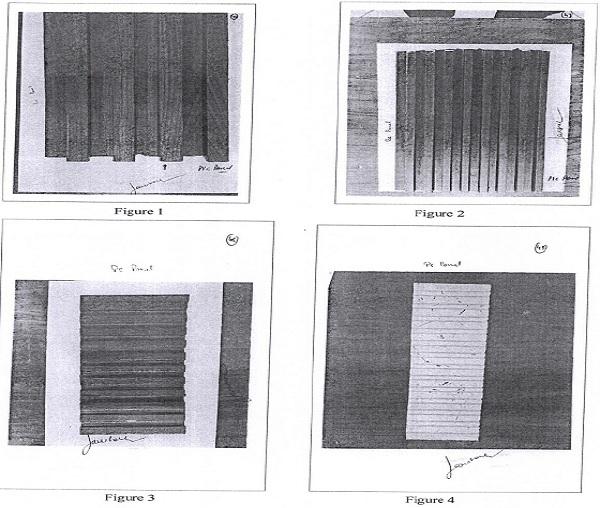
–
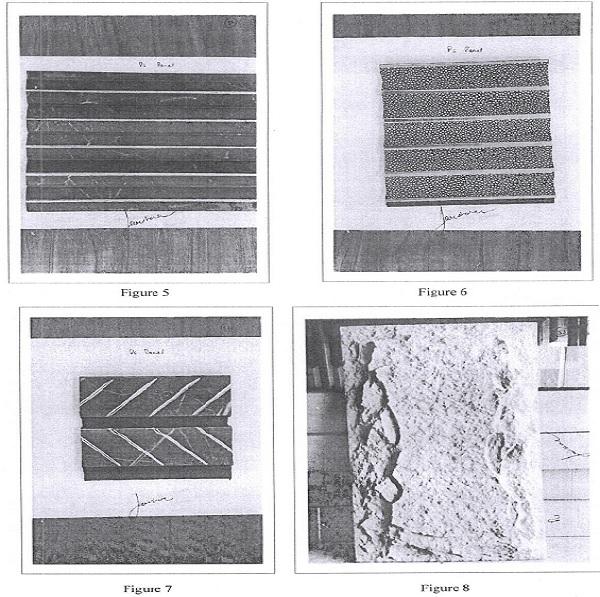
–
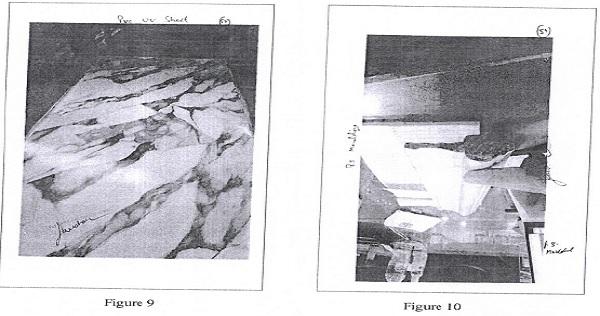
5.17.1. Now, each of the items are discussed one by one:-
(i) PVC Panel: The items in Figures 1 and 2 are marked as PVC Panel by applicant. It is apparent from the photo that the items are not flat sheets. These items have a series of parallel raised ribs or slats separated by deep recesses and the ribs standing prominently clear of the base.
(ii) PS Panel: The items in Figure 3,4,5,6 and 7 are marked as PS Panel by applicant. It is apparent from the photographs that the items are not flat sheets.
(iii) PU Wall Panels: The item in Figure 8 is marked “PU” by the Applicant. It is apparent from the photograph that the item is a piece with a deep, uneven surface made to look like rough split stone.
(iv) PVC UV Sheet: The item in Figure 9 is marked as PVC UV Sheet by applicant. It is apparent from the photograph that the item is a flat board-like piece bearing a printed marble pattern.
(v) PS Mouldings: The item Figure 10 is shown as PS Moulding by applicant. It is apparent from the photograph that the item is not a sheet in any sense. It is an angular, profiled trim section with a curved face
(vi) No photograph has been furnished of PS Sheets, PS Wall Panel Sheets, PVS Panels (Foam) or PVC Sheets. For these four items, the only material on record is the Applicant’s description
5.17.2. From the above Photographs, I observe that the goods namely PVC Panel, PS Panel and PU wall Panel are not plates or sheets. Their ribs, slats, raised bands and relief stand clear of the base and their thickness is not even across their width. The goods namely, PS Mouldings are not sheet in any sense as they are angular, profiled trimmed section with a curved face. Further, I find that the goods namely PVC Wall Panels, PS Mouldings, PS Wall Panels and PU Wall Panels are not plates, sheets, film, foil or strip, nor blocks of regular geometric shape, within the meaning of Note 10 to Chapter 39.
5.18. The third paragraph of the Explanatory Notes to heading 39.21 provides that “Plates, sheets, etc., whether or not surface-worked (including squares and other rectangles cut therefrom), with ground edges, drilled, milled, hemmed, twisted, framed or otherwise worked or cut into shapes other than rectangular (including square) are generally classified as articles of headings 39.18, 39.19 or 39.22 to 39.26.”
5.18.1. From the above, I observe that plates, sheets, etc. with ground edges, drilled, milled, hemmed, twisted, framed or otherwise worked, or cut into shapes other than rectangular (including square), are generally classified as articles of headings 39.18, 39.19 or 39.22 to 39.26 rather than heading 39.21. Such working goes beyond the surface-working and the cutting into rectangles which Note 10 permits. The word “generally” means that such goods may fall under any one of those headings, depending on what the article is. It does not allow them to stay in heading 39.21.
5.19. I now proceed to examine whether the goods have worked edges or have undergone any further working. It is to mention that apart from the photographs, no specifications, drawings, technical literature or samples have been submitted in respect of the subject goods. The Applicant has divided the subject goods into two categories. The first category covers eight items, namely: PVC Wall Panels, PS Sheets, PS Wall Panels, PS Wall Panel Sheets, PU Wall Panels, PVS Panels (Foam), PVC Sheets and PVC Sheets (UV). The Applicant has not provided any details about the edges of the above mentioned eight items. The Applicant also does not explain how one piece is joined to the next. The second category covers PS which the Applicant has described as mouldings, profiled wall panels and goods with interlocking tongue-and-groove edges, designed to be fitted continuously to create a wall or ceiling surface.
5.20. The Port Commissionerate has opined that the goods show evidence of further working and has submitted that PVC wall panels have specially shaped edges designed to join one panel to another. The Port Commissionerate has referred to two common interlocking systems:
(a) Tongue-and-groove system: One edge of the panel is formed with a projecting tongue, while the opposite edge contains a corresponding groove. During installation, the tongue of one panel fits into the groove of the adjacent panel, forming a continuous and stable surface.
(b) Click-lock system: In this system, precision-engineered edge profiles snap together mechanically, creating a firm and integrated joint without the need for additional fasteners.
Such edge profiles involve shaping beyond simple cutting or surface working and facilitate the installation and alignment of panels on walls. The Port Commissionerate has further mentioned that the Applicant has not produced technical evidence to establish that the goods remain plain plates or sheets. In particular, in respect of the PVC Sheets and PVC Sheets (UV), the Applicant has not produced technical evidence regarding the extent of processing, the method of installation or the shape of the edges. The Port Commissionerate further opined that the Applicant’s claim that the goods are merely plates or sheets cannot be accepted.
5.20.1. I concur with the Port Commissionerate that specially shaped, interlocking edges, where present, involve working beyond simple cutting or surface-working, as such edges are designed to enable adjacent panels to fit into or over one another.
5.21. In its rejoinder, the Applicant has not disputed the presence of the aforesaid edges and has submitted that the goods in Advance Ruling No. CAAR/Del/Shri Ganesh/71/2025 dated 07.10.2025, in the case of M/s Shri Ganesh International, were materially identical to the subject goods and that the facts of both cases are identical. This is a bare assertion, unsupported by any material on record. In that case the Authority had before it detailed specifications, product brochures and technical literature. Here, the material on the goods consists of the description in the application and the photographs. In these circumstances, the findings in the case of M/s Shri Ganesh International cannot be applied to the subject goods merely on the basis of the Applicant’s assertion of similarity.
5.22. Note 10 to chapter 39, read with the third paragraph of the Explanatory Notes to heading 39.21, requires determining whether the goods, in the condition in which they are presented for classification, have undergone further working or not.
5.22.1 In the present case, the first category comprises eight items, namely, (i) PVC Wall Panels; (ii) PS Sheets; (iii) PS Wall Panels; (iv) PS Wall Panel Sheets; (v) PU Wall Panels; (vi) PVS Panels (Foam); (vii) PVC Sheets; and (viii) PVC Sheets (UV). I now proceed on the photographs and the description furnished by the Applicant. On that basis, I separate these eight items into two groups, panels and sheets. The first group comprises five items, namely PVC Wall Panels, PS Wall Panels, PS Wall Panel Sheets, PU Wall Panels and PVS Panels (Foam). The second group comprises three items, namely PS Sheets, PVC Sheets and PVC Sheets (UV).
5.22.2. From the above discussion, I find that the Applicant’s photographs of its panels show show raised ribs, slats, bands and deep relief. These panels are not flat sheets. Figures 6 and 7 also show a stepped edge on the PS panels. There is no photograph of the PS Wall Panel Sheets or the PVS Panels (Foam). However, they are named as panels, they are made of the same cellular polymers of styrene as the PS Wall Panels, and the Applicant has not shown that they differ in form from its other panels. The Port Commissionerate has opined that the PVC Wall Panels have specially shaped edges and the Applicant has not disputed this in its rejoinder. The Applicant has not drawn any distinction between these panels. Therefore, I find that all five items have shaped edges or margins that allow one piece to fit into or over another. This is working beyond merely cutting plastic into rectangular plates or sheets. The five items, namely PVC Wall Panels, PS Wall Panels, PS Wall Panel Sheets, PU Wall Panels and PVS Panels (Foam), therefore do not meet the requirement of Note 10, and they fall outside heading 3921. The Applicant’s claim to classify these five items under heading 3921 is rejected.
5.22.3. The Applicant’s photograph of the “PVC Sheets (UV)” shows a flat surface bearing a printed marble pattern, with no rib, relief or shaped edge. The Applicant describes PVC sheets as cellular plates of regular shape and uniform size, not further worked, and the PVC Sheets (UV) as UV surface-worked. Although the applicant has not submitted any technical literature, a plain reading of the product descriptions, namely “PVC Sheets” and “PS Sheets”, indicates that these goods are in the form of flat sheets. Accordingly, considering the description and nature of the goods, Note 10 to Chapter 39, and the General Rules for the Interpretation of the Import Tariff (GRI), I find that all three items, namely, “PVC Sheets (UV)”, “PVC Sheets” and “PS Sheets”, are appropriately classifiable under Heading 3921 of the Customs Tariff Act, 1975.
5.22.4 From the above discussion, I find that three items, namely PVC Sheets, PVC Sheets (UV) and PS Sheets, are covered by heading 3921. For the eight-digit classification, Rule 6 is resorted to. Heading 3921 first separates cellular goods (sub-headings 3921 11 to 3921 19) from other goods (sub-heading 3921 90). The Applicant has stated that all three items are cellular. Within the cellular goods, the tariff items depend on the plastic of which the goods are made. PS Sheets, being of polymers of styrene, fall under tariff item 3921 11 00, “Of polymers of styrene”. PVC Sheets and PVC Sheets (UV), being of polymers of vinyl chloride, fall under tariff item 3921 12 00, “Of polymers of vinyl chloride”.
5.23. In respect of the second category, comprising PS Mouldings, the Applicant has described the category as mouldings, profiled wall panels and goods with interlocking tongue-and-groove edges, designed to be fitted continuously to create a wall or ceiling surface. It has also left mouldings out of its description of the goods as plates: plates (excepts mouldings) of regular geometric configuration. A tongue-and-groove profile is not the result of merely cutting a sheet into a rectangular shape; it involves further shaping of the edges, which goes beyond the surface-working and rectangular cutting permitted by Note 10 to Chapter 39. Apart from its edges, the photograph of the PS Moulding at Figure 10 shows an angular, profiled trim section with a shaped, curved face. It is neither flat nor of uniform thickness across its width. It is, therefore, not a plate, sheet, film, foil or strip, nor a block of regular geometric shape, within the meaning of Note 10. In the present case, I find that PS Mouldings, both by reason of their shaped edges and by reason of their profiled form, involve working beyond merely cutting plastic material into rectangular plates or sheets. Therefore, I find that PS Mouldings do not fulfil the requirement of Note 10 for classification as plates, sheets or similar products under heading 3921. I accordingly hold that PS Mouldings fall outside heading 3921. The Applicant’s claim for classification of PS Mouldings under heading 3921 is therefore rejected.
Scope of heading 3925
5.24. The Port Commissionerate has opined the classification of subject goods is under CTH 3925. Heading 3925 covers “Builders’ ware of plastics, not elsewhere specified or included”. The relevant portion of Heading 3925 is reproduced below:
| Tariff item | Description of goods |
|---|---|
| 3925 | BUILDERS’ WARE OF PLASTICS, NOT ELSEWHERE SPECIFIED OR INCLUDED |
| 3925 10 00 | – Reservoirs, tanks, vats and similar containers, of a capacity exceeding 300 l |
| 3925 20 00 | – Doors, windows and their frames and thresholds for doors |
| 3925 30 00 | – Shutters, blinds (including venetian blinds) and similar articles and parts thereof |
| 3925 90 | – Other: |
| 3925 90 10 | — Of polyurethane |
| 3925 90 90 | — Other |
5.25. The scope of heading 3925 is governed by Note 11 to Chapter 39. It is reproduced below:
11.- Heading 3925 applies only to the following articles, not being products covered by any of the earlier headings of sub-Chapter II:
(a) Reservoirs, tanks (including septic tanks), vats and similar containers, of a capacity exceeding 300 l;
(b) Structural elements used, for example, in floors, walls or partitions, ceilings or roofs;
(c) Gutters and fittings thereof;
(d) Doors, windows and their frames and thresholds for doors;
(e) Balconies, balustrades, fencing, gates and similar barriers;
(f) Shutters, blinds (including Venetian blinds) and similar articles and parts and fittings thereof;
(g) Large-scale shelving for assembly and permanent installation, for example, in shops, workshops, warehouses;
(h) Ornamental architectural features, for example, flutings, cupolas, dovecotes; and
(ij) Fittings and mountings intended for permanent installation in or on doors, windows, staircases, walls or other parts of buildings, for example, knobs, handles, hooks, brackets, towel rails, switch-plates and other protective plates.”
5.26. Note 11 (h): ornamental architectural features
5.26.1. Note 11 to Chapter 39 covers “ornamental architectural features, for example, flutings, cupolas, dovecotes”. The Tariff does not define these words, and reference has therefore been made to the dictionaries. Their meaning is as follows:
(a) “Ornamental”. The Oxford Advanced Learner’s Dictionary, 10th Edition defines “ornamental” as “used as decoration rather than for a practical purpose”.
(b) “Architectural”. The Oxford Advanced Learner’s Dictionary, 10th Edition defines “architectural” as “relating to architecture and buildings”, and the example it gives is “architectural features”.
(c) “Feature”. The Oxford Advanced Learner’s Dictionary, 10th Edition defines a “feature” as “something important, interesting or typical of a place or thing”.
(d) “Fluting”. The Oxford Learner’s Dictionaries (www.oxfordlearnersdictionaries.com) define “fluting” as “a pattern of curves cut around the outside of something, especially a round object”. In the architectural sense, the Dictionary of Architecture & Construction, edited by Cyril M. Harris, Fourth Edition (McGraw-Hill, New York, 2006), defines “fluting” as “A series of flutes, as on a column”, and a “flute” as “A groove or channel, esp. one of many such parallel grooves, usually semicircular or in section; used decoratively, as along the shaft of a column”. The same dictionary describes “fluted work” as “A surface finish that consists of a series of concave grooves” and “reeding” as “An ornament of adjacent, parallel, protruding, half-round mouldings (reeds); the reverse of fluting”-. It defines a “reed” as “A small convex moulding, usually one of several set close together to decorate a surface”.
5.26.2. On a perusal of the definitions of the terms “Ornamental”, “Architectural” and “Feature”, it can be interpreted that the goods in question are in the nature of “Ornamental Architectural Features”. The definitions of “fluting” lead to three points. First, fluting is decoration, not structure. A flute is used decoratively on a column, it is the column that carries the load; the flutes only decorate it. The applicant’s own illustration in its rejoinder shows exactly this: the flutes are grooves on the face of a column. Second, the column is only the usual example of fluting (as on a column). It is not a condition. Third, raised ribs are the same kind of ornament as that of grooves. Reeding is the reverse of fluting, and a reed is one of several set close together to decorate a surface.
5.27. From the foregoing discussion, I find that:
- The PVC panels and PS panels have parallel ribs, raised bands or grooves. When fitted continuously on a wall or ceiling, they produce a surface characterised by repeated ribs or grooves, resembling the fluting expressly cited as an example in clause (h) of Note 11 to Chapter 39.
- The PU panels have a deep, uneven surface designed to resemble rough split stone. Their purpose is to impart to a plain wall the appearance of a stone surface.
- As regards PS Wall Panel Sheets and PVS Panels (Foam), the Applicant has grouped these goods with the panels discussed above and described them collectively in terms of their use and purpose. No distinction has been brought on record regarding their intended use or decorative purpose.
- The PS Mouldings are decorative trim sections with shaped, curved faces.
5.28. From these facts and the applicant’s own submissions, I find that the six items namely PVC Wall Panels, PS Wall Panels, PS Wall Panel Sheets, PU Wall Panels, PVS Panels (Foam) and PS Mouldings are ornamental in nature, as their primary purpose is to enhance the appearance of walls and ceilings. They are also architectural in nature, as they are designed to be affixed to walls or ceilings and to form part of the finished surface of a building. Accordingly, I find that these goods fall within the scope of “ornamental architectural features” under Note 11 to Chapter 39.
5.29. Further, I hold that these six goods are fixed edge to edge to walls and ceilings by pasting or screwing to cover the surface and once fixed they form the finished surface of the wall or ceiling. The goods are attached to the building. They are not merely placed against a wall or hung on it. Once fixed, the goods become the surface of the wall. The Port Commissionerate has opined that the goods are intended for permanent installation on walls and ceilings and that their removability for repair, replacement or renovation does not alter their character as finished building products. I agree with this view. Articles such as doors, windows can also be removed for repair, replacement or renovation, yet they remain building elements when installed. Similarly, the fact that these six goods can be removed does not, by itself, change their character, as they are designed to cover walls and ceilings and form part of the finished interior. Accordingly, I find that, once installed, these six goods become part of the finished surface of the wall or ceiling to which they are affixed and remain there as an integral part of the building’s interior finish. Hence, they are covered under Note 11 to Chapter 39.
5.30. Reliance may also be placed on the ruling of the United States Customs and Border Protection (CBP), Ruling No. HQ 082710 dated 23.02.1990, wherein the authority examined the classification of vinyl mouldings bearing a decorative plastic layer laminated onto their surface and classified them under subheading 3925.90 as builders’ ware of plastics, not elsewhere specified or included.
5.31. I find that the applicant also relied upon the CAAR ruling No. CAAR/Del/Shri Ganesh/71/2025 dated 07.10.2025 in the case of M/s Shri Ganesh International. For the reasons as discussed above, I respectfully disagree with the CAAR Ruling in respect of M/s Shri Ganesh International. Further, it is also pertinent to mention that the Port Commissionerate has filed an appeal under Section 28KA of the Customs Act, 1962, before the Hon’ble High Court of Punjab and Haryana, bearing CUSAP No. 51 of 2026 (O&M) (Principal Commissioner of Customs, Ludhiana v. Ganesh International), against the CAAR Ruling No. CAAR/Del/Shri Ganesh/71/2025 dated 07.10.2025, in the case of M/s Shri Ganesh International. The appeal is pending. Therefore, the said ruling is not taken into consideration for deciding the instant case.
5.32. In view of the foregoing discussion and findings, I find that the six items PVC Wall Panels, PS Wall Panels, PS Wall Panel Sheets, PU Wall Panels, PVS Panels (Foam) and PS Mouldings cover under heading 3925, as they are builders’ ware of plastics not elsewhere specified or included. Accordingly, applying Rule 1 of the General Rules for the Interpretation of the Import Tariff, read with Note 11 to Chapter 39, I hold that these six items namely PVC Wall Panels, PS Wall Panels, PS Wall Panel Sheets, PU Wall Panels, PVS Panels (Foam) and PS Mouldings are classifiable under heading 3925 as builders’ ware of plastics.
5.33. For the eight-digit classification, Rule 6 is resorted to. The six items classified under heading 3925 are not reservoirs, tanks, vats or similar containers (sub-heading 3925 10), nor doors, windows, their frames or thresholds for doors (3925 20), nor shutters, blinds or similar articles (3925 30). They therefore fall in sub-heading 3925 90, covering “Other”. Within that sub-heading the First Schedule provides two tariff items: 3925 90 10, “Of polyurethane”, and 3925 90 90, “Other”. The PU Wall Panels, being of polyurethane, are covered by the specific description at tariff item 3925 90 10. The PVC Wall Panels, PS Wall Panels, PS Wall Panel Sheets, PVS Panels (Foam) and PS Mouldings are not of polyurethane, and no other tariff item of this sub-heading covers goods of this kind, so they are classifiable under the residual tariff item 3925 90 90.
5.34. This ruling is pronounced on the basis of the description of the goods furnished by the Applicant and the photographs. In case of any deviation of the products, the classification determined herein shall not be applicable.
6. In view of the above discussion and findings, I hold that the goods mentioned in the application are classifiable under the tariff items of the First Schedule to the Customs Tariff Act, 1975 shown in the table below:
| Sr. No. | Goods | Tariff item |
|---|---|---|
| i | PVC Wall Panels | 3925 90 90 |
| ii | PS Mouldings | 3925 90 90 |
| iii | PS Sheets | 3921 11 00 |
| iv | PS Wall Panels | 3925 90 90 |
| v | PS Wall Panel Sheets | 3925 90 90 |
| vi | PU Wall Panels | 3925 90 10 |
| vii | PVS Panels (Foam) | 3925 90 90 |
| viii | PVC Sheets | 3921 12 00 |
| ix | PVC Sheets (UV) | 3921 12 00 |
7. I rule, accordingly.